
On the way back
from the Moon, an astronaut
saw “God”
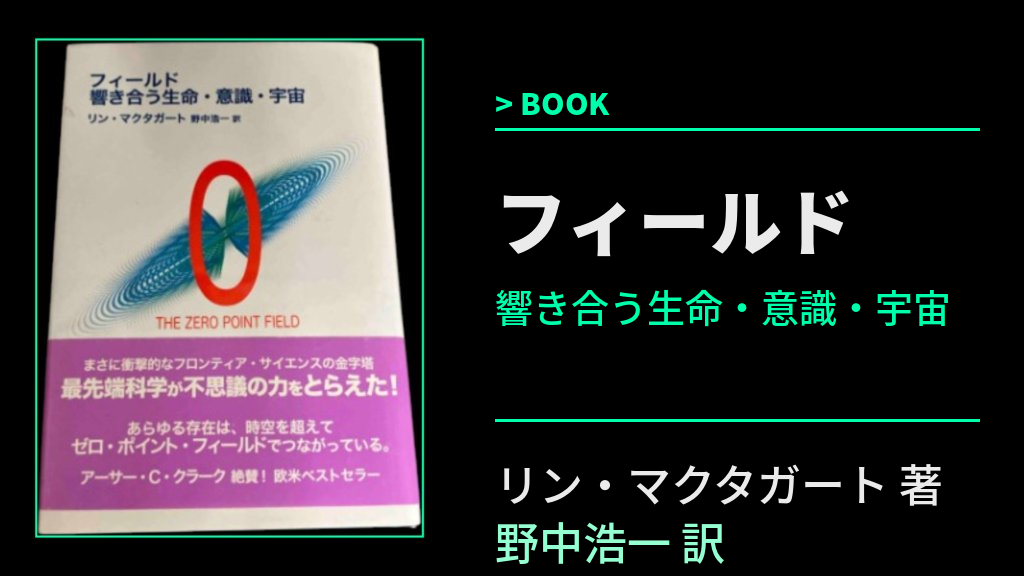
Physics has subtracted “God” from its equations. The Zero-Point Field — an ocean of vacuum that never vanishes, even at absolute zero. What one medical journalist gathered, traveling the world to interview its scientists, was a physics not found in any textbook: you are not an isolated lump of matter, but a “being of light” pulsing endlessly with a vast ocean of energy.

“Everything is connected.” A spiritual cliche. You’ve heard it to death. But this book drags that one phrase all the way down into the laboratory notebooks of physicists.
The quantum vacuum. Inertial mass. Biophotons. Random number generators. The hologram of the brain. These are not dubious coinages but terms drawn from peer-reviewed papers. And yet the verdict split clean in two: praise on one side, the insult of “pseudoscience” on the other. Why did it split? That fault line is what this book really is.
The Earth was outside the window.
February 1971. The command module of Apollo 14 was falling back from the Moon toward Earth. On board was Edgar Mitchell, the sixth man to walk on the Moon. The mission was over. All that was left was to go home.
A rest period. He was simply gazing at the Earth through the window. And then it came.
It was a sensation beyond explanation. Himself, the Earth, everything in the cosmos — people, objects, time — were connected by a single invisible web. Not separate. One, from the beginning. He would later call it an “overwhelming sense of oneness,” and said the only word that fit was the Hindu concept of samadhi.
A doctor of engineering, a Navy pilot, a thoroughgoing technician. A man who had measured the world by reason had touched something outside of reason. The Field begins with this single scene.
The author, Lynne McTaggart, is a medical journalist. Born in New York in 1951, she is known as editor of What Doctors Don’t Tell You, a newsletter that shook the British medical establishment head-on — said to have a circulation of over 100,000. A woman of investigative reporting, she has exposed, one by one, the things medicine and pharma don’t tell you.
Then one day, McTaggart became possessed by a different question. That “connection” Mitchell felt in space — was it merely hallucination, or religious excitement? Or was it something real, something physics could explain?
She spent four years. She traveled to the world’s frontier scientists — quantum physicists, biophysicists, neuroscientists — gathering, one by one, the phenomena they were seeing in their labs that never made it into textbooks. And the book was born. Bathed at once in praise and in abuse. Between those who hailed it as a masterpiece capturing a seismic shift in modern science and those who dismissed it as “pseudoscience,” the verdict split clean in two.
But the very fact that it split is what makes it interesting. What this book asks is not some trivial claim you can crush with a small objection. The scientists McTaggart gathered are saying this: the body you think of as “yourself” is not isolated matter cut off from the cosmos. You are in constant contact with a vast ocean of energy.
What Mitchell saw outside that window may not have been a trick of the mind. From here, we follow it with physics.

Try making nothing. Pump the air out of a box. Block the light. Lower the temperature. Down, and down, all the way to absolute zero (minus 273.15°C), where it can go no lower. Molecular motion stops. A perfect “nothing” should be sitting there.
And yet it doesn’t stop.
Even at absolute zero, that “nothing” keeps trembling, finely. A fluctuation quantum mechanics demands and cannot erase. This is the Zero-Point Field (ZPF). According to the book, it overturns the common sense of empty space. A vacuum is not a place where nothing exists. It is a seething ocean filled with energy.
So why were we never taught this? Because physicists have been erasing it.
In the math, the energy of the zero-point field diverges to infinity. Left as is, the equations break. So physicists use a procedure called “renormalization” to subtract this infinity away. The math goes through. It agrees beautifully with experiment. In practice, no problem at all.
McTaggart gives this subtraction a name. It is, she says, the act of “subtracting God from the equations.”
A provocative phrasing. But it cuts to the core. Physics has advanced by “ignoring for now” the things that are awkward to handle. The zero-point field was the prime example of that ignored “something.” Real, yet erased. The book’s starting point is here: what happens if we put the erased ocean back into the equations?

Knock on the desk. Solid. It hurts. There is surely “matter” there. It has mass. It is heavy. Try to move it and it resists. We call this inertia — an obvious property intrinsic to matter. Or so we have believed.
Three physicists laid hands on that obvious truth. Harold Puthoff, Bernhard Haisch, and Alfonso Rueda. In 1994 they put a paper into the world: inertial mass may not be a property built into matter at all.
According to the book, their hypothesis runs like this. Try to accelerate an object and you feel resistance. But the true source of that resistance is not the matter itself. It is an “electromagnetic drag” that arises as the particles making up matter try to move through the zero-point field — like, they say, the resistance a palm feels pushing through water.
In other words, “weight” is not a tag stuck onto an object. It arises from the relationship between object and field. NASA funding was involved; it was examined at a Lockheed Martin lab and at California State University. Academically it was judged “controversial but substantive” — that is, treated as a hypothesis not easily laughed off.
From here McTaggart takes a dizzying step. If inertia is an interaction with the field, then what is “solid matter”? Might it be nothing more than a pattern of concentrated energy within the field? The desk, the chair, your body. They look solid because the field pushes back.
Matter is like a whirlpool in the sea. The whirlpool is certainly there. But you cannot lift it out, separated from the water.

A pitch-black laboratory. Place a single living cell into a high-sensitivity photon counter. Nothing should happen. Cells don’t glow. Common sense.
The needle moved.
The cell was emitting an extremely faint light. This is what the German biophysicist Fritz-Albert Popp saw. A very weak light given off by every living thing. He named it the biophoton. Plants, bacteria, animals — and humans. Your skin, right now, is leaking light.
It began with cancer research. While studying carcinogens, Popp noticed that cells responded in a special way to light of a certain wavelength — 380 nanometers. It was also the wavelength cells preferred to use when repairing themselves. Light was involved in cellular repair. So where did that light come from?
According to the book, Popp’s answer was DNA. DNA, he held, is the source and the storehouse of this living light. Light taken in from the sun and from food is stored by DNA and released when needed. Life is also a device for hoarding light.
And Popp goes further. The healthier the body, the more ordered the light it emits — light that is coherent like a laser, its phases aligned. What is illness? A state in which this light-communication is disrupted, he says. The book quotes Popp: health is a state of perfect quantum-level communication, and illness is a state where that communication breaks down.
Before you are a lump of matter, you may be a being weaving light.

Your body is made of some 37 trillion cells. Each one knows, right now, what it should do. Heart cells beat, liver cells detoxify, wounded skin closes over. Who is conducting?
Chemicals — that is biology’s standard answer. Hormones and neurotransmitters carry signals in a molecular bucket-relay. But Popp thought that alone was too slow. To keep pace with the countless reactions happening inside the body through chemical movement alone is too slow.
According to the book, Popp’s hypothesis runs like this. Cells converse in light of specific frequencies. Molecules resonate with those frequencies and respond. Light, far faster than chemicals, carries information throughout the body.
The metaphor he used is beautiful. Light is like the conductor of an orchestra. The tens of thousands of instruments (cells) are not sounding off at random. Under a single baton, the whole plays one piece of music. A healthy body is a perfectly tuned orchestra.
Popp brings light even to one of life’s greatest mysteries — morphogenesis. Why does a single fertilized egg differentiate so exactly, hand into hand, eye into eye? Every cell carries the same DNA, so why do they never mistake their roles? Perhaps a pattern of light-interference carries that blueprint. This is hypothesis, no more. But if true, then life, before it is the chemistry of molecules, is a choreography of light.
Inside the body, right now, a concert of light plays on.

Flip a coin a million times and heads and tails come out roughly even. This is probability. Unshakable. If human feeling could change the outcome, casinos would not exist.
And yet, they say it changed.
1979, Princeton University. Robert Jahn, then Dean of the School of Engineering and Applied Science, founded a laboratory: the PEAR (Princeton Engineering Anomalies Research) lab. It began with one undergraduate’s senior thesis. Could a human, just by “willing it,” bias the output of a random number generator — a device that electronically spits out zeros and ones at random? In the experiment, a slight but non-negligible deviation appeared. The dean was startled, and decided to investigate in earnest.
According to the book, over 28 years PEAR amassed 33 subjects and millions of trials. The result: the generator’s output drifted ever so slightly from the 50% baseline — by less than 1%, according to one account. But because the number of trials was enormous, the difference was held to be statistically significant. Human intention appeared to be touching the behavior of a physical machine.
Let me write this honestly. This experiment faces strong criticism. Replication attempts in other labs failed. There is the observation that a single subject (said to be a lab staff member) accounted for 15% of all trials and carried half of the observed effect. Doubts about loose experimental controls persist.
So why doesn’t the book throw this experiment away? McTaggart’s wager runs like this. If the zero-point field is real and everything is connected by information, then a “pathway” for consciousness to touch the physical could, in principle, exist. PEAR’s tiny deviation may be a faint footprint of that pathway. Not proof. But she keeps it on the table as an anomaly too valuable to ignore.

A windowless room. A person sits with eyes closed. Kilometers away, another researcher stands at a location chosen moments earlier by random number. The person in the room does not know the place. And yet they begin to speak. “I see a circular pool. About thirty meters across…” The actual target was a water treatment plant.
This is remote viewing. A phenomenon in which a distant place is, supposedly, “seen” by the mind alone. The book attempts to explain it as information transfer through the zero-point field — the possibility that information is stored in the field across space.
What is striking is that this is not the stuff of occult magazines. In 1972, at the Stanford Research Institute (SRI) in California, physicists Harold Puthoff and Russell Targ began their research. Yes — Puthoff, the very physicist who tried to explain inertial mass through the zero-point field in Chapter 3. The man who chased the field with physics was chasing the field with consciousness too.
And the funding came from the CIA. During the Cold War, determined not to fall behind Soviet psychic research, the U.S. government poured money into this. A series of top-secret projects called SCANATE, and later STARGATE. It was actually used in the field of intelligence. One anecdote survives of a “viewer” pinpointing the location of a crashed Soviet aircraft in Africa to within a few kilometers. In 1995, part of it was declassified.
The verdict is, of course, split. The 1984 assessment by the U.S. National Academy of Sciences was negative. Even so, the fact that a state kept funding it for over twenty years carries weight. What the book thrusts at us, more than the truth of the results themselves, is the picture of a great power betting in earnest on a phenomenon dismissed as “impossible.”

Memory is filed away somewhere in the brain, like a document. So we have believed. Damage a particular spot, and that one memory should vanish.
It did not vanish.
This was the puzzle the neuroscientist Karl Pribram faced. Remove part of an animal’s brain, and no single specific memory cleanly disappears. Memory seemed not to sit at one point but to be scattered across the whole.
Pribram arrived at an unexpected metaphor: the hologram. Shatter a holographic plate and each small fragment still holds the “whole image.” Because information is not at one point but distributed across the entire surface as an interference pattern. Might the brain be the same? Memory, perhaps, is etched across the whole brain like a hologram — as an interference pattern of waves traced by the neurons.
According to the book, this idea resonates with physicist David Bohm’s “implicate order” — the notion that the entire universe holds an order like a single enfolded hologram. If the brain is a hologram and the universe is a hologram, the two speak the same language.
Here McTaggart makes her final leap. If memory is not “stored” in matter inside the brain, then where is it? In the zero-point field. The brain may be not a warehouse of memory but a receiver (an antenna) that reads information written into the field. Consciousness is not a phenomenon locked inside the skull, but a window onto the field — toward this hypothesis the book moves.

Survey once more what we have laid out. A vacuum trembling at absolute zero. A “solidity” the field pushes back with. Light leaking from skin. Cells conversing in light. A machine that drifts when willed. A distant scene seen by the mind. Memory scattered through the brain.
They look like utterly unrelated stories. Physics, biology, psychology, neuroscience — different fields, and different degrees of certainty. But McTaggart tries to stitch them together with a single thread. That thread is the zero-point field.
The book’s claim in a sentence: these anomalies may not be separate mysteries, but branches growing from one great premise. That premise — that everything in the cosmos is, in an invisible field of information, constantly touching and recording one another. Inertia, living light, the remote action of consciousness, the distribution of memory — all are merely different expressions of the same “field.”
Here Puthoff’s two appearances pay off. He tried to explain matter’s inertia through the field, and chased the remote action of consciousness through the field as well. To treat matter and consciousness as the front and back of a single cloth — that is the book’s seam.
Of course, this suturing is precarious. Place high-certainty physics (the reality of the zero-point field) and contested phenomena (PEAR, remote viewing) side by side at equal strength, and the whole begins to look like “one proven picture.” It is precisely at the forcedness of this seam that critics aim the word “pseudoscience.”
But seen another way — the book’s ambition is to bind fractured knowledge back into a single question. Right or wrong aside, that very way of binding is itself the presentation of a worldview.

In Chapter 2, I wrote that physicists subtracted the zero-point field from their equations, to erase an awkward infinity. McTaggart called it the act of “subtracting God from the equations.” The conclusion the book reaches is to undo that subtraction.
Return the subtracted “God” to the equations. The “God” here is not the God of religion. It is a declaration: let us stop erasing, for the convenience of calculation, the existence of the invisible field that binds all things.
And the way the world looks flips over. You are not isolated matter cut off from your environment. You are not an independent being partitioned from the world by the boundary line of your skin. In the book’s words, you are a “pulsating bundle of force,” interacting endlessly with a vast ocean of energy. The boundary line is only a line of convenience.
And the question that runs through the whole book rises up. Might observing — directing consciousness — itself be the creative act that shapes the world? In quantum mechanics, observation fixes a phenomenon. Until observed, the world is a blurred cloud of possibility. If so, the act of seeing is not mere reception. It may be creating the world, each time anew.
This is not proven science. The book’s weakness, and its strength, both lie there. But what McTaggart leaves us is not an answer — it is a shift of stance. Stop seeing yourself as a lonely point cut off from the cosmos. See yourself again as an open window, connected to the field.
That sense of oneness Edgar Mitchell felt at the window of a spacecraft returning from the Moon. Was it hallucination — or the most accurate observation of all? The book places that question into your hands, and quietly closes.

- Title
- The Field
- Full title
- The Field: The Quest for the Secret Force of the Universe
- Author
- Lynne McTaggart
- First published
- 2001 (UK) / 2002 (US, revised ed.)
- Genre
- Science nonfiction / consciousness & new physics









Comments