
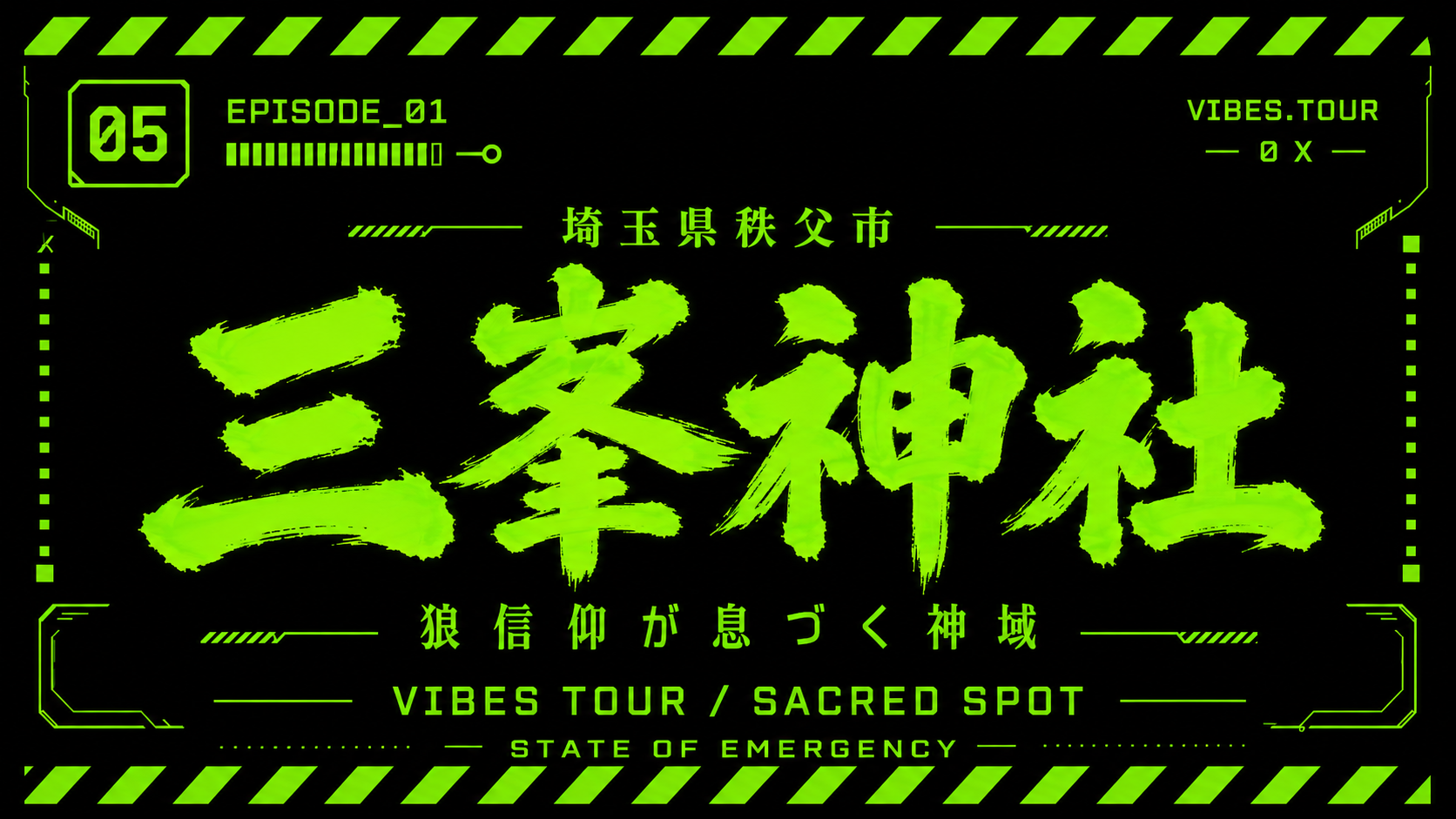

Feel Mitsumine Shrine
MITSUMINE — NEON PILGRIMAGE
Two and a half hours from Tokyo by limited express and bus. Cross the dam of Lake Chichibu, climb the switchbacks, and at 1,100 meters there stands a mountain of wolf worship, 2,000 years old. If the fog comes out, it is a sign of welcome. This is a place where the texture of reality grows just a little unreliable.
SCROLL ▽
Prologue — Deep in the Kanto, There Is a Place That Thins
Take a limited express from Ikebukuro in Tokyo and in about eighty minutes you reach Seibu-Chichibu Station. Change to a bus, and ride another seventy-five minutes or so. The scenery sliding past the window shifts gradually from the convenience stores and houses around the station into mountains, until at last a man-made lake appears, built on the upper reaches of the Arakawa River. Chichibu-ko, the map calls it. The bus crosses the dam’s embankment. Once across, the road suddenly narrows, folds into switchbacks, and begins to climb. Your smartphone loses signal. Your ears clog faintly. You can feel the altitude rising. After a while the bus reaches a parking lot. You step off. The air is different, many people say. To call it merely “clear” is not enough. Something else is mixed into it, some visitors feel.
This is the entrance to the approach of Mitsumine Shrine. Mitsumine, Chichibu City, Saitama Prefecture. Altitude 1,102 meters. The precincts of Mitsumine Shrine lie within the Oku-Chichibu massif, straddling the borders of three prefectures: Tokyo, Saitama, and Yamanashi. Just to the south rise three peaks in a row: Mount Kumotori, Mount Shiraiwa, and Mount Myoho. These are the three peaks from which the shrine takes its name. Mount Kumotori, at 2,017 meters, is the highest point in Tokyo. Mount Shiraiwa is 1,921 meters. Mount Myoho is 1,329 meters, and on its summit the okumiya, the inner sanctuary of Mitsumine Shrine, is enshrined. Mitsumine Shrine, then, is not merely an old shrine. It is a shrine standing at the gateway to genuine deep mountains, the nearest such gateway from Tokyo.
There are many stories here. Around 1,900 years ago, Yamato Takeru, heading east to pacify the eastern provinces, lost his way in these mountains, wrapped in fog. At that moment a white wolf appeared from nowhere and guided him. That is the beginning of Mitsumine Shrine, and also the beginning of the oldest wolf worship in the Kanto region, in which the wolf is enshrined as a divine messenger, an “Okuchi-no-Makami,” an honored “O-Inu-sama.” On the night of the thirteenth day of the ninth month of Kyoho 12 (1727), a monk named Nikko-Hoin was sitting in quiet meditation on this mountain when a great number of wolves emerged from the depths and filled the precincts. He took it as a divine revelation and began lending out wolf talismans to believers. That is the origin of the ritual unique to Mitsumine Shrine, called Gokenzoku-Haishaku, “borrowing the divine messenger.” The box that holds the talisman has several small holes drilled into it. Because a living divine messenger dwells inside, it is said, so that it may breathe.
In 2012, the Year of the Dragon, the stone pavement to the left of the worship hall was wetted with water and scrubbed, and the figure of a dragon with red eyes rose to the surface. In 1905 (Meiji 38), the Japanese wolf is said to have gone extinct. Yet on October 14, 1996, a man named Hiroshi Yagi pressed his shutter nineteen times at a single canid on a forest road deep in the Chichibu mountains. Dr. Yoshinori Imaizumi, an authority on Japanese wolf research, examined the photographs and gave his opinion that it was a “precious animal that may possibly be a Japanese wolf.” What the animal, provisionally named the “Chichibu wild dog,” actually was has never been settled. This is a land where historical fact and legend are intermixed.
And yet, when one tries to write about Mitsumine, there is something that simply laying historical fact and legend side by side cannot reach. The phenomena repeatedly spoken of by those who have visited here do not fit within the frame of legend alone. The instant they passed through the Mitsu-Torii, all surrounding noise vanished at once. In the middle of a prayer ritual, for no reason they could explain, the tears would not stop. The moment their prayer at the worship hall ended, a deep fog suddenly covered the precincts. At the inner sanctuary, they felt they had brought something back with them. Fog, it should be said, appears often in the precincts of Mitsumine. And at Mitsumine it has long been told that the fog is the form of the deity, the form of O-Inu-sama. That fog is present means the divine messenger is, right now, right here, appearing. At an ordinary mountain, fog means “a shame, you can’t see the view.” At Mitsumine it is the reverse. When the fog comes out, you are being welcomed.
And in the mountains near Mitsumine, there are several accounts of people who saw a UFO. On the early morning of August 16, 1981 (Showa 56), a silver bowl-shaped object hovered for about fifteen minutes above the rice fields of Moroyama Town, Saitama Prefecture, and multiple residents witnessed it: the “Moroyama Incident.” The object flew off in the direction of the Chichibu mountain range, and was reported the next day in the Saitama Shimbun and the Saitama edition of the Yomiuri Shimbun. In follow-up accounts, testimony even emerged that the first witness was taken aboard the object, that something was done to him by crew members with dog-like faces, and that he was then released. The mountain realm of O-Inu-sama. An incident that happened there, in which the witness spoke of abduction, and said the crew had dog-like faces.
The way of asking what is true and what is false does not carry much meaning here. Mount Mitsumine is a place where the texture of reality grows a little unreliable. The hardness of the everyday world loosens, ever so slightly, when you come here. You can always file it away as “just your imagination.” Yet the sheer fact that this much has been spoken, over this much time, by this many people, in the same place, does not file away so easily. What follows is the story of one mountain deep in the Kanto, of the deity enshrined there, of the wolf that is its messenger, and of the people who have visited. It is a mountain where fog comes easily, so on the day you visit your view may not always be clear. But if the fog has come out, it means something has already arrived.
Chapter 1 — Yamato Takeru, Swallowed by Fog — The Myth and the Three Peaks

Yamato Takeru guided by the white wolf in the fog / Yamato Takeru & the white wolf
The reign of the twelfth Emperor Keiko. About 1,900 years ago, the origin records of Mitsumine Shrine tell us. Yamato Takeru, a prince of Emperor Keiko, received his father’s command and set out to pacify the eastern provinces. The name “Yamato Takeru” was originally given to him by the brother of Kumaso Takeru, whom he had slain during his western campaign; in the moment before death, the man offered the name, saying, “You are the one truly worthy of the name Takeru.” A young man receives a name in the blood of his enemy, and is sent off by his father’s command to the next war. That was the beginning of the eastern campaign.
The route of the eastern campaign traces a great arc: departing from Ise through Suruga, Sagami, Musashi, Kozuke, Shinano, then reaching the Sakaori Palace in Kai, from there turning north through the Musashi and Kozuke regions, and finally crossing the Usui Pass. To pass from present-day Yamanashi into Gunma, one must cross a steep pass along the way: the Karisaka Pass. The Karisaka Pass lies on the main ridge of Oku-Chichibu at an altitude of 2,082 meters, and was long the greatest obstacle on the old road called the Chichibu Okan. Cross this pass from the Yamanashi side, and spread before you is the Oku-Chichibu massif, including Mount Mitsumine where the shrine sits. There, Yamato Takeru was swallowed by fog.
According to the shrine’s origin records, Yamato Takeru’s party, having crossed the Karisaka Pass, lost their way in the mountains. The fog of Oku-Chichibu does not merely whiten the view. It erases sound. The sound of stream water, the wind shaking the trees, even the sound of one’s own feet on fallen leaves — when the fog comes, all of it loses its edges, and you can no longer tell whether something is happening nearby or far away. You lose your sense of direction. Look back the way you came, and it no longer seems the same scenery. Yamato Takeru was leading an army. He had attendants. Still, he became lost. And at that moment, a white wolf appeared from nowhere. Without warning, out of the fog, a single white wolf showed itself. The wolf began to walk ahead, as if to guide them. Following behind, at a certain place the fog cleared. That place was within the mountain where Mitsumine Shrine now stands.
Yamato Takeru stood there and surveyed the mountains. To the southeast he saw three peaks linked together in beauty. Mount Kumotori, Mount Shiraiwa, Mount Myoho. Seeing that sight, he enshrined Izanagi-no-Mikoto and Izanami-no-Mikoto, the two deities of the creation of the land in Japanese mythology. A young warrior on campaign to pacify the east, just after being saved from the fog, seeing these mountains, why did he suddenly think to enshrine the gods of creation? The origin records give the reason thus: he prayed “that this country may be at peace forever.” What he prayed for was not his own war, but the long future of these islands. That is the first prayer of Mitsumine Shrine.
Let me write a little more about those three peaks. Mount Kumotori is 2,017 meters. Towering at the meeting point of three prefectures — Tokyo, Saitama, and Yamanashi — it is the highest peak in Tokyo. Mount Shiraiwa is 1,921 meters. It takes its name (shiraiwa, “white rock”) from the white limestone exposed near its summit. Limestone is rock formed from the shells of coral and foraminifera accumulated on an ancient sea floor. In other words, the rock near this summit was once at the bottom of the sea. Crustal movement pushed it up to become the innermost peak of the Kanto. Mount Myoho is 1,329 meters. The lowest of the three, yet for Mitsumine Shrine it is the most important, for on its summit the inner sanctuary of the shrine is enshrined.
These three mountains belong, geologically, to a stratum belt called the “Chichibu Belt.” And this Chichibu Belt does not end here. It continues as a single line through Nanki, Shikoku, and into Kyushu. Among Chichibu researchers, one thing has long been noted: the names of the Chichibu mountains resemble the names of the Kumano mountains too closely. The Nachi range, a sacred site of Kumano’s Shugendo, has mountains called “O-Kumotori-yama” and “Ko-Kumotori-yama.” And just west of the Nachi range stands “Mount Myoho.” The Mitsumine peaks of Chichibu have a “Mount Kumotori.” And a “Mount Myoho.” Kumotori and Myoho. These two names exist as the same set, at the innermost edge of the Kanto and at the southernmost tip of the Kii Peninsula. On the same geological belt, the same landforms appear. And the ancient mountain ascetics who saw the same landforms gave them the same names. Similarity of terrain bred similarity of faith.
Trace the origin records of Mitsumine Shrine and you find that in the Nara period, En no Gyoja, the founder of Shugendo, crossed from Izu to Mount Mitsumine and trained there. He stands at the very center of the Kumano Shugendo lineage. In other words, Mitsumine Shrine is not only the land Yamato Takeru reached, guided through the fog by a white wolf. It is also where another vein of Shugendo, stretching from Kumano into the depths of the Kanto, comes to rest. The names Kumotori and Myoho are the trace of that vein.
Here, let me return once more to the fog. Mount Mitsumine has long been called “Mount Mitsumine of the fog.” Because it sits in a basin-like position surrounded by 2,000-meter-class mountains, fog forms easily, meteorologically speaking. And at Mitsumine Shrine there is a special tradition about this fog. The fog is the form of the deity, of O-Inu-sama. That fog is present means the divine messenger — Okuchi-no-Makami — is, right now, right here, appearing. This is not a modern spiritual interpretation. The shrine’s current priests explain it this way to worshippers. Seen thus, the myth of Yamato Takeru takes on a different meaning. To be “swallowed by fog” is not merely a tale of losing one’s way. At the very first stage of the myth, Yamato Takeru had already, literally, entered the realm of O-Inu-sama. That a white wolf appeared from the fog means the fog itself took the form of a wolf and became visible. What Yamato Takeru saw was the very body of O-Inu-sama.
The fog Yamato Takeru saw 1,900 years ago, and the fog a modern worshipper witnesses in the middle of a prayer ritual, are the same fog. The same fog, arising in the same place geographically, produced by the same mechanism meteorologically, interpreted as the manifestation of the same being in faith. This also means there is no rupture between myth and the present. O-Inu-sama still appears on this mountain. Nineteen centuries on, the Kanto has been modernized, and tourists line up for goshuin seal stamps. Even so, the fog still comes. And each time it comes, the story of the white wolf begins once more. This is the oldest layer of the place called Mitsumine Shrine.
Chapter 2 — Those Who Entered the Mountain — From En no Gyoja to Gekkan Doman

An ascetic walking the primeval forest / En-no-Gyoja in the primeval forest
About six hundred years passed after Yamato Takeru enshrined Izanagi and Izanami. Entering the Nara period, a man appeared on this mountain. En no Ozunu, later called En no Gyoja, the founder of Shugendo. The outline of this figure is unclear. Even his birth and death years are unknown. The only certain record is a single sentence in the Shoku Nihongi, compiled in the Nara period: in the third year of Emperor Monmu (699), “En no kimi Ozunu was exiled to the island of Izu.” He lived on Mount Katsuragi, was skilled in sorcery, and was rumored to command demons. His disciple Karakuni no Muraji Hirotari, envious of his master’s power, denounced him to the court, and as a result he was sentenced to distant exile.
Exiled to Izu, En no Ozunu is said to have ridden the clouds at night to climb Mount Fuji and continue his training. The origin records of Mitsumine Shrine say that during that period, he traveled between Izu and Mount Mitsumine to train. Even measured on a modern map, the straight-line distance from Izu Oshima to Mount Mitsumine is over 150 kilometers. Between them lies the sea, and the Kanto Plain. In that era, it was not a distance one could walk round trip. Why did En no Ozunu come all this way? The answer, most likely, connects to the terrain and place-names of the previous chapter. He was a sorcerer who walked Kumano, Katsuragi, and Kinpu. He knew, perhaps, that terrain just like Kumano’s spread across the innermost Kanto. En no Ozunu used the circumstance of his exile to Izu to extend his own field of training all the way to Mount Mitsumine in the Kanto. This was the first moment the vein of Shugendo ran into Mitsumine Shrine.
Some thirty-odd years later, in the eighth year of Tenpyo (736), plague swept through the provinces. Emperor Shomu sent an envoy to Mitsumine Shrine to pray, and is said to have bestowed the divine title “Daimyojin.” The Tenpyo plague was one of the greatest epidemics in Japanese history, claiming even all four Fujiwara brothers. That such an emperor would send an envoy all the way to a shrine deep in the Chichibu mountains to pray is significant. The name of Mitsumine Shrine had already reached the capital at Nara.
Entering the Heian period, one more decisive figure climbed this mountain. Kobo Daishi Kukai. He brought Esoteric Buddhism back from Tang China, opened Mount Koya, and founded the Shingon sect — one of the central figures in the history of Japanese Buddhism. According to the shrine’s origin records, after climbing the mountain Kukai enshrined an eleven-faced Kannon statue beside the Mitsumine sanctuary and prayed for peace under heaven. This was the moment Buddhism officially entered Mount Mitsumine. From then on, Mitsumine Shrine became a mountain of syncretic shinbutsu-konko, where Shinto and Buddhism were one, and those who served were not Shinto priests but Buddhist monks. In other words, the mountain where Yamato Takeru enshrined Izanagi and Izanami became, in the Nara period, a mountain “used” through En no Ozunu’s Shugendo, and in the Heian period a mountain “venerated” through Kukai’s eleven-faced Kannon. Myth, Shugendo, Buddhism. Three layers overlapped here.
Time advances to Kamakura. Among the Kamakura warriors was a man named Hatakeyama Shigetada. Born in Musashi Province, he won through countless battles from the Genpei War to the Oshu campaign, a warrior representative of the early Kamakura period. He revered Mitsumine Shrine deeply, and in thanks for the fulfillment of his prayers, he is said to have donated the land for “ten ri in every direction” around the shrine. One ri is about four kilometers, so he donated the entire land within a circle of roughly forty kilometers’ radius. The enormous sacred tree still standing in the precincts, the “Shigetada cedar,” conveys the scale of that devotion in silence even now. It is a giant cedar about 800 years old, with a trunk circumference of about seven meters and a height of about forty-six meters, said to have been planted by Shigetada’s own hand.
But prosperity did not last forever. In 1352, in the war between the Ashikaga and the Nitta, the Nitta were defeated, and the family of the fallen Nitta Yoshioki fled into Mount Mitsumine and hid. This changed the fate of Mitsumine Shrine. The victorious Ashikaga did not forgive a shrine that had sheltered the defeated. They confiscated the shrine lands and dismissed the priests. From there began a dark age of nearly 150 years. The shrine buildings crumbled, worshippers dwindled, and the mountain fell into ruin. The history of Mitsumine Shrine, continuing for 1,400 years since Yamato Takeru, nearly vanished here once.
In the second year of Bunki (1502), a single mountain ascetic stood on that ruined mountain. An ascetic named Gekkan Doman. His birth and death years are unknown. Seeing the desolate Mount Mitsumine, he resolved to rebuild it. But he had neither money nor people. He began to walk. Across the whole country, alone. To gather funds for the rebuilding, he made a pilgrimage across all Japan for about twenty-seven years. “Please help rebuild Mount Mitsumine,” from town to village, from inn to inn, he kept walking. Twenty-seven years is close to a third of a human life. If he began at thirty, he would finish at fifty-seven. Given the average lifespan of the time, he poured nearly the whole of his remaining life into this pilgrimage.
And at the end of his twenty-seven years of walking, a miracle occurred. In the second year of Tenbun (1533), Gekkan Doman rebuilt the shrine and temple buildings of Mount Mitsumine with the funds he had gathered. That same year, Emperor Go-Nara designated Mitsumine Shrine a branch temple of the Shogo-in monzeki in Kyoto. Shogo-in is the head temple of Honzan Shugendo. In other words, Mitsumine Shrine returned to its rightful position as the head temple of Tendai Shugendo in the Kanto. Gekkan Doman came to be revered as the “restorer.” A single nameless ascetic, walking alone for twenty-seven years, brought Mount Mitsumine back to life. This is not legend; it is fact recorded in the shrine’s official history.
Why did he go that far? The origin records do not state his motive. They say only that he “lamented the ruin of Mount Mitsumine.” But can one keep walking for twenty-seven years on lamentation alone? Mitsumine Shrine is a place that has, since the age of myth, kept telling people something in the form of fog and wolves. To imagine that the one ascetic who first entered the ruined mountain and resolved to revive it received nothing from that mountain is, rather, the more unnatural thought. This is my own conjecture. It is not in the records. But the sheer length of twenty-seven years is, it seems to me, a length that cannot be explained by rational calculation or a declaration of faith alone. From Gekkan Doman’s restoration, Mitsumine Shrine flourished once more. And as a sacred land holding the rank of “100,000 koku,” it was treated with honor even by the Tokugawa shogunate. 100,000 koku is the rank of a daimyo. A shrine was treated on the same footing as a daimyo. Yet the most Mitsumine-like phenomenon of Mitsumine Shrine had not yet occurred. That would begin a further two hundred years later, on the night of the thirteenth day of the ninth month of Kyoho 12.
Chapter 3 — The Age of Kannon-in Koun-ji — The Mountain of Shinto-Buddhist Syncretism

The polychrome worship hall (gongen-zukuri) / The vermilion Haiden
Gekkan Doman rebuilt Mount Mitsumine through his twenty-seven-year pilgrimage in the second year of Tenbun (1533). From then until it was abolished as a temple in the second year of Meiji (1869), for about 330 years, Mitsumine Shrine was a temple called “Kannon-in Koun-ji.” The place we today call “Mitsumine Shrine” was, before the Meiji era, not a shrine but a temple. To be precise, it was a syncretic sacred site of shinbutsu-konko. Enshrined in the main hall were Izanagi-no-Mikoto and Izanami-no-Mikoto. But at the same time, as their honji-butsu, an eleven-faced Kannon was enshrined. There was a torii, there were shrine buildings, but at the same time there were temple halls, and monks were permanently stationed there. Both gods and Buddhas were enshrined in the same mountain, in the same way, served by the same monks. This syncretism was the most common form of pre-modern Japanese religion.
The word “Daigongen” is based on the idea of honji-suijaku, which interprets a Shinto deity as the temporary manifestation of a Buddha. The Buddha is the true body, and the deity is the incarnation that Buddha takes on, changing form to appear before the Japanese. The honji-butsu of Mount Mitsumine was the eleven-faced Kannon, and its form as gongen was Izanagi and Izanami, whom Yamato Takeru had enshrined. To the modern sensibility this may sound a little strange. Is it Shinto, or is it Buddhism? It is unclear. Yet this was the original form of pre-modern Japanese mountain faith. Mitsumine Shrine did not begin as a Shinto shrine. It continued for over 1,500 years as a single sacred site where Shinto, Buddhism, and Shugendo were one. What forcibly cut that down to “shrine” alone and left it so was the Meiji separation of Shinto and Buddhism.
After Gekkan Doman’s restoration, Mitsumine Shrine became a branch temple of the Shogo-in monzeki in Kyoto. Shogo-in is the head temple of Honzan Shugendo. By this, Mitsumine Shrine gained the position of head temple of Honzan Shugendo in the Kanto. Put simply, it became the highest mountain for all the yamabushi of the Kanto region. Successive abbots customarily became adopted sons of the Kazan-in, a court noble family in Kyoto. The temple’s crest adopted the “shobu-bishi” iris-diamond, the family crest of the Kazan-in. Even now you can see this iris-diamond crest everywhere at Mitsumine Shrine. In the fifth year of Kanbun (1665), it became independent from the Yamamoto-bo ascetic order of Ogose, under which it had been, and became a direct branch of the Shogo-in in Kyoto. The main institution was called “Mount Mitsumine Daigongen,” and the administering temple “Mount Mitsumine Kannon-in Koun-ji Byodo-bo.” In the first year of Kanbun (1661), the main hall that still survives today was built — a single-bay kasuga-zukuri main hall adorned with polychrome carvings.
The Edo shogunate treated Mitsumine Shrine with the “rank of 100,000 koku.” This is the same rank as a mid-ranking tozama daimyo. When Ina Hanjuro, the Kanto intendant, surveyed Chichibu, he designated the surrounding “three ri in every direction” of Mitsumine Shrine as precinct land exempt from taxation. A circle of twelve kilometers’ radius. A vast mountain region was, in its entirety, the domain of Mount Mitsumine. And as for the scale of worshippers: a mid-Meiji record notes that the shrine office of Mitsumine Shrine had “facilities able to lodge six hundred people,” and that meals and sake for guests were supplied by their own production. The peak of the Edo period is presumed to have been even greater. At a shrine deep in the mountains, in an age without even a carriage road, it received lodging guests on the scale of six hundred a night. They came by neither bus nor train. On foot, over many days, they climbed the front approach.
Edo-period worshippers climbed the front approach from Owa at the foot, taking over two hours, purified themselves in the waterfall of Shojo-no-Taki, stayed in pilgrim lodgings, and remained on the mountain for many days. Guided by yamabushi, they made the rounds of the auxiliary shrines in the precincts, received talismans, and went home. To climb the mountain, lodge on the mountain, and spend many days in the mountain air was itself the main body of the pilgrimage. At the center of Mount Mitsumine in that era were the monks of Kannon-in Koun-ji — the yamabushi. They were neither Shinto priests nor ordinary monks; they were ascetics. They recited Shinto norito prayers and read Buddhist sutras, burned goma fires and stood under waterfalls. Because they were there, Mount Mitsumine was Mount Mitsumine.
On the twenty-eighth day of the third month of the first year of Meiji (1868), the new Meiji government issued the “Shinbutsu Hanzenrei,” the order to separate Shinto and Buddhism. Remove Buddhist elements from shrines, it commanded. The Meiji government was pushing a policy to place Shinto at the center of the state in order to build Japan as a modern nation. For that, it had to cleanly divide the syncretic state, which had continued for over a thousand years, into Shinto and Buddhism. At this time, a violent anti-Buddhist movement called “haibutsu-kishaku” arose across the land. Sacred sites of mountain faith especially, as ambiguous existences that were neither Shinto nor Buddhist, were violently reorganized. In the second year of Meiji (1869), Mount Mitsumine Kannon-in Koun-ji was abolished as a temple. A temple that had continued for over 330 years vanished by a single order. The Nio guardian statues enshrined in the gate were moved to Shogan-ji in Konosu City, Saitama Prefecture. The name Kannon-in Koun-ji fell out of use, and in its place the old former title “Mitsumine Shrine” was revived. This is the official beginning of the present Mitsumine Shrine.
The Meiji separation changed the institutional structure of Mount Mitsumine. The yamabushi organization was dissolved, and the relationship with the head temple Shogo-in in Kyoto was severed. But it did not change the mountain itself. Even after Meiji, Gokenzoku-Haishaku continued. The Mitsumine confraternities kept active throughout the Kanto. The faith in O-Inu-sama, far from declining, kept spreading through Meiji, Taisho, and Showa. Even when the eleven-faced Kannon hall was converted into a cafe called Shokyo-in, even when the Nio gate changed its name to the Zuishin-mon, the mountain remained the mountain. The fog kept coming, the wolf kept being enshrined, and worshippers went home having sensed something. Institutions change. Names are rewritten. Even so, the mountain itself does not change. What made Mount Mitsumine Mount Mitsumine lay, in the end, not in organization or institution or name, but on the side of the mountain itself.
Chapter 4 — September 13, 1727, the Night the Precincts Filled with Wolves — All of Gokenzoku-Haishaku

The wolf pack filling the night precincts & Nikko-Hoin / Nikko-Hoin & the wolves at night
In the fifth year of Kyoho (1720), a monk named Nikko-Hoin entered Mount Mitsumine. Ten years earlier, the abbot of the time, Ichinyo-Hoin, had died, and for the ten years since, Mount Mitsumine had been without a resident. The buildings Gekkan Doman had rebuilt two hundred years before were beginning to fall into ruin again. This was the second crisis in the history of Mitsumine Shrine. Nikko-Hoin entered that ruined mountain and once again repaired the buildings. What is certain is that he entered Mount Mitsumine, restored the shrine, and then, one night, saw something.
The night of the thirteenth day of the ninth month of Kyoho 12 (1727). Seven years had passed since he entered the mountain. That night, Nikko-Hoin was sitting in quiet meditation in a hermitage on the summit. Alone, in the dark of night, he sat. And then. From the depths of the mountain, many wolves appeared. And they filled the precincts. This is the event recorded in the shrine’s origin records as the origin of Gokenzoku-Haishaku. The words of the record are simple and matter-of-fact: “While Nikko-Hoin was sitting in quiet meditation in his hermitage on the summit, suddenly a great many wolves emerged from the depths of the mountain and filled the precincts. Sensing a divine revelation in that sight, Nikko-Hoin lent out yamainu (mountain-dog) talismans to believers as protection against boar, deer, fire, and theft; they proved efficacious, and this is said to be the beginning of Gokenzoku-Haishaku.”
An ordinary monk, surrounded at night by a pack of mountain dogs, would feel nothing but terror. The response would be to flee, or to drive them off with prayer. Nikko-Hoin was different. He received the pack as “messengers.” Here lies the essence of Gokenzoku-Haishaku. “Gokenzoku” means a divine messenger. In the case of Mitsumine Shrine, this means Okuchi-no-Makami, the wolf. “Haishaku” means “to borrow.” So “Gokenzoku-Haishaku” means “to borrow the deity’s messenger.” A talisman at an ordinary shrine is understood as a copy of the deity’s spiritual power — a kind of “duplicate.” The deity does not dwell in the talisman itself. But the Gokenzoku-Haishaku of Mitsumine Shrine differs from this. The shrine says it “lends out” the divine messenger. It says the talisman is the very “real article” of the divine spirit itself. For the one year you enshrine that talisman in your home, a living divine messenger is truly there.
Gokenzoku-Haishaku has special rites and implements. The application is made at the shrine office, with an offering of 5,000 yen. The first time, you receive a wooden box, the “kenzoku-bako,” to hold the divine messenger, for 2,000 yen. Once the application is complete, you receive a prayer ritual at the worship hall, and the divine messenger descends into the talisman. At home, you enshrine it, box and all, on a kamidana or a pure place above eye level. You offer rice, water, and salt. And here is the point especially worth noting. The lid of the kenzoku-bako has small holes drilled into it, three to six of them. Why? Because a living divine messenger dwells inside, so that it may breathe. Down to the design of the physical implement of drilling holes, the talisman is treated as a “breathing being.” This is fundamentally different from the ordinary sense of a talisman.
The period of Gokenzoku-Haishaku is one year. After a year, you take the talisman and the kenzoku-bako and climb Mitsumine Shrine again. You return the talisman and receive a new one. The old talisman is placed in the Okariya in the precincts and returned to heaven through okiage burning. The Okariya is a small shrine at the innermost part of the precincts, enshrining Okuchi-no-Makami. It is also called the “Tomiya,” the “distant shrine.” Because O-Inu-sama normally dwells deep in the mountains, this place in the precincts is enshrined as a “temporary shrine” — that is the meaning of the name. Its atmosphere differs from the rest of the shrine. There is none of the brilliance of the area before the main hall; it is only quiet, a little dark, filled with a primal presence. On the nineteenth of every month, a rite called the “Tomiya Otakiage-sai” is performed here. Sekihan, red rice, is offered. Here is another tradition. The red rice offered on this day often vanishes. The shrine has interpreted it thus: “This is O-Inu-sama partaking of it.” The divine messenger, right now, right here, ate the rice, it is interpreted. The fog is the wolf’s form. The red rice vanishes. The kenzoku-bako has holes drilled in it. The being called the divine messenger is treated, at Mitsumine Shrine, not as an abstract “divine messenger” but as an intensely physical existence that appears as fog, eats rice, and breathes inside a box.
The reputation of Gokenzoku-Haishaku spread across the whole Kanto in no time. Why did the townspeople of Edo leap at the wolf faith of a shrine deep in the Chichibu mountains? The reason is clear. Fire. Edo was the capital of fire. The Great Fire of Meireki, the Great Fire of Meiwa, and others — great conflagrations killing from thousands to tens of thousands recurred again and again. And one more thing: robbers. Fire and robbers. These were the two great terrors of Edo. The divine messenger of Mitsumine Shrine was said to guard the home from both. The wolf’s keen senses would detect fire or intruders early and drive them off. This struck the townspeople of Edo decisively. At the entrances of Edo tenements, the gateways of merchant houses, the walls of samurai residences — the talismans of Mitsumine Shrine came to be posted all over town.
And the believers began to form their own organizations. A “ko” is a group of people who share faith in the same deity. The mechanism of a Mitsumine-ko was this: a single village or neighborhood would form a ko of ten to several dozen people. Each month they pooled ko-money. With the gathered money, once a year or once in a few years, they chose a representative and sent him to make the pilgrimage to Mitsumine Shrine. This is called “daisan,” proxy pilgrimage. The proxy pilgrim, representing them all, climbed Mount Mitsumine, received the Gokenzoku-Haishaku talisman, and returned. Katsushika, Kamagaya, Matsumoto. Tokyo, Chiba, Nagano. The Mitsumine-ko have been organized continuously from the Edo period to the present Reiwa era, centered on the Kanto and Koshin’etsu — a long-lived network of folk faith spanning several hundred years. At its node stands Mitsumine Shrine.
Finally, let me return once more to the night in the precincts. The thirteenth day of the ninth month of Kyoho 12. From the depths of the mountain, many wolves appeared and filled the precincts. Whether those “many wolves” were real animals, or something else, we have no way to know. But at Mitsumine Shrine it has long been told that the fog itself is the form of the divine messenger. The autumn mountain is prone to fog at morning and evening. The sight of “many wolves emerging from the mountain to fill the precincts” may have been the deep fog flowing into the night precincts, with countless white shapes seeming to writhe within it. Or perhaps a real pack of wolves truly gathered. Either way, that night Nikko-Hoin was surrounded by the body of O-Inu-sama. Whether fog or living wolf, it was the same being. He stood, literally, within the divine messenger. And opening both hands, he nodded: “Let me lend this out.” This is the true beginning of Gokenzoku-Haishaku.
Chapter 5 — Walking the Grounds — Mitsu-Torii, the Dragon in the Stones, the Okariya, the Inner Sanctuary

The Triple Torii & the O-Inu-sama statues / The Triple Torii & wolf guardians
In this chapter, let me leave the discussion of time and look, in order, at what appears before the eyes of a modern worshipper actually walking through Mitsumine Shrine. But this is not a tourist guide. To each place clings a strange phenomenon — as tradition, or as the experience of a modern worshipper. Walk up the slope along the approach from the parking lot, and the first thing to appear is a great white torii. This is the famous Mitsu-Torii of Mitsumine Shrine. Three myojin-style torii are combined in a single horizontal row. One large torii in the center, with a slightly smaller torii nestled against each of its left and right pillars. Three torii in all, joined as one — an extremely rare form. There are only a dozen or so shrines in all Japan with a Mitsu-Torii of this type.
The most famous among them is the Mitsu-Torii of Omiwa Shrine in Sakurai City, Nara Prefecture. Its object of worship is the mountain itself (Mount Miwa). The Mitsu-Torii of Omiwa Shrine is recorded in old documents as “a sacred mystery of the shrine since ancient times,” and it is officially written that its origin and provenance are unknown. And the Mitsu-Torii of Mitsumine Shrine has nearly the same form as that of Omiwa Shrine. Omiwa Shrine, with Mount Miwa as its object of worship, and Mitsumine Shrine, with its faith in O-Inu-sama, have entirely different systems of belief. They are hundreds of kilometers apart. And yet, at the entrances to both precincts stands nearly the same “Mitsu-Torii.” Some researchers explain this too through the connection of Shugendo: the ascetics carried the faith of Kumano and Miwa all the way into the depths of the Kanto, and one trace of that is the form of this Mitsu-Torii. But this is only conjecture.
And here, there are many worshippers who tell of the experience that “the moment I passed through the torii, the sound vanished.” “The instant I passed through the Mitsu-Torii, all the surrounding sound that had been audible vanished at once, and I was wrapped in silence.” “It felt as if the air pressure had changed.” Of course, one can file it away as imagination. But the fact that the same experience, in the same place, is told repeatedly by multiple people at different times is, in itself, a phenomenon. Pass through the Mitsu-Torii and two wolf statues stand on either side. At an ordinary shrine, what stands beside the torii are “komainu” guardian lions. But at Mitsumine Shrine, it is not komainu but wolves that play the role. This is the most Mitsumine-like sight, repeating throughout the precincts. The wolf statues are clearly different from dogs. The ears stand up, the muzzle is long, the ribs show, the posture is low. The oldest O-Inu-sama statue in the precincts was dedicated in the seventh year of Bunka (1810).
Proceed along the approach from the Mitsu-Torii, and on the right appears an imposing vermilion gate. The Zuishin-mon. Built in the fourth year of Kansei (1792). Before the Meiji separation, this gate was called the “Nio-mon.” Inside, Nio guardian statues were enshrined. It was built as the gate of a Buddhist temple. When the temple of Mount Mitsumine was abolished in the separation, the shrine made a wise decision. It removed only the Nio statues and moved them to Shogan-ji, while leaving the gate itself, renaming it the “Zuishin-mon.” Now there is nothing inside the Zuishin-mon. But look up at the ceiling of this gate, and there a dragon’s face is painted. Many worshippers at Mitsumine Shrine pass straight through the gate without knowing this dragon exists.
Pass through the Zuishin-mon, then the bronze torii, and beyond comes into view the sacred tree. Two giant cedars, the Shigetada cedar. About 800 years old, trunk circumference about seven meters, height about forty-six meters. Place your hand on this sacred tree, and some people feel something flow into them. The sensation of touching 800 years of life is real enough. Beyond the sacred tree is the worship hall. Built in the twelfth year of Kansei (1800). A fully lacquered gongen-zukuri, its interior and exterior adorned with polychrome carvings. Finish your prayer at the worship hall, drop your eyes to the left, and there is the stone pavement. Here is the dragon of the paving stones. The year 2012, the Year of the Dragon. They poured water and scrubbed with a brush, and on one of the paving stones, something rose to the surface. The figure of a dragon with red eyes. In the Year of the Dragon, a dragon appeared. Now a ladle and bucket are placed at this spot. Anyone may pour water, make the dragon rise, and pray to it.
Certainly, this may be a natural pattern in the rock that merely happened to look like a dragon. But that the conditions overlapped — that this dragon appeared right beside the worship hall of Mitsumine Shrine, that the year was the Year of the Dragon, that by chance the instruction “let us scrub it” came at that timing in the shrine’s history — cannot be fully explained by reason. And Mitsumine Shrine is, originally, a mountain of dragon-deity faith as well. The Chichibu region is said to lie on a vein of qi flowing from Mount Fuji to Tokyo Bay — a dragon vein called the “shinryu.” The dragon was, from the beginning, on this mountain. And in the Year of the Dragon in 2012, it showed its form on the paving stones. To interpret it that way is, within the context of Mitsumine Shrine, the more natural reading.
Proceed to the right from the worship hall, and more than twenty auxiliary shrines stand in a row. It is like a compendium of the shrines of Japan. This is the result of the yamabushi, as part of their Shugendo training, summoning the principal deities of the whole Kanto and of various places across Japan to here. Beyond them is the okumiya yohaiden, the inner-sanctuary distant-worship hall. This is a “place to pray” for those who cannot climb to the inner sanctuary (the summit of Mount Myoho). When a sea of clouds appears, only the summit floats above the ocean of cloud — scenery truly worthy of the name “power spot in the heavens.”
And proceed to the innermost part of the precincts, and there is the Okariya, also called the Tomiya. It is the heart of Gokenzoku-Haishaku. Pass the tree of matchmaking, advance further along the mountain path, and a torii of a subdued color close to ochre comes into view. That is the entrance to the Okariya. O-Inu-sama originally dwells deep in the mountains. So this place in the precincts is set up as a place to stay temporarily when O-Inu-sama descends to the human world. On either side of the shrine stand statues of O-Inu-sama. There is none of the brilliance before the main hall; it is filled only with quiet, dim air. One pilgrimage account records such an experience. While putting their hands together before the Okariya, suddenly a strong wind blew. Though there was no wind anywhere else in the precincts, before the Okariya alone, a wind strong enough to make leaves dance blew for an instant. Stand before the Okariya, and you feel, in your skin, that the true O-Inu-sama is somewhere in the depths of Mount Mitsumine, in a place unseen.
And the innermost of all is the inner sanctuary. On the summit of Mount Myoho, at an altitude of 1,329 meters, stands a small shrine. The way to the inner sanctuary is about an hour one way on the mountain trail. Pass through the primeval forest called the Thousand-Year Forest, climb the final chain-rope cliff, and there at the top stands the shrine. The view from the inner sanctuary is superb. And when you climb here, many worshippers say they “feel something.” The inner sanctuary is the place where, within Mitsumine Shrine, the boundary is thinnest. Even in the precincts before the main hall, worshippers feel a “presence.” At the Okariya it grows a notch denser. At the inner sanctuary, it is said, there is even the possibility of bringing something back with you. Each single phenomenon can be explained by “imagination.” There is no rational framework to explain all of them at once. And the true form of the place called Mitsumine Shrine appears only when you experience that “all of it at once.”
Chapter 6 — Did the Wolves Vanish? — The Last in 1905, the Photograph of 1996

The canid whose eyes met on a Chichibu forest road (1996) / The Chichibu canine, 1996
So far we have looked at the history of Mount Mitsumine as a mountain that has enshrined the wolf as a divine messenger. Gokenzoku, O-Inu-sama, Okuchi-no-Makami. All of these are words for the wolf. But here there is a fact that cannot be avoided. That wolf — the Japanese wolf — is no more. Officially, it went extinct. The last reliable record of a living Japanese wolf is January 23, 1905 (Meiji 38). The place was Washikaguchi, Ogawa Village, Yoshino District, Nara Prefecture, present-day Higashiyoshino Village. That day, a single young male Japanese wolf was brought to the village. It had been caught in a trap a few days earlier and beaten to death, they said. At the time, an American zoologist named Malcolm Anderson was staying in that village. After negotiation, a sale was concluded for eight yen and fifty sen. Because decay had set in, only the pelt and skull crossed the sea. That pelt and skull are still kept at the Natural History Museum in London. This is the last Japanese wolf on record.
Why did the Japanese wolf go extinct? The factor considered greatest is rabies. From the late Edo period into Meiji, rabies spread through Japan. Wolves infected with rabies became aggressive and began attacking people and livestock. The wolf, until then revered as a “beneficial beast,” suddenly turned into a fearsome creature that attacked people. In addition, Meiji modernization took the wolf’s habitat. The new government, to protect livestock, encouraged the extermination of wolves. Poisoned bait was scattered, guns were fired, traps were set. Rabies, loss of habitat, and organized extermination. These overlapped, and within only a few decades, the wolves that had so abounded in mountains all over Japan vanished almost completely.
And, ironically, the very period when the Japanese wolf was rapidly declining — the first half of Meiji — overlaps with the period when the O-Inu-sama faith of Mitsumine Shrine was at its most flourishing. People climbed Mount Mitsumine, received the Gokenzoku-Haishaku talisman, and sought the protection of O-Inu-sama. Meanwhile, the real wolf went on being killed by poison, gun, and trap. The wolves in the talismans kept increasing; the wolves in the mountains kept decreasing. And then, 1905. The real wolf was gone. But the O-Inu-sama of Mitsumine Shrine did not disappear. The talismans went on being issued. Gokenzoku-Haishaku continued. The fog kept coming, and it kept being said to be the form of O-Inu-sama. Probably, the O-Inu-sama of Mitsumine Shrine was, from the start, a being separate from the biological Japanese wolf. At Mount Mitsumine, the fog itself is the form of O-Inu-sama. So even when the biological Japanese wolf went extinct, the fog kept coming, the presence remained, and O-Inu-sama was on the mountain. What went extinct was the “animal,” not the “god.”
But the story does not end here. People who “saw” the supposedly extinct Japanese wolf never ceased to appear. Especially in the Oku-Chichibu mountain region, testimony of that kind is plentiful. And then, 1996. A decisive event occurred. On October 14 of that year, around four in the afternoon. A forest road in the Chichibu region of Saitama, in light rain. A man named Hiroshi Yagi was driving. Then, from beyond the guardrail, a single canid appeared. Its body was eighty to ninety centimeters long. Yagi’s eyes met the animal’s. “Our eyes met, and I was convinced this animal was a Japanese wolf,” he later said. He stopped the car and took out his camera. The animal did not flee. With trembling hands, Yagi kept pressing the shutter. With great effort, he took nineteen photographs.
Yagi sent the photographs to the man he revered as his teacher. Dr. Yoshinori Imaizumi, former head of the Department of Zoology at the National Museum of Nature and Science. He was Japan’s foremost authority on Japanese wolf research. Dr. Imaizumi compared the photographs in detail with the type specimen of the Japanese wolf in Leiden, the Netherlands. And, citing twelve grounds, he gave this opinion: “What is certain, at least, is that this is a precious animal that may possibly be a Japanese wolf.” This animal was provisionally named the “Chichibu wild dog” and introduced in national newspapers and on television. Of course, there was criticism too. “It looks like nothing but a dog.” “It’s probably a dog-wolf hybrid.” It is not that the “survival of the Japanese wolf” was academically recognized. But what I want to focus on here is not the academic truth or falsehood. It is that the place of the photograph was Chichibu. The Oku-Chichibu mountain region, where Mitsumine Shrine stands. The mountain region of O-Inu-sama. There, a supposedly extinct wolf showed itself before a man, met his eyes, did not flee, and was caught in nineteen photographs.
Yagi later said this: “It appeared before me as if a god had sent it.” He is a man who, as a researcher, had kept searching for the Japanese wolf for decades. And he expressed his decisive encounter as “a god sent it.” In the first chapter, I wrote that a white wolf appeared “from nowhere” before Yamato Takeru. In the fourth chapter, I wrote that a pack of wolves appeared before Nikko-Hoin and filled the precincts. And in 1996, before Hiroshi Yagi, a single wolf appeared “as if a god had sent it.” Across two thousand years, on the same Chichibu mountains, before human beings, the wolf keeps appearing. Yagi later intensified his activity, and in 2010 founded the “NPO Association to Search for the Japanese Wolf.” In the autumn of 2018, a certain howl was recorded in the audio data of a camera he had set in the mountains. The Japan Acoustic Laboratory’s analysis was that it was very close to a sample of a gray wolf’s howl, but somewhat lower in pitch — likely a small-bodied wolf. The Japanese wolf is said to have been the smallest subspecies among the world’s wolves.
In 1905, the Japanese wolf officially went extinct. But the O-Inu-sama of Mitsumine Shrine did not go extinct. As fog, as presence, as god, it remained on the mountain. And in 1996, more than ninety years after extinction, in that same mountain region, a supposedly extinct wolf appeared before a human once more. Rationally speaking, in the Chichibu mountains there may still live a dog-wolf hybrid, a feral dog, or the descendants of a very few surviving Japanese wolves. But within the context of Mitsumine Shrine, one can also say this: O-Inu-sama never went extinct from the start. Even now it sometimes shows itself before those who walk the mountain. Which is true, I cannot decide. But one thing, at least, is certain. In the mountains of Oku-Chichibu, from two thousand years ago to today, before human beings, the wolf keeps appearing. Whether that wolf is animal, god, or phantom — this mountain has, all along, kept refusing to give an answer to that question. And that very refusal to answer is the core of the place called Mitsumine Shrine.
Chapter 7 — Fog, Red Rice, Air Holes — A Place Where Physics Slips

The Okariya (distant shrine), filled with silence / Okariya, the distant shrine
In this chapter, I want to stop for a moment and rearrange the strange phenomena of Mitsumine Shrine that have appeared so far from a single viewpoint. That viewpoint is this. At Mitsumine Shrine, physics often slips. “Physics slips” is my own coinage. The meaning is this. The physical laws we ordinarily take for granted — that things stay where they are, that sound keeps sounding, that offerings do not vanish, that air passes through — at Mitsumine Shrine, those “givens” sometimes slip away, just like that.
First, the fog. At Mitsumine Shrine, the fog itself is said to be the form of O-Inu-sama. Meteorologically, Mount Mitsumine is prone to fog. This can be explained by science. But what worshippers often speak of is a coincidence of timing — “the very instant I finished my prayer at the worship hall, a deep fog suddenly covered the precincts.” It had been clear, and the moment the prayer ended, they were wrapped in a white wall. That fog comes is itself a physical phenomenon. But that the fog comes at the turning point of the prayer, as if “responding.” Here, the “given” of sight slips. Next, sound. The testimony that “the sound vanished” the instant one passed through the Mitsu-Torii. The surrounding noise audible until then vanishes all at once the moment one passes through the torii, and one is wrapped in silence. The “given” that sound keeps sounding slips here.
And then, the red rice. The tradition that the red rice offered at the Okariya at the Tomiya Otakiage-sai on the nineteenth of each month often vanishes. This is the most blatant “physics slips” phenomenon. The most basic physical law — that things stay where they are — this slips. The red rice surely placed on the plate is, after a while, gone. And then, the air holes. The three to six small holes in the lid of the kenzoku-bako of Gokenzoku-Haishaku. The holes explained as being so that the living divine messenger inside may breathe. This is an example where the side of faith has, in advance, built “physics slips” in as a device. The boundary between matter (the talisman) and life (the breathing wolf) slips at the level of the device itself.
In the fog, sight slips. At the torii, sound slips. At the Okariya, the red rice slips. In the kenzoku-bako, the boundary between matter and life slips. Lay these side by side, and one property of the place called Mitsumine Shrine emerges. Here, the membrane separating “this side” from “the other side” is thin. Ordinarily, the world we live in is made of firm physical law. Thanks to that “firm world,” we live in peace. But at Mitsumine Shrine, that “firm world” is, here and there, thinned. And in the places where the membrane has thinned, things from “the other side” seep through. The divine messenger appears as fog. Some presence stands in the silence. O-Inu-sama partakes of the red rice. The living wolf breathes inside the box.
Why does this happen on Mount Mitsumine? Scientifically speaking, these phenomena are each separate, chance coincidences. Fog is weather, sound is terrain, red rice is animals, air holes are the practice of faith. They have no relation to each other. To gather them under the single phrase “physics slips” is merely the human side finding patterns of its own accord — one can say that. But stand on the side of Mitsumine Shrine, and the answer is simpler. This is the mountain of O-Inu-sama. O-Inu-sama — Okuchi-no-Makami — is at once a flesh-and-blood beast, and fog, and presence, and divine spirit. It is a being that moves freely across the boundaries of life, matter, and natural phenomenon. In a place where such a being “is,” it is only natural that the boundaries of life, matter, and natural phenomenon grow thin. O-Inu-sama has that very boundary as its body.
Coming this far, we arrive at a certain premonition. If Mount Mitsumine truly is a “place where physics slips” — if here the membrane between this side and the other side is truly thin — then what seeps through from the other side to this side may not be limited to fog, wolves, and vanishing red rice. In a place where the membrane is thin, may not something else, something stranger, also come out? In fact, there are people who say they saw it. Not in the precincts of Mitsumine Shrine. In the mountain region of O-Inu-sama spreading around it — the mountains of Oku-Chichibu, and at their foot. What they saw was neither fog nor wolf. In the next chapter, I will tell that story.
Chapter 8 — What People Saw on the Mountain

The silver object above the Moroyama fields (1981) / The Moroyama sighting, 1981
August 16, 1981 (Showa 56). It was early on a Sunday morning. Minowada, Moroyama Town, Iruma District, Saitama Prefecture. A quiet rural area spreading at the eastern foot of the Chichibu mountains. Around six in the morning. A farmer headed to the rice paddy right beside his house to cut grass. He was fifty-five at the time. It was his usual work on a summer morning. He sat down on the ridge of the paddy and began to sharpen his sickle. There was no one around. An unremarkable summer morning. Having sharpened the sickle for a while, he stood up. And then. Directly above the paddy ahead, across the road. At a height of about ten meters, it was floating. A silver shape, like an overturned bowl. A hemisphere. Its size was about four to ten meters across. The underside had a mesh-like structure. And it was, soundlessly, slowly, rotating.
He stared at it. Perhaps it, too, was watching him. The object stayed where it was. Neither fleeing nor approaching, it simply floated at ten meters’ height. Not one or two minutes. For about fifteen minutes, that strange object kept hovering above the summer-morning paddy. And he was not the only one who saw it. A passerby, his son and daughter-in-law — multiple residents are said to have witnessed the same object. Before long, the object slowly began to move. And it flew off in a certain direction. That direction was Ogose. Toward the depths of the Chichibu mountain range.
This event appeared in the next day’s newspaper. The morning edition of the Saitama Shimbun of August 17, 1981, on the society page. It was reported with a diagram of the bowl-shaped object and the residents’ testimony. The same day, an article also ran in the Saitama edition of the Yomiuri Shimbun. These newspaper articles are now formally registered as research records in the Collaborative Reference Database of the National Diet Library. In other words, the fact itself that “multiple residents in Moroyama Town witnessed a bowl-shaped object, and it was reported in the newspaper” can, even today, be confirmed as a public record. This is neither an internet rumor nor an urban legend made up later. In the summer of 1981, multiple human beings in a rural area of Saitama Prefecture certainly saw a silver object floating in the sky, and it became a newspaper matter. That far, it is an immovable fact. The problem begins from here.
After the incident, this event was covered by the television director Junichi Yaoi and others, leading figures in UFO programming. And in that coverage, a “continuation” not carried in the newspaper articles came to be told about that first witness, the farmer. From here on is not a fact confirmable in the newspaper. It is testimony he himself later spoke. So whether to believe it can only be left to the reader. The continuation is this. He did not merely see the object. He was, it is said, taken inside it. So-called abduction — a kidnapping by something from another world. When he came to, he was inside that silver object. And there, he faced “crew members” who were not human.
What did those crew members look like? Before going on to that, there is something I want you to recall. From the prologue of this article, we have been pursuing, all along, a single being. Two thousand years ago, when Yamato Takeru, having crossed the Karisaka Pass, lost his way in the fog, the white wolf that appeared from nowhere and guided him. On the night of Kyoho 12, when Nikko-Hoin sat in his hermitage, the pack of wolves that emerged from the mountain and filled the precincts. And in 1996, though supposedly extinct, on a Chichibu forest road, the canid that met Hiroshi Yagi’s eyes and was caught in nineteen photographs. On this mountain, for two thousand years, a certain “form” has appeared before human beings, again and again. From within the fog. From the night precincts. From beyond the forest-road guardrail. And now, in the summer of 1981, inside a silver object that descended from the sky. The words the Moroyama farmer spoke about the face of that crew member were these: it had a dog-like face.
This incident happened at the foot of the Chichibu mountains. The object flew off into the depths of the Chichibu mountains. In other words, this was an event that occurred at the entrance to the mountain region of O-Inu-sama and vanished into the depths of the mountain of O-Inu-sama. And the thing that received the human inside that object — it had a dog’s face. The white wolf that guided Yamato Takeru. The pack that surrounded Nikko-Hoin. The extinct beast that met Hiroshi Yagi’s eyes. And the dog-faced crew member that received the Moroyama farmer. In this mountain region, the “thing from the other side” that appears before people somehow always has the form of a dog, or a form resembling a dog.
Here, I want to return to the first question. Did the wolf become a god? Or is a god appearing in the form of a wolf? The white wolf that guided Yamato Takeru became “O-Inu-sama” as a divine messenger. A flesh-and-blood beast was given divinity. This is the reading that “the wolf became a god.” But another reading is possible too. In the beginning, something was there. You may call it a god. When that something appeared before people, it happened to take the form of a wolf. So before Yamato Takeru, before Nikko-Hoin, before Hiroshi Yagi, and before the Moroyama farmer, it showed itself as “something dog-like.” These two readings seem to contradict, but in fact they may be the front and back of the same thing. Did the wolf become a god, or did a god take the form of a wolf — to that question, no answer comes. And that very refusal to answer is the core of the place called Mitsumine Shrine.
This is a place where the texture of reality grows a little unreliable. A place where physics, here and there, slips. A place where the membrane between this side and the other side is thin. So here, the distinction between god and beast is also thin. The distinction between life and spirit is also thin. Even the distinction between past and present is thin. The fog Yamato Takeru saw 1,900 years ago, and the fog you see today, are the same fog. That white wolf, and the “dog-like thing” that still appears in this mountain region, are the same being. Two and a half hours by limited express from Tokyo. The mountain is there, beyond the dam crossed by bus and the switchback slopes. It is a mountain prone to fog, so on the day you visit, your view may not always be clear. But if the fog comes out on the day you visit Mitsumine Shrine — there is no need to be disappointed. It means something has already come. And that something, perhaps, has a dog-like face.
* This site uses an affiliate program (ValueCommerce) to introduce products and services. Listed prices, business hours, regular holidays, and access are subject to change, so please confirm with each official site before booking or visiting. Images in this article are illustrative.
* The history and traditions of Mitsumine Shrine described in this article (the white-wolf legend of Yamato Takeru, Gokenzoku-Haishaku, fog as the form of O-Inu-sama, the dragon in the paving stones, the red rice of the Okariya, the abduction testimony of the Moroyama Incident, and so on) are based on traditions and shrine lore handed down at the shrine, as well as on newspaper reports and the testimony of those involved; they are not academically established facts. The survival of the Japanese wolf (the Chichibu wild dog and the 1996 photographs) is likewise not academically recognized, and remains only an opinion that it “may possibly be” so.

Savor Every Bit of Mitsumine Shrine
MITSUMINE — EAT, SOAK, EXPERIENCE, STAY
You can reach the 1,100-meter sanctuary on a day trip. But the true form of Mitsumine appears only when you savor all of it — devouring a shiitake bowl, soaking in the Kami-no-Yu hot spring, climbing to the inner sanctuary on a misty morning, walking the deserted night precincts. Eat, soak, experience, stay. A practical guide to savoring Mitsumine Shrine to the marrow.
SCROLL ▽
Prologue — A Day Trip Tastes Only Half of Mitsumine
Mitsumine Shrine is two and a half hours from Ikebukuro in Tokyo by limited express and bus. By access alone, it is within day-trip range, and indeed many worshippers make the round trip in a day. But that is to taste only half of this mountain. The last bus departs in the early evening, and after that the precincts belong to the lodging guests alone. The fog-filled night, the worship hall lit by the moon, the deserted approach. And the first prayer ritual of the next morning, with, if you are lucky, a sea of clouds spreading below. All of these are scenery only those who stayed a night on the mountain can receive.
Edo-period worshippers climbed the front approach from the foot, taking over two hours, purified themselves in the waterfall, and lodged in pilgrim halls for many days. To climb the mountain, lodge on the mountain, and spend time in the mountain air was itself the main body of the pilgrimage. We today can imitate that practice, just a little. This article lays out, in order, the concrete steps for eating, soaking, experiencing, and staying at Mitsumine Shrine. Prices, hours, and transport schedules change, so be sure to confirm the latest information on each official site before booking or visiting.
Chapter 1 — Eat — The Five Great Chichibu Specialties, and the Shiitake Bowl

Chichibu’s famous foods & shiitake-don / Chichibu specialties
Let me begin with the matter of filling the stomach. The pilgrimage of Mitsumine Shrine, if you climb the slopes and aim for the inner sanctuary, becomes a one-hour climb each way. It takes energy. And Chichibu is a treasure house of hearty local food. The locals name “five great Chichibu specialties”: soba, buta-miso-don (pork-miso bowl), waraji-katsu bowl, hormone (offal) grill, and miso-potato. All are rich, strength-giving flavors raised in a land of mountain labor and festivals. To these, let me add a bowl unique to Mitsumine Shrine and a summer specialty.
First, to eat within the precincts, the retro cafeteria of the lodging “Kounkaku” cannot be missed. Its number-one favorite is the shiitake-don. Thick dried shiitake mushrooms, raised soaking up the sacred air of the Chichibu mountains, are marinated in a sweet sauce, fried, and set three atop rice lined with cabbage. Cast in the mold of a katsu bowl, it is a kind of “power food.” The umami of the tender, juicy mushrooms has a richness different from meat, and it soaks into the body after a climb. The number-two gobo-tempura udon is popular too.
- Address
- 298-1 Mitsumine, Chichibu, Saitama (within the shrine grounds)
- Tel
- 0494-55-0241
- Access
- approx. 10 min on foot from Mitsumine-jinja bus stop
- Hours/Fee
- varies by season (within shrine hours)
 See on Tabelog ▶
Once down at the foot, taste Chichibu’s soul food, the waraji-katsu bowl, in its home ground. The Hinoda branch of “Yasudaya,” famed as the originator, is about a fifteen-minute walk from Seibu-Chichibu Station. A thin pork-loin cutlet fried in lard, well soaked in a sweet-savory soy-based sauce. The two cutlets spilling over the bowl differ in texture and never grow tiresome. Few seats and inevitable lines, so visit with time to spare.
- Address
- 1-6-9 Hinodamachi, Chichibu, Saitama
- Tel
- 0494-24-3188
- Access
- approx. 15 min on foot from Seibu-Chichibu Sta.
- Hours/Fee
- 11:30–17:00 (until sold out) / closed Mon.
See on Tabelog ▶
The other pillar is the buta-miso-don. Miso-marinated pork, a Chichibu specialty, grilled fragrant over charcoal and heaped boldly over rice. “Buta-miso-don Honpo Nosaka,” near Seibu-Chichibu Station, is known nationwide as its standard-bearer. The pork soaked in secret miso sauce makes the rice impossible to stop.
- Address
- 1-13-11 Nosakamachi, Chichibu, Saitama
- Tel
- 0494-22-0322
- Access
- approx. 3 min on foot from Seibu-Chichibu Sta.
- Hours/Fee
- weekdays 11:00–15:00 / weekends 11:30–15:30 (until sold out)
See on Tabelog ▶
For those “with no time to wait in line” or “watching the train clock,” the Chichibu Waraji-Katsu-tei inside the “Matsuri-no-Yu” food court, directly connected to Seibu-Chichibu Station, is convenient. One minute on foot, with a Himebuta-brand-pork waraji-katsu bowl and a Matsuri-no-Yu original miso waraji-katsu bowl. Paired with the station-front hot spring below, its strength is the easy drop-in coming and going.
- Address
- 1-16-15 Nosakamachi, Chichibu, Saitama (Matsuri-no-Yu)
- Tel
- 0494-22-7111
- Access
- directly connected to Seibu-Chichibu Sta. (approx. 1 min)
- Hours/Fee
- weekdays 11:00–18:30 / weekends & holidays 11:00–19:30
See on Tabelog ▶
For walking-and-eating, the king of B-grade gourmet, miso-potato. Steamed potato fried in tempura batter, drizzled with sweet miso sauce — good as a snack or with drinks, found easily at stalls, diners, and roadside stations. Chichibu is also a town of hormone grill, with celebrated shops grilling fresh offal over charcoal scattered through the city — a pleasure of this pork-culture land.
And if you visit Chichibu in summer, there is no skipping the natural-ice shaved ice. “Asami Reizo Kanasaki Honten” in Nagatoro is a Meiji-era establishment that still makes its own now-rare natural ice. The mineral-laced ice melts softly and never gives you brain-freeze however much you eat. Lines of several hours form daily — one of the shops that represent Chichibu.
- Address
- 27-1 Kanasaki, Minano, Chichibu-gun, Saitama
- Tel
- 0494-62-1119
- Access
- approx. 3 min on foot from Kami-Nagatoro Sta. (Chichibu Railway)
- Hours/Fee
- 10:00–16:30 (L.O.) / closed Thu. (open daily in Jul–Aug)
See on Tabelog ▶
Chapter 2 — Soak — Kami-no-Yu, and the Station-Front Matsuri-no-Yu

Loosening the journey’s fatigue in a mountain open-air bath / Open-air hot spring at dusk
Once you have worked up a sweat on the climb, you will want to loosen your body in a hot spring. The waters of the Mitsumine area come with a few circumstances worth knowing.
First, the Mitsumine Kami-no-Yu drawn by the precinct lodging “Kounkaku.” A weakly alkaline spring of around pH 8.4, drawn from a source welling up in the Otaki district of Chichibu at the mountain’s foot. Soak for just five minutes and your skin turns smooth, and your body stays warm for a long time — a celebrated water. It is a sodium-chloride spring, excellent at retaining heat. But here is one important note. Day-use bathing at Kounkaku has been suspended since April 1, 2022. In other words, the only current way to enter Kami-no-Yu is to stay overnight at Kounkaku. Stay, and you can soak — that is the present form of Kami-no-Yu.
For those who “just want to wash off the sweat today” or “want to enjoy a hot spring on a day trip,” the Seibu-Chichibu Station-front hot spring “Matsuri-no-Yu” is the best answer. Directly connected to Seibu-Chichibu Station, it offers open-air baths — rock bath, hanami-yu, lying-down bath, and tsubo-yu — plus a high-concentration artificial carbonated spring, silk bath, sauna, and even a rock-bed bath: a complex hot-spring facility. It is just right for one last soak after returning to the foot from Mitsumine Shrine and before boarding the train. Buy the advance admission ticket on Asoview beforehand, and you skip the day-of payment hassle and enter just by showing your smartphone screen. After getting sweaty from the shibazakura or the climb, being able to wash off cleanly before heading home is a big plus.
- Address
- 1-16-15 Nosakamachi, Chichibu, Saitama
- Tel
- 0494-22-7111
- Access
- directly connected to Seibu-Chichibu Sta.
- Hours/Fee
- onsen 10:00–22:00 (last entry 21:30) / admission from ¥1,100
Buy advance ticket on Asoview ▶
Chapter 3 — Experience — The Inner-Sanctuary Climb, the Morning Prayer, Playing in the Valley

Climbing to the okumiya on Mount Myoho, the sea of clouds / Climbing to the okumiya
The “experiences” of Mitsumine Shrine split in two directions. One is the spiritual experience up on the mountain, in the sacred precinct. The other is the active experience down in the valley at the foot.
The foremost experience in the sacred precinct is the climb to the inner sanctuary. The okumiya, enshrined on the summit of Mount Myoho at 1,329 meters, is about an hour’s climb one way on the mountain trail. Pass through the primeval forest called the Thousand-Year Forest, climb the final chain-rope cliff, and a small shrine stands at the top. It is the place said to have the “thinnest boundary” within Mitsumine Shrine, and many who climb it say they “feel something.” Approach it with proper shoes and gear.
Next, the first prayer ritual of the morning. This is the privilege of those who lodge at Kounkaku. The prayer ritual received at dawn, in the hushed worship hall empty of worshippers, has an entirely different density from the daytime. And Mitsumine Shrine’s unique Gokenzoku-Haishaku — borrowing the talisman of O-Inu-sama (the divine messenger) for one year to have your home protected — is also well worth applying for at the shrine office. The box that holds the talisman has small holes drilled into it, so that the living divine messenger inside can breathe.
Turn your eyes to the foot, on the other hand, and the Oku-Chichibu where Mitsumine Shrine stands is the upper reaches of the Arakawa River — a field for valley activities too. The rafting and canyoning of Chichibu and Nagatoro let you feel the “mountain region of O-Inu-sama” from an angle entirely different from worship. For families, or those who want to build an active day, it is worth adding to the plan together with the pilgrimage.
- Address
- Nagatoro & Chichibu area, upper Arakawa River, Saitama
- Tel
- —(各ツアー会社による)
- Access
- around Nagatoro Sta. and the Chichibu area
- Hours/Fee
- seasonal, weather-dependent (reservation required)
Find experiences on Jalan ▶
Chapter 4 — Stay — The Precinct Lodging, or a Hot-Spring Inn at the Foot

The shrine lodging glowing at night in deep forest / The shrine lodging at night
Lodging at Mitsumine Shrine comes down, broadly, to two choices. A “precinct stay,” spending a night within the sacred grounds, or a “hot-spring stay,” resting at leisure down in Chichibu. Which you choose changes the quality of the trip.
If you prioritize the sacred experience above all, the precinct lodging “Kounkaku” is the choice without hesitation. The silence after the last bus departs, the night precincts, Kami-no-Yu, and the first prayer ritual of the morning — all of these belong only to those who stayed here. A single night spent in the deep-mountain sacred site itself becomes the core of the pilgrimage. For a remote sacred site like Mitsumine, JTB’s lodging plans make a reliable entry point for arrangements.
- Address
- 298-1 Mitsumine, Chichibu, Saitama (within the shrine grounds)
- Tel
- 0494-55-0241
- Access
- approx. 10 min on foot from Mitsumine-jinja bus stop
- Hours/Fee
- check-in 14:30 / check-out 10:00 (Kami-no-Yu: day-use bathing suspended)
See lodging plans on JTB ▶
If you do not insist on a precinct stay and want to rest at leisure at the foot, the hot-spring inns of Chichibu city become an option. Beginning with the Seven Springs of Chichibu, historic famed waters are scattered through Oku-Chichibu. To match your travel style, here are two entry points.
For an anniversary or a reward trip, Ikyu’s curated inns. You can choose an inn with an open-air-bath guest room or fine cuisine as a stay one rank above.
- Address
- Chichibu City & Chichibu-gun area, Saitama
- Tel
- —(各宿による)
- Access
- around Seibu-Chichibu / Chichibu Sta.
- Hours/Fee
- for anniversaries & rewards; rooms with private open-air baths, etc.
Find premium inns on Ikyu ▶
For cost-performance, Jalan’s wide range of inns. From around Mitsumine Shrine to Chichibu city, easy to choose by budget and schedule. The review scores are a useful reference, too.
- Address
- Chichibu City & Chichibu-gun area, Saitama
- Tel
- —(各宿による)
- Access
- Mitsumine Shrine & Chichibu city area
- Hours/Fee
- wide range to fit budget & schedule
Find inns on Jalan ▶
Chapter 5 — The Plan — A One-Night, Two-Day Model Course

A sweeping view of the Oku-Chichibu valley / Oku-Chichibu valley
Finally, let me show a one-night, two-day model course that strings together everything so far into a single line.
Day one. From Ikebukuro by limited express to Seibu-Chichibu Station. First, fill up around the station — a waraji-katsu bowl at Yasudaya, or a quick meal at the station-connected Matsuri-no-Yu food court. Change to the bus for Mitsumine Shrine. Spend the afternoon making an unhurried round of the precincts: the Mitsu-Torii, the dragon of the Zuishin-mon, the dragon in the paving stones, the Okariya. Apply for Gokenzoku-Haishaku at the shrine office. In the evening, the last bus departs, and the precincts become a world for lodging guests alone. Check in at Kounkaku, loosen the fatigue of the climb in Kami-no-Yu, and pass a quiet mountain night.
Day two. At dawn, receive the first prayer ritual of the morning in the worship hall, empty of people. If the weather is good, view the sea of clouds from the inner-sanctuary distant-worship hall. With the stamina and time, take on the one-hour climb to the okumiya on Mount Myoho. After descending, return to the foot, and with energy to spare, go rafting in Nagatoro. On the way home, take one more bath at the station-front Matsuri-no-Yu, wash off the sweat, and head home by limited express.
Eat, soak, climb, stay, and soak again. Run through these two days, and the depth of Mitsumine Shrine — never visible on a day trip — remains as a bodily sensation. If you hit a morning when the fog has come out, all the better. For that means something has already arrived.
* This site uses an affiliate program (ValueCommerce) to introduce products and services. Listed prices, hours, regular holidays, transport schedules, and access are subject to change, so please confirm with each official site before booking or visiting. Images in this article are illustrative.
* Day-use bathing at Kounkaku has been suspended since April 1, 2022 (Kami-no-Yu is for lodging guests only). For the reception hours of Gokenzoku-Haishaku and prayer rituals, and whether the climb to the inner sanctuary is possible (entry may be restricted depending on weather and season), please confirm the official information of Mitsumine Shrine. On the first of each month, the distribution of the white kimamori amulet causes severe traffic congestion on surrounding roads, so a private car is recommended over the bus for visiting on that day.



Comments