
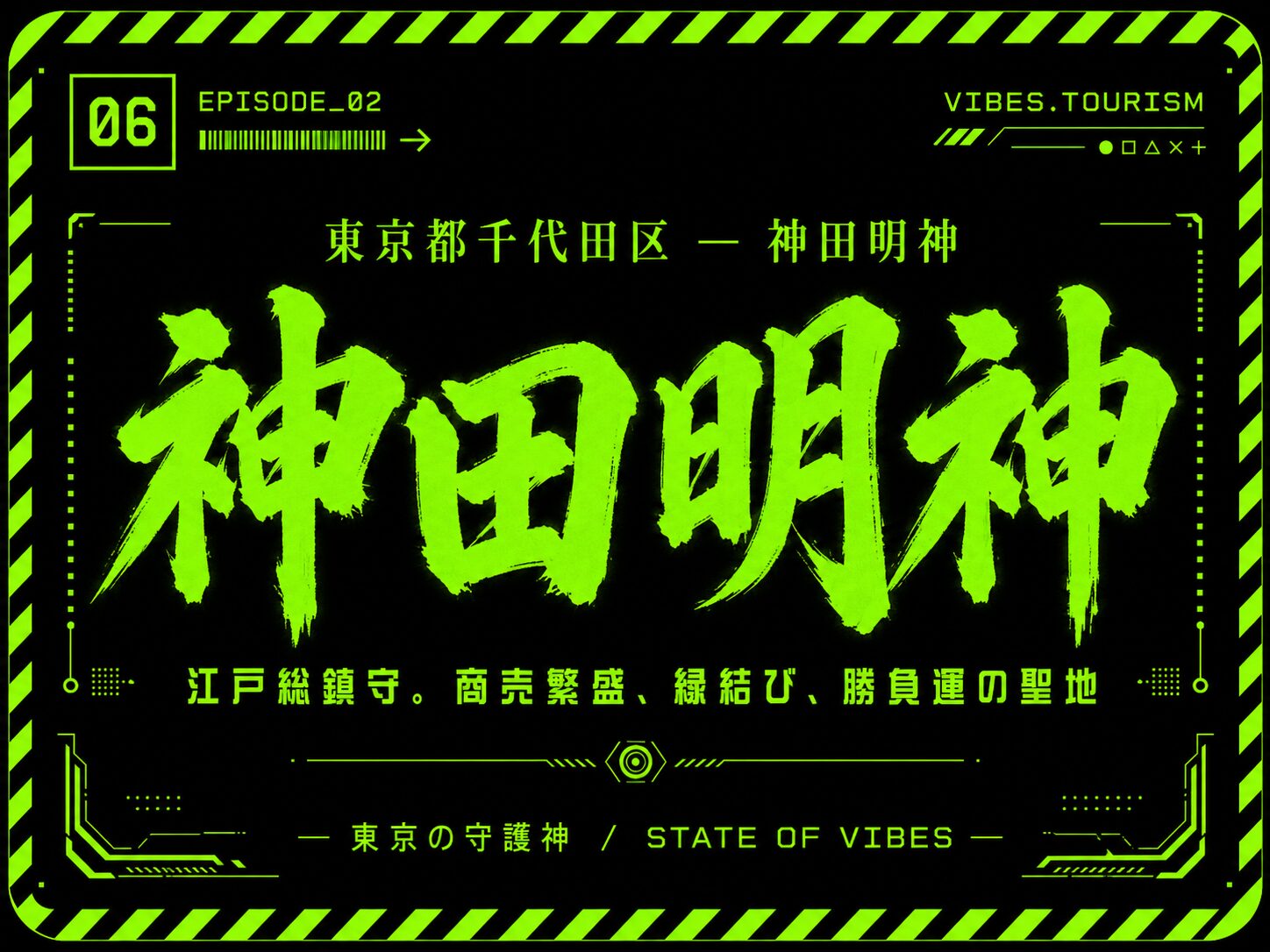

The Shrine That Turned a Slain Man Into a God.
KANDA MYOJIN — NEON PILGRIMAGE
A bright power spot for love and prosperity. Yet enshrined deepest within sits Taira no Masakado — the “rebel” who drew his bow against the imperial court and was struck down for it. Why does a traitor sit in a shrine of love? Next door to the electric town of Akihabara, this shrine still carries a thousand years of grudge and requiem.
SCROLL ▽
Chapter I — Why Does a “Rebel” Sit in a Shrine of Love?
You press your palms together before the main hall of Kanda Myojin, praying for love. Directly ahead, where you bow your head, sit three deities. Daikoku-sama. Ebisu-sama. And third — Taira no Masakado.
The first two are fine — gods of love and commerce. The problem is the third. Masakado is no mythological deity. He was a real human being, a man who drew his bow against the imperial court and was killed for it — the very man history textbooks have branded an “enemy of the throne,” a “traitor.” Why does a rebel sit in the innermost hall of a shrine for love? This is the doorway to every mystery of this sacred place.
Masakado was of noble blood. Born of the Taira clan, a descendant of Emperor Kanmu. His great-grandfather Takamochi-o had come east, and the family had put down deep roots in the Kanto plain; Masakado was its rightful heir. Young, he went up to the capital and served the Fujiwara power-holder Tadahira. He was meant to find his foothold to advancement in Kyoto.
But the capital had no use for him. All that was given to this young provincial warrior was a low post guarding the imperial palace. A man proud of his lineage tasted, in Kyoto, nothing but total disregard. Masakado returned to Kanto.
What awaited him home was a family feud. Sparks flew with his uncles over the lands his father had left. In 935, Masakado struck down one of his uncles. From there it rolled on like a stone down a slope, unstoppable. Uncles, cousins, neighboring lords — one after another turned their blades on him, and one after another he crushed them all. His strength was overwhelming, earning him the nickname “the Tiger of Bando.”
Then in 939 he crossed the decisive line. Intervening in a quarrel between a provincial governor and local lords, Masakado, carried by momentum, burned down the provincial government office. To burn a provincial office was to destroy an outpost of the imperial court. In that instant, a private quarrel became rebellion against the state.
Here Masakado made a move no one had imagined. Having conquered the eight provinces of Kanto, he proclaimed himself “Shinno” — the New Emperor. A new sovereign. A second emperor, separate from the one in Kyoto. He appointed his own court officials in imitation of the throne and tried to raise an independent state in the east. In this country’s long history, the only man ever to openly declare “I do not recognize you” to the dynasty itself — before or since — is this one man.
Legend ties this peak to the Myoken Bodhisattva — the deity of the Pole Star and the Big Dipper, the god at the center of heaven. Masakado, it is told, subdued the eight provinces under Myoken’s protection. The stars had been letting him win — and this “star” becomes the thread that later runs through every mystery of Kanda Myojin.
The end came startlingly fast. Just two months after proclaiming himself New Emperor, in the second month of 940, the allied forces of his cousin Taira no Sadamori and the renowned warrior Fujiwara no Hidesato struck him down. The primary chronicle Shomonki records his death in strange terms — at the moment he was slain, divine punishment suddenly fell, and Masakado was pierced and transfixed by a “shinteki,” a god-loosed arrow. Later ages told that the arrow pierced his temple. The Tiger of Bando fell to the earth in an instant. Legend says Myoken Bodhisattva, seeing Masakado grown arrogant at the height of victory, abandoned him and went over to the enemy. The man the stars had let win died forsaken by the stars.
Masakado’s head was carried to Kyoto and displayed on the great avenue as a severed head — a traitor’s warning to all. That should have been the end. Like the countless losers whose names history records, he too should have returned to the earth. It did not end. On the contrary, that displayed head made an unbelievable move — and it is from there that the true story of Kanda Myojin begins.
 01|TAIRA NO MASAKADO
The New Emperor Stands in BandoShinno / The New Emperor of Bando
01|TAIRA NO MASAKADO
The New Emperor Stands in BandoShinno / The New Emperor of Bando
Chapter II — The Head Flew Home
On the great avenue of Kyoto, it is told, Masakado’s severed head did not rot, month after month. The eyes never closed, glaring wide open. And one night, the head is said to have clenched its teeth and cried out: “Where is my body? Join my head to it. Let me wage war once more.”
And the head rose into the night sky. It left Kyoto and flew east, toward Kanto, where its body lay. The head of a man who, even slain, longed for one more battle, tried to return home under its own power — this is the first legend placed at the very origin of the shrine called Kanda Myojin.
The head fell, spent. Where it landed is today’s Otemachi in Tokyo — the Masakado-zuka, the so-called “Head Mound.” Here lies the heart of this shrine. After the head fell, strange things kept happening around that ground. Plagues spread; disasters struck. People grew afraid. This is Masakado’s curse, they said. The resentment of being slain, the humiliation of being displayed, the bitterness of longing for one more battle never fought — all of it was bursting forth as calamity.
What people did next mirrors the deepest part of this country’s spirit. They did not try to strike the curser back. They enshrined him. Not driving the fearful thing away, but precisely because it was fearful, raising it up as a god to be revered, calming its raging power, and — if possible — turning it into a guardian. In 1309, the wandering Ji-sect monk Shinkyo Shonin performed devout memorial rites for Masakado’s spirit and enshrined him as a deity at this shrine, Kanda Myojin. It was the moment a traitor became a god.
Consider this. Kanda Myojin began in 730, when an Izumo-lineage clan enshrined Onamuchi-no-mikoto. It had nothing to do with Masakado. Yet the head fell right beside that shrine, the curse arose, and to calm it Masakado was invited in. The history of this shrine begins to turn around that single point — where Masakado’s head fell.
The conviction that Masakado was a “cursing god” only swelled as the ages passed. In the Edo period he became the star of kabuki and ukiyo-e. What most fired the imagination was the tale of his daughter, Princess Takiyasha. Avenging her slain father, she vows revenge, is granted toad sorcery, and is reborn a sorceress. She commands a giant skeleton to fight the court’s pursuers — and the colossal skeleton painted by Utagawa Kuniyoshi later became the very image of the yokai “gashadokuro.” Masakado’s blood, within the tales, was passed to his child along with the grudge itself.
Masakado came to be counted, with Sugawara no Michizane and Emperor Sutoku, among the “Three Great Vengeful Spirits of Japan.” But pause here. Michizane and Sutoku too were enshrined out of fear of their curses — the same. And yet there is one decisive difference only Masakado has. Michizane became a god of learning; Sutoku was pacified in distant Shikoku. But Masakado — at the very place his severed head fell, in the center of Japan’s capital — has been enshrined for a thousand years. The feared one still sits squarely in the middle of the most prosperous land.
Why does a rebel sit in a shrine of love? The first answer is this: because he cursed. Because he cursed, he was enshrined; because he was enshrined, this became Masakado’s shrine. But the thousand-year reworking of his worship did not end with this single enshrinement. On the contrary, this was the start of a tug-of-war that would take a thousand years.
 02|THE FLYING HEAD
The Head Flew EastThe Head Flew East
02|THE FLYING HEAD
The Head Flew EastThe Head Flew East
Chapter III — Until an Emperor Declared Him “No Enemy of the Throne”
To enshrine Masakado as a god was no peaceful decision. The act of placing a traitor among the gods was questioned again and again, each time power changed hands. Before Masakado could sit in the main hall of Kanda Myojin, there was a thousand-year tug-of-war of raising and lowering his seat.
First came a tailwind. In 1626, something unexpected happened. Karasumaru Mitsuhiro, an imperial envoy who had come down to Edo, was moved upon encountering Masakado’s legend, and returning to Kyoto he petitioned the emperor: “Masakado is no enemy of the throne.” And Emperor Go-Mizunoo accepted it. A man who had drawn his bow against the court and been slain was pardoned by none other than the emperor himself. Some six hundred and eighty years after his death, the stigma of traitor was officially lifted.
Why did such a reversal happen in the Edo period? Behind it lay the calculations of the Tokugawa shogunate. To a warrior government, Masakado was no mere traitor. He was a great forerunner of the samurai — one who defied the Kyoto court and tried to raise an independent realm in the east. To revere the man who conquered Bando was to speak to the legitimacy of warrior rule. And to be seen protecting the “rebel” Masakado was also a gentle check on the Kyoto court. Ieyasu revered this shrine deeply and made it the chief guardian shrine of Edo. Masakado became a shogunate-sanctioned guardian deity.
But the tailwind did not last. In the mid-Edo period, a quiet demotion took place inside the shrine. “Having a traitor as the foremost deity is, after all, awkward.” Out of such concern, Kanda Myojin pushed the love-god Daikoku-sama up to the first seat and lowered Masakado to the second. Enshrined as a god, yet made to yield the top place. A subtle, but cold, line drawn.
Then came Meiji. The wind shifted from headwind to storm. The Meiji Restoration was a revolution that re-centered the nation on the emperor. In that new order, the existence of Masakado was fatally inconvenient. In 1874, Emperor Meiji was to make a royal visit to this shrine. The government judged thus: it must not be that a traitor who defied the emperor is enshrined in a shrine the emperor worships at. Masakado was dragged down from his seat among the deities. Driven from the main hall, he was moved to a small subordinate shrine in a corner of the grounds. To the vacated second seat, Ebisu-sama was newly brought from Oarai in Ibaraki. The man supposedly pardoned by the Kan’ei imperial decree was, two hundred and fifty years later, returned to the treatment of a criminal.
When did Masakado return to the main hall? In 1984. The year the Famicom lined the living rooms of Japan and, across the world, the internet was drawing its first breath. Until then, for over a century, Masakado had been pushed to a corner of the grounds. The long-held wish of parishioners and devotees was at last fulfilled — and more than a thousand years after he was slain, Masakado “came home” to the third seat in the main hall of Kanda Myojin.
Here, recall something. What have people offered at the Masakado Mound? Frog figurines. In Japanese, the frog — “kaeru” — puns on “to return.” After the head that flew “home” from Kyoto, people prayed that even if demoted or sent far away, they too would one day safely “return” (kaeru) to headquarters — and so they offered frogs. But the one who took the longest, by the most roundabout path, to “return” to the main hall was none other than Masakado himself.
And this must not be forgotten: this thousand-year tug-of-war is not a thing of the past. Masakado’s curse continues, vividly, into modern times. After the Great Kanto Earthquake of the Taisho era, when they tried to demolish the Head Mound and build a Finance Ministry office, the minister and more than a dozen officials died one after another. Lightning burned the building. After the war, when GHQ brought in a bulldozer to level the mound, it overturned and the driver was killed. The plan was scrapped. And so even now, in the middle of Otemachi — among Japan’s most prime real estate — that one plot alone remains untouched as a thousand-year-old head mound. Revere him and he is a guardian; neglect him and he is a curse. Masakado still flows, as such a god, through the underground veins of Tokyo.
 03|MASAKADO-ZUKA
The Head Mound in Otemachi, a Thousand-Year SilenceThe Head Mound in Otemachi
03|MASAKADO-ZUKA
The Head Mound in Otemachi, a Thousand-Year SilenceThe Head Mound in Otemachi
Chapter IV — Why the Big Dipper?
From here, the boundary between fact and legend grows blurred. But the true wonder of Kanda Myojin lies precisely in this hazy realm. No other sacred place has so many unverifiable legends told so earnestly. And the single backbone running through all of them is that “star” that has surfaced again and again — Myoken. We must first uncover what it is.
What is the Myoken that Masakado worshipped? Look up at the night sky. Every star flows from east to west with the passing hours. Among them, one star alone does not move. The Pole Star. At the north pole of heaven, it scarcely shifts position all night, all year. Though the earth spins and the seasons turn, that one point stays still. And so, since ancient times, people made this star the traveler’s standard for direction, and in time regarded it as — the center of the universe.
This reverence for the Pole Star, held by the nomads of Central Asia, crossed into China and joined with Taoism, gaining a decisive meaning. In Taoism, the unmoving central Pole Star (the North Star) was held to be the Heavenly Emperor (Tenko Taitei) itself. The supreme being, seated at the center of heaven, ruling the whole universe. The earthly son of heaven (the emperor) is merely this Heavenly Emperor’s deputy on earth. At the summit of the stars sits the ruler of heaven. This is the core of North Star worship.
Buddhism flowed into this thought, and the Pole Star was given the name “Myoken Bodhisattva.” Myoken means “excellent sight” — the eye that sees through all good and evil and truth. In Shinto it is called Ame-no-Minakanushi-no-Kami. In Taoism it is also called the Chintaku-reifu deity. Though the names differ, they all point to the same single unmoving star. The Pole Star held as many names as it had worshippers.
And circling close beside the Pole Star is the Big Dipper. Those seven stars in the shape of a ladle. In Myoken worship, the Big Dipper assists the Heavenly Emperor and governs the fate and lifespan of every single human. When you are born, when you die. Whether you flourish or perish. The seven northern stars hold that ledger. The stars decide a person’s life and death.
By now, why Masakado — and Edo — connect to the Big Dipper begins to take shape. But one decisive point still remains. The tip of the Dipper’s handle. The seventh star is named Hagunsei, the “army-breaking star.” Hagun — the star that breaks armies. As a sword’s point aims at heaven, the tip of the Big Dipper was seen as a baleful star of war that cuts down enemies. Because of this army-breaking star, Myoken Bodhisattva was no longer merely a god of fate. It became a god that grants victory in war — a god of war. Clad in armor in the northern sky, bearing a sword, descending to the battlefield astride the Genbu tortoise to lead its side to victory — in such a fierce form was Myoken worshipped by the warriors of Bando. The Chiba, the Chichibu, the Soma. The warrior bands that held the Kanto all set Myoken as their clan’s god of war.
And then, Taira no Masakado. The legend that Masakado received Myoken’s protection survives clearly within his battle tales. In the fight with his uncle Yoshikane, when his arrows ran out and he was cornered, a young child appeared, gathered the fallen arrows and handed them to Masakado, and loosed arrows of its own to drive back the enemy. Yoshikane, the pursuer, retreated in fear: “This is no human work — it is heaven’s design.” After the victory, when Masakado knelt before the child, the child declared: “I am the Great Myoken Bodhisattva.” Masakado was a man chosen by the northern star that governs fate and victory, and by its army-breaking power he cut the eight provinces of Kanto into submission. That he could proclaim himself New Emperor was for no other reason than that the stars were at his back.
And so his death too is told through the stars. Myoken Bodhisattva, it is said, abandoned the Masakado who had grown arrogant in proclaiming himself emperor. The star departed to Masakado’s uncle Yoshifumi. When Yoshifumi fell into peril, a star descended from the sky, and by its power he won. From this legend was born the “Kuyo-mon,” the nine-star crest of the Chiba and Soma clans. That crest still carved on the offering box at the Masakado Head Mound. It is the crest of the northern star that let Masakado win, and then forsook him. Chosen by the stars, abandoned by the stars. Masakado’s whole life was a story of the Big Dipper.
With this one point grasped, we can at last proceed to the matter of Edo’s ward. First, from the unshakable facts. The city of Edo was designed by occult principles. This is not urban legend but the history of city planning. Tenkai, the Tendai monk who served as Ieyasu’s strategist, read Edo’s terrain by the Chinese doctrine of the “Four Guardian Gods.” A river to the east (Azure Dragon = Sumida River), a road to the west (White Tiger = Tokaido), a sea to the south (Vermilion Bird = Edo Bay), a mountain to the north (Black Tortoise = Mount Fuji). With Edo Castle at the center, he placed Kan’ei-ji and Kanda Myojin at the demon gate (northeast), Hie Shrine at the back demon gate (southwest), Zojo-ji to the south, and Ieyasu’s own mausoleum, Tosho-gu, due north at Nikko. Edo was no town that formed by nature. It was a city assembled by human hands as a “ward,” upon calculations of direction and yin-yang. That much stands as historical fact.
And here we enter the realm of legend. The author Kado Nanami, in her 1993 book “Could Masakado Become a God?” — later retitled “The Masakado Magic Square” — pointed out a certain arrangement. Seven shrines tied to Masakado: Torigoe Shrine, Kabuto Shrine, the Masakado Head Mound, Kanda Myojin, Tsukudo Shrine, Mizu-Inari Shrine, and Yoroi Shrine. Plot these seven on a map of Tokyo, she said, and they line up beautifully in the shape of the Big Dipper hanging in the night sky.
Why, of all things, the Big Dipper? The answer is already visible. Masakado was a man chosen by the Big Dipper. If you would seal his soul, calm it, and use it as a guardian, then enclosing it in the very shape of the star that let him win makes the most sense as sorcery. By Kado’s reading, this was the Edo shogunate’s “occult project.” Masakado was too great a cursing god. So the shogunate, while enshrining him carefully, arranged the shrines in the shape of the Big Dipper and sealed his soul behind a wall of sorcery, so it could not escape beyond Edo. Calming, yet not letting go. Binding the man of the stars with the stars.
One line of speculation, carried in the monthly magazine Mu, goes further still. On the extension of the direction pointed by the Dipper’s handle — that is, the army-breaking star — sits Ieyasu’s mausoleum, Nikko Tosho-gu. And this is no mere fancy. Nikko Tosho-gu itself was a shrine designed upon Pole Star worship.
After death, Ieyasu was deified as “Tosho Daigongen.” “Tosho” likens Ieyasu to Amaterasu, the sun goddess of the east. The question is why his mausoleum was placed due north of Edo, at Nikko. In ancient China, the unmoving Pole Star was the deity that presides over the universe, the Heavenly Emperor. The very word “tenno” (emperor) derives from “Tenko Taitei,” the deified Pole Star. The north–south line connecting Edo Castle, where the shogun who governs this world’s politics resides, with the Pole Star, the deity who presides over the universe — this is called the “Path of the North Star.” Tenkai built Tosho-gu upon that line. Indeed, the shrine faces south so that the extension of the line through its torii, Yomeimon gate, Karamon gate, and main hall arrives precisely at the Pole Star. To worship Nikko Tosho-gu is the same as worshipping the Pole Star — the deity at the center of the universe. So it was given meaning. Ieyasu, reborn as a god, sought to become one with the unmoving northern star and watch over Edo forever from the center of the universe.
Here, the whole design that runs through Kanda Myojin falls into place. Masakado was chosen by the power of the Big Dipper (the army-breaking star), and forsaken by the star, he lost. Ieyasu became one with the Pole Star itself, at the tip of that Dipper’s handle, and took the realm. The loser chosen by the stars is calmed and sealed at the demon-gate shrine (Kanda Myojin), and the victor who stands at the center of the stars rules over it from due north. Kanda Myojin is the point placed at the very front line of this grand “story of victor and vanquished over the stars.”
The legend continues into Meiji. The Meiji government that toppled the Tokugawa, it is said, disliked the ward Ieyasu had built. And so — with the “iron ring” of the Yamanote Line, they tore the Big Dipper apart. Indeed, several of the seven shrines sit at positions cut off from the other stars by the Yamanote Line. It is even argued that Kabuto Shrine (kabuto = helmet, the head) and Yoroi Shrine (yoroi = armor, the torso) divide Masakado’s body apart — such was the thoroughness. Of course, railways were not laid for the sake of curses. But the shadow of Masakado — and of the Big Dipper — falls so thick over this city that such stories are born and handed down.
What crystallized this theme of “Masakado × the Big Dipper × feng shui × the demon-capital Tokyo” into a single grand entertainment was Aramata Hiroshi’s “Teito Monogatari” (Tale of the Imperial Capital). Tokyo at the end of Meiji. The sorcerer Kato Yasunori plots to summon Masakado, the greatest vengeful spirit of the Kanto, and destroy the imperial capital itself. What stands against him is the real-life Shibusawa Eiichi’s “plan to spiritually protect the capital through redevelopment.” In the work, the repeated fires at the Finance Ministry are depicted as Masakado’s curse — the real curse tales of the Head Mound, woven directly into the story. And the medium Kato chooses as Masakado’s vessel is a daughter descended from Masakado. Bloodline. The grudge, carried down a thousand years of blood, revives in the present.
“Teito Monogatari” is regarded as the first Japanese novel to treat feng shui, Onmyodo, and the art of Kimon-Tonko in earnest, and the image of the onmyoji that appears in today’s anime and games was, for the most part, created by this work. Considering that Kanda Myojin would later become a holy land of anime and subculture, this cannot be dismissed as coincidence. The thousand-year vengeful spirit called Masakado became a worship of the stars, a legend of the ward, a novel, and in time the very source of this city’s subculture.
And that bloodline is not a thing only of legend. The Soma clan, said to carry Masakado’s blood, is real and continues to this day. The valiant “Soma Nomaoi” festival held each year in Fukushima takes its origin from the tale that Masakado captured wild horses for military training and offered them before the gods, and it is still held with a descendant of the Soma clan welcomed as supreme commander. The blood of the man chosen by the stars, and the worship of the northern star, live on — not as legend but as reality — in the soil of the east, even now a thousand years later.
Fact, or legend? The Big Dipper ward, the army-breaking star and Tosho-gu, the severing of the curse by the Yamanote Line — none has been academically proven. But when you stand at Kanda Myojin, what flows beneath your feet is the whole of this hazy, dense story. The one you press your palms to is no mere god of love. He is a single man — chosen by the northern star at the center of the universe, forsaken by that star, and over a thousand years sealed and enshrined at the center of a ward shaped like the stars.
 04|THE BIG DIPPER
The Big Dipper Covers TokyoThe Seven Stars over Edo
04|THE BIG DIPPER
The Big Dipper Covers TokyoThe Seven Stars over Edo
Chapter V — What the Three Deities Grant: Love, Commerce, Victory
Having dived through the depths of legend, let us return to the surface. Passing through the torii, walking this shrine — what blessings do you carry home? Kanda Myojin is not a shrine of dense storytelling alone. The blessings it grants are also extraordinarily concrete.
Before you pass the torii, be aware of the direction beneath your feet. As we saw in the last chapter, this shrine sits due northeast of Edo Castle — the “front demon gate,” the worst direction, through which demons were said to come and go. It is one of the keystones doubly sealing that gate. This shrine was not built to heal worshippers. It was placed to protect the city of Edo from calamity. That is why the torii faces toward the Imperial Palace.
Passing through the Zuijinmon gate, you look up at the vermilion main hall. At a glance it seems traditional timber — but it is not wood. It is steel-reinforced concrete. The reason is fire. The magnificent late-Edo hall burned down in the Great Kanto Earthquake of 1923. For the rebuilding, Kanda Myojin chose reinforced concrete — exceptional for the time. The design advisor was Ito Chuta, a leading architect of the era. And in 1945, when the Great Tokyo Air Raid burned the city to ash, almost all the timber buildings on the grounds turned to cinders. But that one reinforced-concrete hall survived with only slight damage. Having endured two annihilations, it now keeps its vermilion color as a Registered Tangible Cultural Property of Japan. A thing that remains even when burned by fire — that is what people have seen in this shrine.
Stand before the main hall and confirm the three deities you press your palms to. First, Daikoku-sama (Onamuchi-no-mikoto). A god of love and fortune. He binds not only the bonds between men and women but the bonds of commerce, of person to person, and the invisible threads of luck. To the left of the grounds, before the cultural hall, sits a colossal stone statue of Daikoku-sama, about 6.6 meters tall and weighing some 30 tons — the largest stone Daikoku statue in Japan.
Second, Ebisu-sama (Sukunahikona-no-mikoto). A god of prosperous business, medicine and health, and good fortune. Paired with Daikoku-sama, he guards both wheels — bonds and commerce.
And third, Masakado-sama. A god of warding off disaster — and of victory. This is where it bites. Beginning with Iwasaki Yataro, founder of Mitsubishi, renowned industrialists have come to this shrine relying on Masakado’s power to “promise victory.” The man who defied the court, was slain, and had his head displayed is now, as a “god of victory,” the one Japanese businessmen rely on most. Executives who press their palms to Masakado at the year’s first day of work are still without end. From traitor to god of victory — this is the final reversal that the thousand-year reworking of worship arrived at.
The festival that binds these three deities as the chief guardian of Edo is the Kanda Matsuri. A “Tenka Matsuri” (Shogun’s Festival) ranking with the Sanno Matsuri of Hie Shrine, it took its name because the Tokugawa shogun viewed it from within Edo Castle. The main festival is held once every two years, in May. In the Shinko-sai procession, three phoenix palanquins and portable shrines set out from Akihabara and parade some 30 kilometers through 108 neighborhood associations, advancing toward the shrine as a procession of thousands. At the miya-iri, as many as two hundred portable shrines large and small pour into the grounds from morning to night, to the chants of the Edo townsfolk. A festival that calms the demon gate also fills the center of Tokyo with frenzy every other year.
What you can carry home is also extraordinary in number. There are over sixty kinds of amulets. The “Wish Rabbit” charm after Daikoku-sama’s white hare of Inaba; the golden “Minori” charm sealing a rice ear; the “Victory” charm derived from the prayer for triumph at Sekigahara; the “Masakado Disaster-Warding” charm, rare for its black cloth. And the one that could have been born nowhere but here — the “IT Information Safety” amulet. A sticker-type charm to put on your PC or phone. Down the slope lies Akihabara at once. Only in this land, where shrine and electric town stand side by side, could the idea arise of praying to a god for the safety of devices and networks. The offering is around 1,200 yen as a guide. Prices change, so check at the amulet office.
The shrine standing on the ground where, a thousand years ago, a star-chosen rebel fell, now binds love, makes commerce flourish, calls in victory, and even guards the safety of modern IT devices. It turns the slain into a god who brings fortune. Kanda Myojin is the place that shows, most densely and most brightly, the deep power of what it means for this country to “enshrine.” Now, from here, let us turn to the practical side of a journey through Kanda, with this shrine as our starting point.
 05|DAIKOKU & BLESSINGS
Japan’s Largest Daikoku, the Shrine of FortuneThe Largest Stone Daikoku
05|DAIKOKU & BLESSINGS
Japan’s Largest Daikoku, the Shrine of FortuneThe Largest Stone Daikoku
What to Eat Before You Leave Kanda
After your visit, fill your stomach in Kanda. This district is a rare corner of Tokyo where the food of Edo still lives and works. Not shops built for tourists, but the real thing — places running for a century or more — clustered within walking distance.
First, right beside the torii, Amanoya. Founded in 1846, an old purveyor of Myojin amazake that cultivates its koji in a natural earthen cellar six meters underground. For soba, this is a district where the lineages of Edo’s three great soba — Yabu, Sunaba, Sarashina — are all present; the twin peaks are Kanda Yabu Soba and Kanda Matsuya. Yabu Soba was half-burned in a 2013 fire, losing even its broth, yet — like the shrine hall — was reborn in reinforced concrete. Matsuya, founded in 1884, was a regular haunt of the writer Ikenami Shotaro. In winter, the anglerfish hot pot of Isegen (founded 1830). And Kanda is also a holy land of curry, where the “Kanda Curry Grand Prix” is held every year.
| Shop | From Kanda Myojin | Try | Book / Info |
|---|---|---|---|
| Amanoyasweets | right by the torii | Myojin amazake, kuzumochi |  View on Tabelog ▶ View on Tabelog ▶ |
| Kanda Yabu Sobasoba | approx. 8 min walk (Awajicho) | seiro soba, soba-mae | View on Tabelog ▶ |
| Kanda Matsuyasoba | approx. 8 min walk (Sudacho) | mori soba, tempura, soba-mae | View on Tabelog ▶ |
| Isegenanglerfish | approx. 8 min walk (Sudacho) | anglerfish hot pot (year-round; winter is best) | View on Tabelog ▶ |
*Hours, closing days and prices change; please confirm before visiting.
Run Up the Otoko-zaka, Pray at the Head Mound
Kanda Myojin is now also one of Japan’s foremost anime holy lands. The steep stone steps beside the main hall, the “Myojin Otoko-zaka,” are familiar from “Love Live!” Together with “Steins;Gate,” it is listed among the Anime Tourism Association’s “88 Anime Pilgrimage Sites of Japan.” The cultural hall “EDOCCO,” opened on the grounds in 2018, has a shop, cafe and hall, with Daikoku-sama sablé as its specialty, and frequent anime collaboration exhibits. Kanda Myojin can be visited 24 hours, so you can stop by the night grounds on your way back from Akihabara.
And worth the extra walk is the Masakado-zuka (Head Mound) in Otemachi. There is a manner to visiting. The Head Mound is treated as Buddhist; bow before the mound and quietly press your palms together. Idle curiosity is unwelcome. Note the offerings — since the 2021 renovation, offerings and incense within the mound grounds are prohibited, and only coins in the Kuyo-crest offering box are accepted. For a formal dedication, inquire at the office of Kanda Myojin, which manages the mound. It is also passed down that “one must not visit Kanda Myojin and Narita-san Shinsho-ji together” (because Narita-san began as a temple for the prayer to subdue Masakado) — this is less fact than a saying handed down for a thousand years.
| Sight / Experience | Location | What | Note |
|---|---|---|---|
| Myojin Otoko-zaka | beside main hall | Love Live! pilgrimage steps | residential area — keep quiet |
| EDOCCO Culture Hall | on the grounds | shop, cafe, collab exhibits | Daikoku-sama sablé |
| Museum | beside main hall | Kanda Matsuri diorama, etc. | admission fee |
| Masakado-zuka (Head Mound) | Otemachi (subway + walk) | thousand-year head mound / frogs | no offerings; coins only; free |
*Hours and fees change; confirm before visiting. The Masakado Mound can be visited any time (free).
Stay or Stop Over in Ochanomizu & Kanda
Kanda Myojin sits right in the heart of the city. Whether you stay the night or just soak in a bath, the choices are surprisingly many. Choose your lodging by purpose — a fine property for a touch of luxury, a station-side hotel for an affordable base. Ochanomizu, Kanda and Akihabara are where many lines cross, convenient for moving anywhere.
― RICH | An Upscale Stay ―
For anniversaries, or a night to spend at ease. To a fine hotel in the Ochanomizu–Nihonbashi area.
Search on Ikyu.com ▶
― STANDARD | A Casual Overnight ―
As a base for sightseeing and the shrine. An affordable, easy-access place near the station.
Search on Jalan ▶
*The Hilltop Hotel (Yama-no-ue) has been closed since February 2024 (reopening as “Hilltop Hotel Tokyo” in summer 2027). Currently no stays available.
Just a Bath, No Overnight
Kanda has baths where you can wash off the day without staying over. Play in Akihabara, visit Kanda Myojin, and close the day with a soak.
| Facility | Location / Reception | Character | Note |
|---|---|---|---|
| RAKU SPA 1010 Kandabathhouse | approx. 5 min from Ochanomizu / confirm on official site | carbonated bath, sauna, cold bath, lounge floor | late-night stay OK; monthly anime collabs |
| Inari-yusento | approx. 5–6 min from Otemachi/Kanda / confirm on official site | jet bath; runner-friendly sento | sento prices; store bags for an Imperial Palace run |
*Reception hours, closing days and prices change; please confirm on each official site before visiting.
Kanda Myojin — Half-Day to Full-Day Model Route
- AM
Visit Kanda Myojin
Cross Hijiribashi bridge from Ochanomizu Station and pay your respects. Pray to the three deities for love, commerce and victory, and walk past Japan’s largest Daikoku statue, the Lion Mound, and the monument to Zenigata Heiji. For an amulet, the IT Information Safety charm found nowhere else.
- late AM
Amazake at Amanoya
By the torii at Amanoya, a cup of Myojin amazake from koji raised in the underground cellar. Touch Edo’s fermentation culture in the afterglow of your visit.
- noon
Kanda Soba / Anglerfish / Curry
Start with soba-mae at Kanda Yabu Soba or Matsuya. In winter, Isegen’s anglerfish hot pot; for a change of pace, one of Kanda’s famous curry houses.
- PM
Otoko-zaka, EDOCCO, Head Mound
Climb the Myojin Otoko-zaka beside the main hall, and pick up Daikoku-sama sablé at EDOCCO. Walk out to the Masakado Mound in Otemachi and, before the cluster of frogs, quietly turn over the “traitor-and-god” you met on this journey.
- eve
Akihabara → RAKU SPA 1010 Kanda
Drift through the electric town to wrap up. When you want to sweat it off, find your sauna calm at RAKU SPA. If you stay over, savor the quiet grounds at night and morning once more.
*This site uses an affiliate program (ValueCommerce) to introduce products and services. Listed prices, hours, closing days and access may change; please confirm on each official site before booking or visiting. Images in this article are for illustration.
*The legend of Masakado’s flying head, Myoken Bodhisattva’s protection and abandonment, the Big Dipper ward (the seven-shrine magic square), the severing of the ward by the Yamanote Line, and the origin of the Kuyo crest described in this article are based on legends and shrine traditions of the area, and on works and urban legends such as Kado Nanami’s “Could Masakado Become a God? (The Masakado Magic Square)” and Aramata Hiroshi’s “Teito Monogatari” — they are not academically established facts. On the other hand, the founding year, the changes among enshrined deities, the Kan’ei imperial pardon, the reconstruction year of the hall, the Registered Tangible Cultural Property designation, and the scale of the Kanda Matsuri are based on official shrine, governmental and cultural-property sources.

Comments