
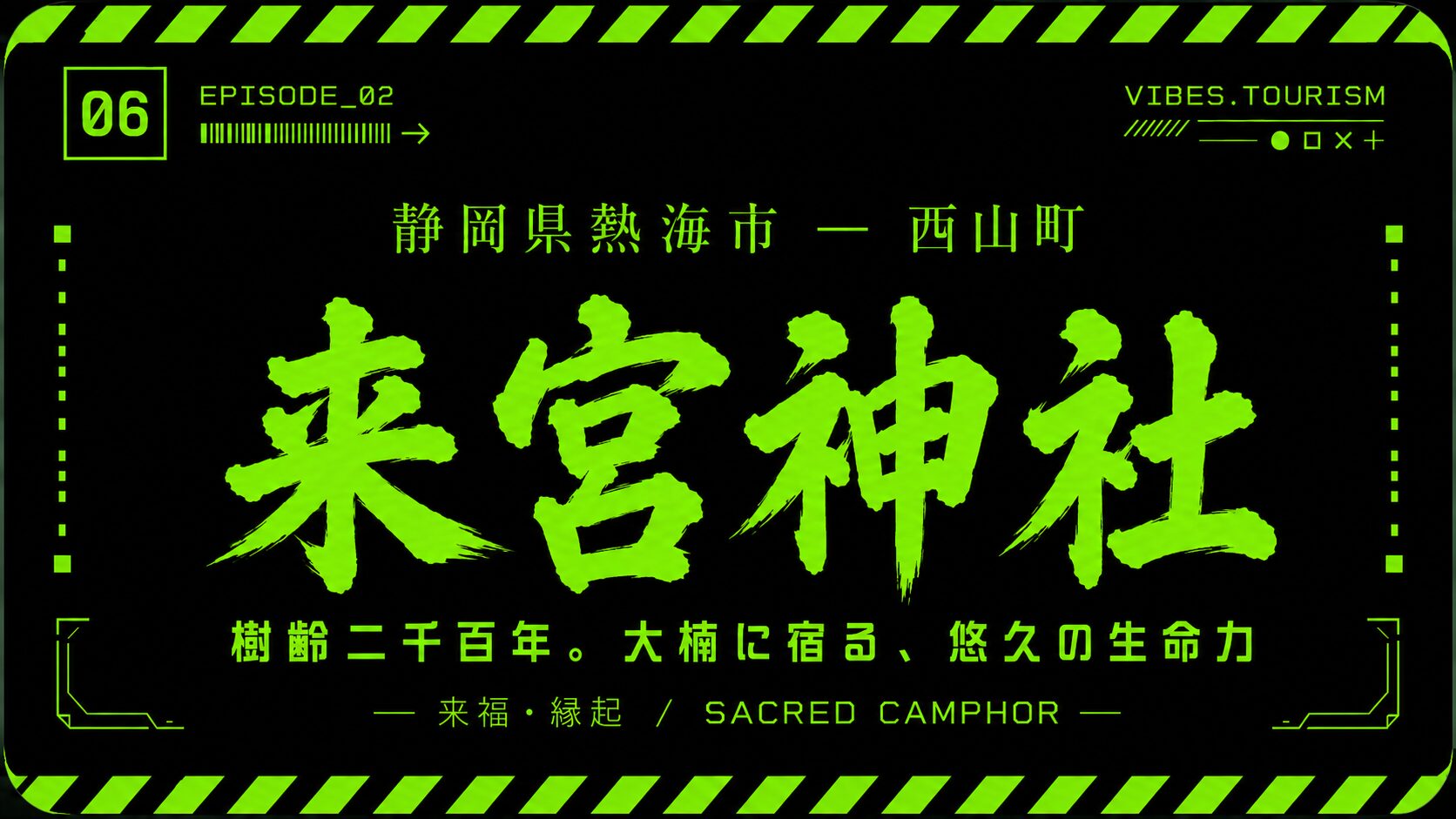

The thing that came from the sea
has not moved for 2,000 years
Take a photo at this shrine, and orbs of light show up in it.
Scientists call them the same thing people call UFOs.
Atami, Kinomiya Shrine. The story of Japan’s strangest tree.
The thing from the sea has not moved for 2,000 years
Take a photo at this shrine, and an orb of light appears in it.
One visitor’s orb was green — until they enlarged it for their phone wallpaper, and it had turned blue. “It’s my ancestors, watching over me,” they said. Stories of “a strange photo I took here” are everywhere at this shrine.
And scientists? They believe these orbs of light are the very same thing people call UFOs.
This is Atami, Kinomiya Shrine. What follows is the strangest tree story in Japan. Laugh it off if you like — but read to the end, and you’ll want to stand before this tree yourself.
First, remember this: the star of this shrine is not a building. It’s a single tree, called the Ōkusu — the Great Camphor.
Age: 2,100 years. Trunk circumference: 24 meters around. Fifteen adults joining hands can barely encircle it. The largest tree in mainland Japan, designated a National Natural Monument.
 The Great Camphor OOKUSU
Here’s bomb number one. This tree is 800 years older than the shrine itself. The shrine was built 1,300 years ago. The tree has stood here for 2,100. So the order is backwards: first there was an astonishing tree, and because of it, people enshrined a god here. The tree summoned the shrine — not the other way around.
So where did the god come from? Here’s where it gets strange.
1,300 years ago, in the sea off Atami, a fisherman hauled up his net and found a tree root in it. Useless. He threw it back. He cast again — and the same root was back in the net. He threw it far away. The third time, it returned again.
The sea has currents. For something thrown away twice to return a third time to the same net — that essentially never happens. This did not merely drift ashore. It came back, on purpose, saying: this is the place I want to be.
That night, a child-shaped god appeared in the fisherman’s dream and said: “I am the god Itakeru. Enshrine me where the sound of the waves cannot be heard.”
Strange, isn’t it? The god came from the sea — yet hated the sound of the sea.
The old Japanese believed that beyond the sea lay another world, “Tokoyo” — something like the afterlife. From there, gods would occasionally visit by boat and leave fortune behind. Such a “visiting guest-god” was called a marebito. Ebisu, the god of fortune, is one of the same family.
And the water’s edge is the boundary between this world and that one. When a god who crossed the sea says “silence the waves,” it may mean: “Close the passage to the other world.” Raise an invisible wall, and bind me to this world.
There’s more. This god Itakeru has a remarkable pedigree. His father is the wild storm-god Susanoo. And in the ancient chronicle Nihon Shoki, Susanoo plucks out his own body hair to create trees — his beard became cedar, his chest hair cypress, and his eyebrows became camphor.
So in the logic of myth, the Great Camphor of Kinomiya is a tree born from a god’s eyebrow. And the god decreed: “Let cedar and camphor be made into ships.” A tree meant to cross the sea. Itakeru carried every seed of those trees across the water and covered Japan in green forests. The god who walked the land planting trees, at last drifted ashore at Atami — as a tree.
Along the Izu coast there are several shrines named “Kinomiya.” Each enshrines a god that washed in from the sea; each holds a tree over a thousand years old — as if something has landed on this shoreline again and again, from beyond the sea. Kinomiya Shrine in Atami is the head shrine of all forty-four Kinomiya shrines nationwide. The very peak of the landing site.
A root that returned three times of its own will. An order to seal the door to the other world. A tree born from a god’s eyebrow, fated to cross the sea. The blood of an incoming god. Can you really call all of this mere coincidence?
2,100 years ago, “it” came from the sea and stopped moving in this forest. It is still here. And it shows itself — as a dragon in the bark, as an orb of light in the night sky.
Next, we step into the sightings.
There is a dragon in the bark
Stand before the Great Camphor and everyone raises their phone. Not because it’s photogenic. For a stranger reason.
Look hard at the trunk. Around the middle, part of the rippling bark looks like a thick serpent coiled around it. And at the lower right, a dragon seems to rear up toward the sky.
This isn’t “if you squint.” Stand in front of it, and the shapes of a dragon and a serpent rise clearly to the eye. That’s why the photos never stop. On 2,100-year-old bark, a dragon and a serpent have made their home.
 Dragon & Serpent in the bark
Those who touch it all say the same thing: “It was warm.” Bark should be cool. Yet it feels warm. “Something flowed into me from my palm,” some say. At the roots, a modest yellow flower blooms — the tsuwabuki, whose meaning is “unbeaten by hardship.” Blooming where no one notices.
This tree carries two legends. Walk one full circle around the trunk, and your life is extended by one year. And circle it once while holding a wish in your heart, told to no one, and the wish comes true. There’s a knack: clockwise, slowly. Never say the wish aloud. Keep it a secret between you and the tree, and walk.
But the scariest story of this tree is yet to come.
There were once seven great camphors. Only one remains. Why?
In the late Edo period, a great dispute split the village, and the lawsuit required money. The villagers decided to sell the gods’ trees. Five of the seven were felled, one after another. And then a saw was set against the last one too.
At that instant — a white-haired old man appeared from nowhere, spread his arms, and shielded the tree. In the next moment the great saw snapped in two in the woodcutter’s hands. And the old man vanished like smoke. The villagers trembled and stopped cutting. That is the sacred tree you now look up at — the tree that people tried to cut, and a god refused.
There is one more tree you must not forget: the Second Camphor. Long ago it was struck by lightning. Its core burned out, nearly hollow — a shell. Touch the back of it and your hand still comes away black with charcoal.
And yet — it has not died. It spreads deep green leaves and grows still. You can even step inside its hollow. Standing within its burned-out body, you can feel the pulse of 2,000 years of life.
Nearly felled, it refuses. Burned hollow, it lives. This is no ordinary long-lived tree. Something dwells in it.
And that “something” is bound to water, too. Behind the forest runs a small stream, the Ryūjin-gawa — the Dragon-God River. Its source, they say, is the spring welling from the Great Camphor’s roots. In the Edo period, a farmer drawing water here saw a great dragon rise from the surface and say, “Make an offering to me.” He obeyed — and that year the rains came and the harvest was rich. So the story goes.
A dragon in the tree, a dragon in the river, a white serpent at the goddess’s feet. In this narrow forest, the presence of dragon, serpent, and water swirls round and round.
By day, the “it” in the tree appears as a dragon in the bark. And at night —?
At night, “it” becomes light.
What the orbs really are — orbs, tree spirits, and UFOs
After dark, about 160 lights come on in the forest of Kinomiya.
Small lights dot the roots and the depths of the branches. The shrine calls this the “Kodama Project” — kodama being the spirits that dwell in trees, rendered as light. Every evening from 5 pm to 11 pm, orbs of light breathe in the dark forest.
 Kodama lights & orb
But in this forest, a different “orb” shows up in photographs — the one from Chapter 1. Round, white, semi-transparent grains of light. The world calls them “orbs.”
So what are they? Here the story leaps from the occult straight into cutting-edge science.
The cold explanation: “It’s just dust.” Airborne dust or water droplets bounce the flash back, blurred. And yes — most orbs are explained this way.
But some orbs cannot be. Enter “plasma” — put simply, a glowing cloud of electrically charged gas. Lightning, auroras, flame: all plasma. The physicist Yasuhiko Ōtsuki spent years arguing that the old “fireballs” of folklore are exactly this plasma.
And a plasma ball drifting through the air is called “ball lightning.” Here is tonight’s biggest bomb. Balls of light flying through the sky have long been called “UFOs.” Orbs, ball lightning, UFOs — could they be the very same “orb of light”? This is debated in complete seriousness.
There’s more. Luis Elizondo, who investigated UFOs (UAP) for the U.S. government, has said: “There may exist conscious plasma life forms — sphere-like things with some kind of intelligence.” The orb of light may not be a mere phenomenon, but “something with intelligence” — that’s how far the frontier has come.
Think it’s fiction? Consider this. In 2024, just south of Atami, above Shirahama Shrine in Shimoda, a luminous object appeared. In a short span it blinked eleven times. Not an airplane’s blink. Not a satellite. When the Coast Guard was asked, “did you fly anything?” — “we flew nothing.” The photographer concluded: “I believe this is a UFO.” And back in 1955, an “orb-like object” appeared over the Shizuoka sky and threw the town into an uproar.
Orbs of light flicker over the shrines of Izu. Coincidence?
One more line connects the dots: the ley line. In Japan there is a “path of light” where power spots align in a straight line — from Tamasaki Shrine in Chiba, through Mount Fuji, to Izumo Taisha in Shimane. Called the “Path of the Rising Sun,” on the spring and autumn equinoxes the sun traces this line from east to west. At its center stands Mount Fuji.
And in feng shui, the path of the earth’s “qi” is the “dragon vein,” and where that energy erupts is the “dragon hole.” Ise Grand Shrine and Nikkō Tōshō-gū are said to sit on such dragon holes. Kinomiya Shrine, some say, sits on a dragon hole where qi arrives underground, straight from Mount Fuji. The water the Great Camphor’s roots draw up may be the Earth’s own energy, delivered from Fuji.
To sum up: the “it” from the sea dwells in the tree, appears as a dragon in the bark, and at night becomes an orb of light. The ancients called that light “a god descending”; today’s people call it an “orb”; those who saw it in the sky called it a “UFO.” Only the names differ. What they saw may be one and the same.
So does the orb just hang there? No. It acts, unmistakably, on the people who come. The next chapter is the testimony.
Testimonies of the summoned
First, the most famous “signal.”
The instant a visitor stands before the Great Camphor, the prayer beads on their wrist suddenly snap. A stone bracelet bursts apart. Stories like this abound.
Normally you’d call it a bad omen. But in this forest, it’s read the opposite way. “It took on something bad in your place, and snapped when its job was done.” So it’s a sign that your luck is turning for the better.
The “and then” stories pile up too. A woman circled the Great Camphor with a wish. The next week, someone she’d lost all contact with suddenly reached out — and they began dating. A person agonizing over a career change got a recruiter’s email on the way home from the shrine, and after six stuck months it all fell into place. A mysterious sluggishness lifted after a visit. There’s even a story of a pet dog’s injury healing after a prayer at the tree.
Everyone says the same thing: “The moment I passed through the torii, the air changed.” So clearly that even the insensitive can feel it — wrapped in a bright “qi.” Meanwhile, the deeply sensitive say “I saw something,” “it was frightening.” The same forest becomes blessing or dread, depending on the person. It caught fire, too, when the famous spiritualist Hiroyuki Ehara introduced this shrine as a “sacred place to visit now.”
Here is the shrine’s other face. This god is not only kind, handing out fortune. It is also a god of “cutting off.”
Long ago, they say, this god drank too much and broke a promise. From that, it came to be worshipped as a god who helps those who want to quit drinking. The offering hall even sells a “sake-misfortune-warding charm.” Not just alcohol — tobacco, gambling, sweets: people carrying a habit they want to break come to make a vow before this god.
There’s an unusual charm too: the “Great Camphor bug-repellent charm.” Camphor leaves keep insects away (it’s the source tree of mothballs). The shrine reads that as: the bug of infidelity, the bug of gambling, a child’s “worm” of night-crying — the bad “bugs” that cling to people, this tree drives away.
In the corners of the forest are small but potent gods. The messenger of the Mitsumine Shrine here is not a dog, but a wolf — from a tale in which wolves gathered around a seated ascetic and filled the grounds, taken as a divine sign. And the “Seven Auxiliary Shrines” all burned in a suspicious fire in 1932, and were finally rebuilt — ninety years later, in 2022. For ninety years the gods waited in temporary lodging. The image of the goddess Benzaiten is the work of Kōun Takamura, master sculptor of Ueno’s Saigō Takamori statue, its doors opened only one day a year, on November 23.
But no matter how many of these stories you line up, the truth stays hidden. You truly meet the “it” of this forest not by day. By night.
At night, inside the barrier
 The Great Camphor at night
Again: by day, Kinomiya is bright. Crowded, cafés full, laughter as people hunt for heart-shaped fallen leaves.
But when the sun goes down, this forest becomes another thing entirely.
5 pm. The 160 lights come on, and the people drain away. The sound of the waves never reaches here (the god commanded it). All you hear is the murmur of the Dragon-God River and the wind in the branches.
And out of the dark, the Great Camphor rises up.
It looks far larger than by day. Lit from below, the 2,100-year-old giant’s gnarled trunk seems to writhe like living skin; its branches spread like arms into the dark. By day, a “photogenic shrine.” By night, a “shrine to be feared.” The same forest, with only the fall of night, turns from a place to worship into a place to face.
Night visitors say that in the emptied forest, an answer to the question at the bottom of their heart quietly descends; that the orbs of light — the kodama — seem to smile close at hand. Others say, honestly: stand there alone and your spine goes cold. You feel watched. It’s frightening.
That’s fine. In fact, that’s right. To “revere” and to “fear” were once nearly the same word. The old people feared their gods first. Handle them carelessly and punishment falls; because they were terrifying, people bowed their heads. Night at Kinomiya returns that forgotten sense to you. Beautiful, and frightening. That is the true texture of facing a god.
The “it” that came in the shape of a tree from a world beyond the sea. The “it” that sealed the door to the other world, cut off the sound of the waves, and shut itself in this forest. The “it” that for 2,100 years has not moved, and keeps showing itself — as a dragon, as an orb of light.
Whether it is a god, a spirit, or the “intelligent light” the scientists speak of — no one knows. Only one thing is certain: the way to find out is to go. To stand before that tree on your own two feet.
Leave after seeing only the daytime, and you’ve seen half of this shrine. If you can, stay until the sun sets. And stand, all alone, before the Great Camphor rising out of the dark.
There, for the first time — you will feel “it.”
— Now, it’s your turn to go.
Eat what the god loves, before you leave
1,300 years ago, what the fisherman offered the god was mugikogashi — roasted, ground barley flour, fragrant and toasty. Today, that same mugikogashi has become sweets. The photogenic treats you eat at the shrine café are the descendants of an offering made to a god 1,300 years ago.
Kinomiya is called “the most stylish shrine in Japan,” with four cafés inside the grounds. Step outside and the port town of Atami awaits: dried fish, ika-mench (fried squid patties), Atami pudding, the steam-steamed hot-spring buns of Enmeidō. A town made for grazing.
Taste Atami — dine in, or take it home
Find seafood lunches and eateries in Atami here.
 Find Atami seafood on TabelogTABELOG ▶
The baths, and the town
The god of Kinomiya declared, “I will protect those who come in” — a god of travelers. And so Atami became a town that welcomes all who arrive into its baths. Over 600 hot-spring sources. For a day trip, the standing open-air bath at Ocean Spa Fuua overlooks Sagami Bay. In summer, fireworks rise over the bay (Atami Marine Fireworks). Half a day is enough to add the Taishō-era villa Kiunkaku, or the MOA Museum of Art with its Sagami Bay views.
After your Kinomiya visit, stay the night in Atami’s baths
A luxury ryokan for a special day; an easygoing onsen inn for a casual trip. Choose by purpose.
Luxury ryokan in Atami on IkyuIKYU ▶
Find Atami inns on JalanJALAN ▶
Atami stays & tours on JTBJTB ▶
Enjoy the baths and experiences without staying over
Buy tickets for day-trip hot springs and activities in advance on Asoview.
Day-trip onsen in Atami on AsoviewASOVIEW ▶
Atami experiences & tickets on AsoviewASOVIEW ▶
How to visit & how to circle the tree
A one-day route
- 1Morning / Kinomiya Shrine
5 min from Kinomiya Station. Main hall & Benzaiten → circle the Great Camphor with a wish → touch the hollow of the Second Camphor → find the dragon and serpent in the bark for a photo. - 2Midday / Café
A rest with fortune sweets at a shrine café. Try zazen at Za-KURA. - 3Afternoon / The town
Graze along Atami Ginza → Kiunkaku or the MOA Museum of Art. - 4Evening / Baths
Loosen your walked-out body at a day-trip onsen (Ocean Spa Fuua, etc.). - 5Night / Kinomiya again
The light-up from 5 pm. Stand alone before the Great Camphor rising from the dark, and quietly repeat your daytime wish.
In the forest where a sea-hating god fell, see off your day, escorted by orbs of light.
Roll up to Kinomiya by car, and — there’s nowhere to park.
Crowded. No parking. Closing early.
Let’s clear Kinomiya’s snags before they hit.
A practical guide to touring Atami’s Kinomiya Shrine with zero stress. Your guide: me, Viv.
The train is by far the easiest.
About 50 parking spaces. They fill fast.
You can park at lots 2, 3, and beside the torii — about 50 spaces total (lot 1 is buses only). ¥300 per 90 min (9–17h). On weekends, New Year, and the annual festival, assume they’re full.
So the train is the surest bet
About 5 minutes on foot from JR Kinomiya Station — one stop from Atami. Walking from Atami Station takes about 20 minutes, uphill. On a hot day or with heavy bags, ride to Kinomiya Station.
When is it quiet?
The first three days of the New Year, the Kogashi Festival (July 14–16), and weekend middays are packed. Aim for a weekday, or first thing (the 9 o’clock hour) on a weekend. After 5 pm the crowds thin and it goes quiet.
 The path from Kinomiya Station
And take care of the restroom now — there’s an accessible one, so no worries at all.
Order of worship
Through the torii, the main hall first. Then Benzaiten. And last, the sacred tree — the Great Camphor. In this order, your mind settles.
Restrooms, strollers, wheelchairs
The grounds have an accessible restroom and a diaper-changing sheet, and barrier-free work has progressed. That said, all of Atami is a hill town. With a wheelchair, come with a helper. Dogs are allowed (not indoors).
Cafés and the offering office are “daytime”
The tea houses, offering office, and goshuin are generally 9–17h, and the cafés close by evening. Even if you’re here for the night light-up, lock in your goshuin, charms, and sweets during the day.
 Before the main hall
There’s a little knack to circling it.
And your wish……don’t say it out loud.
How to circle it
Bow before the tree, then circle once, clockwise, slowly. Tell your wish to no one; hold it only in your heart — that’s the rule. Circle once, and legend says your life extends by a year.
Photo tips
The dragon and serpent in the trunk, and the heart-shaped (inome) fallen leaves, are favorites. There are phone stands, too. When it’s crowded, don’t hog the spot — take turns.
Keep the quiet
Hold off on loud voices and long spot-claiming. A tree that has stood quietly for 2,100 years. Face it with respect, and this place will answer you.
 The sacred Great Camphor
And if you can stay till dark…… you can’t miss the light-up.
Goshuin during the day
Reception is 9–17h. The offering is ¥300 (some sources list ¥500 — check on site for the latest). The wooden original goshuin book is popular. Lines form in the evening, so go early.
The night light-up
The grounds are lit 17–23h. But the offering office closes at 5 pm. So the smart move is “goshuin by day, light-up by night.” At night the crowds thin, and there are windows when you can have the Great Camphor to yourself.
Bring cash
Cashless support at cafés and the offering office is unconfirmed. Keep coins and cash on hand and you’ll never get stuck.
 The night light-up
The rest is at your own pace — enjoy Kinomiya slowly.
Off you go. Take care!

Comments