
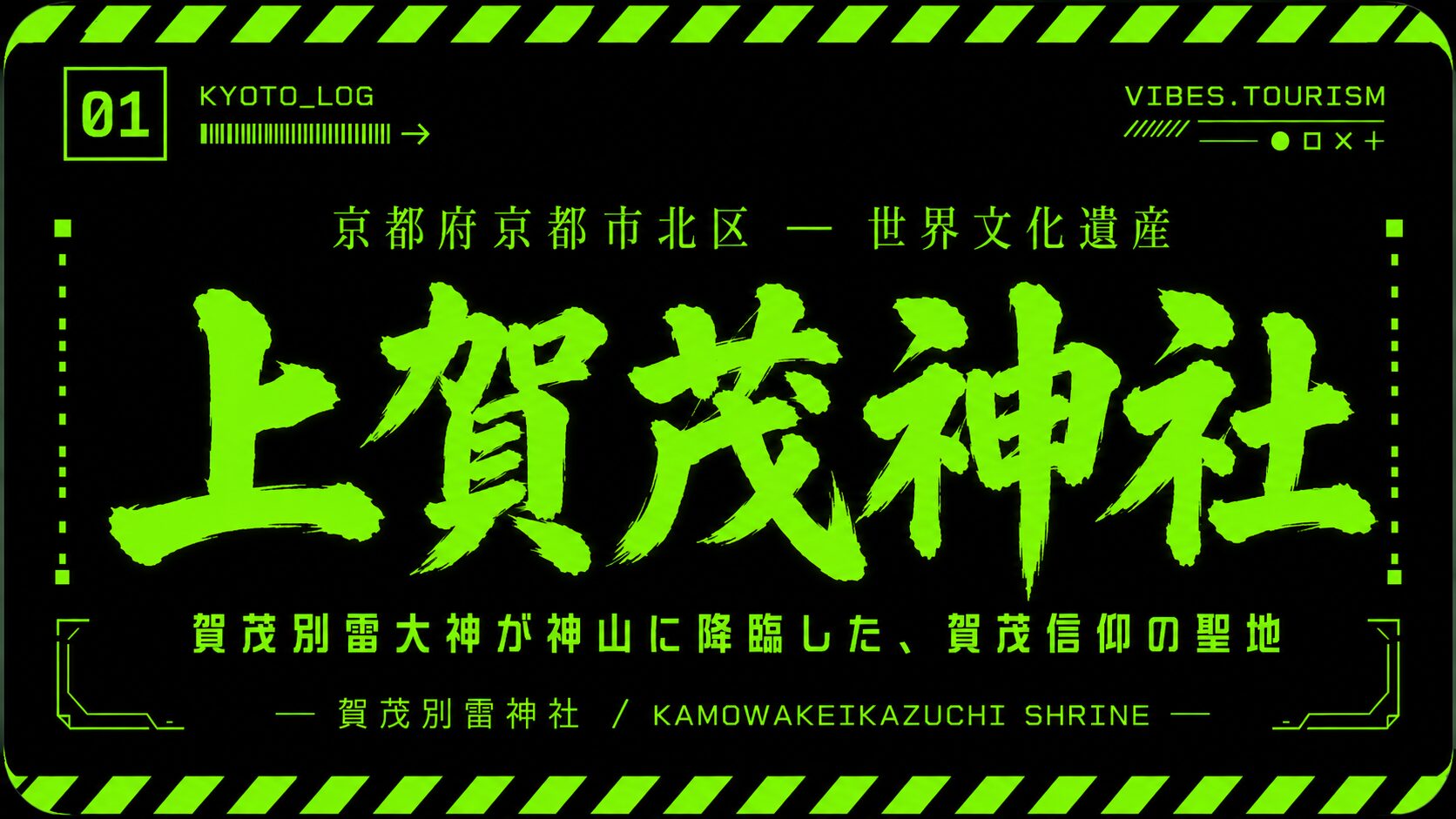

Uncover Kamigamo Shrine.
Born from a vermilion arrow, a thunder god blasted through a roof and vanished into the sky. To pacify that power, the capital of Heian-kyo raised a colossal ritual device to its north. The myths, the wards, the whispers hidden in this forest of national treasures — we are about to drag every one of them into the light.
Why did this god’s birth celebration end by blasting a hole through the roof?
If the legend handed down as this shrine’s origin is true, the common sense of Japanese mythology is overturned at its root. Kamigamo Shrine — a UNESCO World Heritage Site spread across a vast sacred precinct in the Rakuhoku hills of Kyoto. Did you know that this elegant ancient shrine, formally named Kamo-wakeikazuchi-jinja, keeps a “chilling legend” sealed away, one never quite spoken of openly?
The Kamo Shrine is said to have been built here in the 6th year of Emperor Tenmu (677). But the truth of the age of the gods, buried in the darkness of history, is nothing so gentle as the tourist pamphlets suggest. What we found was a record of “a thunder god’s abnormal birth and violent flight” that runs cold down the spine. The shocking truth begins deep within an ancient, dense forest along a stream called the Semi-no-ogawa, upstream of today’s Kamo River.
As Kamo-tamayori-hime-no-mikoto, a princess of the Kamo clan, was purifying herself, a single shape radiating an eerie presence drifted down from upstream. It was one arrow, dyed a vivid vermilion — the “ninuri-no-ya.” By any common sense, a red arrow of unknown origin is nothing but an ill omen. Yet the princess, as if bound by an unknown power, picked it up and enshrined it right beside her sleeping place.
That night, the uncanny energy dwelling in the vermilion arrow is said to have enveloped the princess’s body. Without union with anyone, by the unseen power radiating from a single arrow alone, she conceived. This is no pastoral miracle tale. It is a record of “abnormal contact” with an unknown energy-body that goes by the name of a god. The child born of it was the future principal deity, Kamo-wakeikazuchi-no-mikoto.
Up to here, one might file it away as an ancient mystery. But the true horror bares its fangs at the coming-of-age feast. At a seven-day, seven-night banquet held by the grandfather, Kamo-taketsunumi-no-mikoto, he posed a question: “Offer a cup of sake to the god you believe to be your father.” A cruel interrogation of a divine child with no human father. In the taut silence, the child god quietly declared: “My father is a heavenly god, an amatsukami.”

The instant he hurled the cup toward the heavens, a tremendous bolt of thunder was unleashed from the child god’s body with a roar, shattering the roof overhead as he ascended into the sky. It is the moment a serene birth tale flips into an uncontrollable flash of destruction.
The child god who vanished into the sky is said to have descended again onto Koyama, the sacred peak rising behind the main hall. A colossal device to pacify that extraordinary divine power — that is the true identity of this shrine.
But the story does not end there. Within the grounds sits Iwagami, a rock revered as the strongest power spot, a focal point of “qi” where god and human commune; and the Kamo clan who ruled this land is said to carry a sorcerous bloodline that inherited the calendar and astronomy of the Bureau of Onmyo. And to top it all, there is a whispered theory that Kamigamo Shrine forms one vertex of the “pentagram ward” that Abe no Seimei is said to have stretched across Kyoto.
This story is only the beginning.
Why is a rope-bound rock in a corner of the grounds called the “strongest” spot?
As our investigation team tracked the traces of the thunder god’s destructive flight, the next inexplicable ritual device revealed itself. We walk the vast grounds of Kamigamo Shrine. Advancing along the open approach from the first torii to the second, near the point where two sacred streams — the Omonoi-gawa and the Mitarashi-gawa — meet, there it is. A rope-bound, seemingly ordinary rock. The signboard reads “Iwagami.”

The ordinary sightseer, eyes stolen by beautiful halls and elegant scenery, would surely pass it by as a plain thing. But the priests, and those in the know who understand this land’s “qi,” lower their voices and say: “That one place is in a class of its own. That is the strongest power spot in Kamigamo Shrine — a focal point of qi that must never be defiled.”
Its dreadful true function activates in the most important rite of the Aoi Matsuri (Kamo Festival), one of Kyoto’s three great festivals, held every May 15. On that day, the chief priest alone crouches upon this rock. Facing the imperial envoy sent by the Emperor, he recites the “kaeshi-norito,” a returning prayer that conveys the will of the god. This Iwagami is nothing less than a “hyper-dimensional communication device” that connects the unseen god and humankind on a direct line.
And turning your gaze from Iwagami, you notice two enormous cones of sand before the Hosodono hall, radiating an uncanny presence. These are the “tatesuna.” Their geometric conical form catches the eye at once. They may look like mere sand piles, but they are interpreted as an intensely ritual shape linking heaven and earth: the sharp apex piercing the sky symbolizes the heavenly realm, the broad base the earthly one — a giant antenna receiving cosmic energy directly. The mounds are said to be a yorishiro modeled on Koyama, the sacred peak rising north-northwest behind the main hall.

But what should truly unsettle you is the “yin-yang sorcery” hidden in the details. Did you know pine needles are stuck into the tips of the tatesuna? The right (east) mound bears two needles, the left (west) mound three. This is no mere decoration. In onmyodo, even numbers are “yin” and female, odd numbers “yang” and male. Of this unequal arrangement, a shrine priest has plainly stated that “based on onmyodo, joining odd and even carries the wish for the deity to appear.”
Moreover, some individual occult and spiritual blogs offer this chilling interpretation of their own: “Perhaps the east mound symbolizing yin (female) corresponds to the mother, Tamayori-hime, and the west mound symbolizing yang (male) to the grandfather, Kamo-taketsunumi.” This is, of course, one person’s speculation — but if true, they would have hidden, in the very center of the grounds, a giant spiritual monument embodying the thunder god’s bloodline.
Reports never cease from visitors who have touched this abnormal accumulator of energy: a strong, tingling “qi” felt the instant they neared the tatesuna, or the claim that a photograph captures its powerful ward against evil (all personal anecdotes; reliability grade C). It is said that people once carried sand from the tatesuna home to scatter, hoping to share in that overwhelming power. This is held to be the origin of the “purifying sand” that survives today.
The thunder god’s overwhelming, unseen energy is forcibly bound to earth using Iwagami as a communication device and the yin-yang-charged tatesuna as a receiving antenna. Kamigamo Shrine is no serene place of prayer as we might imagine. It is a colossal sorcery plant where a dreadful ancient technology still runs today.
Why is a shrine famed for “the strongest matchmaking” also feared as “terrifying”?
Trace the rumors on the internet and social media, and strange search terms and testimonies keep surfacing about Kamigamo Shrine — “scary,” “hard to approach.” Behind the “dazzling, elegant public face” the world imagines, why do some people feel dread? The truth our team reached was no cheap curse of vengeful spirits or paranormal phenomena. It is said that because an overwhelmingly dense “qi” accumulated since ancient times swirls here, the spiritually sensitive mistake that density for something “heavy” or “scary.”
And that tremendous divine air draws in those who carry one particular “strong wish.” Just past the tower gate, across a bridge over a beautiful murmuring stream, sits the first auxiliary shrine, Kataoka-sha (formally Katayama-miko-jinja). Enshrined here is the mother who conceived the thunder god from that vermilion arrow, Kamo-tamayori-hime-no-mikoto. Since ancient times she has drawn fierce faith as a deity of matchmaking, fertility, and safe childbirth.

Astonishingly, a thousand years ago in the Heian period, Murasaki Shikibu — author of The Tale of Genji — is said to have visited Kataoka-sha often, composing waka to pray for love fulfilled. The matchmaking ema dedicated here today depict Murasaki Shikibu in twelve-layered robes, in a heart shape modeled on the “futaba-aoi,” the shrine’s sacred crest.
Within the grounds stands an uncanny giant tree, as if the power of matchmaking had taken physical form: the “Mutsumi Sacred Tree,” a Japanese chinquapin over 300 years old. From a single root, several thick trunks writhe upward, tangling together as if binding one another’s bodies. Beneath this tree, couples never cease to pray for an eternal bond with a future spouse and for household peace.
And the finale: the “Wish Stone” quietly placed in a corner of the tranquil garden Shokei-en, deep in the grounds. Two rocks fused with unnatural smoothness, it is also called the “yin-yang stone.” Visitors touch both stones with both hands at once, then worship at the nearby Kamo-yamaguchi-jinja, and their wish is said to come true (sensory descriptions are personal anecdotes; reliability grade C).
The obsession of Tamayori-hime whom even Murasaki Shikibu beseeched; the abnormal life force of a 300-year-old sacred tree; and the sorcerous power of a wish stone where yin and yang fuse. Kamigamo Shrine is no mere beautiful sightseeing spot to pass through with hands clasped.
Why is a misbehaving guardian lion sealed away here?
Overwhelmed by the primal energy radiating from Iwagami and the tatesuna, as if mocking our held breath, the grounds had yet more traps of the uncanny laid within. Two national treasures, forty-one important cultural properties. In 1994, the entire precinct was inscribed on the UNESCO World Heritage List as part of the “Historic Monuments of Ancient Kyoto.” That is the “dazzling, elegant public face” the world imagines. But as our team pressed its on-site reporting, we found that behind that graceful signboard, a murky set of uncanny tales called the “Seven Wonders” lives and breathes.
Most chilling is the “guardian lions of the sacred doors.” On the doors of the main hall and the Gonden beside it — both national treasures — are magnificent guardian lions painted by the Kano school. Legend says that during the Onin-Bunmei War of the Muromachi period, “living guardian lions” that ran riot with atrocities in the capital were sealed, by spiritual power, into the painting on those doors.

The dread does not end there. On the edge of the grounds, east of Ota-jinja, spreads the “Ota-no-sawa.” Come May, about 25,000 rabbit-ear irises (kakitsubata) bloom in unison here — a beautiful marsh designated a national natural monument. Yet locals never touch this beautiful water with bare hands, for a hair-raising saying remains: “Dip your hand in this marsh and it will rot.”
But the true terror this waterside holds goes beyond mere bodily harm. For over a thousand years, that eerily beautiful purple colony has been a “binding device” ensnaring the souls of Japan’s finest cultured minds. In the late Heian period, the poet Fujiwara no Shunzei — known as the compiler of the Senzai Wakashu — left a waka by this marsh: “Koyama ya, Ota-no-sawa no kakitsubata, fukaki tanomi wa, iro ni miyuran.” He layered his own passions upon the spiritual power of Koyama and the dense hues of irises blooming in a marsh laced with poison.
A further coincidence reaches into the Edo period. The national-treasure folding screen “Irises (Kakitsubata-zu)” painted by the genius artist Ogata Korin — those flowers rendered in ultramarine on a gold ground are said to have been modeled on the wild irises of this Ota-no-sawa. The awe here is that even the history of Japanese literature and art was not unconnected to this little marsh. (Note: the art-historical standard view traces the motif to the “Yatsuhashi” scene in The Tales of Ise; the Ota-no-sawa attribution is a local tradition.)
The chain of the uncanny does not stop. Perform the Noh play “Kamo” within the grounds, and the actor is said to be struck by lightning without fail — the “Kamo divine Noh.” And the stone bridge before the tower gate, “Kusunoki-bashi,” is said to be a fossilized ancient camphor tree; from a legend that crossing it grants long life, it is also called the “Longevity Bridge.” Further, a priest in training who cut himself off entirely from the secular world and worshiped without uttering a single word — the “silent priest.” And a bizarre custom of the shake (the priestly lineage), so dreading fire in the sacred domain that they never used fire in their own homes, eating only at others’ houses — the “Kamo borrowed fire.”
Kamigamo Shrine is at once a beautiful forest of national treasures and an unstable, dangerous gateway to another world where the wrath of the gods and the uncanny coexist by a hair’s breadth.
Why do the shrine’s buildings deliberately face every which way?
Having peered into the abyss of the madness-laced Seven Wonders, we noticed the “uncanny orientation” of the buildings arranged in the grounds, and were struck speechless. Counted among the Seven Wonders is “the orientation of the halls and torii.” Across the vast site, besides the main hall, countless auxiliary and branch shrines are scattered. Yet the auxiliary shrines, branch shrines, and even the torii all face in directions splendidly at odds with one another, as if defying any rule.
The key is the giant conical sand mounds, the tatesuna. Glance at a map and it is obvious: Kamigamo Shrine sits to the northeast of Kyoto’s center (Heian-kyo) — on the line of the “kimon,” the demon gate. The tatesuna are said, by one theory, to be a defensive device often seen at shrines on this kimon line: sorcery to welcome good guests and let the uninvited guests (calamities) coming from the demon gate pass on through. It is also called the origin of the “purifying salt” mounds modern restaurants place at their entrances — but the scale is different.

But when our team analyzed old maps of Kyoto, we found this was no matter of a single shrine, but part of a nation-scale defense system engulfing the whole city. At the root of Heian-kyo’s design lies the “Shijin-so-o” (Four Guardian Gods correspondence): east the Azure Dragon (the Kamo River), west the White Tiger (the San’in road), south the Vermilion Bird (the Ogura Pond), north the Black Tortoise (Mt. Funaoka). Even now Kyoto hosts a pilgrimage to the guardian points of this ward, the “Kyoto Five-Shrine Tour.” Guarding the crown of the city at the northern Black Tortoise position — none other than Kamigamo Shrine — it is said to have been founded as a deity warding off the demon gate and protecting the imperial capital at the 794 relocation.
Furthermore, even this perfect four-god ward has a single “weak point”: the northeast, the demon gate where calamity floods in. Extend Heian-kyo’s northeast line on a map and there rises Enryaku-ji on Mt. Hiei, head temple of the Tendai sect — a temple built at the front line to block the intrusion of evil. If Enryaku-ji is the “outer” shield taking the direct hit of calamity, then the “inner filter” deflecting the miasma that leaks inward on the city’s north was Kamigamo Shrine — a view that the Buddhist Enryaku-ji and the Shinto Kamigamo Shrine formed a defensive net linked along the demon-gate line.
That is exactly why the orientation of the halls and torii was deliberately thrown into disorder. By loathing straight lines and scattering the flow of qi, they utterly rob the invading evil spirits of any sense of direction. Do not be fooled by the elegant ring of “World Heritage Site.” Its true form is a defensive fortress that battles the unseen calamity day and night.
Why does this shrine sit at the heart of a giant star guarding Kyoto?
Having exposed its face as a giant fortress deflecting the demon gate, we finally close in on the “bloodline” that has secretly operated this sacred site, and on a vast occult network engulfing all of Kyoto. Who built and long maintained the complex, bizarre sorcery system that is Kamigamo Shrine? The answer is hidden in the history of the “Kamo clan” that ruled this land from ancient times.
The Kamo clan is no mere priestly lineage. They are a family who, in the state’s central organ the Bureau of Onmyo, inherited the way of the calendar and astronomy for generations. Even the famed onmyoji Abe no Seimei is said to have been a disciple who learned onmyodo from the Kamo (the father and son Kamo no Tadayuki and Kamo no Yasunori).

At the base of this onmyodo bloodline, a certain hypothesis lives on today as an urban legend. Open a wide map of Kyoto and connect five points (shrines and temples) with lines: Matsuo-taisha, Ginkaku-ji (Jisho-ji), Kinkaku-ji (Rokuon-ji), Yasaka-jinja — and, to the north, Kamigamo Shrine. Among occult enthusiasts it is whispered that connecting these five points draws a giant “pentagram” that entirely covers Heian-kyo.
The pentagram is a ward-charm in onmyodo, and also the symbol of Abe no Seimei, the “Seiman-kikyo.” Legend says this is the “Kyoto pentagram ward” Seimei stretched to protect Kyoto from spiritual threats, and that Kamigamo Shrine bears one of its vertices (note: this is no more than an urban legend from spiritual-leaning sources, not academically established).
This pentagram (Seiman-kikyo) is no mere ward symbol. Its five vertices are said to represent the very Five Elements of onmyodo — wood, fire, earth, metal, water. Traces telling of Abe no Seimei’s power remain in Kyoto’s streets even now. South of Kamigamo Shrine, in the city, stands Seimei-jinja on the site said to have held Seimei’s residence. Within it is an old well called the “Seimei-i,” said to have sprung by Seimei’s spiritual power. This water is said to hold benefit for curing illness, and visitors seeking to share in its reputation never cease.
Of course, no official academic body would recognize such an urban legend. Yet can the coincidence — that the home base of the Kamo clan, who inherited the Bureau of Onmyo, is counted as a “vertex” of the ward Seimei is said to have stretched — really be dismissed as mere chance?
Kamigamo Shrine is no mere beautiful sightseeing spot. It is a “living magic square” that continues to uphold the very foundation of Kyoto, a sorcery-city spanning over a thousand years.
Can simply visiting really revive memories of a past life?
The vertex of a giant pentagram ward covering all of Kyoto. Now that we know the full scope of the grand “contrivance” that is Kamigamo Shrine, our team stepped into a further abyss: the vivid experiences that ordinary present-day visitors are said to encounter in these grounds. Of course these are testimonies based on personal subjectivity, not scientifically established facts.
Most striking is the account of a “past-life memory” suddenly flashing back within the grounds. One visitor says that while walking the sacred domain, their palm grew hot, and an image surfaced in their mind of themselves serving Kamigamo Shrine as a shrine maiden (personal anecdote; reliability grade C).
There are also voices reporting a “faint green light” floating in the midday sky and gliding away (personal anecdote; reliability grade C — a so-called “orb” sighting). And multiple visitors describe how “the moment I entered the grounds, my fatigue simply lifted and my body felt light” (personal anecdote; reliability grade C).
Now, at such sacred sites, UFO sightings are often told as a set — but let us report honestly. No UFO sighting specific to Kamigamo Shrine could be confirmed in this investigation. Yet that does not diminish the singularity of this sacred domain. The land’s own mysteries — a thunder god blasting through a roof, a wicked guardian lion sealed away, a past-life vision surfacing in a visitor’s mind — are unfathomable enough on their own.
If you’ll surrender a night to this fortress of sorcery, how should you choose your lodging?
Kamigamo Shrine itself has no lodging such as a temple-inn. Steeping in the afterglow of the dense “qi” received in the grounds, where will you rest tonight? Here are two ways to choose — luxury and value.
| Type | Property / Area | Features | Booking |
|---|---|---|---|
| Luxury | Shozan Resort Kyoto (47 Kinugasa Kagamiishi-cho, Kita-ku, Kyoto) | A large resort with a Japanese garden. Open-air public baths, and room types with private open-air baths (VIALA, etc.) | |
| Value | Kyoto Station / Kitaoji / Kitayama area (one bus to the shrine) | Few budget inns sit right by Kamigamo, so access from the central areas is the practical choice |
*Plans, rates, and availability change; please confirm on each site before booking.
After brushing against the sacred air, fill your belly with sublime local comfort food
So far we have guided you through a mysterious world where myth and sorcery intertwine. After drawing that taut, sacred air deep into your chest, a warm and delicious time awaits — the kind that lets your heart unwind.


| Shop | Location | What to order | Details |
|---|---|---|---|
| Imai Shokudo | Beside Kamigamo Shrine | Simmered mackerel set (around 700–850 yen; please confirm). 11:00–14:00, cash only, closed Wed / New Year holidays |  View on Tabelog ▶ View on Tabelog ▶ |
| Aoiya Yakimochi Sohonpo (Kamigamo main shop) | In front of the first torii | Yakimochi (9:00–17:00, open year-round) | View on Tabelog ▶ |
| Jinbado | Beside Kamigamo Shrine | Yakimochi (7:00–16:00, closes when sold out / please confirm) | View on Tabelog ▶ |
*Hours, closing days, and prices change; please confirm before visiting.
A breather with spring-water coffee, and taking home traditional suguki pickles
After filling your belly with delicious local comfort food, it is time to “experience” the history and character of Kamigamo Shrine, and to share a little of it back home. When you feel like resting after walking the grounds, head to “Koyama Yusui Coffee Sen,” right beside the shrine office (open 10:00–16:00). You can enjoy coffee made with “Koyama spring water,” the water flowing from the sacred mountain where the deity descended.

| Name | Location / Contact | What it is | Details |
|---|---|---|---|
| Kyoto Narita (Kamigamo main shop) | 35 Kamigamo Yamamoto-cho, Kita-ku, Kyoto / 075-721-1567 | Suguki pickles (10:00–18:00, closed only Jan 1). One of Kyoto’s three great pickles, over 300 years of history | Official info ▶ |
If the season aligns, do catch a living festival. Every May 15 brings the Aoi Matsuri (Kamo Festival), one of Kyoto’s three great festivals; May 5 brings the spirited Kamo-kurabeuma horse races (preceded by the Ashi-zoroe-shiki on May 1).
*Hours, closing days, and prices change; please confirm before visiting.
A route to glide smoothly between the mysterious and the everyday
Access: From JR Kyoto Station, take city bus route 4 to “Kamigamo-jinja-mae” (right at the shrine), or route 9 to “Kamigamo Misonobashi” (5-min walk). From Kitaoji subway station, routes 37 and Kita-3 also serve it. Parking is normally 200 yen per 30 min (6:00–22:00, exit possible 24h); on busy days a flat 1,000 yen per entry (entry 9:00–16:00).
- Second torii 5:30–17:00; tower gate and amulet office 8:00–16:45. In the crisp morning air, tour the “tatesuna” and “Iwagami.” From 10:00, the special worship (offering 500 yen, until 16:00) lets you view the national-treasure main hall and Gonden up close.
- Take a break at “Koyama Yusui Coffee Sen” beside the shrine office (10:00–16:00).
- Simmered mackerel set at “Imai Shokudo” (cash only, until sold out). For something sweet, “Jinbado” or “Aoiya Yakimochi Sohonpo.”
- Take home suguki pickles from “Kyoto Narita, Kamigamo main shop.”
- For lodging, “Shozan Resort Kyoto” for luxury, or the Kyoto Station / Kitaoji area for value.

Overwhelmed by ageless myth and unseen mysterious power, and yet soothed by delicious coffee and food and local warmth — travel a route that lightly shuttles between “the sacred and the profane,” and enjoy your journey to Kamigamo Shrine.

Show up to Kamigamo Shrine clueless,
and you’ll get stuck.
I’m Viv…
your VIBES TOURISM navigator!
Kamigamo is a big, breezy, lovely place.
But honestly, so many folks trip up on the timing and getting around.
That’s exactly what I’ll help you sidestep, so don’t you worry one bit…!
Everything here is a signpost.
Times and prices quietly change with the season, so always double-check the official sources before you head out.
Three quick checks before you leave, and the whole day gets so much easier
Just picking the right day dodges 90% of the crowds
👨👩👧 Family, couples & solo — everyonethe parking and the approach get packed solid.
If you can shift your date, a weekday morning is by far the easiest.
If the festival is your goal, brace yourself and get there early!

Lock in your ride home first
🚶 Solo travelers (no car)From Kyoto Station, city bus route 4 runs straight to “Kamigamo-jinja-mae” — nice and simple (routes 9 and 46 work too).
Service thins out a lot at night, so confirm that last departure on the official site first (frequencies and times: please verify).
Bring a little extra cash — that’s the move
👛 EveryoneEven if you’re a card-or-phone type, keep some cash (coins included) on hand and you won’t get stuck (nearby ATM situation: please verify).
One small move on the car and the stroller keeps you gliding
170 parking spots on-site, but on busy days just take transit
🚗 Family (car) & three generationsBut on the Aoi Matsuri and New Year’s it fills up early, so on busy days a reserved lot or public transit is honestly the easiest.
On festival days there are traffic restrictions too (route buses can still get through in places).

The gravel approach has a knack for strollers and wheelchairs
👶 With kids · ♿ Three generationsTip the front wheels up a touch and it rolls right along.
There are wheelchair-accessible and multipurpose restrooms too, so take it easy and rest on the benches whenever you need.
Master the timing and the route, and the grounds are all yours
Count backward from closing time (especially for that dusk shot)
💑 Couples & everyonePlan backward — charms and goshuin only until 16:45 — and you won’t get shut out.
If you want to see the national-treasure main hall up close, do the special worship (reception 10:00–16:00, ¥500 offering) in the morning.

Matchmaking comes down to the order you visit
💑 CouplesThe heart-shaped ema at Kataoka-sha are the popular pick.
Where to shoot, and where to just let it be
📷 Couples & everyoneThe tatesuna sand cones are meant to be felt with your eyes — the etiquette is not to touch or disturb them.
Think of it as a place to burn into memory rather than onto film.
Food and breaks go to whoever masters the clock
Time it right to actually land Imai Shokudo and the yakimochi
🚶 Solo · 👨👩👧 FamilyIt’s an easy spot to eat solo, but the lunch rush is real, so earlier is better.
For yakimochi, Jinbado (7:00–16:00, until sold out) often runs out by midday, so go first thing — or fall back on Aoiya (9:00–17:00, open year-round) to be safe.

Rest spots and facilities for kids and grandparents
👶 With kids · ♿ Three generationsThey’re outdoors though, so bring an extra layer in winter.
When your legs give out, take a breather at “Koyama Spring Coffee Sen” beside the shrine office (10:00–16:00) or by the Nara-no-ogawa stream.
Do dinner early — or move north
💑 CouplesFor a relaxed dinner for two, plan from the start to head over to the Kitayama / Kitaoji area, and your evening won’t scramble at the end.
Timing, transit, and cash — sort those three ahead of time, and all that’s left is to soak up the sacred-meets-everyday at your own pace.
Have a wonderful day out there…
off you go!
About this article
The hours, fares, ferry/bus schedules, and access rules listed here were checked against the official sources at the time of writing. But this kind of information can quietly change with construction, weather, festivals, or the season, so treat everything here as a friendly signpost, not a guarantee. Before you actually head out, always confirm the latest details yourself with the official sources (official websites, phone). My guide is the groundwork — the final check is in your hands.[Where to confirm] Kamigamo Shrine (Kamo-wakeikazuchi-jinja) official site / Kyoto City Transportation Bureau (city bus times & routes) / Kyoto City official “Kyoto Travel Navi” (Aoi Matsuri & traffic restrictions) / each shop’s official site or Tabelog (Imai Shokudo, Jinbado, Aoiya Yakimochi Sohonpo) / Kyoto Narita official (suguki).


Comments