
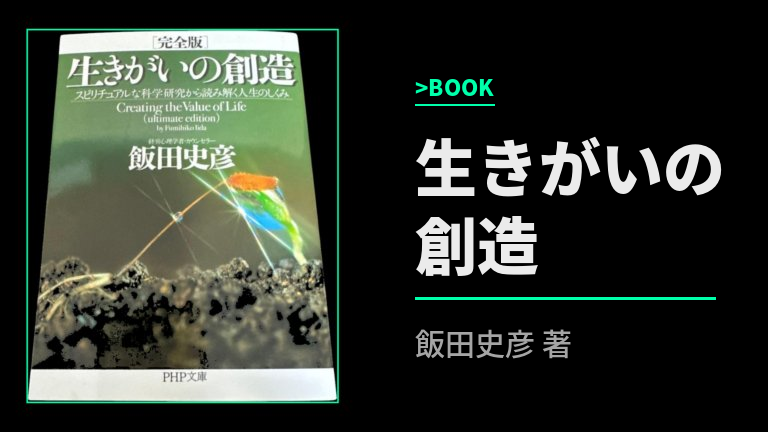

The Creation of a Reason to Live (Ikigai no Sozo)
The Book That Says “You Don’t Have to Believe” — and Changed Two Million People’s Today
The workings of life, read through spiritual scientific research. Why a book that says “you don’t have to believe” can change the way you live today.
Chapter 1 | Why a Book That Never Says “Believe Me” Moved Two Million People01 — IT NEVER ASKS YOU TO BELIEVE

A book about reincarnation. Just hearing the phrase, we tend to brace ourselves.
Surely it’s a book for believers, we think. There is an afterlife, the soul travels on, wake up — surely it will take us by the hand from above. And surely, for those who cannot believe, it’s a story about a world that has nothing to do with them from the start.
Most spiritual books are indeed built that way. The author knows the truth; the reader does not yet. So they whisper, “You are being called,” quietly sorting believers to the inside and doubters to the outside.
But at the entrance of this book, an entirely different declaration is placed.
——You don’t have to believe.
It is a posture so humble it almost catches you off guard. Yet this is no timid preamble. It is the single most important line, the one that sets the stance of the entire book. In fact, the book states it plainly: you may believe or not believe. But if believing makes your life better, then surely you lose nothing.
A clue lies in the subtitle, too. The book’s subtitle is “The Workings of Life, Read Through Spiritual Scientific Research.” Though a spiritual book, it boldly hangs the word “science” on its sign. The publisher, too, calls it “a groundbreaking scientific-spiritual philosophy of life.” Spiritual and scientific — two words that ought to be like oil and water, standing side by side without hesitation.
This strange cohabitation is the true nature of the book.
What the author is trying to prove, in other words, is not that “there is an afterlife.” The very shape of the question is different. The proposition the book raises is clear: “If we acknowledge life after death and reincarnation, how does the way we live change?” That is the question the book devotes its pages to handing the reader.
If, hypothetically, life after death and reincarnation were real — how would the way you live today change?
This “if” is both very cunning and very kind.
Consider it. The moment we are told to “believe,” we build a wall in our hearts. True, or false? Which side am I on? We brace ourselves and clutch the strings of our hearts shut, the way we’d clutch a wallet.
But when told, “Just consider it hypothetically,” that wall slides down. After all, “hypothetically” is enough. You don’t have to decide right now whether it’s true. No need to believe, no need to convert. You simply place one premise in your mind and look at the scenery from there.
This way, even a materialist who scoffs at reincarnation can take part. A thought experiment requires no stance, no faith. It’s the same as how, to consider “if the Earth were a cube,” you don’t have to believe the Earth is a cube. The book bypasses the very entrance that makes people brace the most — believe or don’t believe — entirely, with the single word “hypothetically.”
And yet — and this is the crucial point — the book does not support that “hypothetically” with fluffy wishes or comfortable imaginings.
What supports it is research.
The book’s stance is plain. Life after death and reincarnation have been studied by many scientists, physicians, and university professors in the West and in Japan, and astonishing reports have been made. Building on the fruits of that research, the author sketches the workings of life. Standing not on wishes, but on research reports accumulated around the world. That is why it can call itself “scientific-spiritual.”
And this entrance declaration holds one more device. The reader, told “you don’t have to believe,” lowers their guard and draws closer to the research reports. They draw close, and they recoil. And by the time they notice, they have already begun to think: “If this were true, how would my own life look?”
In other words, what this book ultimately tries to change is not the scenery of the afterlife. It is the single point of how you live today. At the entrance you seem to be asked, “Do you believe in the afterlife?” But what you are really being asked lies far closer to home — your own footing, today.
So what, concretely, are the “research reports” the book builds on? Let us peer in, starting from one representative scene. First, the consulting room of a psychiatrist who did not believe in reincarnation at all.
Chapter 2 | “Go Back to Where the Problem Began” — and the Patient Went Back Thousands of Years02 — IT HAPPENED IN A SKEPTIC’S OFFICE

In speaking of reincarnation research, there is one figure who cannot be passed over: the American psychiatrist Brian L. Weiss. He is one of those who built the foundation on which a “scientific spirituality” like this book’s can stand.
Look at his career and you see a man who was in the place most opposite to the spiritual world. A graduate of Columbia University, he earned his doctorate in medicine at Yale. At a hospital in Miami Beach, Florida, he served as chief of psychiatry. Prescribing drugs, making diagnoses, examining patients by data — a man at the dead center of mainstream psychiatry.
Naturally, he did not believe in reincarnation. If anything, he was on the side that dismissed such talk as “unscientific.” This is an important premise. His record carries weight not because he was a man who wanted to believe, but because he was a man who did not want to.
In 1980, a female patient named Catherine came to him.
Her symptoms were not just one. Fear of water. Fear of choking, her throat closing when she swallowed. Fear of airplanes. Fear of darkness. Fear even of sleep. Phobias and neuroses layered one over another, tightening their grip on her life.
Weiss did everything he could. Careful counseling. Standard treatment. But whatever he tried, the symptoms would not lift. He was at a dead end.
So he stepped into a technique called hypnotic age regression.
Do not misunderstand this. It is no dubious sorcery. In a hypnotic state, the patient’s memory is traced back, little by little, to childhood, to find the forgotten trauma triggering the present symptoms — a treatment technique actually used in psychiatric practice. Weiss picked up this tool strictly as a physician.
After several regressions, a painful memory that seemed to be the cause appeared to surface. But the symptoms did not vanish. Some other cause still lay deeper. Judging so, Weiss guided Catherine into hypnosis once more and gave this instruction.
“Go back to where the problem began.”
As a physician, he must have expected her to return to some childhood scene, an as-yet-undug trauma. But — Catherine followed that instruction literally.
The place she traced back to was not childhood.
Hundreds, sometimes thousands of years ago. Within an ancient landscape she had never seen, she began to speak of the life of someone who was not her present self. That person’s daily life, that person’s name, and even the moment of that person’s death.
It is the scene of a physician, struck speechless, in his consulting room.
Weiss, of course, doubts. Isn’t this the patient’s fabrication? An overly rich fantasy? Just a dream-tale born under hypnosis? As a scientist, to brace oneself so is only natural.
But something that could not be overlooked happened.
As Catherine spoke of life after life, reliving each “death” under hypnosis, in step with it — the phobias that had not budged for either drugs or dialogue began to vanish, one after another.
The fear of water. The fear of choking. What had strangled her for years came loose each time she finished speaking of a past-life death.
This was the fact that first shook Weiss. Before belief or disbelief, as treatment, it worked. Only when the cause was acknowledged to lie in a past life did the patient before him actually grow easier. As a physician, he could not un-happen that result.
Before judging the truth of reincarnation, he was made to halt much earlier, at: “What is this?”
——And yet, up to here, one might still have held one’s ground with “one of those strange treatment cases.” Fantasy happened to help the treatment. That escape route, too, still remained.
That escape route, Catherine herself completely seals off in the next scene. Under hypnosis, she begins to say things that only Weiss himself could possibly know.
Chapter 3 | The Patient Began to Speak of the Doctor’s “Dead Son”03 — WHAT THE PATIENT COULD NOT HAVE KNOWN

As the regressions accumulated, a different kind of voice began to come from Catherine’s mouth.
It was not the memory of her own past life. Messages from beings called “the Masters,” who held no physical body — these, Catherine under hypnosis began to relay, as if passing them along.
Here Weiss is shaken one level deeper. Because the content of those “relayed words” was something the patient could absolutely never have known.
——Catherine spoke of Weiss’s deceased father, and of his son, who had died in infancy.
Pause a moment and consider it.
Catherine is merely a patient. She does not know Weiss’s private life. His family — let alone a father already departed, or a child lost in infancy — there is no way she could know. What they exchange in the consulting room is only talk of her own symptoms. There would be no reason for a doctor’s dead family’s details to be written in a chart.
And yet, in a deep hypnotic state, she spoke of matters concerning the deaths in his family that only the physician himself could possibly know.
Weiss, who had been trying to remain a cool scientist, collapses decisively here.
Coincidence cannot explain it. The patient had no way to research it beforehand. If it were fabrication, there is no way she could pinpoint “the doctor’s dead family” so precisely. Every rational escape route was sealed off at this one point.
He is driven to a place where, rather than “believing” in reincarnation or the existence of consciousness after death, he has no choice but to acknowledge it. A scientist who had been searching for material to deny it ran, at the end of his own inquiry, into a single point he could not deny. This is not a believer’s tale of being moved. It is the record of a man who wanted to doubt, and could no longer doubt.
This whole affair came into the world in 1988 as a book titled Many Lives, Many Masters. The publisher, oddly enough, was the same as Iida’s book — PHP Institute. This book was read in 100 countries and became a bestseller exceeding two million copies.
And from here, the way Weiss moves is, again, exactly like a scientist.
He did not stop at the shock of Catherine alone. After that, he is said to have performed regression hypnosis on more than 4,000 patients. Rather than ending it with a single miracle, he simply piled up the numbers. Furthermore, from his clinical experience, Weiss estimates this: in the course of hypnotherapy, there may be about 3 to 5 percent of cases in which a patient unintentionally, spontaneously slips into past-life regression.
This is a plain, but heavy, figure. Not a special phenomenon deliberately induced, but something that, while doing ordinary hypnotherapy, “happens on its own” at a certain rate. In other words, Catherine was not an exceptional one.
“An expert who did not believe, pushed over by the data of his own consulting room.” The reincarnation research the book builds on accumulates records like this. Next is research that uses no hypnosis at all — a more sudden ambush: the testimony of children.
Chapter 4 | 44 Cases in 35 Years. In India, It Was 25 Cases in 4 Weeks04 — IT WASN’T RARE, IT WAS UNREPORTED

What Weiss dealt with were hypnotized adults. But reincarnation research has data of an entirely different route, a more sudden ambush.
Children. And not hypnotized at all — perfectly ordinary toddlers who, one day, suddenly begin to speak of “the previous self.”
The one who built up this field over half a century was Ian Stevenson, a psychiatrist who, in 1967, established a research base at the University of Virginia’s medical school. What he did was neither clairvoyance nor séance. It was patient interviewing and tenacious cross-checking — a procedure close, as much as can be, to forensic, scientific investigation.
His procedure went roughly like this. A young child, one day, suddenly begins to speak of “the village I lived in before,” “my previous family,” “my previous name,” “how my previous self died.” Stevenson first writes down the child’s testimony. Next, he goes, on his own feet, to investigate whether the “past-life person” the child points to actually existed. He travels to the place. He meets every witness he can, one by one. He cross-checks municipal records and burial records. Further, he confirms whether the child’s body has any birthmark or defect corresponding to the past-life person’s wounds. And finally, he thoroughly eliminates whether it can be settled by any explanation other than reincarnation.
It closely resembles a detective building a case, one at a time.
The beginning was a quiet thing.
Even when Stevenson gathered reports from all over the world, the reliable cases were a mere 44. He published them as a paper in 1960. Combing the whole world, just 44 cases. After all that searching, only this many. It must be a very rare, special phenomenon — everyone thought so. Even the man himself surely thought so.
But in 1961. Having obtained a research grant, Stevenson flew to India for field investigation. And, beginning to search on his own feet, he was astonished.
Within a mere 4 weeks, 25 cases were found.
Combing the world’s literature, 44 cases. And yet, placing himself in the field, in just 4 weeks, 25 cases. The fact this gap thrust forward was only one.
Phenomena suggestive of reincarnation were not few in number. There were simply few opportunities for them to be reported.
Come to think of it, perhaps it is obvious. Suppose your own child suddenly says, “in my previous life.” Most parents are bewildered, laugh it off, and let it end without telling anyone. They do not go out of their way to report it to a psychiatrist. So it was not that “the numbers were few,” but that they “never came out into the world.” Go searching, and they were there, ordinarily, all over.
Moreover, cultures with such testimony were not limited to particular regions. India, Sri Lanka, Burma, Thailand, Turkey, Lebanon, Syria, and later Britain, Germany, Brazil, America — as if betraying the assumption that “reincarnation must be the faith of some special, particular region,” the same kind of children’s testimony was distributed across the world.
Stevenson continued his research for decades afterward, collecting cases around the world. The data gathered finally exceeded 2,000 cases. What was supposed to be a “rare curiosity” grew into a worldwide database.
The book, too, takes up “children who speak of past lives” as one piece of testimony backing the memory of past lives. But speech wavers with mishearing and preconception. What silenced the world’s researchers was not words, but the immovable physical evidence carved into the child’s very body, and the thorough procedure that set out to crush it.
Chapter 5 | A Birthmark Where, in a Past Life, He Was Stabbed05 — THE SCARS THAT CAME BACK

Among the cases Stevenson collected, the most spine-chilling is this.
——A birthmark or congenital defect appears in the same place as a wound suffered in a past life.
On the body of a child who speaks of a past life in which he was killed, at the very stabbed location, there is a birthmark. A child who speaks of a past life in which a hand or finger was severed has a defect at exactly that part. Even the dominant hand and the scars left on the body match the past-life person spoken of. Stevenson collected such “correspondences carved into the body” — more than 200 cases over his lifetime — and at the end compiled them into the two-volume magnum opus, Reincarnation and Biology.
Why does this work?
Verbal testimony can still be argued against. A child’s misremembering, a parent’s imprinting, chance coincidence. But a birthmark present on the body from birth cannot be made by preconception. It has nothing to do with the person’s will. It is immovable physical evidence, already there at the moment of birth. And the position of that physical evidence overlaps with the fatal wound of a “past-life person” never met or known.
And from here is Stevenson’s true worth. He does not get drunk on the eeriness of the evidence. Rather, he puts that very evidence to the doubt, one after another.
For instance, what he valued most was “the order of cross-checking.”
——Record the child’s testimony in writing before the past-life person is identified.
This is a plain, but decisive, procedure. Ordinarily, this kind of story is doubted as “matched up afterward.” The family who heard the child’s testimony searches out a plausible deceased person and, after the fact, embellishes the story: “See, it matches.” Reverse the order, and any number of matches can be manufactured. So Stevenson insisted on writing down what the child said, on paper, before entering the cross-checking work. Testimony first, confirmation after. Only cases that kept this order become truly strong evidence.
Further, he tried to obtain even the autopsy records and physicians’ charts that recorded when, where, and with what wound the past-life person had died. He matched the position of the fatal wound left on paper against the position of the born child’s birthmark. And it matched. Not speech, not memory, but the paper record and the flesh, in agreement.
And what tells of his caution above all is this single line.
“The explanation of reincarnation is the one that should be adopted last of all, after every other explanation has been rejected.”
Stevenson treated reincarnation not as a “conclusion” but as “the suspect who happened to remain to the very end.” The “other explanations” he crushed in each case were, concretely, these: fraud by the family; the person’s or family’s preconception (self-deception); the possibility that the child had unconsciously heard the information somewhere; distortion or confusion of memory; cryptomnesia (latent memory), mistaking something seen or heard long ago for one’s own experience. And even the possibility of extrasensory perception (ESP), like telepathy. Examining these one by one, only what remained, defying explanation after all were rejected, did he keep as a case.
Chapter 6 | He Did Not Stop at the Moment of Death06 — WHAT LIES BEYOND THE PAST LIFE

That there was a past life, by itself, is still only the entrance. What the book depicts as the core of the volume is one step further in, a deeper realm.
The “interval” from when a person dies to when they are next born. The in-between of life and life. The book calls it the “life between lives.” The book’s very structure places a section titled “Return to the ‘Life Between Lives’” — that is how much this is the book’s heart. Because here, and only here, does testimony emerge for the question: “What is a person doing before they are born?”
There is a researcher who, with regression hypnosis, dug into this “in-between of life and life” in earnest: the hypnotherapist Michael Newton.
He, too, was not a spiritual man from the start. He was a practitioner of the clinical field, who used age-regression hypnosis in counseling people troubled by pain or mental distress. He held a doctorate in counseling psychology and was a certified hypnotherapist.
The trigger, he says, was complete chance.
While sending one subject into the past under hypnosis, Newton notices: the subject can trace back even further than the past life — that is, to before being born into that past life, to the state of being soul alone, without a body. Research that speaks of past lives themselves had existed before, beginning with Weiss. But what drew Newton more strongly than past lives was this: “while being soul alone, what on earth is happening?”
So he changes the procedure thus. He sends the subject to the moment of the past life’s death, and does not stop there. He has them advance further, beyond, past the death.
Then the subjects began to speak. What happens immediately after leaving the body. What they encounter there. And how they pass the “interval” until being born next.
Newton compiled the first 29 people’s records into a book. Research that collected the “life after death,” beginning at the moment of death, this concretely was, until then, rare. His investigation continued afterward and, over his lifetime, is said to have reached several thousand people across 35 years. The image of the life-between-lives the book depicts resonates deeply with this lineage of research.
But here, a natural — and most reasonable — doubt arises.
Why can a person in a hypnotic state clearly put that “other side” scenery into words and report it? If they are asleep, surely they can say nothing. And if the therapist induces “this is how I want you to answer,” any number of fabrications could be made.
To these two doubts, Newton has prepared answers, properly.
Chapter 7 | In a Room Without a Lie Detector, How Do You Detect a Lie?07 — WHY THE WORDS CAN BE TRUSTED

Before dismissing the testimony of the life-between-lives as “just a dream-tale,” it is worth seeing the procedure by which Newton “heard it out and distinguished the lies.” Here is where it is unexpectedly logical.
First, “why do the words come out at all?”
Newton imagined the human mind in three layers. The outermost is the layer of consciousness, the part we ordinarily think of as “myself” — the logical part that criticizes, analyzes, doubts. Inside it is the layer of the subconscious. Here, it is said, are stored not only the memories of the present life but even the memories of past lives, all of them. And at the innermost, the person’s core — the layer of the superconscious. Newton thought this superconscious “might be the soul itself.”
The problem is that, while the outermost “criticizing consciousness” is firmly awake, one cannot reach the inner memories. The logical gatekeeper folds his arms at the entrance and will not let you through to the back.
The tool used there was hypnosis.
As hypnosis deepens, a person’s brainwaves change in stages. From the beta waves of ordinary waking, to the alpha waves of relaxation. And then into a deeper realm, the theta waves.
This theta state is the crucial thing.
——The theta state is different from being asleep.
This is decisive. If one falls completely asleep, a person can report nothing. Conversely, if ordinarily awake, the gatekeeper blocks the way inward. But at theta — that intermediate depth — one can keep the channel of deep memory open and, at the same time, answer the therapist’s questions and continue a conversation. What is being seen now, what is being felt, can be put into words on the spot. Not asleep, but the surface, criticizing consciousness has stepped aside. So the innermost memory comes out, turned into words.
Now, the second. “Isn’t it a fabrication the therapist induced?”
This is the sharpest objection always aimed at hypnosis research. Newton answered it in two ways.
One is his own posture. He writes this: I treat every case as if hearing the information for the first time. Rather than inducing with a face that knows the answers, he asks the other person as a listener who knows nothing. People who actually underwent his hypnosis testify thus: he did not plant ideas in my head. Rather, just as it is written in the book, he was a “stubborn interrogator” who objected to everything I said, checking on the spot whether it conflicted with what I had said earlier.
This is the second method — cross-examination.
Newton does not swallow the subject’s words whole. “You said this earlier; does it not contradict what you just said?” he presses on the spot. The subject cannot lie under hypnosis, but they can misinterpret what they saw in the depths. So the therapist’s side must check, from many angles, again and again, the consistency. That he prized “careful cross-examination” from early on was for this reason.
And the strongest logic he finally arrived at is this.
——If the subject were making up a story under inducement, that fabrication would immediately conflict with the other cases.
If it were one person’s fabrication, that person’s wishes and preconceptions would be reflected, and the content would skew. But if the testimony of thousands of separate subjects resembles one another down to the details, that cannot be explained as “individually induced fantasies.” Inducement cannot line up the mouths of this many strangers in the same direction.
The procedure, we understand. The question is how much that consistency amounted to. And from here begins the deepest place in the book.
Chapter 8 | The Man Who Says “There Is No Afterlife” Described the Same World as the Believers08 — ATHEIST AND BELIEVER, THE SAME BLUEPRINT

This is the heart of the book.
If one subject merely spoke of the life-between-lives under hypnosis, settling it is easy. A rich imagination, isn’t it; a well-made dream — and it ends there.
But Newton’s subjects had a feature not easily swept away.
——What they believed was utterly scattered.
People with fervent faith. People with no interest whatsoever in religion. And die-hard atheists who think no afterlife exists. The cultures they were born and raised in, the teachings they believe, are completely different. By rights, the “afterlife” they begin to speak of ought to be each person’s own, dyed in the color of their faith, scattered.
And yet, at the same depth of theta waves, they began to speak, in unison, of a world of astonishingly similar structure.
The soul has something like a group of companions who are born together again and again. To each one, a being like a guide is attached. And, most decisively of all, this.
——Before being born, one plans the next life oneself.
In this coming life, what task to work on. Whom to choose as parents. What difficulties to deliberately take on. The self before birth decides it all, by itself — so it says.
Here, hold your ground and consider. An atheist does not believe in the afterlife. And yet that atheist, in the depths of hypnosis, begins to speak of an “afterlife structure” almost identical to the believer’s. Things contrary to his own conviction. If this were a projection of that person’s wishes or preconceptions, the atheist ought to speak of “a darkness where there is nothing.” It does not turn out so. They describe what they do not believe, just as the believer does.
This is the foremost grounds on which this realm can call itself “data” rather than mere idle talk. An agreement impossible to arrange beforehand, transcending even conviction. Coincidence or fabrication explains it poorly.
Of course, here the skeptic raises a hand. And the way that hand is raised is also legitimate.
Testimony under hypnosis — can’t any amount of it be made by suggestion? Or — cryptomnesia, latent memory. A tale of reincarnation read, heard, or watched somewhere long ago, being replayed as one’s own experience while the person has utterly forgotten it. These are not desperate nitpicking. They are bona fide counter-hypotheses with names.
And the book — here is the truly important part — does not flee from this objection.
The book’s structure even places, within the section verifying the memory of past lives, an item titled “Testimony by Deniers.” That is, it brings to the ring not only affirming voices but doubting voices, of its own accord. And on that basis, the book draws, clearly, the most honest line.
——Reincarnation, and the life-between-lives, are not proven by modern science.
It does not say “it is proven.” It acknowledges, to the end, that “it is not yet scientifically elucidated.” This very cleanness, I think, is the line that clearly separates the book from cheap spiritual books. It does not exaggerate the evidence; what it does not know, it admits it does not know.
And on that basis, the book quietly reverses the question.
To conclude, just because it is not proven, that “it does not exist” — is that attitude truly scientific? Show a person of a hundred years ago today’s smartphone, and they could not have understood it. They could not. But that they could not understand does not mean it did not exist. There are any number of things in the world for which the means to measure them simply has not yet been found. To keep what is unknown at hand, while unknown — that, surely, is the honest attitude of science.
Interestingly, this posture seems to reach precisely those who are bad with spirituality. A reader of a scientific bent left an impression: “if anything, the content was such that you could say denying it outright is the more unscientific.”
The past life in Weiss’s consulting room. The message of the lost family that struck him through. The birthmark on the child’s body that Stevenson wrote down before cross-checking and matched against the autopsy record. And the same blueprint that Newton’s subjects, atheist and believer alike, drew without distinction.
Building on these many pieces of research, the book gently pushes the reader’s back.
You need not believe outright. But to deny outright is still too early. So then, just once, as a trial — “if, hypothetically, I planned this life myself before being born.” With that eye, won’t you look again at your own past?
Beyond that one step spreads the latter half of the book — the philosophy of life. From here on, it is not talk of the “afterlife.” It is talk of your present life.
Chapter 9 | The Same Facts Do Not Move. And Yet Only the Weight Disappears09 — DEATH AS A LINE BREAK

Suppose you take the research up to here “hypothetically.” The first thing to move is the definition of the word “death.”
The book writes this. A person exists in this universe as a body of consciousness, and by entering a physical body, learns various things in the material world. And when a person dies, body and consciousness separate, and the body of consciousness continues to exist, again, somewhere in the universe.
What disappears in death is only the body. The body of consciousness — what the book calls the soul — remains, and is again born into a new life. Death is not an end, but merely the beginning of the next life.
A rewriting of the definition, in a single line. But this becomes the foundation of all the latter half.
Consider its effect in the cruelest scene. For instance, a child who dies young. If death is “the end,” this is simply an unreasonable tragedy. Achieving nothing, tasting nothing, everything cut off. Try to find meaning, and there is no exit.
But if death is a “line break” — here the book offers one re-reading. The short life was not a defeat that lost everything, but perhaps that soul, within that shortness, finished learning what it was to learn and moved on to the next. Or perhaps it was a plan the two arranged together, for the one left behind to work on the heavy task called “loss.”
Here is where one should receive it carefully. This is by no means a story of “so do not grieve.” To give a short life easy meaning and console it is, if anything, cruel. What the book does is only this: gently open one more window, “a view other than unreasonableness is also possible.”
If death is “the end,” life is a one-time, no-redo performance. Fail, and there is no taking it back. Miss the moment, and you miss it forever. So people are afraid. They fear death, fear loss, are beaten down by parting with a precious person. Precisely because there is an “end,” everything becomes pressing.
But if death is a “line break,” the story changes entirely.
A sentence, even broken to a new line, continues. The line changes, but the same writer goes on writing the next line. If so, this life may be merely a single line of one story that goes on and on. Even if you miswrite this line, the story itself does not end.
The world has not changed at all. The facts, too, are the same. What changed is only the definition of one word, “death.” And yet the gravity that hung on your feet suddenly grows lighter.
Having made the entrance with the many pieces of research, from here the book gently sets about reassembling “the difficulty of living now” itself. To re-read death from “end” to “line break.” That is the starting point of the latter half.
Chapter 10 | Why Does Regression Hypnosis Keep Bringing Up Only “Painful Lives”?10 — THE HARDER THE LIFE, THE HIGHER THE COURSE

That testimony we saw in Chapter 8 — “before being born, you plan your own life.” From here, it comes into effect all at once. The book raises this idea head-on.
As you accumulate regression hypnosis, one strange bias comes into view, the book says.
Painful lives appear far more often than easy ones.
By ordinary sense, you’d think it the reverse. If you can choose your life before being born, anyone would want to choose an easy, peaceful one. Surely no one goes out of their way to choose a life full of hardship. So why are lives full of suffering chosen, over and over?
The book’s answer is splendid. The book writes this, clearly.
——If an ordinary life is one year at school, then such a hard life corresponds to one year in graduate school. The reason painful lives appear far more often under regression hypnosis is this. An easy life — that is, a time of rest — does not hold much meaning.
Look at the cleverness of this metaphor. School and graduate school are not superior and inferior. They are a difference of difficulty. A graduate student is not “greater” than an elementary schooler. They are simply working, of their own will, on a harder task. A painful life is the same, the book says. It is not an inferior soul receiving punishment, but a capable soul daring to choose a difficult problem.
An easy time, that is, rest, is pleasant but cannot teach much. So the soul dares, goes out of its way, to choose the difficult course. To learn many things at once. Hardship is not a penalty given as punishment. It is an advanced curriculum the soul volunteered for, the book re-reads.
The book steps further. Within trials and hardships lies the greatest opportunity to learn and grow. So the soul seeks out those trials and hardships from its own side. Far from fleeing, it chooses to go and take them — that is the idea.
This is the “self-planning of life” at the foundation of the book. Before being born, you decide your own task, choose the environment suited to learning it, and are born. The “blueprint” we saw in Chapter 8 becomes, here, the story of your own life.
If so, the misfortune now tormenting you may be not a calamity that fell unreasonably from outside, but a test problem you assembled, with your own hand, in order to learn. To borrow the book’s words, your life is a problem set you gave yourself.
Here, let us honestly pause. This idea has a sharp blade. The logic “your suffering is what you chose” can, one step wrong, become a cruel sermon to those who suffer. To declare to a victim of disaster or abuse, “that is the task you chose,” is violence. So this re-reading turns to poison the moment it is used to judge others. Strictly a tool for oneself, for taking back one’s own suffering — that is where the book’s range lies.
Whether it is true, no one can prove. But place this frame over yourself alone, as a trial, and the same suffering begins to look entirely different. The victim’s unanswerable question, “why is it only me who meets such a fate,” quietly changes form into the participant’s question, “what did I choose this situation in order to learn?”
Chapter 11 | Who Would Choose Parents Like Those? — How the Book Answers That Question11 — EVEN YOUR PARENTS, YOU MAY HAVE CHOSEN

The idea of “self-planning of life” has a continuation that is hardest of all to swallow.
Even your parents, you chose yourself — so it says.
The book writes this point clearly. The circumstances we are placed in in this life were by no means brought about by chance. In the life-between-lives, in the bodiless state, what we ourselves decided determines this life.
Here, the children’s testimony comes into effect. The book contains testimony like this. A toddler, taught nothing, suddenly says, “From the sky, I found Daddy and Mommy, and went into Mommy’s belly.” There are even children who hold the memory of being in the belly, and the memory of being born.
This toddler’s testimony overlaps exactly with the story told in the life-between-lives, “before being born, I chose my parents myself.” An adult under deep hypnosis, and a toddler who knows nothing. Two voices of utterly different position and situation point at exactly the same single point. The phenomenon we saw in Chapter 4 — “testimony from separate routes agreeing” — happens here too. This correspondence produces an eerily strong persuasive power.
The environment, family, circumstances you are born into. The self before birth chose all of it, by itself, the book says.
Those who suffered, raised under harsh parents, will feel a strong revulsion at this, I think. Who would, by preference, choose parents like those? That anger is entirely natural. And here, one must not crudely settle it with “since you chose it, accept it.” That is the very “use that turns to poison” touched on in the previous chapter.
But follow the book’s logic one step further, and here too, that re-reading is prepared.
——You chose, not “to become easy,” but “to learn.”
You chose a difficult parent because there was a task learnable only within that relationship. You chose an unreasonable circumstance because there was a question existing nowhere else. The “advanced course” of Chapter 10 becomes here the family — the nearest, most inescapable story. Something you could never have encountered in a calm, gentle home, you tried to learn only within that hardship — that is the re-reading.
And the book writes the “efficacy” of this idea, clearly. By thinking that life is self-planned, a person can, on the contrary, become mentally easier. Because if you think everything that happens in life is a trial you gave yourself, you can no longer blame others and resent them, or curse fate. In other words, you no longer need to resent anyone.
This is the most ingenious part of this idea, I think. Ordinarily, told to “forgive your parents,” people brace themselves. There’s no way I can forgive. But the book’s logic does not command forgiveness. Merely by placing “that parent is the partner I chose in order to learn,” the target of resentment loses its destination on its own. Not the effort to forgive, but the swapping of the composition, dissolves the resentment.
To repeat, you need not believe this claim. Just, as a trial, gently place it over. Then the exitless question, “why was I born to parents like these,” changes form into a question with room to think: “within this relationship, what was I trying to learn?”
Resentment closes the question, hard. But re-grasped as a task, the question opens once more. What the book offers is not the answer itself, but a single auxiliary line for re-opening a question that had closed.
Chapter 12 | Hatred Does Not Reach the One Who Is Hated12 — LETTING GO OF HATE, AND OF GOODBYE

The re-readings up to here finally converge into the two sufferings that bind the human heart most heavily. Hatred, and bereavement.
First, about hatred.
The book writes that the people around you — both those who love you and those who oppose you — all, for a reason, exist for your growth. The book calls such partners, with whom you are involved again and again, soulmates. “Soulmate” sounds like a sweet word, like a destined lover, but the book’s usage is far sterner. The very one who torments you most may be the soulmate with whom you are most deeply involved.
If even the one who hurt you was, within the long story of learning, taking on the most thankless role — the hated villain — then hatred, little by little, loses its destination.
Here is where the book is gentle. The book does not command “forgive.” Because if one could forgive merely by being commanded to “forgive,” no one would suffer this long. Instead, by the logic of “self-planning” seen in the previous chapter, the book gently removes the foothold of hatred. If you grasp everything that happens in life as a task you gave yourself, there is no longer any need to resent someone else. Release from resentment comes not as the effort to forgive the other, but naturally, as a result of the view of the world having changed.
This is not a story of forgiving the harm and making it as if it never happened. A crime remains a crime. But consider the troublesome nature of the emotion called hatred. Hatred hardly reaches the one who is hated. What it reaches is always the one who hates. The other sleeps, knowing nothing, while only you recall that face again and again in the night, and burn. Hatred burns the hater longest, deepest, of all. To gently set down that unextinguishing fire — it is not for the other’s sake, but for none other than your own.
Next, about bereavement. The book, within a single volume, devotes special care here. It assigns a whole chapter, “Communication with a Loved One Who Has Passed,” to this theme.
If death is a “line break,” then parting, too, is not eternal. The book writes this. When a loved one goes first, people grieve. But always, that person watches over you nearby, and sometimes is even within the same consciousness as you. Family and spouse will, in the next life, meet again and be reunited.
——But the book does not, here, drown in sweet consolation. Rather, it places one strong admonition.
Even if a loved one goes first, never, ever, must you chase after them.
This is an admonition the book writes clearly. This is not merely a prohibition of suicide. Within the book’s view of life and death, there is a logic for why this is “forbidden.” Before being born, you assembled, yourself, the task you decided to accomplish in this life. To throw it away midway and chase after is to break the promise with yourself. So there is no need to chase — the connection is not severed. And you must not chase — the task is still midway. Consolation and admonition emerge, without contradiction, from the same single worldview. Here is the book’s dry consistency.
Not to “forgive,” but to gently loosen the hand you had clenched. To replace “we can never meet again” with “we are merely a little apart for now.” For the amount you let go, the clenched hand opens. And with that opened hand, you can again go on living today.
Chapter 13 | The Contradiction of Piling Up Meticulous Research, Then Saying “You Don’t Have to Believe”13 — IT WAS NEVER ABOUT THE AFTERLIFE

Having come this far, we return to the very first question.
What, in the end, did this book want to say?
Not a detailed map of the afterlife. Not a proof that reincarnation is fact. The past life in Weiss’s consulting room, the family’s message that struck him through, the birthmark Stevenson wrote down before cross-checking and matched against the autopsy record, Newton’s life-between-lives, and the many re-readings of the latter half — all of it, it seems to me, was heading toward a single place.
——To make the way you live today just a little lighter.
The book, in fact, does not hide that aim. What the book most wants to convey is this. If you acknowledge that this world is a place where what you planned in the life-between-lives is tested, then daily life becomes filled with new meaning and purpose. If you can think a difficult circumstance is a problem set you yourself chose, you no longer have to blame and resent someone. By it, a person can, on the contrary, become mentally easier.
Here, look back once more at the book’s structure. In the first half, it piled up the research of Weiss, Stevenson, and Newton, so meticulous. And yet the book, at the end, comes out and says this: you may believe, or not believe.
Is this a contradiction? No. If the book’s aim was, from the start, not “proof of the afterlife” but “the way you live today,” then this is a logical landing. The research was a guide, to bring the reader to this entrance. Once you’re inside, you no longer need to clutch the certificate. The thought experiment “if, hypothetically, it were true” has already made your today a little lighter.
The destination was, not a single one of them, the “afterlife.” The destination is, always, “this world.” Now, holding the difficulty of living, here — your own footing.
What the book offers is not a magic spell that changes the world itself. It is several auxiliary lines that change, just a little, the way the world is seen. Draw them, and not a single fact moves. The one you lost does not come back. The painful past does not vanish. What moves is how you receive that same fact. Only that.
But the human being is a strange creature. More than the fact itself, by the “meaning” pasted onto that fact, we are far more strongly tormented, or saved. That is precisely why, if the way of receiving changes, the way of living changes. If the way of living changes, then in time, life itself changes.
That figure, two million copies in series total. It is, I think, probably not the number of people who wanted to believe in the existence of a spirit world. It is the number of a quiet, straightforward wish — simply to live this one day, today, just a little more easily.
This book, with the sign of science, invites the reader in, and, with a philosophy of life, gently sees them off. At that exit, a single wish, placed there.
Today, a little lighter.
This article introduces the contents of Fumihiko Iida’s “Ikigai no Sozo (The Creation of a Reason to Live).” Quotations and summaries are kept within the scope of introduction; interpretations include the writer’s own reading.
* The language switch button is displayed and functional only on WordPress.







Comments