
 [ KUKAI’S SACRED GROUND / THE MOUNTAIN WIRED TO THE COSMOS ]
There is a mountain only the called ever reach
KOYASAN OKUNOIN — NEON PILGRIMAGE
Wakayama Prefecture, 800 meters up. Koyasan: a religious city where 117 temples cluster on a mountaintop. In its Okunoin, Kukai has sat in meditation for 1,200 years. The things guidebooks never write — nyujo, the daily offering, the Akashic Records, corporate graves, and the strange thread linking an esoteric Buddhist ritual implement to the darkness of Nazi Germany.
SCROLL ▽PROLOGUE There is a mountain you cannot reach unless you are called
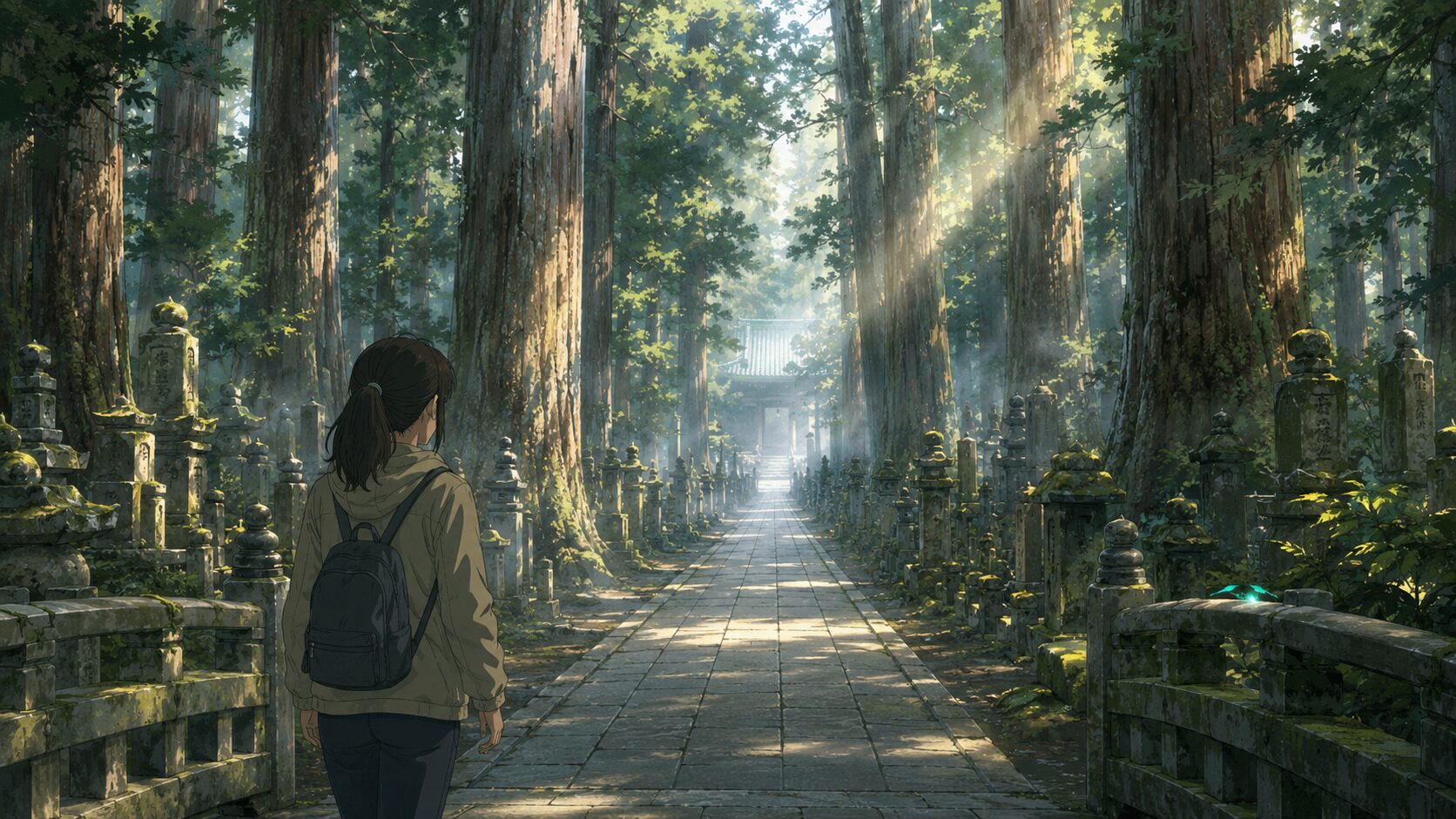
In the northeast of Wakayama Prefecture, on a plateau 800 meters above sea level.
In a basin ringed by the deep mountains of the Kii Peninsula, there is a religious city where 117 temples are packed together. Search the entire world and you will find nothing else like it. An entire town, sitting on top of a mountain, existing for the sake of religion alone.
That is Koyasan.
Look at it on a map and Koyasan sits in a strange place. It is far from Nara, far from Wakayama City, far from Osaka. No bullet train reaches it. From the nearest station you transfer to a cable car, then are jostled along by bus, and only then do you finally arrive. The mountain roads are steep, and in winter they are closed off by snow.
And yet more than 1.4 million people a year set out for this mountain.
Why?
Because they feel they have been “called.”
This is not a metaphor. Talk to people who have been to Koyasan and almost all of them say the same thing.
“Before I knew it, I had decided to go.”
“One day, out of nowhere, Koyasan wouldn’t leave my mind.”
“I suddenly started seeing the word ‘Koyasan’ everywhere — on TV, in magazines.”
“My schedule just cleared itself.”
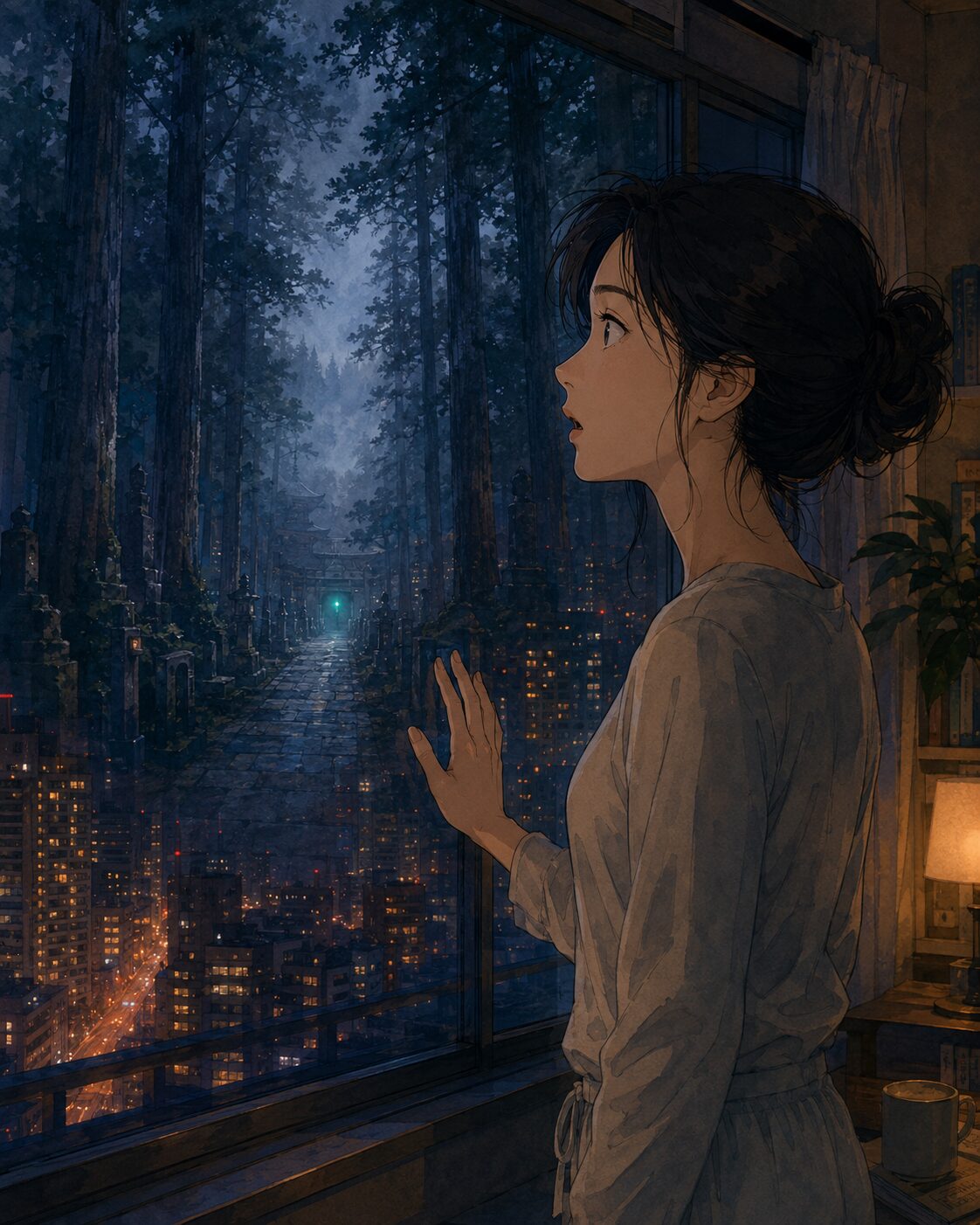
At the turning points of life, when the heart is worn out, when something has been lost — at moments like these, Koyasan calls people. And those who are called always arrive.
Who is doing the calling?
Officially, the answer is this: “Kobo Daishi Kukai.”
On March 21, 835, at 4 a.m., Kukai sat in the full-lotus posture underground at Koyasan’s Okunoin, closed his eyes, and ceased to speak. In esoteric Buddhism this is called “nyujo” (entering meditation). It is not “death.” It is said to be “entering eternal meditation.”
Twelve hundred years later, at Koyasan, Kukai is still alive.
Twice a day, at 6 a.m. and 10:30 a.m., a meal is carried to Kukai. It is a ritual called the “shojingu” (the living offering of food). The dishes are based on Buddhist vegetarian cuisine, but sometimes pasta or stew is served. Once a year, on the day of Kukai’s nyujo, a fresh robe is also delivered. Rain or snow, in typhoons, through wars, through the pandemic — for 1,200 years it has never once stopped.
Whether you call this “faith” or “miracle” is up to you. But as a matter of fact, it continues.
Go to Koyasan and people change. The logic of it can’t be explained. They simply change.
One person finds, partway along the approach path, that they suddenly can’t stop crying. Another says that the moment they cross the Gobyo Bridge at Okunoin, the air “changes.” Another gets a headache the instant they enter the Reihokan museum and has to step outside. Another, in the night at their temple lodging, hears the sound of sutra chanting from the next room — a room that should be empty. Another returns from Koyasan and finds the entire stage of their life has shifted.
Some say “it’s just your imagination.” Some say “it’s the altitude, an air-pressure thing at 800 meters.” But it can’t be explained away.
Because this mountain is not just a tourist spot.
In this article we write the stories about Koyasan that most guidebooks never tell. Who was Kukai? What is the meal ritual that has continued every single day for 1,200 years? The overwhelming power that fills the Reihokan. The corporate graves shaped like Yakult bottles and coffee cups and rockets, lined up along the Okunoin path. And the strange thread by which an esoteric Buddhist ritual implement connects, much later, to the darkness of Nazi Germany.
There is an old cliché — “whether you believe it or not is up to you.” But in Koyasan’s case it is reversed. Believe it or not, those who are called arrive.
CHAPTER 1 Who Was Kukai — The Life of a Monster
Kobo Daishi Kukai. In all of Japanese history, no one else has been so thoroughly deified.
The name “Kobo Daishi” is a posthumous title bestowed by Emperor Daigo in 921, after Kukai’s death. In other words, the state officially recognized him: “You are a daishi — a great master.” No other Buddhist monk has ever received such treatment.
But if you think Kukai was merely a “great monk,” you are mistaken. Kukai burst through the frame of “monk” long ago.
He was born in 774 in Sanuki Province (present-day Zentsuji City, Kagawa Prefecture). His childhood name was Mao. His father was a regional aristocrat, Saeki no Atai Takimi; his mother was Tamayori Gozen. The family was by no means lowly.
At fifteen, Mao was summoned to the capital (Nagaoka-kyo), because his uncle Ato no Otari was a great scholar serving as private tutor to Prince Iyo, of the imperial family. Under his uncle Mao was drilled in scholarship for three years, and at eighteen he entered the university (the national academy of the time). He was always at the top of his class.
Had he stayed on this course, advancement as a government official was certain. He was riding the elite track of his era. And yet Mao threw that path away. He hurled aside the position of an elite bureaucrat with his own hands. He himself later wrote the reason: “I wished to seek the path of truly living as a human being.” And he went into the mountains.
From here begins Mao’s period of “disappearance.” No one knows his exact movements. What is certain is that he spent his days in mountain ascetic practice. Alone, he walked the mountains all across Japan, stood beneath waterfalls, meditated in caves, and pared his food down to a bare minimum.
And then he encountered a single practice: the “Kokuzo Gumonjiho” (the Morning Star Mantra of Akasagarbha). Without understanding this practice, nothing of Kukai’s “monstrousness” can be understood.
What is the Kokuzo Gumonjiho? It is one of the supreme austerities of esoteric Buddhism, with the bodhisattva Akasagarbha (Kokuzo) as its principal deity. “Kokuzo” is, in Sanskrit, “Akasagarbha” — meaning “a storehouse, vast and immeasurable as the cosmos, filled with wisdom and compassion.” In other words, it is a practice of taking the universe itself into one’s own being.
The method is this. You chant the mantra of Akasagarbha: “Nobo akyasha kyarabaya on arikya maribori sowaka.” Each recitation takes about three seconds. You do it ten thousand times a day. Every day for a hundred days. A million times in total.
And it is not enough simply to chant. You chant while counting. Lose count midway, and you start over.
And what happens when you complete it? It is said you gain limitless memory. You never forget anything you have once seen or heard. You instantly grasp and memorize any scripture. Every language, every field of learning, becomes permanently stored in your mind. The ability of “a genius born once in a thousand years” blossoms.
This is not legend. Kukai himself wrote, in his own memoir “Sango Shiiki”: “Here there was a certain monk who taught me the Kokuzo Gumonjiho. The scripture says: ‘If you follow this method and chant this mantra a million times, you will be able to memorize the text and meaning of all scriptures.’ Believing the Buddha’s words, I climbed Mount Tairyu in Awa Province (Tokushima) and devoted myself at Cape Muroto in Tosa Province (Kochi).”
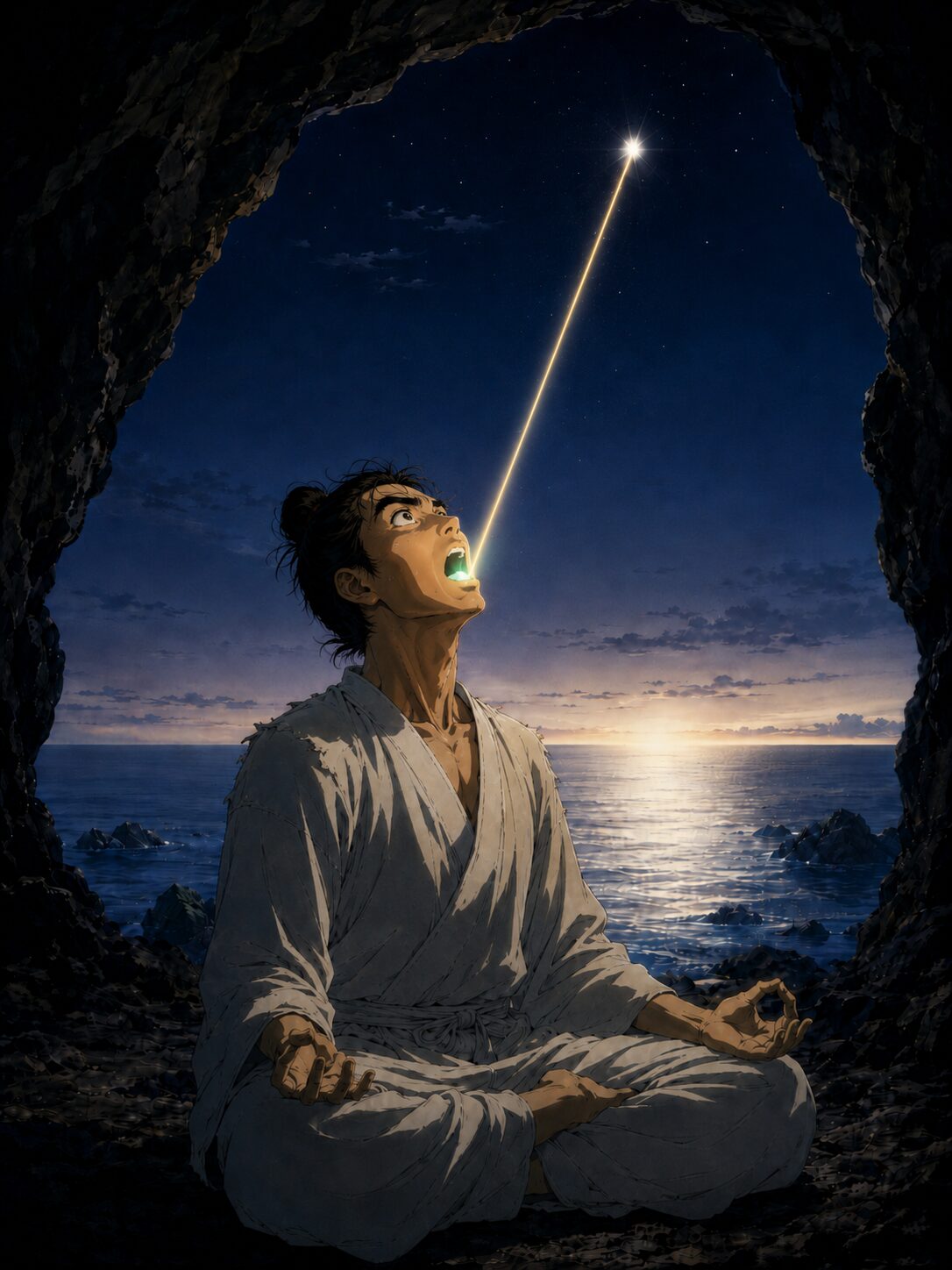
And he continues: “The valley did not begrudge its echo. The morning star came and cast its light.” The valley reverberated his chanted mantra without restraint. And the morning star — Venus — came and cast its light upon him.
What does this mean? Venus in the night sky descended. It flew into Mao’s mouth. Venus is the incarnation of the bodhisattva Akasagarbha. This signifies the “completion” of the Kokuzo Gumonjiho — proof that the practice had been fulfilled.
But this practice is not merely grueling. For a hundred days, sealed in a hall, you chant the same mantra millions of times. Demons and drowsiness assail you one after another. You hallucinate. You hear voices. Your body locks up. Or it begins to move on its own. “One misstep and you stand beside madness, or death.” So it is told in the world of esoteric Buddhism.
And in his early twenties, Mao broke through it alive. He completed it. Here, you could say, his brain was rewritten. His memory was no longer that of an ordinary human. His concentration was no longer that of an ordinary human. His powers of perception were no longer those of an ordinary human.
Everything in Kukai’s “superhuman” achievements from here on rests upon this Kokuzo Gumonjiho. He mastered Sanskrit and Chinese in a matter of months. He crossed to Tang China and, in a mere three months, was transmitted all the deepest secrets of esoteric Buddhism. While studying abroad, he learned Confucianism, Taoism, Nestorian Christianity, Zoroastrianism, even Manichaeism. These were not “because he was a genius.” They were possible because he was one who had completed the Kokuzo Gumonjiho. Read it that way, and everything adds up.
At thirty, Kukai decided: “I will cross to Tang China.” He would go and obtain the deepest secrets of Chinese esoteric Buddhism himself. It was a journey staking his life. In those days, half the Japanese embassy ships sank. There was no knowing whether he would even reach China alive, nor whether he would return alive. And the rule was that students must train in China for twenty years. Twenty years. By the time he returned to Japan, Kukai would be fifty. Even so, he decided to go.
In 804, at thirty-one, Kukai was formally ordained at the precept platform of Todaiji and changed his monastic name to “Kukai.” From a self-ordained monk, he became an officially state-recognized one. And that same year he boarded an embassy ship and set out from the port of Naniwa.
The ships met a storm. Two of the four were lost. Kukai’s ship too was blown far off course and drifted ashore at Chikan, Changxi County, Fuzhou — a place where they were never supposed to land. The local officials suspected Kukai and his party of being illegal entrants.
Here Kukai’s “monstrousness” is first displayed. In fluent Chinese, and in the highest literary style of the era, Kukai wrote a petition. The local officials were astonished. “This is no ordinary Japanese.” Special permission to enter Chang’an was granted.
Arriving in Chang’an, Kukai went straight to Qinglong Temple, where the orthodox successor of esoteric Buddhism, Master Huiguo, resided. Huiguo stood at the very summit of Chinese esoteric Buddhism — a living buddha to whom even the emperor paid homage. He already had more than a thousand disciples, and among them stood ranks of senior disciples who had trained ten, twenty years.
At that time Huiguo had already fallen ill. He sensed his death was near. And the moment Kukai stepped into the room, Huiguo is said to have spoken these words: “I have been waiting for you.”
Passing over a thousand disciples, Huiguo chose to transmit everything of esoteric Buddhism to a foreign monk who had only just arrived. “I shall confer the Dharma upon you.” The Womb Realm abhisheka, the Diamond Realm abhisheka, the acharya transmission abhisheka — the three stages of initiation that would normally take more than ten years, Huiguo transmitted to Kukai in just three months. Scriptures, ritual implements, mandalas, mudras, mantras. The whole of esoteric Buddhism. And he conferred upon Kukai the highest title of esoteric Buddhism, “Henjo Kongo.” A few months after completing the transmission, Huiguo died. As if he had lived for the sole purpose of passing it to Kukai.
Kukai broke the twenty-year rule and returned to Japan in just two years. This, properly speaking, warranted the death penalty. But using the knowledge and the esoteric spiritual power he had gained in Tang, Kukai won the absolute trust of Emperor Saga.
In 810 a political upheaval known as the “Kusuko Incident” broke out. Kukai was summoned by the court and performed an esoteric rite called the “Ninnokyo-ho.” The rebellion was quelled. Was this mere coincidence? The court did not think so. “Kukai’s prayers stopped the war.” From here, the legend of Kukai accelerates.
In calligraphy he is counted among the “Three Brushes.” The other two are Emperor Saga and Tachibana no Hayanari. In other words, Kukai was a calligrapher on par with the emperor of his day. The very pinnacle of Japanese calligraphic history.
As a civil engineer, he repaired the Manno Pond — a vast reservoir in Sanuki Province — in just three months. A difficult project the court had failed to fix despite years of effort, Kukai finished in no time. He had studied civil engineering and hydraulics in Tang as well.
He founded Japan’s first private school, the “Shugei Shuchiin,” opening education to commoners. In that age, education was a privilege of the elite. Kukai broke it. There is a legend that he created the “Iroha” poem. A legend that he created the kana syllabary. These have many competing accounts, but the very fact that people pass down “could it have been Kukai who made them?” speaks to how abnormal he was.
And across the whole country, legends of Kukai remain. The “Mamushi Onsen” hot spring in Itoshima City, Fukuoka, was made to gush forth by Kukai’s spiritual power. At Kawaba Onsen in Gunma, hot water burst out when Kukai struck the earth with his pilgrim’s staff. The Shikoku Eighty-Eight Sacred Sites are based on the path Kukai walked in his training. From Hokkaido to Okinawa — water Kukai made spring forth, temples Kukai built, statues Kukai carved, monsters Kukai vanquished, bridges Kukai built in a single night — there are countless such legends. Even researchers cannot grasp all of Kukai’s legends.
To the common people, Kukai was not “the founder of Shingon esoteric Buddhism.” He was “the superman who comes to help you when you’re in trouble.” When no rain fell, call Kukai and rain came. When disease spread, Kukai chanted a mantra and the disease stopped. When war broke out, Kukai prayed and the war was quelled. People of that time believed this. And even 1,200 years on, there are people who still believe.
Around the age of sixty-one, Kukai informed the court, “I will no longer return to the capital.” And he secluded himself on the Koyasan he had founded. His disciples were anxious. Kukai was preparing something. What that “preparation” was, we write in Chapter 4.
CHAPTER 2 The Three-Pronged Pine — The Implement That Flew Through the Sky, and the Two Dog Guides
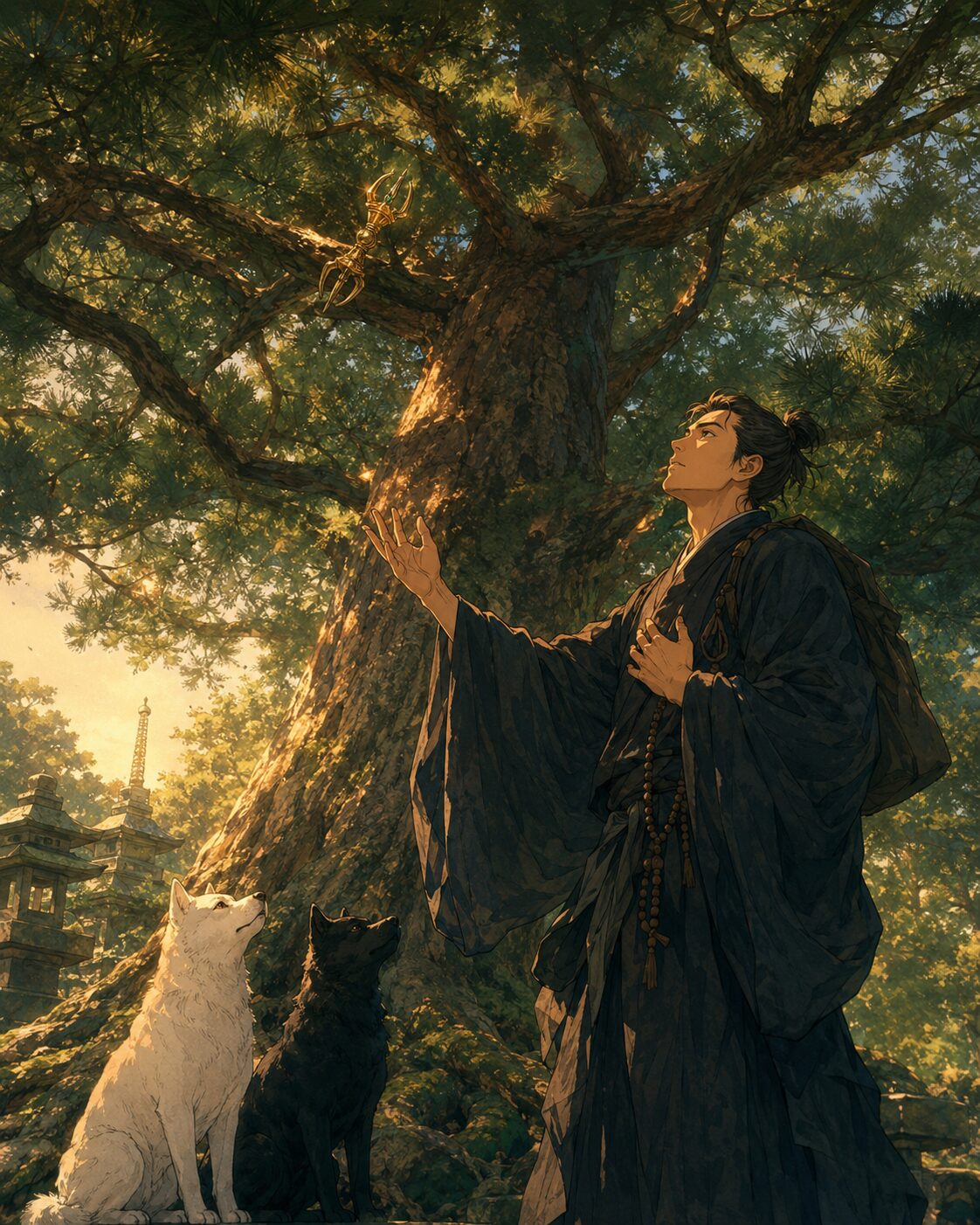
Let us turn back time a little. To just before Kukai, having been transmitted all of esoteric Buddhism in Tang China, returned to Japan. The port of Mingzhou (present-day Ningbo), China.
Kukai was about to return to Japan. But one thing remained undecided. “Once I return to Japan, where should I build the temple of esoteric Buddhism?” Where in Japan was there a sacred place fit for spreading esoteric Buddhism? Kukai did not know.
So he took a strange action. He drew out the esoteric ritual implement he had received from Master Huiguo, the “sanko-sho” (three-pronged vajra).
What is a sanko-sho? It is the most important ritual implement of esoteric Buddhism, called “vajra” in Sanskrit. Its form is a metal pestle split into three prongs at each end, about twenty centimeters long. Originally it was the weapon wielded by Indra, the mightiest god of ancient Indian mythology. Indra was a god who commanded thunder. There is a legend that he shattered the serpent-shaped demon Vritra with this vajra. “Vajra” means “that which is harder than diamond,” “the thunderbolt itself.”
In esoteric Buddhism, this mythological Indian weapon was adopted as a ritual implement, a “symbol of the enlightened mind that shatters worldly desires.” One who wields the vajra breaks demons, deflects calamity, and dispels evil thoughts.
Such an implement Kukai raised up on the shore of Mingzhou. And he threw it toward the east. He threw it toward Japan. “Settle on a sacred place fit for spreading Shingon esoteric Buddhism.” Praying this, Kukai cast the vajra into the sky.
The vajra soared high. And it flew toward the eastern sky. Across the sea. Piercing the clouds. Toward somewhere in Japan.
This is the “Flying Vajra” — the greatest legend in the history of esoteric Buddhism.
“That’s impossible,” says modern scientific common sense. But here, recall once more: this is the story of the man who completed the Kokuzo Gumonjiho. The story of the man who called Venus from the night sky into his own mouth. For this man, just how “impossible” is it to throw a vajra from China all the way to Japan? That judgment we leave to the reader.
After returning home, Kukai searched for the vajra he had thrown. But Japan is vast. From Hokkaido in the north to Okinawa in the south. Where had the vajra fallen?
It was then that Kukai met a strange figure. The stage is somewhere around Uchi District in Yamato Province (present-day Gojo City, Nara Prefecture). A hunter appeared. A ruddy face. Six shaku tall (over 180 centimeters). Wearing a blue kosode, sturdily built. A bow and arrows on his back. And he had two dogs with him. A white dog and a black dog.
The hunter spoke to Kukai. “Where are you headed?” Kukai answered honestly. “I am searching for the ideal training ground for Shingon esoteric Buddhism. In truth, the vajra I threw from Tang must have fallen somewhere. I am on my way to find it.” The hunter laughed. “I am the Dog Keeper of the Southern Mountains. I know of such a place. I’ll have my dogs guide you at once.”
So saying, the hunter loosed the two dogs. The white and black dogs broke into a run. And vanished. “They are heading toward that mountain over there. Follow them.”
Kukai followed the dogs and entered the mountains. Then one more figure appeared. A divine-looking woman in the form of a mountain-dweller. She guided Kukai still deeper. And they reached a flat clearing high on a mountain.
It was within the Kii mountains. A place 800 meters up, completely cut off from human habitation. A mysterious basin ringed on all four sides by mountains. At the center stood a single great pine tree.
Kukai looked up at that pine. And he caught his breath. Something was caught in the pine’s branches. It gave off a metallic gleam. A metal pestle split into three prongs at each end. It was that vajra — the one Kukai had thrown toward the east from the port of Mingzhou in Tang. After three years, crossing the sea, flying through the sky, it had come to rest on this pine branch.
On the spot, Kukai decided. “Here.” This is the sacred place to spread esoteric Buddhism. Here I will build the temple.
It later became clear that the “hunter” and the “mountain-dweller” who guided Kukai were not, in fact, human. The hunter was “Kariba Myojin,” also known as “Koya Myojin.” The mountain-dweller was “Niu Tsuhime,” also known as “Niu Myojin.” Both were local landlord deities long enshrined in the Kii mountains.
In other words, Kukai was guided by gods to reach Koyasan. And the two dogs were the messengers of the gods. Because of this legend, in later ages, statues of dogs came to be placed at shrines and temples associated with Kobo Daishi. Kukai and dogs come as a set.
Incidentally, that vajra caught in the pine still exists today. As the “Flying Vajra,” it is carefully preserved at Kongobuji on Koyasan as a national Important Cultural Property. The actual object exists. The legendary implement Kukai is said to have thrown from China is still at Koyasan today.
The pine on which the vajra had caught is called the “Three-Pronged Pine,” and it still stands in the Danjo Garan at Koyasan.
And here is one more fascinating detail. Normally pine needles grow two to a cluster. But this Three-Pronged Pine grows three needles to a cluster — the same number as the “three split blades” of the vajra. “This is by the spiritual power of the Daishi,” the faithful say.
And it is said that if you find one of the three-needle clusters fallen beneath this Three-Pronged Pine, happiness will come to you. It is the Koyasan version of the four-leaf clover. Put it in your wallet and your luck with money rises. Put it in your bag and your travels are safe. Carry it as a charm and it deflects calamity.
Even now, around the Three-Pronged Pine in the Danjo Garan, there is a constant stream of tourists looking down, searching for pine needles. Families with children search intently. Couples search together. Foreign tourists watch, puzzled, as Japanese people search so desperately for something. Three-needle clusters are rarely found. But the moment someone finds one, they cry out. “Got one!”
In that moment, everyone present is connected to the legend of Kukai. Twelve hundred years ago, from a shore in Tang China, a vajra thrown toward the east. Guided by two dogs, the messengers of the gods, it came to rest, caught in a pine branch deep in the Kii mountains. That story is now, in this very instant, connected to a single pine needle in a child’s palm. This is the air of the place called Koyasan.
And there is one more important thing Kukai picked up: the concept of the “barrier” (kekkai). As soon as Kukai reached Koyasan, he realized: this is no ordinary mountain. “The energy here is too strong.” Left as it was, practitioners would not be able to endure it.
Using esoteric rites, Kukai cast a barrier around Koyasan. “Let the area seven ri square atop Koyasan be a barrier.” Seven ri — about 28 kilometers square. He set that range apart as a sacred precinct, cut off from the outer world.
The “Daimon” (Great Gate) standing at the entrance to Koyasan is the symbol of that barrier. It is 25.1 meters tall. Japan’s second-largest pair of Kongo Rikishi guardian statues stand to the left and right, glaring at those who enter. “Beyond here lies the sacred precinct. Do not bring in the defilement of the lower world.” So the Daimon speaks.
And within this barrier, Kukai built the head temple complex of Shingon esoteric Buddhism: the Danjo Garan. Here stand the Konpon Daito (Great Stupa), the Kondo (Golden Hall), the Mieido, and the Three-Pronged Pine. It is a vast mandala, a three-dimensional recreation of the esoteric Buddhist worldview. Koyasan is not merely a cluster of temples. It is the cosmos of esoteric Buddhism itself, descended to earth.
And at the center of that cosmos, Kukai chose the site of his own grave. Okunoin. Here he would seclude himself for eternity.
CHAPTER 3 Vajra and Hakenkreuz — The Night an Esoteric Implement Summoned the Nazis
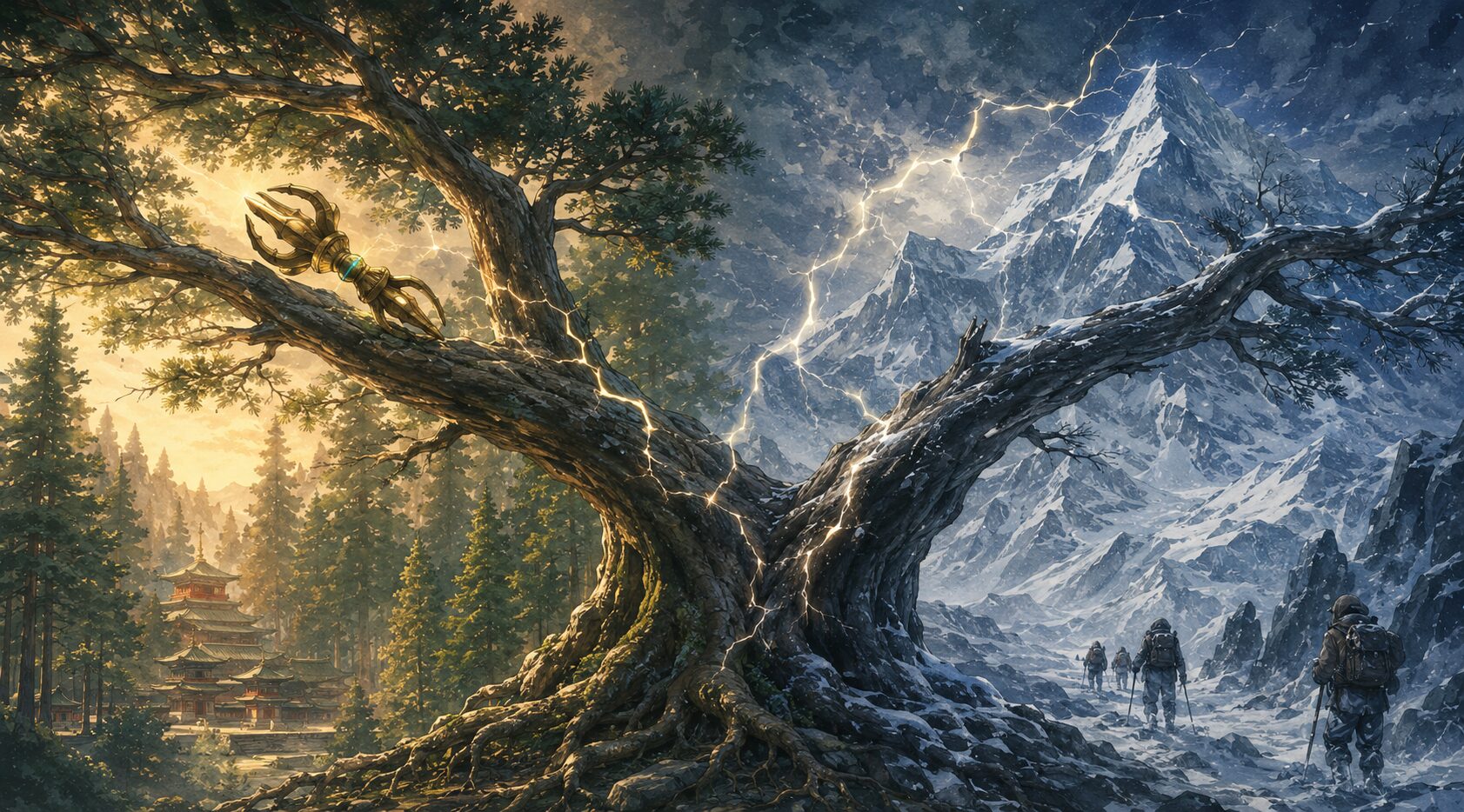
What follows may strike some readers as “too much of a leap.” But the dots are connected, without doubt. It is the attempt to deny the connection that strains credulity.
The era is 1938, on the eve of the Second World War. The place is Tibet. Five Germans were climbing the snow-covered mountains of the Himalayas. They were not tourists. They were an SS expedition of the Nazi Schutzstaffel, led by Ernst Schäfer.
The one who dispatched them was SS chief Heinrich Himmler. As one of Hitler’s confidants, he was effectively one of the most powerful men in Nazi Germany. And he was a man even more obsessed with the occult than Hitler. Why did Himmler send his SS subordinates to Tibet? The reason is one: “to search for the origin of the Aryan race.”
Here the story leaps in another direction for a moment. Let us go back much, much further in time. Around 1500 BC. From the steppes of Central Asia, a certain group of peoples began to migrate. They called themselves “Aryans” — a Sanskrit word meaning “noble people.”
The Aryans pushed south, and south. And they split into two groups. One went to present-day Iran. The other went to present-day India. The Aryans who entered India built there a unique religious culture. It became Hinduism, and the worldview that later became the womb of Buddhism. And one of the supreme gods the Aryans worshipped was Indra, the god who commands thunder.
Indra’s weapon was the vajra. Yes — the origin of that very sanko-sho Kukai brought back from China to Japan.
Here a single line is drawn. The vajra of Indra, supreme god of the ancient Indian Aryans, was transmitted to China, became a ritual implement of esoteric Buddhism, and was brought by Kukai to Japan’s Koyasan. This is the orthodox lineage of esoteric Buddhism.
But in 19th-century Europe, another interpretation was born. When the German archaeologist Heinrich Schliemann excavated the ruins of Troy, he found a strange symbol: the “manji” — called “swastika” in Sanskrit, a symbol that has meant “good fortune” since ancient times. Schliemann thought of it as a religious symbol common to the ancient Indo-European peoples.
And this discovery ran wild in 20th-century Germany. “The Aryans are the supreme race that spread to the world from ancient India.” “The Germanic people are the purest descendants of the Aryans.” “The sacred symbol of the Aryans is the swastika.” This pseudoscience the Nazis absorbed into their own ideology. And they made the swastika the symbol of their party flag. That is the Hakenkreuz (hooked cross). To be precise, what the Nazis adopted was the swastika tilted 45 degrees, the “right-facing swastika.” The direction differs, but the origin is the same.
So it stands. The ancestor of the Hakenkreuz drawn on the Nazi party flag comes from the same place, the same mythology, the same cosmology as the sanko-sho Kukai brought back from China. The sacred symbol of the ancient Indo-Aryans. One branch went, as an esoteric ritual implement, to Japan’s Koyasan. The other went to the banner of the worst dictatorship in human history. Two branches stretching in utterly different directions from the same root.
Why did this happen? Because there was a fanatic named Heinrich Himmler. Even among Nazi leaders, Himmler was outstandingly steeped in the occult. He believed this: “The true homeland of the Aryans is in Central Asia.” “In particular, somewhere on the Tibetan plateau, a people of pure Aryan blood must live, isolated.” “Within them is the key to a spiritual power that grants dominion over the world.”
And he believed one more thing. Somewhere on the Tibetan plateau exists a paradise on earth called “Shambhala,” or an underground kingdom called “Agartha.” There, superhuman knowledge and spiritual power lie sleeping. Whoever obtains it will rule the world. This is no longer the thinking of a politician. It is closer to the delusion of an occultist. But Himmler was in earnest.
And so, within the SS, he established in 1935 an occult research organization called the “Ahnenerbe” (Institute for the Study of German Prehistoric Heritage). The work of the Ahnenerbe was to “research” ancient ruins, mystical thought, and super-ancient history across the world. The search for the Holy Grail. Investigation of Atlantis. The study of runes. Investigation of Germanic mythology. And the expedition to Tibet. This is the very world Steven Spielberg later depicted in the film “Indiana Jones.” It is not fiction. In reality, the Nazis were doing this.
In April 1938, the SS expedition led by Ernst Schäfer arrived in Tibet. They visited Lhasa and met with the regent of Tibet at the time, Reting Rinpoche. And they collected skulls, took photographs, and surveyed the terrain. All “to prove the origin of the Aryans.”
And they are said to have brought back a certain Buddhist statue. Returning to Berlin, Schäfer showed Himmler the statue. The statue was Vaisravana — also known as Bishamonten — one of the Four Heavenly Kings of esoteric Buddhism. Two features were striking. First, a “swastika” was clearly carved on the statue’s chest. Second, the statue was made from a meteorite. Meteoric iron that fell from space, carved into a Buddha. “A Buddha from space.”
This was more than enough to make Himmler tremble. To him, this was “proof.” The origin of the Aryans is in Tibet. The sacred symbol of the swastika came from space. The Nazi Hakenkreuz is the will of the cosmos.
This meteorite statue then went missing for a long time. And in 2012, nearly seventy years after the war, a research group led by Elmar Buchner of the University of Stuttgart published a paper titled “Buddha from space” in the journal “Meteoritics and Planetary Science.” The meteorite statue said to have been brought back by the Nazi Tibet expedition was indeed made of meteoric iron (derived from the “Chinga meteorite” that fell near the Siberia-Mongolia border). (It was later pointed out that there is no firm proof the statue was brought from Tibet by the Nazis, and that it may be a 20th-century European forgery. However, that the Nazis sent an expedition to Tibet and brought something back is itself a historical fact.)
From here the story connects along one more line. Himmler used another symbol as the emblem of the SS. The lightning-bolt-shaped form spelling “SS.” This is a doubling of the ancient Germanic rune “Sigel” — the letter meaning “sun, victory, thunder.”
Thunder. Here, recall once more: the weapon of Indra, supreme god of the ancient Indian Aryans — the vajra. The original meaning of the vajra is “thunderbolt.” Himmler chose, for the symbol of the SS, a sign meaning thunder. The sacred weapon of ancient India symbolized thunder. And that weapon of thunder, in esoteric Buddhism, became the implement that shatters worldly desire. “Thunder” and “Nazis” and “esoteric Buddhism.” Is this coincidence? Or did Himmler know that the “spiritual power of the Aryans” he was seeking survived, in its purest form, in Eastern esoteric Buddhism? The answer no one knows.
But this much can be said. The sanko-sho Kukai brought from China to Japan. A symbol sharing that same origin became, in 20th-century Europe, the banner of the worst of dictators. And Himmler’s expedition reached Tibet, the sacred land of esoteric Buddhism.
The “spiritual power” Himmler sought already existed, more than 1,100 years before he searched for it, on Japan’s Koyasan. In the place where Kukai cast his barrier. Beneath the ground of Okunoin. Within Kukai, who had entered eternal meditation. Had Himmler known of its existence, he might have sent his expedition to Japan rather than Tibet. But he did not know.
And Nazi Germany was defeated. Himmler killed himself immediately after the defeat. The “spiritual power of the Aryans” he believed in was never, in the end, obtained. Meanwhile, at the Okunoin of Koyasan, on that very same day, the meal for Kukai went on being carried. As if nothing had happened. Through the war, on the day of defeat, on the day Himmler killed himself. For 1,200 years, never once stopping.
Is this the power of esoteric Buddhism? Or merely an accumulation of coincidence? Go to Koyasan, see with your own eyes, feel it, and decide. The thing Himmler wanted so badly and could never obtain — you, perhaps, on the Okunoin approach path, may already, without realizing it, be holding in your hand.
CHAPTER 4 Nyujo — The Choice of Not Death, but Eternal Meditation
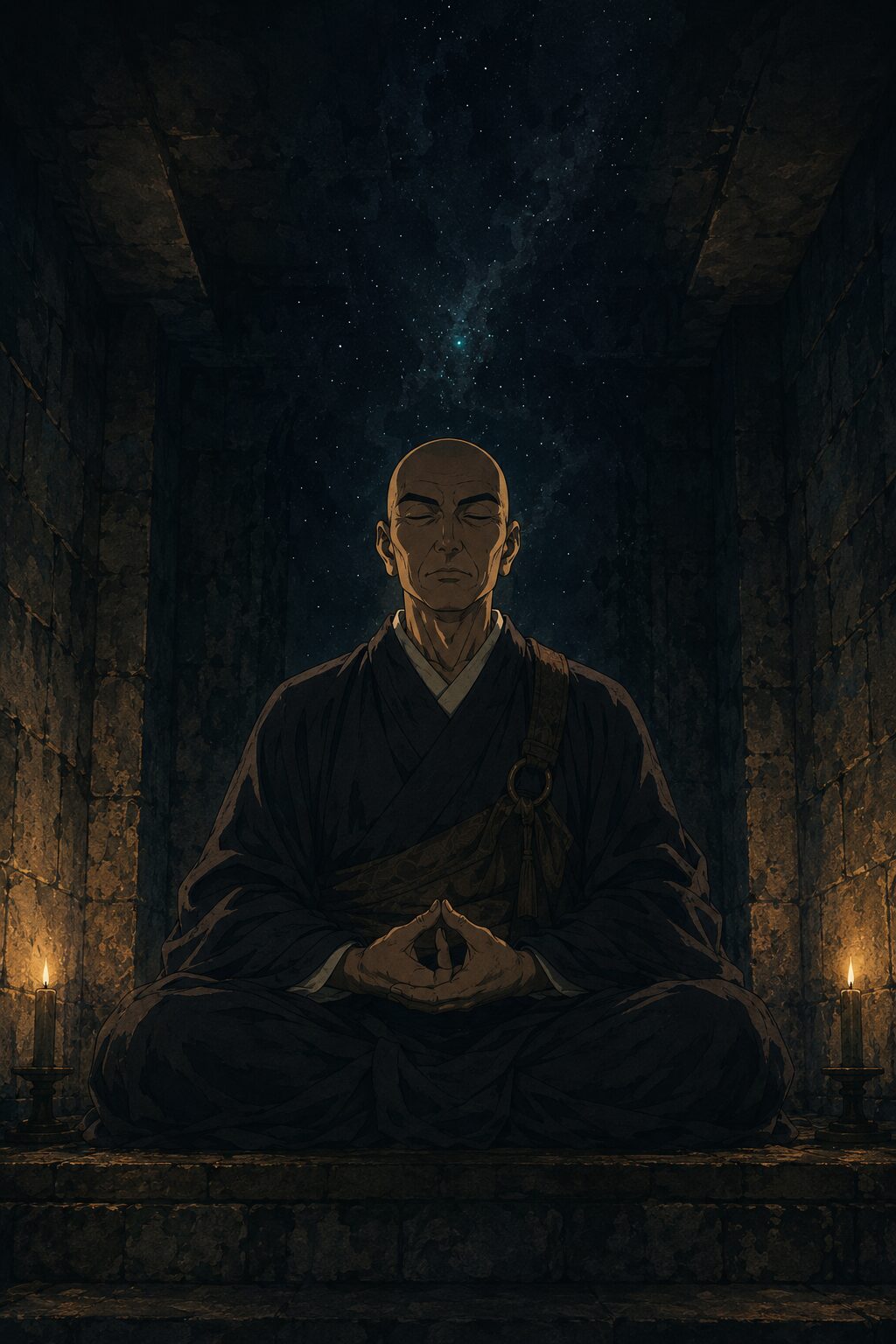
What Kukai, secluded on Koyasan at sixty-one, was preparing — that was nyujo.
In fact, Kukai’s nyujo did not begin suddenly on that day. He had been preparing his nyujo for years. After secluding himself on Koyasan, Kukai’s meals dwindled day by day. First he stopped eating rice. Next he stopped eating wheat. Beans too. Vegetables too. In the end, only water remained. This closely resembles the “mokujiki-gyo” (tree-eating austerity) for becoming a self-mummified buddha — the work of stripping the body’s fat and moisture to the extreme, the physical preparation for bringing metabolism as close to zero as possible.
And on March 15, 835, Kukai gathered his disciples. Around the master, who sensed his death was near, his senior disciples lined up in rows. Quietly, Kukai told them: “Six days from now, on March 21, at the hour of the Tiger (4 a.m.), I will enter eternal samadhi. I am not dying. 5.67 billion years from now, when the bodhisattva Maitreya descends into this world, I will descend together with him as his attendant. Until then, I will remain here, continuing my meditation. My body I will leave here.”
The disciples wept aloud. Kukai went on. “Do not grieve. I will not vanish. I merely change form. My consciousness will now disperse throughout the entire cosmos. So whenever you have need of me, I will be there.”
For the next six days, Kukai took almost nothing by mouth. Together with his disciples, he only kept chanting the sacred name of the bodhisattva Maitreya. “Namu torai-doshi Miroku-sonbutsu.” Maitreya, guide who is to come, we call upon you.
And on March 21, at 4 a.m., Kukai entered the stone chamber. He took the full-lotus posture. Legs crossed, spine straight, both hands forming the mudra of Mahavairocana. This is the most basic — and the deepest — posture of meditation in esoteric Buddhism. Kukai closed his eyes and began to chant the mantra.
Outside, the disciples watched, holding their breath. And time passed. At one point, one of the disciples noticed. Kukai’s chanting voice could no longer be heard. The disciple drew near. Kukai sat unmoving. His breathing seemed to have stopped. But no one touched his body. No one called his name. No one checked his pulse. Because this is not death.
This is “nyujo.”
What is nyujo? By the dictionary, “to enter samadhi.” Samadhi refers to a deep state of meditation. But Kukai’s nyujo is no mere meditation. This is the final secret of esoteric Buddhism. To fix the body, while still living, within meditation. To slow breathing to the extreme, bringing metabolism as close to zero as possible. And to separate consciousness from the body. The separated consciousness unites with “Mahavairocana,” the cosmic source. The body remains here, while consciousness alone disperses throughout the entire cosmos.
This is the “sokushin jobutsu” (becoming a buddha in this very body) of esoteric Buddhism. “This body, just as it is, becomes a buddha.”
In ordinary Buddhism, it is said to take an unfathomable length of time to “attain enlightenment and become a buddha.” Specifically, a span of time measured in “three kalpas” is said to be required. One kalpa is roughly 4.32 billion years. Three kalpas is roughly 12.96 billion years. In other words, it takes more time than the age of the universe before a person finally becomes a buddha. That is the ordinary Buddhist teaching. But Kukai denied it. “No such time is needed. This body, just as it is, in this very instant, can become a buddha.” This was the revolution of esoteric Buddhism. And its ultimate form is nyujo.
Here, one more crucial keyword appears: the bodhisattva Maitreya. The bodhisattva Maitreya is, in Buddhism, the buddha promised to appear in this world after Shakyamuni and save all sentient beings. Before his own death, Shakyamuni prophesied: “5.67 billion years after I die, the bodhisattva Maitreya will descend into this world. At that time, Maitreya will save all those I could not save.” This is the “eschatology” and the “soteriology” of Buddhism.
5.67 billion years. As a figure, it defies imagination. The sun is said to swell into a red giant and swallow the earth in about 5 billion years. In other words, by the time Maitreya descends, the earth may no longer exist. Even so, it is said, Maitreya will come. And Kukai declared that he would wait for Maitreya’s descent. “I will appear again, together with him, as Maitreya’s attendant.”
This is no mere wish. In the worldview of esoteric Buddhism, Kukai has already united with Mahavairocana. Mahavairocana is the cosmos itself. As long as the cosmos exists, Kukai exists. 5.67 billion years is, on the cosmic timescale, an instant. Kukai is spending that “instant” beneath the ground of Okunoin.
Here is a word often confused with “sokushin jobutsu”: “sokushinbutsu” (self-mummified buddha). A sokushinbutsu is, put simply, a mummy. Practiced mainly in the Yudonosan faith of the Tohoku region, a monk mummifies his own body while still alive. Over many years he performs the “mokujiki-gyo,” eating only tree nuts to completely strip the body’s fat. Next he drinks a special lacquer to prevent decay within the body. Then, of his own will, he enters an underground stone chamber. A single bell is placed in the chamber. As long as he can ring it, it signals he is alive. Each day, the sound of the bell is heard. A few days later, a few weeks later. And one day, the bell falls silent. The disciples wait three years and three months before opening the chamber. Inside, in the meditation posture, a desiccated body remains. This is a sokushinbutsu. Even now, more than a dozen sokushinbutsu are enshrined in temples in Yamagata Prefecture, and the actual bodies can be viewed.
But what Kukai aimed at differs from this. Kukai did not try to become a mummy. Rather, Kukai taught that “sokushin jobutsu” is not leaving a mummy behind, but reaching the state of a buddha while still living. Whether the body decays or remains is not the essence. The essence is whether consciousness has united with Mahavairocana.
That said, after Kukai entered nyujo, what became of his body within the inner sanctuary of Okunoin? On this, many theories have been passed down over 1,200 years. One says he is laid in a stone coffin. One says he sits just as he was at the moment of nyujo. One says he became something like a mummy. One says he was in fact cremated. Which is correct, no one knows. Because the inner sanctuary of Okunoin is a forbidden ground that not even the imperial family may enter.
Only one person may enter: the monk called the “yuina,” whose role is to carry Kukai’s meals. And the yuina must never speak to anyone of what he sees within the sanctuary. He is bound tightly by the rule of “absolute secrecy.” For this reason, the truth of the sanctuary remains, even in the present day, an eternal mystery.
According to historical records, it is held likely that Kukai’s body was cremated. The official record of the time, the “Shoku Nihon Koki,” contains a passage stating that Kukai’s body was cremated. On the other hand, in later ages, texts of the nyujo faith appear stating that he “entered eternal meditation.” These are the two historical traditions.
But thereafter, in the process by which faith in Kukai spread explosively, legends were added. “Kukai did not die. He entered eternal meditation.” “Within the sanctuary of Okunoin, he sits in meditation even now.” “Someday, when the bodhisattva Maitreya descends, he will open his eyes again.”
Is this historical fact, or legend? Even among researchers, opinions divide. But here we write something important. It is not a matter of which is correct, fact or legend. For 1,200 years, there have been people who believed “Kukai is still alive.” And those people carried a meal to Okunoin, every single day. Rain or snow, in typhoons, through wars, through the pandemic. Never once stopping. This is the “fact.”
Whether Kukai was historically cremated is no longer the question. The fact that a meal has been carried, every single day, for 1,200 years, keeps Kukai alive even now. People’s faith holds Kukai within eternal meditation.
Okunoin is not merely a grave. It is a “waiting place.” The place where Kukai, within the cosmic timescale, awaits his next turn. Think of it that way, and the meaning of that distinctive air drifting through Okunoin comes into view. Walk the approach path and, for some, the tears suddenly will not stop. Cross the Gobyo Bridge and you feel the air “change.” Before the Toro-do hall, your mind goes blank. This is not your imagination. Someone is certainly there. Sitting. Waiting. And watching you, who have come to worship. “So you’ve come.” It does not become a voice. But it reaches you.
This is nyujo. It is not death. It simply continues, forever. And there is another unbelievable fact continuing at Okunoin, in this very moment: the meal for Kukai.
CHAPTER 5 1,200 Years of Daily Meals — The Living Offering and the Poor Woman’s Lamp
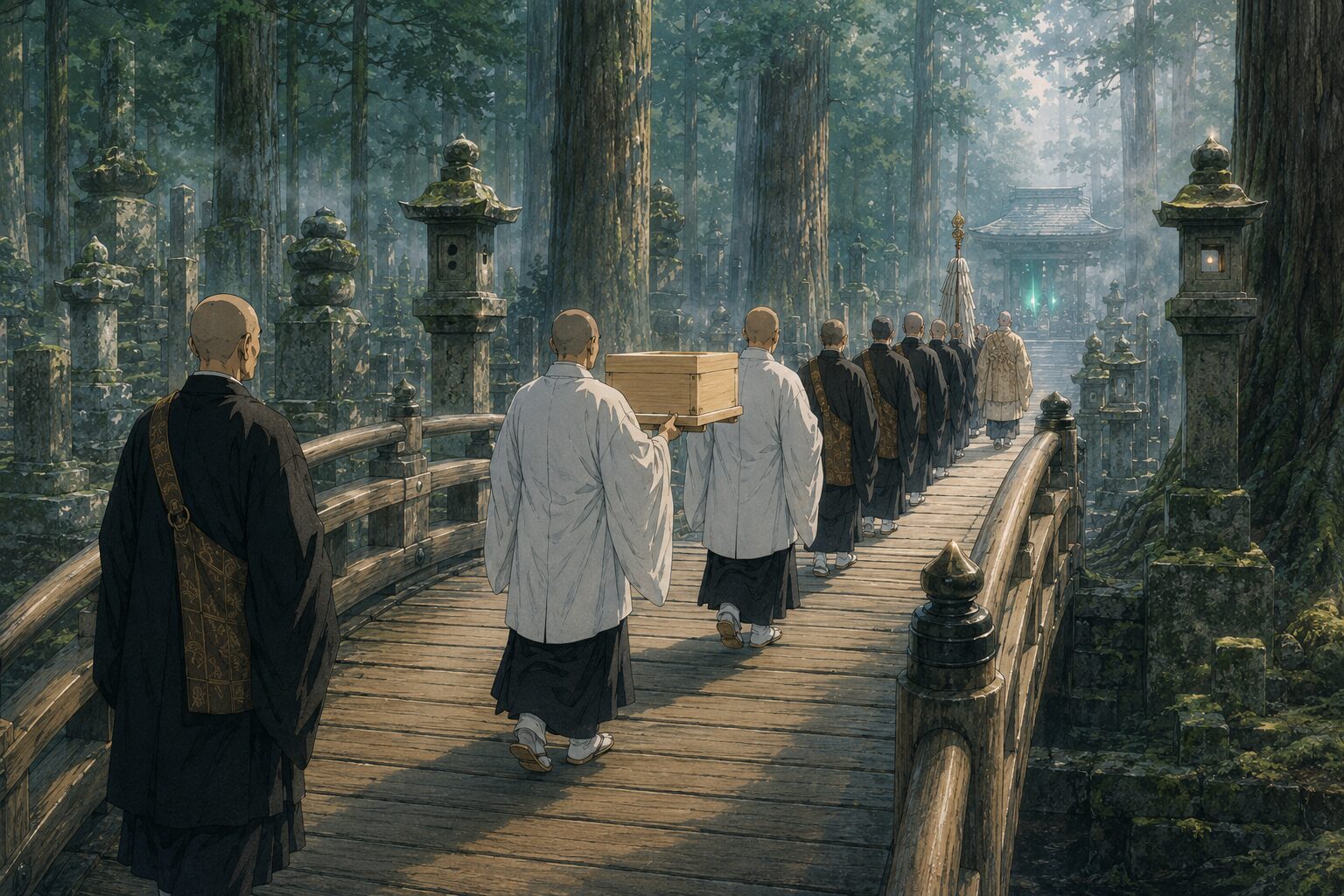
At Okunoin, every morning at 6 a.m., and again at 10:30 a.m. — twice a day, a meal is carried to Kukai. It is a ritual called the “shojingu” (the living offering of food). “Shojin” means “living body.” It is a phrase built on the premise that Kukai still has a living body even now. So he needs food.
This ritual is said to have begun the day after Kukai’s nyujo, on March 21, 835. From March 22, 835, to the present, it has never once been missed in 1,200 years. Consider how abnormal this is. 1,200 years is about 440,000 days. Twice a day, morning and midday, that is about 880,000 times. Every one of them carried, every day.
Rain or snow. In typhoons. On the day an earthquake struck. On the day Kyoto burned in the Onin War. On the day Oda Nobunaga tried to burn Koyasan down. On the day the Meiji government destroyed countless temples in the anti-Buddhist movement. On the day cities across Japan were firebombed in the Second World War. On the day the atomic bombs fell on Hiroshima and Nagasaki. On the day the Emperor’s surrender broadcast played. On the day the Great East Japan Earthquake struck. On the day the pandemic brought all of Japan to a halt. It did not stop.
Is this faith? Madness? Obsession? Or is Kukai really, still, alive?
The procedure of the shojingu is this. At 5:30 in the morning, in a building at Okunoin called the “Gokusho,” preparation of the meal begins. The cooking is handled by specially qualified monks called “gyohoshi.” Their only work is to prepare Kukai’s meals. The menu is traditionally based on Buddhist vegetarian cuisine: rice, miso soup, simmered vegetables, pickles, tea. No animal ingredients are used.
Yet interestingly, in modern times, the menu has changed. There are days when pasta is served. Days when stew is served. Days when curry is served. No one decided this. It is the judgment of the gyohoshi: “Kukai too must want something different now and then.” And every March 21, the day of Kukai’s nyujo, a fresh robe is also delivered. In meditation, Kukai’s robe grows old. So it is renewed. This too has continued for 1,200 years.
When the cooking is finished, the meal is placed in a box of plain wood. At the head of the procession walks the monk called the “yuina.” The yuina inherits, generation to generation, the role of carrying Kukai’s meal to the sanctuary. Behind the yuina, two monks carrying the plain-wood box. The three set out from the Gokusho.
And just nearby the Gokusho, before the “Ajimi Jizo” (the Tasting Jizo), they stop. Here a strange thing is done. They have the Jizo taste the meal. “O Jizo, is the flavor of today’s meal for Kukai all right?” Asking this, they wait a while. The Jizo does not say anything. But this is no mere formality. It is done in earnest. Only when the Jizo gives its “OK” does the meal proceed to the sanctuary.
After passing the Ajimi Jizo, the procession advances along the Okunoin approach path. On both sides of the path tower enormous cedars over 700 years old. Beneath them stand more than 200,000 graves and memorial monuments. The graves of warlords, of imperial family, of commoners, of companies. Through the gaze of all of them, the three monks advance, carrying the plain-wood box.
And they reach the final bridge, the “Gobyo Bridge.” The Gobyo Bridge is a special bridge. The bridge is made of 36 planks, and counting the whole bridge as one, the total is 37. This represents the “37 deities of the Diamond Realm” in esoteric Buddhism. Moreover, on the back of each of the 36 planks, the 37 deities are carved in Sanskrit letters. In other words, to cross the Gobyo Bridge is to tread across the 37 deities of esoteric Buddhism as you cross.
Beyond the bridge is the sacred precinct. From here on, photography is forbidden, eating and drinking are forbidden, hats come off, and you bow before crossing. Beyond the bridge, the “Toro-do” (Lantern Hall) comes into view. This Toro-do is the true heart of Okunoin.
Step inside, and the world changes. From ceiling to floor, lanterns are hung as if to fill every inch of the space. Their number: more than 20,000. Each one holds the prayer of a worshipper. Every lantern, swaying faintly, gives off light. It looks like a galaxy. Look up, look down, look to the sides — light, light, light.
And within this galaxy, two flames burn that have not gone out in over a thousand years.
One is the “Kishin-to,” also known as the “Hinjo no Itto” (the Poor Woman’s Lamp). It has the story of a girl named Oteru.
In the Heian period, in Izumi Province (present-day southern Osaka), there was a girl named Oteru. Abandoned by her real parents, she was taken in and raised by a couple, Okuyama Genzaemon and his wife Oyuki. When Oteru was sixteen, her foster mother died of an epidemic. Despite her heartfelt nursing, before long, her foster father too followed her into death. Oteru was left all alone.
From a traveler she heard the tale of the Koyasan Toro-do. “Its lamps light the road to the afterlife.” Oteru resolved to offer a lamp at Okunoin, praying for the happiness of her foster parents in the next world. But she had no money. Oteru cut off her own long black hair. With the meager money from selling it, she bought a small lamp. And she climbed Koyasan and offered that lamp to the Toro-do. This was in the year 1016.
That flame still burns, unextinguished, even now. For over a thousand years, all this time. The single small flame Oteru offered has become the root light supporting the vast Toro-do.
The other eternal flame is the “Shirakawa-to.” In 1088, it was offered by Retired Emperor Shirakawa. The records state “the retired emperor offered 300,000 lamps.” It is popularly called “the rich man’s myriad lamps.”
“The poor woman’s single lamp” and “the rich man’s myriad lamps.” The flame a poor girl offered after cutting her hair, and one lamp among 300,000 offered by a retired emperor. Yet within the Toro-do, the two flames burn at exactly the same brightness. This is Kukai’s teaching. “The difference between rich and poor does not matter. The purity of the heart is everything.”
And still deeper within the Toro-do is Kukai’s sanctuary. The yuina and the two monks pass through the Toro-do and stand before the sanctuary. They take the meal out of the plain-wood box. Here, the worshippers outside can see nothing. What is done within the sanctuary, no one knows. Only the yuina places the meal before Kukai. And he chants the sutra. “Namu Daishi Henjo Kongo.” Many times over. Then he presses his palms together and withdraws.
This is the ritual of the shojingu, performed every morning at 6 a.m. When the morning is done, it is repeated once more at 10:30 a.m. Twice a day, it continues, every day.
Tomorrow morning, at 6 a.m., at Okunoin, the meal for Kukai will be carried once again. At the very hour you are reading this article. At the hour you are asleep. At the hour you are thinking of something else. At Okunoin, the ritual continues. For 1,200 years, without stopping. And Kukai, today too, receives his meal.
CHAPTER 6 The 148-Year-Old Kukai — The Day Kangen Opened the Sanctuary
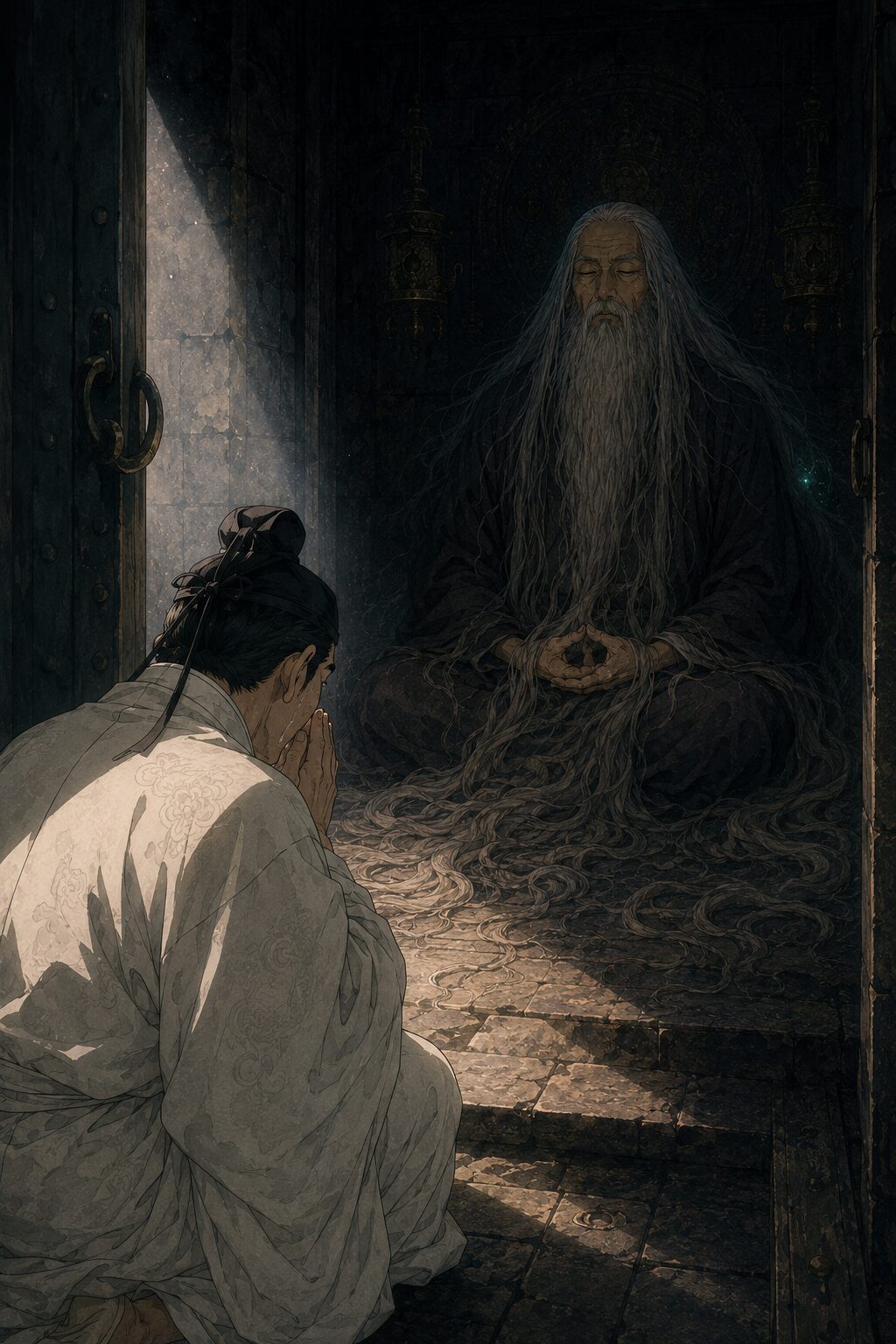
Kukai entered nyujo on March 21, 835. From there, time passed.
The Heian period, the 910s. The world had changed. The disciples who knew Kukai directly had all passed away. Monks of the second and third generations who inherited Kukai’s teaching guarded Koyasan. Kukai’s sanctuary still existed, unchanged, beneath the ground of Okunoin. The shojingu, too, continued every day.
But voices like these had also begun to be heard in the world. “Is Kukai really still alive?” “Has he not already become nothing but bones?”
And in 921, Emperor Daigo decided to bestow upon Kukai the posthumous title “Kobo Daishi.” “Kobo Daishi” means “the great master who widely spread the Buddhist Dharma.” This was a historic event in which the state officially certified Kukai as a saint of the highest rank.
Here a certain ritual became necessary. The posthumous title bestowed by the emperor, and a new kesa (monastic robe), had to be delivered directly to Kukai. For that, one had to enter the sanctuary. The sanctuary had to be opened. This was the first opening of the sanctuary since Kukai’s nyujo. It was 86 years after his nyujo.
The one entrusted with this great role was the highest-ranking monk of Koyasan at the time, Kangen. Kangen belonged to the generation of Kukai’s grandstudents. He was himself an accomplished esoteric monk, and a man deeply trusted by the court.
But Kangen was tense. To open the sanctuary. To set foot in the holiest of holy precincts where Kukai slept. If the inside of the sanctuary were nothing but the remains of bones or a mummy. If Kukai were merely a “dead monk of old.” The long-believed legend that “Kukai is alive” would collapse in that instant. What would become of the people’s faith? What would become of Koyasan? Kangen must have considered this. But it was a command. He had no choice but to open the sanctuary.
According to tradition, that day Kangen performed a special purification, clothed himself in pure white robes, and, with his disciple Junyu following, headed to Okunoin. Standing before the sanctuary, Kangen quietly opened the door. And he stepped inside.
Inside the sanctuary it was dark. Only a faint trace of outside light came in. But before long, Kangen’s eyes grew used to the darkness. And he saw.
In the depths of the sanctuary, a person sat. In the full-lotus posture. Both hands forming a mudra. Eyes closed. Simply sitting. It was Kukai. In that same posture from 86 years before, when he had entered nyujo, Kukai sat there. His body had not decayed. He had not become a mummy. He simply sat, as if alive.
And it was not only that which Kangen saw. Kukai’s hair and beard had grown long. Past his shoulders, past his chest, grown long enough to reach the floor. A dead man’s hair does not grow. Yet Kukai’s hair kept growing.
Kangen is said to have wept aloud on the spot. “The Daishi is alive.” “Grandfather, it has been so long.” Kangen called Kukai as though he were a living blood relative. And with trembling hands, Kangen shaved Kukai’s long-grown hair and beard. He changed him into the new kesa. He conveyed the posthumous title “Kobo Daishi” bestowed by Emperor Daigo. “Grandfather, the emperor has granted you a new name. From now on, you will be called Kobo Daishi.”
Kukai, of course, answered nothing. But Kangen certainly felt it — that Kukai was hearing it. Kangen slowly stepped back and withdrew from the sanctuary. And he closed the door. To those waiting outside, Kangen told nothing. He only said this: “The Daishi was alive.”
Beyond that, Kangen told no one anything. “Absolute secrecy.” That rule was, it is said, established at this moment by Kangen. What one sees within the sanctuary must never be told to anyone. Why? Because if told, people would want to go and verify it. But Kukai’s meditation must not be disturbed. The Kukai within the sanctuary is connected to the cosmos. That connection must not be severed by worldly curiosity. So one must not speak of what one sees. This is the rule Kangen entrusted to the yuina of the future.
And here, try doing the math. Kukai entered nyujo at the age of 62. From there to Kangen’s opening of the sanctuary, 86 years. In other words, the bodily age of the Kukai Kangen is said to have seen was 62 plus 86, which is 148. A human being well past 100, hair and beard grown long, sitting in the full-lotus posture. This is no longer human. Yet Kukai was certainly there.
Kangen’s story thereafter became the fundamental “proof” of Koyasan. “Kukai is truly alive.” This is no legend. Kangen, the highest-ranking monk of the time, verified it with his own eyes. And that witnessing he kept silent about all his life. But Kangen’s expression as he emerged from the sanctuary. The tears with which, it is told, he wept aloud. And the single phrase he uttered: “The Daishi was alive.” This alone was enough. People were convinced. Within the sanctuary of Okunoin, Kukai is alive even now.
And after Kangen, the sanctuary was sealed forever. Only the yuina is permitted, each day, to enter as far as the antechamber of the sanctuary. But the innermost depths of the sanctuary, the very place where Kukai sits, no one may enter. Not the imperial family. Not the highest-ranking monk. Only Kukai is there.
And the tale Kangen saw, of hair and beard that keep growing, has been passed down to the present. In the modern age, rationalist researchers tried to dismiss this tale as “legend.” “A dead man’s hair cannot grow,” they said. But there is an interesting fact. Recent scientific research has confirmed that “the phenomenon of hair appearing to grow after death is real.” To be precise, the hair itself does not grow; rather, after death the skin dries and shrinks, exposing the roots, so that “the hair appears to have grown.” In other words, what Kangen saw was the visual fact that “the hair had grown.” He interpreted that as “Kukai is alive.”
The rationalist may laugh. But here, consider once more. That the skin kept shrinking for 86 years means that Kukai’s body kept maintaining a certain state throughout that time. An ordinary body, after 86 years, would be nothing but bones. Yet Kukai’s body, even 86 years later, retained a form Kangen could recognize as “sitting.” This is not mummification. A mummy’s skin dries crisp, and it cannot maintain a posture.
Something kept Kukai’s body, for 86 years, in the full-lotus posture. That “something” is nyujo. Kangen witnessed it.
And to the present day, Kukai sits in that state, within the sanctuary of Okunoin. Is his hair still growing now? That no one knows. Not even the yuina may enter the innermost depths of the sanctuary. But imagine, perhaps. 1,200 years on, Kukai’s hair and beard may have covered the floor of the sanctuary, crept up the walls, and reached the ceiling. And Kukai, wrapped in that hair, still sits. Eyes closed. Mudra formed. Connected to the cosmos. Awaiting that day, 5.67 billion years from now, when the bodhisattva Maitreya descends.
CHAPTER 7 Okunoin Is the Akashic Records
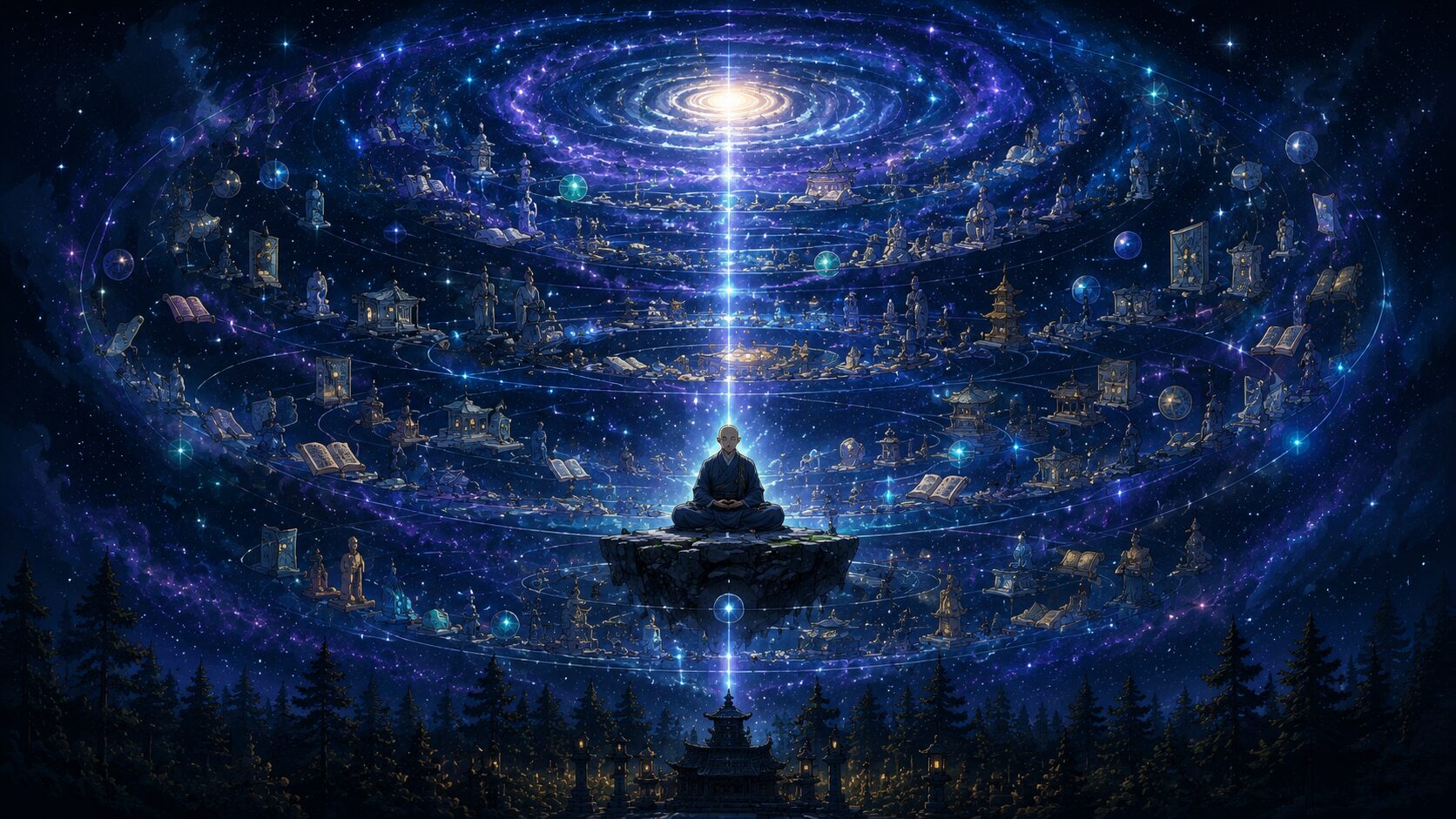
Okunoin is the Akashic Records.
The “Kokuzo Gumonjiho” that Kukai completed in his youth, written of in Chapter 1 — here we collect on that foreshadowing.
First, what are the “Akashic Records”? Put simply, they are “a cosmic-scale library where all information about every existence since the birth of the universe is recorded.” In the world of spirituality they are also called “the library of the cosmos” or “the internet of the cosmos.” From 13.8 billion years ago, when the universe was born, to the present — every event that has occurred, every memory of every soul, every emotion, every piece of knowledge is recorded there. Not only the past. Present events are recorded too, in real time. Furthermore, the possibilities that may occur in the future are contained there as well. “Data that does not exist” in the Akashic Records does not exist.
And only a mere handful of humans can access the Akashic Records. In history, people called “psychics” and “mystics” — Edgar Cayce, Rudolf Steiner, Emanuel Swedenborg — are recorded as having connected to the Akashic Records.
But far longer ago, in the East, there was a man who had already systematized the method of connecting to the Akashic Records. Kobo Daishi Kukai.
The etymology of the word “Akashic” is the Sanskrit “Akasha.” Its meaning is “the void.” And the greatest practice of Kukai’s life, which he completed in his youth, was the “Kokuzo Gumonjiho.” “Kokuzo” is “Akasagarbha.” The bodhisattva that stored (“garbha”) the “Akasha” (void) — meaning “the bodhisattva that stored all the knowledge of the cosmos.”
Here we write it plainly. “The Akashic Records” and “Kokuzo” are the same concept. Their etymology is the same. The concept named “Akashic Records” in the mystical thought that became popular in late-19th-century Western culture had, in the East, long before Kukai’s time, already been known as “Kokuzo.” And Kukai, in his early twenties, had completed the practice of accessing that “Kokuzo.”
Chant the mantra of the bodhisattva Akasagarbha a million times. A hundred days, ten thousand times each day. Partway through, Venus of the night sky flies into your mouth. It was proof of the “completion of the practice.” Kukai connected himself to the source databank of the cosmos. This is the reason for Kukai’s superhuman memory, his ability to instantly master foreign languages, and the words that made Master Huiguo of Tang say “I have been waiting for you.” He already stood in a place beyond ordinary human perception.
And then, nyujo. It was the practice of “fixing the body, while still living, within meditation, and uniting consciousness completely with the cosmic source.” In other words: Kukai left his body at Okunoin while keeping his consciousness eternally connected to the Akashic Records. And within the sanctuary, he sits. Even now, he sits. For 1,200 years, he has been sitting all this time.
Which means — what is the sanctuary of Okunoin? It is “the entrance to the Akashic Records.” It is the physical gateway, in this present world, to “the library of the cosmos.” Kukai, the greatest “holder of access rights” in human history, keeps that door open forever, within the sanctuary.
Listen to the experiences of those who have visited Okunoin. “As I walked the approach path, suddenly everything from my past came back to me.” “The instant I crossed the Gobyo Bridge, I felt as if I knew the time before I was born.” “Within the Toro-do, I felt I was being watched — no, more that I was being surveyed by something.” “After returning from Okunoin, the choices of my life came into clear view.” “I understood my mission.” “The things I’d agonized over all my life suddenly didn’t matter.” Search the internet a little and these accounts of Okunoin experiences come up endlessly. This many people have had this many similar experiences.
And Himmler, written of in Chapter 3. He sent an expedition to Tibet and searched desperately for the “spiritual power of the Aryans.” In the Himalayas he searched for Shambhala. He searched for Agartha. He searched for an underground kingdom. But he could not find it. Why? Because he was searching in the wrong place. The “connection point to the cosmos” he sought was not in Tibet. It already existed beneath the ground of Okunoin, on Koyasan, in Wakayama, in Japan. Opened by Kukai 1,100 years earlier. Himmler did not know this.
And you, living in the present. You, living in an age where you can instantly access information from all over the world via smartphone, via Google. But what you can search on Google is only the knowledge humanity has committed to writing. 13.8 billion years of cosmic memory. The past, present, and future of every soul. What your own soul experienced before you were born. Why you were born in this era, in this country, in this family. What your true mission is. These cannot be searched on Google. But at Okunoin, they can be.
Believing this, more than a million people a year climb Koyasan. And they take something home. It may not be a clear “answer.” But they feel a “direction.” They understand “what they are living for.” This is because Kukai, from within the sanctuary, is turning the pages of the books in the library of the cosmos for them. “The answer to your question is here.” Kukai conveys this to the worshipper without making a sound. The worshipper receives that “answer,” not even fully understanding it themselves, and goes home. And after a while, they suddenly realize. “Ah — that thing I felt at Okunoin, that was this.”
This is the true function of Okunoin. Not merely a grave. Not merely a power spot. Not merely a religious facility. It is the one and only permanent hardware by which humanity connects to the cosmos. Kukai offers his own body as the core component of that hardware. For 1,200 years, all this time. And from here on, for 5.67 billion years, all this time.
And the 20,000 lanterns of the Toro-do are not a metaphor for the stars of a galaxy. They are a recreation of the cosmos itself. Kukai sits at the center of that galaxy. Sitting, he converses with the cosmos until 5.67 billion years from now. There is a legend that the yuina, within the sanctuary, sometimes hears the voice of Kukai chanting the mantra. That is the cosmos itself speaking, through Kukai.
Finally, one more thing. Not everyone can access the Akashic Records. In history, those who have connected are a mere handful. But there is a way to access them. It is “to be called.” When the Akashic Records themselves judge that “we wish to convey information to this human,” the human is called to Okunoin. And the human who is called always arrives.
The phrase written in the prologue — “There is a mountain you cannot reach unless you are called” — this is its true meaning. The one doing the calling is not Kukai. Through Kukai, the cosmos itself is calling. The fact that you are reading this article now may mean, perhaps, that you have already been called.
CHAPTER 8 The Reihokan — Too Powerful to Linger
Koyasan has an Okunoin wired directly to the cosmos. A Toro-do holding flames that have not gone out in 1,200 years. A pine on which Kukai’s vajra, thrown from China, once caught. And one more. A facility better described not as a “place to go” but as a “place to endure.” The Reihokan (Treasure Museum).
The Reihokan sits near the heart of Koyasan, close to the Danjo Garan. Opened in 1921, it is one of Japan’s oldest wooden museum buildings. The treasures the 117 temples of Koyasan have accumulated over 1,200 years — Buddhist statues, paintings, calligraphy, crafts — are gathered, preserved, and exhibited here. Its scale exceeds imagination. National Treasures: 21 items. Important Cultural Properties: 148. Wakayama Prefecture designated cultural properties: 17. Important Art Objects: 2. And including undesignated items, the collection numbers roughly 100,000 pieces. Within the Reihokan building, all of Koyasan’s 1,200 years of “weight” is condensed.
The Reihokan has a special rule: “No photography inside the building.” It is for the protection of cultural properties, but not only that. Those who enter understand. “Here, you must not take photographs.” The urge to photograph does not arise. You feel you must not take anything away. It is that kind of place.
The core of the Reihokan’s exhibits is its Buddhist statuary. Among them, radiating a singular presence, are the “Standing Statues of the Four Heavenly Kings,” attributed to the Kamakura-period sculptor Kaikei. The Four Heavenly Kings are the four deities: Jikokuten (East), Zochoten (West), Komokuten (South), Tamonten (North). In the worldview of Indian Buddhism, they are the retainers of the supreme god Indra, who dwell on Mount Sumeru, the sacred mountain towering at the center of the world. They guard the four gates of Mount Sumeru.
The Four Heavenly Kings Kaikei carved are no mere guardian statues. The musculature is too real. The veins stand out. Thighs, arms, shoulders — all tense like the body of a living human. At their feet they trample demons. A demon is an existence in which human worldly desire and evil spirit are mixed. The Four Heavenly Kings crush them, keeping them from drawing power.
Stand before the statues. And the air changes. Among visitors, some let slip remarks like these. “Just standing before the work, my spine straightens.” “The expression of the muscles is so real, the statue seems about to move.” “I felt our eyes met.” And there are also voices like these. “I can’t stay here long.” “I feel sick.” “My head hurts.” “My chest aches.” “I want to get outside quickly.” Some psychics have written, after visiting the Reihokan: “The vibration is too high. I am a psychic, and even so, I cannot stay here long.”
Here we write something important. The Reihokan’s Buddhist statues are not “scary.” The statues do not attack people. The statues do no harm to people. But the energy drifting around the statues is strong. Too strong. The ordinary human body is not made to withstand it.
To put it in a comparison: anyone can approach a 100-watt bulb. But you cannot approach the sun. The energy is too strong. The Reihokan’s statues are close to the sun. The energy of the “prayer” and “spiritual power” embedded in them has accumulated over 800, 900, 1,000 years. It is condensed within glass cases. For some people, that energy cannot be withstood. The body raises a rejection response. Headache, nausea, dizziness, palpitations. This is by no means “your imagination.”
The attendant at the Reihokan’s entrance, after long years of service, comes to be able to tell, they say. “This person won’t stay long.” “This person will leave right away.” Conversely, “This person will stay here forever.” “This person has been gazing for hours now.” Reactions to the Reihokan differ completely from person to person. That is a difference in each person’s spiritual sensitivity.
And there is a certain work in the Reihokan that radiates the most intense energy. It is the enormous silk mandala called the “Chi Mandala” (Blood Mandala). The “blood” in its name is no exaggeration. It is truly painted in blood, on silk. It is attributed to Taira no Kiyomori. At the end of the Heian period, Taira no Kiyomori, for the sake of esoteric practice, is said to have drawn blood from his own head and had a mandala painted with that blood.
The worldview of esoteric Buddhism, painted in blood, on silk. Human blood, soaked into silk, and made into a picture. Can a human make such a thing? The actual object is in the Reihokan. Its size is unbelievably large. When spread out and exhibited, it covers an entire wall. Stand before it and people freeze. “Is this Taira no Kiyomori’s blood?” “Human blood from over 800 years ago is here.” “And a mandala drawn with it is here.”
There is an account of someone who, before the Blood Mandala, suddenly could not stop crying. An account of something like a memory of a past life flashing back. An account of someone who could no longer stand and sank to the floor. And an account of someone whose headache lasted for a while after leaving the Reihokan.
This is no mere museum. This is a “spiritual storehouse” preserving 1,200 years of prayer, blood, and spiritual power. Within the Reihokan, people must endure that weight.
But here, there is one more thing we want to write. The Reihokan is not a “scary place.” It is a “strong place.” And those who can endure that strength have, here, an experience that changes their life. There is a person who, seeing the Blood Mandala, realized their life’s mission. A person who, seeing Kaikei’s Four Heavenly Kings, made on the spot a decision they had long hesitated over. A person who, seeing Kobo Daishi’s own handwritten “Sango Shiiki” — the momentum of the brush with which Kukai wrote it in one breath — felt something within themselves move.
The Reihokan chooses people. There are those who can stay long and those who cannot. But both are right. Those who cannot stay long have, by that much, high sensitivity. Those who can stay long can, by that much, resonate with the energy of the place. Both experiences can only be had at the Reihokan.
Finally, one piece of advice. If you visit the Reihokan, go before Okunoin. At the Reihokan, take Koyasan’s 1,200 years of “weight” into your body. Then head to Okunoin. The presence of Kukai you feel at Okunoin will look entirely different. Kaikei’s Four Heavenly Kings seen at the Reihokan. The Blood Mandala. Kukai’s own calligraphy. All of them were born from Kukai, of the sanctuary of Okunoin. Feel that flow with your body, then stand before the sanctuary. At that time, you are no longer a mere tourist. As one who has taken on 1,200 years of weight, you face Kukai. And perhaps, at that time, you may hear it. “So you’ve come.” The voice of Kukai.
That said, if you feel unwell at the Reihokan, do not push yourself. That is proof that you have already connected sufficiently with the Reihokan’s energy. Step outside once, and breathe the air. Around the Reihokan, rhododendrons, fresh greenery, and autumn leaves bloom with the seasons. Within that nature, take a deep breath. That alone settles the energy you received at the Reihokan into your body. Then you can head to Okunoin. The Reihokan is Koyasan’s “preparation room.” Here you ready your heart and body, then go to meet Kukai. That is the right way to walk Koyasan.
CHAPTER 9 Those Who Were Called — Unbelievable Stories from Koyasan
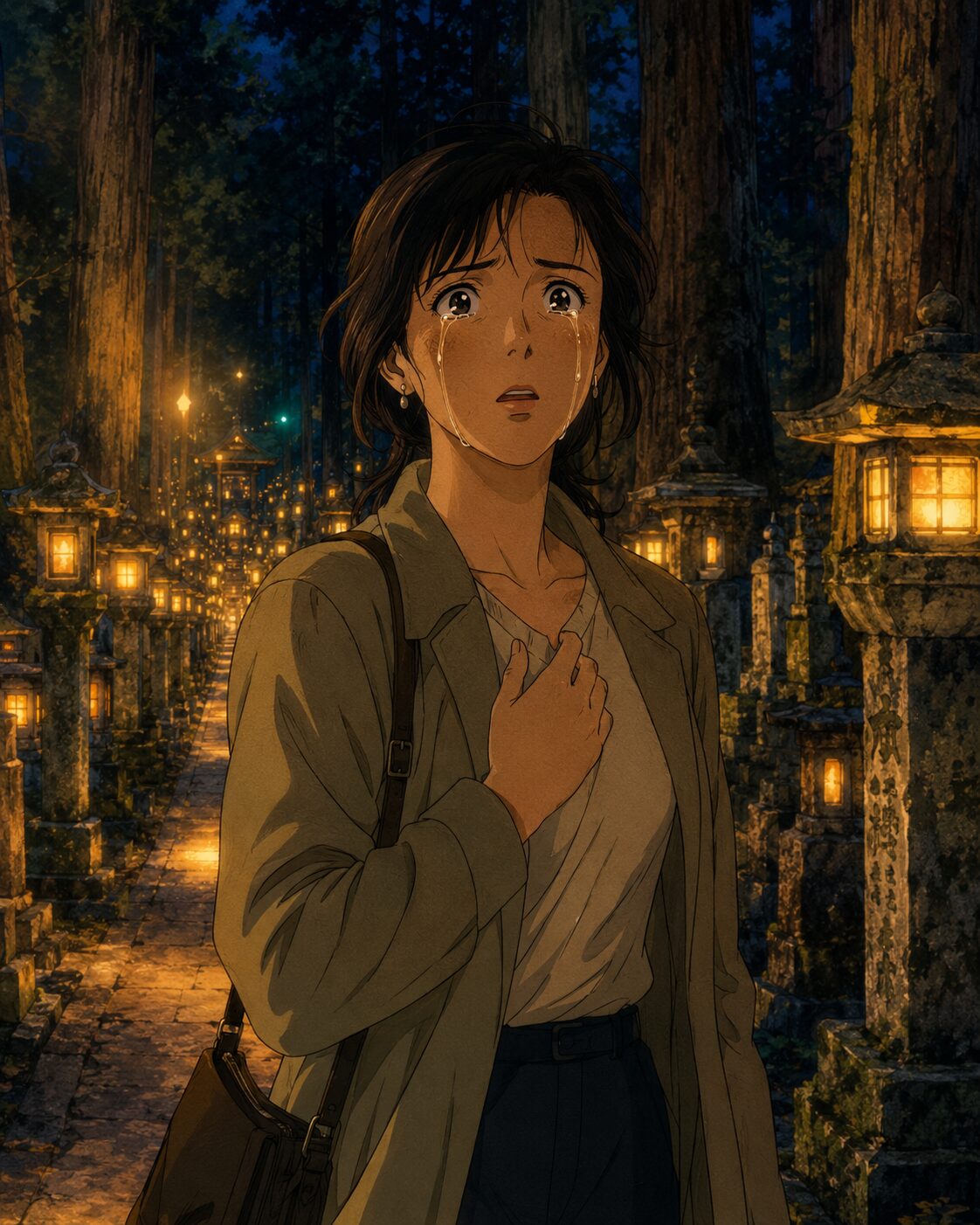
Those who go to Koyasan take something home. It is not a souvenir. It is an “experience.”
What follows is a collection of unbelievable stories that actually happened at Okunoin, the Toro-do, the sanctuary, and the temple lodgings — stories scattered across the internet. All of them experienced by different people, at different times, in different places. If there is a common thread, it is just one: the person themselves feels they were “called to Koyasan.”
First. A woman in her thirties who worked as a company employee in Tokyo.
She had no complaints about her life, she says. Work was going well, love was going well, family was healthy. But one day, suddenly, the word “Koyasan” dropped into her mind. At first she ignored it. Why Koyasan all of a sudden, she herself did not know. But from that day, strange things began to happen. The TV she turned on happened to be airing a special program on Koyasan. Enter a bookstore and a book on Koyasan was stacked at the entrance. At a café she stopped for lunch, the person in the next seat was saying, “Last week I went to Koyasan, you know.” “I’m being called.” She judged it so. Three weeks later, she took paid leave and headed to Koyasan alone.
About 500 meters after she began walking the Okunoin approach path, suddenly her tears would not stop. The reason, she did not know. She was not sad, nor happy. The tears simply spilled, one after another. On both sides of the path, enormous cedars over 700 years old. On the ground, 200,000 graves and memorial monuments. She walked on through them, weeping. By the time she crossed the Gobyo Bridge, the tears had stopped. In their place, her mind had grown strangely quiet.
And the instant she entered the Toro-do, she heard it. “Thank you.” It was not a voice. But certainly, it echoed within her mind. Whose voice, she did not know. But she knew it was the voice of “her late father.” Her father had died three years earlier. In life, she had not been able to say “thank you” to him. That had snagged in her heart all this time. She wept aloud on the spot.
And after returning to Tokyo, her life changed, she writes. What changed, it is hard to explain. But she writes this: “I was able to say a proper goodbye to my father. Until then, my life had been stopped, I realized. Now, at last, I can move forward.”
Second. A woman in her fifties, from Kyushu.
She had received a cancer diagnosis. Stage 3. Surgery was recommended. But something snagged. Before undergoing surgery, there is a place I want to go. So she felt. It was Koyasan. She had never been. Why she wanted to go to Koyasan, she herself did not know. But she felt she had to go. With her husband, the two of them climbed Koyasan.
Before the sanctuary of Okunoin, she pressed her palms together for a long time. “O Daishi, I do not want to die yet. I want to live a little longer. I want to spend more time with my family.” So she asked in her heart. At that moment, within her mind, this echoed. “It’s all right. You will still live here.” It was not a voice. But clearly, it reached her. She wept aloud on the spot. And on the spot she decided. “I will live.”
Afterward, she underwent surgery. The recovery was extremely good. Five years later, she received a diagnosis of full recovery. “Had I not been called to Koyasan, I would have climbed onto the operating table still in despair. Without that voice saying ‘it’s all right,’ my body might not have recovered.” So she reflects.
Third. This is a story from a temple lodging.
A temple lodging (shukubo) is an inn run by a temple. Koyasan has more than fifty of them. Even tourists can stay. You can experience Buddhist vegetarian meals morning and evening, the morning service, sutra copying, and more. A certain man in his twenties stayed at a temple lodging for the first time.
He ate dinner, took a bath, and returned to his room. Late at night, he woke. Something could be heard. It was the sound of sutra chanting. Low, slow, a man’s voice chanting a sutra. At first he thought the guest in the next room was chanting something. But the voice was too close. It was not from the next room. It was being heard right near him. He looked around the room. No one was there. But the voice continued. Ten minutes, twenty, thirty. The chanting did not stop. He was not afraid. He did not know why, but he felt at ease. He knew instinctively that it was not a presence that would harm him. After a while, he fell asleep again.
In the morning, he told a monk at the lodging about it. The monk laughed. “It’s not a rare thing. One of the Daishi’s disciples must be continuing their devotions even in the night.” “Is the disciple a living person?” “No, someone who has already passed. But like the Daishi, they continue chanting the sutra within their meditation.” He was speechless. But certainly, the chanting he had heard was not in modern language. It had a strange cadence, like the pronunciation of the Heian period. “Did I hear someone’s devotions from a thousand years ago?” So he writes.
Fourth. This is the story of another woman.
At Okunoin, she had this experience. As she walked the approach path, suddenly her feet stopped. She had not been pulled by anything. But her feet would not move. Before the eyes of the woman who had halted was a single small grave. An unknown name. Whose grave, she did not know. But she could not move from there. And within her mind, this echoed. “Thank you.” It was the voice of an unknown man.
She pressed her palms together before that grave and prayed for a while. She had not asked for anything. She simply pressed her palms together as if to answer that voice. For about five minutes, she stayed so. Then, her feet could move again. After that, she walked the approach path to the end.
After returning to Tokyo, she had a certain dream. In the dream, an unknown man appeared. “Thank you for the other day. For a long time, no one noticed me, and I waited there. I was glad you stopped for me. Now, I can go.” So the man said, and vanished. Since then, she does not have that dream. “Whose grave was that? Why did I stop? Even now, I don’t understand. But I think something was released through me.” So she writes.
These are all real experiences, reported online by people who went to Okunoin. Search and more will come up. Hundreds, thousands, perhaps tens of thousands. And all share a common point. It is that “between before going and after going, life changed.” Clearly changed. Changed in a way that cannot be ignored. And those who changed say this: “I was called, and I went.” “And I came home having been given an answer.”
Often, the person themselves does not clearly understand what the “answer” was. But looking back later, something had occurred at Okunoin. Whether it was Kukai, the cosmos, or one’s own soul, that is not known. But certainly, something occurred.
CHAPTER 10 The Forest of Corporate Graves — Coffee, Yakult, Rockets, Termites
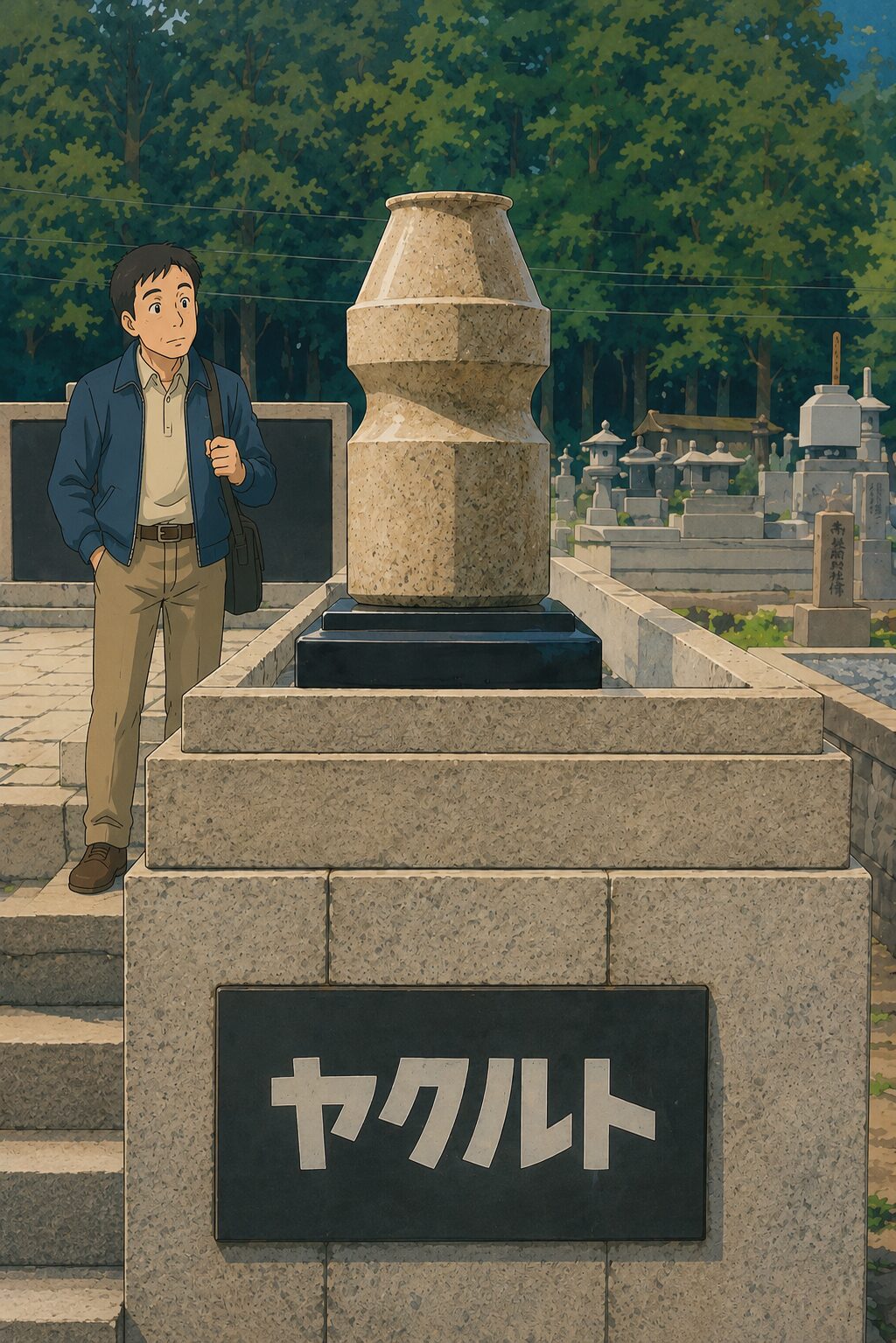
The Okunoin approach path is no mere path. More than 200,000 graves and memorial monuments line it. There are graves of warlords. As written in Chapter 11: Oda Nobunaga, Takeda Shingen, Tokugawa Ieyasu, Uesugi Kenshin, Date Masamune, Akechi Mitsuhide. The principal figures of Japanese history are nearly all gathered here.
But as you walk the path, a different kind of grave, utterly unlike the warlords’, comes into view. These are the “corporate graves.” Okunoin is said to have roughly 100 to 140 corporate graves.
Here, imagine. A grave for a company. The company has not died. The company is still operating, active. And yet a grave stands in the company’s name. Why? Because it is a grave the company built to console the souls of its employees, its business partners, its customers — and the souls of its “products” themselves.
“The souls of products” — what is that, you may think. But the Japanese have long believed that spirits dwell in objects. Needle memorial services, doll memorial services, blade memorial services. Objects, too, have souls. So when you are indebted to an object for many years and the time comes to discard it, you console it with gratitude. They do this at the corporate level. And the “mecca of corporate graves” is the Okunoin approach path.
Let us introduce a few striking corporate graves that come into view as you walk the path.
First, the grave of UCC Ueshima Coffee. As you walk the path, an enormous coffee cup and saucer come into view. On a fine saucer sits a plump, round coffee cup. Inside, even the coffee color is reproduced with red stone — that level of attention to detail. This is the corporate grave of UCC Ueshima Coffee. This grave carries a clear message: “We console here the souls of all the coffee beans, and all the customers, to whom we are indebted.” We drink coffee every day. A single cup uses about 100 coffee beans. Behind it lie an unimaginable number of coffee cherries, the farmers who grew them, the people who transported them, the artisans who roasted them. To all those lives and labor, UCC gave its gratitude form. That is this grave, the coffee cup.
Second, the Yakult grave. Near UCC is another striking grave. It is an enormous “Yakult bottle.” A Yakult bottle, magnified dozens of times the real size, stands along the path. This too shares UCC’s thinking. In each bottle of Yakult, countless lactic-acid bacteria live. To the countless lives of those bacteria, Yakult offers its gratitude. “That Yakult sees today’s prosperity is the fruit of comrades uniting and striving to build a healthy society… we enshrine here the spirits of the departed who served the Yakult industry, and make this the spiritual ground of all Yakult, a remembrance for the people of later ages.” This is the text inscribed on the corporate grave that Yakult Honsha Co., Ltd. erected at Okunoin in 1964. And this enormous Yakult-bottle grave asks of all who see it: “We drink Yakult every day. But have we ever consoled the souls of its lactic-acid bacteria?”
Third, the rocket of ShinMaywa Industries. As you walk the path, something comes into view in the distance. A space rocket. To be precise, a model of “Apollo 11.” A black-and-white two-tone. A pointed tip. A full length so tall you must look up. ShinMaywa Industries is a company that manufactures aircraft parts. As their own grave, they built an “Apollo 11 rocket” at Okunoin. This grave has a deep meaning. Humanity went to the moon. It is one of the greatest scientific achievements in human history. But behind it lay countless engineers, countless sacrifices, countless prayers. ShinMaywa Industries, as a company involved in the history of the aviation industry, consoles here the souls of all those involved. Space development and esoteric Buddhism. The most advanced science and technology, and a faith from 1,200 years ago. They meet on the Okunoin approach path.
Fourth, the termite memorial tower of the Japan Termite Control Association. The Japan Termite Control Association, an industry body engaged in termite extermination, built a memorial tower at Okunoin. Its purpose, what is it? “To console the souls of all the termites they have exterminated.” On the memorial tower is inscribed: “Termites, rest in peace.” On the association’s website it is written: “A symbol of compassion for the lives that, though receiving life in this world, are lost because they cannot coexist with human life, and of gratitude to the pioneers.” Termites are, for humans, pests. They eat away at houses and destroy property. They must be exterminated. But termites, too, have life. If you must kill, you should hold a heart of gratitude and consolation. Termite exterminators visit Okunoin’s termite memorial tower every year. There they press their palms together and bow their heads to the termites whose lives they have taken. Is there a more thorough way of facing life than this? In the world there are many people who must take other lives for their work. Fishermen, farmers, slaughterhouse workers, researchers, medical workers. They handle life. And insofar as they handle it, gratitude and consolation are needed. The termite memorial tower shows us this in its most extreme form.
Fifth, the Fukusuke doll of Fukusuke. The tabi-sock maker Fukusuke has built, as its grave at Okunoin, a statue of its own character, the “Fukusuke doll,” just as it is. That doll with the big head, sitting perched. It sits eternally beneath the cedars of Okunoin. “We console the souls of all the tabi socks, and all the customers’ feet, to whom we are indebted.” At Okunoin, Fukusuke goes on bowing its head to customers, forever.
Sixth, the grave of Panasonic’s founder, Konosuke Matsushita. This is said to be the origin of the corporate-grave boom. Konosuke Matsushita deeply revered Kukai in his lifetime. In 1938, he built the corporate grave of what was then Matsushita Electric Industrial at Koyasan. This is said to be the oldest corporate grave of a joint-stock company at Koyasan. It greatly influenced postwar business leaders. “Konosuke Matsushita built a corporate grave at Koyasan. Then let my own company build one too.” And corporate graves increased one after another at Okunoin. Now, Okunoin has become the largest concentration of corporate graves in Japan.
Nissan Motor, Kokuyo, Kubota, Aderans, Denka, Kirin Beer. The names of countless Japanese companies line the Okunoin approach path. Among researchers who have studied cemeteries around the world, some are speechless on seeing Okunoin. “I have seen graves all over the world, but this is the first place I have seen with such original graves lined up. A coffee-cup grave, a Yakult grave, a rocket grave, a termite grave. This is unlike any cemetery in the world.” And they continue: “And it is the first cemetery, too, where I feel such deep respect for life and soul.”
This is the essence of Okunoin. Every company, in earnest, builds a grave here with gratitude and consolation toward all the lives connected to them — their products, their customers, their employees. And Kukai accepts it all. “So you’ve come. You too have come here.” Within the sanctuary of Okunoin, Kukai, sitting, accepts each and every corporate grave. Warlords, imperial family, commoners, companies, termites. All souls gather here, equally.
Okunoin is not “Japan’s largest cemetery.” It is “Japan’s largest museum of life and soul.” Humans, animals, plants, products — every “existence” coexists here, forever. And Kukai watches over all of it.
When you walk the path, suddenly raise your gaze. Between the branches of the 700-year-old cedars, you may sense Kukai watching you. “What soul have you come here to entrust?” You may feel you are being asked this. And when you finish walking the path, you realize: how many “lives of others” are within you yourself. The things you eat every day. The things you use every day. The people you meet every day. All of them live within you.
CHAPTER 11 Where Friend and Foe Both Sleep — Nobunaga, Shingen, Ieyasu
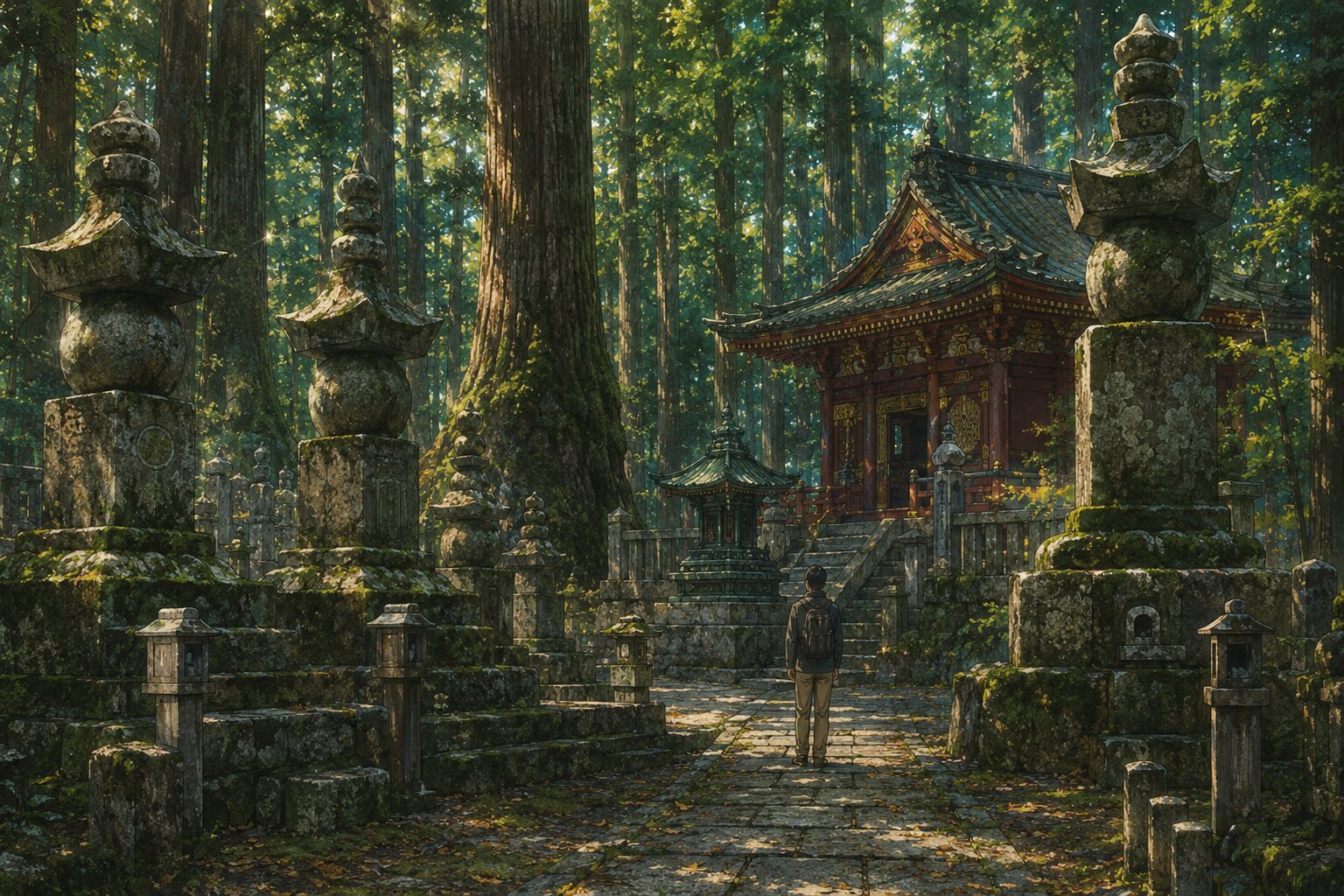
Walk the Okunoin approach path. Advance through more than 200,000 graves and memorial monuments. Enormous cedars over 700 years old. Moss-covered stone pagodas. Sunlight filtering through the trees. And at a certain place, your feet stop. “Oda Nobunaga — Gravesite.”
No huge signboard, no flashy ornamentation. But its presence is overwhelming. The grave of that man, who in the Warring States period tried to unify Japan through terror and violence, is here. And nearby is another grave. “Akechi Mitsuhide — Gravesite.” The grave of the man who killed Nobunaga at Honnoji. Walk a little further and “Toyotomi Hideyoshi — Gravesite.” The grave of the man who served as Nobunaga’s retainer and, after Nobunaga’s death, unified the realm. And walk a little more, and “Tokugawa Ieyasu — Gravesite.” The grave of the man who destroyed the Toyotomi house and opened the Edo shogunate that lasted 260 years.
Here you notice something strange. Nobunaga, Mitsuhide, Hideyoshi, Ieyasu. In life, they killed one another. Mitsuhide killed Nobunaga, Hideyoshi killed Mitsuhide, Ieyasu destroyed the Toyotomi house. Hatred, betrayal, war, slaughter. Their relationships were among the bloodiest in Japanese history. And the graves of these men line up along the same path at Okunoin.
This is, even by world standards, extremely unusual. In the cemeteries of ordinary religions, such a thing does not happen. Christian cemeteries, Muslim cemeteries, Jewish cemeteries, Hindu cemeteries. Each admits only believers of its own sect. And it would be impossible for the grave of a man who was your enemy to stand right beside yours. But at Okunoin, it happens. Why? Because Kukai declared this: “Okunoin accepts all souls.”
Sect does not matter. Status does not matter. Good and evil do not matter. Friend or foe does not matter. All souls can come to Okunoin. This is the fundamental thought of esoteric Buddhism. You could call it the worldview of the “mandala.” A mandala depicts the worldview of esoteric Buddhism in a picture. At the center is Mahavairocana. Around him are arranged countless buddhas, bodhisattvas, wisdom kings, devas, and people, animals, nature — all of it. And within the mandala, all existences are equal. There is no center, no periphery, no above or below. All coexist as parts of the cosmos. Okunoin is a vast mandala, recreating that on earth. And Kukai sits at its center.
The grave of Oda Nobunaga. On June 2, 1582, Nobunaga was attacked by Akechi Mitsuhide at Honnoji and took his own life. He was 49. His body turned to ash in the fire at Honnoji and was never found. In other words, there is no body of Nobunaga. Yet at Okunoin, there is a grave of Nobunaga. This is what is called a “memorial tower.” No body is inside. But it was built to console Nobunaga’s soul here. Interestingly, Nobunaga was, in life, hostile to Koyasan. In 1581, Nobunaga attacked Koyasan and was about to burn it down. Had the Honnoji Incident not occurred, it is highly likely Koyasan would have been destroyed by Nobunaga. That Nobunaga, Koyasan forgave. After Nobunaga’s death, the monks of Koyasan built a memorial tower for Nobunaga at Okunoin. “Soul of Lord Nobunaga, rest here in peace.” They forgave and welcomed in the man who had tried to kill them. This is Kukai’s teaching. “Forgive your enemy.” “Let the past flow away with the water.” “Treat all souls equally.”
And nearby, there is also the grave of Akechi Mitsuhide. After killing Nobunaga, Mitsuhide was struck down by Hideyoshi in a mere eleven days. It was a brief seizure of power called the “three-day reign.” And Mitsuhide’s memorial tower, too, is at Okunoin. Nobunaga’s memorial tower and Mitsuhide’s memorial tower stand near each other. “The one who killed and the one who was killed” sleep side by side. It is a sight you can see only at Okunoin. Incidentally, there is a saying about Mitsuhide’s memorial tower: “No matter how often it is repaired, the stone cracks.” It is said to be because of Nobunaga’s resentment.
The grave of Toyotomi Hideyoshi. From his days as Nobunaga’s retainer, Hideyoshi deeply revered Okunoin. He himself built a temple at Koyasan called “Seiganji” (later Kongobuji) to console his late mother. After Hideyoshi’s death, his grave too was built at Okunoin. Around him, the graves of the principal figures of the Toyotomi house — his mother Omandokoro, his brother Hidenaga, his son Hideyori, his official wife Kita no Mandokoro — are arranged together. It is a section you could call “the Toyotomi family cemetery.” And beside it, there is also the grave of Tokugawa Ieyasu. Ieyasu defeated the Toyotomi retainers at the Battle of Sekigahara. And at the Summer Siege of Osaka, he forced Toyotomi Hideyori to take his own life and destroyed the Toyotomi house. That Ieyasu’s grave is right beside the Toyotomi family cemetery. The man who destroyed the Toyotomi house, and the Toyotomi house that was destroyed. Both sleep side by side. And between the graves of these men, enemies in life, modern tourists walk freely. The hatred, war, and slaughter of 500 years ago are not here. There is only the quiet Okunoin path, with memorial towers lined along it.
The grave of Takeda Shingen. And the grave of Uesugi Kenshin. In the Warring States period, Shingen and Kenshin fought five times at Kawanakajima. The “Battles of Kawanakajima” were among the fiercest in Japanese history. The two tried to kill each other. Thousands of soldiers lost their lives in their battles. The graves of Shingen and Kenshin line up along the same Okunoin path. And strangely, the memorial tower of Takeda Shingen and his son Katsuyori, and the splendid vermilion-lacquered mausoleum of Uesugi Kenshin (an Important Cultural Property), face each other across the path. “The dragon and tiger of the Warring States, 500 years on, face off as if at Kawanakajima.”
The grave of Date Masamune. And Ishida Mitsunari, Kato Kiyomasa, Yuki Hideyasu, Hori Hidemasa, Azai Nagamasa, Asakura Yoshikage. Nearly all the warlords who appear in Japanese history textbooks are here. Count them and the scale overwhelms. Okunoin could be called “the final gathering place of the Warring States period.” They fought, killed one another, and in the end, all came here. And Kukai welcomed them in.
Why did they want to come to Okunoin? Because it was believed that if you came to Okunoin, when the bodhisattva Maitreya descends 5.67 billion years from now, you would share in his salvation. This is the esoteric thought of “the descent of Maitreya.” The bodhisattva Maitreya is the buddha who appears after Shakyamuni. When he descends, all sentient beings are saved. And Kukai, at that time, descends together with him as Maitreya’s attendant. If you build your own grave at Okunoin, Kukai will find you. And you can share in the salvation of the bodhisattva Maitreya. The warlords believed this. In life, they had taken countless lives. They bore the consciousness of sin. They feared falling into hell in the world after death. But if they built their memorial tower at Okunoin, Kukai would save them. They believed so. And Kukai accepted it. “Come. You too, come here. Your sins, I forgive. I accept all souls.”
And there is one more fascinating thing. As you walk the Okunoin path, you come upon a section called the “Muenzuka” (mound of the unconnected). Here, countless small graves and memorial monuments whose owners are unknown are piled up. Lonely souls with no one to claim them. No family, no descendants. Remembered by no one. The graves of countless ordinary people who left no mark on history. And they, too, are at Okunoin. Warlords and nameless commoners line the same path. To Kukai, they are the same. “All souls are equal.”
This is the true greatness of Okunoin. Search the whole world and there is no place like it. Regardless of status, sect, or friend and foe, it accepts all souls. It has held to that thought for 1,200 years.
When you worship at Okunoin, please stop before Nobunaga’s grave. And consider this. “This man, in life, killed tens of thousands of people. He should fall into hell, you might think. But he is here. Forgiven by Kukai. Why?” The answer is simple. Kukai forgives all souls. Because all souls come from the cosmos and return to the cosmos — the same existence. Nobunaga, Mitsuhide, Hideyoshi, Ieyasu, Shingen, Kenshin. In life, they were enemies. But after death, all become the same “soul.” And all souls come from the cosmos and return to the cosmos. On that path of passage stands Okunoin. And Kukai, on that path, sees off and welcomes in every soul. “Good work. Welcome.” So Kukai calls out to every soul. And within that “every,” someday, you too are included. We all, someday, come to Okunoin. Somewhere along the same path as the warlords.
CHAPTER 12 Dogyo Ninin — The Thought That the Pilgrim and Kukai Walk Together
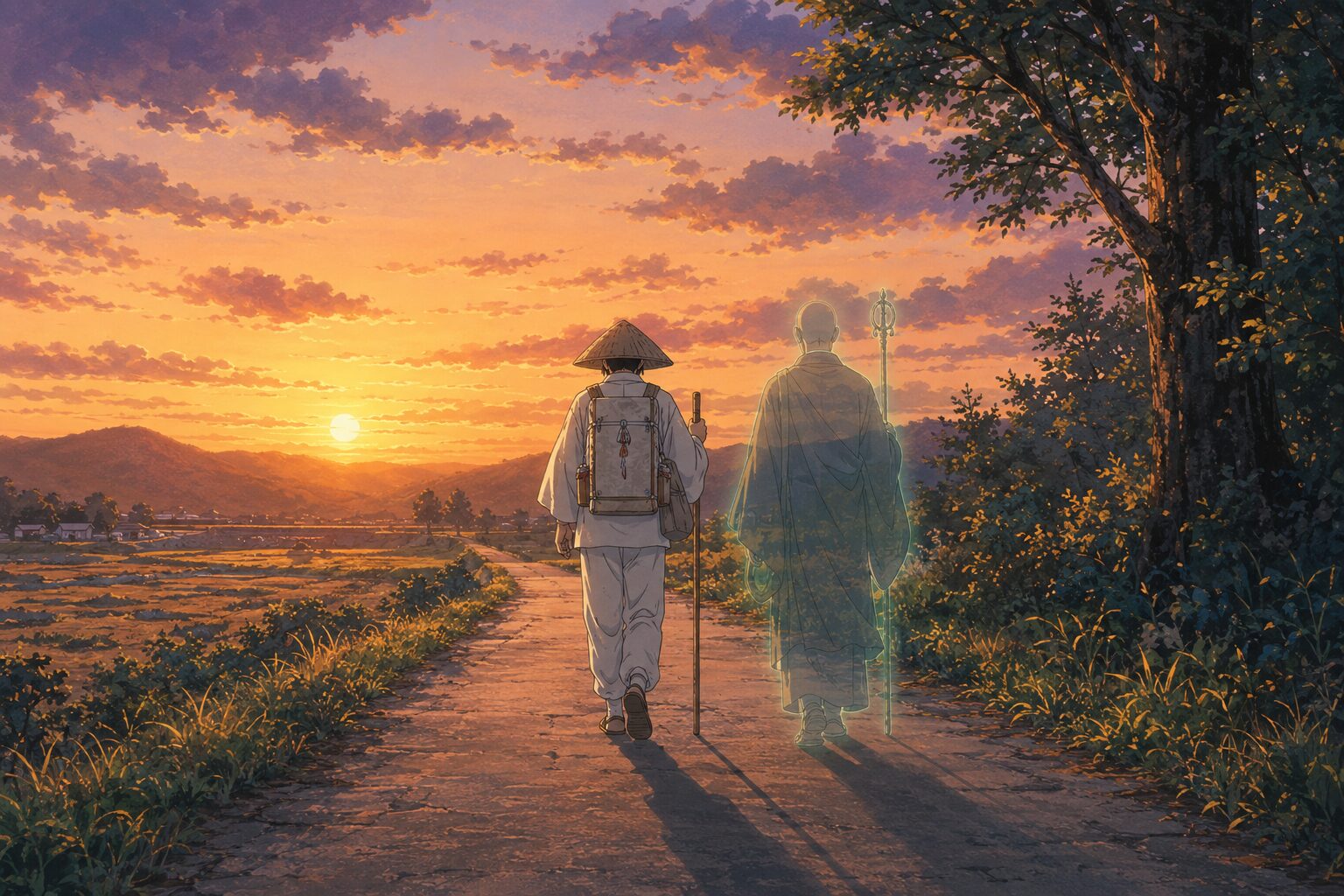
In Shikoku, there is a certain pilgrimage road. The “Shikoku Eighty-Eight Sacred Sites,” also known as “Ohenro.” It is a pilgrimage road of about 1,400 kilometers that circles the island of Shikoku. Along the way, 88 temples associated with Kukai are scattered. You visit them in order. Walk it and it takes about 45 days. By car, about 10 days.
Those who go on the Ohenro wear special attire. White vestments. A white sedge hat. In hand, a kongo staff. At the waist, a stamp book. Around the neck, a wagesa (simplified surplice). And on the hat and the kongo staff is written: “Dogyo Ninin.”
What is “Dogyo Ninin”? Literally, it means “two going together.” But on the Ohenro, most people walk alone. Alone, they circle Shikoku. The road they walk is long and lonely. There are mountain roads, coastal roads, town streets. There are rainy days, and stormy days too. The feet ache. The back is heavy. Even so, they write “Dogyo Ninin.” Why?
The answer is this. “I am not walking alone. Kukai is always beside me.” This is the true meaning of “Dogyo Ninin.” Beside the one walking the Ohenro, Kukai is always there. Unseen, but certainly there. On rainy days. On stormy days. When the feet ache. When the heart is about to break. Kukai walks alongside them. “You are not alone.” “I am walking with you.” “So, keep going.” So Kukai speaks, without making a sound.
Those who have experienced the Ohenro all say this. “At first I thought I was walking alone. But one day, suddenly, I felt as if someone were beside me. From then on, my steps grew lighter.” “The moment I realized I was not alone, the Ohenro became something entirely different.” This is the true form of the Ohenro.
And here, one more important thing. The thought of “Dogyo Ninin” is not only the Ohenro. It is the fundamental worldview of esoteric Buddhism. Kukai is alive even after entering nyujo. And his consciousness does not remain only within the sanctuary of Okunoin. It is dispersed throughout the entire cosmos. Which means Kukai is, anytime, anywhere, beside anyone. Beside the one walking the Ohenro. Beside the office worker exhausted by work. Beside the student agonizing over exam study. Beside the patient on a hospital bed, about to be crushed by anxiety. Beside the person crying alone late at night. Kukai accompanies everyone. Only, most people do not notice it. But those who have walked the Ohenro notice. “Ah, you were beside me all along.” “I always thought I was alone, but in truth I was not alone.” This is the warmest teaching of esoteric Buddhism.
And let us continue the Ohenro story a little more. Why 88 sites in Shikoku? There are various theories, but the most prevailing is that it is “the number of human worldly desires.” It is said humans have 108 worldly desires. The New Year’s bell is struck 108 times to dispel them. But the Ohenro is 88 sites. Why not 108? It is explained this way: “a journey of extinguishing the fundamental 88 worldly desires of humans, one by one.” By circling Shikoku, you extinguish the worldly desires within you, one at a time. And when you reach the 88th, Okuboji. By then, you are freed from worldly desire. This is the final goal of the Ohenro.
And after circling the 88 sites, the pilgrim finally visits one more place: Koyasan’s Okunoin. This is called “kechigan” (fulfillment of the vow). Having circled Shikoku’s 88 sites, you go last to report to Kukai. “O Daishi, I have circled Shikoku. I have walked with you all along. Thank you for your hard work. And thank you.” So you press your palms together before the sanctuary of Okunoin. With this, the Ohenro journey is complete.
Every year, tens of thousands of people walk the Ohenro. For health. For training. To console a deceased family member. For a turning point in life. The reasons differ from person to person. But they always arrive at the same place. Before the sanctuary of Okunoin. And they bow their heads to Kukai.
And there is one more fascinating tradition of the Ohenro: “osettai” (offering of hospitality). The people of Shikoku, when they see someone walking the Ohenro, naturally call out to them. “Thank you for your hard work. Please, take this.” So saying, they hand them tea, sweets, or rice balls. Sometimes they put them up in their homes. Let them bathe. Drive them to the next inn. This is called “osettai.” This is not kindness toward tourists. The people of Shikoku see the one walking the Ohenro as “Kukai himself.” Because of “Dogyo Ninin,” beside the one walking the Ohenro is Kukai. And they offer tea to Kukai himself. To the one who offers osettai, the one walking the Ohenro is an incarnation of Kukai. This too is a teaching of esoteric Buddhism. “Within every other person, there is a buddha.” The unknown person before you. Within that person, too, there is a buddha. So you are kind to them. That connects to nurturing your own buddha-nature. The Ohenro and osettai. These two combine, and all of Shikoku becomes a single vast place of training. And at its center is Kukai of Okunoin.
Here, let us return to our own lives. We are not walking Shikoku. We do not wear the white vestments of the Ohenro. We do not carry a kongo staff. But we, too, are walking the long road of life. The road of work. The road of family. The road of dreams. The road of struggling with illness. The road of heartbreak. The road of bereavement. All of them are long pilgrimage roads. And beside that road, too, Kukai is there. “You are not alone.” “I am walking with you.” It does not become a voice. But there are times you suddenly feel it. When you cry in despair late at night. You feel as if someone beside you is handing you a tissue. When it is hard to get up in the morning. You feel as if someone behind you is pushing your back. It is all Kukai. Kukai is not only within the sanctuary of Okunoin. Kukai’s consciousness, dispersed throughout the entire cosmos, is beside us, anytime. Only, we do not notice it. But the instant we notice, our lives change. “I am not alone.” With that conviction, a person can overcome any hardship. That is “Dogyo Ninin.”
And finally, one more thing. When you walk the Okunoin path, suddenly look back. Behind you, there should be someone. You may not see them. But certainly, someone is following you. It is not Kukai. It is all the people you have met throughout your life. Deceased family. A former lover. Old friends. Strangers you passed by. The souls of all those people walk the Okunoin path together with you. And at their head is Kukai. “You have lived connected to all these people. All of them have supported your life. And from here on, they will keep supporting you.” So Kukai conveys to you. This is the true depth of “Dogyo Ninin.” We are not walking as two with Kukai. We are walking together with countless souls. And Kukai gathers them all together. This is the greatest gift that only those who have come to Okunoin can feel.
CHAPTER 13 Ten Places to Walk Koyasan Deeply
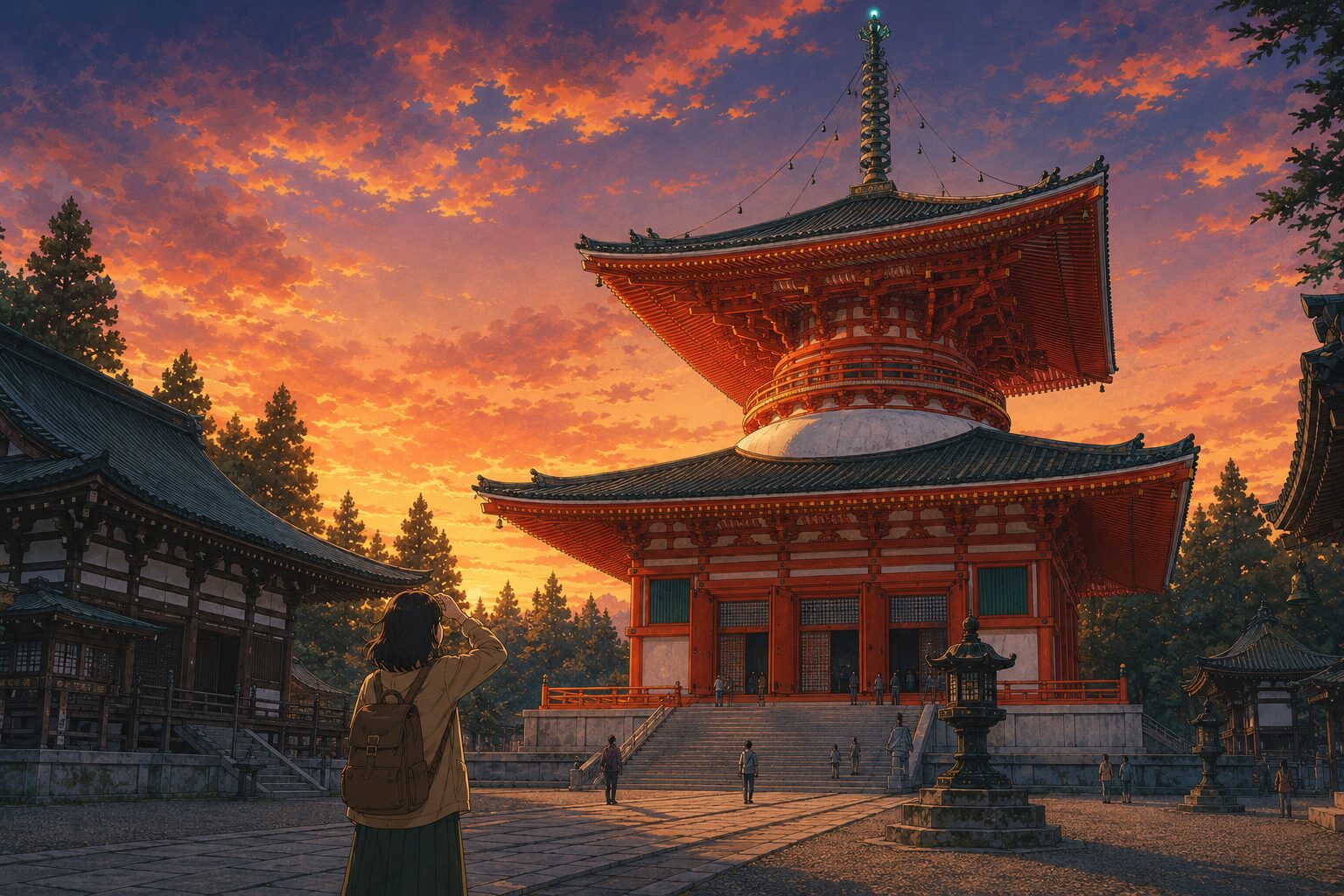
Koyasan is vast. About 3.5 kilometers east to west. A religious city where 117 temples cluster together. You cannot see it all in a day. But hold to the ten places introduced here and you will grasp the true depth of Koyasan. Whether your first visit or your tenth, walk these ten places thoroughly.
[1] Okunoin. Needless to say, the heart of Koyasan. Walk the approach path of about 2 kilometers from the Ichi-no-hashi bridge to the sanctuary. On both sides of the path, cedars over 700 years old, more than 200,000 graves and memorial monuments. Warlords, imperial family, corporate graves — all of it is here. And cross the Gobyo Bridge, pass through the Toro-do, and stand before Kukai’s sanctuary. Here is the beginning, and the end, of everything. The proper order of worship is this. Enter from “Ichi-no-hashi.” Walk the path slowly. Pass “Naka-no-hashi.” Glancing at the Sweat-Wiping Jizo and the Sugatami Well, advance along the path. At the Gokusho, bow your head, and at the Ajimi Jizo, press your palms together. Then cross the Gobyo Bridge. Before crossing, always bow once toward the bridge. This is the boundary between the present world and the sacred precinct. After crossing, photography is forbidden. Remove your hat. Refrain from private chatter. Press your palms together at the Toro-do. And going around behind the Toro-do, give your deepest palms-together before Kukai’s sanctuary. On the way back, return the way you came. This too is the etiquette of worship. When you come to Okunoin, set aside at least two hours here. There is also a “night worship.” A “night tour,” in which a monk guides you along the night path by the light of paper lanterns alone. It is popular, and reservations are essential. It shows a face of Okunoin utterly different from the daytime.
[2] Danjo Garan. The other of Koyasan’s two great sacred sites, alongside Okunoin. The place Kukai first developed when he opened Koyasan. It is a vast religious space that recreates the esoteric worldview of the “Womb Realm mandala” three-dimensionally on earth. Standing at its center is the “Konpon Daito” (Great Stupa). A 48.5-meter-tall, vermilion-lacquered, enormous Tahoto pagoda. Step inside, and the world changes. At the center, Mahavairocana of the Womb Realm. Around it, the four buddhas of the Diamond Realm. On the 16 pillars, the sixteen great bodhisattvas are painted. This is a three-dimensional mandala. You do not see it in a picture. You enter it. And you yourself become part of the mandala. This was Kukai’s design. And the “Three-Pronged Pine” is here too. The legendary pine, written of in Chapter 2, on which the vajra Kukai threw from Tang once caught. Please, try searching for a three-needle cluster.
[3] Kongobuji. The head temple of the Koyasan Shingon sect. “Seiganji,” which Toyotomi Hideyoshi built to console the soul of his late mother, and another temple, “Kozanji,” merged in the Meiji period to become the present Kongobuji. Enter the main hall. In the “Great Hall,” fusuma paintings of cranes and pines by painters of the Unkoku school spread before you. The “Banryutei” is one of Japan’s largest rock gardens. It is larger than the rock garden of Ryoanji in Kyoto. Within a sea of clouds, a male and female dragon are placed, as if guarding Okunoin. Here, press your palms together and simply sit. Time stops. That is the power of Kongobuji.
[4] Reihokan. The Reihokan, written of in detail in Chapter 8. 21 National Treasures, 148 Important Cultural Properties, a collection of about 100,000 pieces. Kaikei’s Four Heavenly Kings, statues by Unkei and Kaikei, the Blood Mandala, Kukai’s own calligraphy. Here, how do you react? Can you stay long, or do you want to leave right away? By that, you learn your own spiritual sensitivity. The admission is by no means cheap. But there are almost no places in the world where you can see this many National Treasures for this price.
[5] Daimon. The enormous vermilion-lacquered gate at the entrance to Koyasan. Height, 25.1 meters. Japan’s second-largest pair of Kongo Rikishi guardian statues stand to the left and right, glaring at those who enter. This is no mere gate. It is the starting point of the barrier of all Koyasan. When Kukai cast the barrier around Koyasan, he built this gate at the entrance of that seven-ri-square boundary. “Beyond here lies the sacred precinct. Do not bring in the defilement of the lower world.” So the Daimon speaks. If you come to Koyasan by car, please pass through the Daimon once before entering the town. Even just passing through, you feel the air change. And in the evening, the moment the setting sun dyes the Daimon red. It is one of the most beautiful sights you can see at Koyasan.
[6] Tokugawa-ke Reidai. The mausoleum enshrining Tokugawa Ieyasu and the second shogun, Hidetada. It is a symbol of the Tokugawa house’s power in the Edo period. But what is interesting here is “why Ieyasu built a mausoleum at Koyasan.” The Tokugawa house was not originally deeply tied to the Shingon sect. Ieyasu was a believer of the Pure Land sect. Even so, Ieyasu built his own mausoleum at Koyasan. Why? Because he believed in the power of Kukai, of Okunoin. “I want Kukai to watch over my soul.” Even the man who took the realm relied, in the end, on Kukai.
[7] Nyonindo. Many people do not know this. Koyasan was, until 1872, off-limits to women. Women could not enter Koyasan. But even so, there were women who wished to worship Kukai. For that, the “Nyonindo” (Women’s Halls) were established. Outside the barrier, at the entrances of Koyasan, seven worship halls for women were set up. One each at the seven entrances to Koyasan called the “Koya Nanakuchi.” Of these, only one remains today. It is a small hall called the “Fudozaka-guchi Nyonindo.” Here, in place of entering within the barrier, women pressed their palms together and offered prayers to Kukai. It is a place where you feel the weight of history.
[8] Shukubo. Koyasan now has more than fifty temple lodgings. Even tourists, anyone, can stay. Stay at a shukubo and you can eat genuine Buddhist vegetarian meals. You can take part in the morning service. You can experience sutra copying and Ajikan meditation. It is not mere tourism. It is a “training experience.” Let us introduce a few recommended shukubo. “Ekoin.” Famous as the base for the Okunoin night tour. Its English support is solid, and it is popular with worshippers from overseas. “Saizenin.” Its garden is extremely beautiful. It has a “Mandala Garden” designed by Mirei Shigemori. “Sekishoin.” It has a long history and has the memorial tower of Takigawa Kazumasu, a retainer of Oda Nobunaga. “Ichijoin.” A shukubo associated with Akechi Mitsuhide. Reservations can be made from the “Koyasan Shukubo Association” site.
[9] Koyasan Cable + Nankai Koya Line. This is not a place. It is a “way to get there.” But the way to Koyasan itself has become like a ritual. From Osaka’s Namba, board the Nankai Koya Line. About two hours. Partway, after passing Hashimoto Station, the scenery out the window suddenly grows deeply mountainous. At the terminus, Gokurakubashi Station, transfer to the cable car. The cable car climbs one of the steepest average gradients in Japan. About five minutes. And you arrive at Koyasan Station. From here, transfer to a bus, about ten minutes to the town. In other words, from Osaka to Koyasan, about two and a half hours. To come all this way, taking this much time. That itself is a form of training. “If you could get to Koyasan easily, there would be no preciousness in it.” So the faithful say. Only those who climb up after much effort can meet Kukai. That is the rule of Koyasan.
[10] Koyasan at night. This is less a place than a “time.” Koyasan has many tourists who come during the day. But once it passes 5 p.m., they all leave at once. And Koyasan at night begins. Unless you stay at a shukubo, you cannot see Koyasan at night. At night, look outside from the window of your shukubo, and the town is hushed. A dim night road, with few streetlights. Beyond it, 700-year-old cedars lit by moonlight. Only the sound of the wind can be heard. This is the true Koyasan. The Okunoin path, which bustled with tourists during the day, transforms into another world at night. Join the “night tour” and a monk guides you along the night path. By the light of paper lanterns alone, you walk the path. You cross the Gobyo Bridge at night. The countless lamps of the Toro-do shine like a galaxy in the darkness. See that sight and you understand. “This is the place wired to the cosmos.” Koyasan at night shows you the true world of Kukai.
That is the ten places. To see them all, at minimum one night and two days, ideally two nights and three days. Some may think “a day trip is fine.” But on a day trip, you cannot see Koyasan at night. You cannot taste the shukubo’s vegetarian meals. You cannot take part in the morning service. That way, the true form of Koyasan does not come into view. Please, stay one night at a shukubo. And at night, open the window of your shukubo and take a deep breath. At that moment, for the first time, you understand. “Ah — I am breathing the same air as Kukai.” From that instant, Koyasan becomes not a mere tourist spot, but part of your own life.
EPILOGUE The Meaning of Your Being Called
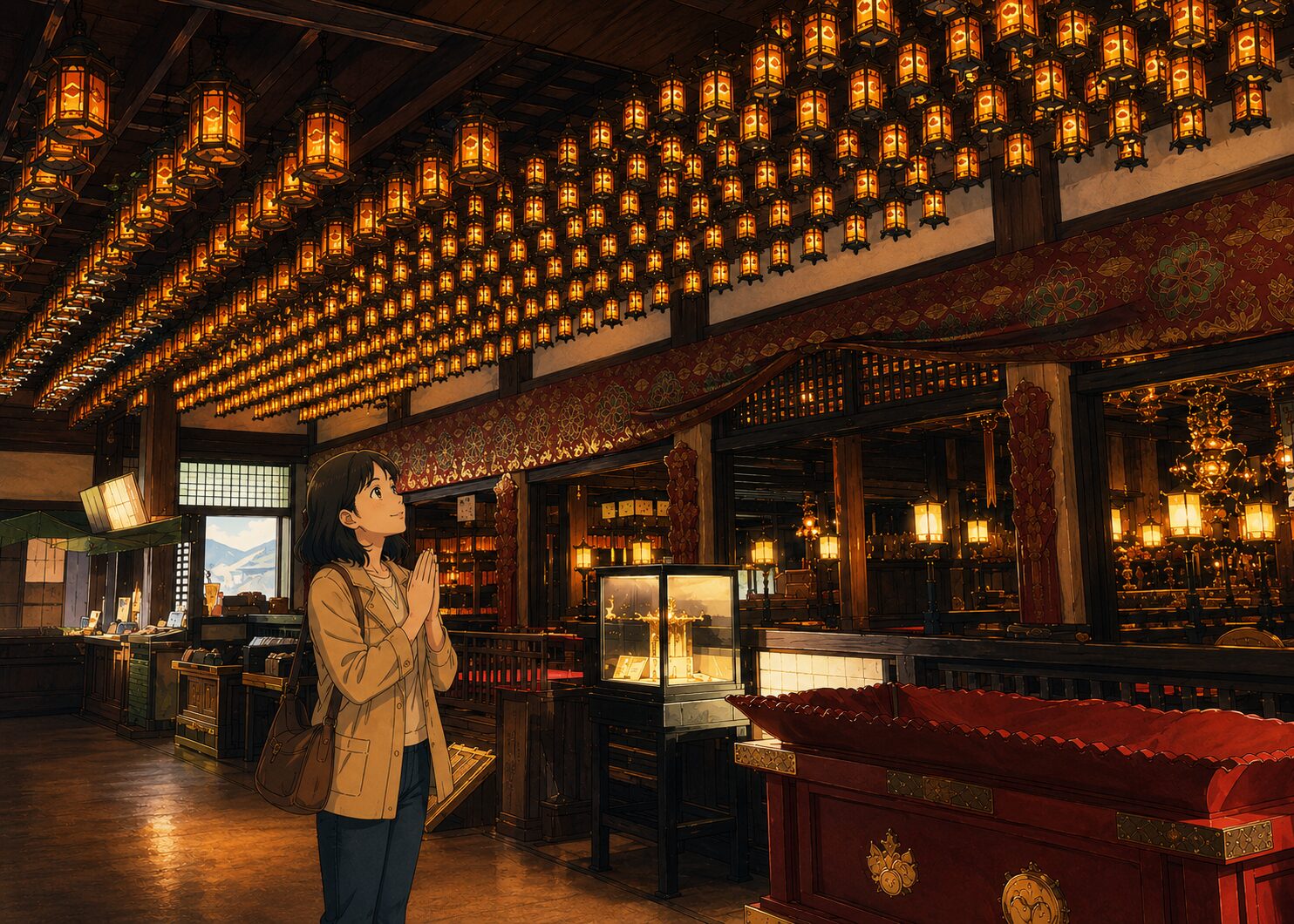
Thank you for reading this far.
We have written about Koyasan. Kukai’s monstrous life. The vajra that flew from China. The strange connection between an esoteric implement and the Nazis. Nyujo, the eternal meditation. The meal that has continued every day for 1,200 years. The 148-year-old Kukai that Kangen saw. The matching etymology of the Akashic Records and Kokuzo. The people who cannot stay long at the Reihokan. The unbelievable experiences that occurred at Okunoin. The corporate graves of coffee cups and rockets. The Okunoin where enemy and ally sleep side by side. The warm thought of Dogyo Ninin. And the ten places for walking Koyasan deeply.
You, who have read this far, should already understand. Koyasan is not a mere tourist spot. It is the one and only place where the cosmos and humanity are connected. And at its center is Kukai. Having entered eternal meditation 1,200 years ago, he sits even now within the sanctuary of Okunoin. And Kukai, keeping the door of the cosmic library open, awaits the visits of humanity.
Here, return to the first question. In the prologue, we wrote: “There is a mountain you cannot reach unless you are called.” Why are people called to Koyasan? Let us write the answer, at the last.
Life has its turning points. When work isn’t going well. When relations with family are strained. When you have lost someone dear. When you no longer know what you are living for. When you fall ill. When you suddenly want to stop and stand still. At such times, people seek something. They seek an answer. But modern society has no answer. Open your smartphone, and social media just streams past. The news is all noise. The advice is contradictory.
At such a time, a certain word drops into your mind. “Koyasan.” At first you ignore it. Why Koyasan all of a sudden, you don’t know. But from that day, strange things begin to happen. The TV is airing a special on Koyasan. At the bookstore, a book on Koyasan is stacked. Someone is talking about Koyasan. “This is no coincidence.” The instant you realize that, you are being called.
And you take paid leave, transfer between bullet train and local train and cable car and bus, and over about two and a half hours, climb Koyasan. You walk the Okunoin path. 700-year-old cedars. 200,000 graves and memorial monuments. And you cross the Gobyo Bridge. In that instant, something happens. Your tears may not stop. Your mind may suddenly grow quiet. You may hear the voice of a deceased family member. You may understand your mission. Nothing may happen. But looking back later, from that day on, your life has changed. That is the power of Koyasan.
And there is one more thing we want to write. To be called does not mean to be chosen. It is not that only “special people” are called. All people are, someday, certainly called. Only, the timing differs from person to person. One person is called at 20. One person is called at 50. One person is called before they die. One person is called after they are reborn. But every soul, someday, certainly arrives at Okunoin. And Kukai knows this. “Come whenever you like. I am waiting here.” So Kukai smiles.
Finally, if there is someone who, reading this article, felt “I want to go to Koyasan.” Go, without hesitation. It is no coincidence. You are, right now, being called. And at Okunoin, Kukai awaits you. “So you’ve come.” Go to hear those words.
And in the galaxy-like light of the Toro-do, suddenly look around. Around you, countless lights are swaying. They are Oteru’s single lamp, Retired Emperor Shirakawa’s single lamp, and each one of the prayers of the countless people who have worshipped at Okunoin until now. And someday, when you come to Okunoin again, your own prayer too is added among those lights. This is Okunoin. A place where time stops, space is wired to the cosmos, and all souls coexist here. A place only those who are called can reach. And a place that forever changes those who reach it. That is Wakayama Prefecture, Koyasan, Okunoin.
Namu Daishi Henjo Kongo.
Gassho.

Show up at Koyasan unprepared, and you
can’t shoot, can’t eat, can’t leave.
Japan’s great mountain of Buddhism is full of spots that bite if you don’t know them. Let’s stay one step ahead and breeze through it all.


PHASE 01Decide a few things before you go, and everything gets easier

01Know about the “combo pass” before you arrive
Koyasan’s main halls each charge their own admission. Pay separately at Kongobuji, the Kondo, the Konpon Daito, and it quietly adds up. Buy a Shodo Kyotsu Naihaiken combo pass first and it bundles everything at a discount. There are two versions: the one sold at Shukubo Association information offices covers five sites, not the Reihokan museum; the one sold at Tourist Association offices (2,000 yen, valid two days) covers six sites including the Reihokan. Decide which one you’ll use before you go.

02Goma and Ajikan need a “booking” and an “early start”
The real magic of Koyasan isn’t just looking — it’s taking part. But goma fire rituals are usually held in the morning. If you stay at a temple lodging you can join without booking, but day visitors need to apply in advance. The Ajikan meditation almost always needs a reservation too, and some temples don’t take phone bookings. Showing up on a whim and being turned away is the biggest waste of all.

03Winter (December on) means snow and ice — assume it
Koyasan sits at around 800m. In winter, snow piles up and the roads freeze. The Koya-Ryujin Skyline (Route 371) is under winter restrictions from mid-December to late March: fully closed at night (5pm–7am), and even by day you need studless tires or chains. And two-wheelers are banned around the clock. Climbing from the Ryujin side on a scooter in winter is a non-starter. If you drive, studless tires plus chains are effectively a must, and February is the peak. On snowy days, don’t push it — public transport is the safe bet.

PHASE 02Once you’re up the mountain, sort out wheels and food first

01Scooter or car: your “route choice” makes or breaks it
There are several roads up to Koyasan, but Route 371 is narrow with rough pavement. On a scooter you can’t pick up speed on the grades, and car after car overtakes you until your spirit breaks. The wide, easy option is the Route 480 way. Even if your car navigation pushes you onto 371, choose 480 your first time and you’ll have a smoother ride.

02Use “Nakanohashi” as your base; arrive early in peak season
The Nakanohashi parking lot near Okunoin has plenty of free spaces and makes a great base. But autumn foliage season and New Year’s are a different story. Full lots and waiting lines are the norm, and on New Year’s Day it fills from early morning with people doing all-night sutra chanting at the mausoleum. In busy seasons, the answer is simple: arrive early.

03Lock in “where to eat,” lunch and dinner, in advance
Here’s the blind spot. Koyasan is vast and sightseeing takes a full day, yet there are few eateries, and almost nothing open at night. If you’re not staying at a temple lodging, you can easily end up a “dinner refugee.” There are only two convenience stores, and both sit off the main road and are hard to find. Over New Year’s, most places are closed. Plan your meals — both lunch and dinner — ahead of time.

PHASE 03At Okunoin, shift your mindset before the bridge

01Past Gobyobashi: no photos, hat off, a bow
At the very back of Okunoin lies Gobyobashi, the bridge leading to Kobo Daishi’s mausoleum. Beyond this bridge, no photography is allowed at all. It’s a sanctuary so revered that even TV crews rarely get permission. You can shoot up to the near side of the bridge. At the bridge, remove your hat, give a bow, then cross. Don’t tap the bridge with an umbrella as you walk, either. Know this, and you’ll carry yourself just right.

02Inside the halls, no photos as a rule
The photo ban isn’t only past the bridge. Inside the Kondo and Konpon Daito, and the Reihokan’s exhibition rooms, photography is also forbidden. Not pointing your lens at the Buddhas or the principal images is basic temple etiquette. You can shoot the exteriors and grounds, so enjoy the contrast.

03Don’t aim your lens at working monks without asking
At Okunoin you may encounter monks carrying meals to the Daishi. It’s a sacred act, and you’ll be tempted to photograph it, but don’t point a camera at the monks without permission. Burn it into your eyes and carry it home in your heart. That’s the most graceful way.

PHASE 04If you’re taking part, a little etiquette makes you look the part

01Decide your “wish” for the goma stick in advance
In a goma ritual, a special wooden stick inscribed with your wish — the gomagi — is fed into the fire, burning away worldly desires in the flame of the Buddha’s wisdom. The etiquette is to decide your wish in advance. Family safety, warding off misfortune, fulfillment of a heartfelt wish… the offering can vary by intention, so go in with one wish set in your heart rather than dithering on the spot.

02Don’t overthink the gestures
As the ritual reaches its height, you place your own goma stick at the altar, and the officiant takes each person’s hands and prays. You don’t have to force yourself to chant the mantra. While the regulars who know it by heart chant along, simply pressing your palms together quietly is plenty. The monks lead the flow, so just let yourself be carried.

03Even if you want to photograph the flames, check first
The blazing goma fire is truly beautiful. You’ll want to shoot it, but the rules on photography differ by hall and temple. Don’t decide on your own — ask first whether it’s allowed. If it isn’t, just burn that power into your heart. That’s the dignity of one who receives.

PHASE 05Mind the cutoffs and your body, and head home content
01The “Shojingu” offering is at 6am and 10:30am
At Okunoin, the 1,200-year-old Shojingu ritual carries a meal to the Daishi twice every day. It sets off at 6am and 10:30am (from the Gokusho offering hall). Not knowing this, people simply pay their respects and leave. At the 6am round, you can enter the outer hall and join the service even without booking a memorial (during the day, the outer hall is for those who’ve booked a service). Rising early is well worth it.

02Make the “inner cutoffs” in the late afternoon
You can visit Okunoin all day, but the inner areas have hours. The underground hall is open until 4:45pm. The Reihokan stops admission 30 minutes before closing, and in winter the Gokusho closes early at 4:30pm. If you arrive late in the day, secure the inner areas first. Once the sun starts to dip, pick up the pace.

03Stay ahead of the 800m chill and fatigue
Koyasan is much colder than the lowlands. In winter the temple lodging corridors are freezing. A thick base layer and non-slip shoes give peace of mind. Okunoin is a quiet path lined with some 200,000 grave markers. If you feel low or worn out, don’t push it — rest on a bench and warm yourself with a hot drink. That, too, is a fine way to make the pilgrimage.

Feel Koyasan
KOYASAN — NEON PILGRIMAGEThe sacred mountain founded by Kobo Daishi (Kukai). Savor Buddhist cuisine, pray before the goma fire, sharpen your mind by copying sutras, and dissolve in the hot springs. A travel guide where food, healing, and ascetic practice cross in a single night.
Koyasan’s Signature Cuisine
The stars of Koyasan dining are shojin ryori (Buddhist vegetarian cuisine) and its jewel, goma-dofu (sesame tofu). No meat, no fish — just vegetables, tofu, and yuba that fill all five senses. It should feel austere, yet somehow leaves you deeply satisfied. That is the quiet magic of Koyasan’s food.
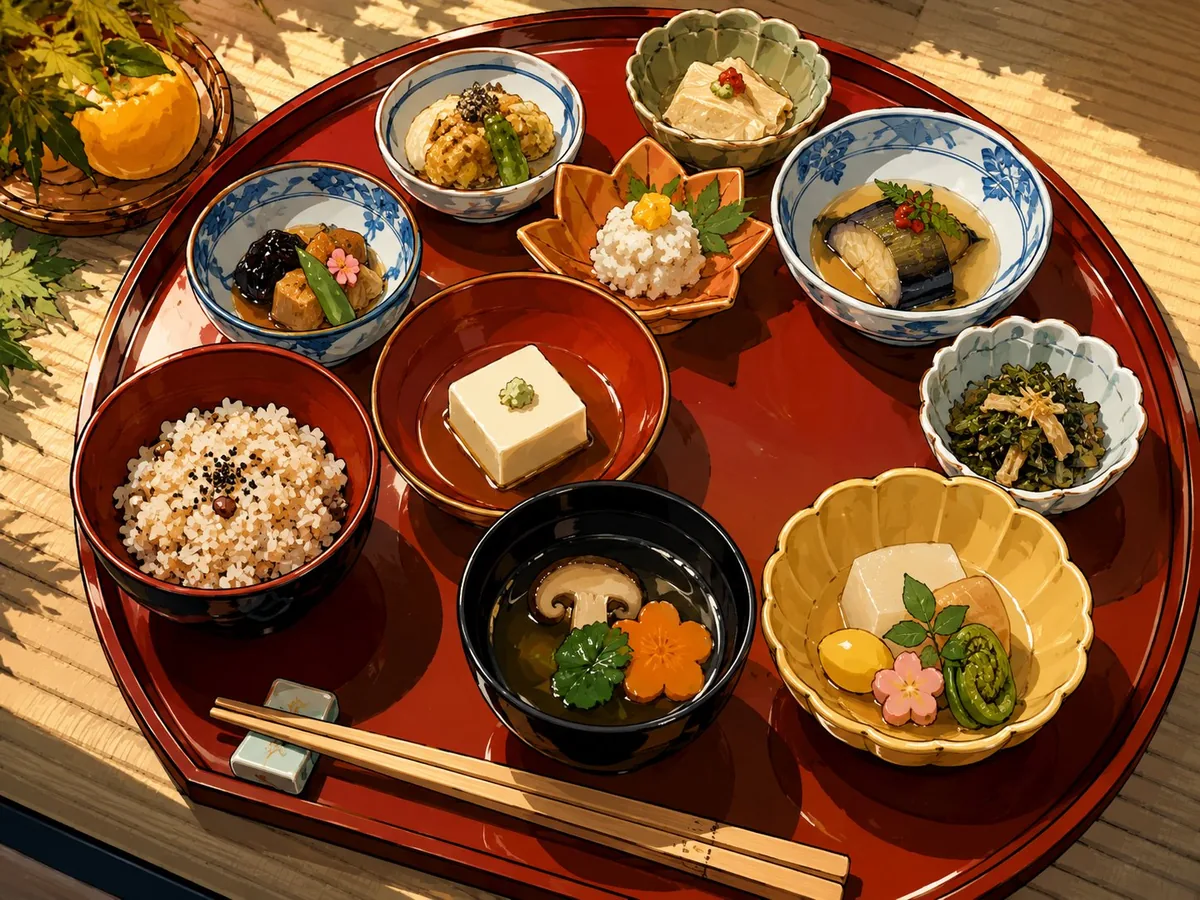
Shojin Ryori
Colorful small bowls on a lacquered tray. Hard to believe it contains no meat or fish — gentle on the stomach, and you wake light the next morning.
Goma-dofu
Sesame tofu made only from white sesame, kuzu starch, and Koyasan’s pure water. White, silky, and surprisingly springy. The signature dish of the mountain.
Koya-dofu & Nama-fu
Freeze-dried tofu said to originate here, and chewy wheat gluten. Deeply savory in simmered dishes and dengaku.
Yakimochi & Fu-manju
Hanasaka’s grilled rice cakes at the foot of the mountain, and mugwort-flavored fu-manju wrapped in bamboo leaf. Perfect for snacking and souvenirs.
Where to Taste It
Kadohama Goma-dofu
A specialist in goma-dofu, from kaiseki courses of fresh sesame tofu to sweets. The one place you cannot miss.
View on Tabelog
Koyasan Ryori Hanabishi
A historic restaurant favored by Kongobu-ji temple. Authentic vegetarian kaiseki by the “five methods, five tastes, five colors” tradition.
View on Tabelog
Chuo Shokudo Sanbo
Serving temple cuisine for over 80 years. Creative vegetarian “hanakago” bento at a reasonable price. English menu available.
View on Tabelog
Koyasan restaurants often have irregular holidays, sell out early, or open only on certain days. For shojin ryori, arrive right at opening and check the day’s hours in advance — or risk missing lunch entirely.
Practices to Center the Mind
The true essence of Koyasan is to “stay and practice.” Sutra copying, Ajikan meditation, and the goma fire ritual are all open to first-timers. Cut off the everyday completely and immerse yourself in 1,200 years of unbroken prayer.
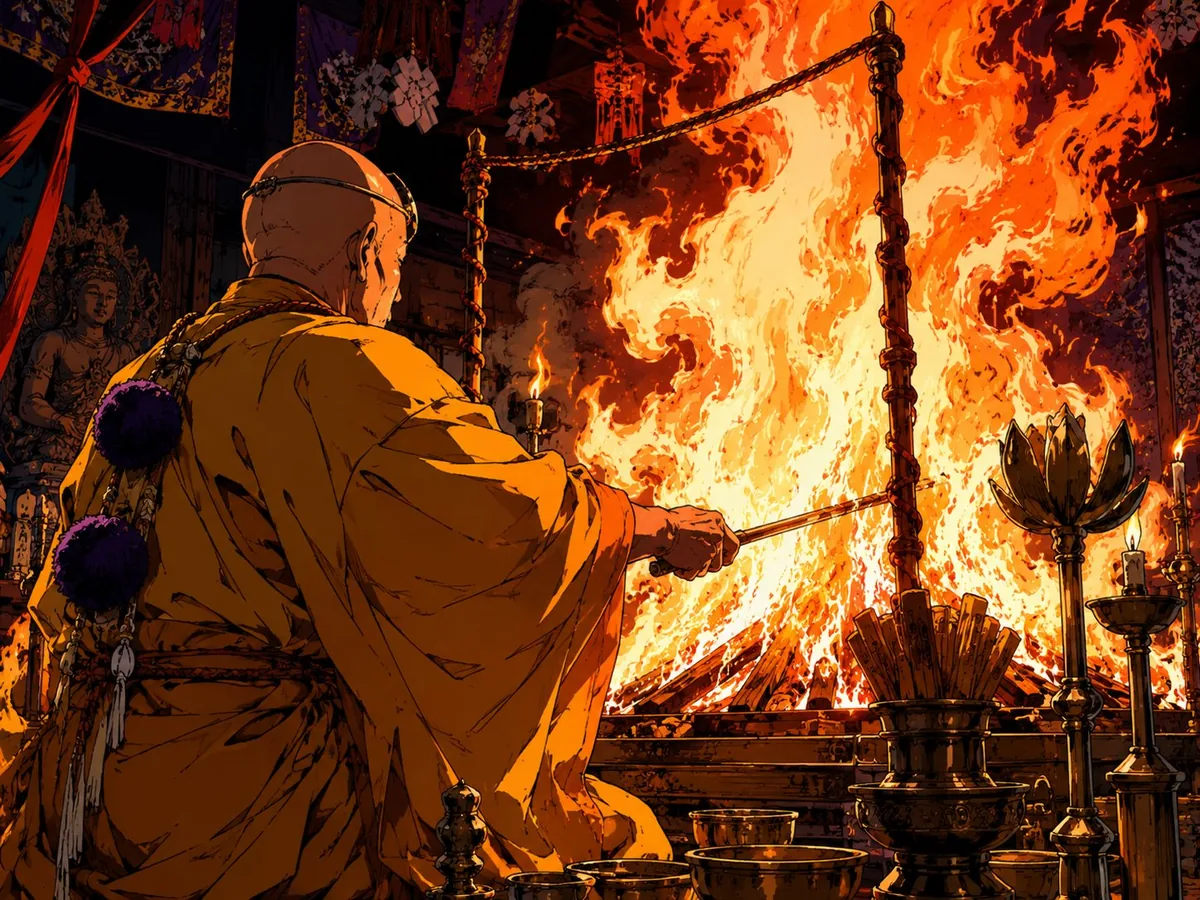
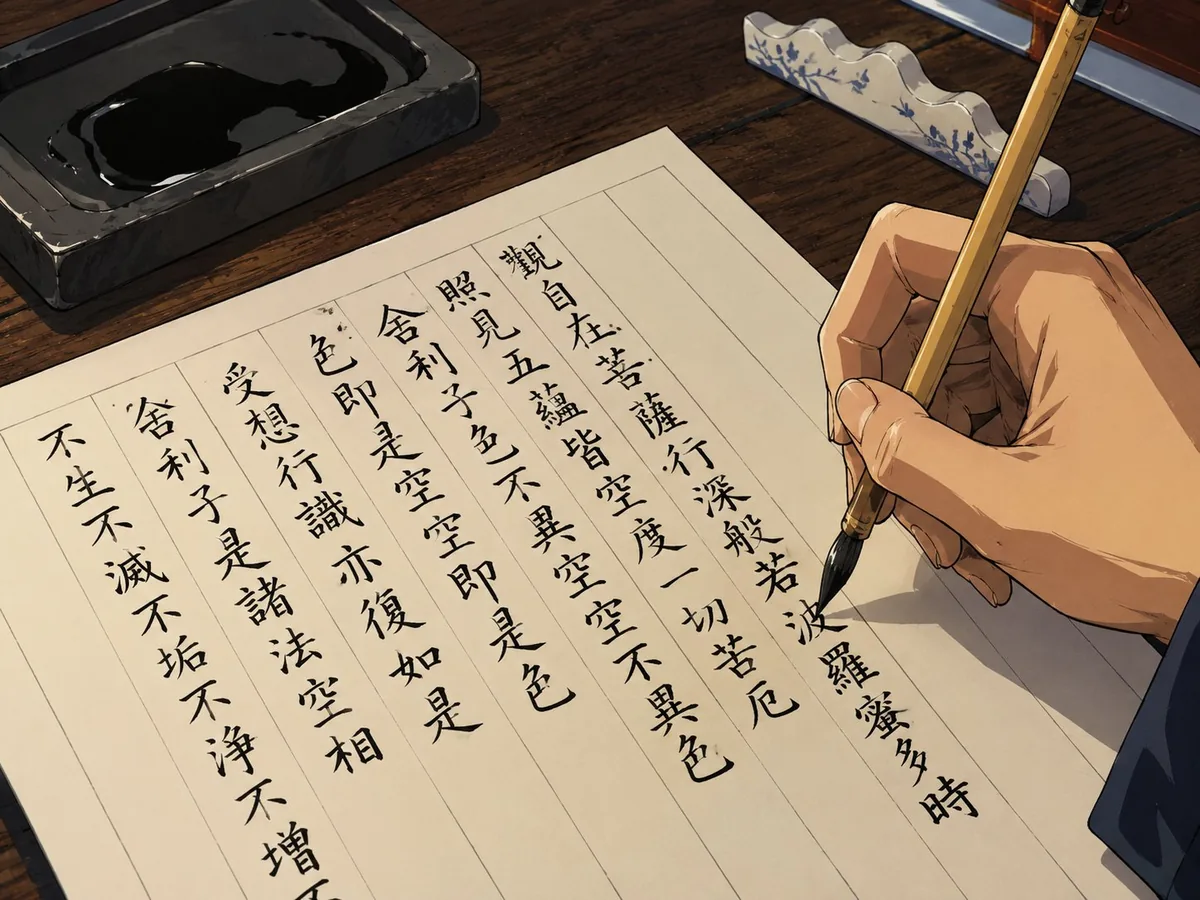
Sutra Copying
Tracing the Heart Sutra is the most accessible practice. As you focus on each character, the noise in your head settles and your breath deepens. Your finished sutra can be offered before Kobo Daishi’s mausoleum at Okunoin.
Ajikan Meditation
Sit before the Sanskrit letter “A” (symbol of Dainichi Nyorai), steady your breath, and trace the sense of self merging with the universe. Guided by a monk for about an hour in a normally closed meditation hall.
Goma Fire Ritual
Wooden prayer sticks are fed to the flames as chanting fills the hall and fire rises toward the heavens — a central rite of esoteric Buddhism. The roar of the flames and the chanting shake all five senses.
Stay in a Temple Lodging
Ekoin lets you experience sutra copying, Ajikan, and the goma ritual for free. Shojin ryori for dinner and breakfast, gardens linked to samurai lords, and the early-morning service — fold the whole experience into a single night.
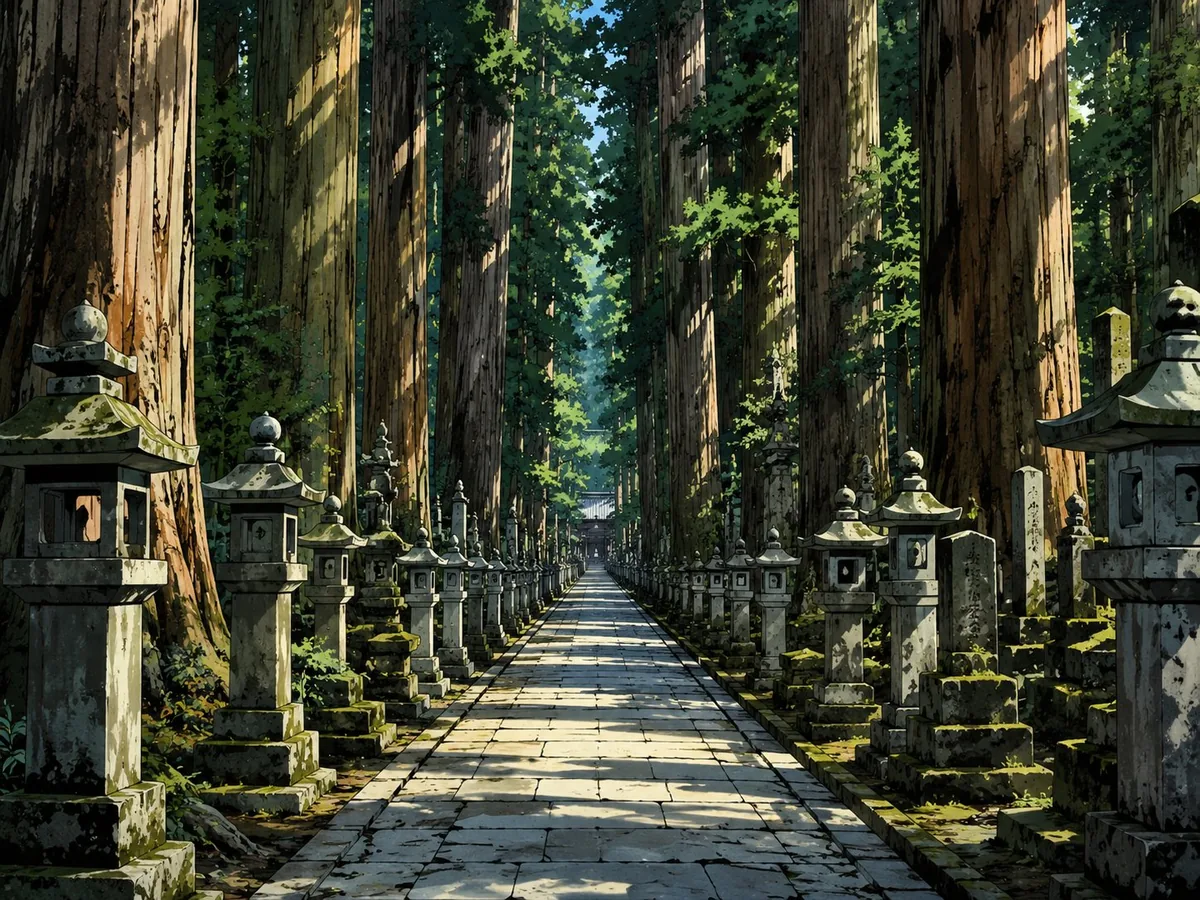
At Okunoin, Kobo Daishi is said to remain in eternal meditation. Walk the night path with a monk or guide as 200,000 gravestones and stone lanterns emerge from the dark — a world utterly apart from daytime, wrapped in sacred air.
Book the Okunoin Night Tour (Asoview)
Hot Springs & Where to Stay
Soak at Fukuchi-in, the only natural hot spring on the mountain, then venture out to Ryujin Onsen, said to have been opened by Kobo Daishi himself. A pilgrimage best closed with hot water and a good night’s rest.
Stay on Koyasan
Premium Temple Lodgings
Curated upscale shukubo and inns with celebrated gardens and refined rooms. For a truly special night.
Book on Ikyu.com
Shukubo & Inns
From temple lodgings offering shojin ryori and morning service to affordable inns. Ekoin (free sutra/goma practice) is in this area.
Book on Jalan
▶ Also search on Rakuten Travel
Stay at Ryujin Onsen
Ryujin Onsen Inns
Inns at Ryujin, one of Japan’s Three Beauty Hot Springs. Soak in silky famed water in riverside open-air baths. Best reached by car via the Koya-Ryujin Skyline.
Book on Jalan
▶ Also search on Rakuten Travel
Ryujin Onsen Motoyu
Day-use bathing without staying. 7:00–21:00 (last entry 20:40), open year-round, ¥800 adults. ※ Watch for icy roads in winter.
| Onsen | Access | Hours · Fee | Water · Notes |
|---|---|---|---|
| Koyasan Onsen Fukuchi-in ONLY NATURAL SPRING ON THE MOUNTAIN | Walking distance from Kongobu-ji (on the mountain) | Reception 9:00–20:00 | Japanese garden by Mirei Shigemori, large bath, open-air bath, sauna. No tattoos. Confirm day-use plans. |
| Ryujin Onsen Motoyu THREE BEAUTY SPRINGS | Via Koya-Ryujin Skyline · car recommended | 7:00–21:00 (last 20:40) year-round / ¥800 adults | Sodium bicarbonate spring. Silky skin. Said to be opened by Kobo Daishi. |
| Yunosato Natural Onsen | Hashimoto side · accessible by train / free shuttle from Hashimoto Stn | 10:00–22:00 / closed Wed | Blend of “gold water” and “silver water.” Gentle on the skin. Restaurant and cafe on site. |
2 Days / 1 Night Model Route
Day 1 · Midday — Worship & Food
Visit Okunoin and Danjo Garan. Lunch on shojin ryori at Hanabishi or Sanbo; goma-dofu at Kadohama.
Day 1 · Evening — Practice & Lodging
Center yourself with sutra copying or Ajikan, then check into a shukubo for a shojin ryori dinner. The Okunoin Night Tour is an option too.
Day 2 · Morning — Morning Service
Witness the solemn start of the day in a hall filled with chanting and shomyo Buddhist song.
Day 2 · Midday — Close with an Onsen
By car, take the Koya-Ryujin Skyline to Ryujin Onsen. By train, soothe travel fatigue at Yunosato on the Hashimoto side.
Stay in the Sacred.
A day trip never shows you Koyasan’s true face. The night silence, the dawn service, the shojin ryori — only by staying does 1,200 years of prayer soak into your body. Choose your stay by your budget.
A Premium Shukubo Night
Famed gardens and refined rooms for a special night.
Book on Ikyu.com
Easygoing Shukubo Stay
Shojin ryori and morning service, made affordable.
Book on Jalan

Comments