
The Mountain That Calls You: Ōmiwa Shrine, Mt. Miwa, and One of Japan’s Oldest Sacred Mountains
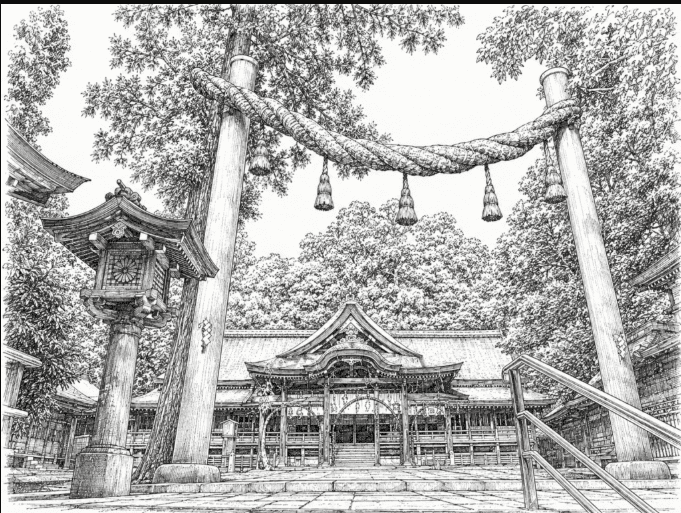
Ōmiwa Shrine (Omiwa Jinja) in Nara enshrines Mt. Miwa itself as its deity — and according to ancient tradition, only those who are called can climb it.
A mountain that doesn’t quite let you in
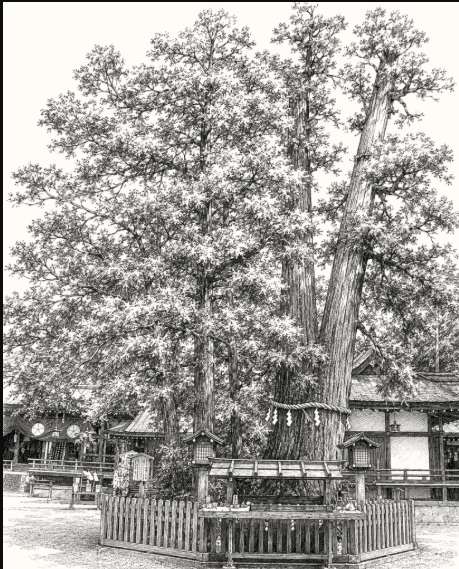
There’s a Shinto shrine in Nara, Japan, called Ōmiwa Shrine (大神神社, sometimes written Omiwa Jinja). It is one of the oldest shrines in the country. It has no main hall. The mountain behind it — Mt. Miwa (三輪山, Miwayama, also written Mount Miwa) — is the deity.
The shrine officially states a set of rules for those who climb. No photography. No sketching. No food. Voices kept low. Conversation only when necessary. And pilgrims often add a stricter, unofficial rule passed down by word of mouth: whatever you experience on the mountain, you do not speak of it casually after you come down.
It sounds like an internet myth, but the rules are real. The official rules are printed on the entry slip at the registration desk. The mountain has been treated this way for at least fifteen centuries, possibly longer.
What’s strange is what happens when modern people try to ignore the call — or just try to go. The phone battery dies overnight, fully charged. The bullet train booking system throws errors only for that one weekend. The bullet train itself goes into “service suspended” mode at exactly the wrong moment. The car won’t start. The legs won’t move.
In the glow of booking apps, train alerts, and anonymous blogs, an ancient mountain still behaves like something outside the system.
Search the Japanese internet for half an hour and you’ll find countless Japanese blog posts and personal accounts circling around the same idea — anonymous, half-confessional, half-disbelieving, all trying to explain something the author can’t quite articulate. The most common phrase across all of them: “It wasn’t time yet.”
This is a guide for travelers who want to know what’s actually there. Some of it is history. Some of it is faith. Some of it is the kind of thing that doesn’t have a name in English yet.
Table of Contents
- Prologue — There’s a mountain you can’t reach unless it calls you
- Chapter 1 — When the mountain itself was the god
- Chapter 2 — The serpent’s love, the girl who followed the thread, and the woman who died on a chopstick
- Chapter 3 — The riddle of the triple torii
- Chapter 4 — The Miwa pyramid theory: hidden geometry across the Yamato plain
- Chapter 5 — What it really means to “not speak of it”
- Chapter 6 — What we saw on the mountain: eight pilgrim stories
- Chapter 7 — The wrathful god and the miracle of sake
- Chapter 8 — Mimuro Sugi: the only sake brewery still standing in Miwa
- Chapter 9 — The purifying sand: a real amulet from the body of the mountain
- Chapter 10 — Food at the foot of the god
- Chapter 11 — Ten places to walk deeper around Mt. Miwa
- Epilogue — To those who feel they are being called
Prologue — There’s a mountain you can’t reach unless it calls you
People in Japan’s spiritual circles say this constantly:
Miwa won’t let you come unless it wants you.
And the strange part is — it’s true. People try to go to Mt. Miwa and can’t. Something always intervenes.
Here are four pilgrim accounts, paraphrased from publicly posted Japanese-language blogs. None of these are official statements from the shrine. They’re personal accounts. Take them as you would any pilgrim’s testimony at any sacred site — neither proof nor pose, just what people say.
The woman who tried three times
A woman in her thirties planned her climb three months in advance. Bullet train booked, hotel confirmed, work cleared. The morning of departure, she woke up with a 39°C fever and no other symptoms. Cancelled.
A month later: rebooked everything. The morning of, her phone rang at 6 AM. Her father had collapsed. Ambulance. Cancelled again.
Third attempt: she came to Nara the night before to be safe. The next morning, the station announcement: service suspended due to a fatal incident. No taxis. No buses. Her phone, fully charged the night before, had drained to zero overnight. She walked. When she finally reached the Sai Shrine registration desk (the climbing checkpoint, which normally closes at noon), the clock read 12:03. Three minutes late.
She made it on the fourth try, a year after she first planned to go.
On her blog: When I was finally up there, I understood. Those three failures weren’t punishment. The mountain was picking the day I’d actually be ready.
The car that wouldn’t start
A man in his forties had just had his car serviced — new tires, fresh oil, full tank. He and a friend planned to drive to Miwa at 5 AM.
Key in the ignition, engine cranks but won’t catch. JAF (Japan’s roadside service) arrives. Mechanic checks everything: battery fine, fuel fine, electrical fine. “This shouldn’t be possible,” he says.
While they stand there, the man’s phone buzzes. His friend: Sorry, sudden high fever. Might be flu. Can’t make it.
The mechanic, still standing by the open hood: “Oh, it started.”
Nothing had been touched. He went to Mount Miwa alone three months later. He doesn’t write about what happened up there.
The bookings that wouldn’t book
A woman in her twenties tried to book a bullet train for an ordinary weekend with no events. Every seat, every time slot: sold out. Every confirmation click: Error during reservation. Different browser, different device, same error. Overnight buses: also sold out, on a route that’s almost never full.
She gave up. The next weekend, booked normally — empty trains, her pick of seats. She climbed, descended, and casually mentioned the strange weekend to a priest. He smiled quietly.
“It was good you didn’t come last week. You must have had business elsewhere.”
She found out later: her grandmother had been quietly hospitalized that weekend. If she’d been in Nara, she wouldn’t have made it back in time.
The legs that wouldn’t move
A woman in her fifties, walking the path between Ōmiwa Shrine’s main hall and Sai Shrine. It’s a five-minute walk along a path called Kusuri-michi, the medicine path.
The torii gate of Sai Shrine came into view. Her legs stopped. Not pain. Not numbness. Just refused to move forward — as if something were pressing back against her chest.
She stood there for ten minutes. People walked past her. Eventually she turned around. The moment she turned, her legs worked normally.
She went home. Her husband met her at the door, looking unsettled. “You’re back? I had this awful feeling after you left.”
That night, on the news: a landslide in the Nara mountains, on the same trail she would have been descending, at roughly the same time window.
On her blog: The legs stopping — that was it.
These four are out of many similar posts. The skeptical reading is straightforward: confirmation bias, selective memory, post-hoc storytelling. Fair enough. But when this many people, posting independently across years and platforms, report the same shape of experience in the same place, “coincidence” stops being a clean explanation.
The believers’ framing: when you suddenly want to go to Miwa for no reason — no Instagram post, no friend’s recommendation, just a quiet pull — that’s the call. Don’t ignore it.
For what it’s worth, I put off going for years. Then one night, at 11 PM, I knew I had to go the next day. Couldn’t explain it. Closed my eyes and saw the mountain clearly, though I’d never seen photos. Opened the booking app — one seat left, exactly the time I needed. The sky over Nara the next morning was the kind of blue that doesn’t render properly on a phone.
Walking up the path toward the shrine, I felt watched. Not in a frightening way — patiently. You came.
Chapter 1 — When the mountain itself was the god
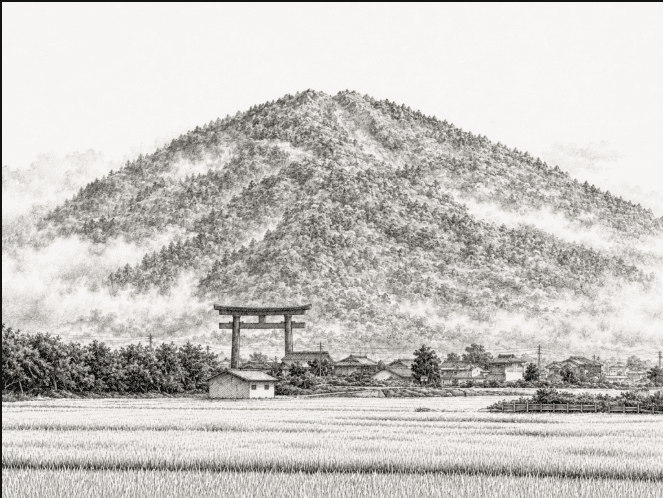
To understand why this particular hill matters this much, you have to go back to before Japan was Japan.
The ancient chronicles — the Kojiki (compiled 712 CE) and Nihon Shoki (720 CE) — preserve some of the earliest written stories connected to Mount Miwa and Ōmononushi, the deity who came to dwell there. What’s remarkable isn’t only the age of these sources; it’s that the form of worship here has barely changed in the centuries since. The mountain a seventh-century pilgrim saw is the mountain we see now. The spot where they bowed is the spot where we bow.
A shrine without a building
When you imagine a Shinto shrine, you probably picture a torii gate, a path, a hall of worship, and an inner sanctuary holding the deity. A building.
Shrines became buildings relatively late. In older Japan — what scholars call Koshintō, ancient Shinto — the gods weren’t kept indoors. They were in the mountains, the rivers, the rocks, the trees, the sea. Nature itself was divine. People prayed toward nature, not at a structure containing it. This predates writing in Japan. It predates the arrival of Buddhism. It predates any organized religion on these islands.
Ōmiwa Shrine preserves that older form almost untouched.
There is no main hall. The deity is the mountain in front of you.
This is, in the global history of religion, quietly unusual. Buddhism, Christianity, Islam — every major tradition eventually built containers for its sacred. At Ōmiwa, the container is the mountain itself, and it has been for as long as anyone can document.
The god named Ōmononushi
The deity enshrined here is Ōmononushi-no-Ōkami (大物主大神).
In the Kojiki and Nihon Shoki, Ōmononushi is described as a part of Ōkuninushi — the great deity of Izumo, one of Japan’s foundational gods. Specifically, he is the sakimitama (the “happy spirit”) and kushimitama (the “wondrous spirit”) of Ōkuninushi, manifesting as a separate god in his own right.
If that sounds confusing, it shouldn’t, by ancient Japanese standards. Gods here have faces — multiple aspects that can split off and act independently. There’s the rough face (aramitama), the gentle face (nigimitama), the joy-giving face, the mysterious face. One deity, several modes of being.
And Ōmononushi’s true form, the chronicles say plainly, was a white serpent.
In modern Western reading, “serpent god” sounds ominous. In ancient Japan it was the opposite. Serpents shed their skin, so they were eternal. They commanded water, called the rain, brought the harvest. To say a god’s true form was a serpent was to say: this is one of the great ones.
And that serpent god, the chronicles say, chose Mount Miwa.
How Ōmononushi came to Miwa
The Kojiki tells the story this way.
Ōkuninushi, the great deity of Izumo, stood on the shore alone. He was halfway through building the country — what would become Japan — and his partner, Sukunabikona, had just vanished across the sea, leaving him with the work unfinished.
“How am I supposed to finish this alone?”
As he stared at the waves, a light appeared on the water. A god, riding the sea toward him.
“Enshrine me at your side, and I’ll help you finish.”
“Who are you?”
“I am your sakimitama and kushimitama.”
His own spirit, manifesting as a separate being.
“Where shall I enshrine you?”
“On the eastern mountain, behind the green walls of Yamato.”
That mountain was Mt. Miwa.
So Ōmononushi came to Miwa of his own will — and from that mountain, the chronicles say, helped shape the country. Japan, in the telling of the Kojiki, was built with the help of the god who sleeps in Mt. Miwa.
The Kojiki was compiled in 712 CE. The Nihon Shoki in 720. These were written records of oral traditions passed down long before. How long had Miwa been sacred before anyone wrote it down? Nobody knows exactly. Archaeologists digging at the foot of the mountain find Jōmon-era remains (over three thousand years old). Yayoi-period ritual sites. Massive burial mounds from the Kofun period ringing the base. At minimum this has been a holy place for a very long time — probably much longer than any written record can confirm.
Before “Japan” was a country, Miwa was already a god.
A mountain that no one was allowed to enter
For most of recorded history, Mt. Miwa was kinsoku-chi — forbidden ground. Off limits to ordinary humans. Only priests and a small number of authorized ritualists could enter, and only for specific ceremonies. Everyone else worshipped from the foot of the mountain, looking up.
This stayed in place for centuries. Through the spread of Buddhism in the 6th century. Through the centuries of shinbutsu shūgō — the blending of Shinto and Buddhism. Through the Edo period, when the Tokugawa shogunate enforced the rules strictly: entering Miwa required permission from a nearby temple, Byōdō-ji. Through the Meiji Restoration in 1868, when the government violently separated Shinto and Buddhism, and Byōdō-ji nearly disappeared. Throughout all of it, the mountain stayed closed.
It wasn’t until the late Meiji era — the early 1900s — that general pilgrim climbing was permitted, conditional on following strict rules.
Think about that for a moment. For thousands of years, the people who lived in the shadow of this mountain did not climb it. They knew it was forbidden. The reason was always the same: the mountain is the god. You don’t walk on a god.
That we can climb today is, in a sense, an aberration. The shrine permits it. But the prohibition has not been forgotten. The rules — no photographs, no sketches, no food, silence — are the residue of that older absolute. They’re saying: we are allowing you in, but do not forget where you are.
The four myths
The Miwa story rests on four old myths, all of them stranger than they look. Each will get its own chapter; here is the shape of them.
The first is the one I just told — Ōkuninushi meeting his own spirit on the shore, and Ōmononushi choosing the eastern mountain. This is the foundation myth: how a god came to live in Miwa.
The second is the story of Ikutamayori-hime, the girl who fell in love with a man who only came to her at night. She didn’t know his name. She didn’t know where he came from. When her parents asked her to find out, she tied a thread to his robe and followed it the next morning. The thread led to the mountain.
The third is the story of Yamato-totohi-momoso-hime, who married a god and asked to see his true form, was told not to be frightened, was frightened anyway, and died horribly. Her tomb is still there at the foot of the mountain. Some serious scholars believe it may be the tomb of Queen Himiko, the shaman-queen who appears in Chinese histories of 3rd-century Japan.
The fourth is the story of Emperor Sujin and a plague that nearly destroyed his country — and the dream in which Ōmononushi told him how to stop it. The remedy involved sake. Japanese sake brewing, in its origin myth, traces back to that night.
Snakes, threads, chopsticks, sake. The mythology here doesn’t sound like the mythology of any other Japanese shrine. It belongs to Miwa, and only to Miwa.
The viewpoint that shows you the puzzle
Before you climb — or after you come down — there’s one more place to stop. From the Ōmiwa precincts, walk about fifteen minutes uphill to Ōmiwa-no-mori Tenbōdai, the Ōmiwa Forest Viewpoint. It’s a small platform, easy to miss in any guidebook.
You stand on it, and the entire Yamato plain opens out below you.
In front, the great torii of Ōmiwa (32.2 meters tall — one of the tallest in Japan). Beyond it, Mt. Nijō, the two-peaked mountain on the western horizon. To your left, Mt. Miminashi. To the right and back, Mt. Unebi. Further right, Mt. Amanokagu. Together with Miwa, these are Yamato no Sanzan — the three (or in this view, four or five) mountains of Yamato, mountains that have been written into poetry since the Man’yōshū in the 8th century.
And once your eyes settle, you start to notice something.
The mountains are too neat.
Each one is a near-perfect cone. They stand evenly spaced across the otherwise flat plain. The placement looks designed.
It probably isn’t. Or — that’s the consensus view, and it’s the responsible position to take. Mountains form. Pilgrims read meaning into them after the fact. Yet enough careful researchers have stood on this viewpoint and felt the same shiver that they’ve written books about it. We’ll get to those theories — and to the actual data — in Chapter 4.
For now, just stand here for a few minutes. Let your eyes do the measuring. And ask the question that this entire region whispers when it thinks no one is listening:
Is this just landscape?
Chapter 2 — The serpent’s love, the girl who followed the thread, and the woman who died on a chopstick
Mythology, in school, was boring. Names you couldn’t pronounce, plots that didn’t quite resolve, characters who behaved without psychology. I felt the same way for years.
Then I went to Miwa.
The myths attached to this mountain are not “stories told long ago.” They are records — possibly stylized, possibly poetic, but records — of things that local people, over generations, decided they could not forget. A serpent god. A girl with a thread. A queen who died on a chopstick. A tomb that may belong to one of the most famous women in Asian history.
All of them mapped onto specific places that still exist, within a two-kilometer radius of Mt. Miwa. You can walk them in an afternoon.
The girl who followed the thread
Long ago, in the Sakurai plain at the foot of Miwa, there lived a young woman named Ikutamayori-hime.
She was beautiful, intelligent, the daughter of a respected local clan leader. She had no shortage of suitors, but she was unattached, and her life was uneventful.
Then one night, alone in her room, she heard the rustle of robes. A door slid open. A man stepped in.
He was unbelievably handsome. Composed. Dressed too well to be from any nearby village. His face had the clean serenity of moonlight on water.
“Who are you?” she asked.
He didn’t answer. He just smiled, sat beside her, and stayed until almost dawn. He talked with her, listened to her. She felt, against all reason, completely safe.
Before light, he left.
He came back the next night. And the next. He never said his name. He never said where he came from. She never asked where he went in the morning. After a few months, she was pregnant.
When her parents noticed, they were horrified.
“Whose child is this? Who comes to you at night?”
She couldn’t answer. She didn’t know.
In ancient Japan, a man whose name and origin remained hidden was understood to be either a god or a spirit — never just a man. Her parents grew quietly afraid.
They gave her a plan.
That night, before her visitor left, she did what they’d told her to do. She took a clay-red thread, tied one end to a sewing needle, and stuck the needle into the hem of his robe. She let the thread feed out behind him as he walked away.
In the morning, the family followed the thread.
It ran out of the room. Across the garden. Past the village. Through the rice fields. Across a small river.
It led to the foot of a mountain.
It led into a shrine on that mountain. It ended inside the inner sanctuary.
Her nighttime lover was the god of the mountain. He was Ōmononushi.
The thread, when her family unwound the spool, had only three winds remaining. Mi-wa — three winds. Miwa.
That is the Kojiki‘s explanation for the name of this place. The town below the mountain, the mountain itself, the shrine: all of them carry the name of the thread that ran out at the god’s door.
The child born to Ikutamayori-hime grew up. His descendants became known as the Miwa clan, later the Ōmiwa clan — the priestly family who has tended this shrine for fifteen centuries. They are descended from a god and a girl. To this day, the Ōmiwa priesthood is still, in part, drawn from this same lineage.
The woman who died on a chopstick
The second story is darker. It belongs to a different generation, a few reigns later in the official chronicles.
Yamato-totohi-momoso-hime was an imperial princess, the aunt of Emperor Sujin (whom we’ll meet again in Chapter 7). She was a miko — a shrine maiden with the gift of receiving the gods. When she spoke, sometimes it wasn’t her speaking. Kings consulted her.
Ōmononushi, the god of the mountain, fell in love with her. He came to her at night, the way he came to Ikutamayori-hime — only at night, never in daylight, never letting her see him clearly.
After many months, she could not bear the uncertainty. She knelt before him in the dark.
“My lord. I am married to you. But I have never seen your face. Tomorrow morning, when light comes, show me yourself. Only for a moment. Let me see what I am married to.”
He was silent for a long time.
“I will be inside your comb box tomorrow morning,” he said. “Open it. But you must not be frightened. Whatever you see — you must not cry out.”
She promised.
At first light, she lifted the lid.
Inside, coiled neatly on the dark lacquer, was a small serpent. White. Beautiful. No longer than the cord of an undergarment. Its scales had a soft inner light, like pearl. Its eyes were watching her.
She knew — intellectually she knew — that she was looking at a god in his true form. She had been warned. She had promised not to cry out.
She screamed.
The serpent vanished. In its place stood a man, fully visible at last, looking at her with terrible disappointment.
“You broke your promise. You have shamed me. And in return, I will shame you.”
He rose into the air, back toward the mountain, and was gone.
She understood, immediately, what she had done. She would never see him again. She had been given one chance and she had failed it.
She collapsed in grief. As she fell, she sat down on a chopstick that had been left near her. The chopstick pierced her, and she died.
Her tomb is on the south side of Mt. Miwa, about fifteen minutes’ walk from Ōmiwa Shrine. It is called Hashihaka — “Chopstick Tomb.”
Hashihaka, and the question no one can answer
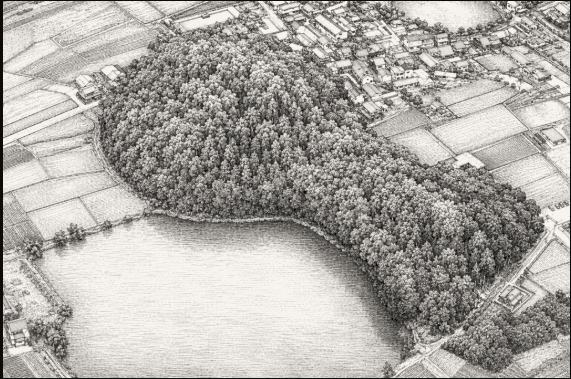
Hashihaka is a keyhole tomb — zenpōkōen-fun — a giant burial mound shaped like a keyhole when seen from above. The front part is square; the back is a perfect circle. The whole structure is about 280 meters long and, at its back, 30 meters high. From the ground it looks like a forested hill. From the air it’s unmistakably built.
The Nihon Shoki records something strange about it:
“By day, it was built by humans. By night, it was built by the gods.”
This is the chronicle’s way of saying: the mound was too vast for ordinary labor. Something else helped.
Modern archaeology dates Hashihaka to the mid-to-late 3rd century CE. This is significant. Because that is exactly the period when, according to Chinese sources, the most famous woman in early Japanese history died.
Her name was Himiko — Queen Pimiko — the shaman-queen of Yamatai. The Chinese chronicle Wei Zhi (the Records of the Wei kingdom, 3rd century) describes her as a ruler who controlled her people through “the way of demons” — a shamanic priest-queen who rarely appeared in public. She received emissaries from the Wei court. The Wei emperor sent her a golden seal. She died, the chronicle says, around 248 CE. A burial mound was built for her, “of a hundred paces.”
The dates line up. The size lines up. And the woman the Japanese chronicles place inside Hashihaka — Yamato-totohi-momoso-hime — is herself described as a miko who married a god. A priest-queen.
A significant minority of modern Japanese archaeologists believe Hashihaka may be the tomb of Himiko. The argument has been made in serious journals. It hasn’t been disproven; it hasn’t been confirmed. The Imperial Household Agency restricts excavation of imperial mounds, and Hashihaka is officially designated as imperial, so digging is not permitted. The tomb keeps its secret.
But just to be clear about what is sitting at the foot of this mountain: it is plausibly the grave of the queen who first appears in any written record of Japan. The earliest named figure in Japanese history. And she is buried in the shadow of Miwa.
Makimuku: the city under the rice fields
If Hashihaka is Himiko’s tomb, then Himiko’s capital would also be near here. And in fact, just north of the mound, archaeologists have been excavating a site called Makimuku since the 1970s.
What they’ve found is remarkable. Postholes from large 3rd-century buildings, possibly a palace complex. Pottery from across western Japan, suggesting Makimuku was a hub where goods from many regions converged. Quantities of peach pits — used in ritual divination. The site is dated to the right period. It’s the right size for a capital.
The mainstream consensus in Japanese archaeology has been shifting, slowly, toward Makimuku as the strongest candidate for the Yamatai of the Wei Zhi. Not proven. But the evidence keeps accumulating in that direction.
If correct — if Makimuku is Yamatai, and Hashihaka is Himiko’s grave — then the foot of Mt. Miwa is not just one sacred site among many. It is the first political center of the Japanese archipelago. The place where “Japan,” in any recognizable form, begins.
A mountain. A serpent god. A queen who could speak with the dead. A capital. A tomb.
All of it, walking distance.
Why these stories still matter
Standing on the path from Ōmiwa Shrine to Hashihaka, in late afternoon, with the sun behind the mountain — you can feel the layered time.
The 8th-century chronicles wrote these myths down because they were already old. Ikutamayori-hime tying a thread to a god’s robe. A queen who died for breaking a promise. These are not stories invented in 712 CE. These are stories already worn smooth by retelling, recorded just in time, before they could be forgotten.
And what you feel walking the paths around Miwa is that they were also, perhaps, not invented in any century. They were encoded. Whoever first told the story of Ikutamayori-hime was telling the truth about something that had happened — perhaps not literally, but truly. A young woman in this region had a relationship with this mountain that her family could not fully understand. The mountain became, in the telling, a god. The strangeness of the encounter became a thread.
If you read these myths as records — even imperfect ones — they suggest that Mt. Miwa has been doing this to people for thousands of years. People feel called. People feel watched. People walk away changed. Different generations tell the story in different words, but it’s the same story.
The myth is still happening. You can see it on the blogs.
Chapter 3 — The riddle of the triple torii
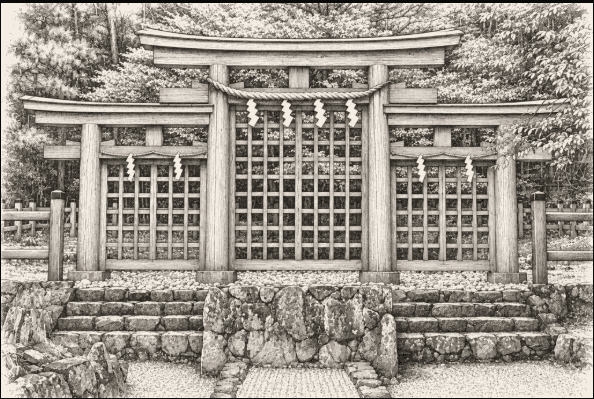
Behind the main hall of Ōmiwa Shrine, where ordinary visitors are not allowed, stands a piece of architecture that has no clear parallel anywhere else in Japan.
It is called Mitsu Torii, the “triple torii,” or sometimes Miwa Torii. Three torii gates are fused together. One large gate in the center, two smaller gates flush against its sides, sharing pillars. From the front it reads almost as a single structure — a wall of gates.
You won’t find another one quite like it. There are a small handful of related triple-gate structures in Japan — at Hibara Shrine (a sub-shrine of Ōmiwa, which we’ll visit in Chapter 11), at Kaiko-no-Yashiro in Kyoto (in a different, triangular configuration), at Ikasuri Shrine in Osaka — but the one at Ōmiwa is considered the original and the most important. Everything else is a descendant or an echo.
Here is the strangest part:
Nobody knows when it was built, who built it, or why.
The shrine itself has been documented for over fifteen centuries. There are records of priests, ceremonies, donations, repairs, construction. But the triple torii has no recorded origin. The shrine’s own historians say: it has simply always been there.
This is unusual. Sacred architecture is almost always documented — a wealthy patron commissioned it, a particular emperor donated it, a specific priest installed it. The triple torii has no such record. It is as if it was built before anyone was writing things down, and then survived intact through fifteen hundred years of rebuilding and rebuilding, always replaced in the same form by craftsmen who didn’t ask why.
A gate at the edge of the world
Ōmiwa has no main hall. The deity is the mountain. So when you stand in front of the prayer hall (haiden) and bow, what are you actually bowing toward?
You are bowing toward the triple torii.
It stands directly behind the prayer hall, hidden from public view. Beyond it, the mountain. The triple torii sits at the seam between the human side of the world and the divine side — between the precinct where pilgrims may stand and the precinct that is the god’s body. Your prayer travels through it. The gates are the channel.
This is the structure’s function, even if its origin is unknown. It is a translator. A door.
Five theories, all unresolved
Because no record explains the triple torii, every theory about it is, in a sense, speculation. But the theories themselves are old, and worth knowing.
The “three winds of thread” theory. As told in Chapter 2, the Kojiki says the name Miwa comes from the three winds of thread that remained when Ikutamayori-hime tracked her divine lover back to the mountain. The number three is built into the place. The triple torii may simply echo it.
The “three sacred mountains” theory. Mt. Miwa was historically known by other names too, including Mimoro-yama and Mimuro-yama — names that themselves contain the syllable mi (three). The three gates may be a topographic signature: this is the place of the three.
The “three altars” theory. Inside Mt. Miwa, three sacred rock formations (iwakura) are recognized as the dwelling places of three gods: Sukunabikona (at the lower rock, Hetsu Iwakura), Ōnamuchi (at the middle rock, Nakatsu Iwakura), and Ōmononushi himself (at the upper rock, Okutsu Iwakura). The triple torii may correspond to the three altars and the three deities.
The “three purifying gods” theory. In Shinto purification ceremonies, three deities of cleansing are invoked. The triple torii may be an architectural rendering of those three.
The “three worlds” theory. Shinto cosmology, in its more elaborated forms, divides reality into three planes: the amatsukami (heavenly gods), the kunitsukami (earthly gods), and the world of humans. The central, taller gate may represent the cosmic axis connecting all three; the two smaller side gates, the lateral channels.
Each of these is plausible. None of them is provable. They may all be right.
The theory that won’t go away
There is one more theory, and it sits outside the mainstream of Shinto interpretation. It comes from the world of comparative religion, alternative archaeology, and Japan’s long-running fascination with the question of where its ancient culture originally came from.
The theory says: the triple torii resembles structures found in ancient Israel.
The ancient Israelite Temple in Jerusalem was divided into three zones: the ulam (porch), the hekhal (the holy place), and the devir (the Holy of Holies, where God dwelled). Only the high priest could enter the innermost chamber, and only once a year. The Temple’s entrance was, in some reconstructions, a triple structure.
At Ōmiwa, the deity dwells in the inaccessible mountain. The triple torii sits at the boundary between human space and divine space. The function maps. The number — three — maps. Some have noted that the formal logic of the layout is uncannily close.
This sits within a broader, much-debated fringe theory called Nichi-Yu Dōso-ron, the theory of Japanese-Jewish common origin — the idea that some component of Japanese culture descends from the ten lost tribes of Israel. Proponents point to a number of “strange resemblances”: the omikoshi (portable shrine) and the Ark of the Covenant; the white robes of yamabushi mountain ascetics and certain priestly garments; words shared, perhaps, between Hebrew and ancient Japanese.
Mainstream historians do not accept this theory. The evidence is circumstantial; the comparisons could as easily be coincidence as inheritance. But the resemblances are not zero, and Japan’s most unusual triple gate stands at the heart of the discussion.
What is provable, what is unprovable, what is suggestive — these categories blur around Ōmiwa.
Hibara: the place where you can actually see it
Ōmiwa’s main triple torii is hidden from view. Tourists cannot photograph it. The shrine permits special viewings on rare occasions, but for almost all visitors, it stays invisible.
There is, however, another way.
Walk thirty minutes north along the Yama-no-be-no-michi — the Mountain Edge Trail, Japan’s oldest documented road — and you reach a small sub-shrine of Ōmiwa called Hibara Shrine (檜原神社). It is sometimes called Moto-Ise, the “original Ise” — the place where, in the time of Emperor Sujin, the sun goddess Amaterasu was first enshrined outside the imperial palace before her cult moved (eventually, after many stops) to its current home at Ise Grand Shrine.
Hibara has no main hall. The deity is the mountain. And in front of the empty precinct, in full view, stands a triple torii.
It is the only triple torii at Ōmiwa that pilgrims can approach directly.
Standing in front of it is a strange experience. The air pressure feels different. The structure is plain wood — there is nothing ornate about it — and yet it sits in the path of attention like a tuning fork. When I stood there, I instinctively didn’t lift my camera. Photography isn’t forbidden at Hibara, but something in the situation made it feel wrong. (That’s my impression. Others photograph freely.)
If you want to understand the riddle of the triple torii, Hibara is where to go. The main shrine will not show you. The sub-shrine will.
The number that won’t let go
Three, in religious history, doesn’t belong to one tradition. It belongs to all of them.
The Christian Trinity. The Buddhist Three Jewels (Buddha, Dharma, Sangha). The Daoist Three Pure Ones. The Three Pilgrim Festivals of Judaism. The Egyptian triads. The Hindu Trimurti. In Shinto itself, deities are counted in threes, fives, and eights, and three is the lowest sacred unit.
Why three? Nobody knows. Across cultures that had no contact with each other, three keeps appearing as the basic count of the sacred. It is one of the few things human religion seems to agree on.
That three has been standing at Ōmiwa Shrine, in wood, for over a thousand years. Whoever built it didn’t tell us why. The shrine, fifteen centuries on, still doesn’t say.
It just stands there. Doing whatever it does.
Chapter 4 — The Miwa pyramid theory: hidden geometry across the Yamato plain
Whether you believe what follows is entirely up to you.
I will be honest. The first time I encountered this material, I rolled my eyes. Pyramids? In Japan? Built before the Egyptian ones? It read like the kind of thing your weird uncle reads in Mu magazine — and in fact, that’s exactly where some of it has been published.
But the longer I sat with the actual data, the harder it was to dismiss. There are too many coincidences. Too many measurements that line up too well. Too many independent researchers, across decades, arriving at similar diagrams.
Mainstream archaeology rejects the “Japanese pyramid” hypothesis. The mainstream position is that the mountains in the Yamato plain are natural features that were later sanctified, and that the apparent geometry is a pattern humans imposed in retrospect. This is the responsible scholarly view. It may well be correct.
But the alternative view is not nothing, and it deserves to be told accurately. Especially because Mt. Miwa sits at its center.
The man who started it
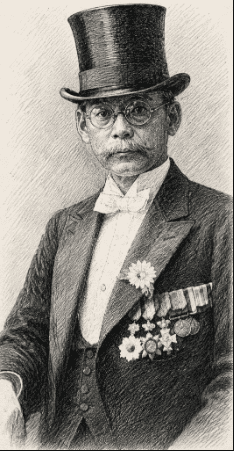
The “Japanese pyramid” idea begins with one figure: Sakai Katsutoki (1874–1940). A Yamagata-born evangelist, lecturer, and proponent of the Japanese-Jewish common origin theory mentioned in Chapter 3. In 1934, he published a book titled Taiko Nihon no Piramiddo — The Pyramids of Ancient Japan.
His claim was sweeping. Japan has pyramids older than Egypt’s. The original form of the pyramid is Japanese. Japan, not Egypt or Mesopotamia, is the cradle of pyramid civilization.
The mainstream response was dismissal. Sakai’s academic credentials were limited. His arguments rested on conjecture, intuition, and ideological commitment to Japanese spiritual exceptionalism — which, in the 1930s, intersected uncomfortably with imperial ideology. He wasn’t taken seriously by professional archaeologists, and he isn’t now.
But he did go out into the field. He visited specific mountains. He took measurements. He documented what he saw. And what he reported, in the case of one mountain in particular, is not nothing.
Ashitake-yama: the “Japanese pyramid”
In Hiroshima Prefecture, Shōbara City, there is a mountain called Ashitake-yama. Elevation 815 meters. From the air, it is a near-perfect cone.
Sakai surveyed it in the 1930s. He reported the following: the mountain is unusually symmetrical; the adjacent peak, Kikkyō-zan, is covered in large stones arranged in patterns that resemble dolmens, directional markers, and offering platforms; viewed from Kikkyō-zan toward Ashitake-yama, the geometry resembles “worship hall facing inner sanctuary” — exactly the layout of a shrine.
In other words: the same logic as Ōmiwa Shrine and Mt. Miwa. The flat-topped place where you stand and pray, with a sacred peak rising in front of it.
Sakai declared Ashitake-yama “the world’s oldest pyramid.” The claim is, of course, undemonstrated. But it isn’t crazy on its face. There is something to the layout. Local signage today still refers to Ashitake-yama as “Japan’s pyramid,” and limited tourism revolves around the claim.
Sakai’s interest then expanded — naturally — to other cone-shaped mountains in Japan that had also been treated as sacred for thousands of years. The single most obvious candidate was Mt. Miwa.
Why Miwa fits the pattern
The argument for treating Mt. Miwa as something more than a natural mountain rests on several observations:
The shape is near-perfectly conical. Most mountains aren’t. Miwa is.
The treatment by the surrounding culture is extreme. For over a thousand years it was forbidden — not just “sacred” in a vague sense, but legally off-limits, enforced by both shrine and state. This is the kind of treatment given to constructed sacred objects, not to landscape features.
Inside the mountain, three rock formations (iwakura) are arranged in a vertical hierarchy: lower, middle, upper. This is reminiscent of the chambered architecture of constructed sacred mounds — antechamber, intermediate chamber, inner sanctum.
Around the base of the mountain, the surrounding landscape is dense with sacred infrastructure: tombs (including Hashihaka and the Sujin and Keikō imperial mounds), shrines (Sai, Hibara, Ōmiwa itself), early settlement sites (Makimuku). The mountain is the center of an organized sacred grid.
And then there is the geometry of the surrounding mountains, which is where this gets strange.
The Yamato plain, viewed as a diagram
The Yamato plain is famously associated with three small mountains: Mt. Unebi, Mt. Miminashi, and Mt. Amanokagu — the Yamato Sanzan. These three are mentioned in the Man’yōshū, the oldest Japanese poetry anthology (8th century), already at that time recognized as a sacred triad.
Plot the three of them on a map. They form a near-isosceles triangle, with Unebi at the apex.
That alone is mildly surprising. Three random mountains rarely form a clean triangle.
Now draw a line from Unebi, perpendicular to the base of the triangle (the line connecting Miminashi and Amanokagu). Extend it to the northeast.
That line, extended, hits Mt. Miwa and Mt. Makimuku — the two mountains directly behind the Makimuku archaeological site, where the possible capital of 3rd-century Yamato lay.
Extend the same line in the opposite direction, southwest, and it intersects Mt. Inbe — another mountain treated as sacred in early Japanese ritual.
Six mountains, in a single line, anchored on a perpendicular drop from the apex of a separate triangle. The Yamato Sanzan plus the Miwa cluster plus Inbe. It is a single geometric figure.
And these are the most sacred mountains in early Japanese history.
That’s the 2D version. There’s a 3D version too, reported in Mu magazine in detailed surveys: the summit elevations of Mt. Unebi, Mt. Miwa, and Mt. Makimuku align — not perfectly, but tightly. A straight line drawn through their peaks in three-dimensional space comes very close.
The skeptical reading: post-hoc pattern matching. Six mountains in a region full of mountains; with enough lines and tolerance, you can connect any subset.
The other reading: someone, at some unknown ancient date, knew what they were doing.
Kuromanta: the case that wasn’t crazy
There is one more piece of evidence that’s hard to wave away.
In 1992–1993, a research group called the Pan-Pacific Society conducted a formal scientific survey of a small mountain in Akita Prefecture called Kuromanta (Kuromata-yama in standard Japanese, an Ainu-derived name meaning “mountain of the gods”). Elevation 280 meters. Local legend had long described it as a “Japanese pyramid.”
The team was not a fringe outfit. It included university researchers, professional archaeologists, and surveyors. They used ground-penetrating radar, geological sampling, topographical surveys.
What they found was published in academic-style proceedings.
The slopes of Kuromanta are oriented unusually close to true north-south and east-west. Natural mountains do not typically have this orientation.
The slope appears to be terraced in seven to ten steps. Whether these are natural geological features or human modifications is contested; the survey team leaned toward “modified.”
At the summit, an arrangement of stones consistent with a small stone circle. Stone circles of this type are associated with prehistoric astronomical or ritual function across many cultures.
And — most striking — ground-penetrating radar detected a substantial cavity approximately ten meters below the summit. A natural mountain should not have a chamber-shaped void at that location and depth. Whatever caused the radar return, it is not normal.
The surrounding landscape, mapped against compass and solar angles, showed: shrines arranged along east-west and solstice lines centered on Kuromanta; Jōmon-period (pre-pottery / early-pottery prehistoric) archaeological sites clustered around its base. The mountain was, demonstrably, a center for surrounding human activity in deep prehistory.
The survey’s conclusion, in careful academic language: Kuromanta is not merely a triangular natural hill.
If Kuromanta — 280 meters tall, in remote Akita — was demonstrably worked by prehistoric humans, then the case for similar treatment of Mt. Miwa becomes less absurd. Miwa is taller (467 m), older in continuous documented worship, more elaborately treated by surrounding culture, and so far never subjected to ground-penetrating radar. Because: Miwa is a deity. You don’t shoot radar into a god.
What might be inside, no one will ever know unless the religious context changes — which it won’t.
The leylines
The other layer of this is leylines — purported alignments of sacred sites across landscapes. The concept is best known from British landscape mysticism but has Japanese versions.
One famous Japanese leyline is called the Goraikō no Michi, the “Path of the Rising Sun.” On the spring and autumn equinoxes, the sunrise traces a line across Japan that passes near or through a remarkable sequence of major shrines and natural sacred sites: Tamasaki Shrine (Chiba), Samukawa Shrine (Kanagawa), Mt. Fuji, Mt. Shichimen (Yamanashi), Mt. Ibuki (Shiga), Chikubu Island (Lake Biwa), Moto-Ise (Kyoto), Mt. Daisen (Tottori), Izumo Grand Shrine (Shimane).
These are not all on a precise mathematical line; they are along a corridor. But the corridor is real, and the sun does walk it. Mt. Miwa sits very close to this corridor and is the anchor of a related, more local network of alignments.
Skeptics point out: Japan is full of shrines. With enough of them, you can always draw a line connecting some. True. But the brightness of the shrines on this particular corridor — Fuji, Izumo, Moto-Ise, Daisen, the great ones — is high. The leyline argument is not equally strong everywhere.
Dragon veins
The Chinese tradition that mapped onto Japan calls these flows of energy ryūmyaku, “dragon veins.” Places where dragon veins intersect or surface are ryūketsu, “dragon points.” Japan has long had a list of dragon-point candidates: Mt. Minakami in Nagano, Mt. Tamaki in Nara/Totsukawa, Bungui Pass also in Nagano.
Mt. Miwa is widely considered to lie on or near a dragon vein. People who follow this tradition will tell you the mountain “discharges” — that the energy that surfaces here is exceptionally clean and exceptionally strong.
This cannot be measured with current science. It can only be felt, or not. Many people who climb Miwa describe a sensation of being charged, lit up, or hollowed out. Some describe the opposite — overwhelm, nausea, the need to descend. The mountain affects people. How it does so is the disputed part.
Lights on the mountain
One last thing, because it keeps coming up in survey reports of “Japanese pyramid” sites.
Lights. Around mountains classified as pyramid candidates, anomalous nighttime luminescence is regularly reported. Kuromanta has folk-art records going back to the Edo period depicting “flying lights” near the mountain, and modern sightings continue. Ashitake-yama has them. Mt. Mikami in Shiga has them. And so does Mt. Miwa.
Pilgrim accounts include: pale blue lights moving along the mountain’s slopes at night; unexplained luminescence visible from the foothills, not from any building or vehicle; light filtering through trees from impossible angles, late in a climb.
These cluster easily with reported UFO sightings if you want to read them that way. They also cluster with quartz-related electrical phenomena and natural piezoelectric discharge in seismically active terrain, if you want to read them that way. Both readings exist. So do the reports.
Inside Mt. Miwa, the three iwakura — the rock altars — are arranged in ascending order of divine rank: Sukunabikona (lower), Ōnamuchi (middle), Ōmononushi (upper, near the summit). The most powerful god is at the top. This is the same logic by which the burial chamber of an Egyptian pyramid is placed near the peak. Miwa is structured like a sacred construction, whether or not it ever was one.
And the GPS reports. Pilgrims describe GPS units behaving oddly on the slope. Compass needles drifting. Cameras failing — which is conveniently consistent with the photography ban, so easy to dismiss. Watches stopping. None of this is scientifically logged. But it accumulates.
What I think, for what it’s worth
I will not tell you Mt. Miwa is a pyramid. I don’t know. The mainstream view — that it is a natural mountain made sacred by long human attention — is probably correct in the boring sense.
But I will say this: the mountain is not behaving like a natural mountain. Or rather, the human response to the mountain, over thousands of years, has not been the response humans usually give to natural mountains. Mountains do not normally produce: a written prohibition against photographs, a fifteen-century continuous priesthood, a triple torii nobody knows the origin of, a tomb at the base that might belong to the first named queen in Japanese history, a near-perfect geometric alignment with five other sacred mountains, a dynasty of strange stories about serpents and threads and chopsticks.
Something here is louder than geology can account for. Whether that loudness is built into the rocks, or whether it is the resonance of thousands of years of human attention, or whether — as a few researchers quietly believe — there is something physical inside that no one has ever measured: open question.
You go to find out, and then you don’t tell anyone what you found out. That’s the rule.
Chapter 5 — What it really means to “not speak of it”
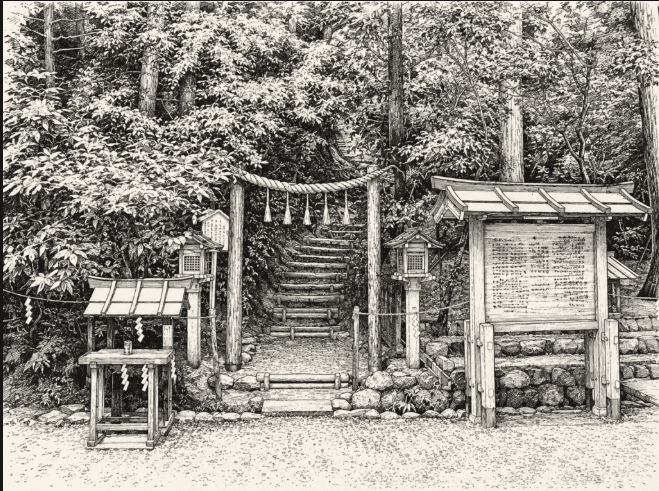
You have heard the rule now in several forms. Do not speak of what happens on the mountain. It appears, in slightly different wording, on the entry slip, in the spoken instructions at the registration desk, in the warnings of regular pilgrims to newcomers.
Why? Why this rule, in particular, so strictly?
There are reasons. They aren’t superstition. They are, when you look closely, an unusually sophisticated piece of cultural design — one that has succeeded for over a thousand years where most religious institutions have failed.
To understand it, you have to walk through what an Ōmiwa climb actually involves.
The climb, step by step
It begins, always, at the main hall of Ōmiwa Shrine.
You enter through the second torii (ni-no-torii), a massive wooden gate inside a long avenue of cedar trees. Even experienced pilgrims, who’ve done this dozens of times, agree on what happens next: the air changes. In summer, the temperature drops noticeably as you pass under the gate. The light becomes cooler, greener. The sound of the surrounding road traffic vanishes. You feel that you have entered an interior — even though you are still outdoors.
You walk the cedar avenue to the prayer hall. You bow, clap twice, bow again. This is the conventional Shinto greeting: two bows, two claps, one bow. There is no inner shrine to look into. You are praying toward the mountain through the hidden triple torii.
To climb, you don’t stop here. You continue.
From the main hall, a small side path called Kusuri-michi — the medicine path — leads you to Sai Shrine (狭井神社), the sub-shrine that serves as the climbing checkpoint. The path is lined with stone monuments donated by pharmaceutical companies and physicians. This is because Ōmononushi is, among his many roles, the god of medicine.
Inside the Sai precinct, on the left of the prayer hall, is the Kusuri-ido — “medicine well.” Sacred water rises from deep beneath Mt. Miwa, surfacing here. Traditionally, drinking this water is the first act of the climb. Bring an empty bottle; you can also fill it to take some home. The water is soft and unexpectedly sweet.
Then you register at the office.
Registration runs (normally) 9 AM to noon. The desk takes your name, address, and phone number — the phone number specifically, in case you fail to return by the deadline and the shrine needs to find you. The fee is small. You will receive two items:
A white sash (tasuki). Worn over one shoulder and across your chest, it identifies you, throughout the climb, as a registered pilgrim. There may be a small bell sewn into it — a soft chiming as you walk.
A hitogata — a paper cutout in the shape of a human. You will use this to purify yourself before the climb. You wipe it across your body to transfer accumulated impurity, then place it at the prescribed location at the climb entrance.
At the climb entrance, beside the hitogata basket, there is a wooden purification wand (haraegushi) and instructions for self-purification. At most shrines, a priest performs this rite for you. At Ōmiwa, you do it yourself.
This is meaningful. The unspoken statement is: the encounter with the god is yours. It cannot be delegated. You arrive at your own preparation, with your own hand.
All electronics, notebooks, sketchpads, and food go in a 100-yen locker at the entrance. You may bring one water bottle. Nothing else.
You pass under the entrance torii of the climbing path.
From this gate forward: no photographs, no notes, no food, no loud voices, conversation only when necessary, and do not speak of what you see.
The world changes.
Why these rules, all of them
Western tourists, encountering this list, sometimes find it excessive. Why so strict? It’s only a mountain.
The shrine’s implicit answer is structured. Each rule does something specific.
Why no photographs? Because the mountain is the god, and you cannot photograph a god. More precisely: photography turns the photographed into a consumable. Once photographed, an image enters the economy of social media, of “I was there,” of bragging, of branding, of clout. The shrine has watched, with quiet horror, what tourism has done to other sacred sites in Japan since 2010. Photogenic shrines have become Instagram backdrops. The sacred function has been hollowed out by the act of being seen. Ōmiwa refuses to enter that economy. Not photographable means not consumable means not turned into a product.
Why no notes, no sketches? Same logic. Notes are pre-photographs. Sketches are slow photographs. The mountain refuses to be transcribed.
Why no food? Eating on the mountain treats the climb as a hike — a leisure activity. The shrine wants it understood as something else: a pilgrimage. Pilgrimages, historically, involve fasting. The no-food rule is a gentle preserved fragment of that.
Why low voices, minimal conversation? Because conversation is what humans do when they are not paying attention to where they are. The instruction is, essentially: be here. Look at the trees. Hear the wind. Walk. Don’t fill the space with chatter. This is a meditation instruction smuggled into the climbing rules.
And — most strangely — why don’t speak of it afterwards?
This is the most interesting rule of all. And the reasoning behind it is deeper than it seems.
Why “don’t speak of it”
Consider what it does, structurally.
The pilgrim climbs the mountain. Something happens — large or small, dramatic or quiet. They come down. They are full of it.
Now: what does a modern person do, after a meaningful experience? They tell someone. They post about it. They write about it. They make it into language.
Here is the catch. The moment an experience is converted into language, two things happen. First, it becomes shareable, which is good. Second, it becomes flatter. The wordless texture of the thing — the smell of the cedar, the angle of the late light through the trees, the sudden recognition that the wind was responding to your breath — that does not survive the conversion to sentences. It can be gestured at, but not held.
A traveler who has just stood in the Sistine Chapel cannot describe the Sistine Chapel. They can only say things like “it was incredible” and “the colors were amazing.” The actual experience is in their body, and language can only point to it from the outside.
If the pilgrim, immediately after the climb, narrates the experience to friends, posts it to Instagram, blogs it on Medium — they are replacing the actual experience with the narration of it. The narration is what they will remember in five years, not the climb. The climb will fade behind the wall of stories they told about it.
This is a well-known phenomenon in psychology, sometimes called verbal overshadowing: putting an experience into words can degrade the memory of the experience itself.
The Ōmiwa rule — don’t speak of it — protects pilgrims from this. The instruction is, in effect: what just happened to you is yours. Keep it. Carry it as itself, not as a story about itself. Let it work on you slowly, over years, in a form that cannot be argued with or filed away as anecdote.
This is sophisticated. It is not the rule of a primitive religion afraid of being misunderstood. It is the rule of a tradition that has watched, over fifteen hundred years, what happens to experiences when they are talked about, and has decided to protect its pilgrims from that fate.
There is a second function. People who try to tell others what happened on Mt. Miwa often find that they are not believed. “Oh, you were imagining it. You were tired. You were stressed.” And the storyteller, hearing this dismissal, begins to doubt themselves. The certainty they had on the mountain — the absolute knowledge that something had happened — wears down.
The rule shields against this too. Don’t tell anyone. Their disbelief will only damage what you actually know.
The price of breaking the rule
The shrine and pilgrim tradition both insist that breaking the rule has consequences. Tatari — divine retribution.
You will find blog accounts of people who described their Miwa experience in too much detail and then ran into a string of bad luck. People who joked publicly about the climb, and had a sequence of misfortunes follow. The accounts are anecdotal. They could be coincidence. They could be confirmation bias — only the cautionary cases get retold; the people who broke the rule and had nothing happen don’t generate stories.
But here’s something interesting. In careful pilgrim writing — the long, thoughtful blog posts I’ve drawn from for this article — the writers often hedge. They will tell part of what happened, but pull back from the most intense moments. They will say, in effect: I want to write about this, but I cannot bring myself to write about that part. It feels wrong.
This is not necessarily superstition. It may be the writers’ own intuition — that the most important parts of the experience genuinely do not survive being typed out. They are protecting their own memory, even from themselves.
One restaurant reviewer, writing about a meal taken near the mountain after a climb, started to describe what had happened on the mountain itself, then wrote:
Even writing this now, I feel a chill of fear. Okay, I’ll keep it brief. On the way down, three people were walking ahead of us. By the time we noticed, there were only two. I’m not going to say more. Divine punishment is real. So that’s all.
Three people had become two. Mid-trail. No fork in the path, no chance to leave. The reviewer chose to stop writing.
You read this and your hair lifts. But notice what the rule has produced: a writer who almost tells the story, then stops. The mountain has reached forward through fifteen centuries and modulated even a casual food review.
That’s how the rule works. Not through enforcement. Through self-imposed reverence.
Why the called still find their way through
The rules are demanding. The climb is steep. The window is short. The conditions are strict. By every modern logic, fewer and fewer people should do this.
And yet — they keep coming.
Because the rules, mysteriously, don’t filter out the people they would seem to. They filter out the wrong people while letting the right people through. Pilgrims who feel called arrive, somehow, with the right state of mind. They read about the rules and find them not oppressive but appropriate. They were already going to be quiet. They were already going to walk attentively. They were already going to refuse the photograph.
People who don’t feel called — they read the rule list and decide it’s not worth the trouble. They go elsewhere. There are easier mountains.
So the called arrive, and the system protects them. They climb. Something happens, or doesn’t, but in the right way. They descend. They don’t speak. The experience does its slow work on them, year over year, the way it was designed to.
This is the deepest function of the rules. They don’t make pilgrimage harder. They make it real.
Chapter 6 — What we saw on the mountain: eight pilgrim stories
What follows are eight accounts, drawn from publicly posted Japanese-language blogs, journals, and reviews. They are paraphrased rather than translated literally. The core events — the visible facts — are as the writers reported them.
The “do not speak of it” rule remains in force. These writers chose to tell anyway, with various degrees of hedging. Read them with the understanding that each writer made a personal decision to break a long-standing prohibition, and most of them apologized for it in some way.
The clothes that stayed clean
A woman, first climb, late winter. She arrived at the registration desk just before the noon cutoff, white sash on, full of nerves. The morning had been clear and bright — perfect climbing weather.
A few minutes into the climb, snow began. Wet, heavy snow, the kind that turns the red clay of the Miwa trail into slick mud almost immediately.
She slowed down. The trail steepened. She was watching her footing carefully, but at one moment her right foot slid out from under her and she went down hard, rolling several meters sideways down the slope, picking up a long smear of wet earth on the way.
She came to a stop. She lay still for a few seconds, taking stock. Nothing broken. She pushed herself up, expecting to be a mess.
Her clothes were spotless.
She had felt the cold of the mud. She had felt the impact. Her body knew it had happened. But her white pilgrim wear had no smear, no stain, no damp. Her hands, knees, elbows — clean. She stood there, looking at her own body, for a long time.
She finished the climb. After descending, she returned the sash at the Sai office. The priest on duty glanced at her and said, casually:
“Did something happen up there?”
She froze.
“…Yes. Something I can’t explain.”
“Mm. It happens. People come down and they have that look.”
That was the entire conversation. She never wrote what she’d actually thought when she felt the fall — what she had said in her own head, what had passed through her in the second she was lying in the wet leaves. But she returned to Miwa many times after that day. The patterns continued, in different forms. She stopped trying to explain them. She just came.
The voice in the avenue of cedars
A woman in her sixties, born in Japan, living in Hawai’i for thirty years. Came back for a short trip to see her aging mother — three nights, four days. The middle day was free. On impulse she searched online for what to do, found Ōmiwa, decided to go.
She is not a spiritual person. She is practical, financial, skeptical. But she had volunteered at a Hawai’i Shinto shrine for years and was familiar with the etiquette.
She prayed at the main hall, kept it brief, and was walking back along the cedar avenue toward the entrance when she felt a small breeze move past her ear.
A voice she had not heard in twenty years said her childhood nickname.
It was her father. He had died twenty years before.
“——chan. Thank you for visiting Mom for me.”
She stopped walking. People passed her on the path. She didn’t notice them.
She stood there, in the green light under the cedars, and wept for ten minutes.
She wrote later: I am not the kind of person this happens to. I don’t believe in this. But I cannot find another explanation, and I’m not going to lie. He was there. He waited for me there. I have lived another twenty years past his death, and somehow, in a country I left, on a path I had never walked, he found me.
She returns to Ōmiwa whenever she can.
The third person who wasn’t there
Two men, mid-descent. The path was lightly populated. About fifteen meters ahead of them, three other climbers were descending together — three middle-aged men, walking in a loose group, talking softly.
One of the two friends was watching them idly. Three figures. Slightly different builds. Slightly different paces. Real, ordinary, climbing back down.
He looked away to check his footing on a difficult step. When he looked back up — there were two of them.
The middle one was gone.
There was no fork in the trail. No place to step aside. The two who remained had not paused, not looked around, were walking at the same pace they had been at when there were three. Their conversation was unaltered. They didn’t seem to notice.
“Where did the third guy go?” he asked his friend.
His friend was already frowning. “…There were three of them just now, right?”
They looked behind them. The trail behind was empty. No third figure. No sound of anyone catching up or having fallen back.
They reached the bottom. At the entrance lockers, they looked around for the missing climber, thinking he must have descended faster somehow. He wasn’t there.
The friend, casually, asked the desk attendant: “There was a group of three guys earlier — about fifteen minutes ahead of us. Did you see them come down?”
The attendant checked the registration log. The desk tracks all climbers by sash number — who’s on the mountain, who has returned.
“…There were no groups of three today, sir. No party of three registered.”
The desk attendant was certain. The registration system is precise. Three-person parties get logged together. None had been logged that day.
The writer added, at the end of his post: I’m not going to write more than this. The shrine asks pilgrims not to. But I saw what I saw. I don’t know what it was. The thought of it, even now, makes my hands feel strange.
The body that didn’t get tired
A homemaker in her forties, no athletic background, two children, a sedentary life. Hadn’t exercised in years. She had felt the pull to climb Miwa for months, then finally made the trip.
The first thirty minutes were brutal. The trail is steep at the start — large irregular stones, more like a staircase than a path. She was gasping within ten minutes.
But every time she paused to rest, her breath came back almost immediately. Normally, she would have needed minutes. Here, it was seconds. She would pause; her heart would slow; she would walk on.
At the halfway point — where most unfit climbers stop and seriously consider turning back — she realized her legs felt fine. Not heavy. Not burning. Light. As if she were being carried, or supported.
She made the summit. She turned around. She descended without difficulty.
Back at the entrance, sitting on the bench to remove her sash, she examined her body. Nothing hurt. Nothing was sore. She felt clean and rested.
At home that evening she told her husband. He did not believe her. “You’re saying you, with your fitness level, climbed a 467-meter mountain and you’re not sore.” She showed him the sash number and the descent log. He stopped doubting.
The next morning, she woke up with no muscle soreness. Day two — none. Day three — none.
She wrote: I am still telling the truth about this. There was no soreness. None. Whatever I climbed with that day, it was not just my body.
She has climbed again since. Each time, the same. She does not understand it. She has stopped trying.
The children laughing in the forest
A man, weekday morning climb. The trail was nearly empty.
About two-thirds of the way up, deep in cedar forest, he heard children’s laughter. Not one child — several. Bright, light voices, the sound of a small group playing somewhere off the path.
He stopped. Looked around. No one was visible. The trail behind him was empty for at least a hundred meters. The trail ahead was empty as far as he could see.
He knew the rules: children under twelve cannot climb without a parent, and groups of children cannot climb at all. There should not be children on this mountain. Certainly not unaccompanied groups of them, laughing somewhere in the trees.
He listened. The laughter was clearer now — not distant, but somehow surrounding him. He couldn’t locate the direction. Front. Side. Above.
The thought formed in his mind, very clearly: these are not children’s voices.
The laughter stopped, instantly. A strong gust of wind moved through the cedars.
He continued his climb in silence and did not hear the voices again.
Back at the Sai office, he mentioned it to the duty priest, who responded matter-of-factly:
“Ah. That would be friends of the god. Nothing to worry about. You were climbing respectfully — they didn’t reveal themselves, but they let you hear them.”
The pilgrim left without asking more.
The white serpent at the middle altar
A woman, first climb, with the formal goal of making an offering at the middle iwakura — the central rock altar partway up the mountain, where the god Ōnamuchi is said to dwell.
She knelt at the altar, placed her offering, pressed her palms together. After a moment, she opened her eyes.
Something moved in the gap between two stones beside her.
A small white serpent slid out, slow, deliberate. About thirty centimeters long. Its scales had that soft inner luminosity that pearl has. Its head turned toward her.
She did not move. She did not feel afraid. The serpent’s eyes were on her, but the attention felt — not hostile, not aggressive. Curious, almost. Examining.
It rested on the stone for several seconds. Then it turned, slid back into the gap between the rocks, and was gone.
She didn’t tell anyone on the mountain. She finished the climb in something close to a trance.
At the Sai office, after returning her sash, she mentioned the incident gently to a priest. I know we’re not supposed to talk about what we see, but — I think I should ask. Did I see what I think I saw?
The priest smiled.
“You saw him. Ōmononushi appears as a white serpent. You were met. That doesn’t happen often. Whatever you were carrying when you came here — he saw it.”
In the months following, decisions in her life that had been stuck for years began to resolve. Not dramatically. Just — clearly. She would describe later that it was as if something had been unblocked. Whatever else white serpents are, they apparently come with after-effects.
She has not seen the serpent again on any subsequent climb. She does not expect to. He answered once. That was enough.
The legs that refused
The fourth account from the prologue, told again here with what she didn’t say the first time.
She turned back. She went home. The landslide happened, on the trail she would have been on, at the time she would have been on it. She survived because her legs had refused to move.
What she added, in a later post:
Some part of me, after that, became aware that what I had assumed about who I was had been wrong. I had been thinking of myself as someone who would climb if she wanted to. As someone whose body did what she told it. After Miwa, I knew that wasn’t true. There was someone else involved. Someone — something — that took up residence in my decisions about my own life, at least for a few minutes. I don’t know what it is. I don’t know how to name it. But I know it exists, because I felt it shut my legs down.
I think most of us live our whole lives without ever finding out that we are not alone in our own bodies. Miwa was where I found out.
The crying she hadn’t expected
A woman in her early thirties, going through a long period of personal collapse. Her work had ended. A relationship had ended. Her family had been distant for years. She had been thinking, in passing, about ending her own life.
She didn’t know why she wanted to climb Mt. Miwa. The thought just appeared one morning. She wasn’t religious. She didn’t expect anything. She just wanted to walk up a mountain.
She registered, took the sash, started the climb.
About ten minutes in, she started crying. Not for a reason — there was no specific thought that triggered it. The tears just began, and they didn’t stop. They came as she climbed, silently, soaking into her sash. People passed her on the trail and said nothing.
Halfway up she had to stop. She sat on a stone and sobbed.
She understood, eventually, what she was crying about. It wasn’t grief. It was permission. Permission to stop carrying everything she had been carrying. Permission to be the person she actually was, instead of the person she had been performing as for years.
A sentence formed in her head — she’s not sure where it came from — you don’t have to do this anymore.
She finished the climb. She came down lighter. Not metaphorically — physically lighter, the way you feel after a fever breaks.
Her life did not immediately reassemble. It took years. But the climb was the turning point. She found work, gradually. She found friends, gradually. She found, eventually, a partner. None of it was caused by the mountain. But the mountain was where she had been allowed to lay down the version of herself that had been killing her.
She wrote: I cried more in those two hours than in the previous ten years combined. The mountain did not tell me anything. It just made it safe to cry. That was enough.
A priest at the shrine, asked once why so many pilgrims weep on the descent, said:
“They come here with things they didn’t realize they were holding. The mountain lets them put it down. Sometimes the putting-down looks like crying. It’s just the body letting go of what it could finally let go of.”
These eight stories are a small selection from a much larger field. The blogs and journals number in the hundreds. The patterns are consistent — the people are not consistent, but the shape of what happens to them is. Most of the writers were skeptical going in. Most came out changed.
You can read this as evidence of something real about the mountain. You can read it as evidence of something real about the pilgrim mind. Both readings are interesting. The mountain doesn’t seem to care which one you choose.
The called keep climbing. And the called keep coming down with the shape of their lives reorganized in ways they didn’t ask for, didn’t expect, and don’t fully understand.
Chapter 7 — The wrathful god and the miracle of sake
It is time for a darker piece of the story.
Ōmononushi is not only a kindly god. He is also — to use the formal Shinto term — a tatarigami, a wrathful god. A god who, when not properly honored, can destroy the country he chose to live in.
He gives and he takes. He heals and he afflicts. He brings rain and he brings plague. The same god, both faces.
And from one of those darker moments — a moment when the country nearly ended — comes one of Japan’s most beloved cultural traditions. Sake.
The story is from the reign of the tenth emperor, Sujin, in the early period that the chronicles describe as the dawn of consolidated Japanese rule. The precise dating is contested; the chronicles place his reign in the 1st century BCE, but most modern historians push it later, perhaps to the 3rd or 4th century CE. The exact century is less important than the shape of the story.
The plague
Sujin was a young and capable emperor. Ambitious. Building a state. He inherited two great deities enshrined in his own palace: Amaterasu, the sun goddess and ancestor of the imperial line, and Yamato-no-Ōkunitama, the great spirit of the Yamato land.
Then a plague began.
Half the population died. The Nihon Shoki records this matter-of-factly: half. Tami no nakaba ni shisubeshi. The country was emptying.
Sujin tried everything. Doctors. Ceremonies. Petitions. Nothing helped. The plague kept moving.
He concluded that the gods themselves were angry — perhaps too powerful to be housed safely inside the palace. He moved Amaterasu out, beginning the long wandering of her shrine that would eventually settle in Ise. The first stop on that journey, the chronicles say, was the foot of Mt. Miwa — at the place we now call Hibara Shrine.
But the plague didn’t stop. Sujin was, by every report, on the edge of despair. I have done everything. There is nothing left.
The dream
One night, the emperor fell into a heavy sleep, and a god stood at his bed.
“I am Ōmononushi, of Mt. Miwa,” the god said. “The plague is my doing.”
Sujin, on his knees: “Why?”
“Because you have not honored me correctly. I have a descendant — a man named Ōtataneko, living in Chinu, in Kawachi. Find him. Have him serve as my priest. Then the plague will stop.”
The emperor woke and immediately ordered a search of the entire country for a man named Ōtataneko.
He was found almost immediately. He was living plainly, in what is now eastern Osaka Prefecture. He had been waiting, in his own way. When the emperor’s messenger arrived, he was not surprised.
Brought before the emperor, Ōtataneko was asked his lineage.
“I am a descendant of Ōmononushi. My ancestress was Ikutamayori-hime, the girl who tied the thread to his robe.”
The girl of Chapter 2. Eight generations later. The thread had run all the way down to this man, and he was the one who would close the circle.
Sujin appointed Ōtataneko as the chief priest of Mt. Miwa. The proper rites were performed. The plague stopped.
This is the founding moment of the formal Ōmiwa priesthood. The clan descended from Ōtataneko — the Miwa or Ōmiwa clan — has tended this shrine ever since. The lineage that began with a girl following a thread to a mountain god has been the priestly lineage for at least fifteen hundred years, possibly longer.
The brewer
But the plague ending wasn’t enough. Sujin wanted to offer his thanks formally — with sake, in the highest manner. He called for the country’s master brewers and chose one of them: a man named Takahashi-no-Ikuhi-no-Mikoto.
Ikuhi was given a single instruction: brew a sake worthy of the god.
“At the cost of my life, I will try,” he said.
What followed is the founding miracle of Japanese sake brewing. The records are sparse on technique, but emphatic on outcome: Ikuhi, in a single night, produced a sake of such clarity and depth that no one had ever tasted its equal. He brought it to Mt. Miwa and offered it to Ōmononushi.
At the offering, he sang:
Kono miki wa, waga miki narazu Yamato nasu, Ōmononushi no kamishi miki Iku-hisa, iku-hisa
This sake is not my sake. It is the sake brewed by Ōmononushi, who built Yamato. May it last forever, forever.
The brewer was saying, I did not make this. The god made it through me.
Sujin was overwhelmed. He elevated Ikuhi to the founder of the brewer’s art. Ikuhi spent the rest of his life teaching the technique across the country, and after his death he was enshrined as a god himself — at Ikuhi Shrine (活日神社), a small sub-shrine within the Ōmiwa precinct.
To this day, Ikuhi Shrine is one of the most sacred sites in the Japanese sake industry. Every year, master brewers from across the country make pilgrimage to it. They pray at the small precinct, offer their year’s new sake, and ask for good brewing in the year to come.
Three words, one sound
There is a strange linguistic fact buried in this story.
In ancient Japanese, the word miwa — the place name — was also a word for sake. (We still see this echo today: omiki, “honorable sake,” shares its core with miwa.) And miwa was also, in older usage, a word for god.
Miwa = god. Miwa = sake. Miwa = the place where the god of sake lives.
Three meanings folded into one sound. Three readings of the same syllable. The mountain, the deity, and the drink — linguistically indistinguishable, locally inseparable.
When you drink sake brewed under Miwa’s auspices, you are, in the old grammar, drinking the god. The thing in your cup is not a beverage that honors the deity. It is, in some deep grammatical sense, the deity in liquid form.
This is why sake matters in Shinto in ways that wine matters in Christianity — but more so. Sake is not a symbol of the divine. In the older logic, sake is the divine, momentarily portable.
The sugidama
If you have ever been in a sake shop or brewery in Japan, you have seen them: large green spheres of cedar branches, hanging from the eaves above the entrance. They are called sugidama.
They mean: new sake is ready. When a brewery hangs a fresh, green sugidama, it announces the year’s first new release. As the months pass, the sugidama dries, turning gradually brown — the visible aging of the sake inside is mirrored by the ball outside.
Every sugidama in Japan, traditionally, comes from Mt. Miwa.
They are made at Ōmiwa Shrine. The cedar branches are cut from sacred trees on the slopes of Miwa. Every year, on November 14, the shrine holds the Jōzō Kigan-sai — the brewing-prayer festival — at which sugidama are distributed to breweries across the country. Each sugidama bears a small wooden tag: Miwa Myōjin no shirushi no sugidama — “the sign-sugidama of the Miwa deity.”
Every time you see a sugidama hanging in any Japanese sake shop, in any prefecture, you are looking at a small piece of Mt. Miwa, dispatched to bless the brewing.
The whole industry is still, in a quiet structural sense, supervised by this mountain.
The wrathful god, properly understood
It is worth pausing on what kind of god Ōmononushi is.
He saves the country. He destroys it. He blesses the rice. He blights it. He grants the love of his daughter to her descendants. He drives a princess to die on a chopstick.
This is not contradiction. This is the older logic of the sacred, before religion was reorganized into “good god” and “bad god” or “god” and “devil.” Ōmononushi is power — raw, undivided, neither benevolent nor malicious by nature. What he gives depends on how he is met.
Honor him correctly, and he is the most generous of patrons: agriculture, medicine, sake, healing, the prosperity of the country.
Honor him carelessly, or treat his mountain as a tourist attraction, or break the etiquette that has stood for fifteen hundred years — and the gifts withdraw. Sometimes worse than withdraw.
This is what tatarigami — wrathful god — really means. Not “evil god.” A god who is a perfect mirror to the respect you bring him.
The rules at Ōmiwa are, in this light, not about religion. They are practical. They are how you handle a power that does not care whether you understand it.
You walk in with the right body, the right silence, the right attention — and you receive whatever the mountain has for you that day. Light or heavy, easy or hard, but real.
You walk in casually, with your phone out and your voice up — and you receive nothing. Or worse.
This is, in its way, an entirely modern understanding of how power works.
Chapter 8 — Mimuro Sugi: the only sake brewery still standing in Miwa
At the foot of Mt. Miwa, a three-minute walk from JR Miwa Station, along the approach road to Ōmiwa Shrine, stands a quiet, old building.
Imanishi Brewery (今西酒造). Founded in 1660. Three hundred and sixty-plus years of continuous sake brewing on the same plot of land.
It is the only sake brewery still operating in Miwa — the place that, according to the Nihon Shoki, is the birthplace of Japanese sake.
Once, there were many breweries in this town. Centuries of war, modernization, depopulation, and economic shocks killed them one by one. Imanishi is the last.
That fact alone would make this brewery worth a visit. The story of how it survived — and what one man did to bring it back from near-death — makes it remarkable.
The labels
Imanishi makes its sake under two main brand names. They look different, and they’re for different occasions.
Mimoro Sugi (三諸杉) — the kanji-script brand. The traditional label. Distributed locally; you’ll find it in shops and restaurants throughout the Nara region, and at the brewery’s own tasting counter. Mimoro is the ancient name for Mt. Miwa. Sugi means cedar — the sacred tree of this mountain. The label is named after the place and the wood of the place.
The flavor of Mimoro Sugi is rich and rounded. It is built for everyday drinking: served warm or chilled, paired with food, made to be enjoyed across a long meal. It does not announce itself. It accompanies the table for hours.
Mimuro Sugi (みむろ杉) — the hiragana-script brand. The contemporary label. Distributed through carefully selected dealers, mostly outside the immediate region.
This is the bottle that has, in the past decade, exploded across the Japanese sake world.
The Mimuro Sugi Roman series — the line that has built the modern reputation — has restrained aromatics, a fresh and juicy texture, and a faint sparkle on the tongue, like the trace effervescence of a clear stream. People who have not historically liked sake — too dry, too strong, too “old fashioned” — try Mimuro Sugi and stop in their tracks.
On the major Japanese sake rating site Saketime, Mimuro Sugi has held the #1 position in Nara Prefecture for years, and has placed in the national top tier. The brewery has been honored at the National New Sake Appraisal multiple times, a rare achievement for a small Nara producer.
The man behind the revival
The fourteenth-generation owner of Imanishi Brewery is Imanishi Masayuki. His path to running the brewery is the kind of story that the sake industry tells over and over, slightly amazed.
He grew up knowing he would inherit. But he didn’t do what brewer’s sons normally do — he did not go to Tokyo Agricultural University to study brewing. He went to Dōshisha University, in Kyoto, to study business.
His reasoning, told later: Making good sake isn’t enough anymore. If you can’t read the market, can’t run a company, can’t make strategic decisions — the brewery will die no matter how good the sake is. Brewing techniques I can learn afterward. Business sense I have to learn now, while I’m young.
After graduation, he joined Recruit Career — a major Japanese staffing and HR firm — as a salesperson. He quickly became a top performer. Year after year he made the company’s top-sales lists. He led teams. He was building a career.
The plan was: return to the brewery at age 30, learn from his father for a decade, become company president at 40. Slow, careful succession.
The plan didn’t survive contact with reality.
One day he was in the middle of a sales meeting when his phone rang. His father.
“Masayuki. I have been told. Three months.”
His father had been diagnosed with terminal cancer.
Masayuki was 28. Two years short of his planned return.
He resigned within the week and went home. His father, despite everyone’s prayers, did not last three months. He died seven days after the diagnosis.
Masayuki, suddenly and without warning, became president of a brewery. He had received no formal training in sake. He had never sat down with his father to learn the family techniques. He inherited the business with no knowledge of how to run its core function.
Worse: when he opened the books, he discovered the company was massively in debt. The previous generation had diversified — restaurants, a small lodging operation — and all the side businesses were bleeding money. The debt was real, and severe.
He has said, looking back: When I came back, I thought my life was over. I’m not exaggerating. I genuinely thought, in those first weeks, that the company was going to fail and I was going to fail with it.
But he didn’t fail.
He shut down the restaurants. Closed the lodging. Cut everything that was not the brewery. If we’re going to die, he reasoned, we’ll die brewing. Not running businesses our family was never good at.
He learned the brewing. Not from his father — that opportunity was gone — but from books, from older brewers who took him in, from trial and error. The first year, he listened. Walked the brewery. Talked to every employee. Asked them what worked, what didn’t, what they thought.
And he made a decision.
This brewery’s only real strength is that it is the only one left in the place where sake was born. Everything else — equipment, scale, marketing budget — we lose on. But this, the location, no one can take from us. We have to bet everything on that.
He bet everything on Miwa.
All water from the Miwa underground aquifer. All brewing by hand, no industrial automation. Every label, every campaign, every story tied to the mountain. The Mimuro Sugi Roman series was the first major release under his philosophy: contemporary technique, ancient place.
It worked. Within a few years, Imanishi went from near-bankruptcy to being one of the most-watched sake brands in Japan. The debt cleared. Allocations to dealers became restricted because demand exceeded supply. Magazines like dancyu featured the brewery repeatedly. A small brewery in rural Nara had become a name that informed drinkers in Tokyo, Osaka, and overseas knew.
Masayuki himself, asked how it happened so fast, says quietly:
This brewery sits at the foot of a god’s mountain. I tried not to forget that. The rest — I think it wasn’t really me.
What the sake tastes like, and why
Mimuro Sugi is built around the water of Mt. Miwa. The aquifer beneath the mountain feeds the brewery directly. Soft water, gentle profile, balanced minerals. In sake, water is said to account for ninety percent of the final character. Whatever the rice does, the water has already set the stage. The Miwa water gives Mimuro Sugi its particular softness — the sense that the sake has been raised gently, not aggressively pressed into shape.
The rice is meticulously chosen. Yamada Nishiki, Omachi, and Tsuyu-hadare — a Nara-only rice varietal that does not grow elsewhere — are central to the brewery’s catalogue. Tsuyu-hadare in particular is what makes a fully Nara-built bottle possible: water, rice, and process all native to the prefecture.
Outside the country, Mimuro Sugi has been making slow but real inroads into international sake markets. Specialist importers in the United States, the United Kingdom, France, and Singapore now carry the brand. If you are reading this from outside Japan, the path to your local shelf is shorter than it used to be.
The bodaimoto series
In recent years, the brewery launched a second flagship line that quietly redefined what it was capable of.
Mimuro Sugi Bodaimoto — the bodaimoto series — revives a fifteenth-century technique developed at Shōryaku-ji, a Nara temple often credited as the actual technical birthplace of modern sake brewing (separate from the mythic birthplace at Miwa). The bodaimoto method uses a unique starter culture, fermented at lower temperatures, that produces a sake with extraordinary depth and a softness that ordinary modern processes cannot match.
The Bodaimoto sake is fermented in wooden barrels — and not just any wood. The barrels are made from Yoshino cedar, the cedar of the Yoshino region in southern Nara, famous for its quality.
And here is the strange detail. A Meiji-era forestry text records that the original Yoshino cedars were transplanted, in deep antiquity, from the slopes of Mt. Miwa. The cedars of Yoshino and the cedars of Miwa share a common ancestor.
So: Miwa water. A traditional technique from Nara. Wooden barrels descended, by lineage, from the cedars of Mt. Miwa itself. The Bodaimoto series is, in every component, a sake of Miwa — water, technique, wood, all tracing back to the mountain.
The labels carry visual references that gather all of this into one image: a small white serpent (Ōmononushi’s form), a rabbit (his sacred day in the zodiac), the sasayuri lily (the shrine’s sacred flower), and — on the barrel-aged Bodaimoto — a blue lotus leaf, a nod to the centuries before Meiji when Ōmiwa was a combined Shinto-Buddhist site and the divine and the buddhic shared the same precincts.
How to drink Mimuro Sugi from outside Japan
You will not, casually, find Mimuro Sugi in a supermarket. The brewery distributes through a network of dealers, each selected for their understanding of sake. In Japan, specialist sake shops in major cities carry it; outside Japan, look for shops that focus on craft sake imports.
If you can read or navigate Japanese sake shop websites, the brewery’s distributor list is published. Many of the international importers maintain online stores that ship to their home markets.
Approach the labels in this order, if you are new to it:
Junmai Ginjō Yamada Nishiki, the entry into the Roman series — clean, fresh, light, and the perfect first impression. If sake-curious friends want to be converted, this is the bottle.
Junmai Daiginjō, for occasions that deserve more attention.
Bodaimoto series, for those who want the strangest and deepest expression — the sake that tastes most like the place.
And whenever possible, drink it lightly chilled, in a clean wineglass rather than the traditional sake cup. The aromatics of Mimuro Sugi reward a glass that lets the nose work.
The shop at the foot of the mountain
If you do make it to Miwa, the brewery’s shop sits along the approach road to Ōmiwa Shrine. It is small. Wooden. Quiet. The staff are knowledgeable; they will help you find a bottle that fits your palate.
You can taste before you buy. They sell bottles you cannot easily find anywhere else — limited-release labels, seasonal special editions, an excellent house amazake (non-alcoholic fermented rice drink), and Shinto offering sets that include a ceremonial sake and a hand-selected egg.
Step out of the shop, walk back toward the shrine, and consider what just happened. You have, in your bag, a small bottle of liquid distilled — under the gaze of this mountain — from this mountain’s water and this mountain’s grain. You are about to carry the deity home in portable form.
It is hard to overstate how unusual a thing this is.
A continuation of the chronicle
Chapter 7 told you about Emperor Sujin, the plague, the brewer Ikuhi, and the founding of Japanese sake.
This is the same story. It is still going. The young brewer running Imanishi today is, in the deepest sense, the same role. Mountain. Brewer. Bottle. Devotee. The components are unchanged; only the names rotate.
When you uncork a bottle of Mimuro Sugi in your apartment, three weeks after you came home from Japan — the room changes briefly. The wood of the cedar avenue is there. The wet stones of the descent are there. The white sash, the laughter in the forest, the legs that almost wouldn’t move — they are all in the bottle, faintly, the way a photograph carries the light of a moment long after the moment has passed.
The mountain travels.
Chapter 9 — The purifying sand: a real amulet from the body of the mountain
If you cannot climb Mt. Miwa — for reasons of timing, of physical limit, of distance, or of having been quietly turned away by the mountain — there is another path.
You can take some of it home.
At the Ōmiwa Shrine office, available throughout the year for a small offering, is something called the kiyome-no-osuna — the purifying sand. A small paper packet of clean white sand, drawn from the sacred grounds at the foot of the mountain.
To a Western reader, “sand from a shrine” might sound modest. Sometimes-charming, often-meaningless souvenir. Let me explain why pilgrims and traditional practitioners take this particular sand seriously.
Why this sand is different
Many Japanese shrines distribute kiyome-suna — purifying sand — or o-shintsuchi — sacred earth. It is a recognized class of Shinto blessing. Some of the most famous: Izumo Grand Shrine, Jōnangū in Kyoto, Sarutahiko Shrine in Mie, Samukawa Shrine in Kanagawa, Toga Shrine in Aichi, Kamigamo Shrine in Kyoto. Each has its own form, its own ritual use, its own tradition. They are all worthy.
But the sand from Ōmiwa belongs to a different category.
This is because of the singular structure of the shrine itself. At every other shrine in Japan, the kami (deity) lives inside the main hall — a building separate from the ground around it. The grounds are sanctified by proximity, but the deity dwells in the building.
At Ōmiwa, there is no main hall. The deity is the mountain.
This means the grounds at Ōmiwa are not “near” the deity. They are the deity’s body. The earth of these precincts is, in the deepest sense, the flesh of the god.
A specialist text on Japanese ritual sand writes the following about Ōmiwa, paraphrased: Because the deity dwells in the mountain itself, the spiritual force of the earth here is unmatched. The accumulated sanctity of this ground — through fifteen centuries of priests, emperors, and pilgrims all directing their attention into this soil — is at a level no other shrine can claim.
Fifteen centuries of concentrated attention have soaked into this ground. The sand is the most portable, transportable fragment of that.
What the sand is used for
There are several traditional applications, ranging from simple to elaborate.
The four-corner blessing of a home. The most common use. Sprinkle a small amount of the sand at each of the four corners of your home — interior or exterior, depending on context. This creates a kekkai, a protective barrier. Negative energy, in the traditional Japanese spiritual framework, has more difficulty entering a space whose corners have been sanctified.
Pilgrims who do this report, surprisingly often, that the atmosphere of their home changes. The “heaviness” that some homes carry — particularly old apartments, or homes near places of high foot traffic — lifts. Sleep improves. Visitors comment on the air without knowing what was done.
These reports are anecdotal, of course. I won’t try to argue them as proof of anything. I will only note that they are common enough among practitioners that they appear with regularity on Japanese blogs and forums.
Northeast and southwest reinforcement. Japanese geomancy, descended from Chinese feng shui, treats the northeast (the omote-kimon, “front demon gate”) and the southwest (the ura-kimon, “back demon gate”) as the directions through which inauspicious energy is most likely to enter. If you wish to fortify a home more carefully, additional sand goes at these specific compass points.
The ritual itself is simple. Stand facing the point. Lightly hold the container of sand in your left hand. Pinch a small amount with your right hand. Sprinkle in three gestures: front-left, front-right, front-left. With each gesture, silently or aloud: Harae tamae, kiyome tamae — “purify, cleanse.” Close with a small bow.
Placement at the bedside. A folded piece of paper, with a few grains of sand inside, placed near the bed of someone who is ill. The traditional belief is that the sand carries the healing presence of Ōmononushi — a god of medicine, after all — and supports the recovery of the body. Used for centuries by families navigating chronic illness or surgery recovery.
Personal carrying. A small pouch of sand, kept in the bag, the wallet, or the pocket. A portable amulet. Particularly valued during travel, at unfamiliar hotels, or in cities where you do not know the spiritual condition of the spaces you’ll be sleeping in.
Major life transitions. New houses, new offices, new businesses, new chapters — the four-corner blessing is performed at the threshold of the new space, before furniture or possessions are moved in. The new space is given the body of the mountain before it accumulates anything else.
The strongest form of this ritual involves the practitioner having performed kessai — personal purification — before the sprinkling: a ritual bath, attention to clean intention, a clear and reverent state of mind. Purify yourself first; then purify the place.
What about expiration
Sacred ritual items in Shinto, by general custom, are returned to the shrine after a year for renewal. New ones are received in exchange. This is the standard cycle for most omamori (amulets), ofuda (talismans), and other shrine items.
Ōmiwa’s purifying sand is — interestingly — an exception. When asked directly, the shrine office has stated that the sand does not have a fixed expiration. Its force is not bound to a calendar year. The sand may remain in a home for many years without diminution.
This is unusual. It reflects the underlying logic: the sand is not a charged object whose charge fades. It is a piece of the deity’s body. Bodies of gods, in the older theology, are not subject to ordinary decay.
If the sand becomes physically degraded — soaked, clumped, dispersed — it can be replaced. If the home’s circumstances change dramatically (a death in the family, a major renovation, a move), some practitioners refresh the sand to mark the new state. But the sand from years ago is not “expired.” It has simply been there, doing its quiet work, for that long.
A note for non-Japanese pilgrims
Foreign visitors are welcome to receive the sand. The shrine office is accustomed to international pilgrims; the explanation may be brief, but the offering is offered. The small fee is contributory rather than commercial — this is not a sale, and the sand is not sold by weight or by quantity. It is a gift, sustained by the gift in return.
If you cannot travel to the shrine, the office accepts mail requests for sand to be sent. You will need to navigate the request in Japanese — or arrange through a Japanese-speaking friend or service. The instructions appear on the official shrine site. The shrine asks, reasonably, that the request be sincere — that the sand is for the actual use, not for resale or display.
The sand should not, under any circumstance, be commercialized. To sell it, to repackage it, to use it as the basis of a product or business — these acts strain the gift. The blessing operates by being given freely. Resale ends the circuit.
If you receive sand and wish to share some with family — entirely permissible, the shrine has confirmed, provided that the sand has not yet been used for the four-corner blessing. Unused sand is still in its receivable state and can be passed on. Used sand has been “placed”; it should remain in the placement.
Sand versus salt
A brief note for Western readers who know the Japanese tradition of mori-jio, the small cones of salt placed at the entrances of restaurants and homes. Salt has a related but different function in Japanese ritual.
Salt is fast, defensive, and reactive. It dissipates negative energy on contact. It is used at the moment of need — after a funeral, after an upsetting event, after an unwelcome visitor. A pinch of salt thrown over the shoulder. A cone at the doorway. The salt acts immediately and then is replaced.
Sand from a sacred mountain works differently. It is slow, structural, and constructive. It does not so much repel negative energy as gradually raise the baseline atmosphere of the space. Where salt resets, sand cultivates.
Many practitioners use both. Salt at thresholds for daily resets; mountain sand at the four corners for the long-term ground state. The two operate at different frequencies.
Why this matters
For thousands of years, this small handful of pale earth has been the most ordinary, most overlooked, most quietly potent of the things Ōmiwa offers.
You can climb the mountain only on certain mornings, in certain weather, with certain conditions met. The mountain itself you cannot take with you.
But the sand — the sand is portable. The sand fits in a coat pocket. The sand crosses oceans. The sand sits in the corner of a Brooklyn apartment, or a Berlin attic, or a Sydney walk-up, and quietly does the same thing it has done in Japanese houses for fifteen hundred years.
It is, in a literal physical sense, a piece of one of the oldest sacred mountains in the world, in your hand. The cost of receiving it is the cost of a small offering. The work it does is harder to put a number on.
If you go to Ōmiwa, receive the sand. If you cannot go, request the sand. Place it in your home according to the simple ritual.
What happens next — what changes, what doesn’t, what you notice three months from now or three years — is not for me to promise. But it has happened to enough people, in enough languages, over enough centuries, that the practice has not stopped being passed down.
That, in itself, is a kind of evidence.
Kiyome no Osuna

It is a sacred item used to purify land, buildings, and places that feel unclean.


Any leftover sand may be returned to the shrine grounds, or to the soil of your own garden.


When filling in a well, scatter the sand over the soil before refilling. When moving house, you may scatter it at either the new or the old home.
The sand is a blessing from the deity — please treat it with care.

Chapter 10 — Food at the foot of the god
After the climb, the body comes back from wherever it has been. It is hungry.
This is by design. Pilgrimage, anywhere in the world, has always closed with food. The body that has emptied itself out on the mountain needs to be filled. The mind that has been opened needs something to do with its hands.
At the foot of Mt. Miwa, the food is exceptional. Not in a tourist-trap sense. In a deep, regional, ancient sense. This is one of those rare places where the famous local dishes are famous for a reason, and where their stories trace back to the same mountain you just climbed.
Sōmen began here
You probably know sōmen — the very thin Japanese wheat noodles, served chilled in summer with a dipping sauce. They are the national summer dish.
What you may not know is where they came from.
The tradition begins in early Heian-period Miwa, around twelve hundred years ago. In the line of priestly families descended from Ōtataneko (the founding priest of Chapter 7) was a man named Taneonoshi, second son of the priest Sai Kusa. Around 827 CE, when famine and plague struck the Miwa region, Taneonoshi prayed at the shrine for a way to feed the suffering people.
The shrine tradition records that a divine instruction came: the land between the rivers Makimuku and Hatsuse is rich. Plant wheat. From the wheat, make a food that can sustain the people.
Taneonoshi grew wheat. He milled it on stone wheels turned by the local water. He kneaded the resulting flour with sacred water from Mt. Miwa, stretched the dough by hand into long thin strands — and a new food entered the world.
This is the origin story, as preserved in shrine records. From this single moment, sōmen spread across the country, becoming over the centuries one of the staple foods of Japan.
The Miwa sōmen tradition — the real, hand-stretched, slow-aged kind — is qualitatively different from anything you’ll find in a supermarket. The technique is laborious. The dough is hand-stretched over and over, drawn finer with each pass, until the strands become almost hair-thin. Then the noodles are aged, sometimes for a year or more — the practice called tsuyu-goshi, “passing through the rainy season.” The aging deepens the flavor and tightens the texture. New sōmen is good; year-aged sōmen is something else.
Real Miwa sōmen carries a stamp on its paper band: a small torii gate. Any package without that stamp, whatever it says on the label, is not certified Miwa.
The teahouse where the noodles taste like recovery
At the foot of the shrine, along the approach road, sits a small wooden teahouse called Sakaguchi Chamise (阪口茶店). It has been there for over a century, in the same building, run by the same family.
It serves nyūmen — the warm version of sōmen. Sōmen in a delicate, fragrant broth, garnished with shiitake, kamaboko fish cake, a slice of yuzu, and a sprig of green onion. That’s it. That’s the dish.
Sit in the wooden interior, near the window that looks out on the avenue of pilgrims passing back and forth. Order the nyūmen. Sip the broth first.
There is something that happens to the body, drinking that broth, after a Miwa climb. It is not metaphorical. The mountain has burned through your reserves. The broth — kombu, bonito, the slow umami of two-thousand-year-old Japanese culinary intuition — goes in and rebuilds you. You can feel each part of your body coming back online.
The noodles themselves: somehow simultaneously light and chewy. Drinking the broth and the noodles together feels less like eating and more like being slowly restored.
I have spent many of the most quietly happy thirty-minute stretches of my life sitting in this teahouse after a Miwa climb. If you do nothing else after descending, sit here. Order nyūmen. Look out at the cedars. Let the rest of the day catch up to you.
Kakinoha-zushi: the desert sushi
The second food you must eat in Miwa is kakinoha-zushi — sushi wrapped in persimmon leaves.
The name confuses people. Sushi, in Nara? Nara is landlocked. There is no coast.
This is precisely the point. Kakinoha-zushi is the food of a place that wanted sushi but didn’t have the sea.
Centuries ago, mackerel caught off the coast of Wakayama Prefecture were lightly salted on the boats and then carried inland on the backs of porters, over the mountains, to Nara. The journey took days. There was no refrigeration. By the time the mackerel reached Nara, it would normally have spoiled.
Local cooks solved the problem with a leaf. The leaf of the persimmon tree, kaki no ha, contains natural tannins with antibacterial properties — a fact known empirically long before science could explain it. They placed the salt-cured mackerel on a bed of vinegared rice and wrapped the whole thing in a fresh persimmon leaf. Pressed it. Let it rest.
The result kept for several days at room temperature, traveled well, and — accidentally — tasted extraordinary. The leaf’s faint, vegetal aroma transferred subtly into the fish and rice. The vinegar of the rice and the salt of the fish balanced each other across the boundary. The result was a food that was, somehow, more than the sum of its parts.
Eight hundred years later, kakinoha-zushi is still made the same way.
You unwrap the leaf. Inside, a small rectangle of vinegared rice, topped with a slice of mackerel (or salmon, or sea bream, depending on the modern variant). The first bite delivers, in order: the leaf’s herbaceous lift, the cool fattiness of the fish, the gentle sweet-tart of the rice. They arrive in sequence, like notes in a chord.
And — strange — kakinoha-zushi is good cold. Better, some argue, after a few hours of resting than fresh. The flavors merge as the package sits. This is the food of long journeys, perfected.
The major brands of kakinoha-zushi in Nara are Hirasō (founded in Yoshino over 150 years ago), Yamato (whose station-bento version is famous), and Tanaka (broad distribution; you can find their boxes even at Tokyo Station). Each has its loyalists. For first-time visitors, Hirasō has the deepest pedigree, and the wisest balance of salt, sweet, and leaf.
The pairing that wasn’t supposed to exist
There is one combination that, in the right hands and the right moment, will rearrange how you think about pairing food and drink.
Chilled Mimuro Sugi Roman, in a clean wine glass. Kakinoha-zushi on a small wooden board next to it.
Take a piece of the sushi. The leaf’s aroma, the mackerel’s fat, the vinegar’s bright edge. Set it down. Now take a small sip of the sake.
The sake — which on its own tasted clean and light, gently fruited — meets the residual fat of the mackerel and blooms. The fruit notes deepen. The leaf’s vegetal note finds an echo in the sake’s faint mineral background. The acidity of the rice resolves against the acidity of the sake. For a moment, the four things — leaf, fish, rice, drink — coexist in a single integrated taste, none of them dominating.
You sit back. Look out the window at whatever’s there. Realize you are, for two or three seconds, completely at rest.
This is what regional food at its highest level is supposed to do. It is what fifteen centuries of refinement in one valley, with these specific ingredients and this specific drink, has produced. You cannot get this combination anywhere else, in this way, with this background of mountain. It is local food in the deepest sense.
If you cannot find your way to Nara, both Mimuro Sugi and Hirasō kakinoha-zushi are obtainable through specialist Japanese importers in major cities worldwide. Importing the persimmon-leaf sushi takes some care — refrigerated shipping, careful timing — but it is done. The combination travels.
Small things on the approach road
Beyond the headline dishes, the road leading to Ōmiwa is dotted with small pleasures.
A street vendor sells sōmen tempura — the noodles deep-fried in a bunch, salted, eaten while walking, crisp and oddly addictive. A small sweets shop offers kuzu-mochi, transparent rice-flour cakes dusted with kinako, the gentlest dessert in the country. A tiny tea bar pours strong hōjicha — roasted green tea — in earthenware cups, served warm even in summer for the proper effect.
None of these will make a guidebook’s top-ten list. They are not famous. They are simply what happens, naturally, when a road has been receiving pilgrims for fifteen hundred years and the people along it have had time to figure out exactly what a tired pilgrim wants.
A small invitation
Picture this. You woke up early in a Nara ryokan. Took the train to Miwa Station. Walked the cedar avenue under green morning light. Climbed the mountain. Came down with whatever you came down with — light, heavy, calm, shaking, you don’t yet know.
It is one in the afternoon. You step into Sakaguchi Chamise. The wooden door slides open. Irasshaimase. You sit on the tatami. The bowl of nyūmen arrives, faint steam rising. You take the first sip of broth.
This is the moment the day will, in your memory, become about.
The mountain is what you climbed. But this — this is what your body will, for the rest of its life, remember.
Travel is, in the end, mostly the search for moments like this. Most people never get one. The structure of the modern world makes it hard. You have to leave too many things behind, and most travelers can’t.
But if you have come to Miwa, and you have climbed, and you have done it the way the mountain asks — then the moment is waiting for you. The teahouse has been waiting for you for a hundred years. The mountain has been waiting for you for fifteen hundred.
All you have to do is sit down and pick up the chopsticks.
Chapter 11 — Ten places to walk deeper around Mt. Miwa
The shrine and the mountain are the heart. But the foot of Mt. Miwa is dense with sacred and historical sites that, taken together, make this region one of the most extraordinary landscapes in Japan.
You can spend a single day here. You can spend three. You can spend a lifetime. Each visit, more emerges.
Below are ten places worth walking to, in order of priority. The first few are inside the shrine grounds; the latter ones extend along the Yama-no-be-no-michi, the ancient road that runs north from Ōmiwa.
1. Sai Shrine (Sai Jinja) — the climbing gateway and the medicine well
Inside the Ōmiwa precincts, the sub-shrine where Mt. Miwa climbing registration takes place. Even if you do not climb, visit. The deity here is the aramitama — the rough, transformative aspect — of Ōmononushi.
If the main shrine is where you go for harmony and accumulation, Sai Shrine is where you go for change. Pilgrims facing major life transitions — a new direction, a difficult choice, recovery from illness, the courage to leave something behind — come specifically here.
Drink from the medicine well (kusuri-ido) before you leave. Sacred water from deep beneath the mountain, served from a small spring at the side of the prayer hall. Bring an empty bottle to take some home.
2. Kuyehiko Shrine — the deity who is a scarecrow
A short uphill walk from the main shrine, atop a rise with a quiet view of the Yamato plain.
This shrine is dedicated to Kuyebiko-no-Mikoto — a god whose original form, according to the Kojiki, was a scarecrow.
The story: when Ōkuninushi (Chapter 1) encountered the mysterious small god who arrived on the sea, he could not identify him. None of his attendants knew. Finally, a scarecrow standing in a field spoke up: that is Sukunabikona, son of Kami-musubi. The scarecrow, motionless in the rice paddies year after year, had been listening — to the wind, to the birds, to passing conversations, to the weather — and had accumulated, by patient stillness, the knowledge of the entire world.
For this, the scarecrow became a god. Specifically, a god of wisdom and learning.
Today, Kuyehiko Shrine is the destination of students before major examinations. The precincts fill, especially in winter, with prayer plaques inscribed with the wishes of young people sitting university entrance exams. There is something deeply moving about this — a culture that took an ordinary scarecrow and turned it into the patron of learning.
The view from the precinct is also worth the climb. The plain spreads below. The great torii of Ōmiwa stands in the middle distance. On clear afternoons, the light here is particularly good.
3. Ikuhi Shrine — the brewer’s sub-shrine
Tucked into a quiet corner of the Ōmiwa precincts, easy to miss if you don’t know to look for it.
This is where Takahashi-no-Ikuhi-no-Mikoto (Chapter 7) — the brewer who made the miracle sake — is enshrined. To the Japanese sake industry, this is the most sacred site in the country. Every major brewery sends representatives here, at least once a year, to pay respects.
If you appreciate sake, stand at the small precinct for a moment. The history of every bottle of Japanese sake you have ever consumed traces, through one long chain, back to this spot.
4. The Ōmiwa Forest Viewpoint (Ōmiwa-no-mori Tenbōdai)
Already mentioned in Chapter 1. About fifteen minutes’ uphill walk from the main hall.
The viewpoint that opens out onto the Yamato plain and reveals the geometric arrangement of the surrounding sacred mountains. Mt. Nijō to the west. Miminashi, Unebi, Amanokagu in the middle distance. The great torii of Ōmiwa. The sense, looking at all of this at once, that something here is organized.
Sunset is the time. The shadows lengthen, the cones of the mountains darken first, and you see the geometry in silhouette. People stand here, quietly, often for thirty minutes or more, without speaking. Photography is permitted at the viewpoint.
5. Hibara Shrine (Moto-Ise) — the original Ise
Thirty minutes’ walk north of Ōmiwa, along the Yama-no-be-no-michi.
Hibara is small, quiet, and physically minimal. There is no main hall. The deity is the mountain. There is a triple torii — the only triple torii you can actually approach and see closely — and beyond it, Mt. Miwa.
This is the first place outside the imperial palace where Amaterasu, the sun goddess, was enshrined. The cult that would eventually become Ise Grand Shrine started here. Before the goddess began the long wandering that ended in Ise, she was at Hibara, looking at Mt. Miwa.
You can stand exactly where she was first installed, and look at what she looked at.
The path to Hibara is lined with rice paddies, small stone Buddhas worn by centuries of rain, the occasional persimmon tree leaning over a stone wall. Walking there is half the experience. Get there in the late afternoon if you can; the light on the triple torii, with the mountain behind it, is one of the views Japan does not advertise.
6. The Yama-no-be-no-michi — the oldest road in Japan
The path you take to reach Hibara is itself a destination.
The Yama-no-be-no-michi — literally “the road at the edge of the mountains” — is, according to Japanese historians, the oldest documented road in the country. It runs along the foothills of the eastern mountains of the Yamato basin, connecting a string of ancient shrines, imperial tombs, terraced rice paddies, and forgotten village sites.
The most rewarding section is from Ōmiwa Shrine to Isonokami Shrine, about four to five hours of walking at moderate pace. You pass: Hibara Shrine, the imperial tombs of Sujin and Keikō, persimmon orchards, the cosmos fields in autumn, plum and cherry blossoms in spring, view after view of the Yamato plain.
You can do shorter sections — Ōmiwa to Hibara, ninety minutes round trip — if a long walk doesn’t fit your day. But if you have a half-day to spare, the full Ōmiwa-to-Isonokami section is one of the great walks in Japan. Very few foreign tourists know about it.
7. Hashihaka Kofun — the keyhole tomb at the foot of the mountain
Fifteen minutes’ walk from Ōmiwa, along the southern approach.
The keyhole-shaped burial mound, 280 meters long, that is — as discussed in Chapter 2 — plausibly the grave of Queen Himiko, the shaman-queen who appears in 3rd-century Chinese records.
You cannot climb the mound. It is designated imperial property. But you can walk around its perimeter. The path circles the mound through quiet residential streets and rice paddies. Even the partial view conveys the scale.
Stand on the southwestern side, where the round portion of the mound rises highest above the plain. The afternoon light catches the cedars on the slope of the mound itself. Old, untouched, watched but not entered.
If Himiko is in there, she has been undisturbed for one thousand seven hundred years.
8. Makimuku archaeological site
Adjacent to Hashihaka, currently being excavated.
This is the candidate site for Yamatai, the ancient capital of Himiko’s polity. Active digs continue. Postholes from major 3rd-century buildings have been uncovered. Pottery from across western Japan, suggesting a hub of commerce. The slow uncovering, season by season, of what may be the earliest political center on the archipelago.
You can walk the site freely. Interpretive signs explain what was found where. It is not a polished tourist destination — it is an active archaeological landscape — and the experience of walking among ordinary rice fields, knowing that beneath the surface is what may have been Japan’s first city, is something the official heritage sites cannot offer.
9. Byōdō-ji — the temple at the seam of two religions
A small temple along the Ōmiwa approach road, often overlooked.
Byōdō-ji was, for much of its history, the jingūji of Ōmiwa Shrine — the Buddhist temple paired with the shrine, in the older system of shinbutsu shūgō (combined Shinto-Buddhist worship). Before the Meiji separation of 1868, gods and buddhas were not strictly segregated. The Ōmiwa precincts included Buddhist statuary, sutras were chanted alongside Shinto prayers, and Byōdō-ji was the integrated temple half of the complex.
The 1868 separation devastated the temple. Most of its halls were demolished. The few remaining structures have been quietly maintained since.
Visiting Byōdō-ji today is to see the seam of two religions, exposed. Inside the same small precinct, Buddhist images and Shinto fittings coexist in a way they almost never do anymore. It is a reminder that Japanese religion, for most of its history, did not insist on the categorical separation that modern presentations imply.
The Mimuro Sugi Bodaimoto labels (Chapter 8) carry a blue lotus — a Buddhist symbol — in homage to this older fusion. The fusion lived here.
10. The great torii of Ōmiwa (Ōtorii)
Visible from miles away, alongside the road approaching JR Miwa Station.
The great torii — 32.2 meters tall — is one of the largest in Japan, and the one designed to be driven through. The road passes beneath it. Cars and trucks roll under it, dwarfed by its scale.
Walk under it on foot, looking up. The wood, the lacquer, the way the cross-beam meets the pillars. You feel, briefly, the proportion the ancient world maintained: humans small, gates large, deities larger still.
Sunset, with the orange sun descending exactly between the pillars, is the photograph. Many evenings, particularly in autumn, that’s how it lines up.
Further afield, if you have more days
The region rewards extended stay. If you have additional time:
Murō-ji, an hour by car east of Miwa. A mountain temple known as Onna-Kōya — “Women’s Mt. Kōya” — because, during the period when Mt. Kōya (the famous Shingon Buddhist headquarters) was closed to women, Murō-ji welcomed female practitioners. The climb to the inner sanctuary, Okuno-in, is a short pilgrimage in its own right.
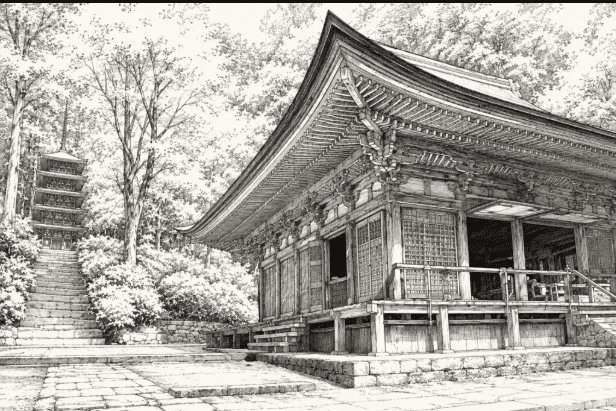
Hase-dera, twenty minutes from Sakurai. The “flower temple,” renowned for peonies in late spring, autumn maples, and a colossal eleven-faced Kannon statue in its central hall.
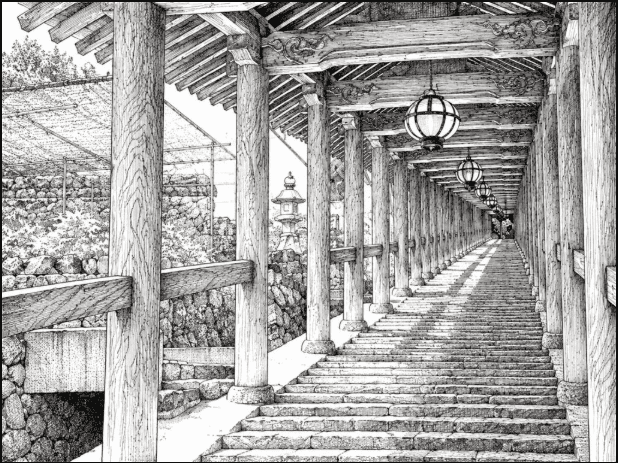
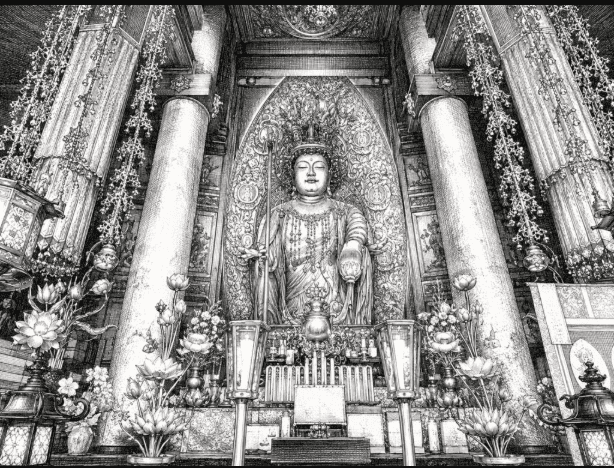
Kinpusen-ji, an hour south in the Yoshino mountains. The headquarters of Shugendō, Japan’s mountain-ascetic tradition. The temple’s main hall houses three enormous blue-faced Zaō-Gongen statues, which together form one of the most overwhelming Buddhist sights in the country. To climb Ōmiwa and then visit Kinpusen-ji is to encounter, in a single trip, the two deepest currents of Japanese mountain religion.
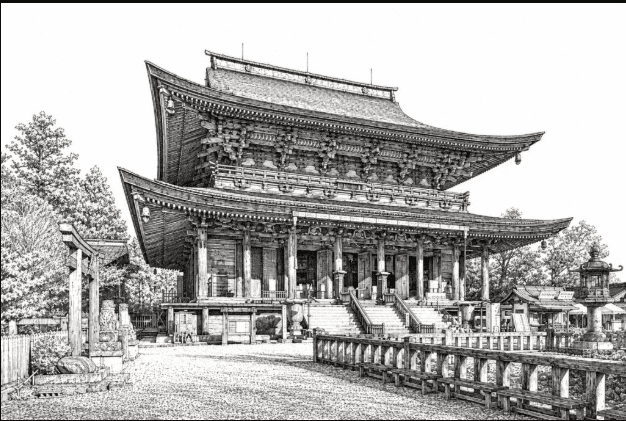
The Asuka region, half an hour west of Miwa. The dawn of Japanese civilization in physical form: tumuli, the ancient stone “ship grave,” the painted Kitora and Takamatsuzuka tombs, Asukadera (Japan’s oldest formal Buddhist temple), and the surrounding villages where the first centralized Japanese state took shape.
A suggested itinerary
For travelers with three nights, four days:
Day one: arrive in Nara. Afternoon at Nara Park, Tōdai-ji (the giant bronze Buddha), Kasuga Taisha. Dinner with Nara cuisine.
Day two: Ōmiwa Shrine. The climb in the morning if conditions permit, registering at 9 AM. Descent and lunch at Sakaguchi Chamise. Afternoon visits to Sai Shrine, Kuyehiko Shrine, the viewpoint. Stop at Imanishi Brewery on the way back. Receive the purifying sand.
Day three: Yama-no-be-no-michi walk. Hibara Shrine. Hashihaka Kofun. Makimuku archaeological site. Optional addition: Byōdō-ji and the great torii at sunset.
Day four: Either Yoshino (Kinpusen-ji), Asuka, or Murō-ji — depending on which line of inquiry pulls you. Return home.
Three days is enough. Five days is generous. A week begins to be ideal, especially if you want to climb the mountain twice — once at the start, once at the end — and feel the difference.
Epilogue — To those who feel they are being called
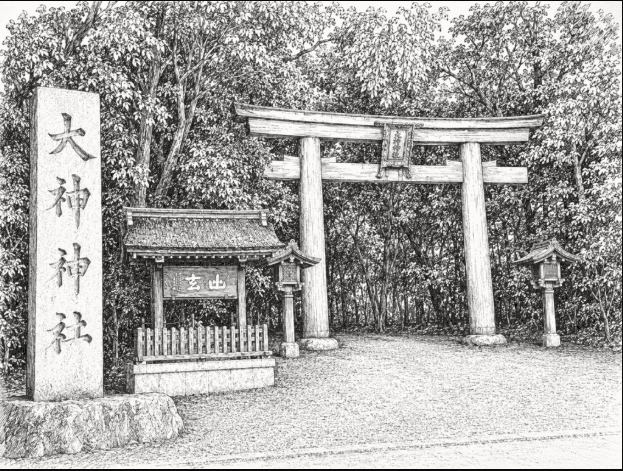
You have read approximately sixty thousand characters by now. That is the length of a short book. You read all of it.
The chances that you read this far without being called are small. People who are not being called do not read sixty thousand characters about an obscure mountain in central Japan. They close the tab in chapter two.
You did not close the tab.
So let me speak directly.
If you have decided to go
Go. Open the bullet train app. Make the reservation. Choose the dates. Choose the lodging.
If things flow easily — if the booking takes effortlessly, the lodging is available, the weather forecast cooperates, and your work and life make room for the trip — then you are being called. The mountain is letting you come.
Travel. Climb. Come down. Don’t speak of it casually.
If, on the other hand, things interfere — if the booking fails, your work explodes, your body refuses, the trip slides out of your reach — then you are not being called now. Possibly later. Possibly not. Don’t fight the interference. Set the trip aside and watch for the next opening.
This is the rule. The called arrive. The not-called are turned back, sometimes gently, sometimes hard.
The day, when it comes
You will board a Shinkansen. You will transfer at Nara or Kyoto. You will get off at a small station with a name written in three characters: 三輪.
You will walk five minutes along an ordinary road, past ordinary houses, and you will pass under a wooden torii gate. The air will change.
The cedar avenue will be longer than you expected, and quieter. You will pray at the main hall. You will walk the Kusuri-michi to Sai Shrine. You will drink from the medicine well. You will register, receive the white sash, perform your own purification. You will leave your phone in a locker.
You will pass under the climbing gate.
You will walk up a mountain that is, in some sense, alive. Something will happen. It may be small — a clarity, a tiredness lifting, a question answered without words. It may be enormous — a voice, a vision, a body that suddenly behaves in a way you did not know your body could. Or it may be in between.
You will come down. You will return the sash. You will recover your phone. You will walk back to Sakaguchi Chamise, sit on the tatami, and eat nyūmen.
This is the moment your trip will, in your memory, become about.
You will, on the way home, stop at Imanishi Brewery and buy a bottle of Mimuro Sugi. You will visit the shrine office and receive a packet of the purifying sand. You will walk under the great torii one last time, look up, bow.
You will sleep on the train back.
After
For weeks, you may not know what happened. You may try to put it into words for friends and find that the words don’t work. You may give up. You may stop trying.
Six months later, you will find that things in your life have shifted. Not dramatically — but actually. Decisions that had been stuck have, somehow, unstuck themselves. Relationships have eased or, when needed, ended. Work has moved. The texture of your daily attention has changed.
You will know, in some way you cannot quite articulate, that this is connected to the mountain.
That is how it works. The mountain does not deliver gifts at the summit. It plants something during the climb, and the something grows quietly, for months or years, until you look back and realize the person who climbed that day is not quite the person you are now.
This is also why we don’t talk about it casually. Talking accelerates the wrong things and damages the slow growth.
Three small requests, if you go
Three requests, from one pilgrim to another.
Keep what happens. The temptation to write a long Instagram caption or a thoughtful blog post will be strong. Resist it. If you must write something, hold back the core. Hint at the periphery. Save the center for yourself.
Receive the sand. The packet costs almost nothing. The sand will work for years. Place it at the four corners of your home. Keep a small pouch in your bag. Let the mountain travel with you in physical form.
Thank before you ask. Walk into the precincts beginning with thanks: thank you for letting me come. Thank you for calling me. Save any requests for later. Bow at the gate when you leave: thank you. I will return.
The mountain reciprocates gratitude. It does not reciprocate transactions.
The honest answer
I do not know what Mt. Miwa is. After everything I’ve read, after multiple climbs, after the patient accumulation of pilgrim accounts, I still don’t know. The mainstream view — that this is a natural mountain that has been sanctified by long human attention — may be right. The alternative views — that something is structurally unusual here, possibly built, possibly older than any document — may be right. Both may be right. Neither may be.
What I know is that, when you climb this mountain, things happen that are difficult to find adequate words for, and most of the people they happen to come away changed in ways that hold.
That is enough.
A note in closing
If you go, and if something happens — write to me, if you can. I cannot reply directly, but I will know. Each story strengthens the network of accounts that makes it more likely the next called pilgrim will find their way.
If you cannot go yet, that’s fine. The mountain has waited fifteen hundred years. It can wait a little longer.
Be in good health. Be safe in your travels. Find rest.
When the time is right — and you will know — go.
— VIBES TOURISM


Underestimate
Mount Miwa, and
it will hurt.

You can read the lovely things about Ōmiwa Shrine anywhere else. This is the opposite: only the walls people actually trip over on-site, and how to get past them. I’ll guide you in four phases, following the flow of your trip.
PHASE 01 / BEFORE YOU GOWhat is decided before you leave home

There are days you simply can’t climb
Climbing Mount Miwa isn’t possible any day you like. The first three days of January, festival days, and days of bad weather are closed to climbers. Known closure days for rituals include January 1–3, plus February 17, April 9, April 18 (morning), October 24, and November 23. On top of that, recent extreme summer heat has led to shortened reception hours and suspension periods in the hot season. Entry can also be halted temporarily depending on conditions. The dates shift year to year, so always check the official latest notice before you set out. If your schedule has flexibility, picking a period with low cancellation risk is the smart move.
You can’t build climbing into a group tour
This is a structural rule. Building a Mount Miwa climb into a travel agency’s tour itinerary is not permitted. Entry is on an individual basis. Even if you arrive as a group by bus, each person must register individually on-site for the climb. If you want to climb Mount Miwa on a group trip, plan it so that each person climbs during free time, on their own.
If you’re bringing companions from abroad
Companions visiting from overseas can be stopped at the climbing entrance. There are conditions foreign visitors must meet to climb, and those who don’t meet them are not permitted to enter. Visiting the shrine grounds themselves is open to anyone — the only issue is the climb onto the sacred mountain. If you have such companions, be sure to read the official site’s guidance for foreign visitors (CAUTION FOR FOREIGNERS) before you go.

PHASE 02 / ONCE YOU ARRIVEThe first wall you hit on arrival

For bikes, it’s a “where to park” wall
Pass the great torii and there’s free parking right away; go up to just before the second torii and there’s a bike lot too. So far so good — the catch comes next. The lot by the second torii is meant for small, moped-class bikes. Larger motorcycles are hard to fit, and some riders report being sent to a lot farther from the entrance. A 125cc-class scooter like a PCX fits easily, but if you’re on a bigger bike, parking is something to confirm on-site. For the latest on bike parking, it’s safest to also check the official info and reservation lots such as akippa.
For cars, it’s a race against time
Free parking spans the north and south great-torii lots, the first torii, and the second torii — about 320 spaces in all. There are spaces, but during the first three days of January and mid-January, heavy congestion leaves some people unable to park and giving up. Arriving first thing makes parking easier. Parts of the lots are sometimes closed temporarily for works such as waterway repairs, so during busy seasons give yourself plenty of time. The nearest station is JR Miwa, a short walk from the approach. Keeping the train as an option is a strong move.

PHASE 03 / BEFORE THE CLIMBOnce you’ve decided to climb Mount Miwa
Reception closes at noon. One minute late and you’re out
You came to climb, arrive in the afternoon, and get turned away at the gate. This is the most common stumble. Climbing reception runs from 9 a.m. to noon. Past noon, no matter how far you’ve come, you’ll be refused. On top of that, you must report your descent by 3 p.m. Working backward, it only works if you reach the climbing entrance in the morning. At reception you fill in a form with your address, name, and contact, offer the 300-yen fee, receive a bell-fitted sash, and enter. The idea of “a leisurely afternoon climb” simply doesn’t apply to this mountain. Note that in summer, reception may close even earlier as a heat-illness precaution, so in hot months always check the official latest notice.
There are no toilets on the mountain
Once you’re on the climbing path, there are no toilets along the way at all. The restroom is just inside the torii of the shrine at the climbing entrance, so be sure to go before you register. Once you’re on the mountain, there’s no turning back.
467m elevation, 4km round trip, about 3 hours for beginners
Hear only the elevation and underestimate it, and you’ll regret it on the way down. The elevation gain from the climbing entrance is about 350m; it’s over 4km round trip and takes a beginner about 3 hours — a genuine mountain climb. There are steep sections and patches of poor footing. Sandals or heels are out of the question; you need shoes you’re used to. On the descent especially, your legs lose their strength, and the bamboo staff you can borrow at the entrance helps more than you’d expect. If you have any doubt about your legs, choosing to stop at the prayer hall rather than forcing the summit is perfectly valid as an act of faith. Plenty of people, I hear, fill a bottle with the sacred “kusuri-mizu” water to keep hydrated along the way.

PHASE 04 / ON THE MOUNTAINThe one mindset to hold inside the sacred body

Photography is banned everywhere on the mountain
Haul up a DSLR meaning to shoot the views, and it all goes to waste. Photography is banned throughout Mount Miwa — no photos, no video, no sketching. The reason is simple: this is not mountain climbing but worship. There’s no room to point a lens at the act of setting foot on the sacred body itself. Leave heavy bags and cameras in a locker near the climbing entrance and go in light — that’s the right call.
No eating, chatter, or gathering either
It’s not just photography. Eating or drinking beyond hydration, chatter, open flames, and gathering plants or stones are all strictly forbidden. You leave no litter, of course. This is no tourist spot but a sacred body. The climb is an act of faith, with etiquette to keep. Once you’ve taken that in, all that’s left is to walk the sacred ground quietly, on your own two feet.


* Statements drawn from shrine tradition are marked as such. Reception hours, fees, parking operations, and whether climbing is permitted are subject to change. Always check the latest information on the official Ōmiwa Shrine website before you visit. The navigator images shown are for illustration.
How to visit Ōmiwa Shrine (practical section)
For the most current information, always check the official Ōmiwa Shrine website: oomiwa.or.jp (Japanese, with limited English pages).
Getting there
- From Kyoto: JR Nara Line to Nara, transfer to JR Sakurai Line, get off at Miwa Station. From Miwa Station, the shrine entrance is a 5-minute walk. Total travel time from Kyoto: about 1 hour 30 minutes.
- From Osaka: JR Osaka Loop Line to Tennōji, transfer to JR Yamatoji Line, then JR Sakurai Line to Miwa Station. About 1 hour 15 minutes.
- From Tokyo: Shinkansen to Kyoto, then as above. About 4 hours total.
Climbing Mount Miwa: the rules
Climbing the mountain is permitted only via registration at Sai Shrine (狭井神社, Sai Jinja), a sub-shrine within the Ōmiwa grounds.
- Registration desk hours: Normally 9:00 AM – 12:00 PM (noon), but hours and access may change due to weather, shrine events, heat-safety measures, or other conditions. Always check the official shrine notice before visiting.
- Descent deadline: All climbers must be back down by 3:00 PM.
- Climbing offering: A small fee or offering is requested at registration. Amounts may change; check the official shrine notice for current details.
- What you receive: A white sash to wear during the climb, and a paper hitogata (human-shaped paper) for ritual purification.
- Rules during the climb:
- No photography
- No sketching or written notes
- No food (water is allowed)
- Voices kept low; conversation only when necessary
- Duration: Round trip about 2–3 hours. The trail is steep in places; proper footwear strongly recommended.
Pilgrims often say that what happens on the mountain should not be discussed casually after descent. Treat this as part of the mountain’s sacred etiquette, even if it is transmitted more by tradition than by tourism signage.
Best time to visit
- Spring (March–May): Plum, cherry, and rapeseed flowers along the surrounding trails. Mild climate, ideal climbing weather. The most popular season — expect more visitors.
- Summer (June–August): Deep green, but hot and humid. Bring water. Note: climbing registration may be suspended or shortened during periods of extreme heat.
- Autumn (September–November): Cosmos and autumn leaves. November 14 hosts the Jōzō Kigan-sai (brewing-prayer festival), which is the spiritual heart of Japan’s sake-brewing calendar. Recommended season.
- Winter (December–February): Few visitors, austere atmosphere. The trail can be slippery; climb with caution and proper gear. Access may be limited during severe weather.
Frequently asked questions
Can anyone climb Mt. Miwa? Climbing is permitted with registration at Sai Shrine within the official hours, subject to current shrine policy. Climbing was historically restricted to priests for over a thousand years; general access has only been permitted since the late Meiji era (early 1900s).
Can foreign travelers climb Mt. Miwa? Yes, but the shrine asks that visitors fully understand the Japanese instructions — either personally or with an interpreter present — and that at least one person in the group has a phone number reachable within Japan. These conditions are stated on the official Ōmiwa Shrine climbing page; confirm details before your visit.
Is photography really forbidden? Yes. Cameras, phones, sketchbooks, and notebooks must be left in the lockers at the entrance. Only a water bottle and the white sash are carried.
What if I’m not religious? The shrine welcomes all respectful visitors. You are not required to be Shinto. The expectation is simply to treat the mountain as a sacred space.
Can I climb in winter? Permitted in principle, but the trail becomes hazardous and access may be limited during severe weather. Cancellations do occur.
Are children allowed? Children under 12 must be accompanied by a guardian.
What if conditions on the day cancel my climb? Registration can be suspended for weather, heat, festivals, or other shrine reasons. Build a flexible day into your itinerary, and consider visiting the main shrine and surrounding sub-shrines even if the mountain itself is closed.
This article is part of VIBES TOURISM — a guide to Japan’s spiritual landscape for travelers who want more than the postcard.
Lodging in Nara varies greatly in character depending on the area.
Around Miwa Station
The area around Miwa Station is the pilgrimage-focused option.
It’s right next to Ōmiwa Shrine.
Within walking distance of JR Miwa Station, you’ll find guesthouses and inns converted from traditional townhouses (machiya).
You can make the climb first thing in the morning.
The luxury of waking and sleeping at the foot of the sacred grounds. A quiet, calm setting.
The pilgrimage-focused option. Right next to Ōmiwa Shrine. Within walking distance of JR Miwa Station, you’ll find guesthouses and inns converted from traditional townhouses. You can make the climb first thing in the morning. A quiet, calm setting. Lodgings are few and dining options limited — book early.

* This site uses affiliate programs. Bookings made through these links help support the running of this site.
Around Sakurai Station
The area around Sakurai Station offers convenient access to Ōmiwa Shrine. Around JR Sakurai Station you’ll find a wide range of options, from business hotels to hot-spring ryokan. There are plenty of lodgings, across a broad range of price points, and dining options are well covered. Ōmiwa Shrine is just one stop away by train. The area itself has little of a tourist-destination atmosphere.
Convenient access to Ōmiwa Shrine. Around JR Sakurai Station you’ll find a wide range of options, from business hotels to hot-spring ryokan. Plenty of lodgings, across a broad range of price points, with dining options well covered. Ōmiwa Shrine is just one stop away by train. Light on tourist-destination atmosphere, but unbeatable for convenience.
* This site uses affiliate programs. Bookings made through these links help support the running of this site.
Yoshino & the Sakurai Highlands
The Yoshino and inner-Sakurai area is where the spiritual intensity deepens. This is the region to base yourself if you plan to venture out to Yoshino, the sacred heartland of Shugendō (mountain asceticism). A deep-mountain, mystical atmosphere, with plenty of hot-spring ryokan. Good access to sites like Kinpusen-ji and Niukawakami Shrine. About an hour by car from Ōmiwa Shrine.
Where the spiritual intensity deepens. This is the region to base yourself if you plan to venture out to Yoshino, the sacred heartland of Shugendō. A deep-mountain, mystical atmosphere, with plenty of hot-spring ryokan. Good access to sites like Kinpusen-ji and Niukawakami Shrine. About an hour by car from Ōmiwa Shrine.
* This site uses affiliate programs. Bookings made through these links help support the running of this site.
Mount Miwa Pilgrimage Navigator
Climbing the sacred mountain — rules for non-Japanese visitors: Entry is permitted ONLY if (1) you understand Japanese explanations completely, either on your own or with an interpreter accompanying you, and (2) at least one person in your group carries a phone with a domestic Japanese number (+81). Visitors who do not meet both conditions cannot be admitted.
JR Miwa Station
Freshen up at the station toilet first. Newly built in 2019, with an accessible stall.
Sando (Approach)
Pass through the second torii. The scent of somen drifts by, but save the meal for after the descent.
Haiden (Worship Hall)
Mount Miwa itself is the deity. An ancient form of worship with no main hall. Press your palms together.
Sai Shrine
Climb registration (300 yen offering). A sip of sacred water from the Yakui-do well. This is the last toilet on the mountain.
The Climb
Into the sacred realm. About 2 km each way, roughly 3 hours round trip. No photos, no food, phones put away.
After the Descent
Into your warmed body, slip a strand of Miwa somen — birthplace of the dish. The pilgrimage is complete.



Comments