
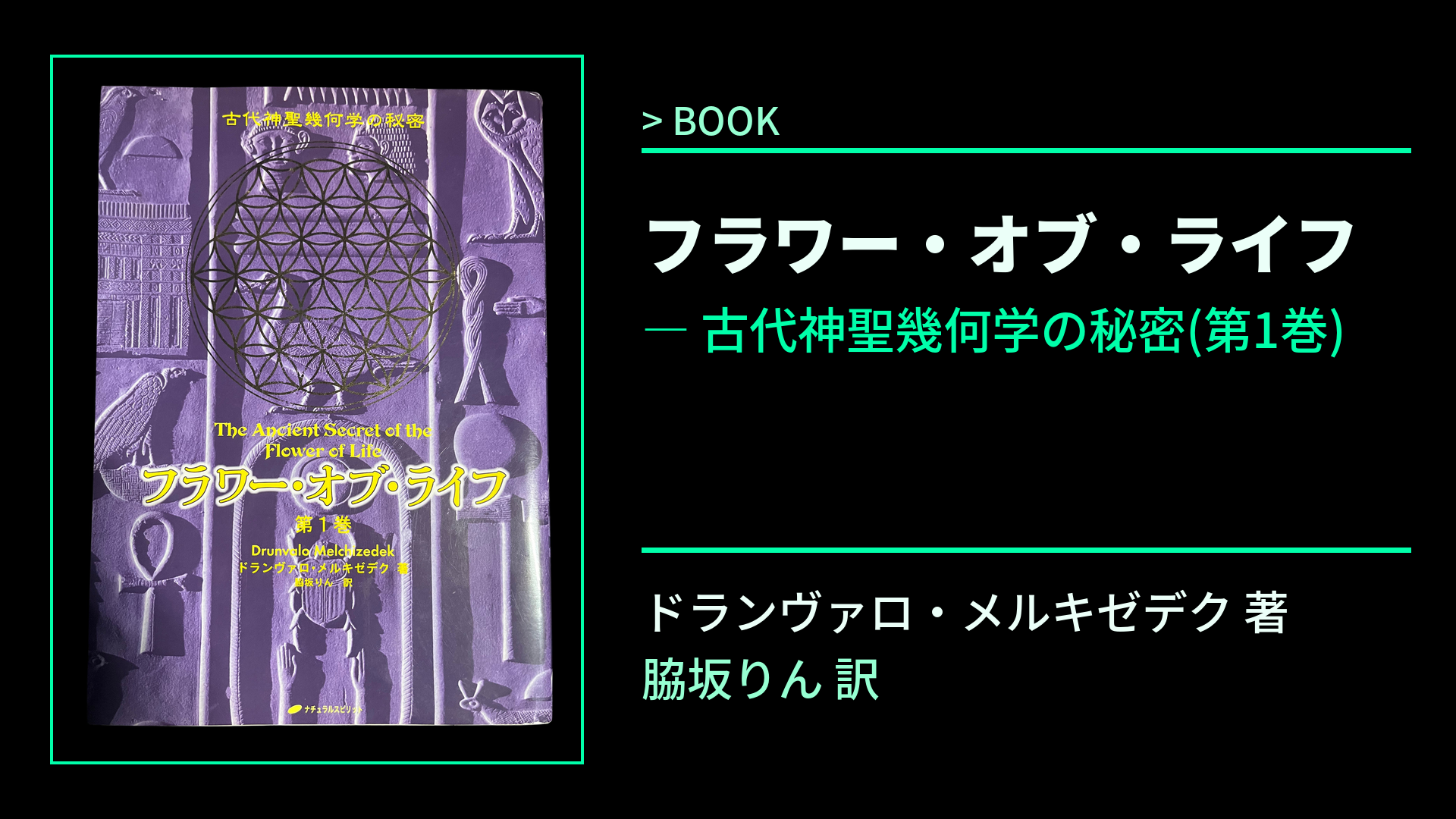
The pineal gland was once
the size of a ping-pong ball.
At the center of your brain sits a single gland. The pineal. According to the book, it was once the size of a ping-pong ball. A man who walked away from physics, guided by a green angel and a violet one, draws the entire universe out of a single circle.
At the center of your brain sits a single gland. The pineal.
According to the book, it was once the size of a ping-pong ball. Today it has shrunk to roughly the size of a dried pea. The reason is simple. We stopped using it. Use it or lose it.
And the book claims this: inside that tiny bead, the blueprint of how the universe was created is still sealed away, whole and entire. Inside the head of every human being.
This is the world of “The Flower of Life,” Volume 1. A man who walked away from physics, guided by a green angel and a violet one, draws the whole of the cosmos out of a single circle. Since its Japanese translation appeared in 2001, this book has reigned as a spiritual bible — and the reason is its overwhelming density of information, and the uncanny ease with which it sets verifiable mathematics and unverifiable myth side by side on the very same page.
This is a book that cannot be summarized. But its entrance, at least, can begin with a single circle.
CHAPTER 01The Man Who Left Physics, and the Green and Violet Angels
Drunvalo Melchizedek was not born a mystic.

His birth name was Bernard Perona. Born in 1941 in Alameda, California. A Vietnam veteran. He majored in physics at the University of California, Berkeley, with a minor in mathematics. He was one semester short of graduating.
And then he abandoned the degree. By his own account, it was because he had noticed something about physicists themselves. When the truth does not fit the framework they believe in, they look away. It was “a science that was not science” — so he writes. The narrator of this book enters the subject of sacred geometry by way of his disillusionment with science. That is the source of the book’s odd credibility. The one speaking is a physics student who threw the equations away.
And he began to meditate. Four or five months later, in 1971, two beings appeared in his room. Each was more than twice the height of a person. One radiated green light, the other violet. They were angels. From then on the two never left his side, guiding him to more than eighty teachers, and at last to Thoth — an immortal being who had lived through Atlantis, Egypt, and Greece. The book’s acknowledgments begin with thanks to these two angels.


Let us be honest here. Parts of his biography are hard to verify. There are claims that what he actually earned at Berkeley was a fine-arts degree, and that no record of a physics or mathematics degree has been confirmed. He changed his name in 1991. The name “Melchizedek” was given to him by a religious group in Vancouver, Canada.
But what is interesting is that the author himself neutralizes such “fact-checking” in advance, within the book. He writes plainly that the information itself does not matter. “If you find an error, look deeper.” Information is merely a vehicle to carry the reader into a certain state of consciousness; what truly matters is not the information but the meditation. Whether you take it as truth or as mere story — that is for you to decide. Listen deeply with the heart; the heart always knows the truth. The book presses this single line on the reader from beginning to end.
CHAPTER 02The Fall Was a Change in How We Breathe
The book’s cosmic history begins with a single “Fall.”

According to the book, about thirteen thousand years ago — more precisely, somewhere between sixteen thousand and thirteen thousand years ago — humanity fell from an extremely high state of consciousness. Through many dimensions, tracing a spiral that had lost control, we dropped, growing denser as we went. And where we landed was this third dimension — our world.
The question is what changed when we fell. And here the book brings up the pineal gland.


According to the book, before the Fall, humanity took in prana — the life energy of this universe — through the pineal gland. It flowed up and down through a tube running through the center of the body. But with the Fall we lost our memory, and we began to breathe through the nose and mouth. Then the prana began to bypass the pineal gland. This one point was decisive.
The book continues: as a result of bypassing the pineal gland, the way we see our world changed at its root. The reality that had been one began to appear split in two — good and evil, light and dark. The book calls this “polarity consciousness.” I am inside my body, looking out at the external world. I and “the thing over there” are separate — that is the feeling. By the book’s account, this is pure illusion. It feels real, but holds not a fragment of truth. It is merely how reality looks from a fallen state.
The idea that the pineal gland is a “shrunken third eye” is not the book’s invention. The pineal gland does contain light-responsive tissue and, evolutionarily, derives from a photoreceptive organ. Some reptiles retain a “parietal eye” on the crown of the head. Descartes called this gland “the seat of the soul.” On top of these real wonders, the book layers its myth of Fall and breath. The seam between fact and myth is, once again, so smooth as to be invisible.
CHAPTER 03The Circle Becomes a Flower — A Universe Anyone Can Draw
So what is the Flower of Life?
It begins with a single circle. Place the center of a second circle of the same size on the rim of the first. The two circles overlap, and an almond-shaped region is born. This is called the “Vesica Piscis.” Latin for “fish’s bladder.” Light and dark, masculine and feminine, spirit and matter — the first step, where opposites meet.

From here it does not stop. Centered on each intersection, you overlay the same circle again and again. When six circles surround one, a six-petaled flower appears. The “Seed of Life.” It is composed of seven circles, and is sometimes laid over the seven days of creation in Genesis. Add circles to the Seed and it becomes the “Egg of Life”; overlay still more and the thirteen-circle “Fruit of Life” rises up.
There is no trickery anywhere in this sequence. With only a compass and a straightedge, anyone arrives at the same figures. Six circles surround one because the interior angle of an equilateral triangle is sixty degrees, and three hundred sixty divided by sixty is six. That is the only reason. Not mystery, but geometric necessity. That is why the honeycomb, the snowflake, the columnar joints of basalt, the carbon rings of graphene, and the compound eye of an insect all choose the same hexagon. When nature seeks efficiency, it always arrives at this shape.
Here lies the reason this spiritual book captured hundreds of thousands of readers. The author declares within it: I spend half my time on left-brain information — geometry and facts. Why? At the Fall, we split ourselves in two, masculine and feminine. The left brain (the masculine) sees only separation. So the left brain must be persuaded by logic itself. When the left brain is convinced to its core that “all is one,” the corpus callosum connecting the two hemispheres opens anew, and the pineal gland activates — so the book teaches.
Draw it and you will know. Move your hands,
and the blueprint of the universe rises from your fingertips.
CHAPTER 04Metatron’s Cube and the Five Perfect Solids
The Fruit of Life — thirteen circles. Connect all their centers with straight lines.
What then appears is “Metatron’s Cube.” According to the book, this is not a flat pattern. It is originally three-dimensional — a solid structure of thirteen spheres assembled into a cross along three axes. Seen from the front, a cube is nested inside a cube.
And within this web of lines, five solids are hidden. The tetrahedron, the cube, the octahedron, the dodecahedron, the icosahedron. The five “Platonic solids” that the ancient Greek philosopher Plato held to be “the fundamental forms that compose the world.” Plato mapped them onto the four elements and the cosmos. Fire is the tetrahedron, earth the cube, air the octahedron, water the icosahedron. And the fifth, the dodecahedron, is the cosmos itself.
Tetrahedron / Fire
Four equilateral triangles. The sharpest solid, made of the fewest faces.
Cube / Earth
Six squares. Stability and matter. A form with both feet on the ground.
Octahedron / Air
Eight triangles. Symmetric top and bottom, a weightless balance.
Icosahedron / Water
Twenty triangles. Closest to a sphere, a flowing form.
Dodecahedron / Cosmos
Twelve pentagons. The fifth element — the shape of the cosmos itself.
According to the book, these five solids are the molds of all matter — from minerals to sound, to language, to living beings. Within a flower grown from a single circle, every part needed to assemble the world is folded away — this is the core of the book.
That the Platonic solids are “the molds of all matter” is not literally true. But the seeds are genuinely buried in nature. The crystal structures of many minerals follow the symmetry of Platonic solids. Many viruses have icosahedral shells. Carbon assembles into regular polyhedra as diamond and fullerene. The book’s claims are laid on poetically, but at their core lies a real symmetry. Between mystery and science. The book always walks along that borderline.
CHAPTER 05The First Eight Cells, and the Membrane That Wraps the Egg
Even within this book, the connection that raises goosebumps most is this one.

Remove the outer cube of Metatron’s Cube, and eight spheres remain inside. According to the book, this is the “Egg of Life” — and this is no metaphor. It is your own beginning.
A human fertilized egg first exists as a single sphere (the ovum and the transparent shell that wraps it). Once fertilized, it begins to divide. One becomes two, two become four, four become eight. What the book focuses on is this first eight-cell stage. The eight cells are nearly equal in size, arranged in a configuration close to an octahedron. According to the book, these eight cells are the living form of the “Egg of Life,” and the archetype of our physical body is inscribed here.
The book further notes that if you draw a circle and a square fitted precisely around these eight cells, that circle matches the proportions of the membrane wrapping the egg — the “zona pellucida.” Sacred geometry overlaps, exactly, with your first week under the microscope.
Here the factual foundation is solid. That a fertilized egg divides two, four, eight; that the eight-cell stage is an important milestone in embryology; that the egg is wrapped in a shell called the zona pellucida — all are basics of embryology. The book lays the meaning of a “geometry of creation” over these real facts. You were born from geometry. It presses that claim on you as a memory of your own body. In this chapter you understand what the book means when it says, “Read with the body, not the head.”
CHAPTER 06The Dogon, Sirius B, and the Dolphin
The book gathers “inexplicable facts” from around the world. Its crown jewel is the Dogon people of Africa.

According to the book, the Dogon people near Timbuktu in West Africa held knowledge that should only be measurable with modern astronomy — and they held it for more than seven hundred years. In their sacred cave there is a wall painting, and one holy man guards it for his entire life. What that painting speaks of is Sirius.
The brightest star in the night sky, Sirius (today’s Sirius A). The Dogon say another small star orbits around it. Very old, very small, made of “the heaviest matter in the universe,” and taking “close to fifty years” to complete one orbit.
Astronomy confirmed the existence of this companion, Sirius B, in 1862. It was a white dwarf. Its orbital period, when measured — 50.1 years. Almost exactly the Dogon’s “close to fifty years.” According to the book, its density is about 1.5 million tons per cubic inch. Set it on the ground and it would pierce through everything, sink to the center of the Earth, oscillate back and forth through the core, and keep swinging until friction finally stopped it.
So where did the Dogon learn this? According to the book, they answered: the cave painting taught us. The painting depicts a disc descending from the sky on three legs, and a dolphin-like being that digs a hole in the ground, fills it with water, and dives in — the “Nommo.” The author layers a Peruvian experience over this anecdote. Room 23 of a hotel in Cuzco (the day Sirius rises again in Africa is July 23), where he found a dolphin-like emblem on the bedspread; when he asked the Uros people by Lake Titicaca, back came a creation myth strikingly like the Dogon’s — a flying disc, and a dolphin-like being that dove into the water.
Read this carefully. The mystery of the Dogon’s Sirius knowledge is real, and was made widely known by Robert Temple’s book “The Sirius Mystery.” In academia, however, the leading view is that the knowledge may have been transmitted from Westerners (missionaries and anthropologists) who visited the Dogon in the early twentieth century. The book leaps from this mystery, in a single bound, to the grandest possible story: contact with extraterrestrials. The mystery as fact, and the interpretation as myth. That very swing is what makes the book worth reading.
CHAPTER 07The Pi Hidden in Sanskrit
There is one more anecdote the book loves to bring up.

According to the book, when a certain Sanskrit verse is translated into its phonetic values, a single number surfaces. 0.3141592653589… a number that continues to thirty-two decimal places. This matches the value of pi divided by ten, exactly, to thirty-two decimal places.
Pi. The ratio of a circle’s circumference to its diameter. The astonishment that ancient people could reach such precision — the book hands it straight to the reader. Each Sanskrit sound corresponds to a numerical value from 0 to 9, and to read the verse was, at the same time, to chant pi. Who embedded such a device in a poem, when, and why? The book asks: is our assumption that “the ancients were primitive” really correct?
As for the source of this anecdote, the book cites a magazine article. The tradition of mapping numbers to strings of letters in Sanskrit numerology (the Kaṭapayādi system) is real, and it is also a fact that Indian mathematics achieved high sophistication with trigonometric functions and series. On the other hand, the specific claim that a particular verse contains pi to thirty-two digits is hard to verify. But the book’s aim is not the truth or falsity of pi’s digits. The anecdote is placed here as a vivid strike of the provocation that runs through the whole book: “Do not underestimate the ancient intellect.”
CHAPTER 08The Sphinx Is Worn Away by Rain
The book’s Egypt section begins with a single geological anomaly.

The Sphinx. According to the book, its surface bears a strange wear. Behind it, in places, the rock is cut as deep as twelve feet (about 3.6 meters). And the manner of that wear is utterly unlike other Egyptian structures. The wear on other buildings is from sand and wind — appropriate to their age. But the wear on the Sphinx looks as though it had been smoothed by water.
The one who noticed this anomaly was the self-taught Egyptologist Schwaller de Lubicz. Later John Anthony West took it up, drawing in the geologist Robert Schoch. In the desert — erosion by water. By computer estimate, to produce this much wear would require at least a thousand years of torrential rain, twenty-four hours a day without rest. From this the book concludes: the Sphinx is at least eight thousand, probably ten to fifteen thousand years old, or older still.
The book makes a still bolder claim: that the reason many Egyptian archaeologists stubbornly refuse to accept this theory is that most of them are Muslim, and the traditional interpretation of their scripture holds that “creation was about six thousand years ago.” To admit anything older than six thousand years would clash with their faith. So they will not even debate it — so the book writes (the author himself notes that this is a report, not an attempt to denigrate religion).
Here we should separate the facts. The water-erosion theory of the Sphinx is a real academic theory; Schoch and others presented geological grounds and have long debated the archaeological establishment. But the counterarguments are also strong — besides the rainwater theory, there are studies arguing it can be explained by salt weathering or differences in rock quality, and the matter is not settled. The “religious motive of archaeologists” theory the book presents is the author’s own personal view, not an established one. Still, it is true that a real controversy exists over the possibility that the Sphinx is older than conventionally thought. If an artifact ten thousand years old were to unsettle the textbooks that hold Sumerian civilization (around 3800 BCE) to be humanity’s oldest — then the book’s excitement is not without roots.
CHAPTER 09The Mer-Ka-Ba — The Spinning Body of Light
And then the book gathers every thread into a single form.

The Mer-Ka-Ba. The star tetrahedron — a solid of two tetrahedra interpenetrating in opposite orientations. A three-dimensional Star of David, the book rephrases. According to the book, this is an energy body surrounding our own. The apex of the upward tetrahedron ends “one palm-width” above the head; the apex of the downward one ends “one palm-width” below the feet. A tube running through the center of the body connects the two apexes, and the width of that tube is the diameter of the circle you make with your thumb and middle finger — you can measure it on your own body.
The word Mer-Ka-Ba, according to the book, was a term understood only in Egypt’s Eighteenth Dynasty, composed of Mer (two counter-rotating fields of light), Ka (the individual spirit), and Ba (the spirit’s interpretation of reality, often the physical body). A state in which light, spirit, and body are integrated into one. A healthily spinning Mer-Ka-Ba is, in proportion to one’s height, roughly fifty to sixty feet across. And here is the astonishing match the book presents — display a spinning Mer-Ka-Ba on a screen with the proper apparatus, and its form becomes the same as an infrared photograph of a galaxy (the heat contour of the Sombrero Galaxy). And that, the book says, is the very shape of the old-fashioned flying saucer.
According to the book, with the Fall, humanity’s Mer-Ka-Ba stopped spinning. The field of light that had been turning near the speed of light came to a halt. That is why we are cut off from our original higher consciousness. Through correct breathing — through specific meditation — the stopped Mer-Ka-Ba can be set spinning again. That opens the door to ascension.
But Volume 1 stops just short of that door. The specific procedure of the Mer-Ka-Ba meditation — the technique of seventeen breaths — is committed to writing for the first time only in Volume 2. The author writes that he hesitated. Would one dive into the final stage of Tibetan Buddhism after reading just a single book? That is precisely why Volume 1 is a book meant to make the reader feel, in the gut, why it is needed — through a grand detour from circle to cosmos, from pineal gland to Sirius, from the Sphinx to da Vinci.
The word Mer-Ka-Ba (Merkavah) is held in the book to be of Egyptian origin, but it is also the Hebrew word for “chariot” (merkavah) — a concept belonging to the lineage of Jewish mystical Merkabah thought. The book reconstructed this ancient mysticism through its own geometry. Because of that originality, it has also drawn accusations of plagiarism. In particular, Stan Tenen of the Meru Foundation has long claimed that the book and its circle appropriated and distorted his geometric research into the Hebrew letters without permission. If you read the book, it is worth knowing both its brilliance and its shadow.
CHAPTER 10Da Vinci, the Human Between Circle and Square
The story leaps from antiquity to the Renaissance.

Leonardo da Vinci. According to the book, he studied the Flower of Life and its mathematical properties, and left the Flower of Life itself and the Seed of Life drawn in his manuscripts. And the decisive evidence the book brings forward is that famous “Vitruvian Man.”
That sketch of a man with arms and legs outstretched, fitted perfectly into both a circle and a square. The book reads it thus: the square is earth (the material world), the circle is heaven (divine order). One and the same human being fits into both at once. In other words, the human body is a geometric bridge spanning heaven and earth. Analyze the figure and the form most saturated with φ (the golden ratio) emerges, hidden — a pentagram. Everywhere in the human body, the golden ratio, about 1.618, repeats.
According to the book, a human being is walking geometry. The division of the body centered on the navel, the proportions of the bones, the arrangement of the face. And the spirals of nature — sunflower seeds, pinecones, the nautilus, galaxies. Running through them all is the Fibonacci sequence. Add the previous two numbers: 1, 1, 2, 3, 5, 8, 13, 21… The ratio of adjacent terms converges, the further you go, on the golden ratio.
Much of the popular claim that the golden ratio is “the key to all beauty” is retrofitted and overstated. But that the Fibonacci sequence appears in the spirals of sunflowers and pinecones is a botanical fact, with a rational reason behind it: the optimization of growth. And the coincidence the book loves most — the DNA double helix advances 34 angstroms per turn and is 21 angstroms wide. Both are Fibonacci numbers. 34 divided by 21 is about 1.619. Nearly equal to the golden ratio φ. The book’s poem, that the golden ratio dwells in the human body, here touches a fragment of the real. Our very genetic information is written in Fibonacci’s proportions.
“The Flower of Life,” Volume 1, is a strange book. Physics and myth, geometry you can draw with a compass and an unverifiable cosmic history, figures anyone can reproduce and a green angel and a violet one. The book sets these two poles, calmly, on the very same page. And where fact ends and story begins — it leaves that line, to the very last, for the reader to draw.
But that is precisely the essence of this book. The author writes it again and again. Information does not matter. If you find an error, look deeper. Whether you take it as truth or as story is for you to decide. Listen deeply with the heart; the heart always knows the truth.
A shrunken pineal gland. A single circle. The first eight cells. A heavy star orbiting Sirius. A Sphinx worn away by rain. A human fitted into circle and square. A counter-rotating body of light. The book gathers these into a single flower. In the hexagons of the honeycomb, in the spiral of the sunflower, in the proportions of your own DNA, you suddenly glimpse the same figure showing through. In that instant, you are already inside the Flower of Life.
A single circle was the entrance to that question.
And according to the book, the answer is already sealed away — whole and entire — inside that tiny bead at the center of your head.



Comments