
The Man Who Saved a Failing Hotel
With Love Alone.
LOVING YOURSELF
Nomura Securities. Wall Street. An MBA from New York University. A man who walked the summit of numbers arrived at the opposite conclusion on a beach in Okinawa. What moves an economy is not efficiency. It is love. And he proved it — not with sermons, but with the numbers on a balance sheet.
 ★ YUNTAKU
A woman earning 680 yen an hour spent thirty minutes chatting with a guest.
It looks like slacking off. Any manager would put a stop to it. And yet that chatter moved the guest, created a repeat customer, and brought profit to the hotel. The labor cost: just 340 yen.
This single scene tells the whole of the book. The author, Kotaro Higuchi, was a top elite at Nomura Securities. A man who lived in the world of numbers and efficiency one day turned it all upside down and declared: Capitalism is not built for workers. It is built for shareholders. And so everyone ends up unhappy.
So what do we do? The book’s answer is distilled into a single question. “What would love do now?” — this question rescues us from a world held captive by money.
First, you need to know who this man is. It changes the weight of every word that follows.
Kotaro Higuchi. Born in Morioka in 1965. After graduating from the University of Tsukuba, he joined Nomura Securities in 1989. In 1993, Nomura Securities International in the U.S. In 1997, an MBA from New York University. By 2001 he was heading the financial business of a real estate trading firm. Results. Efficiency. Compound interest. He was, beyond any doubt, a winner of that world.
 ★ WALL ST → OKINAWA
The turning point was Okinawa. In 2004, while handling hotel investments at Re-plus, he acquired the struggling Sun Marina Hotel for roughly three billion yen. Normally, operations would be left to hotel-management professionals. Instead, through an odd turn of events, he went to Okinawa himself and became the manager of a hotel with 250 staff. He was 39. At running a hotel, he was a complete amateur.
At first he was the very picture of a finance man. Aggressive management. Top-down. He rolled out reform after reform. But building relationships on the ground simply would not work. He could manage numbers, but people would not move. Service was a hollow shell. Morale stayed flat. The methods that had worked on Wall Street meant nothing here.
Stuck, he suddenly realized something. Wasn’t the pyramid — with the president at the top — upside down? The section chief supports the front line, the department head supports the section chief, and the president supports them all. The president should be the supporter who holds up the entire company from the very bottom. From this single realization, the rebuilding of Sun Marina began. And here too he chose what no finance man would ever choose. Not layoffs, not cost cuts. He raised “love” as the company’s guiding principle.
Some will laugh. Rebuild a company with love? But the results silenced the laughter. The details come in a later chapter. Let me say it now: it worked. And it worked in the numbers. Incidentally, this book took twelve years to write. He would write partway, reconsider, and rewrite the whole thing. These 440 pages are the result of that endless repetition. That is why the words carry a weight that cannot be cheaply consumed.
And he has not stopped even now. In 2006 he founded the corporate-revival firm Trinity. From 2012 he stood at the lectern of Okinawa University, wrestling with the poverty of this island. In 2025 he became chief operating officer of a venture attempting the world’s first commercial squid farming. He is not a man who talks theory. He is a practitioner who stays on the ground to the very end. That is why every single line of this book carries weight.
The first question the book throws at us is this. Why, despite working this hard, are we never satisfied?
The answer is cruel. According to the book, the cause is not us. It lies in the very mechanism of the economy. For the economy to keep growing, people must keep feeling that they don’t have enough. Once satisfied, people stop buying. So the economy keeps pouring thirst into our hearts. Forever.
 ★ THE MATRIX
Take a shampoo commercial. A woman with lustrous black hair down to her waist turns around. A beautiful image. But the book decodes the message hidden behind it. “Your hair is shabby.”
Most advertising is not telling you how good a product is. It is imprinting on your subconscious how dull your life is. A shabby reality and a shining ideal. The gap, it says, can be filled by buying. As long as a sense of lack can be manufactured, demand wells up without limit. One line from the book says it all.
“The economy does not satisfy the needs of the customer. The needs of the customer are manufactured for the sake of economic growth.”
Manufacture demand and you sell ten times more. Make people dependent and you earn a hundred times more. The way modern apps and financial products relentlessly stoke our anxiety and our appetite for a gamble is by design. And the book peers all the way to the bottom of the heart that craves money. People do not want money. They want to use money to beat someone. So anyone bound by this motive, no matter how much they earn, is never satisfied until they believe they have beaten everyone.
It is not your imagination. There is evidence.
According to the book, half a century has passed since the era depicted in the film “Always: Sunset on Third Street.” Japan’s real GDP per capita has grown more than eightfold. Eight times the wealth. And yet happiness has stayed flat, not budging in the slightest. The same surveys have been run all over the world, with much the same results everywhere. Past a certain line, material wealth no longer converts into happiness.
 ★ ENDLESS DESIRE
A survey by a certain psychiatrist, cited in the book, is unforgettable. David Krueger asked several hundred people: “How much annual income would you need to live happily, free of money worries?” Nine out of ten answered: about twice my current income.
Here is where it gets interesting. Those people’s incomes actually doubled. The same question was asked again. And they answered — again, that they needed twice as much. The person earning five million yen wants ten million; once at ten million, they want twenty. The goal recedes by exactly as much as you run. This is the true nature of an economy that runs on the fuel of scarcity.
The book does not reject capitalism outright. Money and growth are, in themselves, tools. The problem is turning the tool into the “goal.” The moment you mistake the means for the end, you begin to drift away from happiness.
Here comes a blow that only a man from the heart of finance could land.
According to the book, almost no one realizes it — going public is the most expensive form of fundraising there is. If a listed company with one billion yen in net assets is required to grow 7% a year, over thirty years the profit it must hand to shareholders swells to a total of seven billion yen. The price of raising one billion: seven billion. This is, in effect, an enormous debt with interest attached. And it keeps compounding, until — mathematically — it must one day collapse.
 ★ THE OVERFLOW
The book calls interest “a virus inside the bottle.” Interest breeds interest, multiplying infinitely in a finite world. Capitalism is a system that brought “a pyramid scheme plus compound interest” onto a finite Earth. Someone will inevitably fail to pay it back. A share, at its core, is “the right to extract profit from a company” — and that right becomes the hole that eats away the creativity the company once had.
And here the backbone of the book appears. This system is not built for the people who work. It is built for shareholders. When a local company raises money through shares, the value created by sweat on the ground is sucked out of the region as dividends — out of the prefecture, out of the country — forever. The harder people work, the more value flows out to distant shareholders. So the front line never grows rich. So everyone ends up unhappy.
So can an economy run on love? Higuchi left behind proof — not lip service, but proof made with his own hands.
The Sun Marina Hotel he took over in 2004 had been mired in losses for more than a decade. What he raised was neither layoffs nor cost-cutting, but a move anyone would call reckless: “make love the guiding principle of management.” And the result? According to the book — in less than two years, it was reborn as a highly profitable business generating over 130 to 140 million yen in profit. Its first time in the black in twelve years.
 ★ THE REVIVAL
What did he do? First, he turned over the pyramid in which superiors manage subordinates. He reversed superior and subordinate. He redefined a leader’s job as “removing the obstacles that keep staff from loving the guests.” And then he simply listened, thoroughly, to each one of his 250 employees.
Here the book makes a decisive distinction. “Taking an interest in a person” and “taking an interest in what that person is interested in” are entirely different things. Interest in a person is, in the end, only your own concern. The book states it plainly: interest is one form of indifference. It is only when people meet someone who truly listens to them, someone who turns their attention to what they hold dear, that they first feel “I have been understood.”
His way of listening was concrete. Take one female staff member raising a child. Worried about the evening pickup, she would grow restless thirty minutes to an hour before her shift ended, unable to focus. He proposed: “Come in thirty minutes early and leave thirty minutes early.” That final anxious stretch vanished entirely. Another example: a male facilities worker stationed underground. With no phone signal, he felt awkward going up to ground level every time he had to coordinate the pickup with his wife. So Higuchi ran a dedicated phone line down to the basement. Not flashy reform. He simply faced each person’s “concern.” That was all.
One passage strikes the heart. Managers lament that their staff don’t work hard, make them chant the company creed, dangle bonuses, tighten penalties. But a manager already holds, from the start, the power to light a lamp in a subordinate’s life. All that is needed is to turn sincere interest toward that person’s life — only that.
 ★ THE WINDOW OPENS
And then, the tightly shut hearts of the employees opened, one after another. Hospitality no one had ordered began to overflow from within. He, too, shed his title. Manager though he was, he spent a day in the kitchen as an “apprentice.” The president washing dishes, breaking a sweat. The kitchen roared with life. The one at the top working at the very bottom. The reversal was shown not as an idea, but through his own body.
And then he set the company’s guiding principle — the very question that runs through the whole book. “What would love do now?” This principle came with one crucial footnote. — Among those you love, include yourself.
At the same time, he rebuilt the personnel evaluation from the ground up. The new evaluation had nothing whatsoever to do with performance. It measured by only two criteria. One: how much you helped others — a measure of love for others. Two: how much you grew as a human being — a measure of loving yourself. As the book puts it, to reward someone who has already produced results is mere “observation.” To pay, now, for a power not yet shown — that is “investment.” The clincher was the starting point of the whole idea. He worked backward from “what does it take to raise wages?” to design all of management. The direction was the exact opposite of ordinary management, which cuts labor costs to funnel money to shareholders.
How does love turn into money? The book has a scene that shows it in one stroke. The story of that woman, touched on at the very start.
A woman in charge of the gardens is absorbed in yuntaku — Okinawan for casual chatter — with a guest for thirty minutes. Unscripted, just small talk. But that unadorned conversation moves the guest’s heart. The woman pays no mind to the time, simply enjoying the talk. 680 yen an hour. For thirty minutes, the labor cost is just 340 yen. That 340 yen brought back a repeat customer and dropped into the hotel a profit many times the labor cost.
★ YUNTAKU
McDonald’s menus once carried a witty item: “Smile, 0 yen.” But what the book aimed at was the exact opposite. Not smiling as a service. Without ordering anyone to “smile,” create a place where smiles overflow naturally. When you don’t feel like smiling, you don’t have to. You don’t lie to yourself. Only from there can genuine kindness be born.
Here the book speaks of a decisive reversal. The kindness of every company in the world, however beautifully dressed in words, is in the end merely a “means” to generate profit. Turn it into the “end.” Sun Marina’s value was just one: to make kindness an end, not a means.
And then the book’s question flips completely around. What we should ask is not “why did I switch to management by love.” It is “why do most people in the world not make love the end?” Every baby is born as a being that offers its parents love without expecting anything in return. Every one of us, without exception, should have begun life from love.
Yet this story has its shadow too. The management by love ended in just one year. Right after achieving profitability, he was dismissed from the company and lost everything for a time. The first part of the book closes with chapters titled “profitability,” then “dismissal,” then “loss.” He had won completely in the numbers, yet he himself was driven from the front line by the logic of capital. It is precisely because of this pain that the book does not end as a management treatise, but folds deep into “a journey of loving yourself.” He later opened a “financial talent development course” in Okinawa. This book is the twelve years of content shared there, crystallized into a single volume.
That an economy can run on love is no accident. The book proves it by tracing all the way back to the origin of the economy.
Textbooks teach that the economy began with “barter.” Higuchi denies this. The origin of the economy is the gift. Out of a pure wish to be of use to someone, you offer value. That goodwill circles from person to person. That was the true original form of the economy.
 ★ THE GIFT CIRCLE
History offers an actual example: the concept of “suijo” (yielding-forward) from the Edo-era thinker Ninomiya Sontoku. You offer part of your own share, in advance, for others and for the future. That gift, circling around and around, enriches society as a whole. The book quotes Ninomiya: “An economy that forgets morality is a sin. But morality that forgets economy is mere talk in one’s sleep.” Love and economy were, from the beginning, inseparable.
That memory, the book says, remains even in the Japanese word for “work.” To ease (raku) those around you (hata). That is “hataraku.” Labor in an economy of love is not self-sacrifice. It is the act of giving form to the love overflowing from within you, for someone else’s joy. The moment you reframe it this way, work changes from drudgery into a stage on which you express yourself and connect with the world.
And then the book reveals the true nature of its subtitle, “psychological capital.” It is four powers — hope, self-efficacy, resilience, and optimism. Higuchi’s brilliance lies in treating these not as “individual personality” but as “an asset you can invest in.” The psychological capital of workers rises. The quality of service rises. The value of the brand rises. And finally, cash increases. The true nature of the 140 million yen at Sun Marina was this “chain linking heart and economy.”
Here the book folds back from the outer economy to the inner self. To the heart of the title — “loving yourself.”
Many people misunderstand here. Isn’t loving yourself just selfish and self-centered? The book denies this flatly. Selfishness and loving yourself are exact opposites. Selfishness is the posture of someone who, precisely because love is lacking within them, tries to fill that void by taking approval or whatever can be seized from others. Conversely, a person who truly loves themselves holds a full spring inside, and so naturally loves and gives to others. Love for yourself becomes the source of love for others.
And then the book names the true nature of loneliness. Loneliness is not physically being alone. Loneliness is being apart from yourself. Being alone feels lonely not because you are alone, but because you are not with yourself. So even surrounded by crowds, a person who cannot love themselves remains lonely.
 ★ ALONE IN THE CROWD
The book cites the philosopher Hannah Arendt. Being alone (solitude) and suffering loneliness (loneliness) are entirely different things. The former is rich time spent quietly facing yourself. The latter is the suffering of losing yourself, of being cut off from yourself. Guilt, self-hatred, inferiority, worthlessness — every state in which you become unable to love yourself, the book says, is the same as loneliness. The book tells us, gently but mercilessly: Before searching outside for someone to accept you, first accept yourself. The order has been backward all along.
To step out of the game played for shareholders and begin the journey of loving yourself, an inner release is needed. The final part of the book is the practice for exactly that.
We are on the edge of a cliff, clinging desperately to a single rope. But beneath our feet, in fact, there is solid ground. Let go, and you won’t fall and die. On the contrary, only by letting go can you walk freely. What you grip so tightly — release it, one finger at a time.
 ★ LET GO
The order of release goes like this. The little finger — what you think of as “yourself.” Titles, roles, past glories and wounds. The ring finger — what you think of as “love.” The urge to control, kindness that demands a return. The middle finger — “being right.” The judging mind that says I am right and you are wrong. The index finger — past and future. Regret and anxiety alike are illusions the brain made. Step up to the plate, now. And finally — the thumb — “forgiveness.”
Here the book quotes Taro Okamoto (the very artist VIBES TOURISM once featured). “Everyone thinks life is about accumulation. I think the opposite — we should accumulate downward. The more wealth and knowledge you hoard, the more you lose your freedom. The more you throw away, the thicker and purer your life swells.” It resonates beautifully with the philosophy of releasing the fingers.
And then, forgiveness. The book’s sharpest insight is here. The reason a person cannot forgive someone is that they unconsciously “want to remain the victim.” Forgive the wrongdoer, and you can no longer be the victim. So people write the other’s offenses on a Post-it, gaze at it again and again, and keep their anger burning. But — forgiveness is not for the wrongdoer. To release the resentment you clutch is to free yourself from its weight. Forgiveness is reclaiming the self that is love.
The question that runs through all 440 pages comes down to just one. “What would love do now?”
When writing a single email. When giving instructions to a subordinate. When talking with family. Each time, return to this question. And your actions naturally shift from “taking” to “giving.” To borrow the publisher’s words, this question is the very key that rescues us from a world bound by money.
 ★ THE JOURNEY BEGINS
A fire lit by one person spreads. Touching on Milgram’s “six degrees of separation,” the book goes further. According to one study, happiness is contagious. If you are happy, your direct friend (one degree) is about 15% more likely to be happy, their friend (two degrees) about 10%, and even their friend (three degrees) about 6%. Your happiness quietly reaches even the happiness of someone you have never met, whose name you do not know.
Here the book overturns a piece of conventional wisdom. The “champagne tower” metaphor is often used: first the top glass — yourself — is filled, and the overflow pours down to those below. But what the book shows is this. It is not that you fill up first and then share with others. In the very moment you are becoming happy, the happiness around you is already increasing. The book states it plainly: “To become happy alone, or to make only one other person happy, was impossible from the start.” One person living happily has social value. And the greatest force in society is the force of a single person.
Higuchi has long faced the poverty of Okinawa. His conclusion is searing. The true nature of Okinawa’s poverty is “a lack of self-esteem.” Large subsidies look like help, but over the long term they stripped people of “the self-esteem to stand on their own feet” and deepened dependence. An act meant for good robs the other of their power. And Okinawa is also a miniature of Japan itself.
440 pages. Not a light book. The first half dismantles the structure of capitalism, with logic, mercilessly. But there is nothing to fear. The author tells difficult arguments in a form that reaches straight to the heart, borrowing the power of his own experience and of films and stories. What matters is not to understand with the head. It is to feel with the heart. As you read, gently lay it over your own life. In that moment, the book becomes not mere reading material, but a mirror reflecting yourself.
The single truth a finance professional reached, betting everything. Love, and economy. Running through these two that seem to have nothing to do with each other, what the book points to is this: the simplest and the hardest journey of all — “loving yourself.” It does not end in a day. It takes a long time. But if this title is, for some reason, catching your eye right now — then that journey has already begun.
/ BOOK DATA
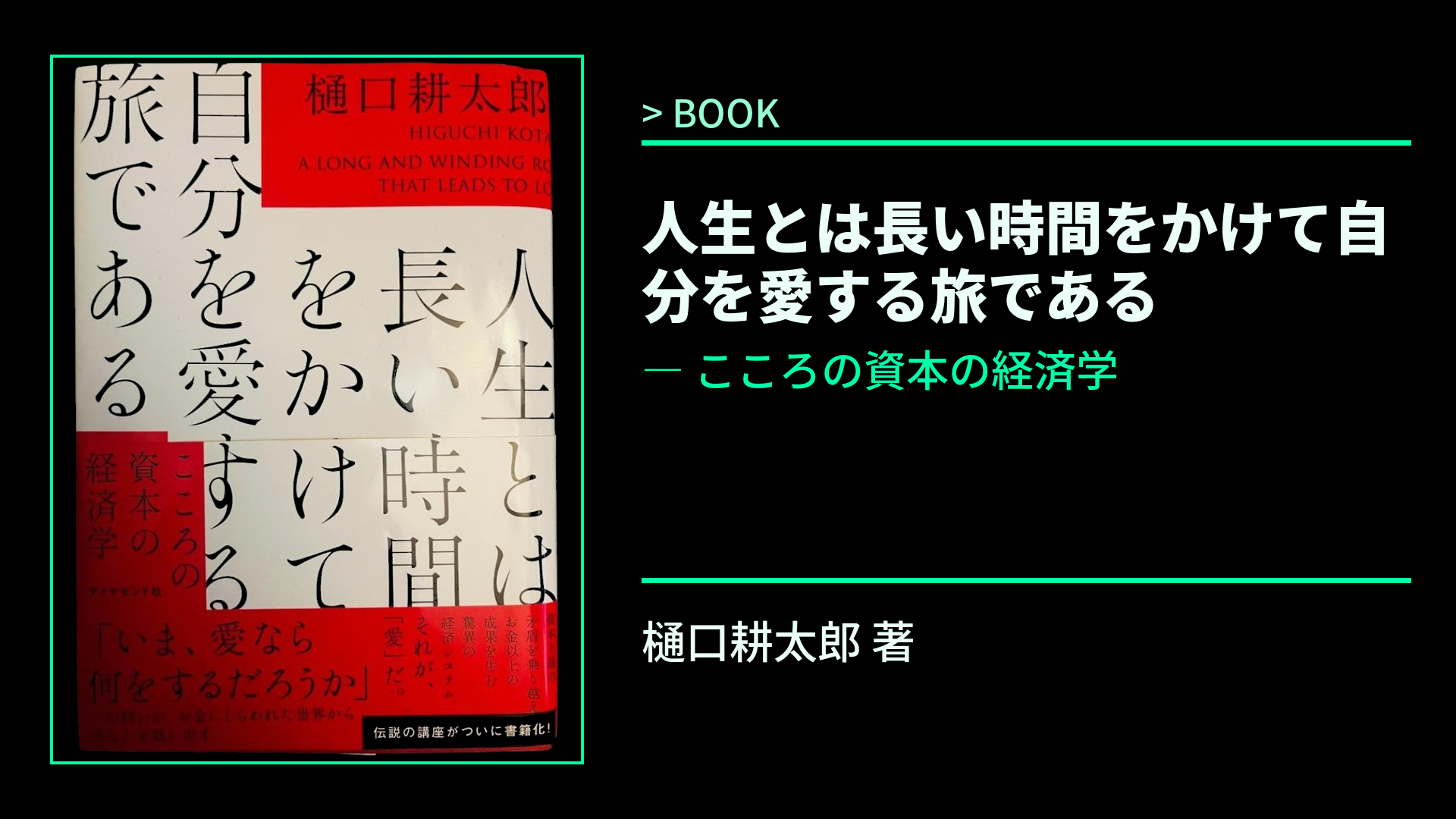
“Life Is a Long Journey of Learning to Love Yourself — The Economics of Psychological Capital”
Author: Kotaro Higuchi / Diamond, Inc. / Published September 2025
A5 paperback, 440 pages / 2,420 yen (incl. tax) / ISBN 978-4-478-11989-1









Comments