
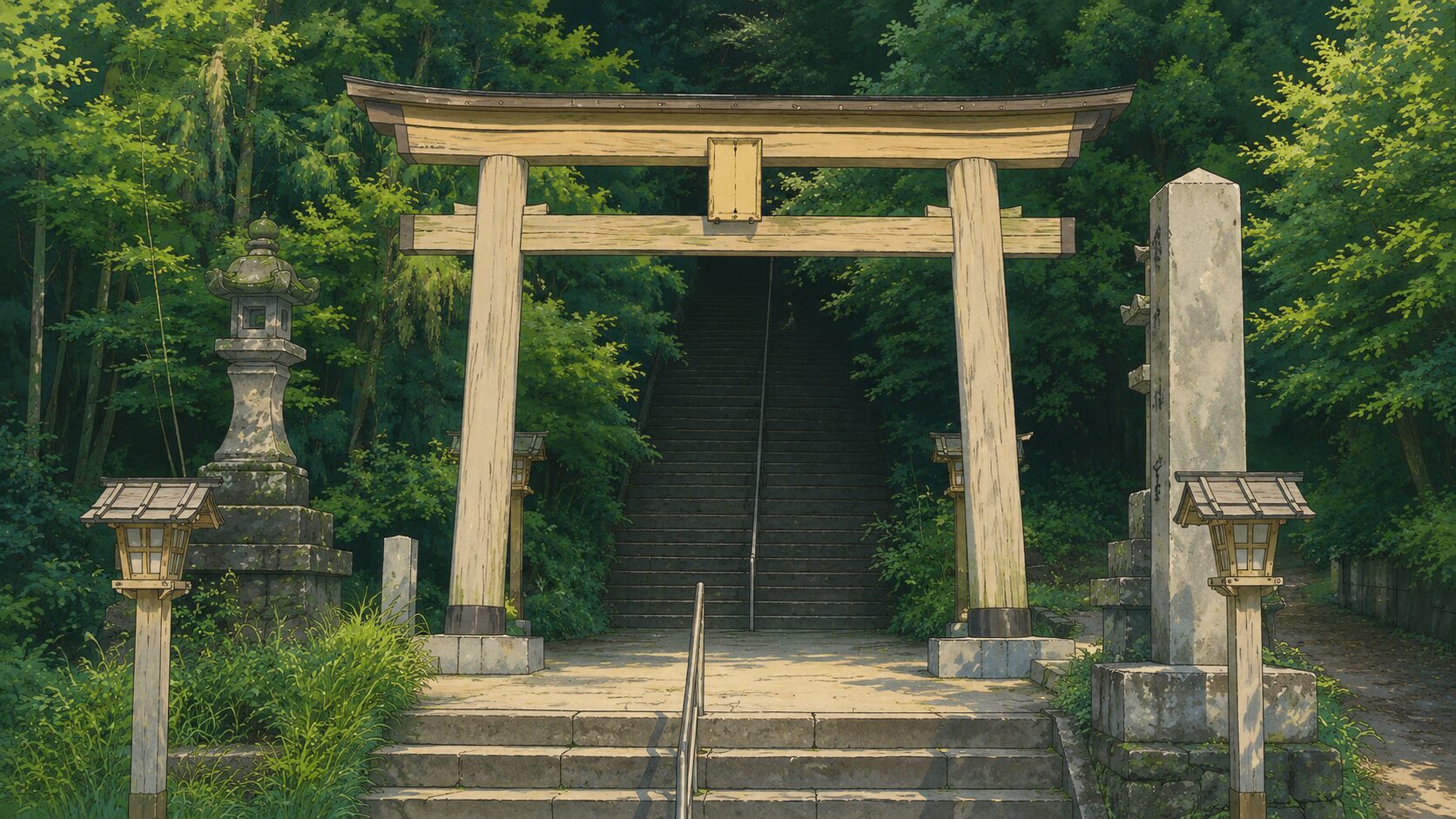
Heitate Jingu — to the Navel of the Earth.
HEITATE JINGU — NEON PILGRIMAGE
You cannot reach it simply by driving along National Route 218. A shrine hidden on the navel of Kyushu, said to be reachable only by the chosen. The life-lineage of fifteen thousand years, the five-colored peoples, and down to the bottom of the earth. The record of a journey descending to the bottom of myth.
SCROLL ▽
Prologue — The Navel of Kyushu, the Road to a Hidden Shrine
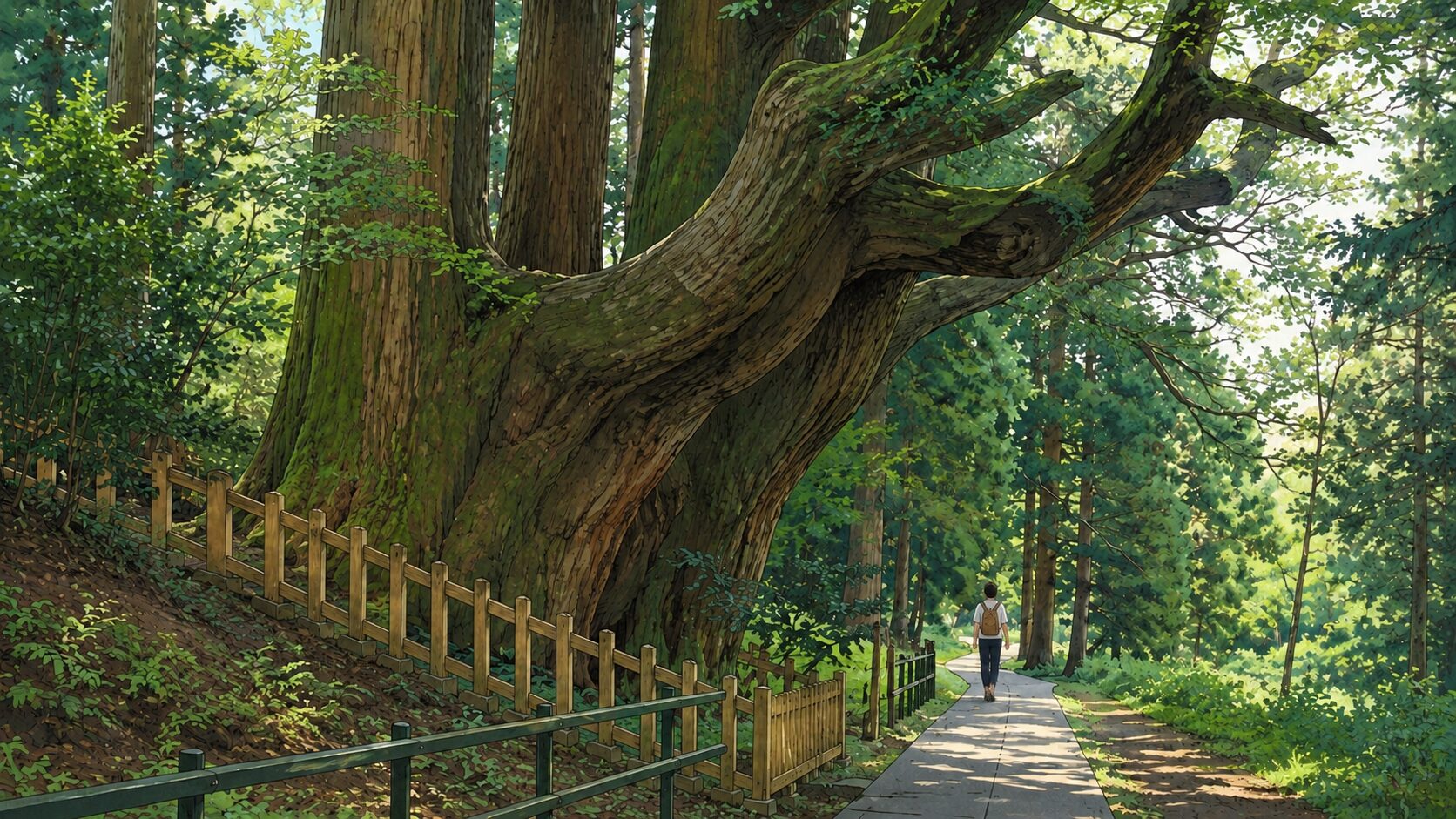
You cannot reach it simply by driving along National Route 218.
In the eastern part of Kumamoto Prefecture lies the town of Yamato. With the outer rim of Mount Aso at its back, this road stretches toward the border with Miyazaki, and locals call it the “Road of Myth.” It is a mountain road that continues on to Takachiho. The green is deep, the sky feels close. And yet, most people pass right by without ever noticing that a single shrine lies hidden along the way.
Where the road draws a gentle curve, a small guidepost stands. “Heitate Jingu.” Unless you are watching carefully, you will miss it. In fact, many who set out to visit this shrine have written that they drove past it at least once. No line of tour buses, no great signboard. This is, in the truest sense, a “hidden shrine.”
Heitate Jingu does not even belong to the Association of Shinto Shrines. While most shrines across the country are linked under that organization, this shrine continues to exist quietly in a place set apart from it. Few shrines so fully deserve the phrase “known only to those who know.” And what those “knowers” say with one voice is this: there is a legend that only the chosen can reach this place.
It may sound like superstition. But when you read the records of those who have actually visited, you encounter strange coincidences again and again. They try to go, but lose their way. Their plans fall through. And yet, as one connection leads to another, they find themselves standing before the shrine as if invited. Many such accounts have been left behind.
Why, in such a remote mountain place, is there a shrine holding so deep a story?
Heitate Jingu is said, in its origins, to “possess a history of fifteen thousand years.” Its beginnings are said to reach back before the enthronement of Emperor Jimmu, before even the descent of the heavenly grandson, to the age of the gods when heaven and earth had only just parted. Within its grounds rises a sacred tree said to bear not a tree-age but a “life-lineage” of fifteen thousand years. And in its main hall is enshrined a treasure opened only once every five years — masks said to depict the ancestral deities of humankind, painted in five colors: red, white, yellow, black, and blue.
This is said to be the land where all the peoples of the world were born from a single place, then divided into five colors and scattered across the earth — their “homeland.”
Almost at the very center of Kyushu, at the point that falls exactly on the map’s “navel.” When you stand at this single point, which might be called the navel of the earth, you quietly step into the most ancient layer of Japanese myth. And this journey does not end with touring the shrines on the surface. From behind the main hall, down through the forest, to a pond where a dragon god sleeps. And further still, to a place where myth and legend connect to the interior of the earth itself.
This is the record of a journey descending to the bottom of myth.
First, let us stand at its entrance.
Chapter 1 — The One Who Raised the Nusa: Takeiwatatsu and the Legend of the White Bird
Every shrine, however ancient and mysterious its telling, has a “public story.” This is the shrine’s tradition — the official origin the shrine itself hands down. It is like the signboard placed at a shrine’s entrance, the outermost face that visitors first encounter. Most worshippers join their hands before this surface story and go home satisfied. There is nothing wrong with that. But on rare occasions, there are those who sense that something darker and deeper continues beyond that signboard. Heitate Jingu is that kind of shrine. And its surface story begins with a single deity and a single white bird.
The time is a little after the age of the gods. There was a deity named Takeiwatatsu-no-mikoto, a grandson of Emperor Jimmu. Having received the command from the first emperor to “pacify the western sea,” he came down to the land of Kyushu — the “Land of Fire” as it was then called.
Let me explain a little about this deity, Takeiwatatsu. In Kyushu, and above all in Aso, he is a great god known to all. According to tradition, the deity once stood before the caldera of Aso, which was then a single vast lake. He kicked through a section of the outer rim, drained away all the water held within, and created a broad expanse of land there. When he kicked through the outer rim, the force of it made him fall back onto his rear, and he cried out “I cannot stand” — and that place, it is said, came to be called “Tateno.” A great pioneering deity, falling and unable to stand from sheer exertion. It is a myth, yet there is something humanly endearing about the tale. In any case, the fertile plain that appeared after the water withdrew became land where people opened fields and ripened rice. To put a human hand to wild nature and transform it into a habitable country — that is what it means to call him the deity who “pioneered” Aso. And the deity is enshrined even now as the principal deity of Aso Shrine, as the guardian of the land he himself opened. For the people of Kyushu, Takeiwatatsu is not merely a character in myth. He is the root deity who created the very earth on which they make their fields, ripen their rice, and live their lives.
That great deity set foot in this land of Heitate during the long journey of his travels around Kyushu.
The shrine’s chief priest hands down that route as follows. From the land of Hyuga — present-day Miyazaki — the deity entered Mitai (Takachiho) along the Gokase River, passed through Mamihara, and proceeded toward the land of Kusakabe. Spread a map and you will see that this is a route tracing the deep mountainous spine of Kyushu. The Gokase River flows while carving the steep valleys of the Kyushu mountains. To go up that stream is to move away from civilization, deeper and deeper into the mountains. And Takachiho — the home of myth, known for the legend of the heavenly grandson’s descent. The deity was walking near that sacred place where the heavenly gods are said to have first descended to earth. Mountains layered upon mountains, valleys carved deep, mist crawling over the peaks. It is no easy passage, where even now the air of myth hangs thick.
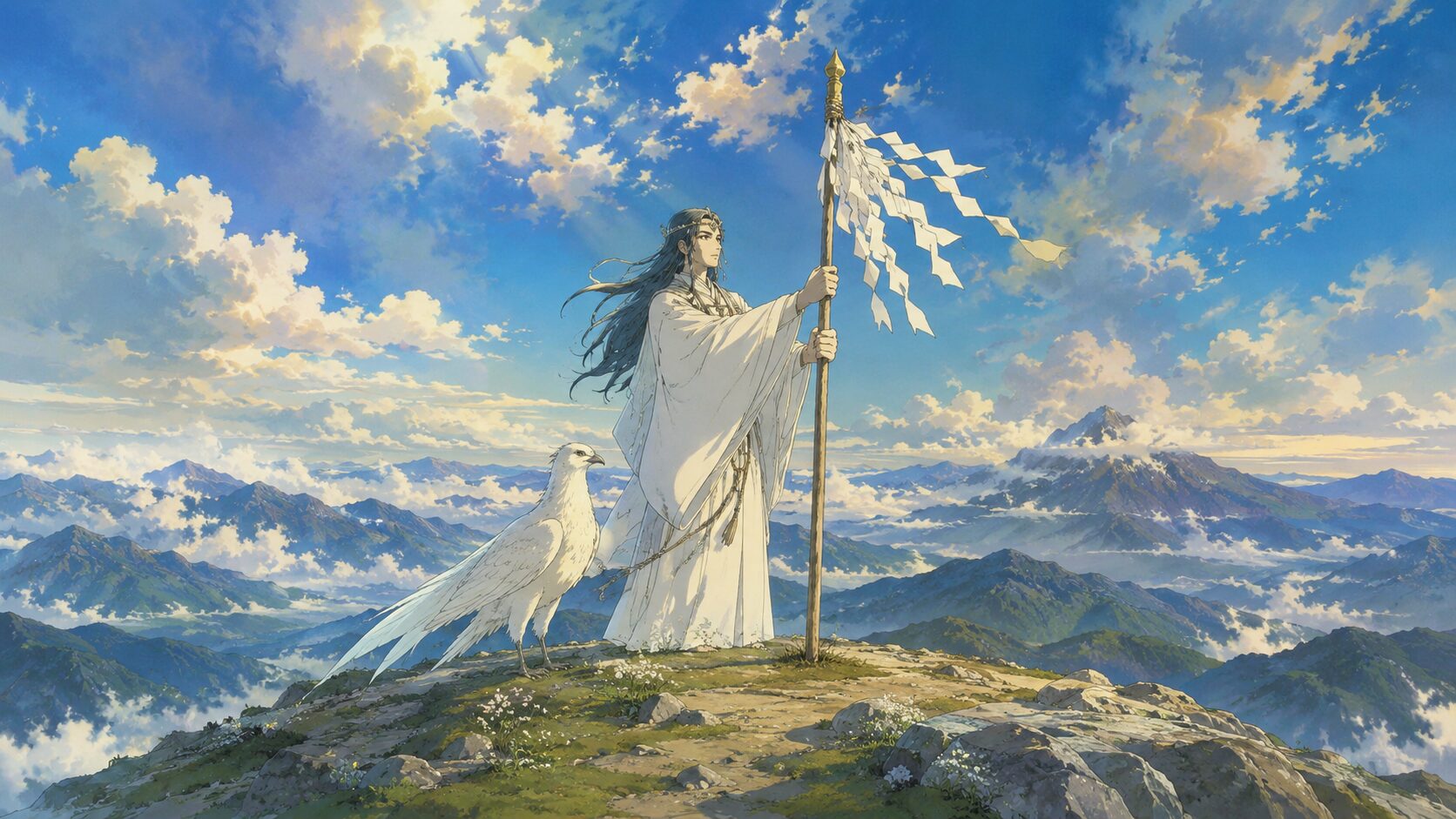
It was somewhere along this way. A single white bird appeared and guided the deity to this land of Heitate.
A white bird guiding a deity — there is deep meaning in this scene. Since ancient times, white birds have been seen as messengers of the gods, or as incarnations of the gods themselves. The unstained white feathers, the figure freely crossing between heaven and earth, unbound by the ground. It was a symbol of a messenger arriving from a dimension other than the human world. In Japanese myth too, the white bird appears again and again as a sign of the sacred. Some may recall the famous tradition that after Yamato-takeru-no-mikoto departed this world, his soul took flight as a white bird. A symbol of the soul soaring through heaven even after death — that is the white bird. And that white bird guided the deity to this land, of all places. Whether you see this as mere coincidence or as the manifestation of divine will, the hue of this story changes entirely.
The deity, stopping his steps as he was led, was struck by the beauty of the view spread before him. Almost at the center of Kyushu, a high vantage with a fine prospect. Mountain ranges stretch on all four sides, the sky opens wide. Below waves deep green, overhead spreads an unobstructed heaven. It is as if heaven and earth meet at this single point. This is no mere passageway, the deity must have felt. There the deity raised the heihaku and worshipped the heavenly and earthly deities — the gods of heaven and earth.
Heihaku is the general term for offerings presented to the gods, and above all it refers to sacred cloth, or the nusa (the wand hung with paper streamers). When welcoming a god and praying to a god, it is the sacred ritual implement raised as the vessel into which the god descends. Even today at shrines you have seen those wands, white paper folded like lightning and hung down. That is the nusa. It is the vessel that connects god and human, where the god is said to descend — the unseen sacred made visible. Because it was the place where this was “raised,” the name is Heitate — “raising the nusa.” The shrine’s name was born from the very act of this single deity. They say a name expresses the substance, and the very name of this shrine has sealed within it, for over a thousand years to this day, that founding moment when the deity raised the nusa. Every time a worshipper speaks the word “Heitate,” that person is, without knowing it, tracing aloud the very moment when the deity worshipped the gods of heaven and earth.
What is intriguing is that the chief priest who tells this legend of the white bird does not see it as a mere chance guidance. The priest says the deity knew from the start that this land was “Takamagahara,” the “Shrine of the Sun” — and that this was precisely why he poured his passion into pioneering Aso: to guard and secure this capital of the gods. In other words, he did not happen to arrive, led by a white bird. The deity knew from the beginning that this was a special place, and had been preparing the whole region of Kyushu for it. The order is reversed. It is not that a god came because there was a sacred place; long before any god came, this was already a sacred place. Even Takeiwatatsu was no more than one deity who came “afterward” to raise the nusa at that ancient sacred site — the priest’s words can be received that way. Behind the surface tradition, a deeper truth of history lies hidden. The priest himself is the one saying so.
This is the very surface origin that Heitate Jingu tells of itself.
Trace the historical records and the shrine’s outline grows a little clearer. In the Engi era (901–923), Tomonari, the great priest of Aso, built the shrine buildings and enshrined the Inner and Outer Shrines of Ise — Amaterasu-omikami and Toyouke-omikami — naming it “Heitate-sha.” Ise, of course, is the sacred place standing at the pinnacle of Japan’s shrines, enshrining the imperial ancestral deity. The fact that the two most revered deities of Ise were deliberately invited all the way to this mountain interior of Kyushu is itself weighty. For it tells us that this land was regarded as a place fit to receive deities on par with Ise. Furthermore, in the first year of Tenyo (1144), the great priest Tomotaka jointly enshrined the twelve deities of Aso and made the shrine the general guardian of the whole Ono district. In addition to the deities of Ise, he enshrined the local guardian deities of Aso as well, placing the shrine at the center of the region’s faith. The present buildings were renovated in the fourteenth year of Kyoho (1729) by the Higo Hosokawa house — by Hosokawa Nobunori. The fact that the Hosokawa, the daimyo who ruled Kumamoto, deliberately took the trouble to do this shows that this shrine held a firm rank in the region and was revered even by those in power. In the sixth year of Meiji (1873), it was ranked as a district shrine.
Lined up this way, we can see that Heitate Jingu has walked the path of a venerable regional guardian, tied to Takeiwatatsu the pioneer-deity of Aso, enshrining the deities of Ise and the deities of Aso. A shrine that enshrines deities who created the land and brought agriculture. A shrine with a firm history backed by records spanning over a thousand years. That is the sincere and solid figure of Heitate Jingu as it remains in the documents.
— But here, let us pause for a moment.
What I have just told is, after all, only the “shrine’s surface story.” The tradition that Takeiwatatsu raised the nusa. The record that Ise was enshrined in the Engi era. These are, so to speak, nothing more than the part exposed at the surface of history. What is exposed at the surface is certainly easy to see and easy to tell. There are dates, there are names of people, events lined up in order. They can even be cited as material. Yet beneath the strata exposed at the surface, far thicker, far darker, far more ancient strata lie spread in layer upon layer. What we usually see is no more than the very topmost skin of it.
For Heitate Jingu holds, separately, a story from an age far older than this Takeiwatatsu — older than the descent of the heavenly grandson, older than Emperor Jimmu, reaching back thousands of years further still. Recall once more the priest’s words. When the deity raised the nusa, this land was already “Takamagahara, the Shrine of the Sun.” Long before anyone raised a nusa, this was already a sacred place. If so, one might even say that the story of Takeiwatatsu is no more than one of the “newest layers” deposited upon this sacred ground. Even a thousand years of history is, here, “new.”
In that “long before,” what was there?
Many who visit Heitate Jingu are drawn toward something the surface origin cannot explain — the staggering span of fifteen thousand years, the masks of humankind’s ancestral deities painted in five colors, the bearing of a hidden shrine that appears in no guidebook. It is not a matter of logic. The moment they pass through the torii and set foot on the approach wrapped in dense cedar groves, many people say they feel “the air is different.” They cannot put it into words well. But surely, there is something here. Beneath the surface story sleeps another, far deeper story. People may sense its presence by instinct, before reason.
Its entrance lies in a single sacred tree rising within the grounds. In the next chapter, we step into the way of counting time called “life-lineage of fifteen thousand years,” utterly different from our common sense — for that tree had stood there since long before Takeiwatatsu raised the nusa. No — to be precise, the “life” of that tree had continued to exist there.
Chapter 2 — The Sacred Tree of Fifteen Thousand Years: The Concept of Life-Lineage
When speaking of Heitate Jingu, there is a number that must always be brought up. Fifteen thousand years.
At this staggering number, most people first feel bewildered. Fifteen thousand years ago — in Japan, that was the time when the Paleolithic was just shifting toward the Jomon period. It is a remote antiquity, when the ice age had only just begun to draw to a close.
But here, if we widen our view to the world, this number suddenly takes on an uneasy meaning. Scattered across the globe are megalithic structures that hardly seem the work of human hands. The pyramids of Egypt, megalithic remains in various places — many have been spoken of as the products of a super-ancient civilization far older than the established theories. And were those great legacies truly born separately, independently, each in its own land? Why are nearly the same traces of nearly the same wisdom left in various places around the world at nearly the same time?
Here there is one bold view. Could it be that the earth once held a “mother super-ancient civilization” surpassing our own, and from it a single power granted the same wisdom, the same civilization, to various places across the world? Atlantis, Mu, Lemuria. Those phantom continents said to have sunk beneath the sea. Their memory is engraved, in changed forms, in the myths and ruins of the whole world. If so, the power that had the pyramids built and the power that brought down a god to this sacred land of Heitate are not separate things. They would be the same power, issuing from one and the same source.
There is no firm proof. But recall — Heitate Jingu is, from the start, a shrine that speaks of “all the peoples of the world being born from a single place, dividing into five colors, and scattering across the world.” The source was one — is this not the very message this shrine has been handing down for fifteen thousand years? The view that the source of the world’s civilizations was one resonates, at a surprisingly deep level, with the legend of the five-colored peoples. The true nature of that resonance will gradually take shape as we read on. For now it is enough to feel that the fifteen thousand years marked by this single sacred tree lie within the same ancient light, the same light, as the world’s great ruins.
But as for the meaning of this number, the chief priest of Heitate Jingu speaks of it very clearly. Fifteen thousand years does not mean the shrine buildings were built fifteen thousand years ago. It means that the “life-lineage” of the sacred tree is fifteen thousand years.
Life-lineage. The word may be unfamiliar. The pulse of life — that is, the continuity of life. This single word is the whole theme of this chapter.
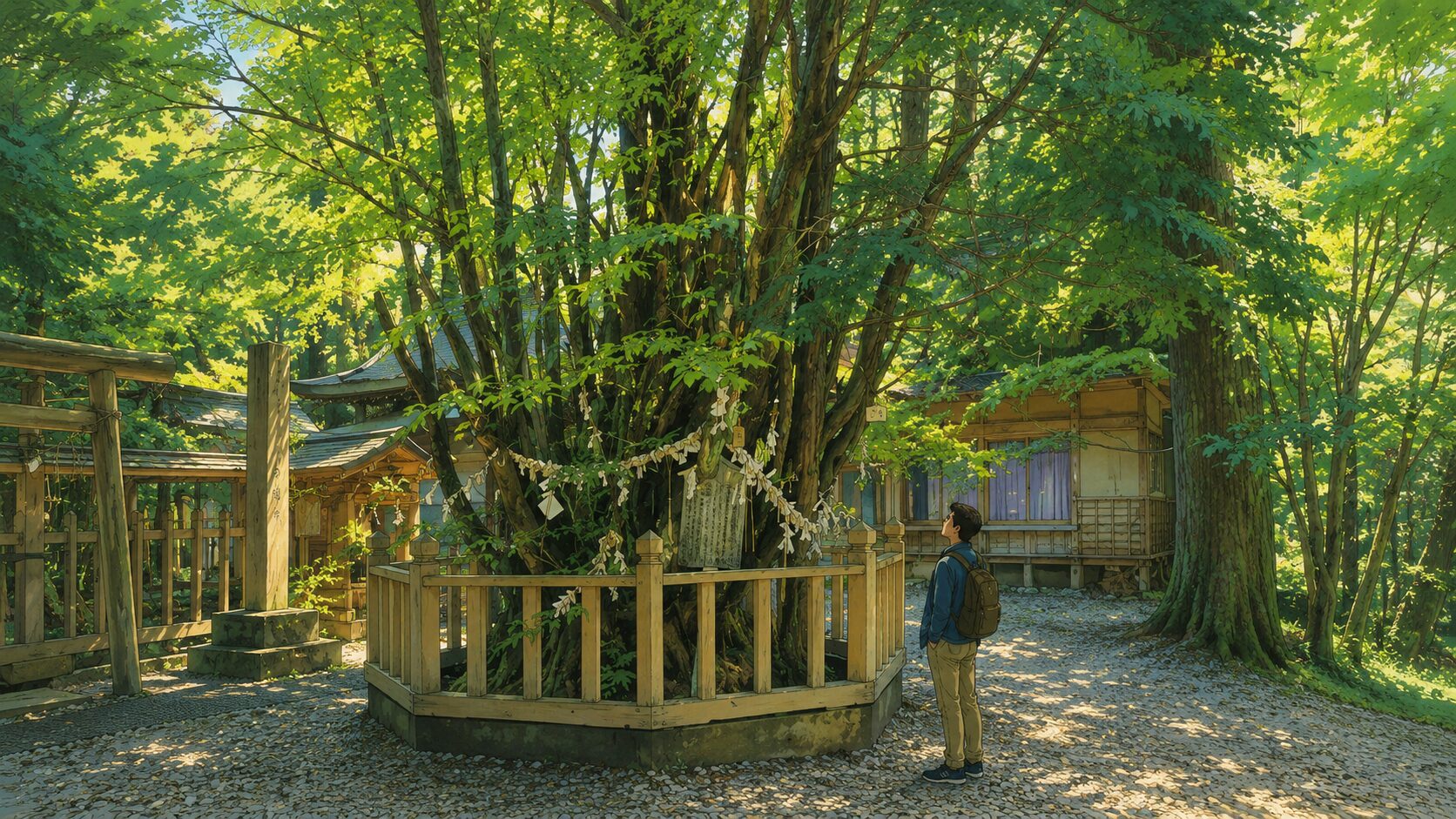
Within the grounds of Heitate Jingu rises a single hinoki cypress. It is the sacred tree called the “Tenjinboku” (Tree of the Heavenly Deity). It stands clothed in an especially divine air within the dense grove. But what makes this tree special is not that it is merely large, merely old. This tree, it is said, has endlessly repeated the cycle in which, from the same stock, a hinoki grows and decays, and from the decayed roots a new hinoki sprouts again — that succession of generations.
Here, let me touch a little on the hinoki tree itself. For the Japanese, the hinoki is a special tree. It grows straight, aiming for the heavens; its timber is fragrant, resistant to decay, and supports buildings for over a thousand years. That Horyu-ji still stands is said to be due to the astonishing durability of the hinoki. Since ancient times the hinoki has been the most revered as timber for shrines and palaces. Its name is said to derive from “fire tree” (hi-no-ki), for rubbing it together produces fire — a sacred tree. As a vessel for enshrining the gods, no tree is more fitting. That a single hinoki was chosen as the vessel for the gods to descend upon has, in itself, a deep necessity.
Try, for a moment, to imagine.
A tree grows over long years, eventually reaches the end of its life, and withers. Normally, that is where one tree’s story ends. It falls, decays, returns to the soil, and that is all. Yet from the root of that decayed stock, the same hinoki puts forth a bud again. A new life rises up, nourished by the remains of the old. It grows over hundreds of years, becomes a giant tree, and at last decays again. Then from its root, the next hinoki — and so on. The tree, by handing off the generations, has carried a single life on at the same single point.
The hinoki now standing in the grounds is said to be the “tenth generation.” Its estimated age is about two thousand years.
Here, pause and consider. The tenth generation, two thousand years. Then if you trace back — the ninth, the eighth, all the way to the first generation — how long does that chain of life become? The shrine counts it as fifteen thousand years. This is the meaning of “life-lineage of fifteen thousand years.” It is neither the building’s age nor a single tree’s age. At the same place, the life of the hinoki has been handed down across generations — its total span. That is the fifteen thousand years.
At this moment, the sense of time we took for granted begins, quietly, to be shaken.
We usually count a tree’s age by “tree-age.” The number of years from when one tree sprouted until today. That is the natural way to count. Look at the stump of a felled tree and growth rings are carved into it. Count those rings one by one and you know how many years that tree lived. One lifespan for one tree. It is an exceedingly clear, unquestionable way of counting.
Yet the sacred tree of Heitate Jingu quietly refuses that clear way of counting. What is counted here is not the number of years one tree lived. It is the “continuity of life itself,” handed down from generation to generation, from stock to stock. The withering of one tree is not an end, but merely a handing-off to the next generation. Death is not what severs the continuity; it is a part of the continuity. How great is this shift in thinking. We grasp “the lifespan of a thing” as a single line with a beginning and an end. But the thought of life-lineage grasps it as an endless circle in which the end folds back into the next beginning.
This may closely resemble the sense we have when counting a “family line.”
One human being’s lifespan is at most less than a hundred years. But if the blood connects from parent to child, from child to grandchild, the history of that “house” becomes hundreds, even thousands of years long. You, a single human being, live only a few decades at most. But your “life” has been handed down without break from your parents, from your grandparents, from ancestors before them. A single thread connecting, without ever once breaking, from some nameless someone tens of thousands of years ago down to you. Had that thread been cut at even one point, the you of now would not exist. The fifteen thousand years of the sacred tree is the very same idea. Not the age of one tree, but the length of the “family line” that the life of the hinoki has spun at the same place. The story of the tree’s, of life’s, of the bloodline’s continuity.
On the shrine’s side, an even bolder tradition remains. At the root of the present tenth-generation tree, traces left by the trees of past generations are said to be visible, in the form of burls. These are called “mirror-burls.” And one of those mirror-burls is said to be from the era of Emperor Sujin, when the tenth generation sprouted; another is said to be from the era of — astonishingly — Amaterasu-omikami, the age of the ninth generation. The names of the gods appearing in myth and the generations of the tree are joined, continuously, upon a single trunk. Amaterasu-omikami is, of course, the supreme deity of Japanese myth. The shrine tells that when that deity was in this world, the ninth-generation tree stood. Here myth and tree are not separate things. They exist side by side upon the same single timeline. Lay your hand on the trunk of the tree, and the age of myth sleeps there as growth rings — this tradition permits such imagining.
What we should recall here is that the span of fifteen thousand years overlaps precisely with the dawn of the Jomon period. For over ten thousand years, the Jomon people changed the patterns of their pottery and the forms of their lives only gradually. Their time was not something that “progressed” in a straight line as ours does. The seasons turn, the generations turn, the same daily life is repeated — they lived within a circling time. A tree decays and revives, decays and revives again. That way of counting life-lineage is the very Jomon sense of circling time. We moderns, who demand results in a year, are questioned for outcomes by the quarter, and are driven by time down to the second — when we lose our words before this sacred tree, it may be because we suddenly touch the “other time” we have forgotten.
Of course, this cannot be proven as literal scientific fact. Whether the first-generation hinoki truly sprouted fifteen thousand years ago, whether the generational succession truly occurred ten times — there is, for now, no way to confirm it. However many rings you count, you will get only the two thousand years of the present tree. So it is easy to dismiss this as “an absurd fabrication.”
But what matters here is not only the question of whether it is fact. I want to turn our eyes rather to the sense behind it — why did this shrine deliberately choose the unfamiliar way of counting called “life-lineage” rather than “tree-age”?
Not to end with the death of one tree. To carry life on at the same place even after decay. In that very continuity, the sacred is seen. This sense is, in fact, by no means peculiar for the Japanese. For example, Ise Shrine rebuilds its buildings entirely once every twenty years. It is the practice called “shikinen sengu,” carried on for over thirteen hundred years. The old buildings are dismantled, and entirely new buildings are raised on the adjacent ground. The buildings themselves become new every twenty years. But what is handed down there is not the “thing” of the buildings. The techniques to build the buildings, the form of the rites, and the gods themselves — the formless essence is transferred to a new vessel and kept eternally. The old decays. But decay is built in from the start, and even so it continues.
Look around the world and the faith that reveres giant trees as sacred is by no means rare. In Norse myth there is the gigantic ash tree “Yggdrasil” standing through the world, its branches and leaves covering the heavens, its roots reaching to the underworld. In India, the Buddha attained enlightenment beneath the bodhi tree. In various places around the world, people have seen gods in great trees, seen the center of the cosmos. But while many of these imagined “one immortal tree,” the sacred tree of Heitate Jingu is a tree that “decays and revives.” Not immortality, but rebirth. Not standing forever, but rising again and again through death. Here lies the originality of the Japanese conception.
The sacred tree of Heitate Jingu stands upon precisely this thought. The single tree, the hinoki, decays. But the life does not decay. It is transferred to the next generation, and the next, kept at the same place, forever. A life that passes through the death of form and continues still. The unique conception of “eternity” the Japanese have long held is, in this single hinoki, condensed whole. If the Western eternity was entrusted to undecaying stone temples and the unchanging figure of one god, the Japanese eternity was entrusted to that which accepts decay and continues while passing on. The sacred tree is the living witness of that thought.
And there is something not to be forgotten. This sacred tree is not merely an old tree. According to the shrine’s tradition, it is at the very treetop of this tree that the gods are said to have descended from heaven. Gods riding on a ball of fire descended, cleaving the night sky, and came to rest at the treetop of this hinoki — so it is told. Try to imagine. In a remote antiquity without writing or states, into a mountain valley sunk in darkness, a ball of fire suddenly descends from heaven. Cleaving the pitch-black night sky, a blinding mass of light slowly descends upon this mountaintop. The ancient people, clad in furs, look up at it. Perhaps they prostrated themselves. Or perhaps, without a voice, they simply gazed at that light. That ball of fire came to rest quietly at the treetop of a single hinoki, and there, at last, the gods revealed their forms. The awe and astonishment of the ancient people who witnessed it, the very first fragment of that memory, may still breathe quietly at the root of that staggering number, fifteen thousand years. That is to say, this tree is the vessel binding heaven and earth, the point of contact where the gods first touched this earth. The life-lineage of fifteen thousand years is not merely a tale of a tree living long. It is a word pointing to the very miracle that the sacred single point where a god descended has been guarded and kept, without ceasing even once, for fifteen thousand years.
Then who, exactly, were those “descended gods”? Who were the gods who, riding on a ball of fire, chose a single hinoki rising on this navel of Kyushu and came down?
Gazing up at the tree of life-lineage fifteen thousand years, our question draws ever nearer to the core of this shrine. When you actually stand before this tree, many people say they are wrapped in a strange sensation. Look up, and the treetop melts into the heavens far overhead; lay your hand on the trunk, and from beyond the cool bark, something pulsing seems to come through. Whether it is the weight of fifteen thousand years of time, or the presence of the gods who once descended here — reason cannot tell. Only that, before this tree, everyone naturally falls quiet, stops their steps, and gazes up for a while. In the next chapter, let us quietly open the door to the five-colored treasure said to be enshrined deep within the main hall and to reveal its form only once every five years — the “Goshiki-shinmen,” the Five-Color Sacred Masks. Within those five colors are hidden the true nature of the descended gods, and the grand message this shrine has continued to send to all of humankind.
Chapter 3 — The Five-Color Sacred Masks: A Treasure Opened Only Once Every Five Years
Shrines have treasures rarely seen by human eyes.
Sacred bodies, shrine treasures, hidden Buddhas — they go by various names, but they are things opened only on a few limited days, once a year, or once every several years. Ordinarily they are firmly enshrined deep in the main hall, far removed from human sight. Why hide them? Because it is precisely by being hidden that their sanctity is kept. What can be seen by anyone, anytime, eventually loses its preciousness. But if it shows its form only once every five years, it keeps its sanctity across time.
In Shinto, there is from the start a deeply rooted sense of revering “what must not be seen.” In myth, Izanagi saw the form of his wife Izanami in the land of the dead though told “do not look,” and an irreparable thing came to pass. Toyotama-hime had her promise of “do not look” at her childbirth broken, and departed to the sea. The sacred keeps its power by being veiled and hidden. When exposed and brought into broad daylight, the sacred often loses its power. To conceal, to hide, to rarely show — that itself is a part of faith. The treasure enshrined deep within Heitate Jingu is exactly such a thing. Its name is the Goshiki-shinmen, the Five-Color Sacred Masks.
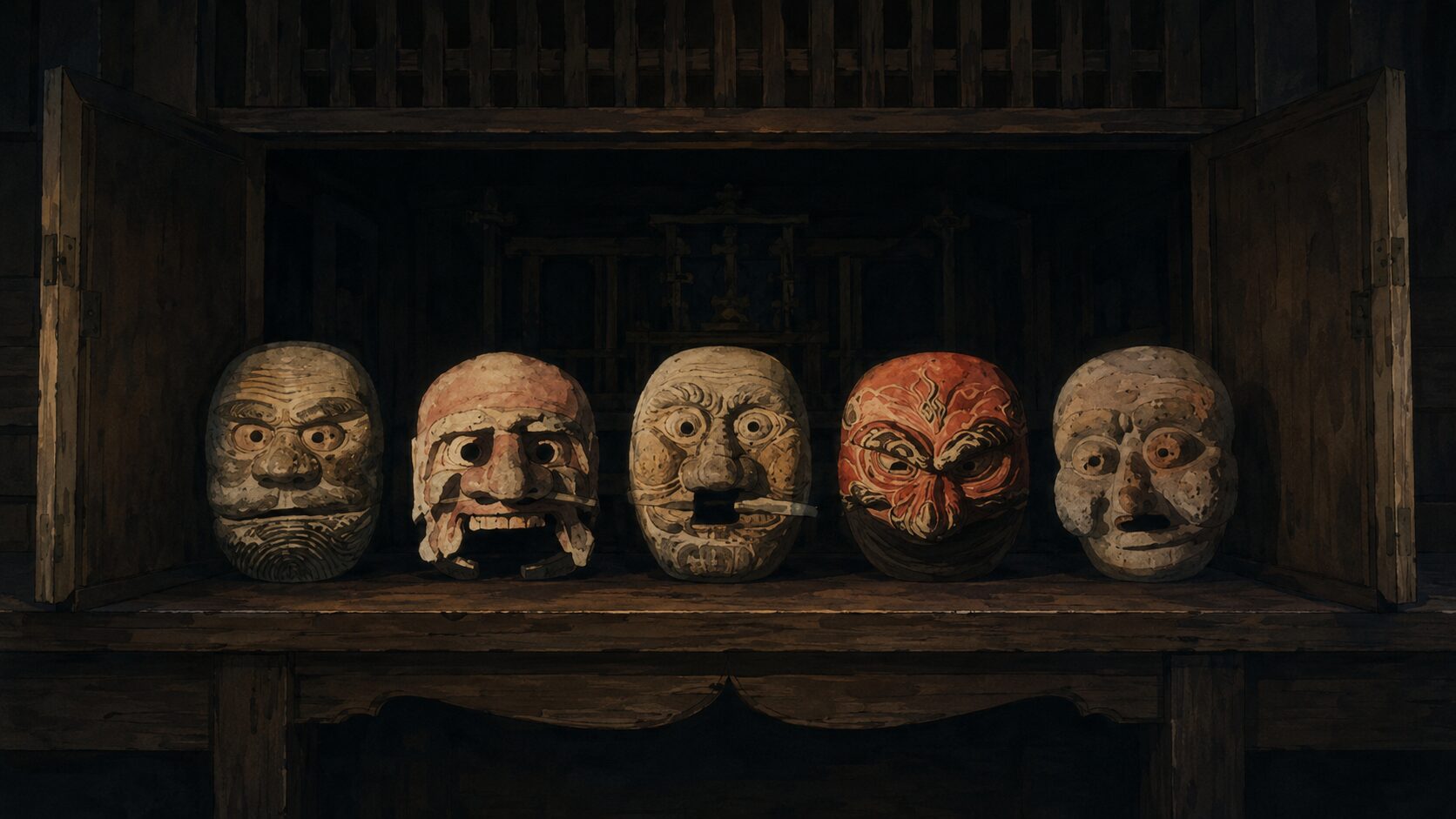
Red, white, yellow, black, blue. Masks shaped like human faces, painted in five colors. That is the Goshiki-shinmen. These five masks are not mere ritual implements. According to the shrine’s tradition, each depicts the “ancestral deity” of one of the five colors of humankind living upon the earth — that is, the great original ancestor of every human being in the world.
What does a person feel when facing these masks? Each mask is not the face of a specific someone. Each is the root of countless people living one “color,” gathered into a single face. So to gaze at these masks may resemble peering into a mirror. The innermost face of someone living somewhere in the world, of a different skin color from your own. And trace it, and it connects somewhere with your own face too. The five masks are five portraits of the great family of humankind. The painted colors are vivid, yet their expressions are somehow quiet, drawing the gazer’s heart into antiquity.
Come to think of it, this is a staggering conception.
The world holds countless shrines and temples, churches and mosques. Most of them offer prayers for the people of a particular ethnicity or a particular region. A Japanese shrine for the Japanese, a local shrine for the people of that land. That is surely the natural form of faith. But Heitate Jingu far exceeds that frame. What is enshrined here is not only the Japanese. People of red skin, of white skin, of yellow skin, of black skin, and of blue. All the colors of humankind living upon the earth. This small shrine in the mountains of Kyushu enshrines, under one roof, the ancestors of every one of them.
— But here, some may have noticed one strange fact.
People of white skin, people of black skin, people of yellow skin. These are people who, right now, live somewhere in the world. Their faces come readily to mind. But what of the remaining two — “people of red skin” and “people of blue skin”? Do red-skinned humans, blue-skinned humans, live anywhere on the earth now? There is a way of calling Native Americans “red.” But a group of humans with literally red skin, blue skin, is nowhere to be found on the actual earth.
Of the five ancestral deities, three overlap with real humankind. But only the two, red and blue, are nowhere to be found. Where did they go? Were they never there from the start? Or — were they once on the earth, but vanished at some point? This question is far deeper than it appears. And as we pursue its answer, we will eventually leave this earth and descend to an unimaginable place — far below, beneath our feet. But that is still ahead. For now, please keep this small sense of discomfort — the “absence of red and blue” — in a corner of your heart. It awaits us once more, at the deepest place of this story.
This is unmatched in the world. A sacred place offering prayers for all the peoples of the world is not something that easily exists. Heitate Jingu is said to be not a mere regional guardian but a place that continues to send a grand message toward all of humankind — and it is owing to the existence of these Five-Color Sacred Masks.
Survey the creation myths of the world and the originality of this conception stands out. The myths of many peoples tell that “we ourselves are the first humans.” A god specially created our people; we are the chosen ones — such chosen-people thinking appears again and again in myths around the world. But the story of the five-colored peoples of Heitate Jingu is not that. It tells that not only the Japanese are special, but that all the peoples of the world are kin who branched from a single source. Of course, as we will see later, the legend of the five-colored peoples also includes a Japan-as-source thinking — “the Japanese are descendants of the golden people.” But what flows at its root is not the superiority of a particular people, but the thought of the common root and harmony of all humankind. To enshrine not “only us” but “all of us.” In this single point, the thought of Heitate Jingu shines with a singular light even among the world’s many creation myths.
There is a day when those Five-Color Sacred Masks reveal their form to the world.
The Goshiki-shinsai (Five-Color Deity Festival). It is the most important festival of this shrine, held every year on August 23. And once every five years, that year alone becomes a “grand festival.” Only in the year of the grand festival are the Five-Color Sacred Masks enshrined deep in the main hall opened, and worshippers may behold the form ordinarily never seen. The next chance is again five years later. How many times in a lifetime could one be present for it? When you think of it that way, the weight of making the journey to this festival sinks in.
In fact, there was a time when this Goshiki-shinsai had been discontinued. Over its long history, the festival’s flame nearly went out. That it came to be held in earnest once more was in 1995. In just such an age — when, having passed through the postwar high-growth period, people had begun to seek the “heart” and the “connections” beyond material abundance — this old festival revived. An age when the world globalized, yet at the same time conflicts of ethnicity and religion grew ever more serious. That this festival, praying “humankind is originally one, be in harmony,” revived as if called by the times, may be no coincidence. Thereafter, to the grand festival once every five years, people gathered from within the country and abroad, as if drawn by that prayer. An old myth revived in the very midst of the present age, taking on a new meaning.
This Goshiki-shinsai is rooted in an ancient tradition. According to the shrine — in a far, far distant past, the ancestral deities of all the peoples of the earth, that is, the great ancestors of the five-colored peoples of red, white, yellow, black, and blue, gathered together in this land and performed a rite to bring about the “harmony” of one another’s spirits. The ancestors of all the peoples of the world gathered at this navel of Kyushu and offered prayers to become one — that, it is said, is the origin of the Goshiki-shinsai. Even now, once every five years, as if to reenact that ancient gathering, people gather to this land from all over the world.
Indeed, in the year of the grand festival, many participants are said to visit from abroad as well. People differing in skin color, in language, in the religion they believe, gather before this small shrine and offer prayers together. That very scene revives the legend of the five-colored peoples in the present.
Try to imagine. The mountain-valley grounds in August, where the cries of cicadas pour down. From among the dense cedar groves, the summer light streams in in many shafts. Beneath it, people gathered from all over the world sit quietly. Various skin colors, various attire. Soon the rite begins, and the voice of the norito prayer echoes through the forest. The doors of the main hall, opened only once every five years. From within, the five masks of red, white, yellow, black, and blue reveal their forms. The faces of humankind’s ancestral deities, said to have been handed down across fifteen thousand years. Before them, people of differing nationalities and religions are wrapped in a single prayer. At this moment, the harmony rite of the five-colored peoples said to have been performed in this land in antiquity becomes not an event within myth but a reality unfolding before our eyes. Time connects, coming full circle. Such a strange sensation, they say, is in this festival.
One person who attended a grand festival left behind the priest’s words like this. The Goshiki-shinsai is a festival that enshrines the five-colored peoples, the ancestral deities of the world’s humankind, and prays for a “world of harmony” in which all the people of the earth recognize and help one another.
In this single word, “harmony,” lies the core of Heitate Jingu’s thought.
Here, let me pause a little on the number “five” and the five colors. The combination of five colors is, in fact, deeply rooted in Eastern thought. In the theory of yin-yang and the five elements that arose in ancient China, the world is composed of the five elements of wood, fire, earth, metal, and water, and to each is assigned a color: blue (green), red, yellow, white, black. By direction, the blue of the east, the red of the south, the yellow of the center, the white of the west, the black of the north. These five colors were the symbol of the “whole,” representing all of the world. The five-colored curtains seen at Japanese shrines, and the five-colored streamers added to the carp banners at the Boys’ Festival, trace back to this thought. That is to say, the five colors are not five scattered things but a completed coloration that, together, expresses “all of the world.” That Heitate Jingu grasped humankind in five colors resonates, at a deep level, with this Eastern cosmology — five that are one, a sense of being many yet, as a whole, one. The Five-Color Sacred Masks are, so to speak, “humankind as a whole” condensed and made visible in five colors.
Five colors. They are the diversity of the world’s humankind itself. Skin colors differ. Cultures differ. Languages differ. What is believed differs. Over these differences, humankind has repeated conflict since the dawn of history. But the Five-Color Sacred Masks grasp those five colors not as things in opposition, but as the “divided forms” of what was originally one. Red, white, yellow, black, and blue — trace them, and they are siblings born from the same single source. That colors differ does not mean being enemies. Rather, they are children of many colors born from the same parent. So, rather than fight, recognize one another, help one another, be in harmony. That is the message this shrine has continued to send to humankind for fifteen thousand years, through the masks of five colors.
Seen even with our modern eyes, this is a startlingly universal, and urgently needed, message. In the world even now, conflict over differences of skin color, ethnicity, and religion never ceases. Precisely because it is such an age, the thought of the five-colored peoples — “we were originally one” — sounds, far from an old-fashioned myth, rather like a prayer toward the future. One priest is said to have spoken of prayer and norito as “joy.” To receive the various things happening in the world, as far as possible, with a heart of joy, and to live while seeing things from that viewpoint. That very attitude is what matters. Harmony is not defeating someone. It is rejoicing in being together, while holding our differences. The Five-Color Sacred Masks quietly show that state, in five colors.
And to these Five-Color Sacred Masks clings an even bolder tradition.
Among the shrine’s treasures, besides the Five-Color Sacred Masks, there are said to be things called “Suio” (Water King) and “Kao” (Fire King). Water and fire. These two opposing, fundamental powers too are hidden deep within this shrine. Furthermore, by one account, the red mask among the Five-Color Sacred Masks is the “Mask of Moses,” sometimes spoken of in connection with Moses, the prophet who appears in the Old Testament. There is even a tradition that the “Water Jewel,” said to be a treasure of the Jews, was brought to these grounds.
These tales already greatly overstep the frame of Japanese myth. This shrine, which enshrines the ancestral deities of all the world’s humankind, somehow connects to Moses of the Old Testament and to a treasure of the Jews. One can, of course, dismiss it as absurd. But precisely because it is a shrine that speaks of the source of all the world’s humankind, it would be no wonder if it connected somewhere to every myth and scripture of the world — once you begin thinking that way, a chill runs down your spine. As for this story of the Water Jewel and Moses, let us delve into it carefully again in a later chapter.
For now, let us return to the question before us.
The five-colored peoples whom the Five-Color Sacred Masks depict. The ancestral deities of humankind — red, white, yellow, black, blue. Who, exactly, are they? Did the world’s humankind truly be born from a single place, divide into five colors, and scatter across the world? And where did that story come from?
In the surface origin of Heitate Jingu — the official history of enshrining Takeiwatatsu and the deities of Ise — this tale of the five-colored peoples does not, in fact, appear. The story of the five-colored peoples is recorded in another place. It is within a certain ancient document said to be older than the Kojiki and Nihon Shoki. In the next chapter, we will at last unravel the true nature of the five-colored peoples — within what kind of myth the ancestral deities of red, blue, yellow, white, and black have been told. And there, once more, we will run up against the earlier question. The red and blue found nowhere on the earth. Where did they come from, and where did they vanish? The entrance to that answer lies in the next chapter. Let us at last open the door to another myth that shakes this country’s common sense.
Chapter 4 — Who Are the Five-Color People: The Ancestral Deities of Five Colors
The five-colored peoples. Humankind bearing five colors: red, white, yellow, black, blue.
When first hearing this phrase, many people are surely seized by a strange sensation. To grasp humankind in “five colors.” To grasp differences of skin color not as opposition or superiority, but as five branches diverging from a single root. This conception both resembles and decisively differs from the idea of “race” we know today. For while the word “race” has often been used as a tool of discrimination and division, at the root of the word “five-colored peoples” flows, from the very start, the thought of harmony — “originally one.”
In the previous chapter, we looked at the Five-Color Sacred Masks that enshrine these five-colored ancestral deities. And we ran up against one strange fact. Of the five colors, three — white, yellow, black — overlap with people now living somewhere in the world. But only the two, red and blue, are nowhere to be found on the earth — that sense of discomfort.
In this chapter, we step one further into the true nature of that discomfort. Where, in the first place, are the five-colored peoples spoken of? Who are they, and where did red and blue vanish?
First, there is something that must be made clear. The story of the five-colored peoples does not appear in the “surface origin” of Heitate Jingu. The shrine tradition that Takeiwatatsu raised the nusa, which we saw up through the previous chapters. The record that Ise was enshrined in the Engi era. In such official history, the word “five-colored peoples” does not, in fact, appear. Then where are the five-colored peoples spoken of? It is within a certain ancient document said to be older than the Kiki — the Kojiki and Nihon Shoki. Its name is the “Takeuchi Documents.”
These Takeuchi Documents will be treated carefully in the next chapter. Here, let us look first only at the figure of the five-colored peoples recorded within them. According to the Takeuchi Documents, the world once had five fundamental races: the red people, blue people, yellow people, white people, and black people. They do not necessarily match the classifications we use today, such as “yellow race” or “white race.” Roughly, it is told this way. The red people are Jews, Native Americans, Arabs, and the like. The blue people are Northern Europeans, Slavs, and the like. The yellow people are the Mongoloid peoples of Asia, such as the Japanese, Chinese, and Koreans. The white people are the Caucasoids of Europe. The black people are Indians, Africans, the peoples of Melanesia, and the like.
And the most important point. These five-colored peoples were not each born separately. They diverged from a single source, the Takeuchi Documents tell. The original humankind was born in this land of Japan, spread out to various places across the world, and, influenced by the climate and weather of each land, branched into the red and blue, white and black peoples. The source is one. This overlaps precisely with the core thought of Heitate Jingu that has appeared again and again in the chapters so far.
However, as for which specific peoples of the world each color of the five-colored peoples corresponds to, it differs considerably depending on who is telling it. For example, in the tradition of a certain Shinto school, the red people are Americans, the blue people Australians, the yellow people Asians, the black people Africans, the white people Europeans. By another account, the blue people are assigned to the peoples of the Pacific islands such as Polynesia and Hawaii. There are accounts making the red people Arabs and Jews, and accounts making them Native Americans. In short, the correspondence between the five colors and actual peoples is, from the start, somehow vague and wavering. This very “wavering” becomes, in fact, an important clue. That the correspondence is not cleanly fixed may show that the five-colored peoples were, from the start, beings spoken of by a principle different from real racial classification.
Now, let us return to the earlier discomfort.
Yellow people = Asian-derived, white people = European-derived, black people = African-derived. These three can somehow be made to correspond to real humankind. But what of the red people and the blue people? Certainly, a way of calling Native Americans “red” has existed historically. There are accounts linking Northern Europeans with “blue.” But that is, after all, metaphor or association; a group of humans with literally red skin, blue skin, does not exist on the actual earth. The three colors overlap with real humankind, yet only the two, red and blue, float somehow ungrounded.
In fact, this point — that “only the red people and blue people cannot be found” — is the greatest mystery long pointed out in the discussions surrounding the five-colored peoples. Were they never there from the start? Or — were they once on the earth, but vanished at some point?
Here there is one bold theory.
Could it be that the red people and blue people, though in human form, were beings a little different from us? And that they still exist — only, not on the surface, but at the bottom of the earth.
It may sound absurd. But what those who advocate this theory cite as a clue is a being familiar to none other than the Japanese.
The red demon and the blue demon.
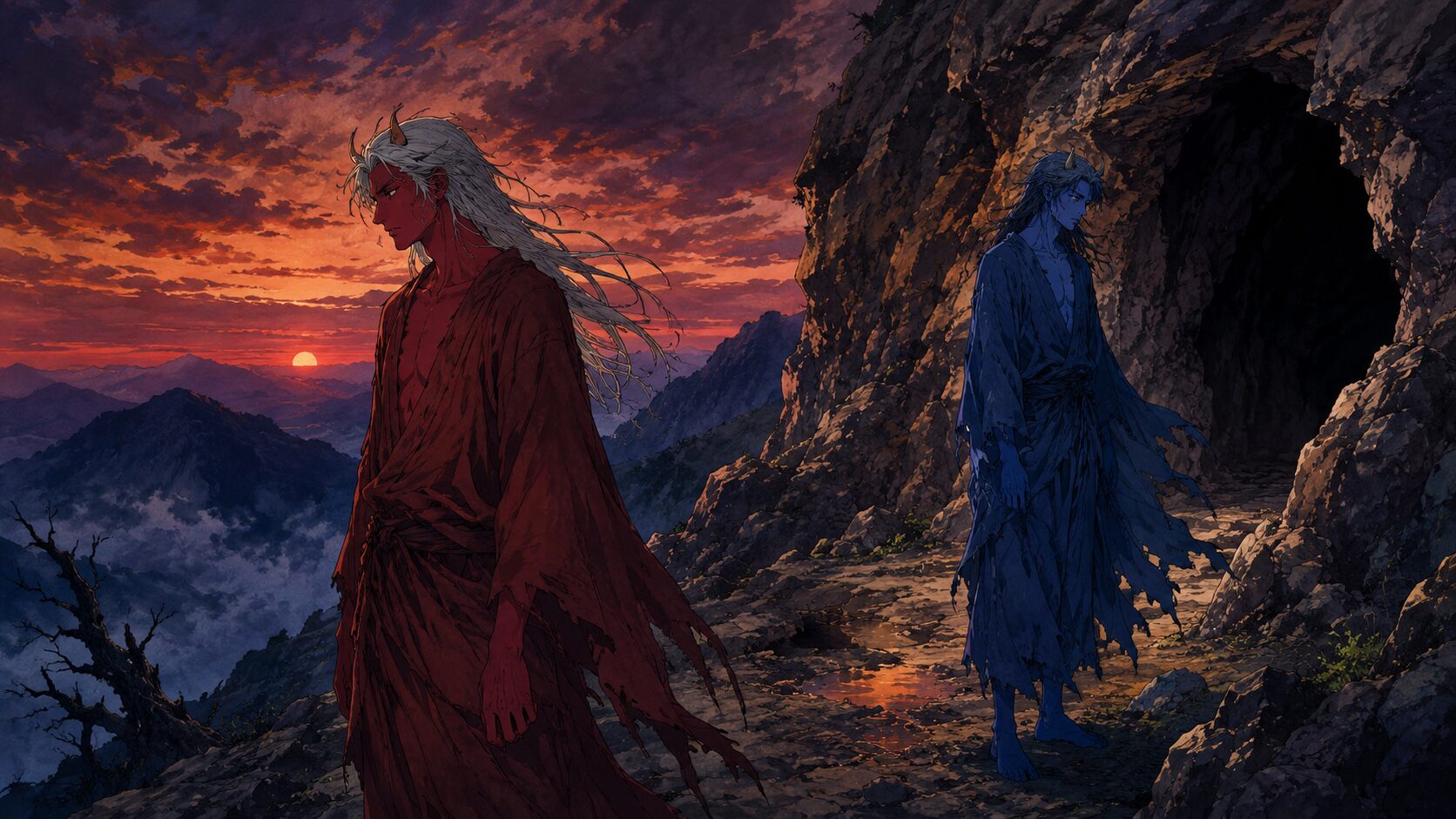
Come to think of it, is it not strange? The demons (oni) appearing in Japanese folktales and traditions are, for some reason, invariably red and blue. Green demons or white demons are rarely heard of. Red demon, blue demon. This pairing of two colors matches exactly the two colors that vanished from the surface among the five-colored peoples. Is this coincidence?
What, originally, are demons? In folklore studies, demons are taken as “dwellers of the otherworld” living deep in the mountains. People who live in mountains far from human settlements and occasionally come down to the village — those who do not submit. By one account, they are the figures of indigenous people who lived in the mountains in antiquity, people who did not submit to the rule of Yamato, handed down as demons. And it is precisely those “unsubmitting demons” who may have been the red people and blue people who vanished from the surface — there is such a view.
This view of “demons = unsubmitting people” has, in fact, long been argued in folklore studies. In the process by which the Yamato court unified the land, there were people who did not submit to its rule and were driven into mountains and frontiers. Tsuchigumo, Kuzu, Emishi — people recorded in the official histories as the unsubmitting, the people beyond civilization. They were often depicted as inhuman, monstrous beings. With horns, in a fearsome form. When the victors write history, those who were defeated and vanished into the mountains often become “demons.” If so, behind the traditions of the red demon and blue demon, the distant memory of people who certainly existed on this archipelago but were erased from the front stage of history may be folded in. To overlay those vanished people onto the red and blue of the five-colored peoples — there is a strange persuasiveness in this conception. Those erased from history, and the colors that vanished from the five-colored peoples. The two meet at a single point: the demon.
Step further and it becomes this. Where is the “otherworld” the demons are said to dwell in? The depths of the mountains, the passes, the caves. With those as boundaries, another world connected to this present world. In Buddhism, the place where demons are is the lowest layer of the six realms, the hells. The hells are at the bottom of the earth. That is, the demons come from underground.
The being that symbolically embodies this view is that “Namahage” handed down on the Oga Peninsula of Akita Prefecture. On the night of New Year’s Eve, monstrous beings wearing demon masks visit house after house. Shouting “Are there any bad children?” These Namahage are precisely the red demon and the blue demon, and in tradition they are marebito — visiting deities — who come from beyond the sea, or from the depths of the mountains. And there is a theory that reads these demons as the memory of underground people rising from the bottom of the earth. The indigenous people who lived in Japan’s mountains, the beings of the otherworld connected to the bottom of the earth. They have long survived within our folktales as the red and blue demons.
There is one more intriguing clue. The Mongolian spot.
Mongoloid babies, including the Japanese, are born with a bluish, bruise-like pigment appearing around the buttocks. It is that Mongolian spot, which fades away with growth. By one account, this is the last vestige of the “blue people” blood that once flowed within us. Only at the most innocent time, just after birth, a blue mark surfaces on the body and then vanishes. It is as if the body secretly remembers that we were descendants of the blue people. Scientifically, the Mongolian spot is an utterly ordinary physiological phenomenon, appearing blue because melanin pigment remains in the deep layer of the skin. But the urge to reread it as “the memory of the blue people” is, before the story of the five-colored peoples, not incomprehensible.
Even so, one thinks. If blue-people blood truly flows within us Japanese. If one color of the five-colored peoples, said to have vanished from the surface, surfaces blue on none other than our own bodies, only at the moment of birth. Then it is the surest proof that those who vanished to the bottom of the earth and we who remained on the surface are, in fact, divided siblings branched from the same root. The red and blue of the bottom of the earth, the yellow of the surface. Though the colors differ and the worlds they live in differ, trace them back and they are one. The story of the five-colored peoples, in the end, converges to the single point: “we are all, every one, originally one.”
Come this far, and one grand sketch faintly emerges.
And the conception of people vanished to the bottom of the earth is, in fact, not Japan’s alone. Around the world, traditions of dwellers in the underground world are distributed surprisingly widely. The “hollow earth theory” that a paradise exists at the bottom of the earth. The sacred underground kingdoms told of in the traditions of Tibet and India. The dwarves and fairies appearing in Norse and Celtic myth, dwelling underground or in mounds. East and West alike, humankind has imagined, again and again, that “at the bottom of the earth beneath our feet, there is another world.” Why have so many cultures spoken of the underground world in the same way? Is it a mere coincidence of fancy? Or, behind it, is there some shared memory? The story that the red and blue of the five-colored peoples descended to the bottom of the earth may connect, somewhere, with these underground traditions around the world. Thinking so, the tradition of a small shrine in the mountains of Kyushu suddenly connects to a mystery on a global scale.
In antiquity, the five-colored peoples were born in this land. Soon they scattered to the world, and yellow, white, and black took root in various places on the surface. But only the red people and blue people, for some reason, vanished from the surface and descended to the bottom of the earth. And there, at the bottom of the earth, they built a unique world and exist still. The figures of them appearing on the surface from time to time appeared to our ancestors as “demons,” and remained as the traditions of the red demon and the blue demon.
Of course, here it must be sincerely noted. This is not the origin that Heitate Jingu officially tells. That the five-colored peoples are recorded in the Takeuchi Documents is a fact, but the tale that those red people and blue people are underground people and demons is, rather than the Takeuchi Documents themselves, an “interpretation” assembled by later researchers and seekers of the occult, tying together various traditions. It is not academically verified history. Here, let us draw a firm line.
But — having drawn the line, one still thinks this.
Why are Japan’s demons red and blue? Why is it precisely those red and blue, among the five-colored peoples, that are not found on the surface? Why does a blue mark surface on our bodies only at the moment of birth? Each one is no more than a scattered legend or phenomenon. But when you tie them with a single line — “the red people and blue people are at the bottom of the earth” — everything begins, strangely, to resonate. There is no evidence. Yet what is this pleasantness of the resonance?
The story of the five-colored peoples now, at last, leaves the surface. The red and blue people said to have vanished to the bottom of the earth. The underground world they are said to have built. As for that door, in the deepest place of this story — Chapter Ten — we will at last open it. Until then, please do not forget this sense that “the red and blue are at the bottom of the earth.”
But before that, we must first return to the very source of the story of the five-colored peoples. That ancient document that is the source of all — the “Takeuchi Documents.” Said to be older than the Kiki, another grand myth utterly different from this country’s official history. In the next chapter, let us open the door to that sealed book.
Chapter 5 — The Takeuchi Documents and the Golden People: Another Myth and the Theory of Japanese Origins
Up to here, in the story surrounding Heitate Jingu, we have heard the name of one book again and again. The source of the five-colored peoples. Another myth, said to be older than the Kiki. At its source lie the “Takeuchi Documents.”
In this chapter, we at last open the door to that sealed book. But before that, there is one thing I want to promise. In this chapter, we first savor to the full the “world the Takeuchi Documents tell.” And on that basis, at the chapter’s end, we sincerely touch on the “other face” — how it is treated academically. The part of light, and the part of shadow. Only by seeing both does the true figure of this strange book rise up.
First, what are the Takeuchi Documents?
Their provenance is itself convoluted, like a story. A group of old documents, stones, iron swords, and the like, said to have been handed down for generations in the Takeuchi house of Isohara town (present-day Kitaibaraki City), Ibaraki Prefecture. They are collectively called the Takeuchi Documents. The one who made them public was a man named Takeuchi Kiyomaro. In 1911 he established the Kosokotai Shrine in Isohara town and founded a religion called Amatsukyo. And in 1928 (Showa 3), he revealed the existence of this group of documents to the world.
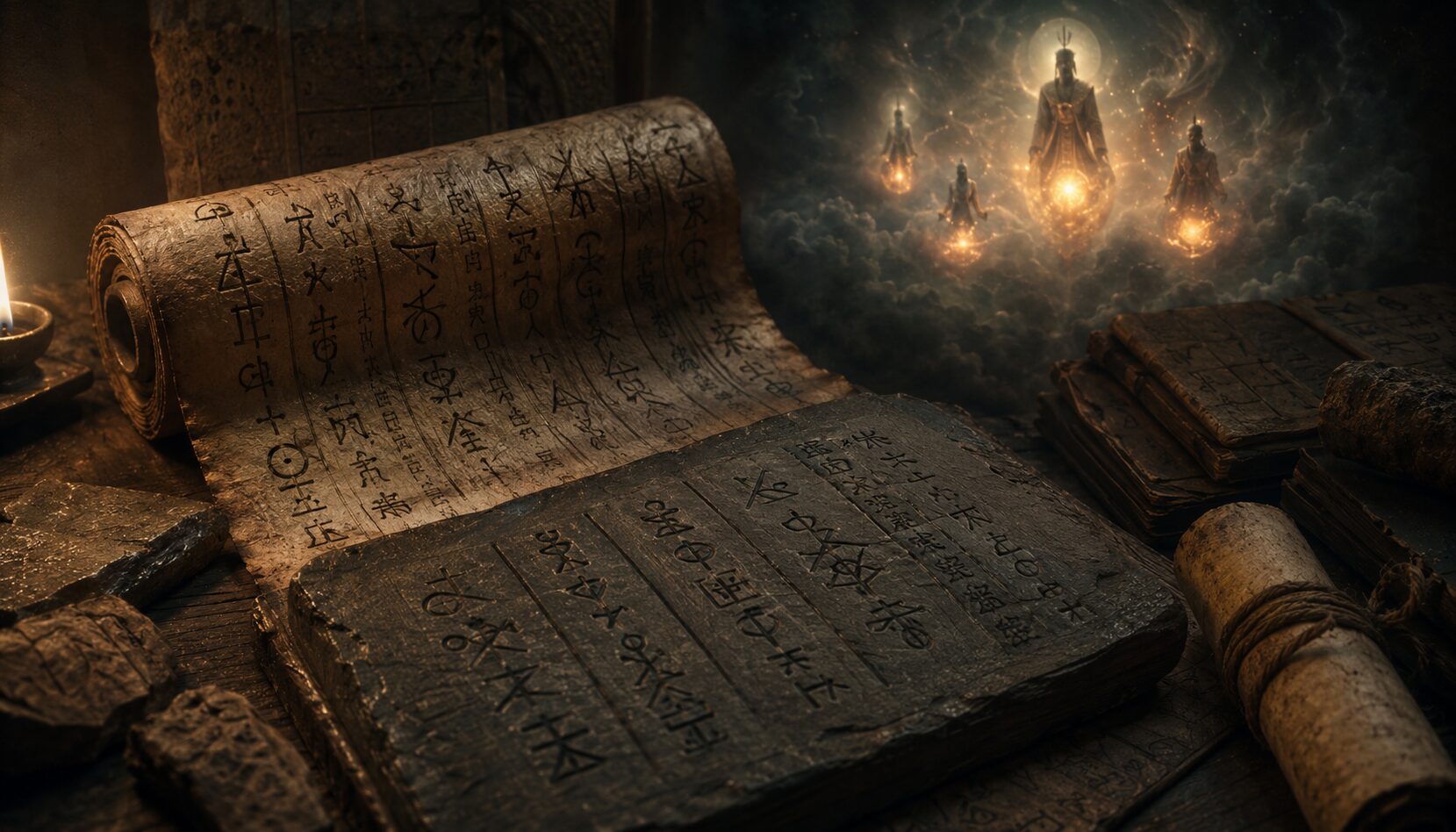
The provenance the Takeuchi Documents claim is grander still. According to it, the originals were written in jindai-moji — characters said to have been used in ancient Japan long before kanji arrived. Receiving the imperial command of the twenty-fifth emperor, Emperor Buretsu, Heguri-no-Matori, a grandson of Takenouchi-no-Sukune, translated them into sentences mixing kanji and katakana. The Takeuchi house is said to be a lineage connected to this Heguri-no-Matori. There were originals in jindai-moji, the ancient court had them translated, and a particular house secretly guarded and handed them down — such an utterly secret-tradition provenance.
This “jindai-moji” too harbors a great mystery in itself. Generally, the established view is that Japan had no native characters until kanji arrived. But in the world of ancient documents, ancient Japan before kanji is said to have had a unique writing system. Moreover, believers in the Takeuchi Documents go so far as to claim that this jindai-moji was the “origin” of all the world’s characters — later Egyptian hieroglyphs, Hebrew, Hangul, the alphabet, and so on. That all the world’s characters derived from Japan’s jindai-moji — this too is an expression of the thick single thought running through the Takeuchi Documents: “Japan is the source of world civilization.” Even characters, then, spread from Japan to the world.
So what does its content tell?
What the Takeuchi Documents depict is a world history utterly different from the Japanese history we learned in school. There, from a staggering antiquity, Japan had emperors. And, far before Emperor Jimmu, super-ancient emperors continuing for generation after generation are said to have ruled the world. More astonishingly, it is even recorded that the founders of the world’s religions — Moses, Christ, Shakyamuni, Confucius — all visited Japan, received teaching from the emperors, and even served them. That is, in the world of the Takeuchi Documents, Japan is the very center of world civilization, and humankind’s civilization and religion all began from this Japan and spread to the world.
It is staggering. So staggering you may laugh. For example, regarding the Takeuchi Documents, there is even a startling tale that Christ did not in fact die on Golgotha but crossed to Japan and lived out his natural life in the land of Aomori. There actually is a place in a certain village of Aomori Prefecture said to be “the grave of Christ,” and the Takeuchi Documents are said to have been the trigger for its discovery. Moses too is said to have come to Japan and trained. It is the height of absurdity. But here, recall the core thought of Heitate Jingu we have seen in the chapters so far. The source is one. The world’s humankind was born from a single place and scattered to the world. The Takeuchi Documents’ claim that “Japan was the source of world civilization” resonates splendidly with this worldview of Heitate Jingu. And in fact, the story of the five-colored peoples handed down at Heitate Jingu is firmly positioned within this worldview of the Takeuchi Documents.
And there is something not to be overlooked. This claim of the Takeuchi Documents — that the world’s religious figures came to Japan — casts a shadow on Heitate Jingu itself. The “Mask of Moses” among the Five-Color Sacred Masks, touched on briefly in a previous chapter, and the “Water Jewel,” a treasure of the Jews said to be handed down in the grounds. Why does Moses, the prophet of the Old Testament, connect to a shrine in the mountains of Kyushu? It is one manifestation of the grand worldview the Takeuchi Documents depict — “the world’s holy figures visited Japan.” As for this story of the Water Jewel and Moses, we will pursue it carefully again in a later chapter. The Takeuchi Documents thus cast their grand shadow over every corner of Heitate Jingu.
Here, let us delve into another myth associated with Heitate Jingu.
The Japanese myth we know — the story of the Kojiki and Nihon Shoki — begins this way. The two deities Izanagi and Izanami give birth to the land; soon Amaterasu-omikami is born; there is the descent of the heavenly grandson, when her grandson Ninigi descends to earth; and further, his descendant is enthroned as the first emperor, Jimmu. This is the story of this country’s beginning as told by the official history.
Yet Heitate Jingu hands down another Takamagahara myth, distinct from this. It is a story from far older than Izanagi and Izanami. Two deities called Kamurogi-no-mikoto and Kamuromi-no-mikoto are said to have descended to this land riding on a ball of fire. The “gods riding on a ball of fire” who descended to the treetop of the sacred tree, touched on in Chapter Two, are precisely these two deities.
And here is the core. These two deities gave birth to the “yellow people” — that is, the Japanese — the original humankind. And those yellow people spread to various places across the world, and influenced by the climate and weather of each land, derived into the red, blue, white, and black peoples. That is, humankind was born in this land of Heitate and scattered from here to the world. This is the land where humankind originated.
Gods descending riding on a ball of fire. To this depiction, we moderns are apt to overlay something else. A craft emitting light, flying in cleaving the sky and alighting on the earth. — A spaceship. It is no wonder there are those who read the “ball of fire” the Takeuchi Documents tell of as a visitor from space who flew here in antiquity. The gods “came down” from heaven. Was that heaven the sky, or the far reaches of the cosmos? The words of myth still endlessly stir our imagination.
Now, the yellow people, the origin of the five-colored peoples, were said to be the Japanese. But the world of the Takeuchi Documents introduces a being one step beyond.
The Golden People (kinjin, or koganebito).
According to the Takeuchi Documents, the Japanese are not mere yellow people. They are said to be descendants of the “Golden People” who transcend the five-colored peoples. The further origin of the five colors. The very center of the source of all humankind. That is the Golden People, and the Japanese are said to be their direct descendants. By one account, the imperial house of Japan is said to be a being carrying the legitimate blood of these Golden People.
Come this far, and we must turn our eyes to the danger this thought holds. The claim that “the Japanese are the center of the world and the most noble” can, one step wrong, tip into a dangerous chosen-people thinking, an ethnocentrism. In fact, the Takeuchi Documents have a history of being lifted up, in a certain period before the war, by ultranationalist people as a “book of glad tidings” backing Japan’s superiority. The world’s civilization all began from Japan — that story was, in the atmosphere of the times, exploited by a certain kind of ideology. This point should be clearly remembered as the part of shadow of the Takeuchi Documents.
Yet what is intriguing here is that the five-colored-peoples thought of Heitate Jingu avoids that danger at an exquisite point. Certainly, the Japan-as-source claim of “Golden People = Japanese” is included. But what the Five-Color Sacred Masks enshrine is not only the Japanese. They enshrine the ancestral deities of all the colors — red, white, yellow, black, blue — equally. And what is prayed for is not the victory of a particular people but the “harmony” of all humankind. Even if the source is in Japan, the five-colored peoples branched from it are all equal siblings — the center of gravity of the story of the five-colored peoples is placed on the side of harmony, not superiority. While drawing on the same Takeuchi Documents, Heitate Jingu sublimates its thought toward not chosen-people thinking but a prayer for the common root of humankind.
— Now. Up to here, we have seen to the full the world the Takeuchi Documents “tell.” Gods riding on a ball of fire, the yellow people, the Golden People, Japan as the land of humankind’s origin. A grand story, full of romance.
But, as promised, in closing I must touch on the other face.
The Takeuchi Documents are, academically, regarded as a “forgery.” This is a fact that must be clearly written. Researchers, for many reasons, judge them to have been made in modern times — from Meiji through Showa. The words and writing style used in the sentences are too new for something of antiquity. The provenance is unclear. The content recorded contradicts established history and archaeological knowledge in every respect. What is said to be the original was confiscated by the authorities in the prewar suppression, then said to have been lost in the Tokyo air raids, and does not exist now. Even to verify it, there is no actual object left to confirm.
About this “suppression” too, let me touch. The story of super-ancient emperors the Takeuchi Documents tell was regarded as dangerous by the prewar state as something profaning the sanctity of the imperial house. In the 1930s, Takeuchi Kiyomaro and the Kosokotai Shrine were charged with crimes such as lèse-majesté and suppressed by the authorities, and about four thousand items of the Takeuchi Documents, including divine treasures, were confiscated. Kiyomaro is said to have finally won acquittal in court, but the confiscated items were never returned and were said to be lost to war damage. Ironically, a book that maximally exalted Japan as “Japan is the center of the world” was suppressed by Japan’s own state. This twisted history too is part of the extraordinary provenance of the thing called the Takeuchi Documents. Even in a world-authoritative encyclopedia, the Takeuchi Documents are clearly cited as “an example that became a topic under the billing of a history book predating the Kojiki, but was later proven to be a modern forgery.”
That is, the grand story the Takeuchi Documents tell — that “Japan was the source of world civilization” — is, as historical fact, not recognized. This is a conclusion to be sincerely accepted.
Then do the Takeuchi Documents have no value at all? That is not so, I think.
Even if not historical fact, the Takeuchi Documents are one grand “book of dreams” spun out by the modern Japanese. Why did the people of this age need so great a story? Why did they want to tell that all the world’s humankind was originally one, that Japan was its source? Projected there, deeply, are the urgent wishes, anxieties, and pride of people who lived the modern age. That it is a forgery and that it strikes the human heart do not contradict. Precisely because it is not fact, the human wish of “may it be so” may be crystallized there in an all the more pure form.
And above all — the real sacred place called Heitate Jingu continues to exist quietly in the mountains even now, bearing this worldview of the Takeuchi Documents. Once every five years, the Five-Color Sacred Masks are opened, people gather from all over the world, and they pray for harmony. That scene is a reality that certainly exists, whether the Takeuchi Documents are a forgery or not. Whether a story is fact and whether that story holds the power to move people are separate questions.
Having opened the door of the Takeuchi Documents, we have reached as far as the Golden People. The source of all, the being said to be the center of all. But Heitate Jingu enshrines another deity, staggering, that resonates even with this thought of the Golden People. The parent deity of all things. The deity said to be involved in the creation of the cosmos itself. Let us look at the name of that deity in the next chapter.
Chapter 6 — Ohotonochi-Ohokami: The Parent Deity of All Things, Enshrined Only Here
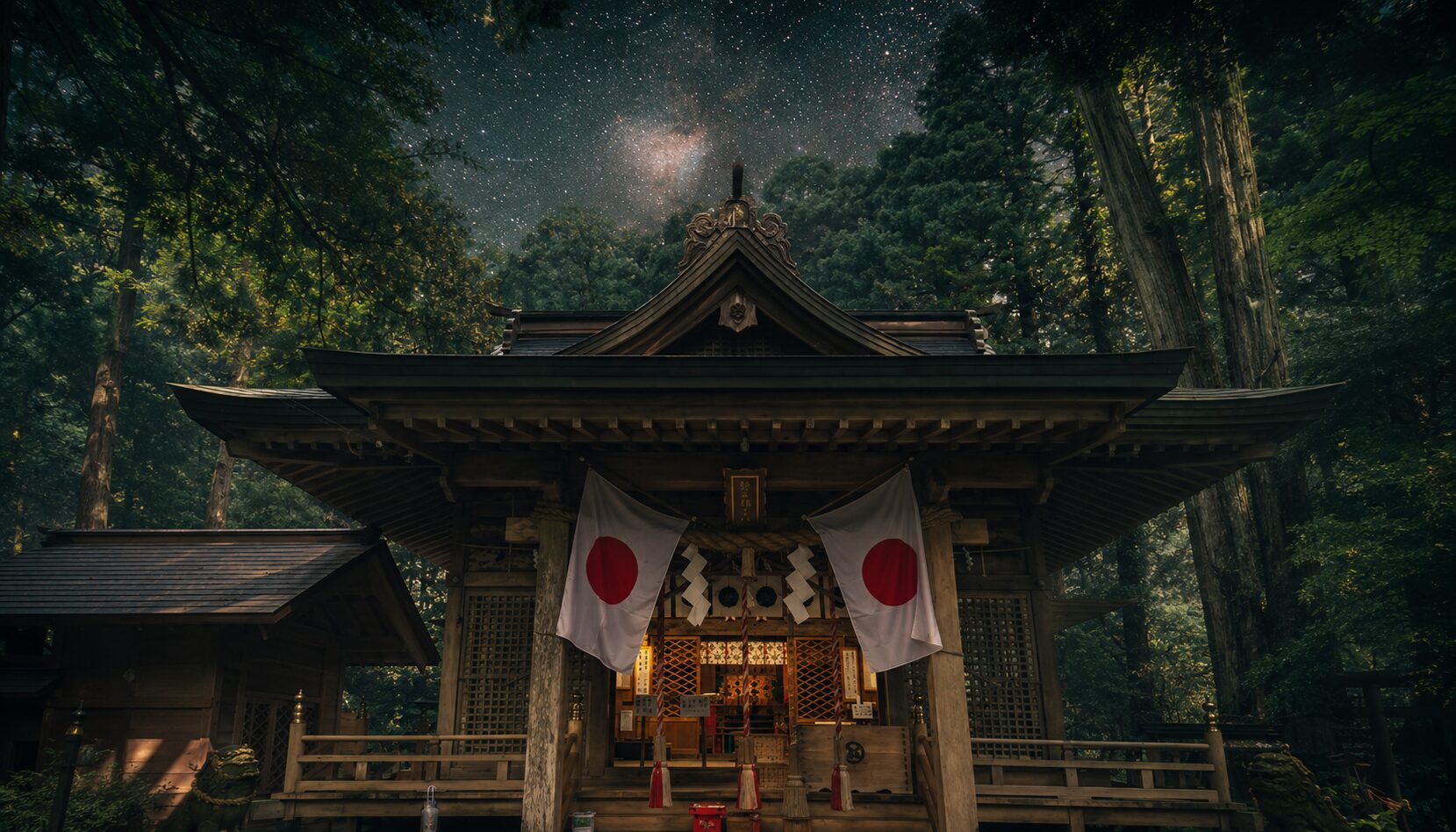
When we worship at a shrine, we usually do not much mind what god is enshrined there. We join our hands, bow our heads, and put our wishes into it. Few people bother to confirm exactly which deity that partner is.
But when you confirm the names of the deities enshrined at Heitate Jingu, one by one, at a certain stage you are seized by a strange sensation, as if your spine straightens. For what is enshrined here is no ordinary group of deities. It is the cosmos itself. The parent of all things. The beings at the very root from which heaven and earth are born.
Let us list the principal deities of Heitate Jingu in order. Kamurogi-no-mikoto, Kamuromi-no-mikoto, Ohotonochi-Ohokami (the Great Cosmic Yamato Deity), Ame-no-Minakanushi-no-kami, Amaterasu-omikami. These five are the central deities. Further, many deities are jointly enshrined, beginning with the twelve bright deities of Aso.
Seeing this lineup, the more one knows about Shinto, the more one may tilt one’s head. It is too far beyond the standard. Ordinarily, the deities a shrine enshrines have a certain “division of roles.” The god of the sea, the god of the mountains, the god of commerce, the god of learning. Or a particular hero or ancestor enshrined as a god. That is the general figure of a shrine. But the deities of Heitate Jingu far leap over such individual roles. Amaterasu-omikami, the supreme deity of Japanese myth. Even she is, here, one of five, in a position near the “lowest seat,” so to speak. And above that Amaterasu-omikami, the deity of the cosmos itself sits firmly enthroned.
The name of that deity is Ohotonochi-Ohokami (written “Great Cosmic Yamato Deity”).
It is read “Ohotonochi.” An unfamiliar name, surely. And no wonder, for this deity is said to be enshrined at only one shrine in Japan, this Heitate Jingu — an exceedingly singular divinity.
What is Ohotonochi-Ohokami? According to what the shrine hands down, it is the “parent deity of all things.” The cosmos itself. And a being symbolizing the sense of oneness with all natural things, including humans. Neither sea nor mountain, nor a deity governing some particular thing. The root of roots, giving birth to all and embracing all. The very words “Great Cosmic” and “Yamato (Harmony)” that compose its name already tell of this deity’s staggering scale. The great harmony of the great cosmos. That is the essence of this deity.
Read this divine name aloud and you notice something interesting. “Ohotonochi.” Written “Great Cosmic Yamato,” it is read this way. It is a reading that, by ordinary readings, would never emerge. The staggering concept of “cosmos,” and “harmony” — a thoroughly Japanese concept meaning concord and accord. These two are joined within a single divine name. The essence of the cosmos is not opposition or chaos but “harmony” — this divine name seems to declare so. The thought of “harmony” of the five-colored peoples, appearing again and again in the chapters so far. When it is expanded to the scale of the cosmos, it becomes the name Ohotonochi-Ohokami. The harmony of humankind and the harmony of the cosmos. The two are manifestations of the same single truth, changed in size.
Survey the world’s religions and the conception of making such a “root of all things” a god is by no means rare. The one god of Judaism and Christianity created the world from nothing. In Indian thought, Brahman, the fundamental principle of the cosmos, is the root of all things. In Chinese Taoism, the “Tao” that gives birth to all things was spoken of. East and West alike, humankind has, at the end of the question “where did everything come from,” found a single root. Ohotonochi-Ohokami too is one of Japan’s answers to that question. Only, into that answer is deeply tinged the color of “harmony,” unique to this country. The root of all is neither a fighting god nor a judging god, but a harmonizing god.
Consider. The navel of Kyushu, a small shrine in the mountains. A hidden shrine where no tour buses come, appearing in no guidebook. In its main hall, the deity embodying the cosmos itself is enshrined, the only one in Japan. In this imbalance, in the greatness of this disproportion, lies the unfathomable depth of Heitate Jingu. In a small vessel, the cosmos is held whole. That kind of sensation.
Why, of all places, this place? Why is it this shrine in the mountains of Kyushu, not Ise nor Izumo, that became the only land enshrining the parent deity of all things? That question resonates deeply with everything we have seen in the chapters so far — the life-lineage of fifteen thousand years, the origin of the five-colored peoples, the source of humankind the Takeuchi Documents tell. Because this is the source of all. Because it is the land of beginning where the world’s humankind was born and scattered to the world. If so, that the deity of the cosmos itself is enshrined in that land is, rather, perhaps only natural. In the land of the source, there is the deity of the source.
Following Ohotonochi-Ohokami, there is one more deity worthy of note. Ame-no-Minakanushi-no-kami.
The name of this deity will ring a bell for those familiar with Japanese myth. At the opening of the Kojiki, when heaven and earth first parted, the deity who first appeared in Takamagahara. That is Ame-no-Minakanushi-no-kami. Positioned at the center of the cosmos, a deity governing harmony and integration. In Japanese myth, the very first deity, the root deity. In Shinto, the first three deities including this Ame-no-Minakanushi-no-kami are called the “three creation deities,” regarded as the source of the power giving birth to all things.
Let me touch a little more on these three creation deities. According to the Kojiki, at the beginning of heaven and earth, the deities who came into being in Takamagahara were three: Ame-no-Minakanushi-no-kami, Takamimusuhi-no-kami, and Kamimusuhi-no-kami. What is intriguing is that these three deities are recorded as having “hidden themselves” as soon as they appeared. That is, they do not come out on the front stage of myth. What moves the story is Izanagi and Izanami, born much later, and Amaterasu-omikami and the rest. The three creation deities are depicted, so to speak, as an unseen root power waiting in the depths of the stage. Giving birth to all, yet not showing themselves. This very character of “hidden root” is what makes Ame-no-Minakanushi-no-kami an unfathomable deity. And that hidden root deity is, at Heitate Jingu, clearly enshrined as a central deity. The deity hidden in the depths of myth is, here, out in front. That alone conveys the extraordinary character of this shrine.
That most ancient root deity of Japanese myth too is enshrined here at Heitate Jingu. Ohotonochi-Ohokami, the deity of the cosmos itself, and Ame-no-Minakanushi-no-kami, the deity of the center of the cosmos. By the very fact that these two are enshrined side by side, it conveys how deeply this shrine is involved with “root,” “center,” “beginning.”
And Kamurogi-no-mikoto and Kamuromi-no-mikoto, whom I listed first of the five. These two deities too are no ordinary beings. As we saw in the previous chapter, in the world of the Takeuchi Documents, these two deities are the very gods who descended riding on a ball of fire and gave birth to the original humankind, the yellow people. Intriguingly, the names Kamurogi and Kamuromi do not appear in the Kojiki or Nihon Shoki as the names of specific deities. By one account, this does not point to a single deity but is a word bundling together all the imperial ancestral deities, from the three creation deities including Ame-no-Minakanushi-no-kami down to Amaterasu-omikami. That is, the collective name of the root deities. Here too, the motif of “the root of all” rises up again and again.
Surveying the deities of Heitate Jingu this way, one grand structure emerges. At the outermost, Ohotonochi-Ohokami, the cosmos itself. Within it, Ame-no-Minakanushi-no-kami, the center of the cosmos. Further, Kamurogi and Kamuromi, bundling the root deities. And Amaterasu-omikami, supreme deity of Japanese myth. It is as if a single shrine holds whole, nested, everything from the formation of the cosmos to the beginning of Japan. From the center of the cosmos to the deity of the sun. From macro to micro. This shrine folds the entire hierarchy of existence into its main hall.
And to these grand deities, the twelve bright deities of Aso are jointly enshrined at Heitate Jingu. Local deities of the land of Aso, beginning with Takeiwatatsu. Here lies another depth of this shrine. The supremely abstract and enormous divinity of “the cosmos itself,” and the deities rooted in the concrete land of Aso, close to daily life. Both poles coexist, without strain, within a single shrine. The deity of the cosmos far away in the heavens, and the deity of the earth beneath one’s feet. The universal and the indigenous. In the joining of hands of these two lies the unique generosity of Japanese Shinto. However grand the cosmology it tells, its feet are firmly planted in the earth of Aso. Not flying off into the conceptual alone, but tied to the land. Precisely because of this, the cosmology of this shrine does not become empty fantasy, and may remain in the heart of the visitor as a firm response.
The deity of the cosmos, and the deity of the land. The root deity, and the deity of daily life. Heitate Jingu enshrines both, without distinction. This may be said to be one extreme form of the generous layered nature unique to Japanese Shinto, which holds the eight million deities. It contrasts with monotheism, which gathers all under the one absolute god. Here, the deity of the cosmos, the deity of the sun, and the deity of the land all coexist in a single place, each keeping its position. It is precisely, as with the five-colored peoples, the practice at the level of the deities of the thought that different things coexist in harmony, not in opposition.
Here, one great question arises.
Why were so many deities gathered into this one shrine?
One view is this. Since Heitate Jingu calls itself “Japan’s oldest,” “the land of humankind’s origin,” “Takamagahara,” the deities enshrined there must, of course, be deities tracing back to the root of the cosmos and humankind. A grand origin befits grand deities. So the deity of the cosmos itself is enshrined — that is one view.
But there is another view. The order is reversed, it says. That is, it is not that they enshrined the deity of the cosmos because a grand origin was later attached, but that, precisely because this land was originally a special place connected to the root of the cosmos, the ancient people found and enshrined here the deity of the cosmos itself. Which is correct, there is no way to confirm. But the fact that many people who actually stood in this land feel, beyond reason, “there is something here,” gives a strange reality to the latter view.
Ohotonochi-Ohokami. The parent deity of all things. The cosmos itself. Before this deity, we may recover a certain sense we usually forget. The sense that our own small existence is, in fact, a part of the great whole of the cosmos. As a single drop of seawater is, in essence, the same as the sea itself, each one of us is a small fragment divided from the great whole of Ohotonochi-Ohokami.
And this sense of “all things divided from the great whole” shares its root with the thought of the five-colored peoples we have seen again and again. Humankind was originally one. The five colors branched from a single source. Ohotonochi-Ohokami may be the ultimate expression of that “single source,” pushed out to the scale of the cosmos. All things are born from a single great harmony and will someday return to that harmony. The deities of Heitate Jingu quietly point to that grand circle.
Having joined our hands for a while before the main hall enshrining the deity of the cosmos, we now, at last, head toward another face of this sacred place. Leaving the shrine on the surface, we descend from behind the main hall into the forest. There is a mysterious pond where a dragon god sleeps. In the next chapter, we step into the most hidden sanctuary of this shrine — the Higashi-Mitarai Shrine and the Pond of the Water Jewel.
Chapter 7 — Higashi-Mitarai Shrine and the Sacred Water: The Dragon’s Pond and the Shrine of the Watershed
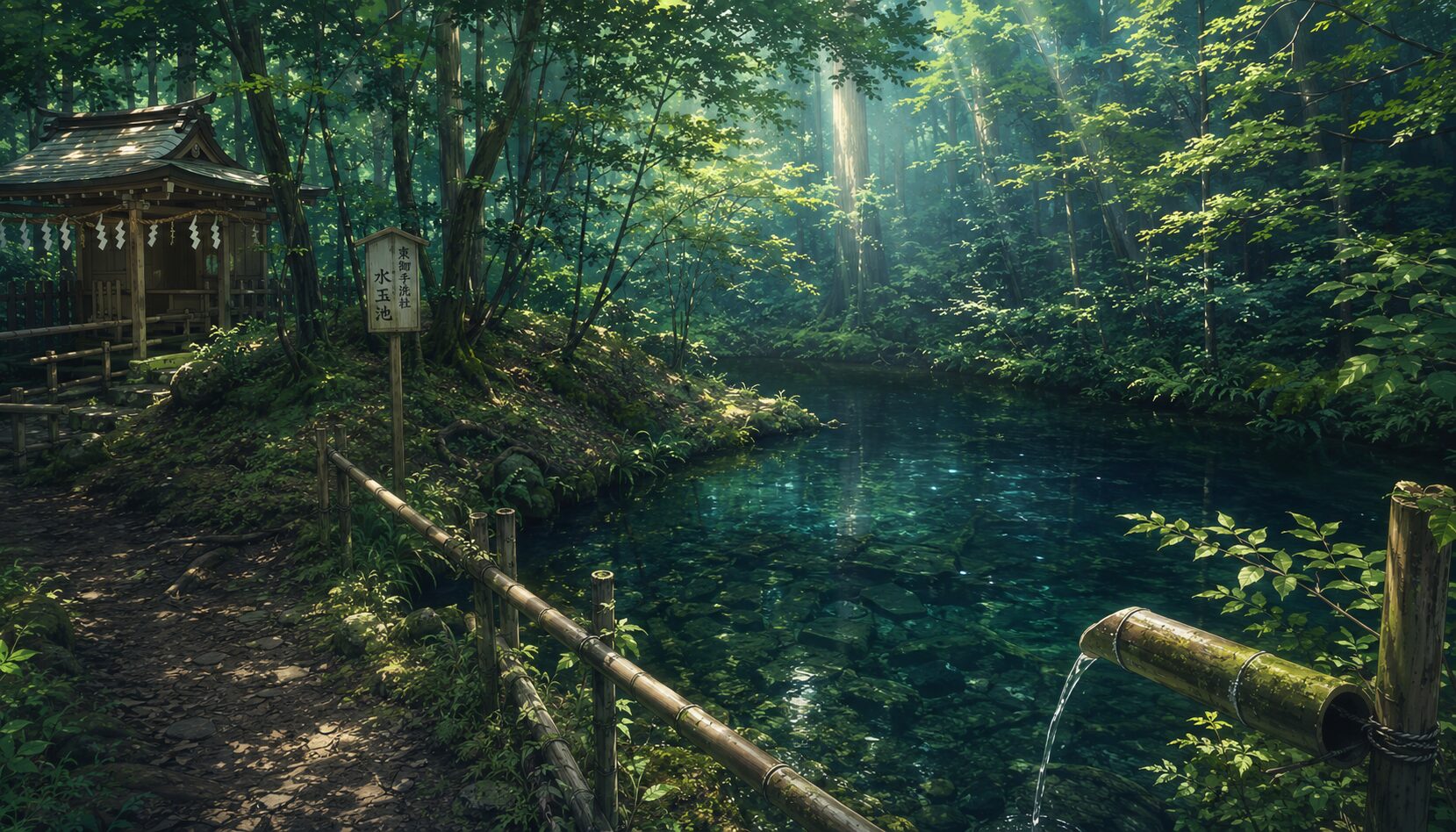
Up to here, we have seen the “surface” of Heitate Jingu. The shrine tradition of Takeiwatatsu, the sacred tree of fifteen thousand years, the Five-Color Sacred Masks, the Takeuchi Documents, and the deity of the cosmos itself. The main hall rising on the surface, and the grand story put into it. But the true depth of this shrine does not, in fact, end with the shrine on the surface.
After joining your hands at the main hall, go around to its west side. Then a single torii stands quietly at the entrance to the forest. Beyond it, the air is utterly different from the bright grounds until now. Beyond the torii, into a dense cedar grove, a narrow mountain path continues down, down.
From here is the other face of Heitate Jingu.
Pass through the torii and begin descending that mountain path. The path is narrow, steep, and after rain it grows muddy. It is a genuine mountain trail, impossible in high heels. From both sides giant cedars press in, the sky overhead is covered by branches and leaves, and the light is scarce. As you descend, the number of worshippers dwindles. Most people go home having merely worshipped at the main hall. Only those who know what lies at the end of this steep descent, and still set foot upon it, walk this path. With each step, the world changes. From the bright shrine of “heaven” to the dark, damp sanctuary of “earth.” We are, literally, descending.
How far must one go down? The end is not in sight. Perhaps about two hundred meters down. Soon, the view suddenly opens.
There, a pond.
It is a quiet pond called the “Mizutama-ike” (Pond of the Water Jewel), or the “Pond of Water Jewels.” At the bottom of the mountain valley, surrounded by trees, its surface holds something quietly, yet deeply. And it is in this pond that a dragon dwells.
According to tradition, in this Pond of the Water Jewel, the Eight Great Dragon Kings are calmed. The Eight Great Dragon Kings are guardian deities of Buddhism, the kings of dragons governing water and rain. Eight great dragon deities appearing even in the Lotus Sutra. The eight dragon kings, beginning with Nanda and Upananda, are known as beings attending the place where Shakyamuni preached the Law, guarding the Buddhist teaching. Those dragon kings are said to sleep coiled at the bottom of this mountain-valley pond. Stand at the pond’s edge and, beneath the stillness of the water’s surface, the presence of something vast certainly seems to lie. To those who can see, it is seen; to those who can feel, it is felt. Even if you see nothing, the taut air of this place surely reaches the skin of anyone.
Even so, why a dragon? Among the world’s cultures, no spirit-beast is so deeply tied to water as the dragon. Its coiling figure recalls swirling water currents. Take to the sky, and it calls rain clouds and looses lightning. The meandering of rivers, the waves of the sea, have all been overlaid on the dragon’s movements. In East Asia, the dragon is the incarnation of the water cycle itself, and for agricultural people it was the most important divinity bringing rain. In drought they begged rain; in long rains they prayed for it to subside. The partner of that prayer was the dragon. The tradition that a dragon dwells in the Pond of the Water Jewel of Heitate Jingu tells, more eloquently than anything, that this land is a sacred place deeply bound to the power of water.
And to this sanctuary, one fearsome taboo is handed down.
To violate this pond, to violate this sanctuary, causes a typhoon — so it is said.
A pond where the dragon god governing water sleeps. Violate it, and the dragon grows angry and calls a storm. A typhoon, the vast calamity of water and wind. This is no mere threatening legend. Awe of the dragon who rules water, a fundamental dread of the power of nature, is put into this taboo. Since ancient times, the Japanese have revered the dragon as the god of water. It sends down rain, makes rivers flow, and at times swallows people in floods. Water is a blessing and, at the same time, a calamity. The incarnation of that ambivalent power is the dragon. This taboo, that one must not violate the pond, is an expression of awe, from antiquity, toward the power of water that is beyond human hands. Do not wantonly disturb it. If you step in, do so with awe, quietly.
In this Higashi-Mitarai Shrine, together with the Eight Great Dragon Kings, Hokushin-Myoken-Ohkami is also enshrined. Hokushin is the North Star. The unmoving star sitting at the center of the heavens, around which all stars revolve. The dragon god of the bottom of the earth and the star god of the center of the heavens. Here too, heaven and earth are joined in a single sanctuary.
And in this sanctuary, there is one more treasure. Water.
In fact, in the very word “mitarai” of this shrine’s name, the sanctity of water is already engraved. Mitarai is the place at a shrine where, before worship, one rinses the hands and mouth and purifies the body. To come before a god, one must first wash away impurity. This act of purifying the body with water is called “misogi” in Shinto. In Japanese myth too, Izanagi, returning from the land of the dead, performed misogi at a river, and at that time the deities, beginning with Amaterasu-omikami, were born. To purify with water is not merely to remove dirt, but the fundamental act of giving birth to new life and sanctity. Higashi-Mitarai Shrine is the very sanctuary governing that “water of purification.” The pond where the dragon god is calmed, and the water of purification. The theme of water folds over itself, layer upon layer, at this place.
Beside Higashi-Mitarai Shrine, from the tip of a bamboo pipe drawn from the water source, pure spring water flows out, gushing. It is the sacred water. Worshippers receive this water here. Many people bring empty plastic bottles to fill and carry home. Water gushing from beside a pond where the dragon god is calmed, deep in the mountains. There can hardly be water more precious than this. However, when drawing this water, restraint is asked. The rule of this sanctuary is, basically, about one plastic bottle per person. One must not monopolize the dragon god’s blessing. It is something to be shared.
But this sacred water has one strange legend.
There are two spring openings. Two bamboo pipes as well. And — the water from the left and right pipes is said to differ in taste.
Water gushing from the same mountain, the same sanctuary. Two spring openings right beside each other. And yet, one side and the other differ in taste. People who have actually compared them say so with one voice. It is hard to believe at first. But this sacred water differing in taste left and right has long been handed down as one of the seven wonders of Heitate Jingu. Why does the taste differ? Are the underground water veins different? Or is a separate meaning put into each of the two waters? Nothing can be said for certain. But if you visit, do hold both in your mouth and confirm the difference with your own tongue.
To this sacred water clings an even older tradition.
The imperial grandson Nigihayahi-no-mikoto — or, as also handed down, Ninigi-no-mikoto — is said to have used the sacred water of this Pond of the Water Jewel to purify all of Japan as he traveled. Sacred water that purifies the land. A grand tradition that water gushing from this land purified all of Japan. Water gushing from the navel of Kyushu reached the whole country and dispelled impurity. Here too, Heitate Jingu quietly tells the consistent story that “this land is the source of all.”
By the way, the name “Higashi-Mitarai (East Mitarai)” calls up a question. If there is an east, is there no west? — There is. A little apart from Heitate Jingu, the “Nishi-Mitarai Shrine (West Mitarai),” also called Nishi-Suijin-gu, sits quietly enshrined. While the eastern Mitarai bustles with the dragon god and worshippers, the western Mitarai stands quietly, blending into the surrounding scenery, known to almost no one. East and west, two Mitarai. This paired arrangement may be no coincidence.
Here, the fact that this shrine sits upon a “watershed” takes on weight. A watershed is the ridge that forms the boundary where fallen rain divides and flows in different directions — east and west, or otherwise. Heitate Jingu stands almost at the center of Kyushu, exactly at the dividing point where water separates east and west. A single drop of rain fallen here will, by a slight difference in terrain, take an utterly different course — some water to the eastern sea, some to the western sea. Arising at the same single point, dividing, reaching different seas.
Does this not resemble something?
Yes — the five-colored peoples. The five-colored peoples, born from a single source, divided and scattered to various places in the world. In this shrine of the watershed, even water falls from a single sky, lands on a single earth, then divides and departs for separate seas. The place called Heitate Jingu embodies, as terrain, the very fundamental thought of this shrine — “the source is one, and from there divided to the world.” The east and west Mitarai, the water dividing east and west. This land is not merely a sacred place rich in water. It is a sacred place that shows, in visible form as the flow of water, the cosmic principle that “the one divides.”
Furthermore, there is a tale about this water not to be overlooked. At the edge of the Pond of the Water Jewel is a sacred field called the “Yukiden.” It is a sacred rice field, raised drawing this water of Higashi-Mitarai. According to tradition, the “Sukiden” that was originally at Nishi-Mitarai was moved to this land of Higashi-Mitarai. And the rice-planting festival performed at that time is said to have become the basis of the Daijosai. The Daijosai is one of the most important and sacred rites of Shinto, performed only once, at an emperor’s enthronement. Newly harvested rice is offered to the gods, and the emperor himself partakes of it — a rite involving the very foundation of the state. The origin of that Daijosai is said to lie at the edge of this dragon god’s pond in the mountains of Kyushu. Beyond whether it is fact, what this tradition seeks to tell is clear. This land is also the source of the most sacred rite of the imperial house. The source of all. Here too, that theme is repeated.
From the shrine of heaven to the pond of earth. We have descended, leaving the bright main hall, all the way to the dark waterside where the dragon god sleeps. And we notice. This shrine holds, together, the story of the surface and another story flowing like an underground vein. There is a front, and a back. A heaven, and an earth. Light, and darkness. And that very motion of “descending” already points to the direction this whole story ultimately heads.
Come to think of it, we have, in this shrine, been “descending” all along. The gods who descended from heaven riding on a ball of fire. From the star at the center of the heavens to the shrine on the surface. And from the main hall to the dragon god’s pond two hundred meters below. Down, down, down again. That the sacred descends from heaven is the manner of telling in many myths. But at Heitate Jingu, that “descending” vector does not stop at the surface. It crosses the shrine, crosses the surface of the earth, and tries to head further below. The dragon god’s pond is one landing along the way, like a stair-landing. As water seeps from there further to the low places, to the bottom of the earth, our journey too will eventually head below the surface — to the world of the bottom of the earth.
For water flows to the low places. To the bottom of the earth, further to the bottom. And in the underground world where the dragon is said to dwell, in the depths where the water veins run — there waits, mouth agape, another vast mystery we will come to face. Those red and blue people, whom I told you in Chapters Three and Four to keep in your heart. The world of those said to have vanished from the surface and descended to the bottom of the earth lies further in the depths of these water veins.
But before that. The sacred water gushing in this dragon god’s pond, and the “red mask = Mask of Moses” of the Five-Color Sacred Masks, and the “Water Jewel,” a treasure of the Jews said to be handed down in the grounds. Water, and again water. Why is this shrine so full of water traditions? In the next chapter, pulling the thread of that water, we connect to an unexpected place — the distant Middle East, the world of ancient Judah.
Chapter 8 — The Gate to the Underground Empire: Agartha, Shambhala, and the Five-Color People
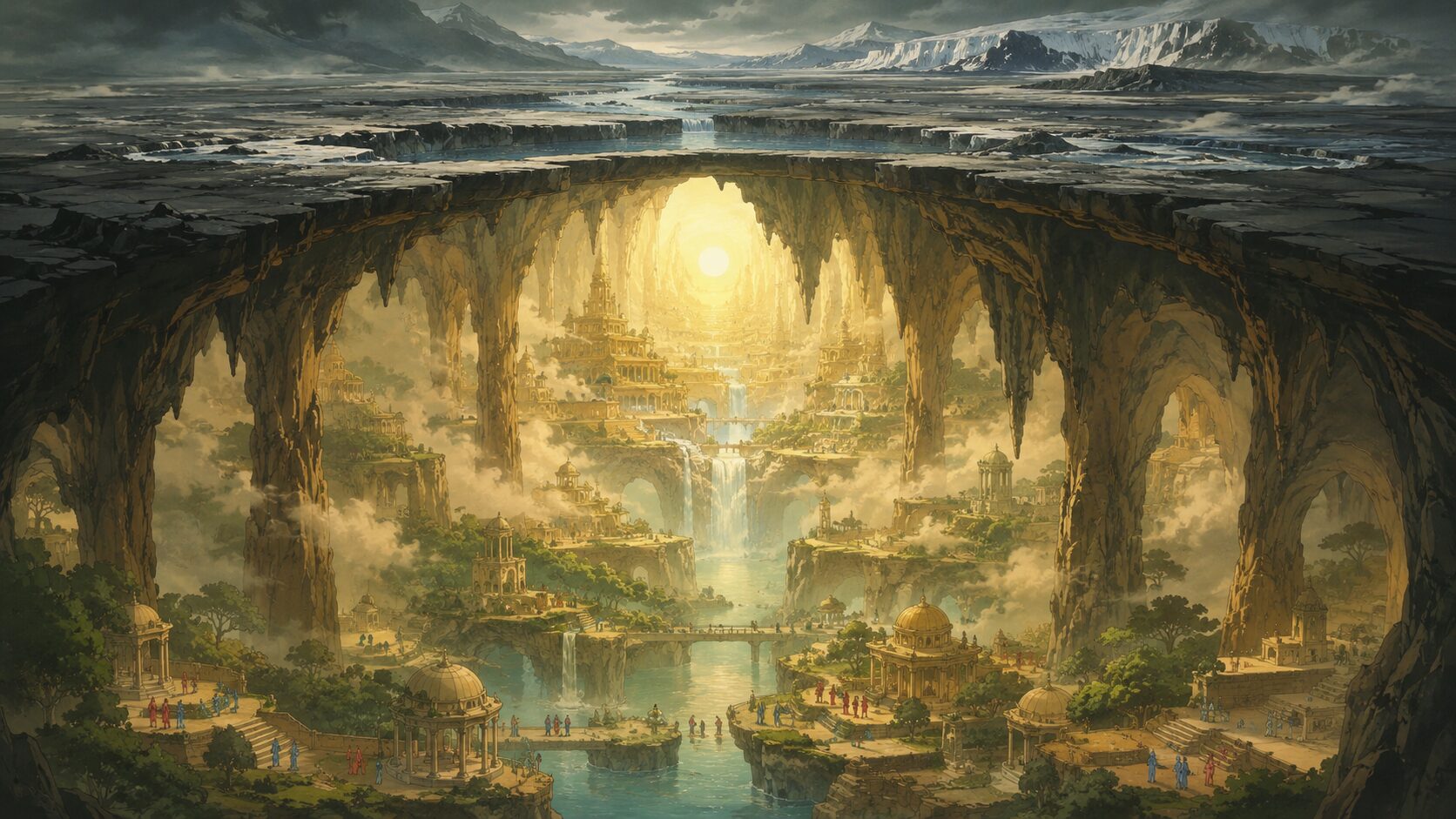
Up to here, we have made a long journey. We looked up at the sacred tree of fifteen thousand years, stood before the Five-Color Sacred Masks, traced the grand world of the Takeuchi Documents, joined our hands before the deity of the cosmos itself, and descended two hundred meters to the pond where the dragon god sleeps. Here and there along that path, we have walked with one question stuck in our hearts like a small thorn.
Where did the red and blue vanish to?
Of the five-colored peoples, the three — white, yellow, black — still live on the surface. But only the two, the red people and the blue people, are nowhere to be found on the actual surface. In Chapter Three I posed this discomfort, and in Chapter Four touched on one bold answer. Could they have vanished from the surface and descended to the bottom of the earth? The red demon and blue demon, the Namahage, and the blue Mongolian spot that surfaces on our bodies only at birth. Are these all faint memories of the red and blue people who vanished to the bottom of the earth?
In this chapter, we at last open the door to that “bottom of the earth.”
However, here a firm line must be drawn. What follows is by no means the origin Heitate Jingu officially hands down. In the shrine tradition, in the origins of the deities, none of what follows appears at all. What we step into from here is the domain called super-ancient history, the occult, urban legend. There is no academic backing anywhere. But — the moment we step into this domain, the foreshadowing we have laid out so far ties together into a single line, strangely. Please witness that scene. This is not a tale of “fact.” It is a tale of “story.” And an excellent story can, at times, pierce the truth of the human heart more deeply than fact.
Then let us open the door. The name of the underground empire is — Agartha, and Shambhala.
The world has long held this kind of tradition. Far below this earth on which we stand. The interior of the earth is in fact a hollow cavity, where an inner world emitting a sun-like light spreads, and people who built a high civilization live there even now. This is called the “hollow earth theory.” It sounds absurd. In fact, modern science completely denies this theory. The earth’s interior is a layered structure of inner core, outer core, mantle, and crust, and there is no cavity. That is the unshakable conclusion of science. This point I record sincerely and clearly.
But even though science denies it, this story of the underground world has, in human imagination, never vanished. Rather, East and West alike, it has been handed down surprisingly widely and deeply.
In the traditions of Buddhism and Hinduism, the underground paradise is called “Agartha,” and a secret entrance is said to lie in the mountains of Tibet. In Central Asia, the same underground paradise has been known by the name “Shambhala.” Shambhala means “stillness” in Sanskrit and “source of happiness” in Tibetan. The name may be unfamiliar, but say its alias “Shangri-La” and you have surely heard of it as a byword for paradise. A paradise of eternity hidden at the bottom of the earth. Chosen sages dwell there, and even if the surface is struck by war or calamity, that place alone keeps prospering quietly. That is Agartha and Shambhala.
This tradition of an underground kingdom captivated many people even in modern times. In 1920, the Polish explorer Ossendowski introduced the underground paradise Agartha in his travelogue. The French mystic thinker René Guénon discussed, in his book The King of the World, the legend of the underground kingdom Agartha continuing from Shambhala. Trace back further and, at the end of the nineteenth century, Saint-Yves d’Alveydre conveyed its existence to the world. And astonishingly, in the myths of various places around the world, descriptions remain — several of them — that entrances to this Agartha are scattered across the surface, from South America to the polar regions.
It was not only mystic thinkers and explorers who were possessed by this legend. Those in power who shook history also earnestly sought the underground paradise and the super-ancient wisdom and power said to sleep there. Especially famous is Nazi Germany. Adolf Hitler and a faction around him who leaned into the occult are said to have sent expedition teams to Tibet and earnestly sought the reality of Shambhala and Agartha, and the hidden power — called “Vril power” and the like — said to sleep there. Those who plotted world conquest tried to find the key to their ambition in the kingdom at the bottom of the earth. The fact that the legend of the underground empire nearly moved real history, not stopping at mere fancy, tells of the unfathomable gravity this story holds. At the bottom of the earth, there is “something” capable of changing the world — many humans believed so.
Around the world, traditions about the underground abound. Beneath Japan’s feet too, there are some. For example, in the myth of the ancient Ainu, a gigantic amemasu (fish) is said to dwell underground, and when it rages an earthquake occurs. At the bottom of the earth, something gigantic lies. When it moves, the earth shakes. — Does this not resonate deeply with the taboo of the Pond of the Water Jewel of Heitate Jingu, the tradition that “violating the dragon god’s pond causes a typhoon”? A gigantic existence at the bottom of the earth. Anger it, and disaster occurs. People around the world have sensed, in the ground beneath their feet, the presence of something that conceals a fearsome power.
Here and there in the world, there are entrances.
— If so. What if one of those entrances was in this Japan, on this navel of Kyushu?
Here, the thorn stuck in our hearts begins to ache.
At the bottom of the earth, there are people who built a civilization and live on. Even when the surface grows turbulent, they keep living there quietly. — Is this not exactly like that theory we saw in Chapter Four? The red people and blue people, said to have vanished from the surface and descended to the bottom of the earth. The story that they built a unique world at the bottom of the earth and exist there still.
In fact, among those who explore super-ancient history, there is a view that firmly ties these two together. The whole of the five-colored humankind was once on the surface. But at some point, a great cataclysm — for example, a great destruction like the Flood of Noah the Old Testament tells of — struck the surface. At that time, the red people and blue people fled the muddy flood, descended to the bottom of the earth, and survived. And at the bottom of the earth, they built up a paradise inheriting super-ancient wisdom. — That is Agartha, and Shambhala. The yellow, white, and black people who remained on the surface eventually forgot their underground brethren, and handed them down merely as “demons,” within the memory of dread.
When this story is assembled, everything we have seen so far ties into a single line. The mystery of the five-colored peoples. The absence of red and blue. The red demon and blue demon. The Namahage. The Mongolian spot. And the underground kingdom Agartha and Shambhala. The scattered points begin to draw a single constellation. The surface story of the five-colored peoples was continuous with the story of the underground empire at the bottom of the earth.
Let us imagine, just a little, that underground paradise. While the surface was sealed by glaciers, or swallowed by a great flood, at the bottom of the earth an inner sun cast its faint light, and a warm atmosphere drifted. The red-skinned people and blue-skinned people, guarding the wisdom inherited from super-antiquity, live quietly, without conflict. While their brethren on the surface spend their days in war and calamity, they simply exist in harmony. — If such a world truly spreads beneath our feet. And if they still keep the “harmony” we who remained on the surface have lost, then the red and blue of the bottom of the earth may, perhaps, be another ourselves, quietly embodying at the bottom of the earth the ideal figure we surface humankind have lost sight of. The world of “harmony” the Five-Color Sacred Masks pray for may already be realized at the bottom of the earth.
And here, recall. That we, in this shrine, have been “descending” all along. The gods who descended from heaven riding on a ball of fire. The pond where the dragon god sleeps, two hundred meters below the main hall. Water flows to the low places, to the bottom of the earth. The sacred place called Heitate Jingu, in its very structure, contained from the start a vector heading from the surface to the underground. Beneath the shrine on the surface, there is the dragon god’s pond. Then, below the dragon god’s pond — ? At the end of that question, the underground empire stands with its mouth open. The bottom of the earth where the dragon is said to dwell. The depths where the water veins run. There the world of the red and blue people driven from the surface spreads — when you think so, the “descending” structure of this shrine rises up as a grand metaphor for the entrance to the underground-empire legend.
Further, there is one more thread. The continent of Mu.
Mu, the mother super-ancient civilization said to have sunk into the Pacific, touched on in Chapter Two. When that Mu sank into the sea in a great cataclysm, where did the survivors go? By one account, they too fled to the bottom of the earth and became part of Agartha. And the continent of Mu has long been told of as deeply tied to Japan, geographically and culturally. The thought of Heitate Jingu that “Japan is the source of humankind,” the continent of Mu, and the underground kingdom Agartha. These are woven together by a single thread, the five-colored peoples — loosely, yet surely.
To repeat, all of these are not verified facts. The hollow earth theory is clearly denied by science. Both Agartha and Shambhala are tradition, myth, products of imagination. Nor is the chief priest of Heitate Jingu officially telling this, by any means. Let me make this clear.
But — even so, one is tempted to ask.
Why did people around the world dream of a paradise at the bottom of the earth? Why are Japan’s demons precisely the red and blue that vanished from the five-colored peoples? Why does this shrine have so thoroughly a “descending” structure? Each one may be an unrelated coincidence. But when you tie them with the single point of “underground empire,” the world fits, all too beautifully, all too orderly, into a single story. At that too-tidy correspondence, we cannot help but feel a chill.
It may not be fact. But human imagination, for some reason, dreams the same dream again and again. The dream that, at the bottom of the earth, there is another world. The dream that lost brethren live on there. The universality of that dream may, perhaps, speak something deeper for humans than fact.
And there is one more thing not to be overlooked. What the act of “descending to the bottom of the earth” has, from antiquity, symbolized. In myth, the hero often descends to the underground world. He visits the land of the dead, passes through trials, gains something, and returns to the surface again. Izanagi too descended to the land of the dead. The heroes of Greece too visited the netherworld. To descend to the bottom of the earth was, at once, to journey an outer geography and a symbol of plunging into the deepest place of one’s own heart. From surface consciousness to the bottom of the unconscious darkness. There, one meets something forgotten, something sealed away. That Agartha and Shambhala still captivate many people even today, handed down in the world of meditation and spirituality, may be because they are not mere geographical places but another name for the depths within ourselves. The gate to the underground empire may, perhaps, open within our own hearts.
We have opened the door of the underground empire. And in its depths, we have glimpsed the paradise of the red and blue people driven from the surface. But the threads of the story surrounding Heitate Jingu do not remain at the bottom of the earth alone. In the next chapter — the “red mask = Mask of Moses” of the Five-Color Sacred Masks, and the “Water Jewel,” a treasure of the Jews said to be handed down in the grounds. Let us head toward that strange intersection where a shrine in the mountains of Kyushu somehow crosses with the distant Middle East, the world of ancient Judah. The story that “the source is one” extends its thread even beyond the bottom of the earth, to the far side of the globe.
Chapter 9 — The Shadow of Moses and Judah: The Intersection of the Japanese-Jewish Common Ancestry Theory
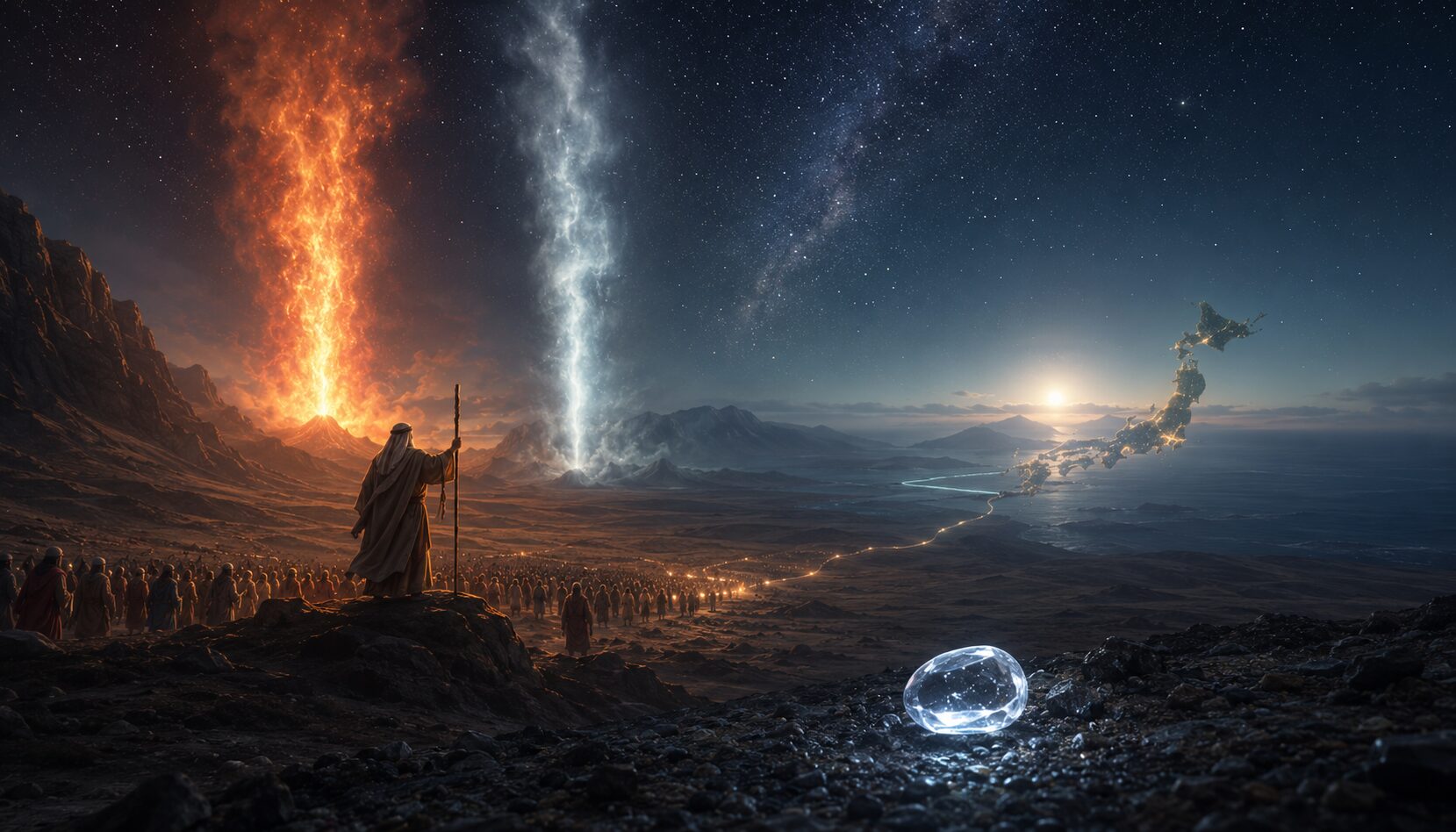
In the chapters so far, in the story surrounding Heitate Jingu, we have several times placed a strange phrase like foreshadowing. The red mask of the Five-Color Sacred Masks is the “Mask of Moses.” In the grounds is handed down a treasure of the Jews, the “Water Jewel.”
A hidden shrine in the mountains of Kyushu, appearing in no guidebook. Why does Moses of the Old Testament appear there? Why was a treasure of ancient Judah brought all the way from the Middle East to this land? Turning from the previous chapter that descended to the bottom of the earth, in this chapter our journey leaps far sideways — to the far side of the globe, the world of the distant Middle East, ancient Israel. And that distant world and this navel of Kyushu are tied by a single thin thread.
First, a disclaimer. What follows, like the previous chapter, is not the official origin of Heitate Jingu. Nor is it academically recognized history. This is tradition, hypothesis, a story in the domain of romance. On that premise, however, let us pull the thread that, strangely, will not stop captivating people.
The tale returns to the Five-Color Sacred Masks.
As we saw in Chapter Three, the Five-Color Sacred Masks are masks of humankind’s ancestral deities, painted in five colors: red, white, yellow, black, blue. And about that red mask, an astonishing tradition is told. This red mask is, of all things, the Mask of Moses, it is said.
Moses. The great prophet appearing in the Old Testament’s “Exodus.” Receiving God’s command, he led the Jewish people who had been made slaves in Egypt and escaped, split the sea to let the people cross, and received the Ten Commandments on Mount Sinai — one of the greatest heroes of the Bible, common to Judaism, Christianity, and Islam. Why is the face of that Moses among the treasures of a shrine in Kyushu?
It is easy to laugh off this tradition as a mere notion. But here is one anecdote not easily laughed away.
In 1998, a Fukuoka television station produced a special program titled “What Did Ancient People Leave Behind?” In it, the Five-Color Sacred Masks were taken up. The program carried photographs of the Five-Color Sacred Masks and flew all the way to Israel. And it visited a certain authoritative professor of Jewish history at the Hebrew University. The reporter showed the photographs of the five masks and asked, “Is Moses’s face among these? Which do you think is Moses?”
Then the professor, without hesitation, pointed to one mask.
It was — the red mask.
The very red mask handed down at Heitate Jingu as the “Mask of Moses” was pointed to as Moses, with no prior knowledge, by a specialist in Jewish history. Coincidence? The probability of choosing one of five is one in five. By no means low. But when you think about why that professor chose red, what he saw in that mask, it seems a shame to dismiss it with the single word “coincidence.” Moreover, this professor was a bona fide eminent scholar of Jewish history, also known for Japan studies. It was not an amateur’s wild guess. The eye of a specialist who had long gazed at the history and faces of the Jews chose red, without hesitation, from among the five masks. The cool response that fact carries is hard to ignore.
Of course, it was an event on the staged setting of a television program. To what extent it was rigorous verification, and from where it was program embellishment, the boundary is now impossible to confirm. But that such an anecdote is handed down at all tells of the unfathomable gravity of the existence called the Five-Color Sacred Masks.
And the other treasure. The “Water Jewel.”
According to tradition, this Water Jewel is a small, transparent stone. And tracing its origin, it leads straight to the story of Moses and the Exodus. In the Old Testament’s Exodus, it is recorded thus. When the Jewish people escaped Egypt, by night a “pillar of fire” and by day a “pillar of cloud” appeared, lighting and guiding the people’s path. Tied to this mysterious light that guided the people, what Moses is said to have held is this “Water Jewel.”
So how did that Water Jewel come to Japan? Tradition tells it this way. In 722 BC, the ancient Kingdom of Israel was destroyed by the Assyrian Empire. At that time, the ten tribes of Israel that went missing — the so-called “Lost Ten Tribes.” A part of them, at the end of a long, long journey, headed far to the east, and at last reached as far as Kyushu in Japan. And the treasure they carried was this Water Jewel — so it is said.
This “Lost Ten Tribes” is one of world history’s greatest romances, lying between history and legend. Ancient Israel was originally composed of twelve tribes. Of these, the ten tribes that composed the northern Kingdom of Israel vanish abruptly from the historical record with the conquest by Assyria. Where did they go? Around the world, peoples claiming “we are the descendants of the Lost Ten Tribes,” and traditions tracing their footsteps, remain dotted here and there. In Africa, in India, in Central Asia. And the terminus at the eastern end, often named, is — Japan. The end of the earth, the land of the rising sun. The promised land they reached at the end of their wandering was this island country of the Far East. It is a grand, and somehow sorrowful, story.
Here, at last, one great thought reveals itself. The “Japanese-Jewish Common Ancestry Theory.”
The Japanese-Jewish Common Ancestry Theory holds that the Japanese and the ancient Jews — especially that “Lost Ten Tribes” — share, traced back, a common ancestor, or have a deep relationship. This theory is by no means new. As far back as the seventeenth century, its bud appeared, and in the Meiji period, the Scotsman Nicholas McLeod, who came to Japan, systematically compiled the similarities between Japan and ancient Judah, said to be the first in the world to advocate the Japanese-Jewish Common Ancestry Theory. Citing the resemblance of the floats of the Gion Festival to the Jewish portable shrine, the common points between Japan’s old customs and Jewish rites, and many other correspondences, he claimed the ancestors of the Japanese came from Israel.
Thereafter too, the Japanese-Jewish Common Ancestry Theory has been handed down, changing form. That Japanese and Hebrew have many words alike in pronunciation and meaning. That the shape of shrine torii recalls the Jewish Passover custom. That the portable shrine resembles the Jewish “Ark of the Covenant.” That the lanterns of Ise Shrine show a pattern resembling the Star of David. — Count them up and the correspondences are surprisingly many.
Let me look at a little concrete detail. For example, the small black box “tokin” that mountain ascetics wear on their foreheads is pointed out to closely resemble the small box “tefillin” that Jews wear on their foreheads when praying. The figure of carrying the portable shrine in a festival recalls the scene of the Jewish people carrying the Ark of the Covenant, it is said. Some even claim that festival shout-words like “Yaaren, Soran,” and even the lyrics of “Kimigayo,” make sense as Hebrew. The manner of purifying the hands and rinsing the mouth at a shrine. The custom of purifying with salt. These too are said to connect with Jewish purification rites. Take each one up, and there are not a few that make one nod, “I see.” Are all these correspondences coincidence? — The urge to ask is well understandable. Precisely because of this, this theory has continued to captivate people for over a hundred years.
However, here it must be made clear. The Japanese-Jewish Common Ancestry Theory is, in the present academic world, treated as a popular myth — a kind of so-called “crackpot theory.” The advocate McLeod himself is sometimes evaluated as a careless figure who tied everything to the Lost Ten Tribes. Linguistically, and genetically, no firm evidence backing the claim that Japanese and ancient Jews share an ancestor has been found. The many “correspondences” too, examined coolly, are mostly seen as coincidental matches or forced connections. This is a conclusion that should be sincerely recorded.
But — even so, for some reason, this theory will not stop captivating people.
Why? For one thing, because this theory resonates all too well with the fundamental thought of Heitate Jingu we have seen. The source is one. The world’s humankind was born from a single place and scattered to the world. The Japanese-Jewish Common Ancestry Theory comes to look, so to speak, like the “empirical edition” of that grand story. Japan and Judah. The eastern end of the earth, and the Middle East. If these two peoples, so far apart, truly branched from a single source, then the story of the five-colored peoples was not mere myth but real history. The Mask of Moses and the Water Jewel are its immovable proof — so the argument goes.
And there is one more correspondence not to be overlooked. Recall. The classification of the five-colored peoples we saw in Chapter Four. Who were the red people? — They were spoken of as Jews, Native Americans, Arabs, and the like. That is, within the story of the five-colored peoples, the red people were, from the start, a color tied to Judah. Precisely because of this, that the “red mask” of the Five-Color Sacred Masks is made the “Mask of Moses” is by no means abrupt. Red = Judah = Moses. This chain was, from the start, built into the system of the five-colored peoples. Recall further, those red people were also the color said to have vanished from the surface and descended to the bottom of the earth. The red people who vanished to the underground Agartha, and the Jews who drifted from the Middle East to Japan. Over the same “red,” the thread to the bottom of the earth and the thread to the far side of the globe cross here. Within the small color-system of the five, the underground empire and ancient Judah are all folded. At the splendor of that design, one can only groan.
And here, recall the Takeuchi Documents of Chapter Five. The Takeuchi Documents told that the world’s holy figures, such as Moses and Christ, all visited Japan and served the emperors. The tradition of Heitate Jingu that Moses came to Japan is precisely one manifestation of this worldview of the Takeuchi Documents. The world’s holy figures gathered in Japan. The world’s peoples take Japan as their source. Among them was Moses of Judah. — The Takeuchi Documents, the five-colored peoples, the Japanese-Jewish Common Ancestry Theory, the Mask of Moses, the Water Jewel. These, though separate traditions, are firmly bundled by the single thick thought of “Japan is the source of all.”
Come this far, we notice one thing.
The story surrounding Heitate Jingu is by no means closed within the frame of Japan. It extends vertically to the bottom of the earth (Agartha), and at the same time extends horizontally to the far side of the globe (Judah). Up, down, sideways. In every direction, it extends its threads. For what this shrine tells is not “the story of Japan” but “the story of all humankind.” The whole of the world’s humankind was born here and scattered to the world. If so, this land is connected to the story of any people of the world, to the hero of any scripture, as a matter of course. Moses, Judah, are no more than one thread of that grand story.
To repeat, these are not verified facts. The Japanese-Jewish Common Ancestry Theory is regarded as a popular myth, and neither the Mask of Moses nor the Water Jewel is academically backed historical fact. But the very fact that, at a small shrine in the mountains of Kyushu, a red mask is quietly called “Moses,” and a transparent stone is handed down as a “treasure of the Jews” — that fact itself certainly exists there. Whether a story is fact, and the fact that the story has been handed down across over a thousand years, are separate things.
To the bottom of the earth, to the far side of the globe. Our journey has extended its threads around the world, centered on Heitate Jingu. But come this far, a certain question surely rises clearly in everyone’s heart. — Is this true? Or is it a grand fabrication? Fifteen thousand years, the five-colored peoples, the Takeuchi Documents, the underground empire, Moses. How should we receive these? In the next chapter, we face that question head-on. Hoax, or real. Tradition, and scholarship. Let us dare to stand on that stinging boundary line.
Chapter 10 — Zero Magnetic Field and Strange Experiences: The Testimony of Those Who Visited
In the chapters so far, we have traced the grand “story” surrounding Heitate Jingu. The life-lineage of fifteen thousand years, the five-colored peoples, the Takeuchi Documents, the underground empire, Moses. These were tales within documents and traditions — stories “savored with the head,” so to speak.
But this shrine has another face. Something that the visitor, beyond reason and documents, directly “feels” with the body. In this chapter, we step into that domain of bodily sensation. To the many strange testimonies people who actually visited this land speak of with one voice.
First, what must be told is the “zero magnetic field.”
Heitate Jingu stands directly upon a gigantic fault running the length of the Japanese archipelago. The Median Tectonic Line. It is one of Japan’s largest fault zones, running through Kyushu, Shikoku, and the Kii Peninsula, extending to the Kanto region. Upon this Median Tectonic Line, for some reason, ancient sacred places are lined up here and there. Ise Shrine, Suwa Taisha, Bungui Pass — renowned power spots are strung along this single line. And Heitate Jingu too is no exception.
Let us think about this a little. The Median Tectonic Line is a gigantic geological scar carved into the Japanese archipelago for over a hundred million years. Upon that line stands Ise Shrine, the pinnacle of Japan’s shrines. Stands Suwa Taisha, a shrine of very, very old faith. Bungui Pass in Nagano is, in recent years, visited by many people seeking healing as a “sacred place of the zero magnetic field.” Mount Koya in Wakayama, Tenkawa Shrine in Nara, and others are said to be near this line too. Is this coincidence? Or did the ancient people sense, with their bodies, some special power running along this fault in the earth, and fix those places as sacred? Geology and faith. Two things that seem to have no relation cross strangely upon this single line. The fact that Heitate Jingu is the “navel of Kyushu” and at the same time a point upon this sacred line running through the archipelago gives the specialness of this shrine yet another depth.
The vicinity of this Median Tectonic Line is sometimes called a “zero magnetic field.” What is a zero magnetic field? Simply put, it is a special place where the S pole and N pole, two opposing magnetic forces, balance and collide just so, canceling each other, so that magnetism is absent or extremely unstable. In such places, the needle of a compass is said not to point north but to waver, unsettled, and keep trembling. And there is a view that the earth’s energy concentrates in such places.
Here, there is something I want to record sincerely. The way of saying “Heitate Jingu is a zero magnetic field” is widely circulated, but about this the chief priest himself speaks very honestly. “There is no place where the magnetic field becomes completely zero percent.” That is, it is not, literally, a place where magnetism is completely zero. But at the same time, the priest also acknowledges that the magnetic field of this land is “special.” Not a complete zero. But it is certainly something different from an ordinary place. — In this honest, undogmatic way of speaking, can we not, rather, place trust? Not declaring exaggeratedly “this is a miraculous zero magnetic field,” but telling it as it is — “not a complete zero, but special.” That sincerity suits the bearing of this shrine well.
Let us set aside scientific rigor for the moment. What matters is, rather, the fact that many people who stood in this land “feel” something, not by reason.
In the East, there has long been the idea of “ki.” Invisible, yet filling heaven and earth, and flowing in the human body too — the energy of life. Qigong, acupuncture, and feng shui all stand upon this thought of “ki.” The relatively new words zero magnetic field and power spot may, pressed to the core, be a modern rephrasing of this sense of “ki.” Places have places where ki fills and places where it stagnates. Stand in a place of good ki, and body and mind are set in order. — Such a sense is old wisdom humankind has shared since before science. The “something” people feel at Heitate Jingu, grasped through this old Eastern concept of “ki,” has parts that fall neatly into place. Especially, the area of Higashi-Mitarai Shrine, two hundred meters down from the main hall. Many people say the area around the Pond of the Water Jewel where the dragon god sleeps is, among the grounds, especially thick with “ki.” Water, green, and stillness. Descend there, and the air feels incomparably deeper, heavier, they say. If you visit this land, do descend not only to the main hall but to this Higashi-Mitarai Shrine. Between the shrine on the surface and the sanctuary at the back, what can be felt is surely utterly different.
What do those who visited speak of?
Most often heard is the sense that “the air changes.” The moment they pass through the torii and set foot on the approach of dense cedar groves, the quality of the air clearly changes from before, they say. Cool, and yet somehow warm. Taut, yet the heart loosens. They cannot put it into words well, but the skin notices first, “this place is different.” Such testimonies are surprisingly many.
Next most often heard are experiences around “sound.” The cries of birds, the sound of wind crossing the trees, sound different from usual, as if special. Or, suddenly, the surroundings fall utterly still. That stillness is so deep the ears ache. Within the rustling of the forest, suddenly some great silence visits. Some say they were present for such a moment.
And, the “sense of returning to the origin.” This is an impressive testimony unique to Heitate Jingu. Stand in this land, and for some reason you are wrapped in a deep relief, as if you have come home to your “very place of beginning,” they say. The reason is unknown. Though you should be visiting for the first time, it is terribly nostalgic. As if, long ago, you had been here. — In this place spoken of as the land of humankind’s origin, the source of all, that people feel a “sense of returning to the origin” seems too good a correspondence, yet in fact people who feel so are endless.
Some speak of even more dramatic experiences. The body shuddered. Tears overflowed for no reason. The palms grew hot and tingling. The core of the head cleared. — Such bodily reactions, seen scientifically, may be explained as quite natural physiological reactions due to suggestion, expectation, and changes in environment. A quiet, solemn space deep in the forest. Overlay on it the story of “a sacred place of fifteen thousand years,” and it is no wonder the human heart and body are prepared to feel something. But — even if so, the “something” that person felt in that moment is, for that person, an unmistakably real experience.
“Only the called can reach it.”
This legend, touched on in the Prologue too, is also told repeatedly as experience. They tried to go, but lost their way. Their plans, for some reason, fell through. Conversely, not having planned it at all, as one strange connection led to another, before they knew it they were standing before the shrine. — Such testimonies around “connection” may, come to think of it, be an accumulation of coincidences that could happen anywhere. People tend to remember the events before and after an impressive place as a special story. Even so, a place where so many people feel, in the same way, “called,” is not something that easily exists.
And this sense of being “called” is apparently not the Japanese alone. To the Goshiki-shinsai once every five years, people gather even from abroad. Among them, it is handed down, have come even people of the world’s distinguished lineages, such as a figure said to be a descendant of the Mughal Empire, and someone of the blood of a noble French house. People differing in skin color, language, culture, and the religion they believe, are for some reason drawn, as if pulled, to this small shrine in the mountains of Kyushu. People living on the opposite side of the globe feel their “origin” in this festival praying for the harmony of the five-colored peoples and visit. — It may be the very moment when the story this shrine has told, that “the world’s humankind branched from a single source,” appears before our eyes as a real scene. Before the Five-Color Sacred Masks, literally “people of five colors” gather. The story summons reality.
How to receive these experiences? That, surely, is up to each person.
Seen scientifically, there is no firm evidence that a zero magnetic field exerts any effect on the human body. Many testimonies may be explained by suggestion, preconception, and natural physiological reactions. That is, as a cool attitude, correct.
But another view is also possible. The human body may be a far more sensitive sensor than we think. Before it can be explained by reason, it feels something. Before logical thought catches up, the skin, the cells, perceive the “presence” of a place. The ancient people must have been far more sensitive to this sense than we are now. They sensed, not by reason but with the body, “this is a special place,” and built a shrine there. That sacred places line up upon the Median Tectonic Line may, perhaps, be the crystallization of the keen bodily sense of the ancient people.
That those who visit Heitate Jingu “feel” something — is it due to suggestion? Or is there truly “something” in this land?
To that question, drawing a clear line of black and white is, probably, impossible. And there may be no need to force a black-and-white answer. What is certain is that many who stood here go home having touched something, each in their own way. Whether that “something” is the earth’s energy, the presence of ancient gods, or something that was within their own heart — only the one who visited knows.
And here, there seems to be one important meaning for us who live in the present. We usually live amid all too much information, stimulus, and busyness. We gaze at the smartphone screen all day, are driven by numbers, and demanded efficiency. Within such days, we may have, before we knew it, dulled our power to “feel.” We have become unable to sense the difference in the quality of air, the sound of wind, the depth of stillness. Precisely for this reason, there may be meaning in the very act of placing oneself in a place like Heitate Jingu, simply standing, simply breathing, and trying to “feel” something. Whether it can be scientifically proven is, in this case, secondary. To open, once more, the dulled senses. To recover the forgotten power to feel the world. In that “opened” state, a person may, perhaps, see what is usually invisible, hear voices that cannot be heard. If Heitate Jingu is “calling,” it may be calling forth the sleeping senses within us.
Now. Up to here, we have traced the grand story surrounding Heitate Jingu and the vivid experiences of those who visited. Fifteen thousand years, the five-colored peoples, the underground empire, Moses, and the zero magnetic field.
But, having read this far, a certain question may be smoldering in your heart all along.
— Is this true?
In the next chapter, we no longer look away from that question. Hoax, or real. Tradition, and scholarship. Believing, and doubting. Let us dare to stand on that stinging boundary line, and look anew at the true meaning of the existence called this shrine.
Chapter 11 — Hoax or Real: Between Tradition and Scholarship
Now, at last, the time has come to face this question.
Up to here, we have traced the dizzying story surrounding Heitate Jingu. The sacred tree with a life-lineage of fifteen thousand years. The Five-Color Sacred Masks enshrining the ancestral deities of all the world’s humankind. The Takeuchi Documents, said to be older than the Kiki. The red and blue people who vanished from the surface and descended to the bottom of the earth. The underground empires of Agartha and Shambhala. The Mask of Moses and the treasure of the Jews handed down in the mountains of Kyushu. And the many strange experiences those who visited speak of.
It is grand. So grand it makes you dizzy. And in your heart, having read this far, one question surely keeps smoldering, refusing to vanish.
— Is this true? Or is it a grand fabrication?
In this chapter, we no longer flee that question. Hoax, or real. To believe, or to doubt. Let us dare to stand on that stinging boundary line.
First, sincerely, let us clearly confirm the view “from the side of scholarship.” In the chapters so far I have drawn the line each time, but let me summarize it again here.
The Takeuchi Documents are, academically, regarded as a “forgery” made in modern times. This is nearly the established view. To the origin of a history of fifteen thousand years, there is no scientific or archaeological backing. The life-lineage of fifteen thousand years of the sacred tree too can be confirmed only as two thousand years from the present tree’s rings. There is no evidence that the story of the five-colored peoples tells the actual origin of humankind. The hollow earth theory is completely denied by modern science. Both Agartha and Shambhala are tradition, are myth. The Japanese-Jewish Common Ancestry Theory is regarded as a popular myth, lacking linguistic and genetic backing. The special effect of a zero magnetic field on the human body is not scientifically demonstrated either. And the chief priest himself acknowledges that “there is no place where the magnetic field is completely zero percent.”
— Lined up this far, it looks as if there is no room to argue back. Seen with a cool, scientific eye, the “historical fact” part of the grand story surrounding Heitate Jingu is mostly denied or lacking backing. This is a sincere conclusion not to be looked away from.
However, for fairness, let me also say this. It is not that scholarship has explained everything to the full. For example, why are Japan’s demons the two colors red and blue that vanished from the five-colored peoples? Why are so many old sacred places lined up upon the geological scar of the Median Tectonic Line? Why did a specialist in Jewish history point, without hesitation, to the red of the Five-Color Sacred Masks as Moses? Why do people around the world dream, again and again, the same dream of an underground paradise? Each one may be explained by coincidence, forced connection, or suggestion. But in the way they overlap, layer upon layer, and converge into a single story, there certainly remains a “something” that reason alone cannot cut through. Science denied much. But it cannot be said to have “solved every mystery.” What was denied is “the claim as historical fact”; the “awe” these correspondences call up in the human heart, science cannot deny.
Then — are all of these “lies,” and “meaningless”? Here, let us pause and consider. I do not think so.
For the question “is it correct as historical fact” and the question “does it have value, does it have meaning” are entirely separate questions. These two must not be confused.
For example, consider the myths of the world. The land-birthing of Izanagi and Izanami in Japanese myth. The story of the gods in Greek myth. The creation in the Bible. Are these “historical fact”? No. As literal fact, a god did not give birth to islands, nor was the world created in seven days. But who would dismiss these myths as “meaningless because they are lies”? Myth is not fact. But it is an irreplaceable vessel of “truth,” telling the meaning of the world, the way of human life, and the relationship with the cosmos, that humankind has spun over thousands of years. Not fact, but truth. — In this seemingly contradictory phrasing lies the very essence of what myth is.
Twentieth-century mythologists thought this. Myth is not the immature “mistaken science” of primitive people. It is another language by which humans understand and take on the meaning of their own existence, the formation of the world, the mystery of life and death. While science asks “how the world works (how),” myth asks “why the world is, why we live (why).” These two are not competing. Their roles differ. A microscope cannot measure the beauty of a star, nor a telescope the depth of love. In the same way, to try to measure the truth of myth with the yardstick of science is, in itself, to mistake how the tool is used. The point “the Takeuchi Documents are scientifically a forgery” is correct. But that correctness is as beside the point as saying “this painting is not nutritious.” A painting is not for eating. Myth too is not for providing scientific fact.
The story surrounding Heitate Jingu lies on precisely this same horizon. Fifteen thousand years. The five-colored peoples. The Takeuchi Documents. The underground empire. As historical fact, these are not proven. But the “truth” they seek to tell — the world’s humankind was originally one, so transcend differences of skin color and ethnicity, recognize and help one another, be in harmony. — What of this message itself? Is it a lie? Is it meaningless? Rather, is it not a deep truth urgently needed precisely by the present world, where conflict never ceases?
Here there is a paradox. Precisely because the story is not “fact,” the “prayer” put into it rises up in pure form — that paradox. Had the five-colored peoples been verifiable historical fact, it would become a mere “past event.” But precisely because it is myth, is story, it continues to be a “call” to us living now, across the ages. Fact belongs to the past. But myth belongs to the eternal present.
Come to think of it, human history is also a history in which such “stories that are not fact” have moved reality. People believed in myth and built gigantic temples. Believed in the words of scripture and set out on distant pilgrimages. Believed in founding stories and nurtured a sense of belonging to nations. Whether those stories were literally fact is not the essential issue. That people believed them, were moved by them, and built up real culture and society — that very fact is weighty. A story has the power to remake reality. Even if that story was “made,” no — rather, precisely because it was “made,” there is crystallized in it the unmistakable wish and passion of the people who made it, believed it, and handed it down. The Takeuchi Documents, the five-colored peoples, are, in that sense, one cultural heritage in which the grand “dream” of the modern Japanese is crystallized. To call a dream a lie is easy. But when we ask why that dream was dreamed, what that dream brought to people, we touch a human truth that can never be seen by verification of fact alone.
And there is one more thing to consider. The true nature of the “suspiciousness” of what is regarded as “suspicious.” The Takeuchi Documents are regarded as a forgery because they were made in modern times, because the provenance is uncertain, because they contradict existing history. But here, what is intriguing is, why did the modern Japanese “make” so great a story? Why did they want to tell that all the world’s humankind was one, that Japan was its source? Projected there is the urgent thought of people who lived the turbulent age of modernity. The pride of trying to stand among the world. The anxiety of being swept away by Western civilization. The wish to position their own roots at the center of the world. A forgery is, at once, a lie and an honest mirror reflecting the heart of the people of that age. So to dismiss it with “it’s a forgery” and end there is a waste. When we ask why it was born, what people sought in handing it down, the forgery begins to tell us another kind of “truth.”
Besides, there is something not to be forgotten. Even if scholarship judges “it is not fact,” the shrine called Heitate Jingu really exists there, and once every five years the Five-Color Sacred Masks are opened, people gather from all over the world, and pray for harmony — this scene is an unmistakable “fact.” Whatever the truth or falsehood of the story, the practice of people who believe that story and pray before it certainly exists. And that prayer moves the heart of the visitor, makes them feel something, and can even change a way of life. If so, for that person, that story may be more “real” than any historical fact.
Hoax, or real. — Probably, the very way of posing this question is mistaken.
The story of Heitate Jingu is, in the sense of “fact that would be recorded in a history textbook,” not real. But in the sense of “a myth that moves the human heart, changes the view of the world, and illuminates the meaning of living,” it is unmistakably real. What should be asked is not “fact or lie.” It is “what is this story telling us,” “what meaning does it hold for us living now.” — That is the side to ask.
In closing, perhaps one may say this. When we visit Heitate Jingu, we can take either of two attitudes. One is to take it all at face value and immerse our whole self in the mystery of fifteen thousand years. The other is to keep a cool distance and observe it as an interesting cultural phenomenon. But the richest is, probably, to hold both at once. Knowing “this may not be fact,” yet still letting the beauty of that story make the heart tremble. Doubting, yet believing. Keeping distance, yet immersing. — On that suspended, stinging boundary line lies the true savor of this shrine.
This attitude of “doubting, yet believing” is by no means a sloppy, noncommittal attitude. Rather, this is, I think, a mature, intellectual attitude. To swallow anything and everything whole is dangerous. But to dismiss anything and everything as “unscientific” is, in its own way, impoverished. The world holds things divisible by science and things not divisible. Before the indivisible, not to force out an answer hastily, and to be able to remain a while within that “not-knowing.” To be able to savor mystery as mystery. That is, perhaps, one rich ability we moderns tend to forget. Heitate Jingu reminds us of that ability. Here, neither to flaunt knowledge and laugh “this is a fabrication,” nor to blindly believe everything and lose oneself, suits the place. Simply, quietly, with awe, to stand there. To receive the unknown as unknown. That very humility may be the attitude most befitting a place called a sacred site.
Science, and myth. Fact, and truth. Doubt, and faith. Heitate Jingu stands between both and does not tell us to choose one or the other. It simply, quietly, asks. How do you feel?
Now, the long journey too draws near its end. To us, who have traced the grand story and gazed between hoax and real, only one question remains. — Then, how does one actually visit this land? In the next chapter, returning at last to reality, let us guide you to this navel of Kyushu — how to reach it, and how to tour it.
Chapter 12 — Visitor’s Guide: How to Reach It and How to Tour It
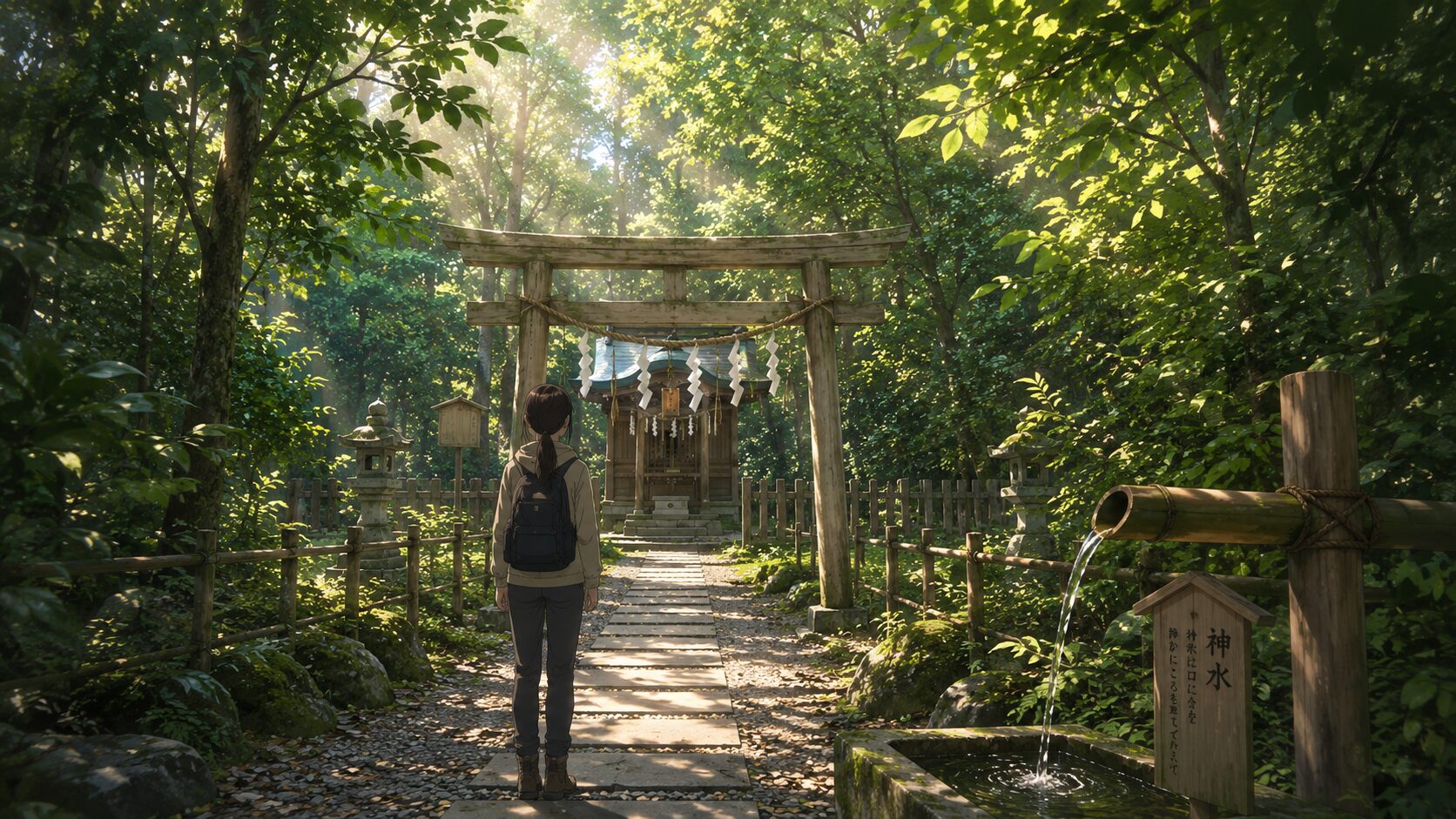
We have shared a long journey of story together. From the sacred tree of fifteen thousand years, through the five-colored peoples, the Takeuchi Documents, the underground empire, Moses, to the question “hoax or real.” In our heads, we have journeyed quite far.
But however grand the story, in the end it begins with a single step of reality. To actually stand, on one’s own feet, on this navel of Kyushu. In this final chapter, returning from the dizzying story to reality, we guide you to how to reach Heitate Jingu and how to tour it. This is a chapter for practice, to turn the journey of the head into a journey of the body.
First, the place.
Heitate Jingu is enshrined in Ono, Yamato Town, Kamimashiki District, Kumamoto Prefecture. South of the outer rim of Mount Aso, deep in the mountains near the border with Miyazaki Prefecture. It is at the position called the “navel of Kyushu,” almost at the center of Kyushu.
To reach it, a car is most realistic. From central Kumamoto City it is about a hundred minutes; from the scenic Tsujun Bridge about thirty minutes; from the home of myth, Takachiho Gorge, about forty minutes. Basically, follow National Route 218. This road is relatively easy to drive, but as you near the shrine, mountain-road curves continue. Keep your speed moderate. Especially if visiting for the first time, driving in daylight hours is strongly recommended. In winter, the road surface can freeze in the morning chill, so it is reassuring to have studless tires or chains. And, as touched on in the Prologue, the entrance to this shrine is, unless you are watching, easy to miss. A large torii of white wood standing along the national road. That is the landmark. Relying on car navigation or a map app, take care not to miss that torii.
Let me give rough estimates from major starting points. From the air gateway, Aso Kumamoto Airport, it is about an hour and a half by car. From the Mifune Interchange of the Kyushu Expressway, via National Routes 445 and 218, allow over an hour. When heading south on the expressway from the Fukuoka direction too, you go via Kumamoto and enter the mountain road. In any case, what can be said in common is that “the last mountain-road section takes time.” It is long after getting off the expressway. It is wise to estimate with more margin than the time shown by the map app. For the destination setting of car navigation, searching by address (Ono, Yamato Town, Kamimashiki District, Kumamoto Prefecture) or phone number is reliable. In the mountains, smartphone signal can be unstable. Confirming the route in advance lets you drive with peace of mind.
You can also head there by public transportation. But honestly, it requires considerable resolve. From central Kumamoto City, Aso Kumamoto Airport, or the Takamori direction, an express bus runs, but its frequency is about one round trip a day. There is guidance to get off at “Mamihara” and walk about forty minutes from there. Or, take a bus bound for “Mamihara” from the Kumamoto bus terminal and get off at the “Ono Heitate-gu-mae” bus stop. In any case, allow around two hours. Since the number of services is few, be sure to check the timetable in advance. A plan with margin, including transfers and walking, is essential. — But, thought of another way, this “hard-to-reach-ness” is itself the Heitate Jingu character. You cannot go easily. Precisely because of this, the emotion when you reach it is all the deeper. If you think of it as going to confirm, on your own feet, the legend that “only the called can go,” even that long road becomes part of the pilgrimage.
The parking lot is maintained free of charge. The entrance is near the torii along National Route 218. There are a first parking lot and a second parking lot, and on ordinary Sundays and holidays you can usually park without trouble. However, there are days to note. The first three days of the New Year, and August 23, when the Goshiki-shinsai is held. On these days it is often full from early morning. On days when crowding is expected, aim to arrive early. Parking on the mountain road is dangerous, so absolutely avoid it.
Now, at last, worship.
Pass through the white-wood torii along the national road, and beyond it a long stone-step approach continues. This stone-step approach is the first highlight of Heitate Jingu. Many worshippers say they are struck more by the atmosphere of this approach than by the shrine buildings themselves. On both sides, moss-clad guardian dogs quietly watch over the worshippers. Dense groves of trees. Dappled sunlight falling on the stone steps. With each step climbed, the sense of going from the secular world into the sanctuary. Here, do not hurry; climb slowly.
Climb the stone steps to the top, and the main hall appears. The buildings are by no means large. Nor gorgeous. Rather, they are a calm, modest design. But seen with eyes that know the story so far, you cannot help but think that deep within this modest building, Ohotonochi-Ohokami, the deity of the cosmos itself, is enshrined, and the Five-Color Sacred Masks sleep. In a small vessel, the cosmos is held. Holding the greatness of that disproportion in your heart, join your hands quietly.
The time needed for worship, if only the main hall, is enough in thirty minutes. But that means you have savored only half of Heitate Jingu. If you descend firmly to Higashi-Mitarai Shrine and spend time at the edge of the Pond of the Water Jewel, allow an hour to an hour and a half for the round trip and stay. Further, if you draw the sacred water, receive the goshuin seal, and slowly savor the atmosphere of the approach, about two hours. You have come all the way to this sacred place where “only the called can go.” Rather than hurrying past, do take ample time. This place is too precious to “consume” in haste.
And — to go home here would be a waste. The true essence of Heitate Jingu lies beyond the main hall.
Facing the main hall, on the left, the west side, there is another torii descending into the forest. Beyond it is the descending mountain path continuing to Higashi-Mitarai Shrine. The sanctuary of the Pond of the Water Jewel where the dragon god sleeps, touched on in detail in Chapter Seven. You will descend a steep, narrow mountain path of about two hundred meters. The path grows muddy easily, and being a genuine mountain trail, the equipment for your feet matters. In heels or new leather shoes, it is simply impossible.
Here, let me touch on clothing and what to bring. To truly savor Heitate Jingu, easy-to-walk shoes are essential. Sneakers or trekking shoes are desirable. On rainy days and after, it grows especially muddy, so wear non-slip shoes. In summer, being a mountain valley, insect repellent makes it comfortable. In winter, it grows cold, so gloves and a neck warmer are good. A thin rain jacket, since mountain weather changes easily, is reassuring to have. And if you receive the sacred water, an empty plastic bottle. However, as touched on in Chapter Seven, draw about one bottle per person. Not to monopolize the dragon god’s blessing is the etiquette.
Descend to Higashi-Mitarai Shrine and, at the edge of the Pond of the Water Jewel, stand for a while. You should be able to feel air clearly different from the area of the main hall — deep, thick air. The pond where the Eight Great Dragon Kings sleep. The two sacred waters, differing in taste left and right. Only those who have descended this far can meet the other face of Heitate Jingu.
As a memento of worship, there is the goshuin seal. The goshuin of Heitate Jingu will be a memorable one as proof of visiting this sacred place. You can receive it at the offering office.
Here, let me touch a little on the manners of worship. As we have seen, Heitate Jingu is not a mere tourist spot. It is a special sacred place, handing down a life-lineage of fifteen thousand years and praying for the harmony of all the world’s humankind. Precisely for this reason, when visiting, hold a corresponding respect and restraint. Before passing through the torii, a light bow. The approach is said to be the path of the gods, so avoid the center (the seichu) and walk at the edge — that is the old etiquette. If there is a water basin, purify the hands and mouth before going to the buildings. And above all, what matters is to keep stillness. To make loud noise or frolic does not suit this place. The sanctuary of Higashi-Mitarai Shrine is an especially sacred place. To wantonly disturb the waterside or leave trash must absolutely never be. Recall that taboo, that violating the pond where the dragon god sleeps causes a typhoon. It is an admonition from antiquity: do not forget awe of nature. More beautiful than when you came. To walk quietly, with awe and gratitude. That is the greatest respect to this sacred place.
If you take photographs, there are several highlights. The white-wood great torii along the national road. The long stone-step approach and the moss-clad guardian dogs. The cedar groves where dappled light falls. And the mysterious Pond of the Water Jewel of Higashi-Mitarai Shrine. However, there are also subjects whose photography is not permitted, such as the interior of the main hall and the Five-Color Sacred Masks. Whether photography is allowed, follow the on-site guidance, and do not point your lens carelessly at sacred subjects. Incidentally, some say “a strange light was captured” in photos after worship. Whether you see it as a reflection of the lens or as some presence is — up to you.
About the season to visit. Most walkable and beautiful are the fresh greenery of May to June and the autumn foliage of October to November. Especially on rainy days and right after, the colors of moss and cedar bark come out deep and thick, and the mysterious atmosphere increases all the more. The freshness of a clear day is not to be dismissed, but a Heitate Jingu wet and moist is also exceptional. And, if possible, visit in the early morning hours. With few people, you can slowly savor the “ki” of this sacred place in the stillness.
If you wish to be present for the Goshiki-shinsai. The festival is every year on August 23. And once every five years is the grand festival. The grand festival where the Five-Color Sacred Masks are opened and people gather from all over the world. When the next grand festival is, confirm before visiting. If you could be present on that day, of which you do not know how many times in a lifetime you could attend, it would be an unforgettable experience.
In closing, a little about the surroundings. Heitate Jingu is on a sightseeing route also called the Road of Myth. Nearby is the Tsujun Bridge, a stone arch bridge designated a national treasure, and beyond it the home of myth, Takachiho, also awaits. Set Heitate Jingu at the center of a day and combine it with such nearby famous spots, and it becomes a journey to savor whole the deep-mountain mythic world of Kyushu.
Let me sketch a little a plan for touring. For example, if entering from the Miyazaki side, first visit Takachiho Gorge. It is the stage of the myth of the heavenly grandson’s descent, where the deep gorge and emerald-colored water are divine. You will trace, on your own, the very route that Takeiwatatsu, guided by the white bird, is said to have passed in Chapter One. From Takachiho, cross the mountains along the Gokase River, and in about forty minutes it is Heitate Jingu. From the home of myth to the land of humankind’s origin. A journey connecting myth upon the map. Or, if entering from the Kumamoto side, first stop at Tsujun Bridge. It is a grand stone aqueduct bridge made in the Edo period, and the sight of its water discharge is spectacular. This bridge that conveys water, and the sacred water of the Pond of the Water Jewel. By the theme of “water,” two famous spots connect loosely. From Tsujun Bridge to Heitate Jingu is about thirty minutes.
As for lodging and meals, being mountain-valley land, the choices are by no means many. Many people tour in a day, but if you wish to savor the stillness of this land’s morning or dusk, a plan to stay at an inn in the Aso direction or Takachiho and visit Heitate Jingu in the early morning is also splendid. Heitate Jingu in the morning light, with no people, is exceptional. For meals, roadside stations commanding the magnificent scenery of Aso, and shops making use of local ingredients, are dotted about. To savor the bounty of the land after worship is one of the joys of the journey. The mountain’s bounty, rice raised on pure water. The taste of this land itself is, so to speak, a gift from the great earth.
Now, with this, the preparations are complete. You know how to reach it, and how to tour it. The rest is only for you to pass through that white-wood torii on your own feet.
To you, who have read this long story this far. In closing, at the end of this journey, there is one thing I want to convey. On the next, final page, let me tell it, and quietly close this long journey.
Epilogue — Standing on the Navel of the Earth
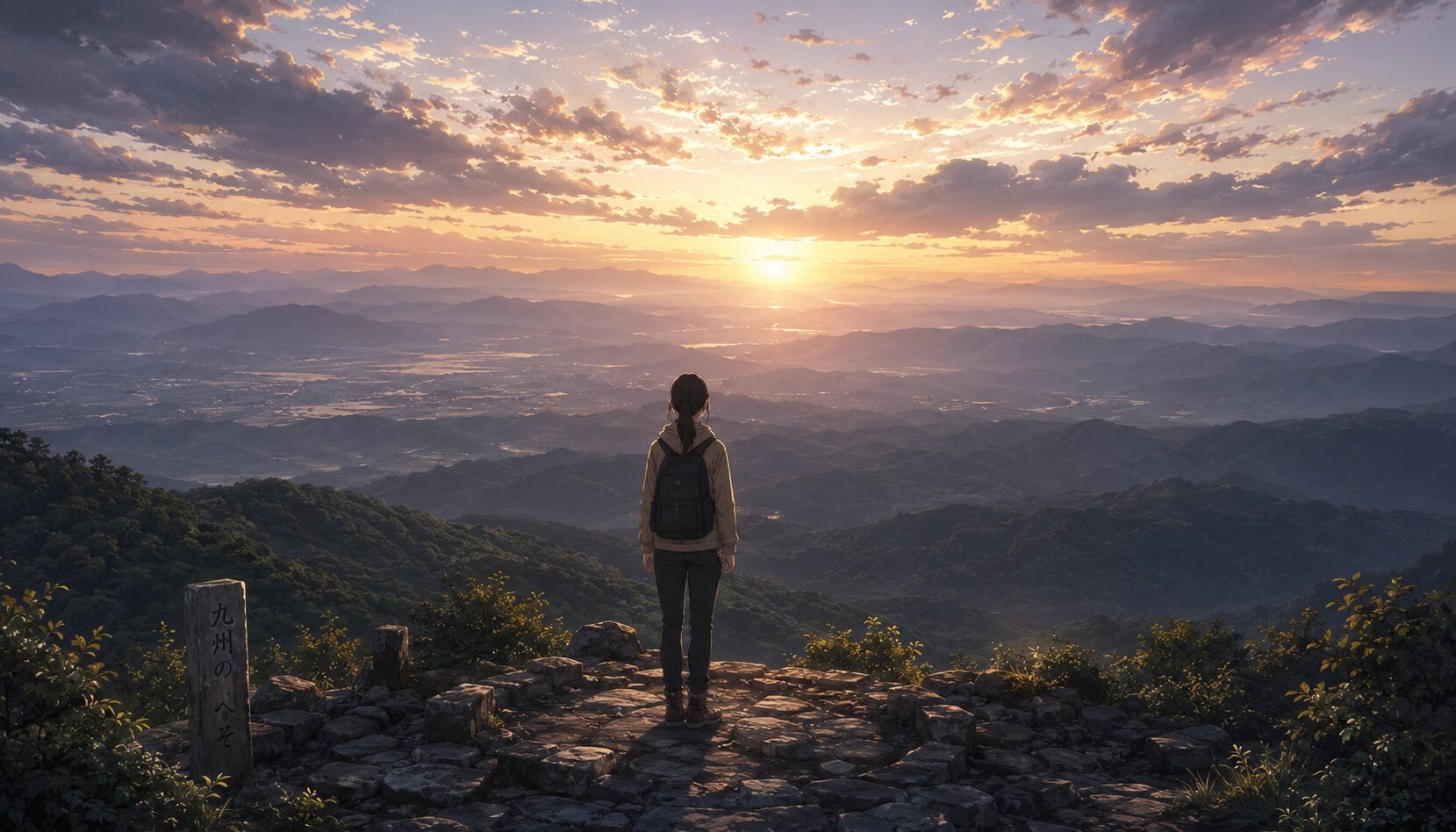
It was a long journey.
From a small torii hidden in a curve of National Route 218, our journey began. At that moment, we thought we stood merely before a hidden shrine. But what continued beyond that torii was a world deeper and wider than imagination by far.
We looked up at the sacred tree marking a life-lineage of fifteen thousand years, and stood before the Five-Color Sacred Masks opened only once every five years. We opened the door of the Takeuchi Documents, said to be older than the Kiki, and joined our hands before the deity embodying the cosmos itself. From behind the main hall, we descended two hundred meters to the pond where the dragon god sleeps, and in the depths of those water veins, glimpsed the underground empire said to have been built by the red and blue people who vanished from the surface. We marveled that a shrine in the mountains of Kyushu was tied to the story of Moses and Judah, far away in the Middle East. And we lent our ears to the strange experiences of those who visited, and at last faced, head-on, the question “is this true?”
Up, down, sideways. Our journey, centered on this single point, extended its threads in every direction. From the deity of the heavenly cosmos to the underground empire at the bottom of the earth. From Japanese myth to Judah on the far side of the globe. So small a point was connected to so wide a world.
Why does so great a story gather at this single point?
At the end of the journey, its reason at last comes into view. It is because this land is spoken of as “the source of all.” The world’s humankind was born from a single place, divided into five colors, and scattered to the world. The single point of that beginning. If it is the source, then it is only natural that it connects with every place in the world, with every story. For the source is the place from which everything flows out.
The navel of the earth. The navel of Kyushu. This single point, falling exactly at the center on the map.
The navel is, come to think of it, a strange place. It is the trace of where we were once joined to our mother. Before being born, we were, through the umbilical cord, joined as one with our mother’s life. The navel is the undying proof of having “once been one.”
When Heitate Jingu is called the “navel of the earth,” a deep meaning dwells there. The world’s humankind was, once, one. People differing in skin color, language, and culture, now far apart, are, traced back, divided forms of the same life born from a single source. To stand on the navel of the earth is to touch that memory of having “once been one.”
The five-colored peoples. Red, white, yellow, black, blue. Those who scattered to the surface, those who descended to the bottom of the earth, those who crossed the sea to distant lands. Though the colors differ and the places they live differ, trace them and all are one. What this story has sought to hand down for fifteen thousand years was, in the end, that single point. We were one. So do not fight. Recognize one another. Be in harmony.
Whether that is historical fact, we need ask no longer. As we saw in Chapter Eleven, whether it is fact and whether it is truth are separate things. Even if fifteen thousand years cannot be verified. Even if the five-colored peoples are myth. The truth of that prayer — “we were originally one” — is urgently needed precisely by the present world. In this age where conflict never ceases over skin color, over ethnicity, over faith.
The journey over, I recall once more that white-wood torii. A small entrance you would overlook unless watching. But beyond it, the cosmos, the bottom of the earth, the whole history of the world, were folded in. In a small vessel, everything was held. It may, perhaps, resemble each one of us. A small, single human being. But within them flows the life-lineage of fifteen thousand years — no, all the history of life far longer than that. You, a single point, are also connected with the source of all.
When we stand on the navel of the earth, we recall that we are a part of a great whole. Not alone. Not an isolated point. We are divided forms of one great life. If we could carry that sense home as a souvenir, this journey would hold a firm meaning.
Now, the story closes here.
But the true journey may begin from here. Next, it is your turn to pass through that torii. The navel of Kyushu, the navel of the earth. On that single point where the time of fifteen thousand years sleeps, stand on your own feet. And confirm. Whether there is truly “something” there. Or — whether that “something” was, all along, within you yourself.
That prayer flows out, even now, from this quiet mountain shrine, to the world.

Feel Heitate
HEITATE — NEON PILGRIMAGE
An ancient shrine resting in a forest 600 meters up, at the navel of the Kyushu mountains. The Takamagahara where, legend says, the five-colored peoples of the world once gathered. A sacred cypress said to have lived 15,000 years. The Mizutama Pond of the Eight Great Dragon Kings. Myth and mystery cross here — your travel guide to Yamato, Kumamoto.
The Five-Colored Peoples and the Mystery of the Masks
At the heart of Heitate Shrine lies the legend of the Goshikijin — the Five-Colored Peoples. In primordial times, so the tradition goes, the ancestral deities of humankind — red, white, yellow, black, and blue — gathered on this ground to unite their spirits in harmony. The homeland of all humanity. That is what this sanctuary is said to be.
Enshrined in the main hall as proof: the shrine treasure, the Goshiki Shinmen — the Five-Colored Sacred Masks. Wooden masks said to portray the ancestral gods of the five peoples. You cannot see them on an ordinary day. They are revealed only at the grand festival held once every five years.

The legend traces to the Takeuchi Documents, a chronicle claimed to predate the Kojiki and Nihon Shoki, Japan’s oldest histories. It records that the world once held five primordial races — red, blue, yellow, white, and black. Be clear, though: scholars regard the Takeuchi Documents as a modern forgery. None of this is established fact. And yet one thing is certain — these masks and this festival have created a singular place where people pray for harmony beyond race.
One more riddle. Some say that of the five colors, only three correspond to skin tones seen at the festival today. Where did the red and blue peoples go? Some interpretations connect them to oni legends and tales of an underground world. The mystery remains wide open.
The Goshikijin Festival is held every year on August 23. Every fifth year brings the grand festival; the four years between are minor ones. The most recent grand festival took place in 2025.
Walk the Forest to the Mizutama Pond
Pass under the plain-wood torii on Route 218, and a long stone stairway climbs into the forest. About 150 steps to the main hall. The buildings themselves are not large — it is the cedar grove along the approach and the taut, charged air that keep drawing pilgrims here.
Within the grounds towers the sacred cypress called Tenjin-boku, said to be the vessel into which the deities Kamurogi and Kamuromi descended. Its lifeline is said to span more than 15,000 years — life carried on from generation to generation. Here, that word “lifeline” stands as an actual living tree. Beside it grows the Ioe-sugi, a giant cedar whose sideways branch turns and rises skyward mid-reach.

To the rear left of the main hall, through a torii and down a forest path, you reach the inner sanctuary: Higashi-Mitarai-sha, a small shrine to the god of water. Beside it lies the Mizutama Pond, still and quiet. A sacred precinct where the Eight Great Dragon Kings are said to dwell. The spring water rising here has long been whispered about for healing the sick.


Walk. Stop. Breathe deep. Move at that rhythm, and what comes into focus is not whether the mysteries are true — it is the change inside you. The ground gets wet. Sneakers or trekking shoes are your friend.
What You Must Eat Before You Leave
Heitate sits in a forest at 600 meters. There is no restaurant strip at its gate. But Yamato, Aso, and Takachiho, all linked by road, form one of Kyushu’s great treasure houses of food. Rice and vegetables raised on famed spring water; meat raised on volcanic bounty. What you eat will change what you remember. Here, as your travel pro, are the plates you cannot skip.

Start with Aso’s soul food: takana-meshi and dago-jiru. Takana-meshi is rice tossed with pickled Aso takana mustard greens stir-fried in oil — sharp, peppery, addictive. Grown in cool highlands and volcanic soil, Aso takana is small, tender-stemmed, and unmistakable. Dago-jiru is a bowl of flat hand-kneaded wheat dumplings simmered in miso broth heavy with root vegetables; the chew of taro stems is the taste of this land. It warms you from the core.
Do not skip the meat. Kumamoto means akaushi red beef and basashi horse sashimi. Akaushi rice bowls rich with lean umami and fresh basashi are standards across the Aso region. And Yamato’s specialty is game — wild boar and deer from the Kyushu mountains, even wood pigeon. Salt-grilled wild ayu and yamame trout are the luxury of a clear-stream village. Best savored with local sake at a reservation-only mountain kitchen like Moto-Satsumaya.

If you push on to Takachiho in Miyazaki, Takachiho beef is non-negotiable. Winner of the Prime Minister’s Award at the national wagyu competition — Japan’s best, full stop. Raised on spring water from the Sobo range and quality grass. At the JA co-op’s own Takachiho-gyu Restaurant Nagomi, you can taste that pedigree teppanyaki-style at a fair price. Along the Takachiho Gorge walking trail, Araragi-no-Chaya serves kappo-zake — sake warmed in green bamboo — with whole roasted chicken, the columnar cliffs in view. Takachiho is also said to be the birthplace of nagashi-somen, flowing noodles: in summer, mandatory.
Save room for sweets and souvenirs. Right across from the shrine, the natural-yeast bakery Pan Kobo YamaGEN (cafe attached) bakes apple pie and blueberry cake — the perfect pause after worship. To carry home: toasty Takachiho kamairi pan-roasted tea, Kumamoto’s Yabe tea, candied chestnuts, spring-water rice. And in the Mamihara district survives a celebration dish called taimen — a whole simmered sea bream served over somen noodles.
| Where to Eat | Location / Contact | What to Order | More |
|---|---|---|---|
| Pan Kobo YamaGEN 1 min walk |
Ono, Yamato — directly in front of Heitate Shrine. Irregular closures; check ahead | Fresh-baked apple pie / blueberry cake | Tabelog ▶ |
| Shokusai-no-Sato Fushimi Kaiseki & soba |
Ono, Yamato — behind Heitate Shrine (about 4 min on foot) | Shokusai set with soy-milk hot pot (yuba). Souvenirs: miso-cured tofu, candied chestnuts | Tabelog ▶ |
| Moto-Satsumaya Reservation only |
Tsujunkyo area, Yamato (near Tsujun Sake Brewery). Courses require booking | Mountain kaiseki of game, wild ayu and yamame with local sake. Casual bukkake green-tea soba lunch too | Tabelog ▶ |
| Roadside Stations Seiwa Bunraku-mura / Tsujunkyo Michi-no-eki |
Seiwa = on Route 218 (6 min by car from Heitate) / Tsujunkyo = at the Yamato-Tsujunkyo IC (about 30 min) | Dago-jiru, game, spring-water rice, Yabe tea. Local goods for souvenirs | — |
| Takachiho-gyu Restaurant Nagomi JA co-op direct |
Mitai, Takachiho (about 40 min by car) TEL 0982-73-1300 |
Japan’s best Takachiho beef — teppanyaki / yakiniku (yakiniku requires booking by the day before) | Tabelog ▶ |
| Araragi-no-Chaya Gorge views |
Along the Takachiho Gorge walking trail | Kappo-zake bamboo sake, whole roasted chicken. Gorge views | — |
*Hours, closing days, and reservation policies change. Check each restaurant’s Tabelog or official page before visiting.
And the finest souvenir is free: the sacred spring water of the Mizutama Pond at Higashi-Mitarai-sha. Drawn within the grounds, it has been whispered about for healing since old times. Tuck an empty bottle in your bag.
To the National-Treasure Bridge and the Gorge of Myth
With Heitate as your axis, two landmarks sit within easy driving range: on the Kumamoto side, the National Treasure Tsujunkyo Bridge; on the Miyazaki side, Takachiho Gorge. Heitate’s Takamagahara legend runs unbroken into the mythic landscape of this whole region.

Tsujunkyo is a stone-arch aqueduct built in the Edo period to carry water to a drought-stricken plateau. The mighty jets released from its center were designed to flush out sediment — today they are the spectacle the bridge is famous for. About 30 minutes by car; it pairs naturally with Heitate.


Takachiho Gorge is a V-shaped canyon of columnar basalt, carved where Aso’s pyroclastic flows met the Gokase River. Its symbol, Manai Falls, drops about 17 meters — one of Japan’s 100 finest waterfalls. A rental rowboat takes you right beneath it. By night, the Takachiho Shrine kagura hall hosts the Takachiho Kagura dance every evening. Nearby stands Amano-Iwato Shrine, keeper of the myth of the sun goddess’s cave. A day of walking through mythology with your whole body.
Stay and Soak: Minami-Aso and Takachiho
Heitate is an old shrine deep in the hills — no inn town at its gate. For a base, choose Minami-Aso, linked by road, or Takachiho in Miyazaki, bound to Heitate by myth. Free-flowing hot springs and country feasts close out a pilgrimage in style. And even without staying the night, famed baths welcome day visitors all over this area.

| Area | From Heitate | Character | Best for |
|---|---|---|---|
| Minami-Aso Onsen |
About 60 min by car (via Michi-no-eki Asobo-no-Sato Kugino) |
Detached-villa inns with free-flowing springs. Views of Aso’s five peaks; famed water. | Best overnight base |
| Takachiho (Miyazaki) Myth |
About 40 min by car | Night kagura and the gorge — the classic myth pairing. Kyoto-style kaiseki inns too. | Stay & sightseeing |
| Central Yamato Mountain village |
About 20–30 min by car (about 30 min to Tsujunkyo) |
Mountain inns like Tsujun Sanso. A good day-trip base too. | Day trips / simple stays |
For a day soak, the options run deep. Minami-Aso holds hidden springs reborn after the Kumamoto earthquakes: Jigoku Onsen “Seifuso.” and its famed Suzume-no-Yu, where sulfur water bubbles up through the bath floor itself (bathing wear required), and Tarutama Onsen “Takibiyori” just up the road, with jade-tinted cloudy water. Jigoku Onsen is tied to legends of Takeiwatatsu-no-Mikoto, the deity of Aso Shrine — echoing softly with Heitate’s own story. Closer to Heitate on the Yamato side, Tsujun Sanso also takes day bathers.
| Day-Trip Onsen | Address / Contact | Hours (guide) | The Water |
|---|---|---|---|
| Jigoku Onsen Seifuso. Hidden spring / Suzume-no-Yu |
2327 Kawayo, Minami-Aso Official: jigoku-onsen.co.jp |
Day bathing reception 10:00–15:00 Closed Tue (irregular closures) |
Sulfur spring rising through the bath floor. Bathing wear required (rental-inclusive plans). |
| Tarutama Onsen Takibiyori Rebuilt after the quake |
2331 Kawayo, Minami-Aso TEL 0967-67-0006 |
Day bathing available (check official info for hours) | Jade-tinted cloudy water. Waterfall-view open-air and private baths, plus a cafe. About 400 m from Seifuso. |
| Hinoyama Onsen Dondoko-yu Aso’s largest class |
Minami-Aso (near Aso Farm Land) Official: dondokoyu.com |
11:00–22:00 (last entry 21:00) | Garden open-air baths of lava rock and great trees. Free-flowing milky-green sulfate spring. Akaushi beef restaurant attached. |
| Tsujun Sanso Closest to Heitate |
Yamato (near Tsujunkyo Bridge) | Day bathing available (check hours) | A mountain bath you can slip into between Heitate and the bridge. Sauna and open-air bath. |
*Day-bathing hours, closing days, fees, and bathing-wear rules vary by facility and may change. Confirm with each facility’s official information before visiting.
Stay Somewhere Exceptional
All-room open-air baths in Minami-Aso, Kyoto-style kaiseki in Takachiho. Source springs and country feasts — one special night.
▶ Book on Ikyu.comFamed Baths, No Fuss
Minami-Aso and Yamato onsen inns at fair prices. Dinner of famed water and mountain fare — drop in for a night.
▶ Book on JalanPublic transport to Heitate is nearly nonexistent — one express bus round-trip a day, then a 40-minute walk. This is car country, about 100 minutes from central Kumamoto. To bundle transport and lodging, a package tour is a real option.
▶ Find transport + stay on JTBModel Route: Two Days, One Night
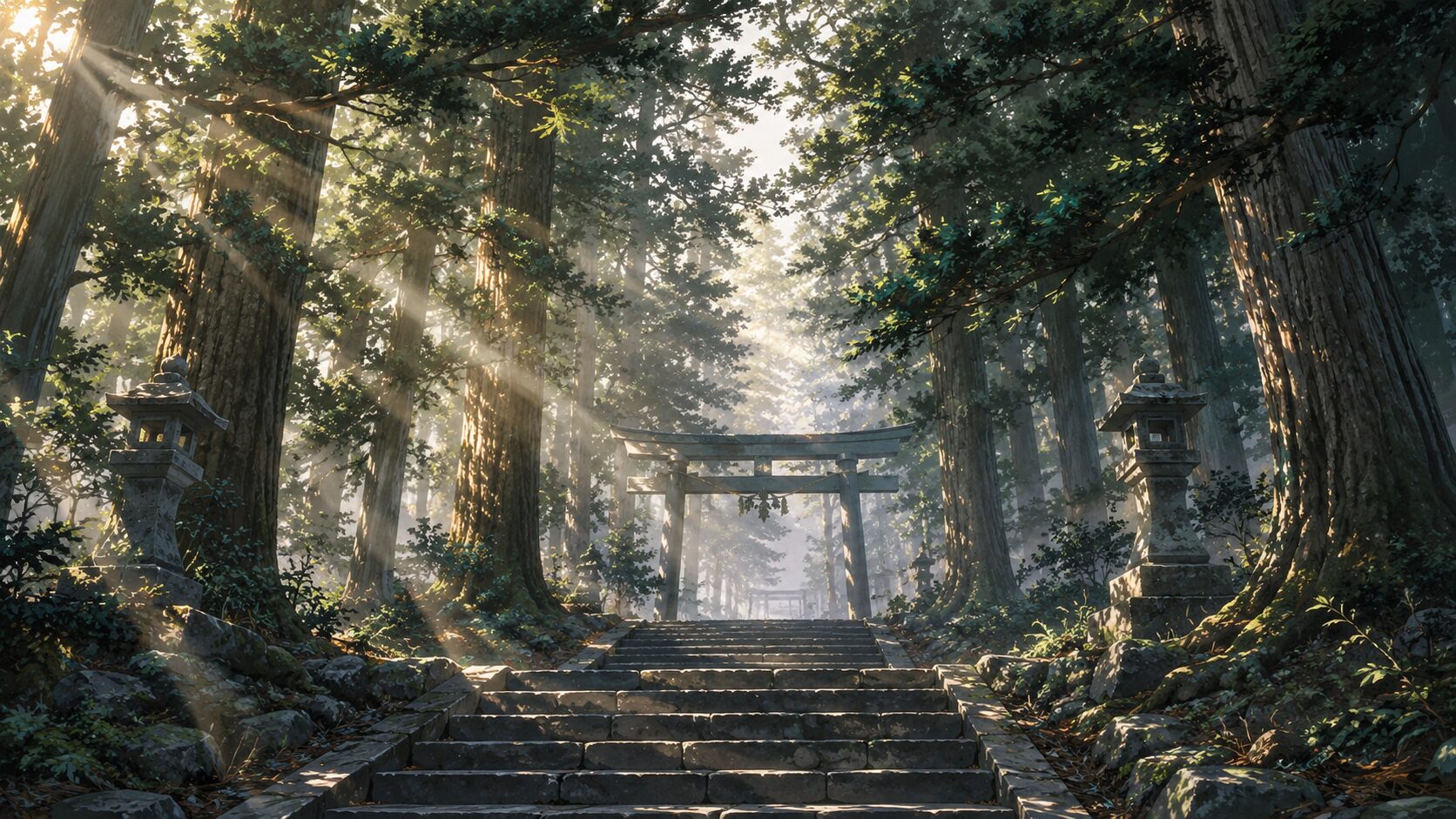
Heitate Jingu — show up unprepared, and you might just tear up a little.
 YOUR GUIDE / VIV
PHASE 01Decide a few things before you go
Most people pair Heitate Jingu with a trip to Takachiho. On a map they look close, so it’s tempting to think “I’ll just swing by on the way.” That’s the very first trap.
From Takachiho, the drive is roughly 30 minutes. But that road — National Route 218 is mostly a single lane each way, and you can end up crawling behind a big lumber truck. Some stretches still have alternating one-way sections left over from post-earthquake roadwork, so on a bad day, 30 minutes can stretch toward an hour. Pack your schedule too tight and this is where it falls apart.
One more important thing. The famous Goshikijin Festival is held every year on August 23rd, but only once every five years is it the grand festival — the other four years are smaller observances. The last grand one was in 2025, so the next is 2030. If it’s the big ceremony you want to witness, don’t get the year wrong.
Also, this place sits around 600m up in the mountains. Winter brings snow, and the roads ice over. Roll up in light clothes on summer tires and you risk getting stuck on a slope. If you’re coming in winter, snow tires or chains aren’t optional.

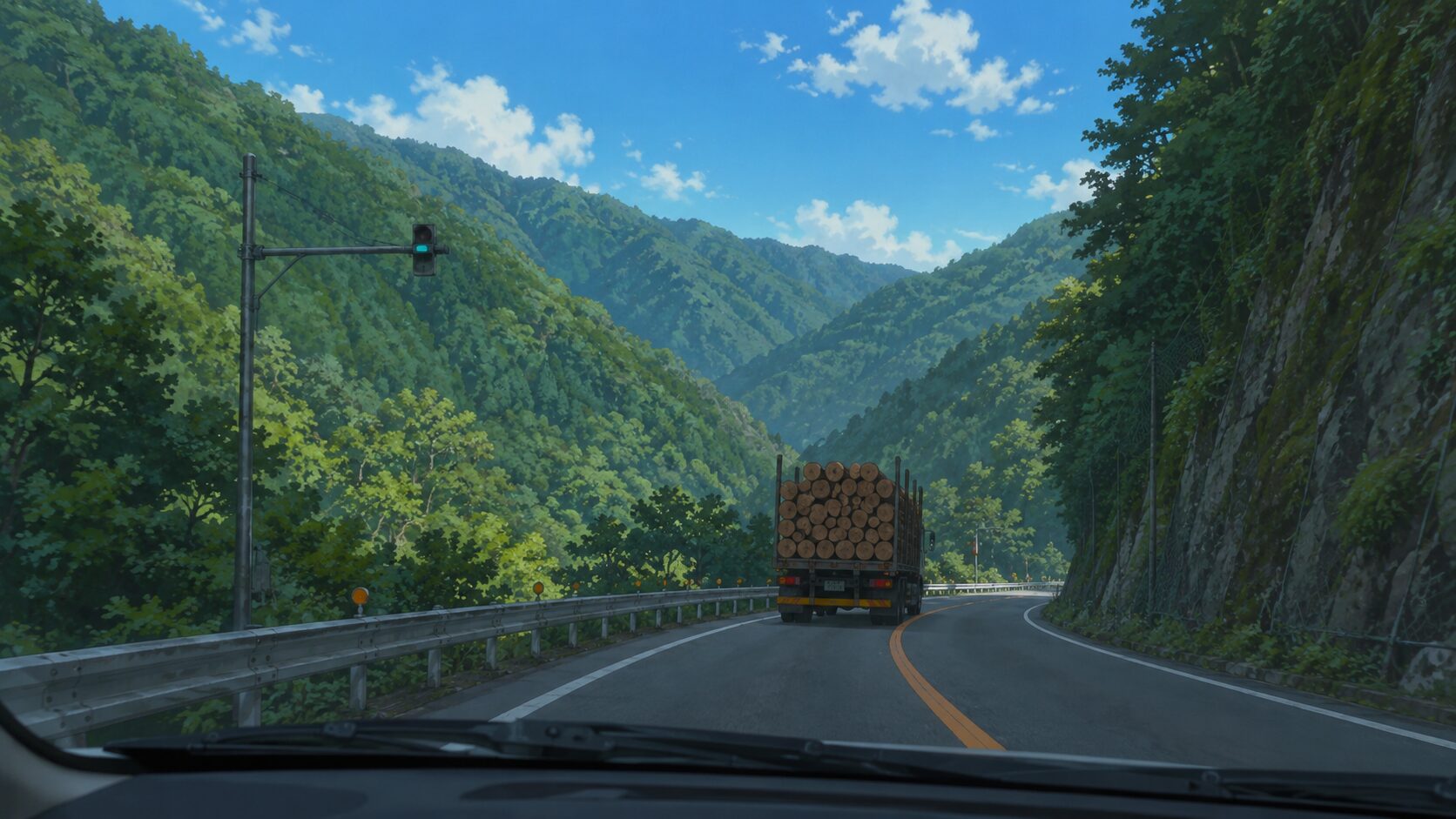
PHASE 02First thing on arrival — parking
Follow your car’s GPS and it’ll wind you up a narrow mountain road until the parking lot suddenly appears. Without a heads-up, plenty of people blow right past it going “wait, was that it?” And once you’ve passed, there aren’t many wide spots to turn around — so stay calm, and once you spot the torii gate, ease off the gas.
Parking is free, with room for about 80 cars (across the first and second lots, plus more in the woods to the east). Normally you’ll have no trouble. The exceptions are the first three days of the New Year and August 23rd for the Goshikijin Festival — those fill up early in the morning. Plan to arrive at midday on those days and you may end up circling the mountain roads. On busy days, early bird wins.

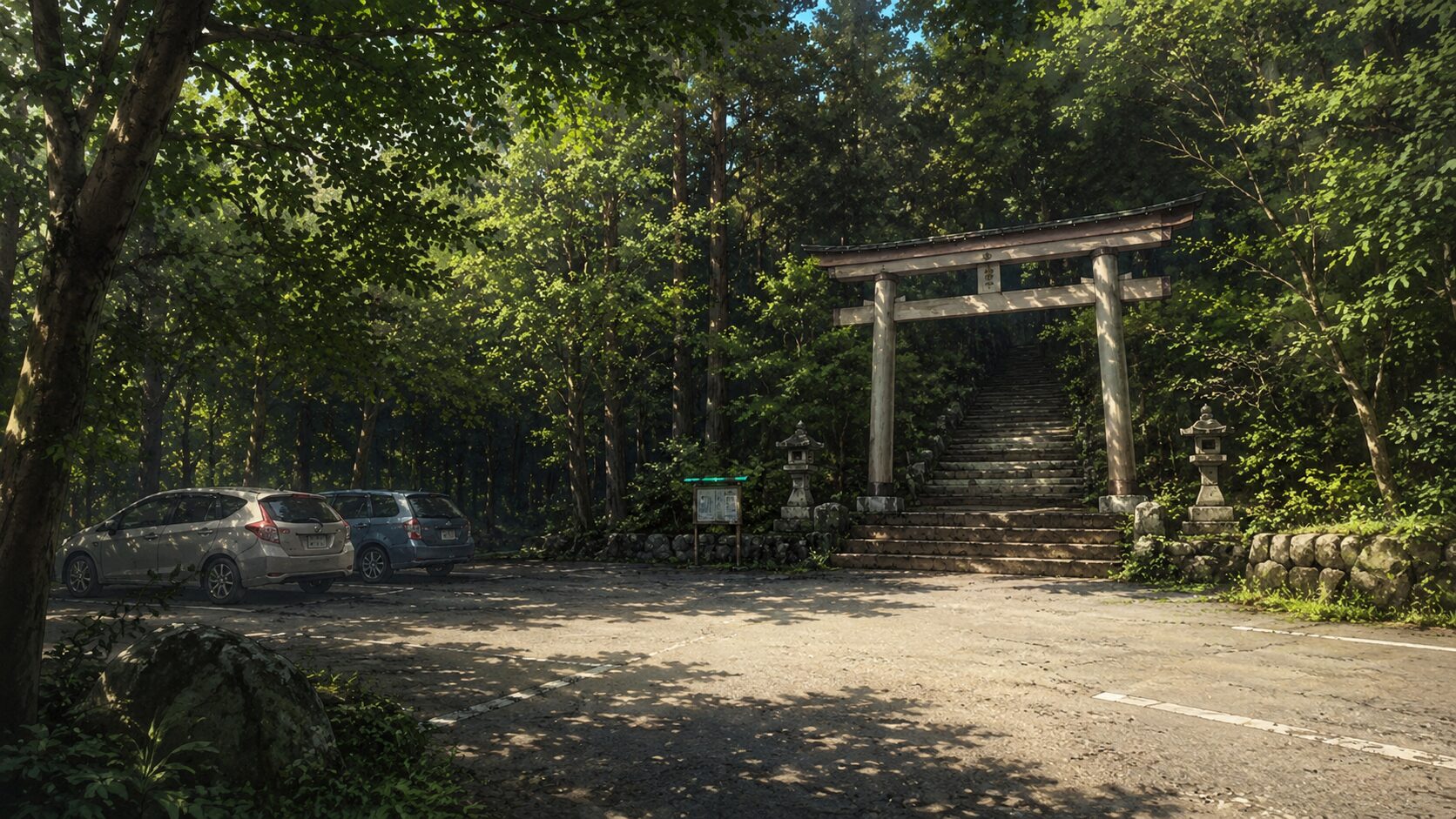
PHASE 03Before the climb — food, restrooms, footwear
You’re up in the mountains here, so there’s almost nowhere to eat nearby. What little there is tends to close by evening, and convenience stores are hard to spot. Count on grabbing lunch “somewhere around there” after your visit, and you may genuinely go hungry.
That’s why the old rule is to handle both food and restrooms back in the Mamihara shopping street before you head up. Mamihara has eateries and even a doughnut shop — a nice spot to pause. Assume the shrine has plenty of restrooms and snacks and breeze past Mamihara, and you’ll be muttering “I should’ve stopped” up on the mountain.

PHASE 04At the hall — don’t leave the good stuff behind
From the torii to the main hall is about 150 stone steps. There’s a landing partway up, so take it one step at a time. At the top, a quiet hall awaits.
The biggest shame here is grabbing your goshuin stamp or some water and dashing off. If the timing’s right, the priest may ring a bell over your head and offer a blessing — everyone who receives it comes away saying “I’m so glad I came.” Don’t rush; put your hands together properly at the hall.
And the famous “Goshikijin masks” — said to represent the five peoples of the world. Photos of them hang in the main hall, but the actual masks are normally a hidden sacred treasure. Expect to see the real thing and you’ll be let down, so receive them “through the photos and the connection” instead.
One reassuring note: worship, parking, and the blessing are all free. No need to brace yourself — just a quiet offering from the heart.
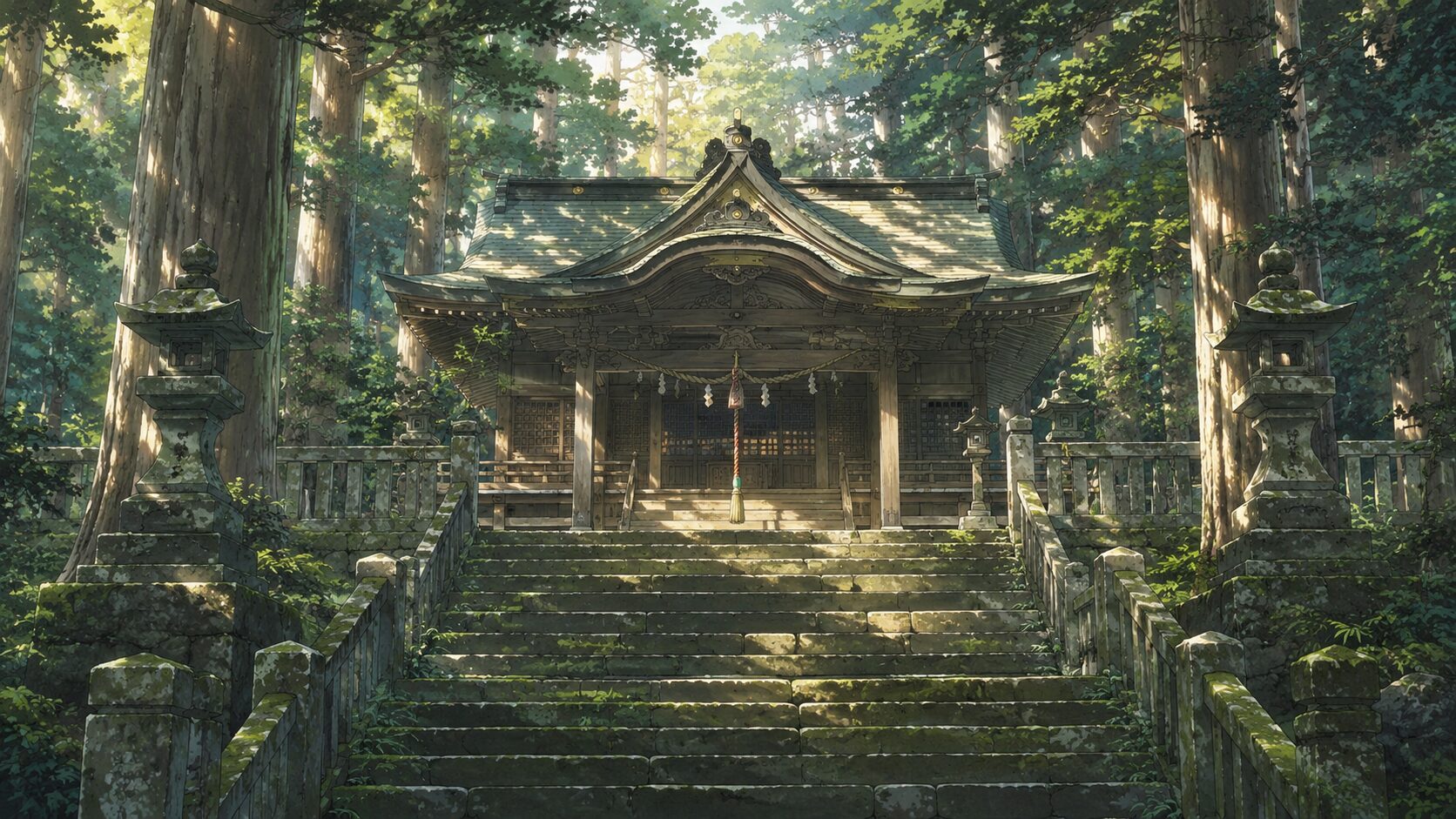
PHASE 05Higashi-Mitarai — go prepared, and committed
To the left of the main hall stands another torii. Beyond it is Higashi-Mitarai, a spring of sacred water. Bring an empty bottle and you can fill it from a bamboo spout and carry it home — a quietly popular spot.
But this is what I most want you to watch out for today. From the torii to the water, you descend a steep, narrow dirt path for 5–10 minutes each way. After rain it gets muddy, and you’ll have to climb that slope back up. Underestimate it as “just over there” and go in sandals or heels, and you’ll really struggle. Sneakers are a must.
A quiet word for anyone unsteady on their feet, or bringing along older family. There’s actually a gentler bypass road, wide enough for a car, beyond the water deity’s spot. Use that for the round trip instead of the steep dirt slope and it gets far easier. No need to force the steep descent.
The hours, fees, parking capacity, festival dates, and access rules listed here were confirmed against official sources at the time of writing. But details like these can quietly change due to roadwork, weather, ceremonies, or the season, so please treat everything here as a friendly heads-up rather than a guarantee. Before you actually set out, always confirm the latest details yourself with the official sources (official website or phone). My notes are just the prep work — the final check is in your hands.

Comments