
Prologue: A Bell Clutched in the Hand of a Man Who Died in Shinjuku
Shinjuku, Tokyo. On a street in this city where high-rise towers carve up the sky, a salaryman suddenly collapsed and breathed his last. What the police who rushed to the scene found beside the body was a small bell, clenched tightly in his hand. The cause of death would soon be ruled poisoning. And the single clue to unraveling the case was this — the bell.
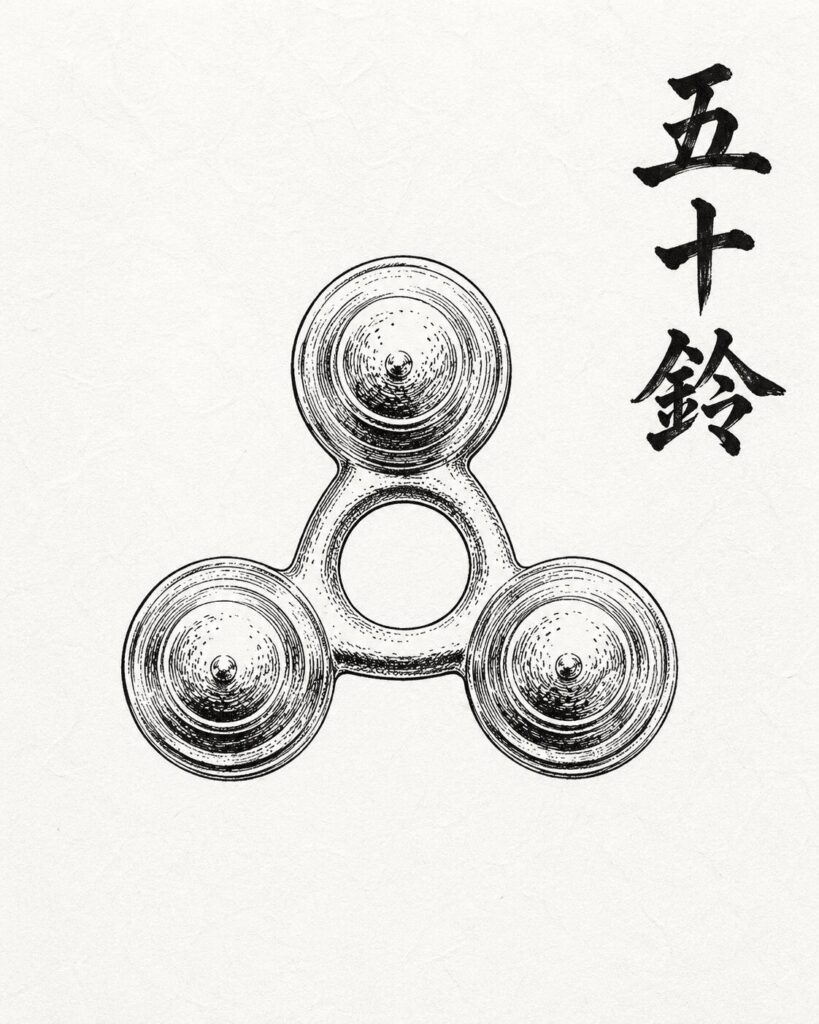
The bell’s name is the Isuzu. It was a sacred treasure handed down at one shrine alone, seated deep in the mountains of Nara Prefecture. Inevitably, the investigation moves from the great metropolis toward the far interior of Nara. This is the opening of Tenkawa Densetsu Satsujin Jiken (The Tenkawa Legend Murder Case) — the film adaptation of Uchida Yasuo’s mystery novel by the master director Ichikawa Kon, released in 1991 as the fifteenth-anniversary commemorative production of Kadokawa Pictures.
The story itself is fiction. But the single image this film seared into the minds of people across Japan was unmistakably real: that a shrine enshrining the deity of the performing arts, and handing down a distinctive bell of three spheres strung together, truly exists in the mountains of Nara. And that, from long ago, this bell has been believed to harbor something beyond human understanding.
Tsubonouchi, Tenkawa Village, Yoshino District, Nara Prefecture. In this land, embraced by high mountains and limpid mountain streams, stands Tenkawa Daibenzaiten Shrine — commonly known as Tenkawa Shrine. Counted among Japan’s three great Benzaiten shrines — or, by some reckonings, its five — it is an ancient shrine whose principal deity is Ichikishima-hime-no-mikoto, who presides over the performing arts, music, eloquence, and wealth. Its founding reaches back to the Asuka period: opened by En no Gyōja, the founder of Shugendō; a place where Kōbō Daishi Kūkai gave himself over to ascetic practice; where a Noh actor of Zeami’s bloodline dedicated a mask. The sediment of prayer accumulated over well more than a thousand years lies layered upon this small shrine in the mountains.
And yet, what has been talked about most concerning this shrine is neither its lineage nor its cultural treasures. It is, rather, the sheer abundance of strange experiences recounted, one after another, by those who have visited. Unexplained rapping sounds that rang out overhead the very moment a visitor stepped up into the worship hall. A hall of spirit-pacification that one finds oneself having wandered into, without knowing how. A computer screen that had changed by the time a visitor returned home, though no one had touched it. A stone, said to have fallen from the heavens, that grows tinglingly warm when one holds a hand over it. The place is whispered to be a “zero magnetic field” where compass needles go astray; the shrine’s hereditary priestly family carries a legend of being “a bloodline that carries the blood of oni”; there are even stories of luminous objects flying to the inner sanctuary.
Why do mysteries gather at this one shrine in such numbers? It is no coincidence. This is precisely the question the present article seeks to unravel. The many mysteries Tenkawa Shrine has accumulated are by no means a heap of baseless tall tales. Each one of them is connected, by a sure thread, to the character of the deity this shrine enshrines, to the sacred treasure it has handed down, and to the history it has inscribed. Because it is a shrine that enshrines the deity of the performing arts, mysteries of sound occur here. Because it hands down a bell that traces back to the myth of Ama-no-Iwato, the heavenly rock cave, people speak of a power that shakes the soul. Because it stands on the sacred ground of Shugendō, legends of oni live on.
Neither dismissing the mysteries as superstition, nor uncritically exalting them as the mystical, we will untangle them together with the entire thousand-year structure of faith that lies behind them. From the true identity of that bell clutched by the man who died in Shinjuku, to the origins of the myth in which the deity of the arts once danced — let us trace them, one by one.
Before that, however, there is one rumor that cannot be passed over. “Only those who are called can ever reach Tenkawa Shrine.” Let us begin with the truth behind this, the most famous of all its legends.
Chapter One: The Truth Behind the Shrine That Calls
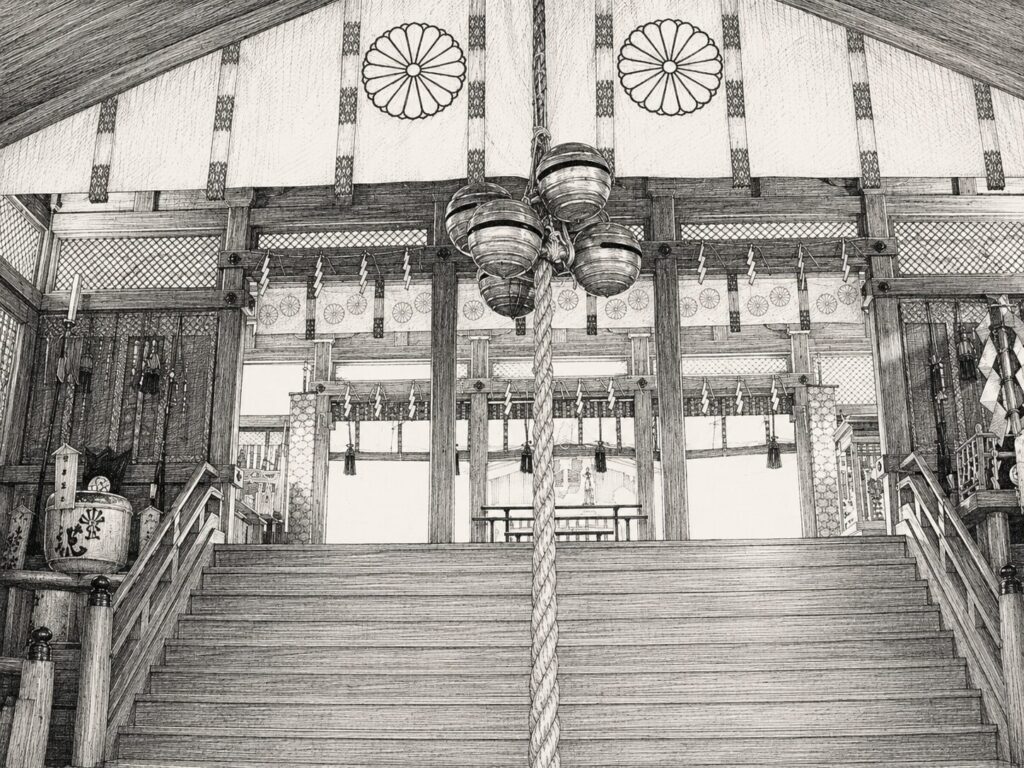
Anyone who begins looking into Tenkawa Shrine will, without fail, run into one sentence first: “Only those who are called can ever reach it.” It appears in tourist guides, in personal travel journals, in online reviews — stamped out, as if from the same mold. It is repeated so often that in the end it almost sounds like a slogan the shrine itself put up. In this chapter, I want to dig as deeply as possible into the truth behind this saying, the most widely known of Tenkawa’s many mysteries. And I want to dig it out completely here. For “whether or not one is called” is, in the end, nothing more than the entrance to the shrine that is Tenkawa. Stand hesitating before the door, and the true world that lies beyond it will never come into view.
The way the legend is told follows a strangely consistent pattern. Let us look first at the stories of those who “could not go.” The moment they decide to go, they fall ill. Sudden business intrudes and the plan falls through. The car breaks down along the way and will not move. They lose the road and, however long they drive, never arrive at the shrine. One travel-journal writer summarized the legend this way: for some reason, just when it is time to go, you fall ill, errands intervene, the car breaks down and you cannot reach the shrine — and that is why “only those who are called can go.” She herself, though she knew of the shrine’s existence, had assumed she would “probably never go in her lifetime.” Then one day, by sheer chance, she came across an advertisement for a day tour visiting Tenkawa and Tamaki Shrine, and ended up signing on. Encountering a coincidence like that, it seemed, was itself what it meant to be “called” — so she wrote. The stories of not being able to go and the stories of having gone are often two sides of a single coin within one and the same person.
This “difficulty of getting there” is by no means imagined. Tenkawa Shrine is seated near the very center of Nara Prefecture, deep in the interior of the Kii Mountains. For those traveling by public transportation, the starting point is Shimoichiguchi Station on the Kintetsu Yoshino Line. Even riding a limited express and then a local express from Abenobashi in Osaka, it takes a good hour and a half just to get this far. And the real trial begins after stepping off the train. From Shimoichiguchi Station to the bus stop nearest the shrine, one is rocked along on the Nara Kotsu bus bound for Nakaiosumi for roughly one hour. This bus, threading its way up the roads between the mountains, runs only a few times a day. Miss one, and you may wait hours for the next, in a mountain hollow with nothing around. By car, it is about two hours from central Osaka. The latter half is an endless succession of roads so narrow that passing an oncoming car is a struggle, and in winter the surface freezes over. Even having arrived, the shrine’s parking lot holds a mere thirty cars. On weekends and holidays, the wait for a space is said to exceed seventy minutes at times.
Lay out the realities of access this way, and it becomes clear how skillfully the legend of being “called” or “not called” mirrors the actual conditions. In a place this hard to reach, a slight dip in one’s health, a small slip in one’s schedule, one missed bus, a single snowfall — any of these translates directly into the result of “not being able to arrive.” At a shrine in front of a city station, one could shake off a minor ailment or a late start and pay one’s respects anyway. At Tenkawa, that is not how it goes. One small unraveling collapses the entire itinerary and forces the pilgrimage itself to be abandoned. The structure that so readily produces the experience of “obstacle after obstacle piled up, and I could not go” is built into this land as its very terrain.
Is everything, then, a fabrication fully explained by geography? Before drawing that conclusion, let us also listen to the stories of those who were “called.” Here too, there is a clearly shared pattern. The trigger almost always arrives as an abrupt flash of intuition. One blog writer had gone through a long stretch in which her schedule never aligned — wanting to go, yet unable to. Then one day, the feeling welled up in her chest: “I have to go — now.” In that instant, the standstill that had lasted so long dissolved as if it had never been, the way opened, and before she knew it she was standing before the shrine. For another visitor, the trigger was even more unaccountable: a message arrived from an acquaintance, without any preamble whatsoever — “This just came down to me out of nowhere, but — have you ever been to the Benten-san in Tenkawa Village?” Drawn in somehow, she accepted the invitation, and by the next day she was crossing roads frozen with snow, in the midst of a severe cold wave, on her way to Tenkawa Village.
What these experiences share is that the sensation of being “called” takes the form not so much of one’s own plan or will as of an impulse slanting in from outside. It had been on your mind for a long time. Information about the place kept finding its way to your eyes and ears of its own accord. Someone suddenly speaks its name. Such small coincidences link together, and at the moment some critical point is crossed, a person becomes certain: the time to go has come. The Tenkawa pilgrimage differs in kind, at its root, from the sort of shrine visit one plans and accomplishes by force of will. It is a receptive sense — bound up with waiting, with entrusting oneself, with feeling for the ripening of the moment.
That said, not every visitor brings home a dramatic story. There are more than a few voices saying that, after reading endless warnings that “you cannot go unless you are called” and bracing themselves accordingly, they arrived so easily it was almost a letdown. One social-media poster wrote honestly that, having set out intimidated by warnings on every side, she found herself thinking “wait — that’s it?” at how simply she arrived, and that the approach to the shrine — apparently a popular sanctuary now registered as a Japan Heritage site — was bustling with crowds. It is a hidden sanctuary of mystery and, at the same time, an unmistakably popular tourist destination. Before the gates of a shrine held in awe as a place “only those called by the deity can reach,” today’s visitor confronts a seventy-minute queue for parking. This seemingly contradictory scene is the reality of the modern Tenkawa pilgrimage. And the mystique of the hidden sanctuary and the bustle of the tourist site, while appearing to contradict each other, in fact amplify each other. The story that “you cannot go unless you are called” draws people in, and the crowds thus drawn spread the story further still.
Here, let us honestly lay out the psychological mechanism of this legend. Given a location more than an hour by car from the nearest station, with public transportation this limited, only a person with the strong will of truly wanting to go can manage even to assemble an itinerary in the first place. Precisely for that reason, the proportion of visitors who come nudged along by coincidence or intuition grows relatively large, and that “sense of being guided” eventually crystallizes into the word “called.” Add to this that human beings feel a thing is more valuable the more effort it cost to obtain. The long train transfers, the bus that does not come, the winding mountain road, the frozen surface, the full parking lot — when one stands at last before the shrine after passing through these layered barriers, the very magnitude of the effort is converted, just as it is, into the sense of having been “specially chosen.” In a place easily reached, only easy meanings come to dwell. In a place not easily approached, the bare fact of having approached it becomes charged with special meaning.
And yet something remains in this land that such explanations cannot exhaust. Why is it that around Tenkawa Shrine — this one shrine — the stories of being “called” have accumulated with such density? Shrines just as deep in the mountains, with access just as poor, can be found all over Japan. Yet it is Tenkawa alone that has gone on being spoken of, across more than a thousand years, as the place that “calls,” the place one “cannot reach without a bond of fate.” What produces the difference is not geography. It is what this shrine enshrines, and what it has handed down. Its character as a shrine of the deity of the performing arts. A bell that traces back to the myth of Ama-no-Iwato. The history of Shugendō trodden firm by En no Gyōja and Kūkai. A priestly family said to carry the blood of oni. These layered depths are what raised a mere “hard-to-reach shrine in the mountains” into a shrine that “calls” people to it.
So let us now release the question of whether one is called or not. That is the talk of the entrance. What matters is what lies beyond that door. What is it that those who arrive encounter? Why are people drawn here, at such cost? The answer is condensed into a single small sacred treasure this shrine hands down: a bell of strange form, three spheres strung in a row — the Isuzu that the man who died in Shinjuku held clutched in his hand. In the next chapter, we make our way at last into the heart of this shrine: toward the true identity of the Isuzu, reaching all the way back to the myth of the heavenly rock cave.
Chapter Two: The Bell That Came from the Heavenly Rock Cave
The bell clutched in the hand of the man who died on a Shinjuku street. That sacred treasure, seared into the minds of people across Japan by the film Tenkawa Densetsu Satsujin Jiken (The Tenkawa Legend Murder Case), is none other than the Isuzu handed down at Tenkawa Daibenzaiten Shrine. But do not mistake this bell for a mere prop in a story. The Isuzu is the very heart of the shrine that is Tenkawa, a small metal form into which the essence of the deity this shrine enshrines has been condensed. The true world that lies beyond the entrance-question of being “called” — the question we released at the end of the previous chapter — begins with this bell.
The Isuzu is a sacred treasure of distinctive form: three spherical bells joined into one. It is utterly unlike the bells of an ordinary shrine. It is neither the hontsubo suzu — the large bell rung by shaking its rope above the offering box — nor the kagura suzu, the cluster of bells a shrine maiden holds in sacred dance. The sight of those three spheres strung together leaves a strong impression on anyone who sees it. Why three? Why this form? To answer those questions, we must go back to one of the most famous scenes in all of Japanese mythology: the tale of Ama-no-Iwato, the heavenly rock cave.
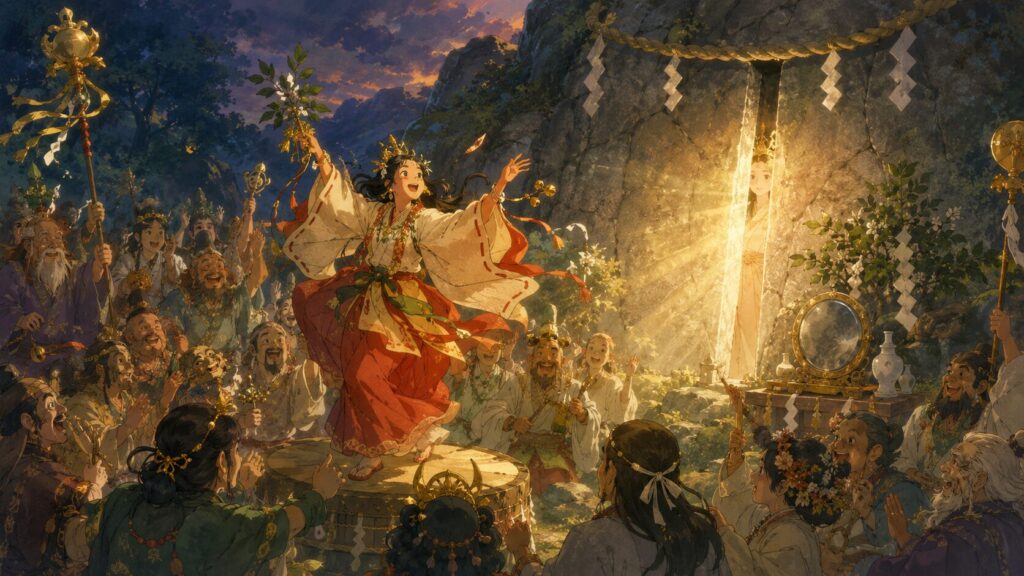
The myth tells it this way. The sun goddess Amaterasu-Ōmikami, grieved by the violent outrages of her younger brother Susanoo-no-mikoto, shuts herself away behind the door of the heavenly rock cave. With the sun goddess — the source of all light — hidden from view, both Takamagahara, the Plain of High Heaven, and Ashihara-no-Nakatsukuni, the Central Land of Reed Plains, are plunged into darkness, and every kind of calamity comes bursting forth. The myriad gods, at their wits’ end, gather before the rock door and rack their wisdom. And then they hit upon a stratagem: before the rock door, they hold a magnificent festival. At its center danced Ame-no-Uzume-no-mikoto, the goddess of the performing arts. Possessed by the divine, she danced wildly, and at the sight of her the assembled gods burst out laughing, and Takamagahara roared. Amaterasu-Ōmikami, finding the merry air outside suspicious, opened the rock door a crack to peer out — and in that one instant, seized by the gods, light returned to the world.
According to what Tenkawa Shrine hands down, the Isuzu is held to be the same as the kamiyo suzu — the “bell of the age of the gods” — that Ame-no-Uzume-no-mikoto held in her hands at that moment. Ame-no-Uzume, it is told, danced before the rock door holding a halberd hung with bells. The Isuzu, in other words, is the bell that rang out at the very center of that mythic festival which brought light back to the world. That Tenkawa Shrine is a shrine enshrining the deity of the performing arts and music, and that this sacred treasure derives from the bell of Ame-no-Uzume — the two facts are bound together by a single thick thread. It is sound and dance that hold the power to open what has been closed and to call back the light that was lost. The Isuzu is that mythic conviction, given form.
And the most essential meaning of this bell is invested in each of its three spheres. Tenkawa Shrine teaches that these three spheres represent three states of the soul. The first is iku musubi. The second, taru musubi. The third, tamazume musubi. These three, it is taught, denote three states of decisive importance for the evolution of the soul. The words are unfamiliar to the ear, but behind their sound lies an astonishingly refined view of the soul held by the ancient Japanese.
Musubi, if written in kanji, is 産霊 — “generative spirit.” It is a concept native to Japan, denoting the mysterious power that brings forth, binds together, and generates. Of the three deities of creation who came into being on the Plain of High Heaven at the very beginning of heaven and earth, no fewer than two bear the name musuhi — Takamimusuhi-no-kami and Kamimusuhi-no-kami. From this alone one can see how close to the very root of the Japanese worldview this power was placed. Musubi is nothing less than the creative working of the cosmos itself, joining together what is scattered and bringing forth new life and new value.
And that musubi, the Isuzu tells us, is strung together in three phases. The first, iku musubi, written in kanji as 生魂 — “the living soul” — represents the state of vivid life-force that brings forth all things: the power straining to be born, the phase of vitality in which things rise into being. The second, taru musubi, is 足魂 — “the sufficing soul” — representing the state in which that working brims over and reaches fullness, with nothing lacking and nothing in excess: the phase of plenitude in which the life that has welled up matures and is fulfilled. And the third, tamazume musubi, is 玉留魂 — “the soul gathered whole” — representing the state of the soul in which the whole is unified and brought together as one. Life-force and fullness, no longer scattered, harmonize and become a single body: the phase of completed unity. The power that brings forth, the power that fills, and the power that gathers all into one. When these three bind together, the soul arrives at the harmony it was meant for. The explanatory text accompanying one of the shrine’s talismans describes these three as a trinity of harmony — “body, mind, and soul,” or “heaven, earth, and humanity.” The three spheres of the Isuzu offer themselves to us as a small model of the cosmos that can be rung in the palm of the hand: the three phases of the soul, harmonized into one.
Here lies the core of Tenkawa Shrine’s faith. Shake the bell of three joined spheres, and the sounds of the three musubi — iku, taru, tamazume — melt into one and ring out together. This is not merely a sound for driving off evil and beckoning the divine. It is a sound that harmonizes, within a single vibration, the three phases of the soul: the power that generates life, the power that brings fullness, and the power that gathers them into one. According to what the shrine officially teaches, the exquisite, stream-like ringing of the Isuzu deeply purifies body and mind, harmonizes the soul, restores it to the state it was originally meant to hold, and causes new vitality to well up. Just as the goddess of the performing arts shook her bell before the heavenly rock cave and brought light back to a world that had been sealed shut, the sound of the Isuzu loosens the blockages within the soul of the one who hears it and calls back its original harmony. Here is the ground on which Tenkawa Shrine is called “the shrine of sound,” “the shrine of the soul.”
Revealed by the Isuzu
Come to think of it, the fact that this shrine’s principal deity, Ichikishima-hime-no-mikoto, is a goddess merged through syncretism with Benzaiten resonates deeply with the thought embodied in the Isuzu. Benzaiten was, from the first, a goddess of music, cradling the lute-like biwa in her arms. Trace her roots and one arrives at Sarasvatī, the river goddess of ancient India. The murmuring of flowing water, unimpeded eloquence, the notes of music being played — Benzaiten is a deity who presides over invisible “flow” and “resonance.” As water flows ceaselessly from high to low, and as sound shakes the air and carries far, this goddess has as her very nature the power to set in motion what has stagnated and to keep it circulating. The harmony of the three musubi — generating, filling, gathering into one — the melody trembling on the strings of the biwa, the sound of a murmuring stream: their root is one. All are expressions of one and the same principle — “to circulate, to resound, to bind.” Why did the deity who shakes the Isuzu have to be a goddess of music? The answer is that this goddess is a being who embodies the very “flow” of the cosmos.
Once one knows the thought embodied in the Isuzu, the many mysteries surrounding Tenkawa Shrine come to look entirely different. We will examine them in detail in later chapters: the testimony of a visitor who heard an unexplained rapping sound overhead at the very moment of stepping up into the worship hall; the fact that artists and musicians gather to this shrine as if drawn by a magnet. These are by no means scattered coincidences. Precisely because this is a shrine that has held at its core, for more than a thousand years, the idea of awakening the circulation of the soul through sound, the mysteries of sound gather here. The Isuzu is the single central axis that binds together every mystery of the shrine called Tenkawa.
Kōbō Daishi Kūkai, too, is said to have brought back bells from the Tang capital as sacred implements of esoteric Buddhism, and to have dedicated them to this land of Tenkawa. The bell has been, in East and West alike, a sacred instrument of sound for communing with the unseen world. Among all such bells, the Isuzu — bearing on its small body the circulation of the three souls — is perhaps the most philosophically profound bell in Japan. That the man who died in Shinjuku should have been clutching this bell, of all bells, is a piece of storytelling one can only call the author’s superb intuition. For the Isuzu is a sacred treasure that reaches all the way to life and death, and to the destination of the soul.
What, then, was the “dance” of Ame-no-Uzume-no-mikoto, who shook that Isuzu and brought light back to the world? Why do dance and sound hold the power to move the gods? In the next chapter, let us make our way into the secret that lies still deeper within Tenkawa Shrine’s character as “a shrine enshrining the deity of the performing arts” — into the mechanism by which sound calls the divine down.
Chapter Three: Sound Calls the Divine Down
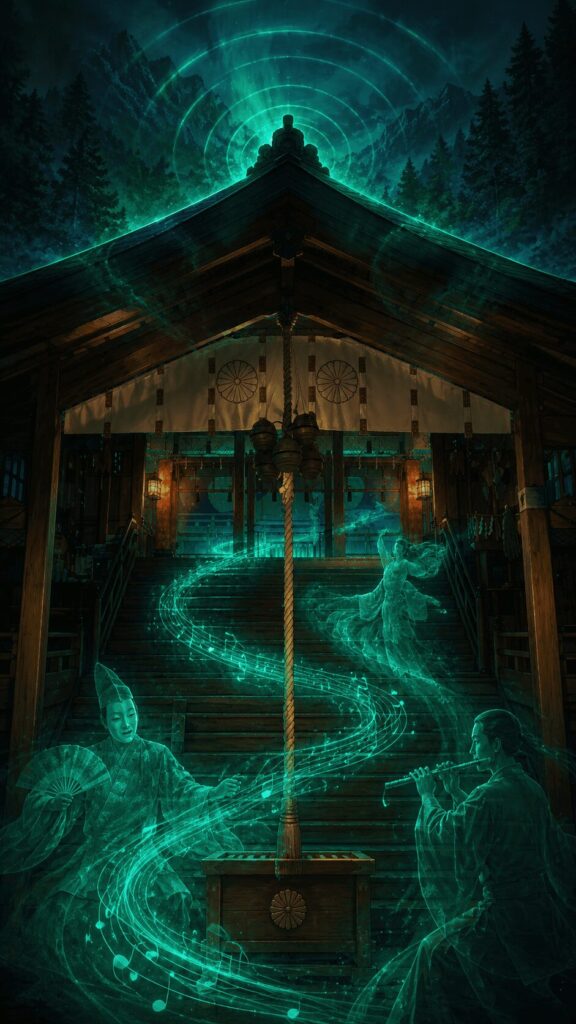
The Isuzu we saw in the previous chapter was a sacred treasure of sound, harmonizing three souls into one. But recall, once more, that the first to shake that bell was the goddess of the performing arts. Ame-no-Uzume-no-mikoto, dancing wildly before the heavenly rock cave, a halberd hung with bells in her hands. What drew the sequestered sun goddess out from behind the rock door was neither reason nor force. It was the divinely possessed dance of a single goddess, and the sound that adorned her body. Here is the other core of the shrine that is Tenkawa: the conviction that sound and dance hold the power to move the gods.
In Japanese mythology, the dance of Ame-no-Uzume is no mere entertainment. It was the most important sacred rite of all — the one that saved the world from crisis. In that scene of utmost extremity, with the sun goddess hidden, the world sunk in darkness, and every calamity bursting forth, what the gods relied upon in the end was a “festival,” and what stood at its center was dance and sound. That fact carries weight. The final means of breaking through catastrophe was neither military might nor stratagem, but the performing arts. This tells us how deep a power the ancient Japanese saw in the performing arts. The performing arts were the most fundamental technique by which gods and human beings could meet.
Nor should we overlook the point that Ame-no-Uzume danced in a state of divine possession. She did not perform choreography of her own will. She brought the divine down into her body and danced as the divine moved her. This is called kamigakari — divine possession. When the dancer forgets the self and surrenders the body to something greater, the power of the divine manifests through that body. At the origin of the performing arts there was always this sensation of kamigakari. To dance, to sing, to play, is a circuit for becoming one with something beyond the ego; and when that circuit opens, the world of the gods and the world of human beings — ordinarily held apart — are joined for a fleeting moment. The dance of Ame-no-Uzume is precisely the record of an instant when that circuit stood fully open.
What it means that Tenkawa Daibenzaiten Shrine hands down the sacred treasure of this Ame-no-Uzume and enshrines the deity of the performing arts and music should, by now, be evident of itself. For this shrine, music and dance and drama are not garnishes for the amusement of the gods. They are themselves the sacred technique for communing directly with the divine. That the principal deity, Ichikishima-hime-no-mikoto, is a goddess of music merged with the biwa-cradling Benzaiten only strengthens this character further. Tenkawa is a shrine that teaches the way to the divine through sound — a rare sacred place where the act of expression itself becomes prayer.
Why have so many artists been drawn to this shrine deep in the mountains? The answer to that question, too, lies here. The full roster I leave to a later chapter, but from Noh actors to present-day musicians, a great many artists across every genre have come to Tenkawa as if half led there. This is somewhat different from the worldly-benefit visit of “praying for progress in one’s art because this is the deity of the performing arts.” Those who make their living by expression all know it from experience: in the moment when something truly good is born, the feeling is less that one is “making” it than that one is “being made to make it” — that it “came down.” A superb performance, a superb dance, superb words, often arrive from somewhere beyond the calculations of the ego. It is, in essence, the same experience as the kamigakari of Ame-no-Uzume.
If artists are drawn to Tenkawa, it is most likely because this shrine affirms head-on the sensation of something “coming down,” and enshrines it as sacred. The intuition that the wellspring of one’s creativity is not one’s own alone, but part of some far greater current — an intuition every artist senses somewhere deep down — Tenkawa Shrine has given the form of faith and guarded for more than a thousand years. That is why people who grapple daily with the secret of creation that logic cannot exhaust feel, before this shrine, a deep assent that does not resolve into words: this is the place where the true identity of what I do every day is enshrined.
From this vantage point, the many “mysteries of sound” surrounding Tenkawa Shrine become a great deal easier to understand. As will be detailed in a later chapter, there is the testimony of a visitor who heard an unidentifiable rapping sound overhead at the moment of stepping up into the worship hall. And the artists who say they sensed something here and received the inspiration for new work are beyond counting. At a shrine that enshrines a deity of sound and has placed communion with the divine through sound at its very core, people report supernormal experiences having to do with sound — this is no strange coincidence, but rather a consequence that follows in a straight line. The character a place holds and the phenomena that occur (or are said to occur) there resonate with each other at a deep level. Tenkawa is a shrine of sound; and that is precisely why the mysteries of sound gather here.
Here I would like to press a little further into the relation between the performing arts and sacred ritual. Many of Japan’s traditional performing arts have their origin in sacred rites. Kagura is, as the word itself says, dance for the delight of the gods; Noh and kyōgen, too, if one traces them back, were sacred arts dedicated at the festivals of temples and shrines. The performing arts and faith were originally one. From the modern era onward, the performing arts were severed from sacred rite and became an entertainment industry; the stage moved into the concert hall, and the audience turned into consumers. But at Tenkawa Shrine, that primal bond from before the performing arts and sacred ritual ever parted is alive even now. As we will see in a later chapter, this shrine possesses a splendid Noh stage; Noh masks dedicated by a lineage carrying Zeami’s blood have been handed down here; and to this day Noh is performed as sacred rite. Tenkawa is a living museum, preserving whole and intact the memory of the age when the performing arts were sacred ritual.
This fact poses a quiet question to those of us living in the present. We consume music as playlists on streaming services. We take the stage as entertainment, viewed with a purchased ticket. These are rich pleasures, to be sure; but meanwhile, the dimension the performing arts once held — communion with the divine — has receded entirely into the background. That singing, dancing, and playing were originally prayer, acts of becoming one with something beyond the ego: this memory we have all but forgotten. Stand before Tenkawa Shrine, and that forgotten dimension suddenly rises up again. Here, sound is not a commodity but a way to the divine. Expression is not a means of self-realization but a prayer of surrendering oneself to a greater current. If this shrine deep in the mountains has never ceased to draw artists across the ages, it is most likely because the thing they had dimly sensed in their daily work yet could never put into words — the original form of the performing arts — is here enshrined in plain sight.
Come to think of it, the phenomenon of kamigakari is by no means confined to antiquity. The state of self-forgetting that present-day musicians call “entering the zone.” The moment a novelist describes as “the characters beginning to move on their own.” The improviser’s sense that the fingers are moving faster than thought. The names differ, but all of these point to the experience of something greater flowing out through oneself once the calculations of the ego are released. At root it is the same as Ame-no-Uzume’s possession before the rock door. Tenkawa Shrine has named this universal secret of creation with the old but exact word kamigakari, and has guarded it as sacred. That is why it is precisely those who pursue the most advanced forms of expression who nod most deeply before this most ancient of shrines.
Sound calls the divine down. Dance brings light back to the world. Expression becomes prayer. All of these are merely different ways of saying the same single truth that the one shrine called Tenkawa embodies. Just as the Isuzu of the previous chapter was a “sacred treasure of sound,” this shrine itself is a “sacred place of sound.” And at the center of that sacred place sits a single goddess who presides over music, eloquence, and wealth. In the next chapter, let us turn our gaze to that goddess — to Ichikishima-hime-no-mikoto herself. Why does a deity of water preside over music? Why does Benzaiten sit at the center of a shrine of the performing arts? Flowing water, resounding sound, circulating wealth: things that appear unrelated at first glance are, in fact, deeply bound together within a single deity. That is what we will see next.
Chapter 4: Ichikishima-hime, the Goddess of Water
The deity enshrined at the heart of Tenkawa Shrine is called Ichikishima-hime-no-Mikoto. Yet many who visit this shrine call her by another name: Benzaiten. As the shrine’s formal name, “Tenkawa Dai-Benzaiten-sha,” makes clear, this is unmistakably a shrine that enshrines Benzaiten. One goddess, two names. In that fact alone, a thousand years of the history that Japanese faith has walked are inscribed. The stories of “sound” and “soul” we have followed in the previous chapters flow into this single point—this goddess—and are bound together there. In this chapter, we will face the deity of Tenkawa head-on.
First, let us untangle the relationship between the two names. Ichikishima-hime-no-Mikoto is one of the Three Munakata Goddesses who appear in Japanese mythology. Benzaiten, on the other hand, traces her origins to an Indian goddess who came from the continent together with Buddhism. Why are these two deities, originally so utterly different in their origins, enshrined as the same goddess? It is due to the long-standing mode of faith in Japan known as shinbutsu shūgō—the syncretism of Shinto and Buddhism. The gods of Buddhism and the native gods of Japan were overlaid upon one another and worshipped as different aspects of the same deity. Within that current, Ichikishima-hime, deeply connected to water, and Benzaiten, the goddess of water, gradually melted into one. The original enshrined deity of Tenkawa Shrine was Benzaiten, and it is said that after the Meiji-era separation of Shinto and Buddhism, she came to be called by the Shinto deity name Ichikishima-hime-no-Mikoto. Yet in both the shrine’s name and its faith, the name Benzaiten lives on vividly to this day.
So what kind of deity is this Benzaiten in the first place? The official history of Tenkawa Shrine explains the essence of this goddess with astonishing clarity. Benzaiten, it says, is the ancient Indian goddess Sarasvati, said to be the deification of the exquisite manner in which a river flows. Sarasvati was originally the name of a sacred river in India, a goddess who personified that river. In other words, the most fundamental character of Benzaiten is not that of a goddess of wealth, nor a goddess of the arts, but first and foremost that of a “goddess of water.” This is a decisively important point. At the very top of the divine virtues that Tenkawa Shrine proclaims stands “Great Deity of Water.”
From her being a water deity, all the other characteristics of this goddess derive, like a river gathering its tributaries. The shrine’s history beautifully depicts that succession. Benzaiten is “a goddess of eloquence and music, as honest and exquisite as the murmur of flowing water.” When you think about it, no explanation could be more fitting. The unobstructed murmur of a flowing river is a metaphor for unobstructed eloquence, and a current ceaselessly playing its tones is music itself. The sound of flowing water, its clear resonance—from this, the character of a goddess of eloquence and a goddess of music arises entirely naturally. The character of Tenkawa as a “sacred site of sound,” which we have followed up to the previous chapters, had its source in this goddess being a “deity of flowing water.” Water flows, sound resounds, and words are spun without stagnation. All of these are merely different manifestations of the single nature of one goddess.
And Benzaiten possesses yet another face: that of a goddess of wealth and treasure. But this, too, was not added abruptly. The shrine’s history explains it thus: “later, this shifted, and she came to be worshipped as a deity of commerce who ‘manages wealth’ (zai o benzuru).” That which flows, circulates, and moves without stagnation—this quality of water overlaps with the circulation of wealth and riches as well. Money, too, generates value only when it is kept circulating rather than allowed to stagnate. The very Chinese characters for “Benzaiten” (弁財天) carry the meaning of “managing wealth.” The water deity, through governing flow and circulation, became a deity of wealth as well. Water that nourishes life, music that nourishes the heart, wealth that nourishes living—what Benzaiten governs is, in short, all things that “moisten and circulate.”
This perspective of the “goddess of water” also gives a clear answer to the question of why Tenkawa Shrine came to be enshrined, of all places, in that mountain-deep land of Ōmine. As we have seen in the previous chapters, the deity of Tenkawa was enshrined as the guardian of the highest peak, Mount Misen, when En no Gyōja opened Ōmine. Why enshrine a water deity at a mountain summit? At first glance, it seems strange. But the mountain is the very place where water is born. The rain and snow that fall upon the mountain seep between the rocks and flow down to the villages as countless mountain streams. The peaks of Ōmine were a vast watershed nourishing the entire Kii Peninsula. Indeed, it is said that the faith of this land was, from ancient times, deeply connected to the worship of the deity of mikumari—the distribution of water. To enshrine a goddess of water at a mountain summit was nothing other than to revere the very blessing of the water this mountain produces as a deity, and to pray for its distribution. Beneath the graceful image of Benzaiten lay the utterly urgent reality of water, which held people’s life and death in the balance.
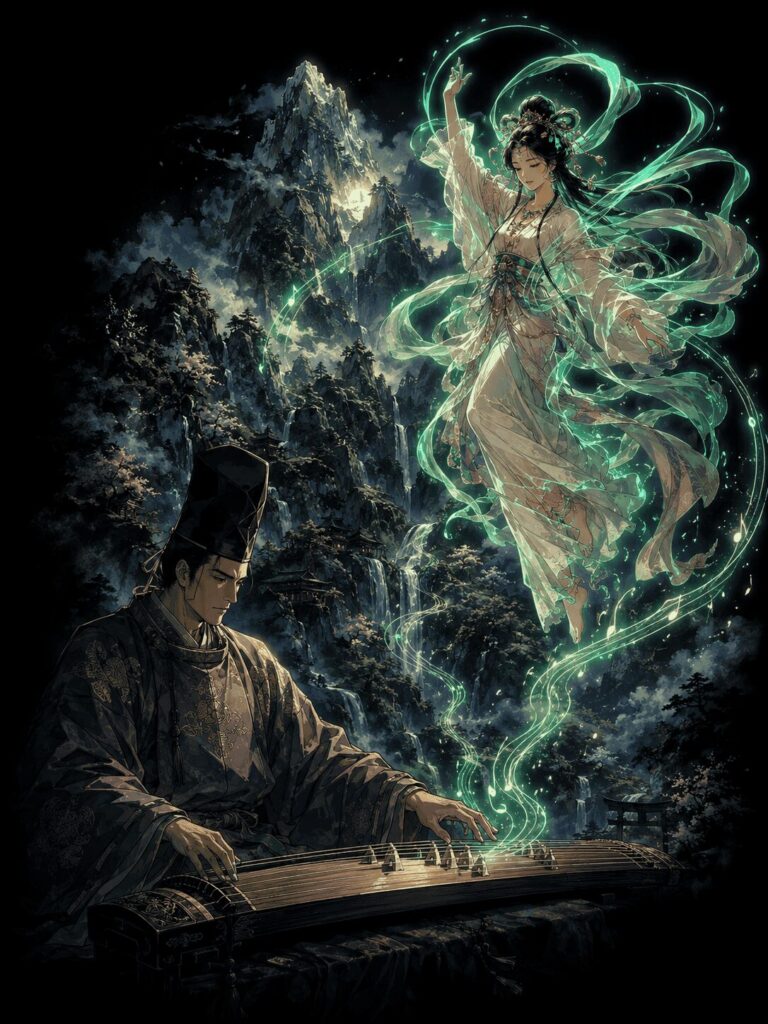
The legend surrounding the founding of Tenkawa Shrine also magnificently tells of this character as a goddess of “water” and “sound.” The shrine’s origin tale relates this. Long ago, Prince Ōama, driven into a corner by a struggle over imperial succession, visited Yoshino—the homeland of the gods who guard the Yamato court—and played the koto, praying for victory. Then, as if riding upon the sound of that koto, a celestial maiden clad in karatamao appeared from the heavens and blessed his victory in battle. This celestial maiden was none other than Misen-no-Ōkami, said to have been enshrined by En no Gyōja at the summit of Mount Misen. In time, the prince won the Jinshin War and became Emperor Tenmu, and to repay the celestial maiden’s protection, he built a divine hall at the foot of the mountain and named it “the Palace of Ame-no-Yasukawa” (the Heavenly Tranquil River). This is said to be the beginning of Tenkawa Dai-Benzaiten-sha, and this “Ame-no-Yasukawa” is also said to be the origin of the place name Tenkawa.
Let us once again turn our eyes to the beauty of this founding tale. What called forth the deity was neither sword nor words of prayer, but the sound of the koto. Music summoned the goddess from the heavens. Just as Ame-no-Uzume drew Amaterasu-Ōmikami out from the rock cave with dance and bells, Prince Ōama summoned the celestial maiden of Misen with the melody of the koto. The single truth that runs through this shrine—that sound moves the gods—is already embedded within the very story of its founding. Tenkawa Shrine was, from its very inception, “a shrine where one communes with the gods through sound.”
Tenkawa Shrine is counted as one of the Five Great Benzaiten of Japan, alongside Itsukushima Shrine (Hiroshima), Hōgon-ji Temple and Tsukubusuma Shrine of Chikubu Island (Shiga), Enoshima Shrine (Kanagawa), and Kinkasan (Miyagi). Furthermore, according to its official history, an important text of Shugendō records this shrine as the beginning of the invocation of Benzaiten in Japan, and if we follow this, Tenkawa is the very source of Benzaiten faith in Japan. A single celestial maiden enshrined at the water source of a mountain summit descended to the foothills, summoned by the sound of the koto, and in time became the source of the Benzaiten faith that would spread across all of Japan—when you consider this, you are once again overwhelmed by the magnitude of meaning held by this small, mountain-deep shrine.
Water flows, sound resounds, wealth circulates, and words are spun without stagnation. Within the single goddess Ichikishima-hime = Benzaiten, all of these are bound together as one. The sound of the Isuzu bells we saw in the previous chapters, and the dance that draws down the gods, too—these flowed forth from the nature of this goddess. Yet the journey of facing the deity of Tenkawa is not yet over. Upon the mountain of Ōmine, where this graceful goddess of water is enshrined, another tale of an entirely different countenance is inscribed: the legend of the ascetic who commanded demons. In the next chapter, we will once again turn our gaze back to the rugged mountains and venture into the story of En no Gyōja, said to have opened this shrine, and the demons said to have followed him—and the shrine family said to carry the blood of those demons.
Chapter Five: En no Gyōja and the Bloodline of the Oni
Tenkawa Shrine enshrines Benzaiten, the graceful goddess of water. But turn your eyes to this shrine’s other face, and an entirely different presence rises into the air. The presence of oni. Though it is the shrine of an elegant goddess presiding over the performing arts and wealth, legends and beliefs concerning oni cling to Tenkawa with a strange density. Why do oni dwell at a shrine of Benzaiten? The key to that riddle lies in the story of one superhuman figure said to have opened this shrine — En no Gyōja — and of the oni who, tradition says, followed him.
En no Gyōja is the legendary figure regarded as the founder of Shugendō. He is En no Ozuno, born in Katsuragi in Yamato in the latter half of the seventh century, during the Asuka period — a being half history and half legend, of whom even the official history, the Shoku Nihongi, records that he was exiled to Izu for using sorcery that led the people astray. In the steep mountains of Ōmine, stretching from Yoshino toward Kumano, he heaped austerity upon fierce austerity until at last he perceived Kongō Zaō Gongen and opened the way for Shugendō, Japan’s own religion of the mountains. The founding of Tenkawa Shrine reaches back precisely to this opening of Ōmine by En no Gyōja. It is told that when he opened Ōmine, he enshrined on the highest peak, Mount Misen, the Benzaiten who had first appeared in answer to his prayers — and that this was the beginning of the shrine. Tenkawa is a deity enshrined at the very moment Shugendō was born into this world, together with its first cry.
In the legends of En no Gyōja there are two beings who attend him without fail: a married pair of oni called Zenki and Goki — the “fore-oni” and the “rear-oni.” According to tradition, these two were originally savage creatures, feared for attacking people and even for snatching and devouring children. But En no Gyōja, by his supernatural power, captured this oni couple and subdued them — by one account, he hid their own child from them, and through their grieving taught them in their own flesh the sorrow of a parent whose child is taken. Their hearts changed, Zenki and Goki thereafter became faithful disciples who followed En no Gyōja, supported his severe mountain austerities, and became guardians of the practice grounds of Ōmine. Fearsome oni, reborn through the guidance of an ascetic into sacred protectors. This story fixed, once and for all, the image of the oni in Shugendō.
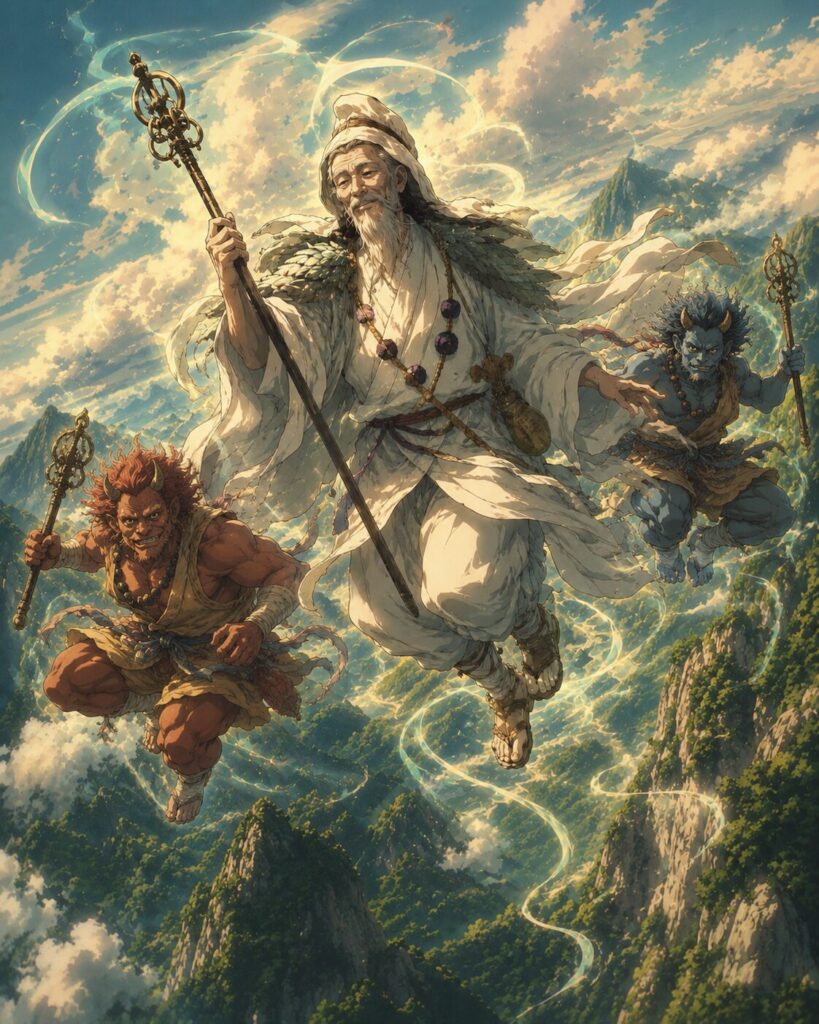
And here lies the core of Tenkawa’s oni faith. People held to be the descendants of Zenki and Goki went on, in the land of Ōmine, to keep pilgrims’ lodges that cared for the mountain ascetics, guarding the practice grounds ever after. Indeed, in the hamlet of Zenki along the Ōmine Okugakemichi — the great trail of austerities running the spine of the Ōmine range — families professing descent from the oni, the Gokijo family foremost among them, have lived generation upon generation, and keep a pilgrims’ lodge there to this day. “Descendants of the oni” is no metaphor, and no fabrication. It is the story of real family lines that have actually sustained the Shugendō of Ōmine for thirteen hundred years. The posterity of the oni whom En no Gyōja subdued still guards the sacred mountains — this one fact alone shows what a singular world the Ōmine massif is, where myth and reality run together.
The hereditary priestly family of Tenkawa Shrine — the family that has guarded this shrine generation after generation — is likewise deeply joined to the lineage of stories surrounding En no Gyōja. The present priestly house is the Kakisaka family; its line is held to descend from a disciple of En no Gyōja, founder of mountain worship, and Kakisaka Mikinosuke, who serves as honorary chief priest, is said to be the sixty-fifth of his line. Sixty-five generations — a succession that staggers the mind. One family has guarded one shrine across more than a thousand years. The sheer weight of that immeasurable time is itself what gives Tenkawa Shrine its unfathomable depth. It should be noted that a telling also circulates abroad which makes this priestly family “the direct descendants of Zenki and Goki themselves”; but the family that has, as a matter of historical record, carried the name of the oni’s descendants is the Gokijo family of the hamlet of Zenki, and its relation to the Tenkawa priestly house must be kept carefully distinct. Even so, the fact itself — that the posterity of En no Gyōja’s disciple has gone on guarding this shrine — speaks eloquently of the inseparable bond joining Tenkawa, Shugendō, and the story of the oni.
There is one observance that displays the density of Tenkawa’s oni faith more vividly than anything else: the rite of Oni no Yado — “the Lodging of the Oni” — held at Setsubun. At shrines and temples all over Japan, Setsubun means scattering beans to the cry of “Oni wa soto, fuku wa uchi” — “Oni out! Fortune in!” — and driving the oni away. At Tenkawa Shrine, the exact opposite takes place. Here the cry is “Oni wa uchi, fuku wa uchi” — “Oni in! Fortune in!” — and far from being driven off, the oni are courteously welcomed into the shrine. To receive the oni as honored guests, and to entertain them: that is the essence of the rite called Oni no Yado. The oni is treated not as a calamity to be exorcised but as a sacred being to be revered. A Setsubun that welcomes the oni in is exceedingly rare anywhere in the country, and it throws the singularity of Tenkawa’s oni faith into sharp relief.
Come to think of it, there are few shrines anywhere that treat the oni with such care. The great majority of shrines drive the oni outside as calamity; Tenkawa Shrine welcomes the oni inside as a sacred guest. Whether the oni is “a thing to be exorcised” or “a thing to be revered” — within that fundamental difference of stance is condensed the core of the faith this shrine has carried. A shrine that does not drive the oni away: it is the expression of a singular worldview that regards even the raging power the oni symbolizes not as an enemy to be expelled, but as something to be faced, and welcomed in.
At the root of this idea of “Oni in!” lies the view of the oni peculiar to Shugendō. As the story of Zenki and Goki shows, in Shugendō the oni is no mere symbol of evil or terror. It is the symbol of an immense power which, once subdued and turned about, transforms into a sacred protector. The raging power of nature, the awesome thing beyond human understanding — not to expel it, but to revere it, welcome it, and win it to one’s side. It is a state of insight that Shugendō, which has spent its history facing the mountain — that object of dread which does not easily suffer human approach — could alone have reached. If Tenkawa Shrine welcomes the oni in, it is because this shrine is a sacred place that chose not to fear and keep at bay the wild power of the mountains, but to commune with that power deeply.
Here, recall once more the legend we examined in Chapter One: “only those who are called can ever reach it.” The sense that the sacred mountain does not lightly admit entry — it is continuous with the worldview of Shugendō we have seen in this chapter, of an awesome mountain where even oni dwell. The mystery of Tenkawa can never be exhausted by the single face of the graceful Benzaiten. Behind her stands the legend of an ascetic who commanded oni; a mountain guarded by the oni’s descendants; a rite that receives the oni as a guest. The elegant goddess and the raging oni: that these two poles dwell together in a single shrine — this is precisely what makes Tenkawa a place without a measurable bottom.
This mountain of prayer that En no Gyōja opened would be walked, a century and several decades later, by another giant. That figure — called by some the greatest genius in the history of Japanese Buddhism — returned from the Tang capital bearing the newest esoteric teachings, and is said to have thrown himself into ascetic practice in this land of Ōmine before opening Mount Kōya. And to the deity of Tenkawa, it is told, he offered a sacred treasure carried home across the sea. His name: Kōbō Daishi, Kūkai. In the next chapter, let us trace the other grand lineage of prayer, handed down from En no Gyōja to Kūkai.
Chapter Six: The Treasure Kūkai Offered
The road of prayer through Ōmine that En no Gyōja opened was walked, a century and several decades later, by another giant: Kōbō Daishi, Kūkai. This figure, called by some the greatest genius in the history of Japanese Buddhism, is said to have given himself to ascetic practice in this land of Tenkawa before opening the great sanctuary of Mount Kōya, and to have offered here a sacred treasure brought home from the Tang capital. The thousand-year lineage of prayer inscribed at Tenkawa Shrine passes from En no Gyōja to Kūkai, and here deepens by yet another degree.
The sheer magnitude of Kūkai as a figure hardly needs retelling. Born in Sanuki, dissatisfied while still young with the established learning, he threw himself into austerities in the mountains and forests. In time he crossed to Tang China aboard a mission ship, and in Chang’an, from the master Huiguo (Keika), heir to the orthodox line of esoteric Buddhism, he received the whole of its inmost teachings within an astonishingly short span. After returning to Japan he founded the Shingon school, received the devotion of Emperor Saga, and established Kongōbu-ji on Mount Kōya and Tō-ji in the capital. In calligraphy he is counted among the Three Brushes; in engineering and education, too, he left his mark. He was, in every sense, a universal genius. And one of the practice grounds where this Kūkai placed himself again and again, from youth into his prime, was Ōmine — was Tenkawa.
The official records of Nara Prefecture state the connection between Kūkai and Tenkawa plainly: at Tenkawa Daibenzaiten Shrine, opened by En no Gyōja, Kūkai — then practicing in the mountains of Ōmine prior to the founding of Mount Kōya — undertook sanrō, a secluded retreat. Sanrō means confining oneself within a shrine or temple for a fixed period of practice. Kūkai, it is told, devoutly worshipped Benzaiten in this land of Tenkawa, and built the Myōonin Gumonjidō — the Hall of Gumonji of the Sublime Sound — where he carried out his austerities. “Gumonji” refers to the Kokūzō Gumonji-hō, the rite of Ākāśagarbha: the ferocious esoteric discipline of reciting the mantra of Kokūzō Bosatsu one million times, by which one is said to gain superhuman powers of memory. The episode is well known of the young Kūkai devoting himself to this Gumonji practice and, in a cave at Cape Muroto, receiving the mystical experience of the morning star flying into his mouth. That same Kūkai, the tradition says, labored at the same discipline of Kokūzō here in the land of Tenkawa.
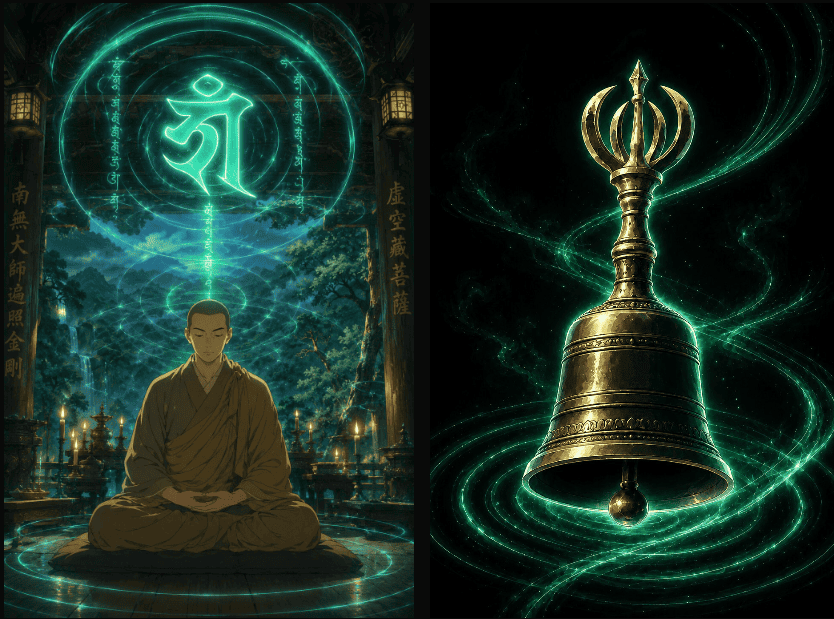
More astonishing still, it is also told that through his practice at Tenkawa and in Ōmine, Kūkai perfected Ajikan, the central meditation of esoteric Buddhism. Ajikan is the fundamental contemplative method of Shingon: through visualizing the single Sanskrit letter “A,” one merges with Dainichi Nyorai, the cosmic Buddha who is the root and source of the universe. The single letter “A” — the beginning of all sound, the symbol of the origin of all things. One holds it in the mind’s eye, settles the breath, and realizes in one’s own body that one’s inner Buddha-nature and the truth of the cosmos are one. That this meditative system, standing at the very core of Japanese esoteric Buddhism, came to fruition in none other than the land of Tenkawa is a fact not to be overlooked when weighing what this shrine means.
Here is something that deserves fresh attention. The letter “A” that Kūkai contemplated at Tenkawa is the sound held to be the beginning of all sounds. As this article has traced from the start, Tenkawa Shrine has been, through and through, a sacred place of sound: beginning with the dance and bell of Ame-no-Uzume, the heavenly maiden descending to the notes of Prince Ōama’s koto, the Isuzu attuning the soul. On that same ground, Kūkai sought union with the cosmos through contemplating “A,” the primal sound. The Shinto faith of sound, and the esoteric Buddhist contemplation of sound. Two spiritualities of utterly different origin resonate deeply with one another, in this land of Tenkawa, at the single point called “sound.” Perhaps it was no mere coincidence that Kūkai chose this place for his practice. May it not be that this genius of his age sensed, with all his keenness, the power that fills this land — the way that leads through sound to the sacred?
And Kūkai left in this land a treasure that had crossed the sea. At Tenkawa Shrine there is preserved, as a relic of his connection, the gokorei — a five-pronged vajra bell, an implement of esoteric ritual that Kūkai is said to have brought back from Tang China. The gokorei is a ritual implement used in esoteric rites: its grip takes the form of the gokosho, the five-pronged vajra whose shaft splits into five points, with a bell fitted beneath. Rung during the rites, its pure sound is held to delight the assembled Buddhas and summon sentient beings toward awakening. Here again — a bell; here again, sound. The Isuzu, descended from the kamiyo bell of Ame-no-Uzume; and the esoteric gokorei that Kūkai carried from Tang China. The bell of Shinto and the bell of Buddhism, handed down at one and the same shrine. The depth of the fusion of kami and Buddhas that Tenkawa Shrine embodies is symbolized to perfection in the coexistence of these two bells.
In addition, the shrine is said to preserve the Daishi-hitsu Hannya Shingyō — a copy of the Heart Sutra held to be in Kūkai’s own hand. That a scripture from the brush of Kūkai, renowned as a master calligrapher, should be handed down at this shrine deep in the mountains itself tells of the depth of the bond between Kūkai and Tenkawa. These objects have been passed down across more than a thousand years as unmoving testimony that Kūkai truly set foot in this land, prayed here, and practiced here.
The bond between Kūkai and Tenkawa continued, in an unexpected form, even after he left this land. On Mount Kōya there are seven shrines of Benzaiten known as the Kōya Shichi Benten — the Seven Benten of Kōya. Of these, the Benzaiten of Dake Benten-sha, seated on the summit of Bentendake, is said to have been ritually invited there by Kūkai from this very Tenkawa Benzaiten Shrine. The heavenly maiden of Chapter Four, who granted victory to Prince Ōama, was led by Kūkai’s own hand to Mount Kōya and became a guardian deity of the sanctuary of esoteric Buddhism. Kūkai, who had practiced at Tenkawa, took the goddess of Tenkawa with him — as a wake-mitama, a divided spirit — to the Mount Kōya he himself would open. Enshrined on Misen by En no Gyōja; summoned by the koto of Prince Ōama; carried to Mount Kōya by Kūkai — here the story of a single goddess closes its circuit on a grand scale.
The Shugendō of En no Gyōja; the esoteric Buddhism of Kūkai. The footprints of two giants — of Japan’s mountain faith and of its Buddhism — cross at the single point called Tenkawa. How many shrines can there be that have laid up sanctity upon sanctity to such a degree? The weight of the legend from Chapter One — “only those who are called can ever reach it” — should now feel entirely different, having confirmed the strata of history one layer at a time. This is a place where, for thirteen hundred years, the highest figures of Japanese spirituality have offered up their prayers, again and again.
The journey back through history pauses here. From the next chapter, let us return our gaze to the “performing arts” this shrine enshrines. In the medieval centuries after Kūkai’s departure, Tenkawa Shrine became inseparably bound to another art that stands for Japan itself — Noh. A lineage carrying the blood of Zeami dedicated to this mountain shrine a Noh mask said to be among the oldest in existence. In the next chapter, we trace that mask, and the memory of Tenkawa as a sacred ground of the performing arts.
Chapter Seven: Thirty Noh Masks and the Bloodline of Zeami
The Shugendō of En no Gyōja; the esoteric Buddhism of Kūkai. Upon the strata of prayer inscribed by these two giants of mountain faith and Buddhism, Tenkawa Shrine, entering the medieval era, laid down yet another brilliant history of the performing arts — Noh, the stage art Japan holds up to the world. To this shrine deep in the mountains have been handed down many precious Noh masks from the formative age of the art, and inscribed at their center is the story of the desperate prayer of a family carrying the blood of Zeami, who brought Noh to its perfection. The essence of Tenkawa that we saw in Chapter Three — sound calls the divine down — here takes on its most concrete form.
Let us first confirm its value as cultural property. Tenkawa Shrine preserves thirty wooden Noh and kyōgen masks, designated Important Cultural Properties of the nation. Thirty is a strikingly large number for the Noh masks held by a single shrine. What is more, they are works of exceedingly high value, dating from the formative age when Noh had only just taken shape, through the Muromachi period. In addition, many precious Noh and kyōgen costumes are preserved here, beginning with a karaori brocade robe said to have been dedicated by Toyotomi Hideyoshi. Among the masks is a shōjō mask carved by Yamazaki Hyōe, a master mask-carver of the early Edo period; Tenkawa Shrine is, as it were, a treasure-house embodying the history of Noh itself. Why did Noh masks and costumes of this caliber gather not at the great temples and shrines of the capital, but at this shrine deep in the Kii Mountains? In the answer to that question, the depth of the bond between Tenkawa and Noh is condensed.
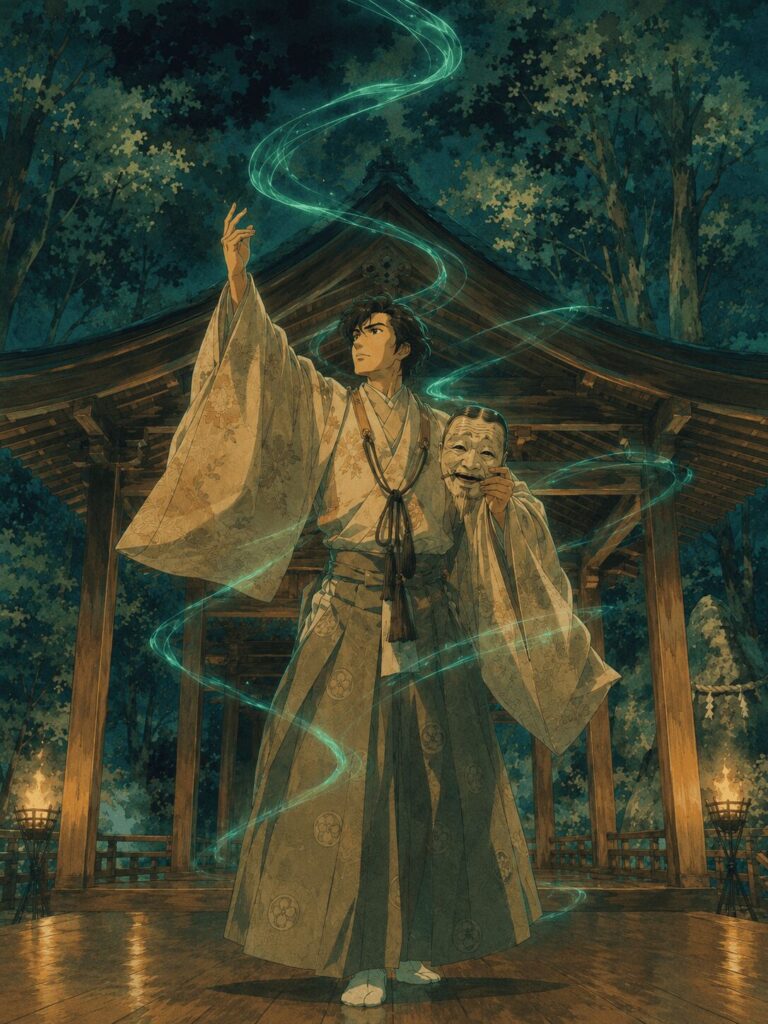
There is one Noh mask that stands as the symbol of that bond. It is called the Akobujō — a jō mask, bearing the countenance of an aged man. Used in portraying gods or noble figures of great age, this mask is a celebrated work of distinguished provenance, said to have been worn by Zeami himself, the perfecter of Noh. The material is camphor wood; the period, from the Nanbokuchō era into the early Muromachi. Its dignified bearing aside, what makes this mask truly singular is a single line of characters written in ink upon its reverse.
There, it reads: “Tōsen — reverently dedicated before the treasured presence of Benzaiten… Eikyō 2, eleventh month. Kanze Jūrō, with reverence.” Eikyō 2 is the year 1430 of the Western calendar. Kanze Jūrō is Kanze Motomasa, the eldest son of Zeami. This mask, in other words, was dedicated before Benzaiten by Zeami’s heir Motomasa, together with a performance of the Noh play Tōsen (The Chinese Ship). Praying that the wish held in his heart be fulfilled and brought to completion — so the ink inscription quietly tells. A few characters written on the back of a single Noh mask carry one Noh actor’s desperate prayer across six hundred years, down to the present.
Why did Motomasa have to offer so desperate a prayer here, in this land of Tenkawa? Behind it lay a family crisis painful enough to be remembered in the history of Noh. Motomasa’s grandfather Kan’ami and his father Zeami had perfected sarugaku under the patronage of the shōgun Ashikaga Yoshimitsu, raising Noh to the heights of art. But when the shogunate passed to Yoshinori, the family’s circumstances turned dark. Yoshinori favored On’ami — Motomasa’s cousin — and brought down merciless persecution upon father and son, Zeami and Motomasa. They were barred from the retired emperor’s palace; stripped of the historic post of gakutō, the troupe’s headship; and the father, Zeami, would in time be banished to far-off Sado. A family that had stood at the summit of glory was robbed, one after another, of its standing and of its stages.
In the midst of that adversity, Motomasa staked everything on a revival. And the place he turned to was this Tenkawa Shrine — flourishing in kagura, enshrining the deity of the performing arts. Motomasa, who by one account came at the bidding of his father Zeami, traveled all the way to this mountain shrine, danced Tōsen on the Noh stage before the deity, dedicated the Akobujō mask, and prayed with a single heart for the restoration of his family’s art. One who lives by the way of the performing arts, offering up everything in prayer to the very deity who is the source of those arts — the history of performance at this shrine, begun in the possessed dance of Ame-no-Uzume, here crystallized, nearly a thousand years on, as the prayer of a genius actor carrying the blood of Zeami.
But the ending of this story is a painful one. Motomasa, who had prayed for revival, is said to have died — his prayer unanswered — a mere two years after the dedication, in Eikyō 4 (1432), at Anotsu in Ise, a stop on a touring performance, while still in his early thirties. It was a death far too early, at the very height of his powers as an actor. His father Zeami, devastated by the death of this heir whose talent he had loved above all, left behind a memorial text, Museki Isshi — “A Page of Dream Traces.” In it Zeami mourned Motomasa without stinting: “though my own child, a master without peer,” and further, “an adept surpassing even his grandfather” — a master exceeding even the late Kan’ami. And in the depths of that grief, Zeami himself was banished to Sado two years later, in Eikyō 6 (1434), at the age of seventy-two. To lose his successor, and then to be made an exile himself — the family’s suffering deepened as if the bottom had fallen out of it. The Akobujō mask dedicated at Tenkawa is, for that reason, also the keepsake of a prayer that went unfulfilled. The hope and the bitter regret of one genius actor who danced believing in his revival — this mask holds them quietly still, behind the dignified countenance of its old man’s face. Today, the Akobujō and the other masks are all kept from public view, and they rarely meet human eyes. But the very fact that they are preserved at this shrine speaks eloquently of what a singular sanctuary Tenkawa was for those who lived by the performing arts.
The shrine’s official account of its origins records Tenkawa’s bond with the performing arts in words of pride. The grove of the Tenkawa sanctuary, it says, has been revered as iwasaka — a sacred precinct of stone — and as manai, a sacred wellspring; and the whole of it is “a consecrated garden (yuniwa) that responds in sympathy to the resonance of sublime sound (myōon).” And from antiquity, it continues, sarugaku and dengaku were dedicated in this land to pacify malevolent spirits and to honor the ancestral dead, and this place has been held to be “a sacred ground of the unity of god and human (shinjin gōitsu).” A place where gods and human beings melt into one through the medium of the performing arts. No words could state more plainly the essence of Tenkawa we saw in Chapter Three — that sound calls the divine down. If Motomasa dedicated the Akobujō here, it was precisely because this was that “consecrated garden of the unity of god and human”: because he believed that here, through art, his prayer would reach the deity.
And what deserves special note is that this tradition of the performing arts is by no means a relic of the past. At Tenkawa Shrine, to this day, Noh continues to be dedicated before the deity at the grand festival each July and at the great spring and autumn festivals, performed by Noh actors of the five shite schools, the Kanze school among them. On the Noh stage of this mountain shrine, exactly as six hundred years ago, Noh is danced as an offering to the divine. In the same place where Motomasa dedicated the Akobujō, living art continues even now as prayer to the deity. Tenkawa is at once a museum preserving the memory of the age when the performing arts were sacred rite, and a rare working sanctuary where that memory is still alive and still performed.
En no Gyōja, Kūkai, and the bloodline of Zeami. Shugendō, esoteric Buddhism, and Noh. Into the single shrine called Tenkawa flow, layer upon layer, the deepest currents of Japanese spirituality and Japanese performing art. But this thickness of history is in no way confined to the distant past. In the next chapter, let us move the hands of the clock forward, all at once, to the present. To this shrine where Motomasa offered his prayer, artists of every genre continue to be drawn even now, as if led here. Sakamoto Ryūichi, Matsutōya Yumi, Nagabuchi Tsuyoshi — we make our way into the story of the strange bonds between Tenkawa Shrine and the artists of our own time.
Chapter Eight: The Artists Who Are Called
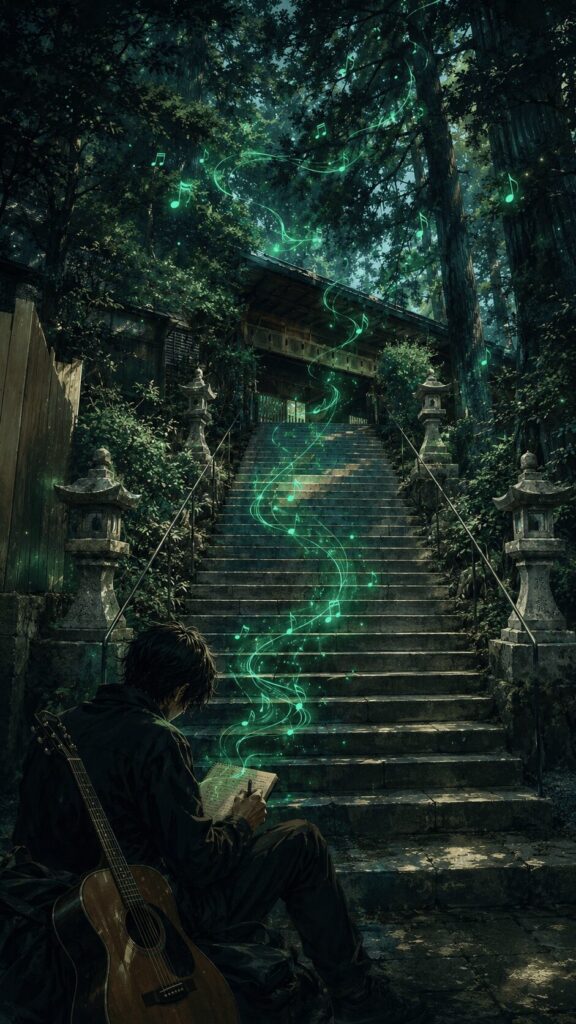
Roughly six hundred years have passed since Kanze Motomasa dedicated the Akobujō mask. The times have turned, and the same mountain roads the Noh actors once walked are now climbed by the artists of the present day. With a magnetism unchanged from its days as the sacred ground of medieval Noh, Tenkawa Shrine continues to draw musicians and performers even now. Why does this shrine of the deity of the performing arts attract artists across the ages? How does the essence we saw in Chapter Three — sound calls the divine down — breathe in the present? In this chapter, I want to trace the stories of artists who have left verifiable footprints here.
Among present-day artists, the one bound most deeply and most concretely to Tenkawa Shrine is, first of all, Dōmoto Tsuyoshi. Born in Nara Prefecture, Dōmoto is known to have made this shrine a spiritual anchor for some twenty years, visiting it again and again. That bond bore its most vivid fruit in “Eni o Yuite” (Tying the Bonds), a song released under his solo name in April 2011. He is said to have written the original draft of its lyrics during a stay at Tenkawa Shrine. Nor is that all: the recording of the song, and even the shooting of its music video, took place at this shrine. A song conceived at a mountain shrine of the deity of the performing arts, and given its form on that same ground. The very title — “Tying the Bonds” — seems quietly to embody the divine virtue of Tenkawa, which binds person to god and person to person. An artist placing himself within a sanctuary and bringing forth a work there: in essence, it differs not at all from Motomasa dancing Tōsen at Tenkawa.
Another artist with a confirmed bond to Tenkawa Shrine is Nagabuchi Tsuyoshi. Several episodes attesting to his connection with Tenkawa have been handed down. One concerns the ceremony held at the rebuilding of the main sanctuary in 1989, the first year of the Heisei era. This solemn rite is said to have been performed in the presence of celebrated musicians, among them Nagabuchi Tsuyoshi and Hosono Haruomi, known for Happy End and Yellow Magic Orchestra. To stand witness at the renewal of the main sanctuary — the most sacred place a shrine possesses — itself tells of the depth of their bond with this shrine. Further, Nagabuchi Tsuyoshi is also said to have held his wedding at Tenkawa Shrine. To mark one of life’s great thresholds before this mountain deity of the performing arts — that, one may say, is the expression of a trust that goes beyond any single visit.
Beyond these two, the artists spoken of as having ties to Tenkawa Shrine are too many to count. Matsutōya Yumi, Sakamoto Ryūichi, Matsuyama Chiharu, Kitarō — artist after artist whose names are written into the history of Japanese music is said, in one telling or another, to have made the pilgrimage to this mountain shrine. To be sure, some of these accounts rest on firm records, while others do not rise above hearsay. There would be little point in prosecuting the truth of each one. What matters is the fact itself: that the names of so many artists of the first rank have come to be spoken, entirely naturally, around this single shrine called Tenkawa. Why Tenkawa, of all places? That question is the essential one.
Why are artists drawn to Tenkawa? Part of the answer lies in the very character of this shrine, as the preceding chapters have shown. The principal deity of Tenkawa Shrine, Ichikishima-hime-no-mikoto, is — as Benzaiten — the deity presiding over music, art, and the performing arts. Her roots lie in Sarasvatī, the goddess of sound, the deification of the murmuring of flowing water. For one who makes a living by expression, to offer prayer to the deity of the performing arts is surely the most natural of impulses. But the reason Tenkawa draws artists lies somewhere beyond the simple fact that “it is a shrine with blessings for the performing arts.”
As we saw in Chapter Three, superior expression often arrives from beyond the calculations of the ego. In the moment something truly good is born, the maker’s experience is less “I am making this” than that something “comes down,” that one is “being made to make it.” As Ame-no-Uzume danced in divine possession, at the core of creation there is a moment of surrendering oneself to something greater. Tenkawa Shrine is a rare place that has affirmed this sensation of “coming down” head-on, and has enshrined it as sacred for more than a thousand years. That, surely, is why artists who grapple daily with the secret of creation that logic cannot exhaust feel, before this shrine, a deep assent that does not resolve into words: this is the place where the true identity of what I do every day is enshrined.
In addition, the harshness of the road to Tenkawa, which we have seen since Chapter One, is surely not unrelated to its pull on artists. A shrine of stillness, embraced by clear streams, reached at last only after crossing fold upon fold of mountains, far from the clamor of the city. Cut off completely from the everyday, this place grants its visitors the deep quiet and concentration that creation requires. In a modern society saturated with information and stimulus, it grows ever harder to listen for one’s own inner voice. The mountain stillness of Tenkawa offers an environment without equal for an artist to reconnect with the deepest part of the self. As Dōmoto Tsuyoshi brought forth “Eni o Yuite” in this land, this is a place for returning to the wellspring of creation.
The fact that Tenkawa Shrine continues to draw the artists of the present is the surest proof that the faith this shrine has carried is no relic of the past. The dance of Ame-no-Uzume, the koto of Prince Ōama, the Noh of Motomasa, and the music of today’s artists. The medium, the style, the age all differ, but running through them is one and the same undertaking: to commune, through sound and expression, with something beyond human understanding. Tenkawa Shrine is a living sanctuary where that undertaking has continued unbroken for thirteen hundred years. The deity of the performing arts is calling new artists still.
Now — in the chapters so far, we have traced the deities of Tenkawa Shrine, its sacred treasures, its history, and the people who gather there. From the next chapter, let us turn our gaze once more to the “place” itself on which this shrine stands. Within the precincts of Tenkawa Shrine there is a singular structure of sacred space known as the Shiseki Sansui Yatsu no Mori — “the Four Stones, Three Waters, and Eightfold Grove.” And scattered within it are stones of mystery said to have fallen from the heavens — the tenseki, the heaven-stones. Beginning with those stones, over which a strange sensation is said to envelop the hand held above them, we now make our way into the spatial structure of Tenkawa as sacred ground, where visitors speak of sensing “vibrations” and “ki.”
Chapter Nine: The Four Stones, Three Waters, and Eightfold Grove
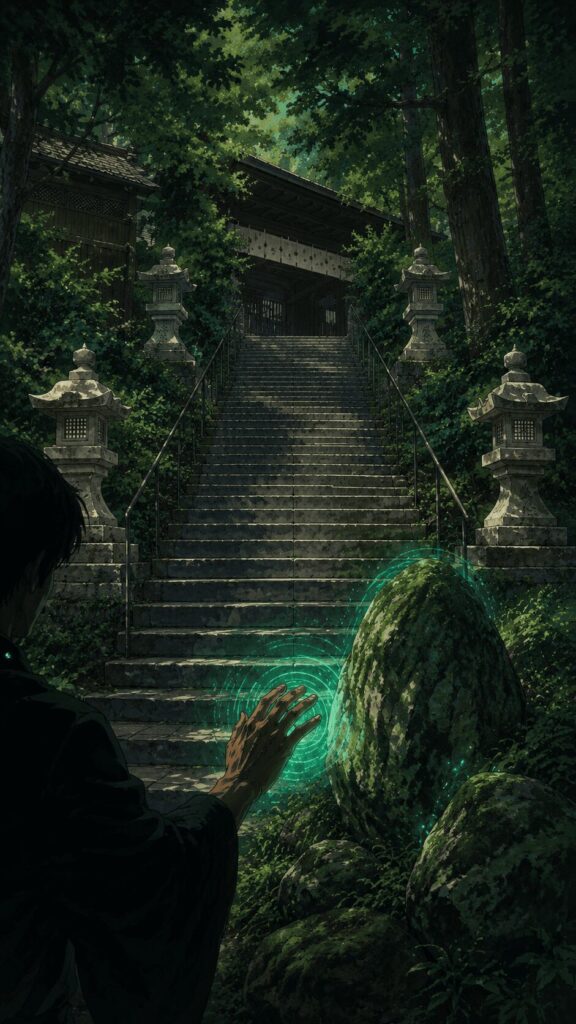
Thus far we have traced the deities of Tenkawa Shrine, its sacred treasures, its history, and the people who gather there. In this chapter, I want to turn our gaze to the “place” itself on which this shrine stands — to the spatial structure of its precincts. For the precincts of Tenkawa Shrine are not simply grounds on which buildings happen to sit. They carry a deliberate design of sacred space, founded on a clear body of thought and known as the Shiseki Sansui Yatsu no Mori — “the Four Stones, Three Waters, and Eightfold Grove.” And scattered at its heart are stones of mystery, over which visitors say they sense “vibrations” and “ki.” Let us make our way into the world of the tenseki — the heaven-stones — which so many visitors, it is said, cannot help but go and test for themselves.
“The Four Stones, Three Waters, and Eightfold Grove” is the phrase that describes the sacred precinct of Tenkawa Shrine: four stones fallen from the heavens, three welling springs of pure water, and eight groves — the area these enclose is held to be the holy ground. What the phrase reveals is that the sanctuary of Tenkawa was conceived not as a single shrine building, but as one great kekkai — a sacred enclosure — woven of the natural elements of stone, water, and grove. The stones fallen from heaven bring divine power down to earth; the welling springs water the land and set life circulating; and the eightfold grove wraps and guards the whole. A space like a living mandala, in which heaven, earth, and all of creation are one body: that is the sacred precinct of Tenkawa.
Among all of this, what seizes the visitor’s heart most strongly are the “four stones” — the tenseki. The tenseki are stones said, quite literally, to have “fallen from the heavens,” and they are venerated as iwakura — stones in which a deity dwells. Of the four tenseki said to exist, three are enshrined within the precincts, where worshippers may visit them. The remaining fourth is said to lie in the Tennokawa — the “River of Heaven” that flows beside the shrine — though which stone it is, no one now knows for certain. Of the four stones that fell upon this holy ground, one alone rests beyond the reach of human eyes — and that fact, if anything, quietly deepens the sense of this precinct’s recesses, and of a mystery not yet unraveled.
The three tenseki enshrined in the precincts rest each in a place of different character. One stands to the right of the stone stairway leading up to the worship hall. One stands at the left of the landing at the top of the steps, before the Gosha-den, the Hall of the Five Shrines. And one stands in the innermost grounds beyond the main sanctuary, beside the Gyōja-dō, the hall enshrining En no Gyōja. To visit these stones one by one, scattered as they are along the path of worship, becomes in itself a small pilgrimage — a way of tasting the sacred precinct of Tenkawa with one’s own body. At first glance they are nothing more than natural stones, simply there. But in their bearing — venerated for thirteen hundred years as “stones of the gods, fallen from heaven,” and having received prayers beyond counting — there drifts, unmistakably, an air that is not ordinary.
Around these tenseki, visitors have offered up a number of striking accounts. The most often told concerns the sensation of holding a hand over the stone. There are those who say that when they brought a hand near the stone just to the right inside the torii, the palm grew warm, with a tingling heat. Others say that standing before the stone, they felt as if the very density of the air were different in that one spot. It is easy to dismiss such sensations as fancies without scientific basis. But the fact that so many visitors, each independently, go on reporting sensations of a similar quality is not something to be handled lightly. At the very least, it is certain that many people sense in this place some power that works upon the senses of those who come. Whether to call it “vibration,” or “ki,” or to take it as the psychological effect that a sacred place produces, is left to each person’s own way of receiving it.
In speaking of the mysterious space of Tenkawa Shrine, there is one more term that cannot be left out: “zero magnetic field.” A zero magnetic field denotes a singular place where the earth’s magnetic fields are said to cancel one another out, so that a compass needle cannot settle; the term is often invoked as the emblem of a power spot charged with strong energy. In the environs of Tenkawa Shrine, too, there is said to be a point called a zero magnetic field. Best known is Raigō-in, which stands immediately beside Tenkawa Daibenzaiten Shrine. There remain, in fact, accounts of visitors who came to this place, held up a compass, and watched to see how it behaved. The needle would not settle; it wavered and swung — and such experiences are passed on as testimony to the singularity of this ground.
Here, the story of Kūkai from Chapter Six rises up again, unexpectedly. At this Raigō-in stands the Ajikan stele — a monument inscribed with the inmost essence of Shingon esoteric Buddhism, which Kōbō Daishi Kūkai is said to have realized in his body through his practice at Tenkawa. Centered on the Sanskrit letter “A,” symbol of the source of all things and of the cosmos itself, and inscribed with the characters of the Kōmyō Shingon, the Mantra of Light, this stele is the very crystallization of the state Kūkai attained in the land of Tenkawa. The singular space called a zero magnetic field, and the esoteric sanctuary of contemplating the root of the universe, overlap in the one and same place called Raigō-in. Something that science cannot measure, something beyond human understanding — Kūkai sensed it keenly more than a thousand years ago, and the visitors of today are reaching to sense it still. Is it not the very fact that people across the ages have gone on feeling “something” in the same place that speaks, more eloquently than anything, of this land’s unfathomable power?
The structure of the sacred precinct called the Four Stones, Three Waters, and Eightfold Grove; the stones fallen from the heavens; the singular point called a zero magnetic field. What these hold in common is the recognition that the place called Tenkawa Shrine is, before ever being a religious institution made by human hands, first of all “a land in which nature itself is charged with sacred power.” Recall once more the official words we saw in Chapter Three: the grove of the Tenkawa sanctuary, the tradition says, is in its entirety “a consecrated garden (yuniwa) that responds in sympathy to the resonance of sublime sound.” Stone harbors divine power, water sets life circulating, the grove enfolds the whole, and that whole responds to the sublime resonance — Tenkawa Shrine is not the single point of a shrine building, but a place where the space of this sacred precinct itself, like one enormous instrument, goes on sounding a holy resonance. The “vibration” visitors say they feel when they hold a hand over a tenseki may be one small part of that resonance.
If the tenseki of the precincts and the zero magnetic field embody the mystery of Tenkawa in, so to speak, “visible” form, this shrine holds yet another world — one in which, within a still deeper silence, visitors undergo experiences that do not resolve into words. In the next chapter, we close in at last on the heart of the strange stories surrounding Tenkawa Shrine. The unidentifiable sound said to have rung out overhead at the moment of ascending into the hall. The shrine a visitor found herself having wandered into. And the small but unforgettable irregularities said to have occurred after returning home from the pilgrimage. Into the core of Tenkawa’s mysteries — told only by those who arrived — we now step.
Chapter Ten: What Happens During the Visit
Up to this point, tracing the sacred treasures, the deities, the history, and the spatial structure of Tenkawa Shrine, we have confirmed, one layer at a time, the background against which so many mysteries gather at this shrine. That it is a sanctuary of communion with the divine through sound. That stones fallen from the heavens compose its sacred precinct. That it is a shrine which welcomes the oni in. With those layers of background in place, in this chapter I want at last to listen to the strange experiences themselves, as the visitors actually tell them. Let it be said in advance: everything introduced here is something individual visitors have recounted and written down as their own experience. Their truth cannot be proven. But in the very fact that so many people, each independently, go on telling of experiences of a similar quality, the singularity of the place called Tenkawa is reflected.
Most often told are experiences having to do with “sound.” One might say these are mysteries fitting for Tenkawa Shrine, the sanctuary of sound. One visitor left this account of receiving a formal blessing inside the worship hall. When the norito — the ritual invocation — began, a tremendous sound rang out from somewhere above and to her left: a violent cracking, “baki-baki-baki.” A sound like a building groaning, like something bursting — a sound whose source could not be placed. It is the phenomenon commonly called a rapping sound; but it occurred overhead at the same moment the norito was being intoned. At a shrine enshrining a deity of sound, at the very instant words of prayer were being offered, an inexplicable sound rang out — whether to dismiss this correspondence as mere coincidence, or to receive it as some kind of answer, is left to the feeling of the one who was there.
The same visitor also set down a strange experience from the road there. Driving by the car’s navigation, she was led onto a mountain road so narrow that two cars could not pass each other. Ordinarily this would chill the blood; but strangely, every time she met an oncoming car, it was always — without exception — at a stretch wide enough to pass. On the narrow defiles she met not a single oncoming car, and as if guided by something, without once being brought to a standstill, she slipped through and arrived at the shrine. One might call it a concrete instance of the sense of being “called” that we saw in Chapter One.
The experience of “a guided going-astray” is also often told. One visitor unexpectedly mistook the order of the worship route and walked off in a direction she had not planned. Where she came out, she found herself in a corner of the grounds that even her companion — a friend well versed in shrines across the country — had never once set foot in, and the two looked at each other in surprise. And just as they turned to retrace their steps, a gust of wind came suddenly sweeping down from the mountain. The wind whirled up the fallen leaves and sent them rattling across the ground. Standing in that wind, the visitor wrote, she felt cleansed — as if she had received misogi, ritual purification, by the wind itself. To stray from the path one had meant to follow, and there to meet an experience that stays in the heart — at Tenkawa, such “guided wanderings” are told again and again.
Nor do the mysteries confine themselves to the visit itself. In the case of Tenkawa Shrine, accounts of things that happened after returning home are strikingly numerous. One visitor wrote about her trip to Tenkawa and posted it on her blog. After that, she says, odd things began to occur. When she switched on her computer, though no one had changed any settings, the start screen had at some point become a photograph of the torii of Tenkawa Shrine. And not once only — it happened again and again, she writes. She adds that she began to have recurring dreams of visiting Tenkawa Shrine, over and over. The pilgrimage finished, the everyday supposedly resumed — and yet the presence of Tenkawa goes on clinging to you afterward. This “afterglow upon returning home” forms one of the great hallmarks of Tenkawa’s mysteries.
Looking at these accounts, one notices several recurring patterns. One — as we have just seen — is the pattern of “the bond continuing after one returns.” The shrine appears again and again in dreams. Tenkawa comes to mind at odd, unguarded moments. The desire to visit again wells up irrepressibly. It is as if those once “called” to Tenkawa remain joined to this shrine, long afterward, by an invisible thread. The story we saw earlier — Dōmoto Tsuyoshi holding this shrine as a spiritual anchor across twenty years — might also be seen as one expression of this “continuing bond.”
How, then, should we receive these strange accounts? One stance is to dismiss them all as coincidence, as suggestion, as imagination. The rapping sound may be a natural phenomenon of building materials responding to changes in temperature. The going-astray was simple carelessness, and the wind merely weather. The computer screen changed through some error of settings. Such explanations are certainly possible. But there is another stance: to respect the very “way of feeling” of those who tell these experiences. Met with the same natural phenomenon, there are places where one feels “mere coincidence” — and places where one cannot help feeling “I was guided by something.” Tenkawa Shrine is, unmistakably, the latter. Why? Because, as this article has traced throughout, this shrine carries the staggering thickness of thirteen hundred years of accumulated history — of sound, of stone, of water, of oni, of prayer. That thickness hones the senses of those who come, and lets them find special meaning in small events they would ordinarily pass over.
In other words, may it not be that strange experiences are told at Tenkawa Shrine because this is a place that opens human receptivity to its fullest? The mountain stillness, the murmur of clear streams, the stones fallen from heaven, the prayers to a deity of sound — all of it switches the visitor’s mind into a mode utterly unlike the everyday. And when one faces the world with senses thus honed, noises and winds and coincidences that would ordinarily go unremarked suddenly rise up charged with meaning. One can call that “imagination”; one can call it “the answer of the gods.” There is probably no point in deciding which is correct. What is certain is that the place called Tenkawa Shrine holds the power to make people undergo such experiences. And that power is itself the true identity of Tenkawa’s mystery — the thing that has gone on calling people to this land for thirteen hundred years.
These personal, inward experiences, said to occur during the visit and after returning home — they tell us that Tenkawa Shrine is no mere tourist destination, but a sanctuary that works deeply upon the inner life of those who come. In the next chapter, let us walk to one more special place, where that sanctity of Tenkawa is said to dwell with particular density: the Misogi-den, the Hall of Purification, standing in stillness a little apart from the main sanctuary. And into what lies hidden there — the male stone and the female stone, and the Tanabata legend of Orihime and Hikoboshi, the Weaver Maiden and the Herd Boy — we now make our way.
Chapter Eleven: The Misogi-den and the Weaver Maiden of Tanabata
The sanctity of Tenkawa Shrine is not confined to the central precincts where the main sanctuary stands. If anything, the deepest part of its mystery may dwell precisely in the quiet, little-frequented stillness a short distance away. In this chapter, let us walk to the Misogi-den — the Hall of Purification — standing on the bank of the clear stream called the Tennokawa, and make our way into the beautiful Tanabata story hidden there: a story of stars, of water, and of weaving.
From the precincts where the main sanctuary stands, it is a walk of about ten minutes along the Tennokawa. Some five hundred meters on, deep along the riverside, a hall stands in quiet seclusion: the Misogi-den, also called the Chinkon-den, the Hall of Spirit-Pacification. It is the riverside hall of the previous chapter — the one a visitor told of reaching without ever having planned to. The shrine’s own official guidance, too, urges visitors to make their way not only to the main sanctuary but also to the Gosha-den before the stone steps of the approach, and to the Misogi-den, about ten minutes’ walk from the precincts. Removed from the brightness of the main sanctuary, with only the murmur of the clear stream sounding, this place is — as its name declares — a sanctuary of deep stillness, for the purifying of body and mind and the calming of the soul. Many visitors say that when they place themselves at the Misogi-den, they sense a honed quietness different again from that of the main sanctuary.
The Tennokawa flowing before the Misogi-den is beautiful enough to stop the breath. Transparent emerald-green water slides unhurried between the rocks. In the gentler seasons, one may see families pitching tents on the far bank, or people enjoying river fishing. Merely gazing at that limpid current, visitors say with one voice, feels like having the heart washed clean. That Benzaiten was, in her origin, a goddess of water — here one understands it on the skin. The very sound of the stream’s murmuring is the voice of this shrine’s deity.
And when one looks from the Misogi-den across the Tennokawa, a particular rock can be seen out in the river: a sacred spot known to those who know, called the Rokkaku-iwa — the Hexagonal Rock. True to its name, this six-sided rock sits at just the point where the Tennokawa curves and meets the land. Standing where the river’s current bends and where elements topographical and mystical fold over one another, the Rokkaku-iwa has from old times been an object of the local people’s faith. Resting quietly in the middle of the clear stream on the far bank from the Misogi-den, this rock speaks softly to those who look on it of a sanctity utterly unlike any built sanctuary — the sanctity that nature itself harbors.
This clear stream, the Tennokawa, brings Tenkawa Shrine one more beautiful story: the legend of Tanabata, the festival of the stars. The “Tennokawa” — the River of Heaven flowing upon the earth — and the “Amanokawa” — the River of Heaven hung across the night sky, the Milky Way. Two rivers, bearing the same name, flowing parallel — and that correspondence drew the story of the stars down into this land. The Tanabata legend handed down at the shrine tells it this way. In the age of the gods, when the night of Tanabata came, the Benten enshrined at Tenkawa Shrine and Gozu Tennō, who rests at the Yasaka-sha on the far bank of the Tennokawa, would converse together with many gods upon a stone in the river called the Mushiro-iwa. The earthly Tennokawa and the heavenly River of Heaven overlap, and the stars of the night sky are mirrored on the face of the clear stream — that visionary scene sets the Tanabata legend off all the more beautifully.
What is fascinating here is that the Mushiro-iwa, the stage of that divine conversation, is held to be one of the tenseki — one of the four heaven-stones we saw in Chapter Nine. According to what the shrine hands down, in the far past, on a night of the Boar (inoko), four stars — meteorites — fell around Biwayama, the “Lute Mountain” where Benten is enshrined. Those four stones are the very “four stones” of the Four Stones, Three Waters, and Eightfold Grove, and the Mushiro-iwa, it is said, is one of them.
A beautiful origin is also told for the name of this Biwayama, the mountain where Benten is said to rest. According to the Yamato Meisho Zue, an illustrated gazetteer of the mid-Edo period, when En no Gyōja set out to open the perilous paths of Ōmine, he first prayed on this mountain for a sign of divine power — whereupon a pure spring welled flowing from a hollow in the rock, and the divine spirit shone forth in a ring of light. And from that holy ground there sounded a resonance like the tone of a biwa, which swept away the clouds of confusion from people’s hearts; and from this, the story goes, the mountain was named Biwayama. Here again, the “sound” that rings through a sacred place is told of as a power that purifies the human heart. When one remembers that Benzaiten is the goddess of music who cradles the biwa, that the mountain where she rests should bear the lute’s name is almost too fitting.
In other words, a divine stone fallen from the heavens serves as the sacred seat where the gods of the stars gather once a year. Stones fallen from heaven, the earthly Tennokawa, the heavenly River of Heaven, and the conversing of gods bound to the stars — heaven and earth and water and stars are joined, inseparably, at this single point. And when one recalls that the very name of the shrine — Tenkawa, “the River of Heaven” — derives from this same river, the Tanabata story takes on a meaning that reaches down to the very root of the shrine’s name.
To this Tanabata legend an elegant sequel is appended. Ariwara no Narihira, the great poet of the Heian court, has been linked in local telling to this land’s Tanabata tradition. Narihira has a celebrated poem: “Karikurashi / tanabatatsume ni / yado karamu / ama no kawara ni / ware wa kinikeri” — having hunted the day to its close, I shall beg lodging of the Weaver Maiden tonight, for I have come to the riverbed of the River of Heaven. The poem itself is preserved in Ise Monogatari (The Tales of Ise) and the Kokin Wakashū, and is generally held to have been composed elsewhere; but at Tenkawa, this song of the tanabatatsume — the weaving woman — has long been told as one with the local Tanabata legend. According to what the shrine relates, Narihira would come every year on the night of Tanabata to visit a woman of the village of Tenkawa who was skilled at the loom; and Narihira’s grave, it is said, remains near Tenkawa Shrine to this day. Upon the story of the conversing star-gods is laid the love legend of a courtly poet. The Tanabata of Tenkawa forms a story layered rich and many-fold, in which myth and the literature of the court have melted together.
Enshrining Benzaiten, a goddess of water; taking its name from the River of Heaven; making stones fallen from the sky its sacred precinct; handing down the Tanabata of the star-gods — seen in this light, it becomes clear how deeply the shrine called Tenkawa is woven of the images of “heaven,” “water,” and “stars.” As we saw in Chapter Four, Benzaiten was originally Sarasvatī, goddess of flowing water. That goddess of water rests on the bank of an earthly clear stream; that stream overlaps with the River of Heaven in the night sky and calls the stories of the stars down to earth. The stillness of the Misogi-den, the bearing of the Rokkaku-iwa, the legend of Tanabata — all of these are different expressions of the one fact that Tenkawa is “a sanctuary of water binding heaven and earth.”
And now this article draws near its close. We began with the riddle of the Isuzu clutched in the hand of the man who died in Shinjuku; we entered through the legend that “only those who are called can go”; and we have traced the deities of Tenkawa Shrine, its treasures, its history, the people who gather there, the mysteries of its precincts, and now the Misogi-den and the story of Tanabata. In the final chapter, carrying everything we have seen, I want to set down a practical guide to the visit, for those who will actually travel to this shrine. The fortune-slips written in ancient word-spirits; the amulets of the deity of the performing arts; the hot springs and lodgings. And at the very end, let us return once more to that question: what does it truly mean, to be “called”?
Chapter Twelve: A Pilgrim’s Guide — and What It Means to Be Called
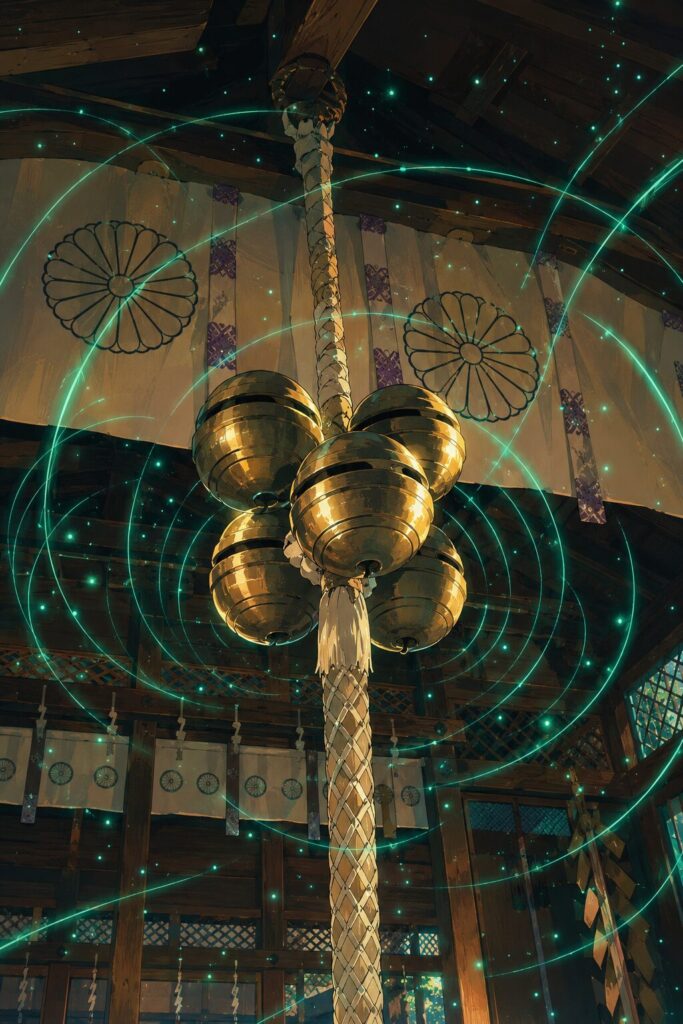
Across eleven chapters, we have traced the shrine called Tenkawa Daibenzaiten-sha: its sacred treasures, its deities, its history, its performing arts, the mysteries of its precincts, and its many strange tales. In this final chapter, carrying all of that journey with us, I want to set down a practical guide for those who will actually visit this shrine. And at the very end, once more — and only once more — let us return to the question from which this journey set out. What does it truly mean, to be “called”?
First, the practical facts of getting there. By public transportation, the starting point for Tenkawa Shrine is Shimoichiguchi Station on the Kintetsu Yoshino Line. From the station, take the Nara Kotsu bus bound for Nakaiosumi and alight at the “Tenkawa Daibenzaiten-sha” stop — the shrine is just there — but this bus runs only a few times a day. As touched on in Chapter Two, missing one can cost you several hours, so be sure to check the timetable before setting out. By car, it is about two hours from central Osaka. The latter half is a long succession of narrow mountain roads, and in winter the surface freezes, so depending on the season, winter equipment is indispensable. The shrine’s parking lot holds about thirty cars. On weekends and holidays it fills quickly, so it is wise to come with time to spare.
Amulets and goshuin seals are dispensed at the shrine office roughly from 8:00 in the morning to 4:30 in the afternoon. For those wishing to receive a formal blessing, same-day requests are not accepted; one must reserve by telephone at least two days in advance. On festival days and on days of volunteer work at the shrine, blessings may not be available, so confirming beforehand is the safe course. The statue of Benzaiten enshrined in the main sanctuary is, moreover, ordinarily withheld from view, and is unveiled only at the grand festival held each year on July 16 and 17. If you wish to stand face to face with the central image of this shrine, timing your visit to this season is one way to make the pilgrimage.
The manner of worship, too, holds points of interest particular to this shrine. Worship at the front hall follows a one-way path: enter from the left as you face the hall, and when your prayers are finished, pass out to the right. And above all, what you will want to experience at this shrine is to ring, with your own hand, the sacred treasure we saw in Chapter Two — the Isuzu. Before the worship hall hangs an Isuzu for visitors to ring. To make this bell sound beautifully, however, takes a small knack. According to those who have visited: do not simply shake it. Set strength in your belly, push it slightly forward, and then draw it back toward you with a turning motion — and a clear tone will ring out, like the murmuring of a stream. Surprisingly few people, it is said, manage to ring it well — so by all means, try. For that sound, as we saw in Chapter Two, is the special resonance that attunes the three souls: iku-musubi, taru-musubi, tamazume-musubi.
Among the amulets, the one to seek above all is the Isuzu-mamori — an amulet in the form of the Isuzu itself. Made of brass, it sounds a translucent tone each time it sways on the body. For those who walk the road of the performing arts, of course, but equally for anyone who prays for the harmony of the soul, it may be called the amulet most fitting to this shrine. In recent years it has grown popular; some items run low, and at times, it is said, they are dispensed with priority to those who have come in person to worship. If one comes into your hands, treasure it — and count that, too, as a “bond.”
And the fortune-slip of this shrine is a singular thing, rarely to be met with elsewhere. Called the Kodai Kotodama Gotakusen — the Oracle of the Ancient Word-Spirit — it is written, true to the “ancient” in its name, in archaic, recondite language and flowing cursive script, like some old manuscript. Unless you are at home with classical Japanese, you may make out little more than whether the fortune is good or ill — it has even been called “the hardest fortune-slip in Japan to decipher.” Moreover, the explanatory notice posted before one draws is said to read, “This oracle is written sternly” — which puts a certain tension into the one about to draw. If you cannot read your slip, ask a priest at the shrine office for its meaning. To inquire of the divine will through ancient word-spirits, at a shrine of the deity of the performing arts and of eloquence — that fortune-slip, you will likely feel, carries a special weight, as if turning your gaze back upon the course of your own words and your own expression.
When your worship is done, do extend your steps to the sacred places nearby. The Misogi-den, about ten minutes on foot — seen in Chapters Nine and Eleven — and the Rokkaku-iwa on the bank opposite offer a stillness and mystery different again from the main sanctuary. And at Raigō-in, facing the shrine’s torii, towers a giant ginkgo said to have been planted by the hand of Kōbō Daishi Kūkai himself — its age put by some at over eight hundred years, by others at over twelve hundred. From its form, branches spread wide enough to hide the temple hall from view, one feels an overwhelming force of life. Stand before this ancient tree recalling the story of Kūkai from Chapter Six and the zero magnetic field from Chapter Nine, and the feeling will run all the deeper.
If you have leisure to go further still, make for Dorogawa Onsen, about twenty minutes by car from Tenkawa Shrine. This is a hot-spring town of long history, grown up as a lodging post for the ascetics who challenge Mount Ōmine. The pure water that only so deep a mountain country yields, and the air of the onsen streets still thick with the presence of Shugendō, are a fitting close to the Tenkawa pilgrimage. If you wish to savor unhurriedly a land that a day trip rushes through, stay a night at Dorogawa Onsen and visit Tenkawa Shrine in the clear air of the following morning — a way of making the rounds that will stay in the heart.
And so — thank you for keeping company on this long journey. At the last, let us return once more to the question from which it set out. “Only those who are called can ever reach Tenkawa Shrine.” What, in truth, does this legend mean?
Those who have read this far may already know. To be “called” is by no means a matter of a god capriciously sorting one person from another. It is, rather, the human heart answering to the staggering thickness and depth that this shrine has laid up over thirteen hundred years. The mountain of Shugendō that En no Gyōja opened. The esoteric sanctuary where Kūkai contemplated the letter “A.” The shrine of the performing arts where Motomasa, of Zeami’s blood, offered up his prayer. The Isuzu, descended from the bell of Ame-no-Uzume. The stones fallen from heaven; the Tanabata river where the star-gods converse; the shrine that receives the oni as a guest. Places where prayer and story have folded over one another to such a depth are not many in this world. That thickness hones the receptivity of those who come, and lets them read meaning in small signs they would ordinarily pass over. To find “guidance” in a coincidence on the road; to hear an “answer” in a sound caught at the shrine; to feel a “binding” in the bond that continues after returning home. Is this not the true identity of the phenomenon called being “called”?
If so, then whether one is “called” is not a question for the god’s side alone. It is also the question of whether the heart of the one who comes stands ready to face the depth of this shrine. The door opens precisely before the one who wishes it open. In the moment the thought first stirs in you to set out for this shrine deep in the mountains, you may already be half “called.” That small Isuzu, clutched in the hand of the man who died in Shinjuku. The faint sound its three spheres ring — might it not, even now, be reaching faintly to you who read this? And if that sound moves your heart — then, by all means, go: deep into the mountains of Nara. The goddess of the performing arts is waiting for you, on the bank of a clear stream.

They say only the chosen reach Tenkawa──
but honestly? The tricky part is the bus.
Tenkawa Daibenzaiten-sha (Tenkawa Shrine), Tenkawa Village, Nara — just the snags, and how to slip past them.
 GUIDE / VIV
Hi, I’m Viv — your guide here at VIBES TOURISM. Today we’re heading deep into the Nara mountains, to Tenkawa Daibenzaiten-sha (Tenkawa Shrine) in Tenkawa Village. I’ll leave the pretty photos and the history to the other sites — what I do is hand you, ahead of time, the spots where people actually get stuck.
Everything here is a signpost, not a promise. Bus times, fares, and parking can all change without much notice, so before you set off, please double-check the latest with the official sources. The final check is yours to make.
PHASE 01Half your trip is decided before you even leave

The bus to the shrine runs just 3 times a day — each way
 GUIDE / VIV
This is the big one. The direct bus from Shimoichiguchi Station to the stop right by the shrine (“Tenkawa Daibenzaiten-sha”) runs only 3 times going in — 8:47 / 13:20 / 17:20. Coming back, from the shrine, it's only 3 times — 7:01 / 15:26 / 16:23 (about an hour each way, roughly ¥1,410).
So if you take the first bus in at 8:47, your ride home is either 15:26 or 16:23. Miss it and you're genuinely stranded — so jot down both directions before you go, okay?
🚶 Solo travelers — this is your lifelineSame route, but the timetable shifts with the season
 GUIDE / VIV
On this line, the schedule differs between May–November and the winter months, so don't just trust last year's timetable. The day before you go, take one quick look at Nara Kotsu's latest schedule. Nothing tricky about it — just check, and you're set.
Roads ice over in winter — sort out your tires
 GUIDE / VIV
Tenkawa Village sits deep in the mountains. In winter (roughly Dec–Feb) you can hit icy or snowy roads. If you're driving, keep winter tires or chains in the car and you've nothing to worry about. A little prep now saves the panic later.
🚗 This one's for everyonePHASE 02Where to park once you arrive
Parking is free — but there are only about 30 spaces, so brace yourself
 GUIDE / VIV
Most people come by car. The lot is free and paved — that's the good news. The catch: there are only about 30 spaces. So beyond cherry-blossom season (late March–early April) and holidays, plenty of visitors report it nearly full even on an ordinary weekend afternoon. Plan to arrive early and you'll save yourself circling around.
👨👩👧 For families and couples▸ The layout is confusing: The painted lines are vague, so it's easy to wonder “wait, where do I park?” There are two entrances, east and north — mind that on busy days.
▸ Never park on the street: The mountain roads are narrow, and parking there blocks emergency vehicles and troubles local residents. For large vehicles or campervans, a quick call to the shrine beforehand is the safe move.
PHASE 03A heads-up before you pass through the torii

There's little signage — so here's how to walk it, up front
 GUIDE / VIV
Honestly? There's almost no signage or explanatory boards here. The various halls (En-no-Gyoja Hall, the Five-Shrine hall, the main hall, the Inari shrine) are scattered all around, and a lot of people end up standing there thinking “where do I even start?”
From the parking lot, follow the flow of people and you'll come out in front of the shrine office — that's the entrance to the grounds. Pay your respects at the main hall, see the Five-Shrine hall nearby, and if you have time, walk on to the Misogi-den purification hall (about 10 min on foot, with its own parking). Keep just that in your head and you won't panic even if you wander.
🚶👨👩👧 For solo travelers and familiesSort out cash up front — and yes, there's a restroom in the parking area
GUIDE / VIVVisiting itself is free. But a goshuin (shrine stamp) is ¥300, and for charms and the like you'll often need cash. ATMs are scarce up in the mountains, so carry a little extra in coins and ¥1,000 notes and you'll feel covered.
As for restrooms — there's one right in the parking area, easy to find, so no worries there. Families with kids, get that sorted here before heading into the grounds and you can take your time.
PHASE 04Little courtesies on the grounds

Please hold off on photos inside the main hall
GUIDE / VIVMuch of the grounds is fine for photos, but the rule is to refrain from shooting inside the covered hall over the worship and kagura halls. A prayer ritual may be underway, after all. Near the main hall and the deities, lowering the camera and pressing your palms together feels best of all.
💑 Couples — give the photo-hunting a rest right hereA few small promises, so everyone enjoys the visit
GUIDE / VIVJust a little more. Carry pets in your arms when you visit (please don't let them walk on the ground), and no drinking or smoking on the grounds. Also, there are no trash cans, so take your rubbish home with you. None of these are really “rules” so much as small kindnesses for the next person — I'd be glad if you saw them that way.
PHASE 05Planning the trip back — and a meal

Eat early and check ahead — many places close on Mondays
GUIDE / VIVWithin walking distance of the shrine gate there are indeed places to eat. For a meal, there's “Otori” (12:00–18:00 / L.O. 17:30, closed Mondays); for a cafe, “organic cafe naya” (10:00–17:00, closed Mondays and occasionally otherwise). But step away from the village's main strip and shops thin out fast, and many close on Mondays — so if you're going on a Monday, check they're open first. Eating lunch on the early side is the right call.
💑🚶 For couples and solo travelersWork backward from your cash and your return bus, over lunch
GUIDE / VIVShops around here are mostly cash (though you can use PayPay at the roadside station in places). And remember those return buses — 15:26 / 16:23. Roughly map out lunch → visit → bus the moment you arrive, and the whole day flows nicely to the end. Nothing to worry about — sort out the timing and Tenkawa is a gentle place to be.
GUIDE / VIVThanks for staying with me this far. Take care, and off you go.
Have a lovely time at Tenkawa. ──Viv
About this article
The hours, fares, bus frequencies, and parking details here were checked against the official sources at the time of writing. But this kind of information can quietly change with construction, weather, events, or the season, so please read everything here as a signpost. Before you actually set off, always confirm the latest yourself with the official sources (their website or by phone). My guidance is the groundwork; the final check is yours to make.
[Sources to check] Omine Hongu Tenkawa Daibenzaiten-sha official site / Nara Kotsu bus timetable (Route 7, Shimoichi–Tenkawa line) / Tenkawa Village official site (tourism & restaurant list)


Comments