
Prologue: A Sky from Another Land, from the Past, on the Ceiling of a Tomb
In Asuka Village, Nara Prefecture—a small village of some five thousand people, with nothing but rice paddies and ancient burial mounds—there is a tomb. The Kitora Tumulus. Sometime near the end of the seventh century, someone was laid to rest here.
On the ceiling of its stone chamber, a starry sky was painted. It is a full-fledged star chart: more than three hundred stars scattered in gold leaf, joined by vermilion lines to form constellations, with even the celestial equator and the sun’s path traced out as circles. The dead lay sleeping with the cosmos held above their head.
KITORAMURALS INSIDE THE STONE CHAMBER — KITORA TUMULUS
Peer down into a stone chamber sleeping beneath the earth of Asuka ── a box-shaped room of four rising walls. Genbu guards the north, Seiryu the east, Suzaku the south, Byakko the west. At their feet circle the twelve zodiac animals. Tap a wall to activate its guardian beast. ● marks murals newly confirmed in the latest survey.
The Four Gods ─ Guardian Beasts of the Directions
Each of the chamber’s four walls bears the guardian beast of its direction. At nearby Takamatsuzuka Tumulus the Suzaku was destroyed by grave robbers — Kitora is the only tomb in Japan where all four gods survive together. The dead sleep encircled by stars and sacred beasts.
玄武 Genbu ─ Black Tortoise
North wall. A snake coils once around a tortoise, which twists its neck back to lock eyes with it. Hexagonal shell pattern; spotted scales along the snake’s back.
青龍 Seiryu ─ Azure Dragon
East wall. A dragon curving its long neck in an S, jaws open. Mud covers most of it; only the red tongue and foreleg tips remain visible. The zodiac “Dragon” was newly confirmed here.
朱雀 Suzaku ─ Vermilion Bird
South wall. A scarlet sacred bird spreading both wings, kicking off the ground in flight. Painted on the closing stone; feathers and eyes finely detailed. The zodiac “Snake” was newly confirmed.
白虎 Byakko ─ White Tiger
West wall. A slender, long-necked white tiger — unusually facing north. Forelegs thrust out, mouth and eyes wide open. The zodiac “Monkey” was newly confirmed.
Until this point, it is simply a beautiful story.
Until this point, it is simply a beautiful story. The problem came afterward.
Researchers at the National Astronomical Observatory measured the position of each star painted in the chart, one by one, and ran the calculations. When, and where, was this night sky actually observed? The answer they arrived at was strange.
The year observed was around 300 AD—roughly four hundred years before the tomb was built.
And the place observed was not Japan. The latitude pointed to a sky across the sea, on the continent—somewhere around Chang’an or Luoyang in China.
Let us lay it out once more. On the ceiling of a late-seventh-century Japanese tomb, a sky four hundred years old—and a foreign one at that—had been painted. Why did the dead need, above their heads, the stars of a past no one had seen, of another country? Who carried it here, and for what purpose?
The answer has still not been found.
This is the land called Asuka.
At the southern edge of the Nara Basin, cradled among the mountains, this village is the place where the country we call Japan became “Japan.” Buddhism arrived from the continent in the sixth century, the first full-scale temples were built, the institution of the emperor took shape, and the name “Japan” was born here. The very Asuka of the “Asuka period” that everyone learns about in textbooks is this landscape of rice paddies.
Yet for all that it was the center of such momentous history—or rather, perhaps precisely because of it—Asuka is also the land where the mysteries run thickest in all of Japan. Walk the village footpaths between the fields, and the mysteries lie, quite literally, at your feet.
Beside a rice paddy, a turtle carved from more than ten tons of granite has crouched for over a thousand years. The villagers say: when this turtle one day turns to face west, the Nara Basin will sink beneath a sea of mud. A mere legend. You try to laugh it off, and you cannot. For in the land nearby, geological surveys have confirmed that in ancient times a large-scale landslide occurred, damming a river so that part of the basin became like a lake. To the absurd ghost story, the facts of geology quietly draw close.
Walk a little farther and a massive stone appears, hollowed into a dish shape and joined by strange grooves. What the stone was for, no one knows. Go farther still, and a cracked stone chamber lies exposed to the elements, said to be where “an ogre captured travelers, cooked them, and ate them.” In the south of the village sleeps a pyramid-shaped tumulus, stones piled up in steps—unlike anything else in Japan. At the on-site briefing for the excavation, some four thousand people are said to have formed a line along the paddy footpaths, hoping for a glimpse of the “Nara pyramid.”
Even after scholars have spent more than a hundred years digging, measuring, and debating, the mysteries of Asuka remain unsolved. And into that empty space, an entirely different kind of story comes flooding in.
A barely believable theory about the true nature of the megaliths. A hypothesis that an ancient foreign religion had been brought to this land. A story that would tear up by the roots the very origins of the country called Japan. One literary master staked a certain theory on a novel; at the time, the academic world coldly ignored it. Yet a single fragment of evidence that might support it would, decades later, be dug out of the earth at another ruin.
This site discards neither. The facts that archaeology has built up—”this much seems certain”—and the imagination that spills over from their edges—”beyond here, no one knows.” Keeping the two clearly separated, we walk both. What is scholarship, and what is fantasy? Without losing sight of that boundary line, we want to draw as close as we can to the true nature of the magnetic field that is Asuka.
A thousand years of mystery lie scattered in the rice fields.
First, to that past sky painted on the ceiling of the tomb.
Let us park the bicycle and go peer inside.
Chapter 1: Face West, and Nara Is Finished
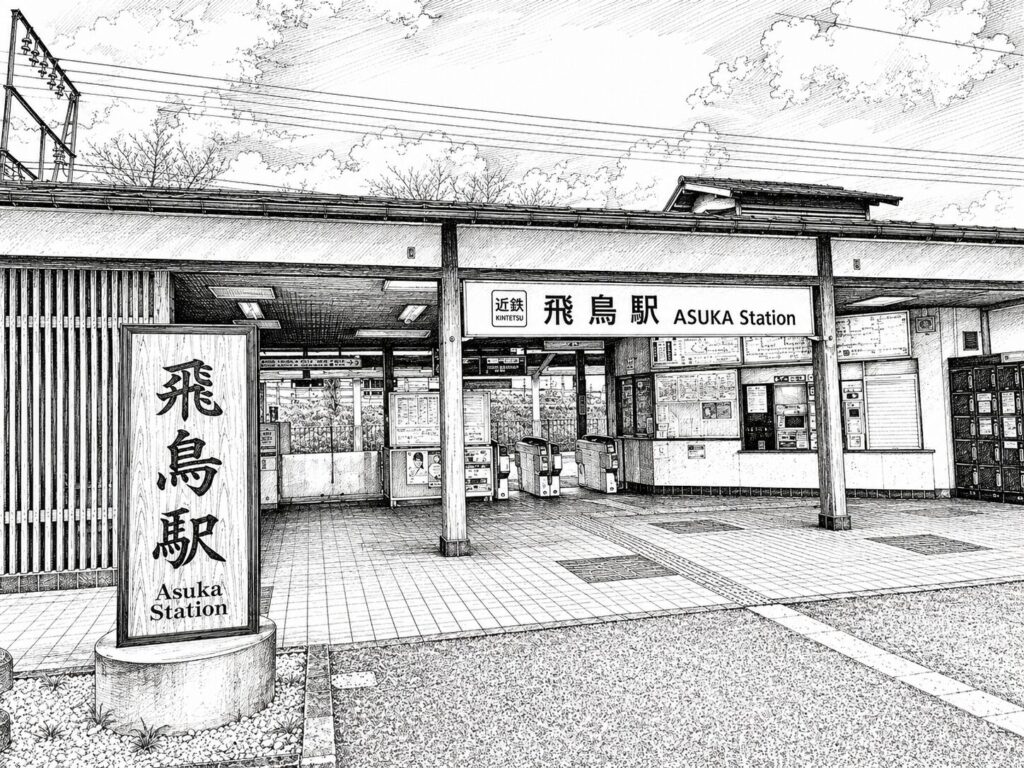
Rent a bicycle at Kintetsu Asuka Station and head north along a narrow path between the rice paddies. The tourist map marks only one thing: “Kameishi”—the Turtle Stone. Following the signs, you turn off onto a side lane, and there, right beside the hedge of a private home, in a corner fenced off with wooden rails, it sits.
Three point six meters long, two point one meters wide, one point eight meters tall—a massive block of granite. The upper half remains rough, natural stone. But on the lower portion, near the ground, eyes and a mouth and something like hands have been carved. Two bulging, goggling eyes. A mouth set in a downward curve. It wears a strange expression—somehow smiling, yet at the same time fixing its gaze on something. Kameishi. A beloved figure, the symbol of Asuka Village sightseeing, printed even on postcards.
And yet this charming, endearing stone carries a chilling legend.
The locals tell it this way. At first, the Turtle Stone faced north. At some point it turned to the east, and now it faces southwest. Should this turtle change its direction once more and glare due west—toward Taima—then the whole of Yamato Province, the entire Nara Basin, will sink beneath a sea of mud.
Why “west,” and why “Taima”? Behind this lies the following tale.
Long ago, when the whole of the Yamato Basin was still a great lake, a conflict broke out between Taima, on the far shore, and Kawahara here. After a long struggle, the Taima side won and carried off all the water of the lake. The Kawahara side, robbed of its water, dried up, and the countless turtles that had lived in the lake all perished. The villagers, pitying them, carved the turtles’ likeness into stone to console their spirits—and that, it is said, is this Turtle Stone.
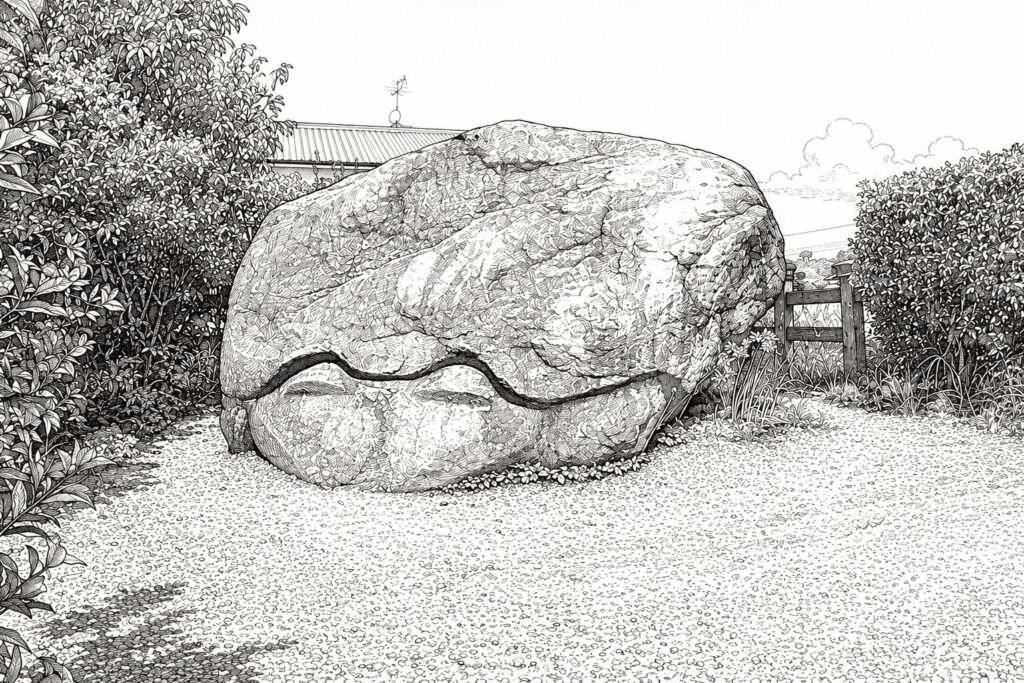
When the incarnation of the dead turtles turns to face Taima, the place that stole the water, the stolen water comes back. No—it returns in excess, and swallows everything. This is the shape of the apocalyptic prophecy handed down in the village.
Just a village legend. A lake, an incarnation of turtles—surely the stuff of laughable nonsense. One is tempted to dismiss it that way. And yet, from beneath that “laughable nonsense,” something unexpected shows its face.
At the western edge of the Nara Basin, where the Yamato River passes out of the basin and flows into the Osaka Plain, there is a district called Kamenose. Lying close to Taima, the place that appears in the Turtle Stone legend, this whole area is known as one of Japan’s most notable landslide zones. When certain underground strata absorb water, they begin to slide, and the surface itself shifts on a massive scale. Even counting only from the Meiji era onward, it has repeatedly caused large-scale landslides, and in modern times has even crushed a railway tunnel—dangerous ground.
And concerning the geology of Kamenose, the following has been pointed out. In the distant past, a large-scale landslide occurred here, and the collapsed earth and sand dammed up the Yamato River. The river, with nowhere to go, backed up toward the basin and pooled there, and for a period the upstream area was left in a lake-like state. Even the explanatory notes on the Turtle Stone introduce this geological fact as the legend’s background.
In other words, at the core of the seemingly absurd legend that “long ago, Yamato was a lake,” there lies a fact confirmed by geology. And the structure of the prophecy—”steal the water, take it back, and the basin sinks beneath water”—matches, to an eerie degree, the mechanism of the Kamenose landslide: dam the river, and the water really does flow backward and flood the basin.
Of course, the ancient people surely did not understand the mechanism of landslides scientifically. But over a long span of time they remembered how the water actually behaved in this land, and passed it down, entrusting it to an incarnation in the form of a turtle and to the direction of west. Seen this way, this legend ceases to be a mere ghost story. It can also be read as an ancient memory of disaster prevention—an attempt to deliver the danger inherent in the land itself, in the form of a story, into the future.
So then, what exactly is the Turtle Stone itself? Who carved so enormous a stone, and when, and for what purpose?
Here, too, almost nothing is known for certain.
The most widely accepted theory holds that it was a boundary marker indicating the four edges of the grounds of a nearby temple called Kawaharadera. About five hundred meters east of the Turtle Stone lie the remains of Kawaharadera, built in the Asuka period. The idea is that this Turtle Stone may be one of the stones placed as a marker to indicate the boundary of the temple’s holdings. There is also another theory: that it marked the boundary between a residential area and a burial ground.
But if so, why did it have to take the shape of a “turtle”? If the point were merely to mark a boundary, a plain stone pillar would have sufficed. To that, there is no answer.
And the matter grows more tangled still. In fact, there is even debate over whether this stone is really a turtle at all. A real turtle would have a rounded face, with its eyes set on the sides of its head. But this stone has a face closer to a triangle, and its eyes bulge upward. Some researchers point out that this may be not a turtle but a frog. This stone that we call “Kameishi” and onto which we have layered turtle legends may, perhaps, depict something else entirely.
A stone that has sat at the edge of the rice paddies for more than a thousand years, with its endearing face. Its true identity, the reason it has changed direction, why it is a turtle (or a frog)—not one of these has been settled. The only thing we know is that this stone is not facing west.
This is how the mysteries of Asuka begin. Even in a single pebble of a stone, marked in small print on a tourist map and turned into a postcard, a question of unfathomable depth lies submerged. And the Turtle Stone is merely the entrance to the countless mysteries scattered through this village.
I climb back onto the bicycle and head for the next stone.
Chapter 2: The Stone the Ogres Ate, the Stone That Came from Space
18:42
Claudeが返答しました: Walking through the rural fields of Asuka, there are moments when one’s sense of reality wavers and tilts.
Walking through the rural fields of Asuka, there are moments when one’s sense of reality wavers and tilts. It is because stones too enormous, too incomprehensible, sit there too casually. In this chapter, we visit two of the most representative. One is a stone said to be where “ogres ate people.” The other is a stone whispered to have “come from space.”
Northeast of Kintetsu Asuka Station, in the area sandwiched between the tomb of Emperor Kinmei and the tomb of Emperors Tenmu and Jitō. Walking along a footpath between the fields, you find a massive, flat stone slab lying on a rise beside the path. About four and a half meters long, two point seven meters wide, and roughly one meter thick. Its surface is smooth and flat, looking very much like a platform meant to “set something” upon. The Ogre’s Cutting Board (Oni no Manaita).
A few dozen meters from there, across the footpath and on a slightly lower spot, lies another giant stone, its interior hollowed clean out. The cavity is about one point five meters wide and one point three meters tall. This one is the Ogre’s Privy (Oni no Setchin). Setchin is an old word for a toilet.
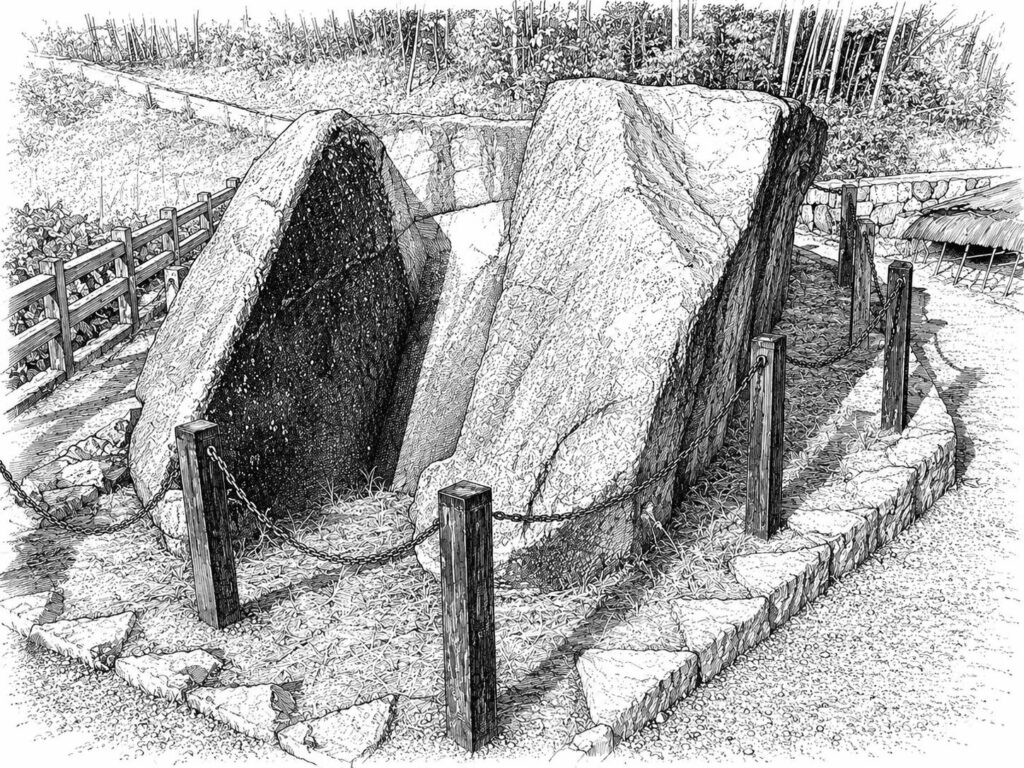
A chilling legend clings to these two stones.
Long ago, this area was called Kirigamine, and an ogre dwelled here. The ogre would send down mist upon passing travelers to make them lose their way, and when they were stranded and at a loss, it would seize them. Then it would cook and devour the travelers on the elevated “cutting board,” and when its belly was full, it would relieve itself in the “privy” below. A cooking platform and a toilet. These two giant stones have been handed down as the vivid props of an ogre’s dining table.
Of course, this is a legend. Their actual identity is clear.
The two stones were originally the stone chamber of a single burial mound. To be precise, they form a type of burial facility characteristic of the final-period tombs, called a “hollowed-out, side-entrance stone sarcophagus” (yokoguchi-shiki sekkaku). A mass of hard stone (described as quartz diorite, or sometimes granite) was hollowed out into a box shape, and a coffin was placed inside. The “cutting board” was the floor stone of that chamber, and the “privy” was the lid stone that capped it. Over long years, the earthen mound was lost, and the lid stone tumbled from its position atop the floor stone, leaving the two separated by several dozen meters. On the floor stone there remain traces of where a door stone was set, as well as mortise holes thought to be from a later attempt to split it off for use as building stone.
Today it is managed by the Imperial Household Agency as one of the satellite tombs (baichō, small accompanying mounds) attached to the nearby tomb of Emperor Kinmei, and both stones are fenced off. In other words, this was not an ogre’s kitchen but a grave—and that of a person of high rank.
But here, one is tempted to consider a question. Why did the ancient people think of this not as a “grave” but as an “ogre’s cooking platform and toilet”?
They probably did not know it was a grave. The mound had vanished, and only two giant stones lay exposed in strange shapes. One a flat platform that looked as though a person could be laid upon it. The other a hollowed-out cavity in which a person could crouch. And there they lay, in a misty valley. Faced with giant stones whose purpose they could not understand, human imagination chose the most visceral story. The ogre that eats and the human that is eaten. More than the truth that it was a grave, this story could better account for the sheer strangeness of these stones.
If the ogre’s stones summoned a “monster of the past,” then the stone we visit next has summoned the “future,” or “outer space.”
A little west of central Asuka, on Iwafune Hill at the border with Kashihara City. Near the summit of a hill roughly one hundred thirty meters in elevation, it appears after you push your way through a bamboo grove. The Masuda Rock Ship (Masuda no Iwafune).
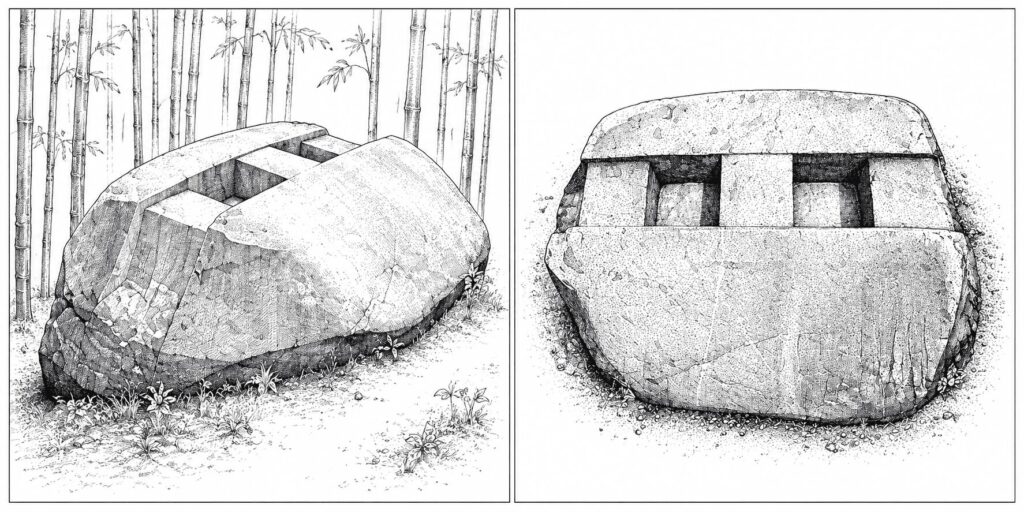
First, you are overwhelmed by its size. Roughly eleven meters east to west, about eight meters north to south, and about four point seven meters tall. Its estimated weight is said to be eight hundred tons, or by some accounts over a thousand—the largest stone structure in Asuka. On top of the massive trapezoidal mass of rock, two square holes, each about one point six meters on a side and one point three meters deep, have been bored at intervals. The upper half of the sides has been polished smooth as if measured with a ruler, with a band-like groove running all the way around. Yet the lower half remains as it was, left with rough, lattice-patterned working marks, as though unfinished.
This bizarre appearance has intensely stimulated the imagination of those who see it. The skill to carve hard granite this precisely. And to have pulled it off, no less, atop a steep slope ill-suited to the work. Who on earth, and when, and for what purpose—?
In the world of scholarship, a number of candidates compete. The oldest is the theory that it was the pedestal stone of a monument associated with Kōbō Daishi, Kūkai, built in the Heian period to celebrate the completion of the nearby Masuda Pond. The very name “Masuda Rock Ship” comes from this. Others that have been proposed include an astronomical-platform theory (a stand for observing the heavens), a tomb theory (to hold cremated bones), and a watchtower theory.
And in recent years, the most strongly favored is the side-entrance stone sarcophagus theory. The same as the Ogre’s Cutting Board and Privy just discussed—a tomb’s stone chamber, in other words. The two holes on top correspond to the spaces for holding coffins. In fact, the stone chamber of the Kengoshizuka tomb, located several hundred meters southeast of the Masuda Rock Ship, has a structure quite similar to these two holes. Some researchers point out that if the Rock Ship were tipped ninety degrees onto its side, the two holes would form exactly the entrance of a sideways stone chamber. In other words, the idea is that this may be an unfinished stone chamber, abandoned partway through being carved as a grave because, for instance, a crack developed in one of the holes and the work failed. The rough working marks on the lower half would then be evidence that the finishing had not yet begun.
Up to here is the domain of scholarship. They began making a grave’s stonework and stopped. That is the most reasonable answer.
But the giant stones of Asuka will not leave people alone with only reasonable answers.
That appearance of the Masuda Rock Ship. A massive mass of rock, like two turtle shells joined side by side, with two square holes bored in the center. Among the people who first laid eyes on it in the forest, a certain voice began to rise.
—Is this not a spaceship?
A spaceship that flew in from another world and crash-landed in the forest. Its outline, the claim goes, overlaps with the shape of the Masuda Rock Ship. The two holes are the traces of a device for inserting something. The precisely polished sides are workmanship impossible with the technology of Earth. Even the location on a steep slope unsuited to the work can be explained if one thinks of it not as having been “carried and installed” but as having “landed there.” Such assertions have been repeated again and again in the context of occult magazines and ancient mysteries.
For the record, let me state it clearly. This is not a scholarly theory. Nor is it a story with archaeological backing. It is, purely, a product of imagination called forth by the bizarre appearance of a giant stone.
Yet this notion of a “spaceship,” outlandish as it seems, connects to one lineage of the world’s ancient mysteries. For instance, the great ancient Indian epic, the Mahabharata, features flying vehicles called “vimana.” Gods and heroes ride them across the sky, at times burning cities to ash with terrible weapons. In the occult world, the idea has persisted unbroken of regarding these vimana as “flying machines that actually existed in ancient times,” or “spaceships,” and linking them to unexplained megalithic structures around the world. The view of the Masuda Rock Ship as a spaceship lies within that broad current.
To repeat, these are not “fact” but “story.” Onto something for which scholarship has produced the answer “unfinished stone chamber,” people have layered a different story: “spaceship.” But the very fact that such a story comes into being speaks to the unfathomable strangeness of this stone called the Masuda Rock Ship. Eight hundred tons of granite, carved atop a steep slope to a precision difficult even with modern tools, and then, for some reason, abandoned partway. That fact keeps rolling along, unchanged, right at the feet of those who laugh at the spaceship theory.
Ogres eat people, and a spaceship sleeps in the forest. The giant stones of Asuka mercilessly drag out the stories that lie deep within the hearts of those who behold them.
Next, let us head toward the very heart of Asuka’s “mysterious stone structures”—the source, you might say, of those very stories.
Chapter 3: Water for Whom—The Realm of Immortals and the Tree of Kabbalah
The stone stands south of Asukadera, atop a gentle hill.
A flat slab of granite, about five point five meters long, two point three meters wide, and one meter thick. On its upper surface, a number of round hollows have been carved, all linked to one another by thin grooves. Dishes, and channels connecting the dishes. Or it could look like the circuit diagram of something. The Sakafune-ishi (the Sake-Boat Stone). Among Asuka’s mysterious stone structures, it is one of the most famous and the most fiercely contested in interpretation.
The name comes from an old conjecture that its shape resembles a tool for pressing sake. The literati of the Edo period recorded it as “a stone where a wealthy man of old made sake.” But did it really press sake? Did it boil medicine? Extract oil? Or was it something else entirely—for a long time, no one knew the purpose of the hollows and grooves.
The turning point came in the year 2000.
At the northern foot of the hill where the Sakafune-ishi sits, at the bottom of a valley enclosed by ridges to the east, west, and south, a large-scale excavation was carried out. And from within the earth, a strange stone contrivance emerged.
First, a square intake tower built up from eleven tiers of cut sandstone. Its structure draws groundwater up through the interior, to gush out from the mouth at the topmost tier. The gushing water first collects in a stone basin hollowed into an oval shape. The water that overflows from there pours into a stone set beside it—a stone basin in the shape of a turtle.
The turtle-shaped stone structure (kamegata sekizōbutsu). About two point four meters in total length, about two meters wide. A mass of granite carved to render a head, a tail, and four legs. The part corresponding to the shell on its back is hollowed into a bowl about one point two five meters in diameter and twenty centimeters deep, made to hold water. Water flows into the shell through a hole at what would be the turtle’s nose, and when it fills, it flows out through a V-shaped groove at the tail. Gushing water, filtered, collected, and released—it was that kind of exquisite water device.
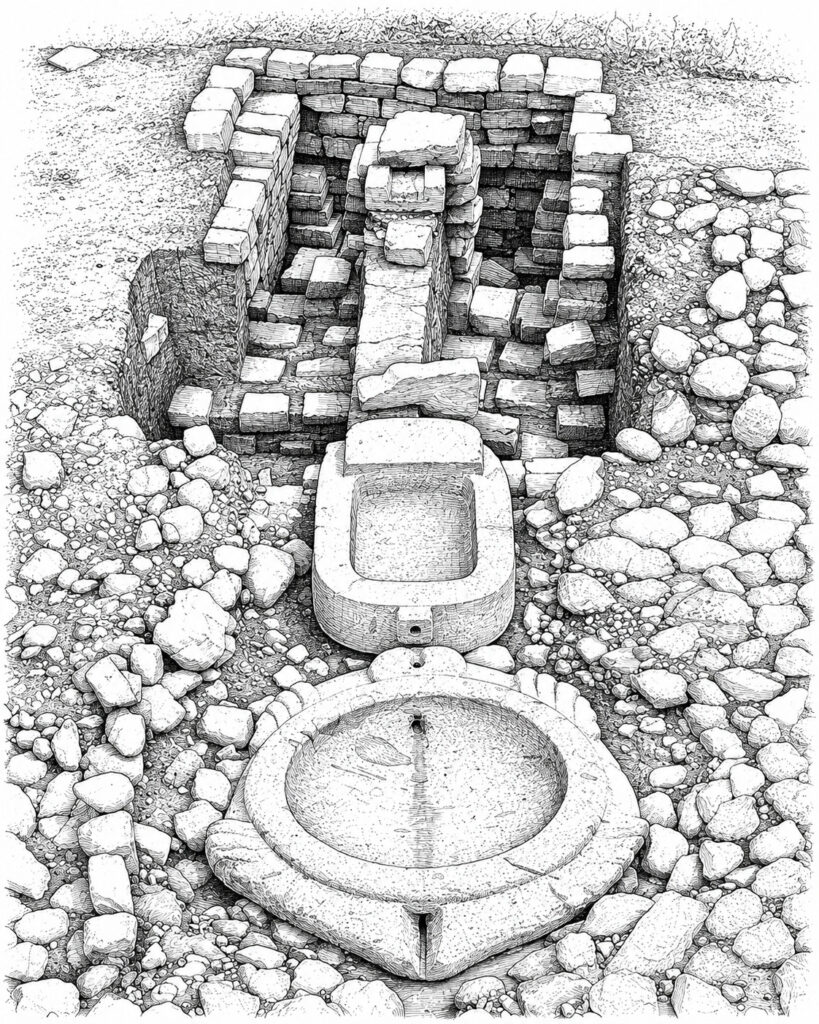
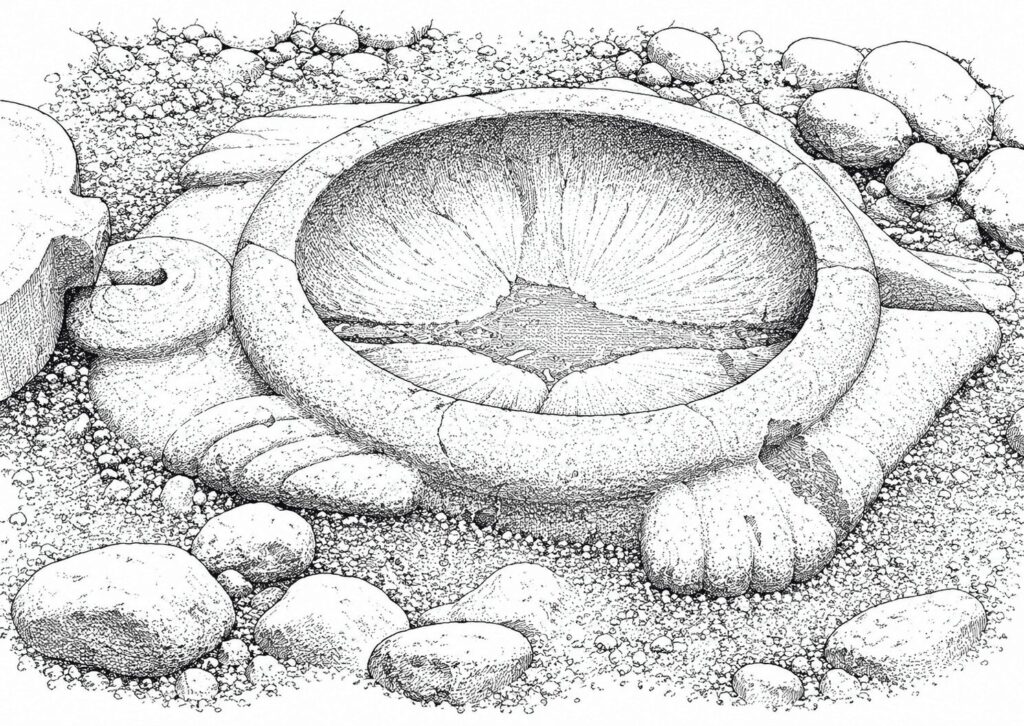
This discovery brought the character of the Sakafune-ishi site into much clearer view.
Along the slopes of the hills enclosing the valley, a stone wall built up from cut sandstone to a height of over a meter ran all the way around. Its total length reached as much as seven hundred meters. The top of the hill had been shaved down, and in the lower areas, large-scale construction had been carried out using rammed-earth technique (hanchiku, a method of pounding earth firm). Who could have done civil engineering on this scale, and for what?
The clue lay in the Nihon Shoki. In the reign of Empress Saimei, an entry for the year 656 reads thus: “On the mountain east of the palace, stones were piled to form a wall.” And it also records that, beside two zelkova (tsuki) trees on the ridge, a tall hall was built, named the “Futatsuki-no-miya” (Palace of the Two Zelkovas), also called the “Amatsu-miya” (Heavenly Palace).
The excavated seven-hundred-meter stone wall, and the Shoki’s description of “stones piled to form a wall.” The two correspond to an eerie degree. It came to be thought that this very area was the Futatsuki-no-miya built by Empress Saimei, or a ritual site connected with it.
So then, what was carried out at this “Heavenly Palace”?
What rises into view here is the thought of Taoism. A researcher involved in the excavation of the turtle-shaped stone structure points this out. The turtle is a creature of special significance in the Chinese thought of immortals and the divine. The legendary mountain “Mount Penglai” (Hōraisan), where the immortals who attained eternal life were said to dwell, has from ancient times been spoken of as riding upon the back of a giant turtle floating in the great sea. The alternate name of the Futatsuki-no-miya, “Amatsu-miya” (Heavenly Palace), is likewise a term appearing in Taoist scriptures, referring to a celestial palace where the immortals dwell.
In other words, according to this theory—Empress Saimei was attempting to build, on the hills of Asuka, an artificial realm of the immortals. She would shape in stone a great turtle bearing Mount Penglai, draw pure spring water into it, and recreate the utopia of eternal life here on the earth. To purify the body with gushing water, and commune with the heavens. In the artificial space at the bottom of a sealed valley, where nothing but the sky can be seen, the empress was likely trying to face something not of this world.
Indeed, the excavated stone-paved space was strangely closed off. Surrounded by high ridges and sandstone walls, what you see standing there is only the sky directly above. There is not even room enough to hold a banquet for many people. An extremely artificial ritual site, cut off from the outside world, like a sealed chamber. A device for communing secretly with the gods, or with the world of the immortals—seen this way, the strangeness of this stone contrivance comes to make a certain sense.
Up to here is the figure of the Sakafune-ishi site as drawn by archaeology and ancient history. A sacred device, against the backdrop of Taoist thought on the immortals, with which the sovereign performed a ritual of water. From the unearthed pottery, it is known that this place continued in use for a long time, from around the mid-seventh century to about the tenth.
But—that Sakafune-ishi atop the hill. About that giant stone carved with dishes and grooves, like a circuit diagram, no conclusion has yet been reached. Even now, when the turtle-shaped stone structure has come to be explained as “a ritual of water,” the purpose of the Sakafune-ishi itself has not, in fact, been settled. And this “geometric pattern that defies explanation” comes to summon an entirely different story.
From here on, it is the world of Mu.
The several round hollows carved into the upper surface of the Sakafune-ishi, and the grooves connecting them. There are those who argue that this figure resembles a certain sacred image handed down in “Kabbalah,” the mystical thought of Judaism.
In Kabbalah there is a fundamental diagram called the “Tree of Life” (Sephirot). It schematizes the structure of the creation of heaven and earth by God using ten circles (Sephirah) and twenty-two straight lines connecting them. The ten circles represent the stages by which God’s light flows down into the material world, and within their arrangement and pathways, it is held, all the secrets of the universe and of humankind are folded. It is an exceedingly important image that forms the very foundation of Western mystical thought.
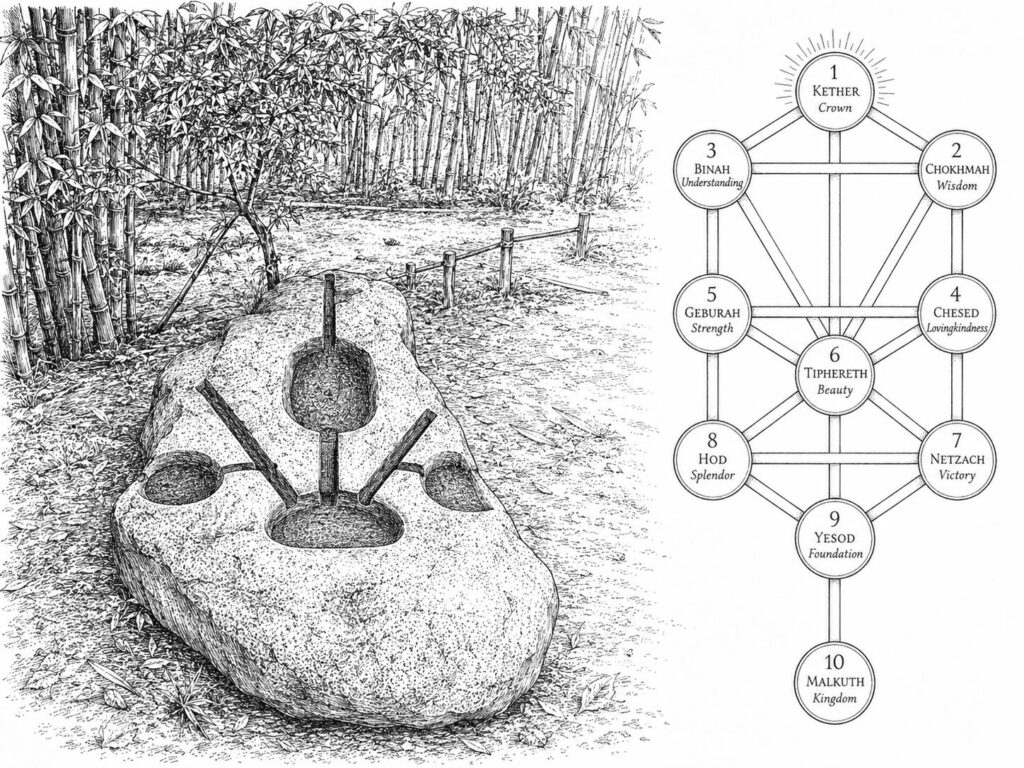
In the occult world, the claim runs thus. The round hollows of the Sakafune-ishi, and the grooves connecting them. That very arrangement—might it not be a copy of this “Tree of Life”? If so, then the mystical thought of Judaism would have reached ancient Asuka—so the argument goes.
For the record, let me state it clearly. This is not a scholarly theory. There is no archaeological basis for linking the Sakafune-ishi with Kabbalah. It is a product of imagination, setting out from the impression that the figures “resemble” each other. To begin with, the image of the Tree of Life was arranged into its present form only in far later ages, and to connect it directly with seventh-century Asuka involves far too great a stretch.
Even so, behind the repeated telling of this kind of theory lies one large story. Might the ancestors of the Japanese be connected to the lost tribes of Israel of remote antiquity?—the fringe hypothesis known as the “Japanese-Jewish common ancestry theory.” Within this story, Asuka’s group of mysterious stone structures are often reread as “traces of Judaism brought into Japan.” The view of the Sakafune-ishi as the Tree of Life appears as one part of that larger story. As for this Japanese-Jewish common ancestry theory itself, let us take it up squarely, once more, in a later chapter.
Scholarship says: this is a device for a ritual of water, modeled on the Taoist realm of the immortals. Mu, on the other hand, says: this is a stone carved with the cipher of Jewish mystical thought.
There is no need to decide here and now which is “correct.” What is certain is only the fact that, for over a thousand years, that flat stone atop the hill has gone on showing those who behold it entirely different universes. The eternal life of Taoism. The Tree of Life of Judaism. A single slab of rock, carved with dishes and grooves, bears upon its back two mystical traditions—East and West—at one and the same time.
Just as Mount Penglai rides upon the back of a turtle.
Next, we head for the place where the dead sleep. The tale of two burial mounds that cradle murals in brilliant color.
Chapter 4: A Starry Sky Four Hundred Years Older Than the Tomb
At the entrance to this site, we posed a single mystery. The mystery that the starry sky painted on the ceiling of the Kitora tomb is four hundred years older than the grave itself, and points, moreover, not to the sky of Japan but to that of the continent. Here, we stand once more before that starry sky. And we descend to its depths—a bottom that grows deeper the more you peer into it.
First, I want to tell of how this tomb was found. That itself is already out of the ordinary.
The existence of the Kitora tomb was long thought to be nothing more than a small hill. The turning point came just after brilliantly colored murals were discovered in the adjacent Takamatsuzuka tomb. A nearby resident’s word that “there is a similar tomb close by” became the thread that led to investigation. In 1983, a fiberscope was inserted into the stone chamber to explore the interior, and on the far wall, a picture resembling the “Genbu”—a black turtle and snake entwined—rose into view. In 1998, a re-survey was conducted with a camera that could turn up, down, left, and right, and the Azure Dragon, the White Tiger, and—the astronomical chart on the ceiling emerged from the darkness. In 2001, the Vermilion Bird too was confirmed. Inside a small stone box that no one could set foot in, a universe in brilliant color had been sealed away for thirteen hundred years, seen by no one.
On the walls of the stone chamber are painted the Four Gods that guard the four directions. The Azure Dragon to the east, the Vermilion Bird to the south, the White Tiger to the west, the Genbu to the north. In Japan, the Kitora tomb is the only place where all four of these gods survive together. Below them, moreover, are the images of the twelve zodiac animals, with beasts’ heads and human bodies. And on the ceiling, a full-fledged astronomical chart, representing more than two hundred seventy stars in gold leaf and connecting them with vermilion lines. Centered on the celestial north pole, it depicts a triple set of concentric circles—the inner circle, the equator, and the outer circle—along with the ecliptic that marks the sun’s path. On the eastern incline, a sun of gold leaf; on the west, a moon of silver leaf. The dead one took their rest guarded on four sides by sacred beasts, cradling a complete universe overhead.
An astronomical chart this thorough has no parallel even in East Asia. It is roughly five hundred years older than the famous Southern Song–era astronomical chart preserved in Suzhou, China. As a surviving astronomical chart that depicts the actual positions of stars based on observation, it is rated among the very oldest in the world.
The problem begins here.
Astronomers took on this star chart. Engraved in the arrangement of stars is a phenomenon called “precession,” by which the stars shift little by little over long ages. So if one measured the positions of the stars precisely, one ought to be able to calculate backward to when that starry sky was observed—or so it should have been.
And yet the answers came out, depending on the researcher, utterly different.
One study calculated a value of around 80 BCE. Another produced around 300 CE. There is even a view that puts it around 400. Analyzing the same single chart with the same theory of precession, the dates that come out scatter by units of hundreds of years. Why on earth?
To this mystery, a researcher at the Nara National Research Institute for Cultural Properties has offered an answer. Blunt to the point of being deflating, yet an answer that sends a shiver.
—The Kitora astronomical chart is, to begin with, simply not precise.
Observing the chart in detail, a number of strange things come into view. The positions of the painted constellations are switched around from the actual night sky. The sizes and tilts of the constellations also differ from the real ones. The proportions of the triple circles that should indicate stellar positions are not correct either. As for the circle of the ecliptic, the sun’s path, the very position at which it is drawn is wrong. And looking at the under-drawing lines, it is said one cannot even read any trace of a careful attempt to copy from an original chart.
In other words, it would be quite impossible to actually observe the heavens using this chart. The positions of the stars simply do not possess the precision needed to derive a date from precession. And so each researcher who analyzes it comes up with a wildly different date.
Here, the way it looks flips over.
This starry sky, praised as “a precise astronomical chart among the world’s oldest,” was, when examined closely with the eyes of science, also a rather sloppy, careless chart. So, was that because the technology of ancient people was immature?
Probably not. The Nara institute’s researcher conjectures thus. The Kitora astronomical chart is not the practical, precise star chart itself, but a chart “redrawn” from one onto the narrow circular canvas of a stone-chamber ceiling. Not a genuine observational chart, but a copy taken from a genuine one—a miniature of the universe, so to speak. If so, then it did not matter if the positions of the constellations were somewhat off, or if the proportions of the circles were skewed. For this is not a chart meant for a living person to use for observing the heavens.
This was a universe for the dead.
Here, the deepest mystery of this chapter opens its mouth. Why, on the ceiling of a dark, sealed stone chamber that a single person can barely enter, did they go to the trouble of painting a universe that no eye would ever behold?
Probably it has to do with the ancient view of life and death. To set the dead one at the center of a complete universe. To place the celestial north pole overhead, to have sacred beasts guard the four directions, to bring the sun and moon into attendance, and to create within a small stone chamber another self-contained heaven and earth. There the dead one lies, forever, as the lord of the universe. Precision fit for practical use was never needed from the start. What was needed was only the form and the meaning: “this is a complete universe.”
And we return to the mystery at the outset.
The starry sky on which that “miniature universe” was based pointed, by calculation, to the sky of an era far older than the late seventh century when the grave was built—and to a continental latitude, not that of Japan—so multiple analyses suggest. Scattered though the dates are, all of them are the sky of long before Asuka, across the sea.
How are we to think of this?
The most straightforward interpretation runs thus. The people of Asuka did not observe and paint the starry sky themselves. A star chart made on the continent hundreds of years before was transmitted to Japan across the sea, in the form of a book or a model. The painters of Asuka, using that old continental star chart as their model, copied it onto the ceiling of the stone chamber. And so what spreads there is not the night sky of Asuka, but the sky of a foreign land in a past no one had ever seen—.
To carry the past universe of a foreign land aboard a book, and recreate it above the head of the dead. That is also a quiet proof of just how deeply the Japan of that time was connected to continental civilization, and how it sought to take in that entire system of knowledge. The age of Asuka was an age that imported even the universe across the sea.
Of course, this is no more than “the most straightforward interpretation.” Why it had to be that particular star chart, who carried it, whether one can truly declare it is not the sky of Asuka—nothing is settled. This universe, sealed in the darkness of stone for thirteen hundred years, still does not reveal all of its origins, even when the latest science is turned upon it.
The past sky of a foreign land, cradled by the dead as they sleep. The most beautiful, and the most silent, mystery in Asuka still twinkles, even now, beneath the ground of Asuka Village.
Next, to the tomb beside it. The tale of Takamatsuzuka, where women in brilliant color smile.
Chapter 5: Whom Did the Asuka Beauties See Off?
From the Kitora tomb, a dozen-odd minutes’ walk to the north. Within the same Asuka Historical National Government Park, there is another mural tomb. The Takamatsuzuka tomb. The place where those “Asuka Beauties,” printed in textbooks all across Japan, sleep.
The discovery of this tomb, too, was by chance to begin with. Around 1962, when a villager was digging a hole to store ginger, he struck a square cut stone deep in the earth. That was the wall of a stone chamber that had slept for thirteen hundred years. And in March 1972, at the moment a full-scale investigation lit up the interior of the stone chamber—the investigators caught their breath.
In the darkness, people in brilliant color stood.
Green, yellow, deep blue, vermilion, pink. Women clad in vivid robes, holding fan-like implements and ceremonial objects resembling a “back-scratcher,” faced this way. The colors were so alive it was hard to believe they had been painted thirteen hundred years before. This group portrait of women would later come to be called the “Asuka Beauties,” and would grace the front pages of national newspapers in color photographs as the greatest discovery of the postwar era. This sparked an unprecedented “Asuka boom” across all of Japan.
On the walls of the stone chamber were painted not only the group of women but a group of men, and the Four Gods that guard the four directions. The Azure Dragon to the east, the White Tiger to the west, the Genbu to the north. The Vermilion Bird should have been on the south wall, but here it is lost. This is because the tomb was robbed around the Kamakura period, and a hole was opened in the south wall. On the ceiling, as with the Kitora seen in the previous chapter, a starry sky was painted. The dead one was guarded by the Four Gods, cradled a universe overhead, and was attended by retainers in brilliant color, as they took their eternal sleep.
Who on earth was the person buried with such lavish care?
Here begins the most famous “puzzle-solving” in Asuka. The occupant of the Takamatsuzuka tomb has, to this day, not been identified. To begin with, among the tombs of the Asuka region, those whose occupant is known are the rarer kind.
There are several clues. The date the tomb was built was at first estimated, from unearthed bronze mirrors and the like, to be from the end of the seventh century to the start of the eighth, and was settled by a 2005 investigation to be within the era of the Fujiwara-kyō capital (694–710). When the human bones found in the stone chamber were examined, the occupant appeared to be an elderly man in his forties to sixties. Because a mirror with the same pattern as the buried “sea-beast-and-grape mirror” (kaijū-budō-kyō) was unearthed from a tomb built in 698 in Xi’an, China, this mirror is thought to be something the envoys to Tang China brought back.
Surrounding these clues, the theories about the occupant divide broadly into three.
The first is the theory that he was a prince of the imperial family. The area around this tomb spreads with the burial grounds associated with Emperor Tenmu, who established his palace in Asuka. So might the one buried here be one of the princes connected to Emperor Tenmu?—so the argument goes. As concrete candidates, the names of Prince Osakabe, Prince Takechi, and Prince Yuge are raised. Among them, Prince Osakabe, said to have died at forty-six or forty-seven, is considered a strong candidate because that is close to the estimated age of the unearthed bones.
The second is the theory that he was not a prince but a powerful subject. The representative figure is Isonokami no Maro, a noble of the highest class of the time. However, taking this theory would push the date of the tomb down into the Nara period.
And the third is the theory that he was royalty of immigrant descent. The idea is that he may be a person carrying the blood of the royalty of Baekje, or of Goguryeo. Behind the rise of this theory lies the very style of the murals. It has been pointed out from early on that the composition depicting the Four Gods, and the clothing of the group of women, closely resemble the tomb murals of Goguryeo on the Korean Peninsula. Culture that crossed the sea, blood that crossed the sea—their traces remain vividly in this stone chamber.
A prince? A minister? Royalty of immigrant descent? Decisive evidence still does not exist. The Asuka Beauties in brilliant color have kept their mouths shut for thirteen hundred years about whom it was they saw off.
Now, this Takamatsuzuka tomb holds, apart from the identity of its occupant, one more fact that sends a shiver.
The remains of the occupant found in the stone chamber had no skull. And the sword that had been buried with the body had had only its blade drawn out.
By the prevailing view, these are held to be the work of Kamakura-period grave robbers. The robbers carried off the skull and drew out the blade. But here, there are those who advance a different view. The interior of the stone chamber where the coffin was placed has almost no gap for a person to slip into. In that narrow space, to go to the trouble of carrying off only the skull and drawing out only the sword’s blade—could such laborious grave robbing really happen? And what is more, most of the valuable burial goods were left in place.
From there, an interpretation like this arises. This was not grave robbing. Might the remains without a head, and the sword without a blade, have been buried intentionally from the start? If so, what would that mean—might it not have been a magic rite to seal away the resurrection of the dead?
For the record, let me write it down. This is not a settled scholarly theory. That the skull and blade are missing is a fact, but to link the reason to a “curse” is not something with documentary backing; it is, purely, one inference. To think of it, as the prevailing view holds, as the result of grave robbing would be the moderate position.
Even so—the fact remains that a noble person who should have slept attended by retainers in brilliant color, cradling a universe, was found having lost their head and with their sword broken. Why did the master of a tomb adorned this courteously lie there in such a state? Lavish funeral rites, and a cruel mutilation. That gap casts an indescribable shadow over this tomb.
Who was buried, why there is no head, and for what purpose a brilliantly colored universe was painted. The Takamatsuzuka tomb, holding as many as three unanswerable questions, is now sealed up and kept far from human eyes.
That “sealing,” too, comes with a bitter tale. For over thirty years from the 1972 discovery, the murals continued to be eaten away by mold inside the stone chamber, deteriorating gravely. The cause is held to be inadequate air conditioning, and mold brought in by the coming and going of people. In the end, in 2007, the Agency for Cultural Affairs made an unprecedented decision. It resolved to dismantle the stone chamber, take the murals outside, and restore and preserve them in a separate facility. The Asuka Beauties have now left the underground stone chamber where they were born and raised, and continue to receive quiet treatment within an artificially controlled room.
A painting that kept its colors in the darkness for thirteen hundred years begins to be damaged the instant it is found. That, too, was a bitter paradox: that our very desire to “see” the mysteries of Asuka damages those mysteries themselves.
Next, let us head to the site of the most blood-soaked incident in that Asuka. The tale of a single man’s head flying in the garden of a palace.
Chapter 6: The Head That Came Flying
Near the center of Asuka Village, Asukadera. Leaving its grounds through the western gate and walking some hundred meters along a path between the rice paddies, you find, alone in a sea of rice ears, a small stone pagoda standing. A five-ring pagoda (gorintō) made of granite. Behind it, the gently sloping Amakashi Hill. A tranquil place, with only sparse tourists.
But this stone pagoda has carved into it the vivid memory of the most famous assassination in Japanese history.
It is the head mound (kubizuka) of Soga no Iruka.
His head, it is told, came flying this far.
The tale goes back to the early summer of 645.
At that time, the clan that held overwhelming power in the court of Asuka was the Soga. A clan that rooted Buddhism in Japan, built temples, formed marriage ties with the imperial family, and held the center of government across four generations. At its peak stood the Grand Minister Soga no Emishi and his son, Iruka. Iruka had studied under a monk in his youth, and was such a figure that he was said to have prompted the remark, “Among those who entered my school, none is as gifted as Iruka.” But his power had gradually swelled to the point of overshadowing the imperial family.
Those who felt a sense of crisis at this were the imperial Prince Naka no Ōe (later Emperor Tenji) and Nakatomi no Kamatari (later the founder of the Fujiwara clan), who came from a mid-ranking noble house.
The very meeting of the two is characteristic of Asuka. The occasion, it is told, was a kemari (kickball) gathering held at the “Plaza of the Zelkova Tree” west of Asukadera. Prince Naka no Ōe, absorbed in the kemari, kicked off his shoe in his excitement. It was Kamatari who picked it up and respectfully presented it. From this casual gesture, the two deepened their friendship. And in the mountains, in secret, they worked out a certain plan. The overthrow of the Soga clan.
The opportunity came in the sixth month of that year.
Envoys from the three kingdoms of the Korean Peninsula—Silla, Baekje, and Goguryeo—were to come to court bearing tribute. The ceremony would be conducted in the great hall of the Asuka Itabuki Palace. Iruka, as Grand Minister, would certainly attend. Prince Naka no Ōe and Kamatari chose the setting of this ceremony as the stage for the assassination.
That day, it rained.
In the great hall, Empress Kōgyoku was seated, and Iruka sat in attendance. Soga no Kura-yamada no Ishikawa-maro, who, though a member of the Soga clan, had joined the plan, began to read aloud the memorial of the ceremony. But the men whose duty it was to strike could not move, frozen with fear. Ishikawa-maro, faced with an assault that would not come no matter how long he waited, trembled in his voice and broke into sweat. The moment Iruka noticed his suspicious manner—
The hidden Prince Naka no Ōe leapt out himself and struck at Iruka. Saeki no Komaro and the others followed. Iruka, caught off guard, was cut down, and desperately appealed to Empress Kōgyoku that he was innocent. But he was given the finishing blow. His body, it is said, was carelessly cast out into the garden where the rain poured down.
An assassination at the edge of a palace garden, in broad daylight—no, on a rainy day. And before the very eyes of the sovereign. This is the “Isshi Incident” that appears without fail in the textbooks of Japanese history. The next day, Iruka’s father, Emishi, also set fire to his own mansion and took his life. The Soga main house, which had reached the height of glory, perished in an instant. And with this incident as the catalyst, the remaking of the state by Prince Naka no Ōe and Kamatari—the “Taika Reform”—began.
Up to here is the course of the Isshi Incident as transmitted by the Nihon Shoki.
Now, let us return to the tale of the head mound.
The site of the Asuka Itabuki Palace where Iruka was cut down (now called the Asuka Palace Site) and this head mound are separated by about six hundred meters in a straight line. By common sense, a severed head could not possibly fly six hundred meters. This is plainly a matter in the realm of legend.
So why was such a legend born?
The severed head of Iruka flew. And by one telling, that head pursued the chief instigator of the assassination, Prince Naka no Ōe, or else Kamatari. A head that, in the extremity of its bitterness, dances through the air and falls upon the one who killed it—. This is counted among the very oldest of the traditions of the “vengeful spirit” (onryō) that survive in Japan.
When you think about it, Iruka had all the conditions to become a vengeful spirit. Holding overwhelming power, he was cut down by surprise before the sovereign. He was given the finishing blow without even time to plead his innocence, and his body was cast out into the rain. There are few deaths as bitter as this. People, faced with the ferocity of his violent death, harbored a dread that “he is sure to bring a curse.” The legend of the flying head is the reverse side of how deeply the perpetrators—or the people who passed the tale down—feared Iruka’s bitterness, the depth of that fear.
Indeed, meaning can be read even in the direction the head mound is built to face. This five-ring pagoda stands with its back to Amakashi Hill, where the mansions of Iruka and his father Emishi are said to have stood. As if bearing the home base of the destroyed clan upon its back, the head mound is placed. The surviving five-ring pagoda itself is estimated to be from the Nanboku-chō period, but the very fact that the memory surrounding Iruka’s head has continued to dwell in this place makes one feel the weight of more than a thousand years of time.
A man of power, cut down before the sovereign, his head flying off to pursue his enemy. The people who feared it build a mound, and try to quiet his soul. Behind the splendid Buddhist culture and the refined star charts of the age of Asuka, there flowed, surely, such vivid blood, such rancor, and the hearts that feared it.
The small stone pagoda in the rice paddies stands quietly today as well, bearing Amakashi Hill upon its back. Tourists point their cameras and pass on by. But at its feet, the memory of blood shed on a rainy day fourteen hundred years ago still sleeps.
Next, let us tell the tale of another “thing that does not move,” which lived through that age of blood. The tale of a single Buddha that, no matter how many times it is burned, goes on sitting in the same place.
Chapter 7: Burned, Yet It Does Not Move
From the head mound of Soga no Iruka, about a hundred meters to the east. In a corner surrounded by rice paddies stands a modest temple. Asukadera. It has none of the splendor of a tourist temple. But in this temple’s main hall sits the “beginning” of all the Buddhist statues of Japan.
The Great Buddha of Asuka. The oldest Buddhist statue in Japan.
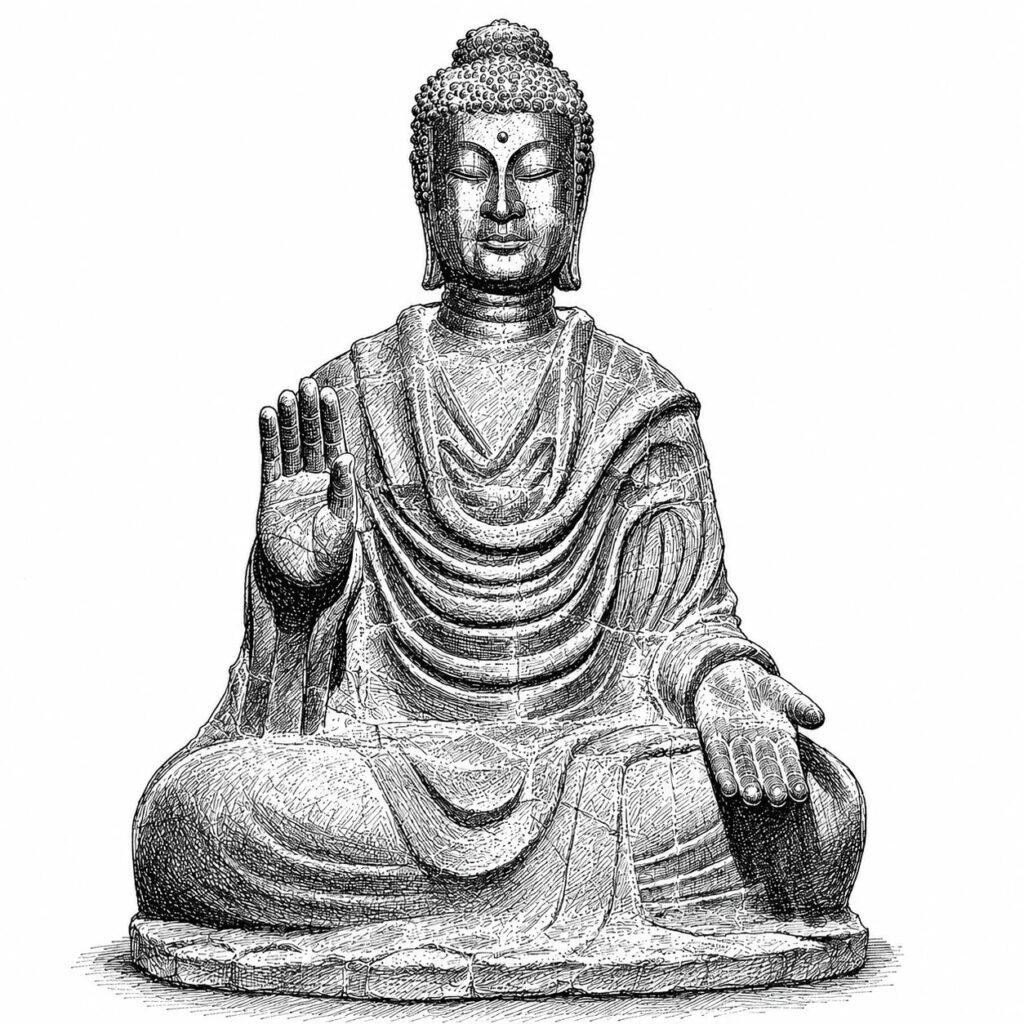
Before that, I want to establish how special a place this temple is.
Asukadera is the first full-fledged temple in Japan. It was built by that very Soga clan, the one that perishes in the Isshi Incident seen earlier. Over whether to accept or reject Buddhism, Soga no Umako had been in conflict with Mononobe no Moriya of the anti-Buddhist faction. Umako, praying for victory in that fight, vowed, “If I can win, I will build a temple and spread the Buddhist law.” And when he destroyed Moriya, true to his vow, he set about the construction of a temple in 588. It was completed in 596. With a pagoda at the center and golden halls arranged on three sides—east, west, and north—it was a great temple complex of unprecedented scale for the time. For the construction, many engineers were invited from the Korean Peninsula, and for the first time in this country, roof tiles were fired. Asukadera is, literally, the starting point of full-fledged temple architecture in Japan.
Incidentally, the “Plaza of the Zelkova Tree,” where Prince Naka no Ōe and Nakatomi no Kamatari met as touched upon in the previous chapter, was also west of this Asukadera. Both the Isshi Incident and the Taika Reform began right under the nose of this temple. Asukadera was, truly, a nexus where the religious history and the political history of Japan intersect.
Its principal image is the Great Buddha of Asuka.
Formally, it is a bronze seated statue of Shaka Nyorai (Shakyamuni Buddha). Commissioned by Empress Suiko, it was the work of the immigrant-descended Buddhist sculptor Kuratsukuri no Tori. Its making is told to have begun in 605 and to have been completed in 609. Its seated height is about two point seven five meters. It used fifteen tons of bronze, and its surface was gilded with as much as thirty kilograms of gold. Now the gold has flaked away and it has jet-black skin, but when it was made, it must have shone dazzlingly.
Looking up at its face, you meet a strange expression. A long, slender contour. Almond-shaped, narrow eyes. And, hovering at the mouth, a faint smile. This smile has a name: the “archaic smile.” Originally, it is an expression seen in the sculpture of ancient Greece. It came, by way of the Silk Road, all the long way east, and arrived in this land of Asuka. In other words, the Great Buddha of Asuka is also a flower that bloomed at the easternmost end of the long, long road of civilization that stretches from the Mediterranean. Deep within the smile of the jet-black Buddha, the sunlight of Greece is faintly dissolved.
Now, this Great Buddha of Asuka holds two great mysteries.
The first. Is this Buddha truly the “oldest Buddhist statue in Japan”? Put another way, how much of the Buddha now sitting in this main hall dates from the original construction of 609?
Asukadera, over its long history, was struck by fire many times. In particular, in two great fires—in 887 of the Heian period and in 1196 of the Kamakura period—the temple complex burned down, and the Great Buddha too was severely damaged. Afterward, the rebuilding of the complex did not go smoothly, and there was even a period, it is said, when the Great Buddha was left to sit out in the open, without even a roof.
For this reason, it was long thought thus. The Great Buddha of Asuka largely melted away in the repeated fires, and was remade in later ages. What remains as it was at the founding amounts to no more than a part of the face and a few of the fingers of the right hand. Despite being the oldest Buddhist statue in Japan, the Great Buddha of Asuka is not designated a National Treasure, and the reason for this, it has been held, is precisely that “most of it is later repair.”
And yet, in recent years, research has appeared that shakes this prevailing view. A research team from Waseda University analyzed the Great Buddha by X-ray. And between the portions held to be “from the founding” and those held to be “repaired from the Kamakura period onward,” there was no marked difference in the composition of metals such as copper. This result, they say, indicates that most of the Buddha’s body is, in fact, likely still as it was at the start of the Asuka period.
In other words, at this very moment, expert opinion is divided over whether “almost nothing remains” or “almost all is as it originally was.” How much of a Buddha made fourteen hundred years ago dates from fourteen hundred years ago. Even with the latest science turned upon it, no conclusion has yet been reached. The oldest Buddhist statue in Japan has not even had the content of that “oldest” settled.
And the second mystery—no, this one should perhaps be called a quiet astonishment rather than a mystery.
Its whole body burned in fire, repaired again and again, and at one time left out in the open. Having passed through such hardship, this Great Buddha of Asuka has not, in fourteen hundred years, moved from its place even once.
This is not a figurative way of speaking. By investigation, it has been confirmed that the stone of the pedestal on which the Great Buddha sits—Ryūzan stone produced in Hyōgo Prefecture—has not been moved even once since the founding. The current main hall is rebuilt on the very spot where the Central Golden Hall, originally the center of Asukadera, had stood. In other words, the position where we now venerate this Great Buddha is the exact same place where, fourteen hundred years ago, Soga no Umako, and Prince Shōtoku, joined their hands toward this Buddha.
The chief priest of Asukadera has said this: that the Great Buddha not having moved means that we, in the present day, can join our hands in the very same place where Prince Shōtoku once prayed.
The Buddha hall burned, was rebuilt, the Buddha’s body was repaired and became the object of controversy. Even so, the place where it sits, alone, did not budge an inch in fourteen hundred years. And so this Great Buddha has never once been taken outside. It has not even been lent out to an art exhibition. It is not that it cannot be moved, but that it is not moved. Though the building changed, though parts of its body changed, the single point of “praying in this place” has been protected through fourteen hundred years.
Come to think of it, the head of Soga no Iruka seen at the beginning of this chapter was told to have been cut off and to have “flown.” A head moved, stolen, wandering. Meanwhile, the Buddha of the temple built by that same Soga clan does not move, no matter what happens. A head that flew, and a Buddha that does not move. The land of Asuka holds these two extremes within a distance of a mere hundred meters.
The jet-black Great Buddha smiles faintly today as well, in a place not a hair’s breadth different from fourteen hundred years ago. Wearing the smile that arrived from Greece, burned, scraped away, it simply goes on sitting there.
Next is the tale of another “impossible thing” that sleeps in that Asuka. The one and only pyramid-shaped tomb in Japan.
Chapter 8: The Pyramid of Nara
In the summer of 2014, an archaeological announcement raced across the nation.
The Miyakozuka tomb in Asuka Village, Nara Prefecture. This tomb, until then thought to be an ordinary small square-shaped mound, was found by excavation to have a pyramid-like form, with stones piled up in steps. The reports called it the “Pyramid of Nara.” At the on-site briefing held later, as many as four thousand people lined up along the footpaths between the rice paddies to catch a glimpse.
A pyramid, in Japan. A story hard to believe at first, but this is, in all truth, the fruit of academic investigation. This time, we close in on the true nature of this “Pyramid of Nara.”
The Miyakozuka tomb lies a little to the southeast of the center of Asuka Village, on the sloping ground at the tip of a ridge. Before excavation, it was thought to be a quite ordinary square mound, about twenty-eight meters on a side. And yet, in the investigation from 2013 to 2014, something unexpected was found on the surface of the mound.
Stones had been piled in steps.
The height per step was about thirty to sixty centimeters. Above it was a flat, terrace-like surface about six meters wide, and then more stone piling, and then another flat surface—and that was stacked up many tiers high. At least four tiers were confirmed. Including the unexcavated portions, it is reconstructed as having been a stepped pyramid reaching, in all, seven to eight tiers. The scale of the entire mound is forty-one meters east to west and forty-two meters north to south. Its height is over four point five meters, and depending on the angle from which it is seen, exceeds seven meters. It is an imposing large square mound, rivaling the imperial tombs of the time. Its construction is estimated to have involved a cumulative workforce of as many as thirty thousand people.
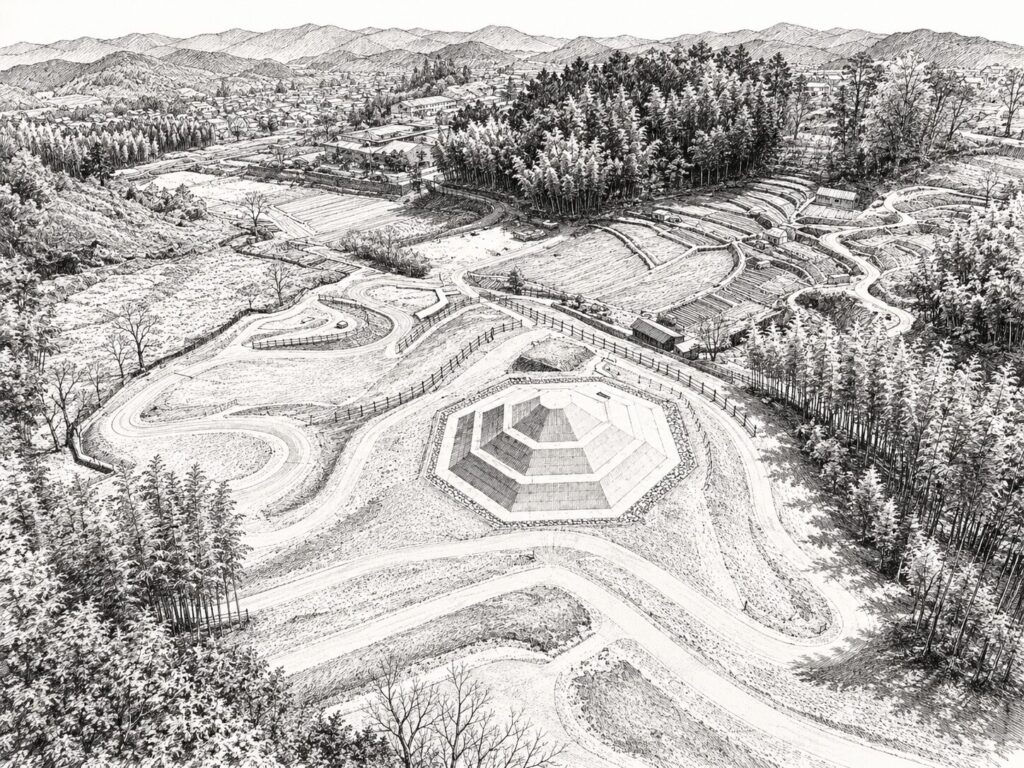
A tomb in the shape of such a “stepped pyramid” has no other example in Japan. The Miyakozuka tomb is the one and only stepped-pyramid-shaped tomb in the country.
So why does a tomb of such a shape exist in Japan, all alone, just this one?
Here, we need to turn our eyes across the sea.
In fact, tombs with stones piled up in steps—the form called “piled-stone mound” (tsumiishizuka)—are clearly seen in the tombs of the kings of the fifth-century Korean Peninsula, particularly Goguryeo and Baekje. Stones piled up in steps, that form climbing toward the summit, calls a pyramid to mind exactly. The stepped-pyramid structure of the Miyakozuka tomb may have a deep connection with these piled-stone mounds of Goguryeo and Baekje—so the researchers point out.
In other words, the “pyramid” of the Miyakozuka tomb has nothing to do with Egypt, nor with aliens. It was a manner of tomb-building that came across the sea, from the continent. How deeply Asuka was connected to the culture of the Korean Peninsula—in this chapter, too, we strike against the same fact again. The Great Buddha of Asuka in the previous chapter, its expression came from Greece. The tomb here, its form came from the Korean Peninsula. Asuka was a place like a vast river mouth, into which the civilizations from across the sea flowed in, one after another.
So then, who was buried in this continental-style pyramid?
The name raised as the strongest candidate is Soga no Iname.
Soga no Iname is the person who is, in effect, the founder of the Soga clan that wielded power in Asuka. Soga no Umako, who built Asukadera and appeared in earlier chapters, was Iname’s son. Soga no Emishi and Iruka, who perished in the Isshi Incident, were Iname’s descendants. In other words, Iname is the person who stands at the starting point of that clan, which went on driving the history of Asuka.
Why is the Miyakozuka tomb thought to be Iname’s grave? The clue is close at hand.
A mere four hundred meters north of the Miyakozuka tomb. There stands another giant-stone tomb that everyone knows. The Ishibutai tomb (Ishibutai Kofun). Its earthen mound lost, the side-entrance stone chamber assembled from giant stones laid bare—a symbol of Asuka. Its occupant is strongly thought to be Soga no Umako.
Umako’s grave is right to the north. And the Miyakozuka tomb was built a little earlier than that Ishibutai tomb. If so—this imposing large square mound, lying right beside Umako’s grave and built a generation before Umako, might it not belong to Umako’s father, that is, to Soga no Iname? To think so is an extremely natural thing. Indeed, the Miyakozuka tomb and the Ishibutai tomb face each other across the river that flows through the valley, and there is a view that the two may have formed a paired set of “side-by-side graves” (narabibaka). The graves of father and son, across the valley, standing side by side as if nestling together—.
Of course, it cannot be declared with certainty to be Iname’s grave. To take the occupant as Iname, decisive evidence is still lacking, and there is also a theory that views a different tomb as Iname’s grave. As is the way with the tombs of Asuka, here too the occupant is not settled.
Even so, the question that the Miyakozuka tomb thrusts at us is vivid. Why did this clan of Asuka go to the trouble of choosing the form of a continental king’s tomb—the stepped pyramid—for their own grave?
One view runs thus. The Japan of that time was just in a transitional period, as the long-continued age of the keyhole-shaped tomb came to an end and a new tomb form was being sought. In that search, the Soga clan may have learned from the piled-stone mounds of China and the Korean Peninsula, the most advanced civilized lands, and built this stepped pyramid. The Soga clan, who were the first to accept Buddhism, built the first temple, and went on inviting continental engineers. That clan took in the cutting edge of the continent even into the form of their graves. The Miyakozuka tomb may, by its very form, tell of how strongly the clan known as the Soga oriented itself toward “across the sea.”
Incidentally, this Miyakozuka tomb has one more modest alternate name. “Kinchōzuka” (Golden Bird Mound). On the morning of New Year’s Day, atop this mound, a golden rooster crows—such a legend remains in the locality. A golden rooster dancing in the light of the new year, atop the stepped pyramid. The tombs of Asuka always have such quiet legends nestled beside their academic mysteries.
The one and only pyramid in Japan, built in the manner of a continental king. At its summit, a golden rooster crows. On the southern ridge of Asuka, it still casts its square shadow today.
Next, we draw at last toward the very core of the mysteries of Asuka. Was it only culture and technology that came from across the sea? Or—had people come, too? The tale of the “Asuka Persia theory,” which a single great literary figure staked his life to take on.
Chapter 9: The Persians Were Here
Up to here, we have struck against the same fact again and again. A smile that came from Greece. A pyramid that came from the Korean Peninsula. A star chart that came from the continent. Asuka was a land into which the civilizations from across the sea flowed in, one after another.
So then, not only culture and technology—had people come, too?
And not only from China and the Korean Peninsula, but from much farther west. From beyond the Silk Road, around present-day Iran—from ancient Persia.
There was one man who staked his whole life on this question, which at first glance seems absurd. A writer representative of Japan, Matsumoto Seichō.
Speak of Seichō, and you speak of the master of socially-conscious detective fiction, known for Points and Lines and The Castle of Sand. But in his later years, he became deeply absorbed in ancient history. And what he burned with obsession over, above all, was Asuka’s group of mysterious stone structures. And from 1973 into the following year, he put a single full-length novel before the world, in the form of a newspaper serial. The Path of Fire (Hi no Michi).
The protagonist of the story is Takasu Michiko, a young woman researcher of ancient history. Toward Asuka’s mysterious stone structures—the Sakafune-ishi, the Masuda Rock Ship, the Monkey Stones, and other giant stones of unknown purpose—she holds a certain hypothesis. These are neither of ancient Japanese origin, nor things that came from China or Korea. Might they be the products of a far more distant religious culture, that of Persia?
The hypothesis Seichō developed within the novel runs thus.
In seventh-century Asuka, Persians came over the sea and settled. And they brought into this land the religion of ancient Persia—Zoroastrianism (the fire-worshipping faith). That Sakafune-ishi was a device for producing the sacred liquor “haoma” used in Zoroastrian rites. And the Masuda Rock Ship may have been a fire altar built by Zoroastrians, who held fire sacred. The “Futatsuki-no-miya” said to have been built by Empress Saimei, seen earlier—that facility also called the Taoist Heavenly Palace—might in fact have been tinged with the color of a far western religion, alien to both Japanese and Korean religion—.
For the record, let me note it. This is a novel. Takasu Michiko is a fictional person Seichō created. But the contents of the paper she presents within the work was a single “theory” that Seichō himself thought through in earnest. To write this novel, Seichō went all the way to Iran for research, and walked the ruins of Zoroastrianism on his own feet. While taking the form of a novel, in truth he was putting his own theory—the Asuka Persia theory—before the world.
So, how did the academic world receive this great writer’s challenge?
Coldly.
The reaction of specialist researchers of ancient history was close to outright silence. A “bold hypothesis” advanced by a writer out of his field—they only laughed at it with a tinge of sarcasm, a researcher who knew the time relates. Persians living in seventh-century Asuka? Zoroastrianism transmitted there? Such a tale was nothing but a writer’s fancy, lacking academic backing—. That was the general way the academic world of the time received it.
There is, to be sure, no evidence directly linking the Sakafune-ishi with Zoroastrianism. Even in today’s research, the connection between the Sakafune-ishi and Zoroastrianism is viewed as thin. In that respect, it is hard to say that Seichō’s specific hypothesis is academically supported.
But—the tale does not end here.
A little over twenty years after Seichō passed away. In October 2016, the Nara National Research Institute for Cultural Properties made a certain announcement. It was something that, quietly but deeply, set astir the people who had laughed at Seichō’s “crackpot theory.”
From the Heijō Palace site in Nara City, a single wooden tablet (mokkan) had been found. A long, narrow wooden strip, about twenty-seven centimeters long and about three centimeters wide. It itself had been unearthed in 1966, already half a century before. It is a record of overnight duty at the “Daigakuryō,” which trained officials. But the written characters had faded, and for a long time, part of a name had lain dormant, unreadable.
The latest infrared photography was performed on that wooden tablet. And the characters that had until then been unreadable rose up out of the darkness.
“Hashi” (破斯).
This is the same word as the Chinese “Boshi” (波斯), meaning Persia. On the tablet was written: “Ingai-daisakan, Hashi no Kiyomichi.” That is, an official named “Kiyomichi,” with the surname “Hashi (Persia),” was working as a supernumerary clerk in a government office of the Nara capital—(it should be noted that this person’s name was at first read “Kiyomichi” (清通), but was later re-read as “Kiyomichi” (清道)).
This was the first time that characters indicating a Persian had been confirmed from a domestic excavated artifact. The researcher says he may have been valued for his international knowledge and appointed as an official.
In ancient Japan, a Persian was here. And not merely washed ashore, but working as a bureaucrat in a government office of the capital. The scene that Seichō wrote in his novel as having “been possible,” and which the academic world laughed off, rose up as an unmistakable fact, by a single wooden strip that came out of the earth.
However, here, we must stop and be precise. For this moving “reversal drama” must not be told to excess.
This wooden tablet is from the Nara period, the year 765. Meanwhile, the stage Seichō set was the Asuka period, more than a hundred years before that. The place, too, is not Asuka but the Nara capital, Heijō-kyō. In other words, this tablet proves that “there were Persians in Heijō-kyō in the Nara period,” but does not directly prove that “there were Persians in Asuka in the Asuka period.” Still less does it at all back up Seichō’s specific hypotheses themselves—that the Sakafune-ishi was a device for producing haoma liquor, or that the Masuda Rock Ship was a fire altar.
Even so—the meaning of this tablet is by no means small.
The country of ancient Japan was connected to the world far more widely than we vaguely imagine. To this island nation floating at the eastern end of the Silk Road, a Persian had, in reality, come across the sea. Sure evidence of that emerged from the ground. If so—it is no longer possible to laugh off, from the start, as “impossible,” the possibility that people and culture from the west flowed into the Asuka of a hundred years earlier. The scene Seichō was seeing was, at the least, not pure fancy.
The great writer could put his intuition before the world only in the form of a novel. The academic world ignored it in silence. But a single wooden tablet that came out of the earth, across half a century of time, announced this: “The Persians were here.”
The mysteries of Asuka, in this way, spread far beyond the frame of the East. And there is a story that pushed that “spread” more boldly, more radically. A story that seeks to overturn, from the very foundation, the formation of the country called Japan itself.
From the next chapter, we will at last step outside the map of archaeology.
Chapter 10: The Path of the Sun
Picture a single map.
With the Nara Basin at the center, from Awaji Island beyond Osaka Bay in the west to Ise in Mie Prefecture in the east. Onto that map spanning two hundred kilometers east to west, lay a ruler and draw a single straight line. North latitude thirty-four degrees thirty-two minutes. A line of latitude that runs all the way around the earth, east to west.
What lines up along that line?
The Hashihaka tomb. A giant keyhole-shaped tomb said by some to be the grave of Himiko. Hibara Shrine. An ancient shrine that takes Mount Miwa as its sacred body, told to be the original shrine of Ise Grand Shrine. Hasedera. Murōji. And at the eastern end, the site of the Saikū, where the imperial princess who served Ise Grand Shrine lived. Trace it west, and there is Ōtori Taisha in Sakai. And farther, across the sea, to an ancient shrine of Awaji Island—.
Sacred sites connected with sun worship and ancient ritual line up, as if stamped out, in a row along this single line.
This is the “Path of the Sun,” the most famous ley line in Japan.
A “ley line” is a word referring to the phenomenon of ancient ruins and sacred sites lining up in a straight line on a map, and to that straight line itself. It has been reported all over the world, and it is a theme that stirs up romance and mystery—”might ancient people have intentionally arranged sacred sites along a straight line?” And in Japan, its leading example is this Nara “Path of the Sun.”
The starting point of this theory was a single photographer.
The photographer Ogawa Kōzō, who had gone on photographing the old art of Nara, records in a book he wrote in 1973 called The Original Image of Yamato that he noticed a strange thing. Taking the Hashihaka tomb of Nara as a base point, due east and due west of it—that is, along the line of the same latitude—a number of sacred sites connected with sun worship line up. He named that line of latitude the “Path of the Sun.”
There was a person whose heart was strongly seized by this theory. An NHK director, Mizutani Keiichi. Mizutani, fascinated by Ogawa’s theory, finally created a single television program. Broadcast on February 11, 1980—National Foundation Day—the NHK Special The Unknown Ancient World: Traveling the Mysterious 34°32′ North. The program covered the two hundred kilometers from Awaji Island to Ise, pursued the mystery of the sacred sites lined up along this line, and, with the cooperation of the Geospatial Information Authority of Japan, demonstrated a verification of “how could ancient people have drawn this east-west line?” By this program, the “Path of the Sun” became, in a single leap, known across the whole country.
Indeed, when you line up the latitudes of the points along the line, the correspondence is eerie.
Hashihaka is at north latitude thirty-four degrees thirty-two minutes twenty-one seconds. Hibara Shrine, thirty-four degrees thirty-two minutes eighteen seconds. Hasedera, thirty-four degrees thirty-two minutes nine seconds. Murōji, thirty-four degrees thirty-two minutes sixteen seconds. Mount Miwa, too, is in the thirty-four degrees thirty-two minutes range. Many of the sacred sites fit splendidly within the very slight span of thirty-four degrees thirty-two minutes, and around twenty seconds at that. One second of latitude is about thirty meters in distance. Despite these sacred sites being dozens of kilometers apart east to west, in the north-south direction they line up exactly within a range of several hundred meters.
And in speaking of this “Path of the Sun,” the most poetic and most famous is the tale surrounding the eastern starting point.
The Saikū at Ise, at the eastern end of the line. This is the place where the imperial princess, the “Saiō,” dispatched from the capital to serve Amaterasu Ōmikami of Ise Grand Shrine, lived. Amaterasu Ōmikami is the god of the sun—the sun goddess. Meanwhile, Hibara Shrine, toward the western side of the line, is also known as an ancient shrine deeply connected from old times with the sun goddess Amaterasu. Two sacred sites enshrining the god of the sun are placed, east and west, upon the same latitude, with almost no deviation.
Is it coincidence? Or—.
On the days of the spring and autumn equinox, the sun rises from due east and sets in due west. On that day, if you stand near Hibara Shrine and look straight east, the morning sun rises from the far direction of Ise. The setting evening sun falls straight west, beyond Osaka Bay. The “Path of the Sun”—might it be a line on which the ancient people copied onto the ground the very trajectory of the sun itself, joining the rising morning sun and the setting evening sun? Thought of that way, this single line of latitude suddenly begins to take on a sacred meaning.
So then, where does Asuka stand in this story?
The main line of the “Path of the Sun” itself passes a little north of Asuka, around Mount Miwa. But Mizutani Keiichi, who spread this theory, left interesting observations about Asuka’s mysterious stone structures, too. For instance, the Masuda Rock Ship, which has appeared many times. Mizutani pointed out that if you join the Masuda Rock Ship and Mount Miwa with a line, on the extension of that line lines up Mount Kagu, one of the three mountains of Yamato. Further, he says that, seen from Mount Nijō, the Masuda Rock Ship is positioned in exactly the direction where the sun sets on the day of the summer solstice. If this were fact, then that mysterious giant stone, too, was intentionally placed in that spot with the movement of the sun in mind. The mystery of Asuka’s stone structures is, in this way, built into a larger geometry: a ley line of sun and direction.
Reading this far, the “Path of the Sun” may come to seem like an immovable ancient truth. But—here, we must stop. In order to be honest.
The “Path of the Sun” is not an established theory officially recognized by the academic world. And, when you investigate closely, this “straight line” also has “fraying” that cannot be ignored.
For instance, the sacred site of Awaji Island, taken as the western endpoint of the line. When you measure its latitude, there are points greatly displaced to the south from the main line of thirty-four degrees thirty-two minutes north. As for the Saikū in the east, where exactly its precise center lies is, in fact, unclear. In other words, “all the sacred sites line up exactly in a single straight line” is told a little too beautifully, and in reality there are certainly parts that stray from the line or where the points to fit have been selected. Within the “almost” of “almost a straight line,” there is, in fact, a considerable amount of room for interpretation.
And it can also be thought of this way. Around the Nara Basin there are countless tombs, shrines, and temples. With that many points, when you draw a single line somewhere, it can happen, by probability, that several sacred sites happen to line up near it. To draw a line afterward and say, “see how they line up,” is an easy thing—so the voices of criticism, too, run deep.
And yet, even so.
Even supposing that several of the points were coincidence, the fact that the Saikū and Hibara Shrine, both enshrining the god of the sun, lie upon almost the same latitude does not vanish. And above all, there is one certain thing. Up through the previous chapters, we have seen it repeatedly. That the people of Asuka took in the most advanced astronomical knowledge from the continent, made calendars, observed the stars, and actually built cities like Fujiwara-kyō and Heijō-kyō, conscious of precise orientation. They actually possessed the advanced technology to read the movement of the sun and measure direction.
When people who know the movement of the sun and can measure the east-west direction choose a sacred place, can it be declared that they were not at all conscious of the trajectory of the sun? Whether the “Path of the Sun” was a precise design down to every corner, we do not know. But to deny even the possibility that the ancient people found some meaning in the connection of sun, direction, and sacred site—that may, on the contrary, be the unnatural thing.
The morning sun rises, the evening sun sets. Beneath that one-day journey of the sun, people built graves, enshrined gods, and offered prayers. Imagining so, you quietly draw a single line on the map of the Nara Basin. You trace with your finger the names of the sacred sites lined up along the line, from east to west. With that alone, the vastness of the sky that the people of over a thousand years ago looked up at suddenly presses upon your heart.
Whether this is sound scholarship or a beautiful illusion. That judgment, I would leave to you. Only the fact that this single line has drawn the hearts of so many people—that alone is certain.
Now—in the next chapter, we at last leave the map of archaeology completely. Into the world of a “hidden Japanese history” that is grand, perilous, and outstandingly fascinating, which goes so far as to link the very origin of the country called Japan with the Jews of the distant Middle East. Prepare your heart.
Chapter 11: The Hidden History of Japan
From here on, the character is distinctly different from before.
Up through the previous chapters, we have mainly walked between the facts built up by archaeology and history, and the “various theories” that spill over from their edges. But what this chapter treats is an entirely different kind of story, positioned in the academic world as “fringe theory”—peripheral hypotheses with thin grounding—and largely told as conspiracy theory or occultism.
First, let me write down the most important thing. None of the theories introduced from here on have been academically proven. Rather, many specialists clearly deny them. Understanding that, I want you to read them as a cultural phenomenon: “there are stories this grand, stories that have drawn people in this much.” They must not become indistinguishable from genuine history. The boundary line, I draw clearly.
So then, to the entrance of that “hidden history of Japan.”
The starting point of it all is a single, outlandish hypothesis.
“The ancestors of the Japanese are the lost people of ancient Israel.”
It is called the Japanese-Jewish common ancestry theory (Nichiyu Dōsoron).
According to the Old Testament, ancient Israel was made up of twelve tribes. Of these, ten tribes were conquered by Assyria around the eighth century BCE, and vanished suddenly from history. The so-called “Ten Lost Tribes.” Where did they disappear to?—to this, one of the greatest mysteries of ancient history, there are people who give an answer like this. They continued their journey east, and east, crossed the Silk Road, and finally reached the Far Eastern island nation of Japan, and became the ancestors of the Japanese.
This theory has a fairly old history, appearing from around the seventeenth century and systematized by Westerners who came to Japan in the Meiji era. And the things raised as its “evidence” are truly diverse. Let me introduce a few. However, I will always add, too, that for each there is a counterargument from researchers.
For instance, shrines. The Japanese-Jewish common ancestry theory claims that the structure of Japanese shrines resembles the portable temple of ancient Judaism, the “tabernacle” (makuya). The sacred area enclosed by curtains or fences, the ritual in its inner depths held as a secret rite, a basin of purifying water at the entrance, a light kindled—one can certainly enumerate points in common. But against this, there is the following counterargument. The form of shrine buildings as it is now took shape only after Buddhism was transmitted and shrines came to be built in imitation of temples. To link it directly to the ancient Jewish temple is a stretch.
For instance, the hexagram (Star of David) carved on a lantern of Ise Grand Shrine. The Japanese-Jewish common ancestry theory holds that this is the very proof of a connection between Ise Grand Shrine and Judaism. But there is a decisive counterargument to this. To begin with, that lantern on the approach to Ise Grand Shrine was donated after the Second World War, and is not something handed down from antiquity. Moreover, the figure of the hexagram itself became established as a symbol of Judaism comparatively recently, and was not a “Jewish crest” from antiquity. The hexagram, a simple geometric pattern, appears everywhere, East and West alike. It is only natural that researchers do not place weight on it.
For instance, the children’s song “Kagome Kagome.” The Japanese-Jewish common ancestry theory interprets “kagome” as “the eyes of a basket”—that is, the hexagram (Star of David)—and reads the whole of the lyrics as a Jewish biblical cipher. But this, too, has no academic backing, and is no more than an interpretation relying on imagination—that is the general view.
For instance, the sound of words. It is held that Japanese and Hebrew have words similar in sound and meaning. But the languages of the world have countless words, and for sounds to happen to resemble each other is quite ordinary. The similarity of language is, by itself, no evidence of anything—this, too, is common knowledge in linguistics.
In this way, when you verify the “evidence” of the Japanese-Jewish common ancestry theory one by one, for nearly all of it a reasonable counterargument exists. In the academic world, this is clearly treated as “fringe theory.” That is, as a claim of serious history, it does not hold up. That, I want to make clear.
Even so, this story, for some reason, never ceases to draw people in. And Asuka appears, again and again, as an important stage of that story.
Here, I must raise the name of a singular person. Asuka Akio. A manga artist and a so-called “science entertainer,” who has published an enormous body of work in fields like ultra-ancient history, UFOs, and UMAs (cryptids). The worldview he draws out pushes the Japanese-Jewish common ancestry theory more boldly, more radically still.
At its center is the concept of “Kabara” (迦波羅).
In Asuka Akio’s theory, it goes like this. On the surface of Japanese history is the magic of Onmyōdō. But behind it exists one more, hidden system of magic. That is “Kabara”—a hidden system of knowledge that, as can be guessed from the name, connects with the Jewish mystical thought of “Kabbalah.” And the ones who have governed this hidden magic, he expounds, were the ancient immigrant clan the Hata, and the Kamo clan, said to be of the same lineage. It is even claimed that the Hata clan were Jewish primitive Christians.
Further, it develops into a grand story in which part of that Kamo clan organized a secret society called the “Yatagarasu,” and has manipulated Shinto and the rituals of the imperial court from behind the scenes for over a thousand years. Speak of the Yatagarasu, and it is properly the three-legged sacred bird said to have guided the eastern expedition of Emperor Jinmu. That is reread as the name of a shadow organization that secretly controls the rituals of the imperial family.
For the record, let me emphasize it once more. These theories—”Kabara,” “the Yatagarasu secret society,” “the Hata clan = Jewish”—are not at all academically recognized. The very existence of the Yatagarasu society is clearly positioned as a claim of conspiracy theory and occultism. These are not historical fact, but close to a grand fiction created in modern times.
So then, why does Asuka appear in this story?
There are several reasons. First, Asuka was the center of the age when immigrants were most active. As we saw up through the previous chapters, here there was a Buddha’s smile that came from Greece, a pyramid that came from the Korean Peninsula, a star chart that came from the continent, and even traces of Persians having been here. There is no other land so full of the presence of “across the sea.” And so the imagination that “there must have been those who came from farther still, from Judaism” swells here exceptionally easily.
Further, the mysteries of Asuka we have seen up to this chapter are, one after another, gathered up into this “hidden history of Japan.” The geometric pattern of the Sakafune-ishi was held to be the “Tree of Life” of the Jewish mystical thought of Kabbalah. There are those who expound that even the keyhole-shaped tomb, that uniquely Japanese tomb form, was shaped after the sacred vessel of ancient Judaism, the “jar of manna.” The legend that Prince Shōtoku was born in front of a stable is overlaid with the story of Jesus Christ, born in a stable. The mystery-filled ancient magnetic field of Asuka is, for this grand story, an ideal stage like no other.
Let us organize this.
In the academic world, it goes thus. Asuka developed by deeply taking in the civilization of East Asia, centered on China and the Korean Peninsula. Into that, things and people from far western Persia and thereabouts were also faintly mixed. That is the quite natural internationalism of the eastern terminus of the Silk Road.
Meanwhile, in the story of the “hidden history of Japan,” it goes thus. Asuka is a hidden sacred land built by the lost people of Judaism. Their traces are carved, as ciphers, into the stone structures, the tombs, the shrines. And a secret society that guards them still breathes, somewhere, even now—.
To repeat, the latter is not history. It is a fringe story, lacking academic grounds. But it is also a fact that this many books have been written and this many people have been enthralled. Why do people so want to link Japan and Judaism? Why do they want to see, in the stones of Asuka, the mystery of the opposite side of the earth?
Probably it is because of that “inexplicability” that the land of Asuka itself gives off. Giant stones of unknown purpose. The starry sky of a foreign land of the past. The one and only pyramid in Japan. When faced with these, human imagination leaps lightly over the frame of East Asia, and stretches its story to the ends of the earth. The many fringe stories may be proof of how far the mysteries of Asuka carry the human heart—of the long reach of that range.
Not to lose sight of the boundary line between fact and story. As long as you do not forget that alone, this “hidden history of Japan” can be savored to the full, as another face of the magnetic field that is Asuka.
Now, the long journey, too, draws near its end. Next, let us tell the tale of a single prince, said to have lived in that Asuka and to have seen through to the future. The tale of Prince Shōtoku, and the “prophecy” he is said to have left behind.
Chapter 12: The Prince Who Saw the Future
The last protagonist of the story of Asuka can be none other than this person.
Prince Shōtoku (Shōtoku Taishi). Also called Prince Umayado, he is the legendary figure representative of the Asuka period. He established the twelve cap ranks, enacted the Seventeen-Article Constitution, deeply revered Buddhism, and dispatched the envoys to Sui China—the great statesman of ancient Japan, familiar from the textbooks. That is the person.
But what I want to tell of in this chapter is not the “statesman Prince Shōtoku” of the textbooks. It is another—the Prince Shōtoku as superhuman, as prophet, whom people have passed down for over a thousand years.
First, his very birth was no ordinary matter.
The prince’s mother, Princess Anahobe no Hashihito, when she happened to pass before a stable (umaya) within the palace, suddenly went into labor and gave birth to the prince, it is told. And so he was called “Prince Umayado” (Stable-Door Prince). A saint born before a stable—some will have thought this a tale heard somewhere before. As touched upon in the previous chapter, this legend is at times told overlaid with the story of Jesus Christ, said to have been born in a stable. Because by the time the Kojiki and Nihon Shoki were compiled, Christianity (Nestorianism) had already been transmitted to China, there is a view that it may be that influence. Of course, this, too, is not a tale with firm proof.
The prince after his birth was also superhuman. The most famous is this anecdote. The prince could distinguish the appeals of ten people speaking all at once, and answer each one correctly. A superhuman ability to distinguish multiple voices at once. From this legend, the prince was also called “Toyotomimi”—that is, “the possessor of richly keen ears.”
It is precisely because the prince bore such numerous superhuman legends that, in later ages, a certain “rumor” was born.
Might Prince Shōtoku have been able to see through to the future? And might he have written down those prophecies?
This prophetic book said to have been left by the prince is called the “Miraiki” (Record of the Future).
The trigger lay in a passage of the Nihon Shoki, the history compiled in the Nara period. Of the prince, it was recorded that he “knew beforehand what was yet to come.” “To know what is yet to come”—it can also be read to mean that he knew in advance the things of a future that had not yet happened. This single sentence became, in later ages, a great source of the legend that “Prince Shōtoku was a prophet” and “he left a book recording the future.”
This “Miraiki” strongly stirred the imagination of medieval people. For instance, in the masterpiece of war chronicles, the Taiheiki, there is such a scene. The warrior Kusunoki Masashige, who took on the overthrow of the Kamakura shogunate, actually opened and read Prince Shōtoku’s “Miraiki” at Shitennōji, it is told. There, a future political upheaval was prophesied, and Masashige, seeing it, became convinced of the restoration of Emperor Go-Daigo. Within the story, the prince’s prophetic book appears as a key that moves history.
However, here, too, it must be made clear.
There is no evidence whatsoever that Prince Shōtoku truly left a book prophesying the future. Books calling themselves “Miraiki” appeared in the world in numbers from the medieval into the early modern period, but most of them are thought to be forgeries made in later ages. A “genuine” one in which the prince himself recorded the future has never once been found.
Even so, why did people go on seeking the “prince’s Miraiki”?
Probably, for people living in anxious, unforeseeable ages, they wanted to believe that “that great saint must have known the course of this troubled world.” The prophetic book was a device of the heart, for entrusting anxiety about the future to a saint of the past and quieting it. That the existence of Prince Shōtoku was believed in and revered so deeply—the legend surrounding the “Miraiki” is, more than anything, proof of that. Even in recent years, things calling themselves the prince’s prophecies are repeatedly taken up in occult contexts. Even fourteen hundred years on, the prince goes on being “one who knows the future.”
Now—let us leave the tale of prophecy about here.
The place where that Prince Shōtoku is told to have been born is in Asuka. At the end of our long journey, let us visit it.
Tachibanadera. A modest temple standing amid the rural fields of Asuka Village. According to the temple’s tradition, on this land there once stood Emperor Kinmei’s detached palace, the “Tachibana Palace.” The prince’s mother went into labor within that palace and gave birth to the prince. That is, this is the birthplace of Prince Shōtoku. It is also counted as one of the so-called “Seven Great Temples founded by Prince Shōtoku,” told to have been built by him. At its founding, it is said, it was a great temple complex with as many as sixty-six halls lined up, but it was lost to repeated fires, and the current buildings are mainly from the Edo period onward. In the grounds, a well told to have been used for the prince’s first bath also remains.
And in the grounds of this Tachibanadera, too, a “mysterious stone structure” in the Asuka manner is quietly placed.
The Two-Faced Stone (Nimenseki). On a piece of granite about one meter tall, two human faces, each facing a different direction, are carved on the left and right. One is a gentle countenance, the other a harsh one. The right is said to be the face of good, the left the face of evil. It often is explained as representing the two-sidedness of good and evil that the human heart holds.
That said, this too is a stone structure of the Asuka period, and in truth, for what purpose, and by whom, it was carved is not known. Like the Turtle Stone and the Sakafune-ishi, the Two-Faced Stone, too, is one of the mysterious stones of unknown purpose. Only, that combination—a stone with two faces of good and evil, placed at the birthplace of Prince Shōtoku—makes those who see it peer into the depths of the human heart. A gentle face, and a harsh face. It can also be seen as silently telling of the difficulty of facing the human heart, of the Buddha’s teaching the prince is said to have expounded.
Here, let us look back over this long journey once, upon the map.
Asuka is a small village where, with a bicycle, you can tour much of it in a day. At the Turtle Stone you touch the eeriness of prophecy; at the Sakafune-ishi you see the vision of the immortals. At Ishibutai and Miyakozuka you look up at the giant-stone graves; at Takamatsuzuka and Kitora you meet a brilliantly colored universe. At Asukadera you join your hands before a Buddha unmoved for fourteen hundred years, and at the head mound beside it, you shudder at the legend of the flying head. And at Tachibanadera, you stand at the place of birth, and reflect your own heart in the Two-Faced Stone.
A village you had thought held nothing but rice paddies and tombs, you realize, the more you walk it, to be a vast labyrinth holding bottomless mysteries. That is the land of Asuka.
A prince told to have seen the future was born in this village. And at his birthplace, an answerless stone with two faces, of good and evil, is still placed today.
Next is the final chapter at last. Why does Asuka, holding so many mysteries, never cease to draw people in to this degree? Let us consider the meaning of this long journey.
20:11
Claudeが返答しました: Chapter 13: Why Does Asuka Call to People?
The long journey, too, ends here.
At the last, I want to stop the bicycle and look out over the scenery of Asuka Village once more. A quiet basin, surrounded by low mountains, spreading with terraced rice fields and tombs. A farm village that could be anywhere, with more rice paddies than convenience stores. And yet this small village has gone on calling to people for more than thirteen hundred years. Scholars, great writers, occultists, and countless travelers who visit as if drawn by something.
Why does Asuka call to people this much? At the last, I want to consider that question.
One answer would be the “density of mysteries.”
Recall what we have seen on this journey. The Turtle Stone, feared to sink Nara if it faced west. The stone chamber where ogres were told to have eaten people. The Masuda Rock Ship, called even a spaceship. The Sakafune-ishi, harboring the vision of the realm of immortals. The foreign starry sky, four hundred years older than the grave. The brilliantly colored Asuka Beauties, and the headless remains. The flying head, and the Buddha unmoved for fourteen hundred years. The one and only pyramid in Japan. The traces of Persians having been here. The ley line of the Path of the Sun. And the grand hidden story said to connect even to Judaism—.
This many mysteries are packed densely into a village spreading with rice paddies, a mere few kilometers square. Each one is a mystery enough, by rights, to become a book of its own. And they appear, one after another, each time you turn a footpath. There is no other land, search all of Japan as you might, where “things we do not understand” gather at such high density. People are drawn, irresistibly, to things they do not understand. Asuka is the vast reservoir of that “not-understanding.”
But mysteries alone, in their abundance, could not go on calling to people for so long. Asuka has one more special quality.
It is that this is the “place of Japan’s beginning.”
In this village, the Buddhism that came from the continent put down its roots for the first time. The first full-fledged temple was built, and the oldest Buddha in Japan sat down. The institution of the emperor took shape, and the name of the country, “Japan” (Nihon), was decided. The Isshi Incident occurred, the Taika Reform began, and the framework of the ritsuryō state was built. The deepest roots of this country we call “Japan” are buried beneath these rice paddies.
It is precisely for this reason that the mysteries of Asuka are not mere mysteries. They are inseparably bound up with a fundamental question: “where on earth did we come from?” Deep within the wish to know the true nature of the Turtle Stone lurks a larger longing—to know the beginning of this country. When we stand in Asuka, we are peering into the first page of the story called Japan.
And—through this journey, we have confirmed, again and again, one more important thing.
It is that Asuka was by no means a village of a closed island nation.
The Buddha’s smile arrived from far-off Greece, transmitted along the Silk Road. The form of the pyramid came from the tomb of a king of the Korean Peninsula. The starry sky above the dead was a universe observed on the continent. And a Persian was, in reality, working in a government office of this country. Asuka was a vast river mouth, into which flowed even things from East Asia—no, from the western ends of the Eurasian continent. It was a window thrown wide open to the world.
That very fact of having been “open” became the rich soil that gave birth, in later ages, to those grand stories—the Persia theory, the Kabbalah theory, the Japanese-Jewish common ancestry theory. If it was connected to the world this far, might not something from farther still, something stranger still, have come? Asuka’s internationalism was real enough that one cannot help imagining so.
On this journey, we have gone on keeping one rule.
To clearly separate the two: the facts that archaeology has built up—”this far is likely certain”—and the stories that spill over from their edges—”from here on, no one knows.” What is scholarship, and what is fantasy. Not to lose sight of that boundary line.
The tradition that Nara sinks if the Turtle Stone faces west is a legend. But at its feet lay a geological fact: the landslides of Kamenose. The tale that the Masuda Rock Ship is a spaceship is fancy. But that giant stone wore a real strangeness enough to give birth to that fancy. The fascination of Asuka lies not in either fact or story alone. It dwells precisely upon that boundary line, where the two contend, melt into each other, and illuminate one another.
And so Asuka turns away no one.
To the person who seeks only rigorous fact, it shows the sure starting point of an ancient state connected to the world. To the person who loves boundless fancy, it offers the dazzling stories of spaceships and Jews and prophecies. And to the person who is neither, who only wants to walk a quiet countryside, it opens unsparingly the gentle scenery of terraced fields and tombs.
Thirteen hundred years ago, the people who lived here are gone. What they thought, why they carved those stones, why they painted foreign stars on the ceilings of the dead. The truth of it, perhaps, we will never know, forever.
But it is precisely because we do not know that people visit Asuka again. They stop before a stone lying along a footpath, imagine the heart of someone from over a thousand years ago, and, tucking their own answer quietly into their breast, go home. And again, someone else comes, and before the same stone, spins yet another story.
That endeavor has continued, unbroken, for thirteen hundred years. And it will go on, no doubt, hereafter.
In the rice paddies, a thousand-year mystery lies.
To peer into it—you too, to Asuka.

Devour Asuka.
Fourteen centuries ago, this is where the nation of Japan began—the first capital, the first great Buddha, the first coup. Take in that memory not as ruins behind glass, but with your whole body: by bicycle, by hot-pot, by a single quiet morning after a night here.
The Largest Tomb, Stripped Bare
The symbol of Asuka is a tomb with no roof. Ishibutai Kofun is a square mound roughly 50 meters on a side, and its lateral stone chamber is among the largest of its era in Japan. Yet the mound of earth that should rise above it is gone. More than thirty giant stones—some 2,300 tons in all, the ceiling stone alone near 77 tons—lie bare and weathering under open sky.
Why is there no earth? It is thought the covering mound was stripped away in some distant age, leaving the chamber exposed. The most likely occupant is Soga no Umako, the man who moved this country in the early 7th century—but it is not confirmed. One of Japan’s largest stone chambers, and no one knows whose grave it is. A tomb of unknown identity has become the village’s greatest sight. This is the entrance to Asuka.
Asuka is a village that hides nothing. The tomb bares its insides, the ritual waterways lie open in the fields, and the flavors of a capital from fourteen centuries ago still come to the table. So you don’t view this village through glass—you touch it, ride through it, taste it. You can swallow the land where Japan began, whole.
The Stones Still Won’t Answer
Some twenty mysterious stone objects are scattered across the village, and for most, no one knows who carved them or why. The foremost is Sakafune-ishi, lying on a hill wrapped in bamboo: a flat granite slab about 5.5 meters long, its top face cut with round and oval basins linked by slender grooves. Water, sake, or oil—clearly a device for flowing liquid, yet its use is still unknown. Its north and south ends are cut away, said to have been hauled off in later centuries as material for castle walls. Later excavation found a turtle-shaped stone at the foot of this hill that once channeled water. A place of ritual under Empress Saimei, or of divination, people say—but no answer has come. Asuka leaves only the question, and keeps its silence.

Walk, and the proper nouns from your textbooks rise straight out of the ground. Asuka-dera, built in 596 by Soga no Umako, was Japan’s first true temple. Its central image, the Great Buddha of Asuka (a seated bronze Shakyamuni), was finished in 609 and stands about 2.75 meters tall. Through fire and repair, for fourteen centuries it has never once moved from this spot. Umako and Prince Shotoku joined their hands before this very Buddha.
A stone’s throw from that temple, at the Asuka Palace site in 645, Prince Naka no Oe and his allies cut down Soga no Iruka—the Isshi Incident that launched the Taika Reform. The Iruka Kubizuka mound standing among the rice paddies is said to mark where his severed head came to rest. The scene of the deed is now quiet countryside. Asuka leaves its history lying just as it fell.
Asuka Is Devoured by Bicycle
Stone monuments, temples, tombs—they’re scattered all over the village. So the right move in Asuka is a rental bicycle. There are shops by Asuka Station and in front of Ishibutai; electric-assist bikes can be rented on the spot that day (no reservation needed, though in peak season it’s wise to arrive early). The village is just the right size to loop in a single day, and with an e-bike even the terraced-field slopes aren’t hard. The small lanes you’d miss by car, the smell of the paddies, the soft wind—there’s a lot here you can only catch from a bike.

 Book on Jalan ▶
*Experience dates, prices and availability vary. Strawberry picking generally runs as a seasonal, reservation-only activity from about January to May. Check each booking page for the latest. Other programs such as magatama-bead making and Asuka-era costume experiences are also offered in the village.
What You Should Eat Before You Leave
Far from the sea, this mountain village honed flavor with ingenuity instead of fish—curing mackerel in persimmon leaves, drawing noodles with Miwa’s water, simmering hot-pot in milk. In Asuka, the old food culture Nara is proud of lines up right along the trip’s route. First, lock in the four signatures worth eating before you go.
| Nara signature | What it is | Where to meet it in Asuka |
|---|---|---|
| Kaki-no-ha sushilocal face | Salt-cured mackerel on vinegared rice, wrapped and rested in antibacterial persimmon leaves—the wisdom of landlocked Nara. | At Mendoya’s set, or souvenir shops—available around the village. |
| Miwa somenbirthplace | Neighboring Sakurai’s Miwa district is said to be the birthplace of hand-pulled somen—some 1,300 years, prized for its firm bite. | As warm nyumen at Mendoya and elsewhere—just right after a walk along the approach. |
| Asuka-nabeonly here | Chicken and winter vegetables simmered in a milk-based broth. The dairy that came from Tang China and was prized at court was, it is said, first simmered with chicken by monks. | At Yumeichi Chaya and Mendoya (mainly in winter). A bowl you can meet only in Asuka. |
| Ancient riceAsuka staple | Black and red rice carrying the traits of rice’s wild ancestors. Richer the more you chew—eating the same grain as the capital’s people 1,400 years ago. | The ancient-rice set / black-rice curry at Yumeichi Chaya, right next to Ishibutai. |
Where to eat those four? Lock in the two spots right by Ishibutai and the trip runs itself.
| Shop | Place | What to get | Book |
|---|---|---|---|
| Yumeichi Chaya (farm restaurant)by IshibutaiGround floor is the “Asuka no Yumeichi” shop—take home hot-pot kits and ancient rice | Next to Ishibutai Kofunin Asuka Historical National Government Park | Ancient-rice set, black-rice curry. The winter-only Asuka-nabe set can be ordered in a single portion. | View on Tabelog |
| Mendoyalong-establishedOver 100 years. No MSG—made by hand with well water and organic vegetables | Oka, AsukaOkadera / Asuka Palace area | The signature Asuka-nabe (2+ people, reservation required). A “taste of the road” set brings nyumen, kaki-no-ha sushi and warabi-mochi together too. | View on Tabelog |
Beyond the four signatures, Asuka holds other flavors of its age. So, an ancient cheese of slowly boiled-down milk, was the phantom dairy sweet nobles ate praying for long life. Yamato-nabe, an Asuka-nabe softened with soy milk, and the wobbly godofu set with kudzu and soy milk, or the house sesame tofu, almost always come alongside the meals at Yumeichi Chaya and Mendoya. None of these appear on booking sites—which is exactly why, found only on the ground, they’re worth ordering.
*For souvenirs: the village brand strawberry “Asuka Ruby,” the ancient cheese “So” (from Milk Kobo Asuka and others), Nara pickles and kaki-no-ha sushi, plus ruin-themed treats like “Fuhonsen senbei” and “Kitora Shijin senbei.” The “Asuka no Yumeichi” shop sells ancient rice and Asuka-nabe kits. Hours, closures, menus and reservation rules vary—check each shop before visiting. Asuka-nabe is served mainly in winter.
A Bath, and One Night
See the stones on a day trip and it’s over by midday. But the silhouette of the tomb at night shows its true face. After the daylight drains away, you watch the black chamber from a dim-lit terrace—that hour is something you can now buy in Asuka.
There is a bath in the village too: the municipal “Taishi-no-yu” (Asuka Health & Welfare Center Tachibana, near Ishibutai). But its hours are irregular—sources split on whether it’s weekdays only or daytime only. If you plan to drop in, confirm the hours and closing days on the official site first. To be sure of ending on a soak, there’s a hot spring just north of the village in Kashihara that stays open into the night.
| Drop-in bath | Place / hours | Character of the bath |
|---|---|---|
| Taishi-no-yucheck firstAsuka Health & Welfare Center Tachibana | 543-1 Tatsube, AsukaNear Ishibutai / hours irregular—confirm on official site | A clean municipal bathhouse. A quick soak between sights. Two baths and a sauna. |
| Asuka-no-yuopen till latenatural hot spring / super sento | 375 Daigo-cho, KashiharaJust north of Asuka / 10:00–late night (closed 4th Tue) | Open weekends and nights—the real thing. Open-air baths, carbonated cypress rotenburo, “beauty” bath, various saunas. A restaurant on site for a drink after. |
*Hours, closures and prices vary—check each official site before visiting. Reported hours for Taishi-no-yu differ by source.
Check availability on Ikyu ▶
Find an inn on Jalan ▶

*Rates, availability, meals and closures vary. Check the latest on each official or booking site before reserving.
Two Days to Devour Asuka
See Ishibutai, eat Asuka-nabe, sleep with the tomb for company, walk an empty morning. With a rental bike, the village loops in just about a day.
Find an Asuka trip on JTB ▶
*This site uses an affiliate program (ValueCommerce) to introduce products and services. Listed rates, hours, closures and access may change—please confirm on each official site before booking or visiting. Images are for illustration. The occupant of Ishibutai (the Soga no Umako theory), the origins of Asuka-nabe (Tang-derived court dairy), the Iruka Kubizuka legend, and the uses of Sakafune-ishi and the turtle stone are subject to multiple theories; some statements rest on tradition or common belief rather than established scholarship.


Comments