
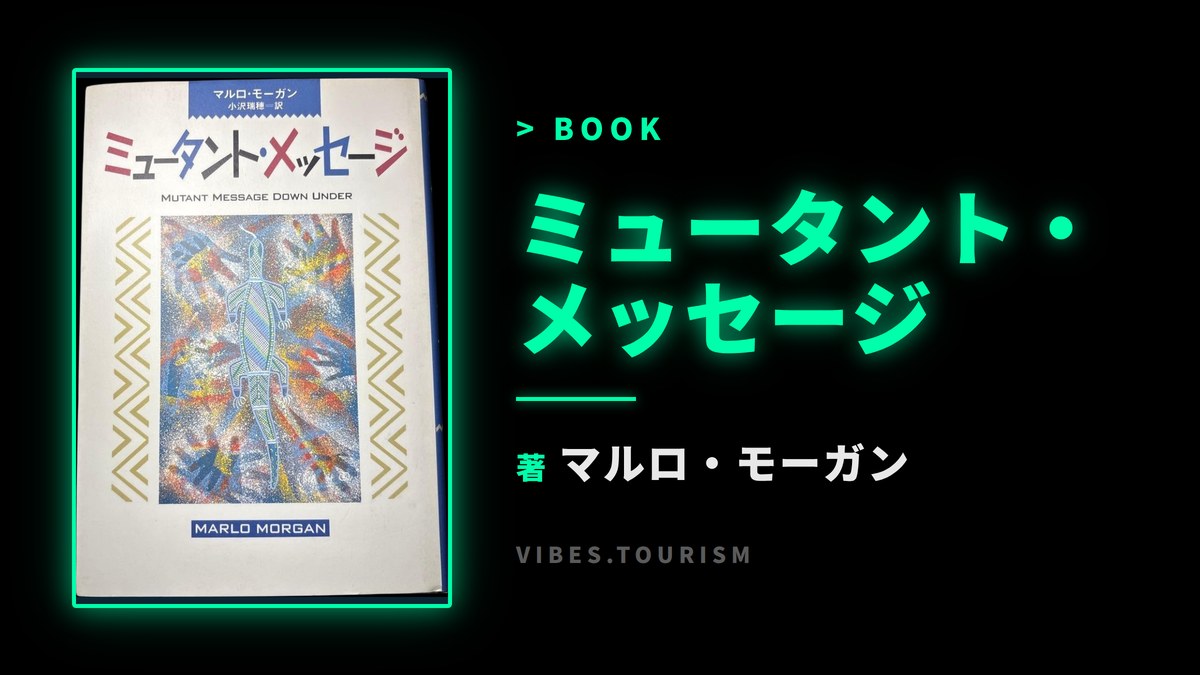

The ones who mutated
were you
A people who own nothing, walking the desert barefoot. They called civilized humans “Mutants.” What is the message a tribe—who let go of property, of storing up, of words, of aging—left to us, on the eve of their own vanishing?
The first lesson this book throws at you is a hard one. What you own is not a source of security, but a source of fear.
You won’t nod along right away. We live by the opposite assumption. Savings mean security. Insurance means security. A house, a car, more things—security. So we accumulate. We believe, almost without question, that abundance is a matter of how much we possess.
In the opening pages, that assumption is set on fire. Invited by the tribe who call themselves the Real People, the author watches her wallet, passport, camera, jewelry, and the good clothes off her back tossed one by one into the flames. All that remains is a single cloth to wrap around her body. From here, she will walk the desert owning nothing.
Stop and consider this. When you gain one more possession, what grows alongside it?
The fear of losing it.
Buy a phone, and the worry of dropping it is born. Buy a house, and the worries of earthquakes, fire, and the mortgage arrive. As savings grow, so does the dread of them shrinking. The number of things you guard is exactly the number of worries you carry. We think we are buying security, but we are buying fear, one piece at a time—that is the mechanism this book points to.
According to the book, the Real People own nothing. So they can lose nothing. For people who never draw the line that says “this is mine,” the job of guarding the inside of that line never arises in the first place.
A possession is the line between yourself and the world, made into the shape of an object. And depending on how you draw that line, the very same world looks completely different. To our eyes, the desert is “a place with nothing.” To theirs, the same desert is “a place where what you need is set out, ready, when you need it.” Neither is lying. One counts only the inside of the line as “existing,” the other counts the whole world. That is the only difference.
We live in rooms packed with things and still feel something is missing; they laugh and say “we have everything” with a single cloth. What was missing, it turns out, was never things.
In the room of whoever is reading this, there is probably clothing untouched for two years, and a subscription you forgot to cancel. What they provide is not convenience but a small guarding job. Try letting go of just one thing today. What decreases is a possession; what grows lighter, you will feel in your body, is the fear.
The opening flames are neither ritual nor spectacle. They are the work of erasing a line. What burned in that fire was not the wallet or the clothes, but the single word “mine.”

“Forewarned is forearmed.” Fill the fridge, stack up savings, take out insurance. To prepare is the responsibility of an adult, and those who don’t are the careless ones—so it goes, in our world.
This book portrays people who live the exact opposite. The band of Real People sets out on a desert journey carrying almost no food and no water. No map either. According to the book, they grow no crops and gather no harvest; each morning they simply set out trusting that “today too, the universe will provide what we need.” And the universe, it is written, never once let them down.
“That’s absurd,” you think. You’re allowed to. But first, look at the most astonishing scene of how “the universe provides” unfolds in this book.
Midway through the journey, the author is suddenly told to walk at the front. She has no idea where water is, or food. As expected, a full day’s walking turns up nothing. On the second day, in the blazing heat, still no water and no food appear. On the third day, unable even to make a sound from dehydration, she goes from one to the next of her sixty-two companions, begging—help me, I’m going to die like this. The reply that came back: we too are hungry and thirsty. But this is your lesson, and so we will support you with all our strength.
At the moment she resigns herself to death, a voice sounds within her. “Become water. When you can become water, water will be found.” Abandoning logic, she becomes water in all its forms. Cold water, blue water, murky water, rain, snow, steam—she pictures every kind of water filling her body. And then, beyond the flat earth, a pool of utterly clear water, about three meters across, appeared. So the book writes.
Whether you believe the miracle, set aside. The lesson this scene carries matters more. To store up is distrust—“the world will not provide”—made into the shape of an object.
A refrigerator is a convenient box. It is also a box of distrust. Without the premise that tomorrow’s food may not be obtainable, that box is unnecessary. Savings, insurance, stockpiles—all are built on the same premise. In other words, we live stacking up, day after day, certificates that read “the world cannot be trusted.” We think we store up because we are anxious, but the order may be reversed. Because each act of storing makes us re-confirm the premise of distrust, the anxiety never ends.
As proof, consider this. At what number in your bank account will you finally feel secure?
You won’t be able to answer at once. A preparation with no finish line is the same thing as anxiety with no end.
You needn’t take their trust for some strange superpower. You use the same kind of trust every day. Air. You do not store tomorrow’s portion of air in your lungs. Because you trust completely that, when you breathe, it will be there. The Real People treat food and water with the same degree of trust that we give to air—that is all.
For us to live owning nothing starting tomorrow is, realistically, impossible. But we can change the direction in which we count. A morning that counts future lack—“what if I run short”—and a morning that counts present sufficiency—“today too, it is all here.” The same single day becomes an entirely different day.
They own nothing not because they are poor. It is because they trust the world as much as they trust air.

Words are supposed to be the summit of communication. We sharpen vocabulary, study how to convey things, and books on how to speak become bestsellers. The better you are with words, the more you connect with others—so it is believed.
This book presents people who overturn that premise. The Real People conduct much of their daily communication without using their voices. Mind to mind, directly. The Japanese chapter title is “The Cordless Phone”—a phone with no line, that is, the communion of minds.
If you’ve braced yourself, expecting the occult, first look at the condition this book attaches to the ability. That part, at least, is made to strike even someone who believes in no telepathy at all.
According to the book, mind-to-mind communion is possible for them because they tell no lies whatsoever. Not just the big lies. No small fudging, no embellishing a story, no telling only part of the truth—none of it. Because lies are zero, things to hide become zero. Because there is nothing to hide, they can keep their minds open, unafraid to receive or to give. In this book, the communion of minds is portrayed not as a superpower, but as a byproduct of having nothing to hide.
Then what is the voice for? Their answer is delightful. According to the book, the voice is not, at root, a tool for talking. It is a tool for singing, for celebrating, for healing. Use the voice for chatter, they say, and it drifts into nothing but small, trivial conversations.
There is also a scene where the author herself tries to learn this communion. And she writes honestly—as long as even one thing she “wanted to keep hidden” remained in her mind and head, she simply could not do it. What blocked the line was not a lack of ability, but an inventory of things to hide.
But the scene that chills the spine most in this chapter is another one. The author, still unable to commune, talks with the tribe by voice and explains her own culture. The gravy poured over meat, for instance. The sugar coating over a cake. Listening along, they reply at once—that is the essence of your society. To cover and hide what lies beneath.
Merely explaining a sauce, and back came a diagnosis of civilization. Come to think of it, we are good at covering. We cover ingredients with seasoning, faces with makeup, true feelings with pretense, anxiety with a smile. Even that revising of a message three times before sending—half of it is not “the effort to convey” but “the effort to convey while hiding.” Before being a tool of transmission, words run at full capacity every day as a filter that selects and covers, cutting from the whole of one’s mind only “the parts fit to release.”
So the takeaway of this chapter is not a method for acquiring telepathy. It is a reverse calculation. When you feel you “can’t get through” to someone, what is lacking is usually not vocabulary; what is in excess is the amount you both hide. With someone to whom you show your whole mind, even clumsy words get through. With someone with whom you hide your inventories, no matter how many words you spend, it never feels like it got through. You, too, must have a face that comes to mind.
Their phone has no cord not because the technology is advanced. It is because there is nothing to hide.

The body is a precise machine; when it breaks, you carry it to a specialist to be fixed. That, roughly, is our view of the body. And we must not forget that the author herself is someone who worked in that world of Western medicine.
There is a scene she writes of witnessing—one of the book’s finest. A companion falls from a cliff and is slammed onto a ledge twenty feet below. The shin bone breaks through the skin and juts out: an open fracture. In the middle of a desert with no hospital and no medicine, what happened?
First someone’s head-cloth comes off and is wrapped around the thigh to stop the bleeding. The healer does not touch the wound. He slides his hand slowly over the leg, held about an inch away. According to the book, this was the work of “making the bone remember the shape of the healthy leg it had built over thirty years.” Removing the shock of the instant the bone broke, awakening in the bone itself the memory of “this is your true form.” Then three healers raise their voices and “speak” to the bone. And—though no one appears to pull it—the protruding bone slid smoothly back into the hole.
For the finishing touch, the long, mysterious tube the woman healer always carries appears. As for what is normally inside that tube—it held the women’s menstrual blood, wrapped and stored in plant leaves. On this day, she opens the bottom of the tube, draws out a black, tar-like substance, and seals the wound shut like glue. The next morning, that man—the Great Stone Hunter—stands and walks as if nothing had happened. Not a trace of a limp. The black natural adhesive dries and flakes off in a few days, and by the fifth day, all that remains where the bone had jutted out is a thin scar.
“Impossible,” modern medicine would say. And that is fine. What deserves attention is not the truth of the miracle but the premise of these people the book portrays. In their world, the initiative for healing lies with the body itself. The body carries out, exactly, what the mind is convinced of. In a place where everyone is convinced beyond doubt that “it heals,” the body gives its all toward healing—the core of their medicine, the book portrays, is this absence of doubt, more than any knowledge of herbs.
Here let me connect just one point of outside medicine. The placebo effect—the phenomenon where taking a drug with no active ingredient, believing it “works,” actually improves symptoms—is a fact confirmed by modern medicine. The very pathway by which the mind’s conviction affects the body’s state is acknowledged on the side of science, too. What this book portrays can be read as people who use that pathway not as a narrow back road, but as the main street.
Now, here is where the reader comes in. If the body listens to the mind, what are you making your body listen to, every day?
“I catch colds easily.” “I’m old now, so I heal slowly.” “My constitution holds onto fatigue.” Thinking them mere habits of speech, we read the same instruction sheet aloud to our bodies every day. By their standard, this is a self-prescription of curses. The reverse holds too. Words that trust the body do no harm, at the very least. And they are, surprisingly, free.
The most effective medicine in their healing may not be herbs but the absence of doubt. And that one medicine can be prescribed from tonight, without going all the way to the desert.

There is good in the world, and there is bad. Comfort is good, discomfort is bad. From the moment we are born, we live sorting the world into these two. Insects, unpleasant; heat, the enemy; pain, to be eliminated. Without a shred of doubt.
This book has an intensely revolting masterpiece of a scene that uproots that sorting. Flies.
Desert flies are no gentle thing. According to the book, at dawn a swarm of millions blackens the sky, enters the ears, climbs up the nose, claws at the eyes, slips through the gaps in the teeth and invades even the throat. They cling all over the body; looking down, she seemed to wear “a moving black armor.” The author genuinely pleads that if this many insect legs kept crawling over a body, a person would go mad. Hell, she says.
Then the elder, Regal Black Swan, admonishes her. This reply in the book is the gem. “Everything has a purpose. There are no freaks, no misfits, no accidents. There is only what humans do not yet understand.”
And the elder reveals the flies’ true nature. The flies enter the ears and, while you sleep, clean out the sand and earwax that have collected. That is why their ears hear perfectly. They climb the nose and clear it. It will grow hotter from here; if your nose is blocked, you will die. The flies cling to the body and carry off, completely, the waste it has expelled—the very pest that modern people drive away with insecticide, they welcome as a cleaning crew that works for free.
The elder concludes. People only ever “eliminate” what is unpleasant, and never try to “understand.” When the flies come, we surrender. Perhaps it is time you surrendered too.
Here is the place to be floored. The same flies were “hell” to the author and “cleaners” to them. The flies have not changed at all. What changes is only the understanding of the side that sees them. There is no absolute “enemy” in the world. There is only what we do not yet know the meaning of—this is what the book is saying.
You can’t read this off as a desert story. We, too, sort every day. This boss is the enemy. This traffic jam is the worst. This failure is a stain on my life. But the instant we decide “enemy,” we shut, with our own hands, the door to understanding its meaning. Later, you realize “it’s because of that detour that I am where I am”—that happens, doesn’t it? That is the moment when the meaning of what you once called “enemy” finally becomes clear, years later.
Picture one thing you currently think is “the worst.” Is it really an enemy? Or a cleaner whose meaning you simply can’t yet see? Try putting the verdict on hold, just a little. With that alone, the “enemies” in your world decrease, one by one.

In the previous chapter, they said, “Don’t eliminate what is unpleasant—understand it.” This chapter is another intense scene where that idea appears at the level of the body.
There is a Japanese chapter titled “Buried Alive.” Literally, the author is buried in the desert ground for two hours, only her head left out.
Imagine it. Your whole body fixed in sand, unable to move a finger. In the book she writes honestly—if they walked away just like this, she would become bleached bones here. At first she dreaded that lizards, snakes, and desert mice would run across her face. For the first time in her life, she truly understood how a paralyzed person feels. You will the arm to move, and it won’t—that sensation.
But once she stopped resisting, closed her eyes, and began to concentrate on “releasing toxins from her body and drawing in the cool, pure power of the ground,” time passed quickly. And when her buried body was dug out, she writes this—“We left the odor behind in the ground.”
Here lies the decisive difference between us and them. We think of body odor as something to “erase.” Deodorant, perfume, antiperspirant. In short, to cap it and cover it over. “Cover and hide what lies beneath”—the essence of civilization the tribe named in the previous chapter—is exactly what we do under our arms every morning. They are the reverse. The true nature of odor is waste the body wants to expel, and rather than cover it, they grasp it as something to “release and leave behind” in the earth. To cap, or to expel completely. The opposite idea.
Of course, you needn’t get buried alive starting tomorrow. But this reversal of thinking is usable. We try to “erase” unpleasant sensations right away—fatigue, pain, a hazy mood. Suppress with medicine, distract with diversion, decide not to look. Cover, and hide. But in this book’s view, that discomfort may be a signal the body or mind sent saying “I want to release this.” Cap it, and what wanted out keeps accumulating inside.
Look anew at discomfort, not as an enemy to erase but as a sign of poison wanting out. Like her, who left the odor behind in the ground, give what has piled up a proper release, somewhere. From the civilized custom of covering and hiding, to the custom of expelling completely. This is something you can do without being buried in sand.

Every year we hold a strange festival. The birthday. We celebrate, saying “congratulations,” while in truth no one wants to grow older. We call it joyous while dreading age. Each year we paper over this contradiction with the candles on a cake.
The exchange when the author told the tribe about birthdays is striking. According to the book, they were at first purely puzzled—why celebrate such a thing? There is nothing special about getting older. It takes no effort. It is something that merely happens.
When the author asked in return what, then, they celebrate, the answer was this. They celebrate having gotten better. Whether you became a better, wiser person than last year’s self—only you can know. So the person who believes they have becomes the one to tell everyone, “the time has come to celebrate.” And then they are celebrated grandly. The Japanese chapter title, “Happy Unbirthday”—the anniversary that is not a birthday is opened this way.
Be floored here in two stages. The first is the reversal of what is celebrated. Not the passage of time (no one’s achievement) but growth (the person’s own achievement). Come to think of it, a birthday is not a day on which the person accomplished anything. It is merely a day on which they were alive. The second is the reversal of who declares it. Not the calendar and others, but self-declaration. By our sense of things, the height of audacity; but their logic holds. The only one who can observe inner growth is the person themselves.
What is astonishing about this system is that the fear of aging structurally cannot arise. A way of living that counts years automatically becomes a way of living that counts remaining time, and the larger the number, the more frightening. In a way of living that counts growth, the number only piles up. It does not decrease. So each celebration makes you richer. That they do not fear aging (as the book portrays) is not because they are especially brave, but because what they count is different.
While we’re at it, let me add the matter of their names. According to the book, the Real People’s names are “Great Stone Hunter,” “Woman Healer,” “Secret Keeper”—the names of that person’s talents. And they hold that everyone is born with multiple talents, and a single life is too short to display them all. The author also writes that their language has no word corresponding to “work.” Living and the exercise of talent are, from the start, not separate. They have no such cage as ours—fixing the self to a single job title on a business card, and when that role wavers, wavering along with it.
Now, the self-declared celebration—let’s say you do it too. There is only one condition. To be able to say, in your own words, “this is where I got better than last year’s self.”
—Could you say it right away?
If you couldn’t, it is not because you haven’t grown but, probably, because you haven’t been counting. Years increase on their own, so not counting causes no trouble; but growth piles up only where someone counts it.
On their calendar there are no numbers. There is only the mark of a day you could say you’d gotten better.

For us, a meal is almost entirely a “purchase.” Meat lined up in packs, vegetables in bags. So that we need not think about what was once alive and what it was, the scent of life is cleanly erased at the point of sale.
The table in this book is the polar opposite. The Real People, before they put anything in their mouths, always offer gratitude to that life. The Japanese chapter titles include “The Dinner Party” and “Chocolate-Covered Ants?” and, as you’d guess, larvae and ants rise to the table too. At first the author cannot get them down. But to a body that has kept walking the desert, they gradually turn into a feast.
What’s more, their “receiving” differs from our supermarket in its very mechanism. According to the book, when they hunt, they do not corner the prey. They sense the sign that the kangaroo itself has decided “now, I offer my body to the tribe,” and they know when and where that life will be offered. A hand held over an unseen yam beneath the ground trembles above the one that is ripe and ready to eat. Rather than seizing food, they receive what is offered. It is less a hunt than a rendezvous.
Read it as a tale of eating gross things, and you miss the body of this chapter. The body is what gratitude is doing.
Gratitude is the recognition of “having received.” It is the confirmation of a relationship—there is a counterpart, and something was given to me. A purchase, on the other hand, has no counterpart. There is only the exchange of money and goods, and no relationship with the life arises—or rather, that convenient system exists precisely so that no relationship arises.
Humans have an honest trait. We treat what we have a relationship with carefully, and what we have no relationship with carelessly. We carry an umbrella borrowed from a friend with care, yet think nothing of leaving a cheap plastic one behind. That psychology. The instant we call nature a “resource,” the counterpart becomes a thing. We do not thank things. Things can be treated carelessly. Overfishing, waste, the throwaway use of the environment—at the root is not malice but the severing of relationship.
They take no more than they need not because they are patient. It is because the counterpart is not a “thing” but “a life that offered itself.” No one throws away what they have received.
By the way, our language already has a word born from the very same place as theirs. “Itadakimasu.” “I humbly receive your life”—that was, originally, a declaration of gratitude before a meal. We kept only the word, neatly, and left its contents behind at the point of sale.
From today’s meal, just one dish is enough. Before your chopsticks touch it, picture what was once alive and what it was. The taste won’t change. But one “relationship” returns to the table. If drawing a line is civilization, erasing one line is something you, too, can do tonight.

When we hear “god,” what comes to mind is mostly an officer of surveillance and scoring. There are commandments, deeds are recorded, good deeds add points, bad deeds subtract—judged by what you did. That, for many religions, is the image.
According to the book, the being the Real People believe in is quite different. Its name is “Divine Oneness.” Not a god in human form, but a single consciousness flowing through all living things. And what this being sees is not the deed, but the intent. Not what you did, but why you did it—so they hold. Ooota, the interpreter, says: Oneness is concerned not with what we do, but with why we do it.
First, let me break down “a single consciousness.” Picture the sea and its waves. The waves look like separate things, one by one, but in fact they are all the motion of the same sea. Between one wave and the next there is no true boundary. If one wave began to insist “from here on is my water,” it would be absurd, wouldn’t it? —But that is exactly what we do, in this book’s vision of the world. The enclosure of the individual is an illusion of a wave that counted itself as cut off from the sea; in truth all is connected, one. That the healer in Chapter 4 could heal the fractured hunter without touching him, that they could sense the kangaroo’s “sign of offering” in Chapter 2—all of it rests on this “connected, one.” Events that looked like scattered wonders are here bound into a single view of the world.
And so the meaning of “seeing the intent” changes too. If all is one, deceiving someone is like the sea’s right edge deceiving its left—you cannot, in principle, do anything hidden from yourself. The watching god is not outside. It is at the very bottom of your own inside. So what is asked is not the externally observable deed, but the intent you yourself know within.
This ethic uproots our “safe as long as no one finds out.” In a world that judges by deed, results-that-turned-out-fine, and doing-it-on-the-sly, are possible. In a world judged by intent, deception is structurally impossible. Because the audience is yourself. Conversely, a small kindness in a place no one watches is, in this world, a perfect score. A kindness done in hiding ranks above a good deed done to be seen—doesn’t that sound like an ethic you’ve heard somewhere? Our “the sun is watching” faces the same direction as their Oneness.
Try picking one thing you did today and digging “why?” three times. The first answer brings out the pretense. The second brings out the circumstances. What comes out on the third is what their god sees.
Their god needs no surveillance camera. Because the one watching is you yourself.

There is a word I saved for last. The “Mutant” of the title. It means a transformed, altered being.
Those who see this book’s title usually think: it must be a story about peculiar people who keep up a primitive life in the desert. The reverse. According to the book, the ones the Real People call Mutants—altered beings—are not themselves. They are us. Seen by them, who have lived fifty thousand years as the original humans, the ones who mutated are the side that began drawing lines—the civilized. In their words, the Mutant now dies without even knowing the feel of rain on bare skin, lives inside artificial heating and cooling, and suffers heatstroke at ordinary temperatures. Surrounded by things, seeking happiness in things, working a whole life only to buy things—beings who have drifted from the original life. That is us.
Told this, when you look back over the nine chapters, all of it connects into a single line. The line of possessions. The line of storing up. The line of words. The line between body and mind. The line of “friend or foe.” The line that caps even body odor. The line of age. The line with food. And the line with the divine. Not one of these did they draw. They were all tools needed only by altered beings cut off from nature. The more lines we drew, the safer we were supposed to be; yet inside the lines, we raised fear, anxiety, and loneliness. What we lived in was not a fortress but a cage.
And in the book’s final stretch, the greatest fact is revealed. The Real People had chosen, of their own will, to depart from this planet. To bear no new children, and to make the present generation the last. The continuation of the species—that attachment a living thing can least let go of, to the very end—even that, they let go. How is such a thing possible without an air of tragedy? Because they truly believe the Oneness of Chapter 9. Even if a wave vanishes, the sea does not lessen by a single drop. The wave-form called the tribe simply ends, once; what it returns to is, from the start, a single consciousness. The fear that “we must continue” arises only in one who thinks of themselves as a single wave cut off from the sea.
So what did the departing people do with their last strength? Not build a gravestone, not leave a record. It was to entrust a message to those left behind—to us. This is the true identity of the title’s “Message.” The elder tells the author: we leave the earth to you. Please watch what your way of living is doing to the water and the animals and the air, and to one another. Please find a solution without destroying this planet. What the departing ones worried about was not their own disappearance, but us, the ones left behind.
And in the message there was neither judgment nor despair. There is still time. According to the book, the reason they chose the author as messenger from among the many Mutants was that they felt many Mutants were, somewhere in their hearts, beginning to return to the original human.
Finally, let me touch on it just once. This book was fiction. The author herself admits it. And yet this book has been read by nearly a million people worldwide in the HarperCollins edition alone, translated into twenty-four countries, and still keeps producing readers who say “it changed my life.”
Strange, isn’t it? At the teaching of a false desert, a false tribe, why do real tears fall?
The answer is already out. Because the hunger this book points to is the real thing. Surrounded by things, yet not enough. Always connected, yet alone. Growing ever more convenient, yet never lighter. If that feeling rings true—if something aches as you read this book—it is proof that the “human before the lines were drawn” is still alive inside you. The mutation is not complete.
So, finally, I’ll close this article with a single question.
What is the line you are guarding most desperately today? And that line—do you truly need it?
The message was addressed to you from the start. Whether the sender really exists changes not a single letter of what the letter says.

by Marlo Morgan
Originally self-published 1990; HarperCollins edition 1994.
Japanese edition: Kadokawa Shoten, trans. Mizuho Ozawa (1995 / bunko 1999).
The Japanese translation is effectively out of print; available secondhand.


Comments