
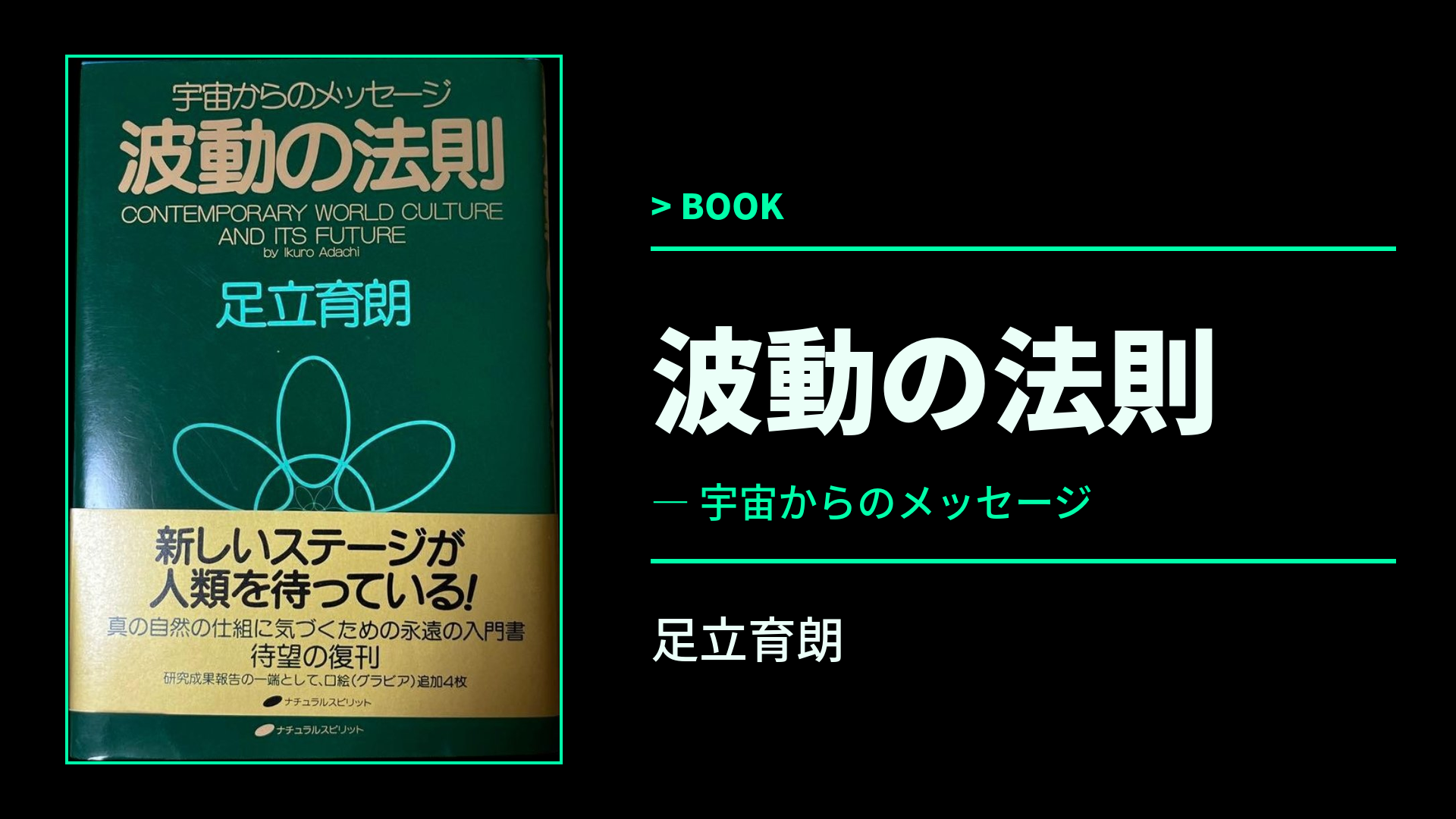

The man who used a
draftsman’s hand to copy
the blueprint of the cosmos.
A licensed architect out of Waseda threw his life away at forty-three, saying he had been “nothing but ego.” With the very hand that drew blueprints, he began simply to transcribe the figures and equations descending from the cosmos. His sister copied that same cosmos with a brush. This is the record of that round trip.

The word “vibration” is one everyone now uses without a second thought. But it is little known that the single book which settled this word into everyday Japanese walked out into the world completely unarmed.
Zero references. It grants no wish. It proves nothing. And still, there is a book that survived thirty years on someone’s shelf. It was written by an architect who had lived forty years in a place far removed from the cosmos and the soul.
What this book ultimately confronts you with is not a grand cosmology. It is a step so small it’s almost anticlimactic: “Today, can you choose the side you faintly felt?”
An architect is, by trade, a person who makes a living by transmitting.
He translates a building that exists only inside his head into lines and numbers. That drawing is then read by the workers on site, by the client, by the official at city hall. Unless every one of them can picture the same thing, the building doesn’t rise a single millimeter. A blueprint is the ultimate language of transmission — a way to copy your own image, exactly, into another person’s head. Ikuro Adachi was a man who had handled that language for more than forty years.
Born in Tokyo in 1940. He finished the architecture program at Waseda and opened his own office in his twenties. He drew plans, calculated structures, put up buildings. He had lived about as far from “messages from the cosmos” and “the soul” as the opposite side of the planet.
And then, at forty-three, he stopped his hand.
What set it off was a question almost laughably plain. When you design, there are moments when, after all the reasoning is wrung out, an answer simply drops in from somewhere. That “flash of insight” everyone has felt. Most people file it away as instinct, or experience, and move on. Adachi couldn’t file it away. Where, exactly, does that thing that drops in come from? What is intuition? What is a flash? Once it started bothering him, it would not stop.
Forty-three is the age at which a life is hardest to walk away from. There’s an office. There’s a family. There’s the credit you’ve built up and the living that runs on it. Most people stop thinking the unnecessary thoughts right there. They pretend not to notice the self that has stopped, and they go back to the drawings.
Adachi did not go back.Instead, he negated forty-three years of himself, wholesale. He had lived on the premise of being an architect, and never once faced the things that actually matter — what a human being is, what it means to live. It had all been ego — that is how he looks back on it. And in 1983, with his younger sister Sachiko Adachi as his partner, he set out to chase something incomprehensible called “vibration.” A licensed architect dug up the very ground he stood on and turned it into a vacant lot, with his own hands.
What grew out of that vacant lot is this book, The Law of Vibration. It came into the world in 1995, went out of print once, and still readers would not let it go; it was reissued in 2007. For nearly thirty years it survived on someone’s bookshelf, until it finally settled the word “vibration” into everyday Japanese.
A man who had lived by transmitting bet the back half of his life, whole, on something else. The interesting part is that the one thing left untouched to the end was the hand that drew. The architect’s hand stayed an architect’s hand. Only the subject changed — from buildings to the cosmos. What Adachi does in the pages ahead is, in short, to draw the blueprint of the universe.

The most spine-tingling story in this book is not inside the text. It sits just before the book itself came to be.
Ikuro Adachi had a younger sister. Sachiko Adachi. Born in 1946. A perfectly ordinary commercial designer who handled interiors and color coordination at a design firm. She picked the season’s colors and arranged rooms. A line of work with no connection to the cosmos or the soul.
And to this brother and sister, at almost the same time, the same thing happened.
Separately, yet as if by prior agreement, they both intuited it: everything in this universe is made of combinations of vibration. Normally this is the scene where one says it and the other worries, “Are you all right?” But these two siblings both grasped it. Two people of the same blood received the same signal, in the same period.
And here is where it gets interesting. The two of them divided the roles.
Ikuro himself writes it: his sister would express that vibration through art, while he would receive it scientifically, as information, and convey it — that is what they decided together at the start. Receiving the same thing, they changed the exit. The brother, with an architect’s hand, transcribes it into equations and geometric figures. The sister, with a painter’s hand, draws it out in color and form. A brother who records, a sister who expresses. Rarely has an inspired pair split the work so cleanly between the sciences and the arts.
The sister bent her life sharply after that. In 1985 she quit being a steady designer and began calling herself a “cosmic artist” — a painter of the universe. Sounds dubious? And yet in 1989 her work was selected for an art exhibition in New York. This was not a hobby that stayed a hobby. Just as her brother copied the cosmos in words and equations, the sister truly went to copy the cosmos with a brush.
The decisive thing happens when you set the two of their works side by side.
Among the paintings the sister left is one titled “The Door to Another Dimension (Teleportation).” Meanwhile, the title of Chapter Six in her brother’s book reads: “The Future of Earth’s Culture — Through Spacetime Movement (Teleportation).”
The words are different, the medium is different. One is a single painting, the other a chapter built from reasoning. And yet the single word they each arrived at was exactly the same. Teleportation. The two were looking at the same scenery through different windows.
So when you read this book, you may keep one more person beside the page. Someone looking up at the same cosmos, trying to answer not in words but in pictures. The brother wrote it; the sister painted it. One and the same thing.

A book that pretends to be science usually comes armored. Experimental data, references, quotations from important people. Armor laid out to say, “Look, here is the evidence,” and to silence the reader.
This book walks out unarmed.In the preface, Adachi confesses it flatly. There are no references in this book. He makes no conjectures, builds no hypotheses. He merely reports, as accurately and concretely as he can, the information he received from the cosmos by intuition. The banner he raises is “to report accurately,” not “to explain so it’s easy to understand.” Reporting and conveying look alike but face entirely different directions. The first tries to be faithful to the facts; the second tries to accommodate the listener. Adachi chose the first.
Normally a groundless cosmology is laughed off and that’s the end of it. Yet Adachi hands you, himself, the very weakness that would get him laughed at. This is information from a dimension far higher than the knowledge humanity now possesses, he writes, perfectly calm. Which means: you cannot prove this, and you cannot disprove it either. He sets out in the open the weakness most people would hide. This act of sealing his own escape route somehow generates an odd force.
But the part that toys with the reader most comes next.
When it comes to spiritual books, the going rate is fixed. Read this and your wish comes true, money arrives, you grow healthy, a special power awakens — whispers that light a fire under the reader’s desires. Because, as a business, that is what sells best.
Adachi kicks away that tastiest part himself.I want money, I want superpowers, I want to be healthy. All of that, he says, is nothing more than personal desire. A special power sprouting in only one part of the body is, seen as a whole, actually an unhealthy state in which harmony has collapsed — he goes that far. In a genre whose royal road is selling wish-fulfillment, he cuts down the wish itself as “disharmony.” It is a book that denies, right in front of you, the very thing the customer came wanting.
So what, then, are we supposed to do.
Here Adachi flips the order. Do not reach toward the thing you want, he says. Stop wanting; first make up your mind, and move, plainly, toward what is harmonious. Repeat that, calmly, and your vibration gradually settles and rises, steadily. And then — as a result of that — your health, and the things you’d wished for, follow along on their own, after the fact.
Want it, and it flees. Let it go, and it comes.It proves nothing. It grants no wish directly. That this book still survived thirty years on someone’s shelf is probably because of that subtraction. A book that sells you nothing is far more trustworthy than a book that promises you everything. Adachi never once said “believe me.” He only said, “This is how I received it; the rest is up to you,” and pushed the reader away. To that very curtness, people reached back.

Picture the science textbook. A nucleus at the center of the atom, with neutrons and protons packed inside it. Electrons whirling around the outside. That picture. Children all over the world learn the same one.
Adachi takes that same picture and writes a different meaning over the top of it.
The neutron is consciousness, he says. Its role is to harmonize and to amplify — to gather everything toward harmony and spread energy outward. The proton is will. Its role is to transmit love — to send out, outward, the law at the root of the universe called “love.” And the electron, he says, is a state in which the energy called the “photon” is spinning round and round.What is he saying. Put into earthbound words, it comes to this. Inside the smallest part of matter, the part that cannot be divided any further, the “power to notice” and the “power to head toward” are already built in from the start. Mind and matter were not born separately and joined later. From the very beginning, they were one and the same thing.
We were taught the reverse. First there was matter; after it assembled into something dizzyingly complex, a brain formed, and mind popped into being like a kind of bonus. Matter first, mind after. Adachi flips that order. Mind, he says, is at the root just as deeply as matter is. It is no afterthought, no add-on.
Here is one place that is very much like Adachi. He does not try to prove this enormous redefinition to anyone. He neither runs an experiment to show it nor pours out words to persuade. He simply transcribes the structure exactly as he received it, in silence, into figures and equations. In fact, the true identity of what makes this book feel “hard to read” is precisely these figures and equations — and Adachi does not redraw them for beginners. He receives, and he puts it out. That’s all.
Accept this overwrite, and the world turns strange.
It is no longer only humans and animals that possess a mind. Minerals, plants, the cup on the desk, a single screw in the drawer — each is said to harbor its own consciousness and will. “Objects have a heart too,” “treat your things with care” — that feeling the Japanese have vaguely held for ages. Adachi explains it not as a sermon or a metaphor but, with a straight face, as a physical phenomenon at the level of the atom.
This chapter is the vital point of the whole book. Consciousness dwells in the neutron — whether you can swallow that one point decides whether everything that follows, the talk of the soul, of illness, of how to live, stands up, or collapses all together. If you can pass through here, you already have one foot inside the world Adachi sees.
Asked “Who are you?”, a person first gives a name, then an occupation, and finally, usually, points somewhere around the chest. This body. This is me. Almost everyone believes that without a shred of doubt.
Adachi pours cold water on it. That is not you.By the information he received, the true substance of a human being is something called the exapieco (EXA PIECO). It’s hard to render in Japanese, but roughly it means “an aggregate of atomic nuclei.” Not just any nuclei, though. A gathering of nuclei that have no electrons.
Recall the previous chapter. The electron was “a state of spinning photons,” the part by which matter appears in this world — the display device, so to speak, for showing up as substance. The exapieco does not have that electron. So it does not appear as matter. It can’t be seen. It can’t be touched. No instrument registers it. And yet it certainly exists. That, Adachi says, is what you really are.
What we picture when we hear “the real me” is usually personality, accumulated memory, the pileup of experience. He’s stubborn; that summer’s memory. To Adachi, none of that is you either. Personality and memory are mere attachments stuck onto the body. The exapieco, the main body, does not vanish even when the body perishes. This is the closest thing in the book to the “soul.” And this too is no privilege of humans alone — it dwells in minerals, in plants, in that single screw.
If it doesn’t vanish, then why be born wearing this troublesome body at all.
Adachi’s answer has no hesitation. To learn how the universe works, and to grow your own vibration toward the higher, harmonized side. For that, you chose this vessel of a body yourself and were born. Life is neither a punishment nor an accident of chance. It is like a study-abroad with a fixed term, that the soul decided to “come and learn” and chose. The things that don’t go well, the unreasonable troubles — see them as assignments at your study-abroad site, and how they look begins to change.
If so, then death is not the end. It is only taking off the vessel. After it’s taken off, the main body remains, intact.
And someone who held this not as reasoning understood in the head but as a way of living itself stood, in reality, right beside this book. Someone who lived as if utterly unafraid of taking off the vessel. Who that someone is, we’ll set aside for now.

If the exapieco is the real self, then who, exactly, is this sensation that right now I think of as “me”? You’d naturally want to ask that. Adachi answers by dividing human consciousness into three. There are three living inside you, he says.
The first is the surface consciousness. The book calls it Dica. Its job is to protect the body. Flee from danger, feed you when you’re hungry, calculate so you don’t lose out. Properly speaking, it’s a useful watchdog for staying alive. But in the modern age, Adachi says, this watchdog tends to grow fat and run wild. “As long as I’m fine” becomes its catchphrase, and from morning to night it keeps calculating loss or gain, winning or losing. The noisy voice you usually take to be “yourself” is mostly this Dica.
The second is the subconscious. Called Fic. This one never comes to the front — an unsung worker beneath the floorboards. It stores away all your past memory and single-handedly takes charge of maintaining the body. It makes the heart beat, closes wounds, replaces cells while you sleep. The vast labor of keeping the body running twenty-four hours without a single command from you — all of that is Fic’s doing.
The third is the essence. The exapieco. The true protagonist, holding the role of the antenna that receives information from the cosmos.
Now for something a bit mean. At this very moment, the very act of you working your head — “Dica? Fic? What does this mean, let me understand it properly” — that working itself is Dica’s job. Loss or gain, right or wrong. The instant you set about measuring like that, the narrowest-sighted watchdog elbows its way forward. The harder you strain to “understand” this book, the further, ironically, you drift from the true protagonist. It’s built as that kind of twisted trap.
We live thinking “I am one.” But lift the lid and there are three, and the one gripping the microphone most self-importantly was the smallest-vesseled Dica. The exapieco, the rightful protagonist, is drowned out by the watchdog’s barking and is barely audible.
So the problem is this: it isn’t that your essence is weak. The watchdog is just too loud. When Adachi cut down the desire to “make a wish come true” in Chapter Three, it connects seamlessly to here. The one barking “I want money, I want power” is usually Dica. Until you quiet that voice, the voice you should truly be hearing never gets through.
The core of the book’s view of the human being. Dica = surface consciousness (the ego), Fic = subconscious, essence = the exapieco. The three-layer structure is the book’s own concept; read it as distinct from established psychological terminology.
There’s one passage everyone who reads this book agrees “hit home.” The talk of “resolve.” Even the publisher’s blurb sums up the heart of the book’s practice as “always resolving instantly and moving in a harmonious direction” — this is the backbone.
Adachi writes it like this. The instant you decide, from the bottom of your heart, “I will do this,” the transceivers of neutrons and protons inside your body multiply explosively in number. The vibration you emit then suddenly grows strong and orderly, and the universe begins to tune itself to you.
The neutron was consciousness, the proton will. So in Adachi’s terms, to “resolve” is not a matter of guts or willpower. It is a switch that physically changes the output of you as a transmitter. Not a matter of feeling but of apparatus. This is just like him.
The way we usually go about deciding is more or less fixed. Loss or gain, set it on the scales. Count the risks. Take out insurance. Waver, endlessly. We were taught that examining things carefully like that is the attitude of a wise adult.
Adachi says that very scale is what muddies your vibration. The state of wavering is, in short, a state of putting out weak signals in both directions at once, swaying. The waves scatter, and every one is weak. A genuine resolve, by contrast, has no wavering. The answer is out, instantly. So the output lines up at a single point and grows strong. What you emit “before deciding” and “after deciding” is, he asserts, as different as another person.
To put it as a metaphor, resolve is a matter of the number of antennas. The antennas of a wavering person point every which way and can’t catch any signal cleanly. The instant you steel yourself, all the antennas snap into the same single direction. So information starts coming in, and the people you need, the convenient coincidences, somehow approach from the other side.
You don’t decide after discerning the right answer. Because you decide, your vibration turns toward the right answer. So Adachi pushes your back, almost impatiently. Just decide, boldly. Not: move once it sits right with you; rather, because you decide to move, it sits right afterward. The prescription Adachi hands to a person frozen and unable to move was not “gather more information,” nor “be more careful.” Stop wavering. That was all.
When we fall ill, we brace ourselves. Beat it down with drugs. Cut it out. Annihilate the virus. Illness is an enemy to defeat, an opponent in a war — modern medicine is built, more or less, on this stance.
Adachi overturns the stance, whole.Illness, viruses — they too are, in short, energy carrying a specific vibration, he says. And it is not an enemy that came to attack. It is a message that was delivered. The sender is none other than your own essence — the exapieco. The text reads: “The way you’re living now, the way you’re using your consciousness, is a little off course from the harmony of the universe.”
The reasoning of Chapter Four takes effect here. When the neutron (consciousness) and proton (will) keep emitting a vibration twisted by anxiety, anger, or ego, that distortion seeps, little by little, all the way into the atomic nuclei of the body’s cells. Illness, he says, is the alarm that sounds when that distortion finally crosses a limit.
Think it an enemy, and you want to beat it down and erase it.
Adachi calls it “kindness.” That pain, that disorder — it didn’t come to torment you. It came to let you know, before things become irreversible, that your orbit has drifted. That’s the view he takes. So the attitude he recommends is a slightly anticlimactic line: “Thank you for letting me notice.”
Picture a fire alarm. Tearing the alarm off because it’s shrieking won’t put out the fire. Unless you face the real reason it’s ringing — the fire burning somewhere — nothing is solved. To Adachi, silencing only the symptom with drugs is close to the act of tearing off the alarm. Don’t blame it for ringing. Look at why it rang.
And gratitude, he says, has the power to cancel out distortion. The vibration of gratitude neutralizes the ego-twisted vibration and gently draws it back to its original harmonized state. Of course, this is not a “don’t see a doctor” argument. But facing the same fever, the same pain, whether you see it as “an enemy’s attack” or “a letter from family” — that alone changes, wholesale, how you carry yourself from there. This question, thrown in from outside medicine, turns out to strike a surprisingly sharp point.

By this far, it should already be clear that Adachi is a man who has gone quite far out. Even so, I think this is the chapter where the most readers can no longer keep up.
Adachi begins to speak of teleportation as the culture humanity will advance into next. Objects, people, leaping across distance, moving to another place in an instant. The very stuff of SF films. He sets it down not as a fantasy but as a coming, ordinary stage — with a perfectly straight face. The title of Chapter Six in the book is, no joke whatsoever, “The Future of Earth’s Culture — Through Spacetime Movement (Teleportation).”
Here, that sister from Chapter Two quietly shows her face once more.
Among the paintings the sister Sachiko left was one titled “The Door to Another Dimension (Teleportation).” The brother wrote it as a chapter, in reasoning; the sister painted it as a single canvas, in color. The forms that emerged are utterly different, and yet the word the two arrived at was, to the letter, the same. Teleportation. The brother who copied the cosmos in equations and the sister who copied it in paint walked separate roads and met at the exact same spot. It is a slightly eerie coincidence.
Teleportation, taken seriously, is preposterous, no two ways about it. If you close the book here, no one could blame you.
Yet there is, in Adachi’s manner of telling, one strange honesty. He hypes it neither as a “miracle” nor as a “superpower.” As if revealing the trick of a magic act, he explains it plainly, as an extension of nature’s mechanism. In his head, a cup harboring consciousness and a person teleporting are continuous. From the single premise that everything is a vibrational wave, both are derived in the same way. The conclusion is outlandish, but the reasoning that leads there has not wavered once since the first line.
So this book does not permit cherry-picking. “The part about consciousness dwelling in the neutron was interesting, but teleportation is a bit much” — that attitude doesn’t actually hold. The moment you swallowed the talk of consciousness, teleportation comes out of the same tap. Whoever nodded at the entrance has no choice but to nod at the exit. Whoever bursts out laughing at the exit was, in truth, faintly doubting from the entrance.So this chapter is a test of faith. How seriously had you actually set foot into this world? Here, you’re confronted with it whether you like it or not. If you laughed, that’s proof of a sound nervous system, nothing to be ashamed of. But Adachi went to peer at the scenery one step outside that soundness — and did it, moreover, two-handed, together with his sister. This book is the record of that round trip.

We’ve heard, this far, about some rather unusual people.
An architect who received the cosmos in equations. A sister who turned the same signal into paintings. A neutron with consciousness, a soul without electrons, the teleportation of planets. Every bit of it impressive. Interesting, too. But somewhere in your heart you must have been thinking: this is a story about special people like that brother and sister, and it has nothing to do with me. Huh, there are strange folks in the world. So saying, you’re getting ready to close the book.
Adachi, at the very end, stops your hand.There is something the book had been saying all along — obliquely, but without ever wavering. Wring the reasoning piled up over nine chapters down to a single line, and it comes to this.
— Everything that happens to you is happening in tune with the vibration you yourself are emitting.That’s a fairly frightening line.
In Adachi’s terms, what’s happening around you now, the people you meet, the chances that roll in, the troubles that crash into you — all of it is no accident. Things carrying a wave at the same pitch as the wave you, a vibrating body, put out are drawn in and become reality. The good and the bad alike. He writes it plainly: however good, however bad, you yourself bear the responsibility.
Bad luck, the other person’s fault, the times are to blame. We live forever pinning the unpleasant things that happen to us on the outside. Because it’s easier. Adachi seals that escape route. What is happening to you, you called. It is no one’s fault. This is not blame. He is teaching the order. Because if the cause is on your side, then what can be changed is on your side too.
So how do you change it.
Here, Chapter Seven’s “resolve” finally reveals its true meaning. Back then Adachi said that when you resolve, the transceivers inside your body — the exapieco — multiply explosively in number. More apparatus, and the wave you emit grows strong and orderly. Change the wave you emit, and what comes drawn to it, in tune, changes.
In other words, resolve was not a guts-and-grit argument. It was the single switch for re-choosing the reality you draw in next.And what muddies this is just as clear. Wavering, the calculus of loss and gain, and conjecture. While you have it on the scales — “this way? no, but…” — your wave keeps putting out weak signals scattered every which way. Even an intuition that came down from the cosmos snaps the instant your head runs ahead with “and then what happens?” The more you think, the more the reception cuts out, the wave muddies, and the reality you summon blurs.
So Adachi’s prescription was, from start to finish, just one. Don’t think. Decide. Move toward the side you felt.Sounds like mere spiritualism? It isn’t. In his mind this is the most concrete procedure there is for operating reality.
And here is the true end.
Recall: the exapieco was not a rare talent dwelling only in special humans like Adachi and his sister. It dwelt in minerals, in plants, in the cup on the desk, even in a single screw in the drawer. Even in a screw, it’s there.
Then there is no way it isn’t in you, looking at this page right now.The apparatus for receiving the cosmos has been loaded into your core since the day you were born. What Ikuro Adachi spent two hundred forty-four pages reporting was not his own special memoir. It was the instruction manual for the apparatus that, even now, runs silently inside you. In the bath, on the station platform, an answer drops in out of nowhere — that feeling. You can’t say why, but somehow you think “this way” — that hunch. You have already received it thousands of times. Adachi merely put a name to what you do every day.
If so, there is only one thing left to do with this book.
Stop trying to understand it. The one who wants to judge “got it” or “don’t get it” was that watchdog, Dica. From the very start the book has been saying to quiet the watchdog. So don’t decode it. Try it.
What to eat for lunch today. At the corner, go right or left. Stop searching for a reason, just once; without calculating loss or gain, put your foot out — before you think — toward the side you faintly felt was “this way.” Not a whim, not fortune-telling. It is the smallest switch there is for turning on the power of the apparatus loaded into your core.
And the one next reality that step summons — that alone cannot be shouldered for you by the screw on the desk, nor by the sister who painted, nor by Adachi himself who received the cosmos.
What you choose next.That alone decides what happens to you next.

“What happens to you is called by your own vibration” and “resolve multiplies the exapieco’s transceivers” are verified against the book’s own text. This article introduces the book’s claims and does not scientifically guarantee their truth.


Comments