
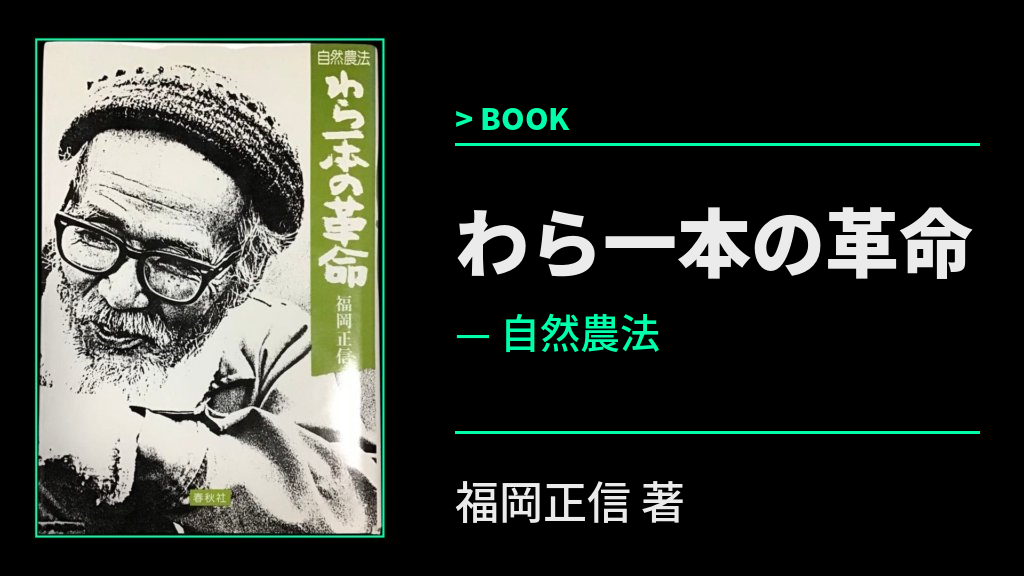
The One-Straw Revolution
Don’t plow. Don’t fertilize. Don’t spray. Don’t weed. The man who said all of that — somehow harvested more.

Drop a single straw onto the field. That alone makes the vast machinery of modern agriculture unnecessary. This is not a book about farming. It is the record of a man who tried to prove, in the soil itself, one idea: that human beings need do nothing at all.
A man who once peered into a microscope was, one day, standing in a rice field. And not just any field — a field where nothing had been planted.
Masanobu Fukuoka was no amateur farmer. He was a trained agricultural scientist, a graduate of Gifu Higher Agricultural and Forestry School (now the Faculty of Applied Biological Sciences, Gifu University). His specialty was plant pathology — the science of dissecting, with a scientist’s eye, why plants fall ill. In 1934, after graduating, he took a post in the plant inspection division of the Yokohama Customs office, a cutting-edge front line where imported plants were watched under the microscope for stray pests and pathogens. He was not a man outside of science. He stood at its very core.
The proof is that he left papers behind. In 1937 he published research on citrus gummosis disease in the journal of the Phytopathological Society of Japan. Find the disease, identify the cause, devise the countermeasure — that was his work. The scheme modern agriculture believed in — if there is a problem, beat it back with science — he embodied better than anyone.
And so the whole book begins with a single question. Why did this scientist abandon science?
Later, having also served at an agricultural experiment station in Kochi Prefecture, he knew the front line of modern farming from the inside. Plow, fertilize, spray, pull the weeds. Do whatever a human being can do to raise the yield — in that era, everyone believed without doubt that this was “progress.” As Japan headed toward its period of high growth, agriculture too was rushing headlong into mechanization and chemicals.
Against that current, one man pushed back, alone. And he was a scientist who should have been at the head of the pack. In 1947 he resigned his post and returned to farming in his home region of Iyo. From then until his death in 2008, he lived for natural farming and nothing else.
This book, The One-Straw Revolution, is the record of what that man thought in the rice field and tried to prove in the rice field. But make no mistake. This is not a tale of “a man who knew no science returning to nature.” It is the tale of a man who knew science to its depths, and then glimpsed a place science could not reach. He took off the white coat not out of ignorance — but because he saw that beyond the lens of the microscope, there was nothing.
So what is that “nothing”? Let us begin with the single night that drove him into the fields.

It all happened in a single night.
In his twenties, while working at the Yokohama Customs office, Fukuoka fell ill with acute pneumonia and wandered the edge of death. He survived, but even after leaving the hospital the fear would not lift. What is death? What is it to live? Sleepless nights followed, and he wandered the hills. Then, one morning.
Having passed the night on a hill overlooking the harbor, he watched the dawn arrive. A single bird called out. The mist began to clear. In that instant, something inside him broke open. “There is nothing in this world after all” — that, he wrote, is what he realized.
The knowledge humanity had piled up, its values, its anxieties — all of it lost its meaning. Human knowledge and human effort are, every bit of it, useless. This was the birth of the philosophy of “nothingness” that would later become the root of both his farming and his thought. Do not mistake the order. He did not arrive at the realization by thinking about farming. The awakening came first, and farming was chosen as the means to prove it true.
Here is the strangest and most important point in the book. Ordinarily a book on agriculture begins with “how do you make things grow well?” Fukuoka’s starting point was the exact opposite. “Is it not true that human beings really need do nothing at all?” He set out to test that question in the one place that allows no escape: the rice field. A field does not lie. If he let go of unnecessary tasks one by one and the rice still ripened, then he could prove that most of human labor had been needless.
Of course, not everything went well the day after the awakening. The first thing he tried, back in his home village, was to leave his father’s citrus grove alone and “do nothing.” The result — the trees withered and the grove was destroyed. It was not the simple story that stopping all care returns land to nature. “Doing nothing” and “abandoning” are not the same. That failure taught him something decisive. Natural farming is not merely throwing things aside. It is discerning precisely the unnecessary human meddling, and pulling only that away.
The awakening came in one night. But translating it into the language of the rice field took the long years that followed. Next, let us look at the “four nothings” he carved away.

Boiled down, farming has only four tasks. Till the soil. Apply fertilizer. Spray chemicals. Pull the weeds. To all four, Masanobu Fukuoka said the same thing: not needed.
These are the four great principles of natural farming — no tillage, no fertilizer, no pesticides, no weeding. Taken one by one, each tears up a farmer’s common sense by the roots.
No tillage. Do not plow. Discard the premise that soil is something to be turned. As Fukuoka saw it, tilling the soil is the work of plant roots, earthworms, and microbes. When a human drives in a plow, the soil dries and its structure collapses. Leave it untilled, and the creatures underground soften it on their own. It is human intervention that, in fact, leaves the soil impoverished.
No fertilizer. Apply none. Not even compost. Feed a crop and it grows coddled and frail. Withhold, and the crop builds the strength to live on its own — and its flavor deepens. The land’s fertility is nourished by the straw and roots returned to the field, and by plants like clover. Not carried in from outside, but cycled in place.
No pesticides. Spray nothing. Pests appear because the balance of the ecosystem has broken down. Spray, and the beneficial insects die too; the balance tips further, and you spray still more. Don’t spray, and the insects that eat the pests survive, and before long the field finds its own equilibrium. Disease, too, is thrown off by crops that have grown strong.
No weeding. Do not pull the grass. But this is not “neglect.” Weeds are not torn out by the root; they are cut at flowering time and laid down where they fall. The fallen grass becomes a blanket — holding moisture in summer, warmth in winter — and rots, in time, into fertilizer. The weed is not the enemy; it is put to work as an ally.
What the four share is a single idea. Nature is already turning perfectly. It is human meddling that breaks the balance. So pull the hand away. Do not restore what was broken — simply do not break it in the first place.
By common sense, this looks like agricultural suicide. A field left untilled, unfertilized, unsprayed, unweeded — surely it would be swallowed by weeds and that would be the end. Everyone thought so. Yet in Fukuoka’s field, the rice ripened. How was that possible? Because the “order and technique of how you stop” was as precise as the choice of “what to stop.” The next chapter steps into that art of subtraction.

Modern agriculture is built on addition. Short on yield? Add fertilizer. Insects appear? Add pesticide. Short on hands? Add machines. Each time a problem arises, something is tacked on to solve it.
Fukuoka’s farming was the exact reverse. When a problem arises, first ask whether something can be taken away. In the English-speaking world his method came to be called “do-nothing farming,” and it was named for this thoroughgoing philosophy of subtraction. Yet “do nothing” invites misreading. More precisely: don’t do what need not be done. Making that distinction was the work of his whole life.
The technique that captures his method is the continuous no-till direct seeding of rice and barley in rotation. It goes like this. Before harvesting the rice, sow barley seed across the field. Once the rice is cut, scatter its straw over the ground. Before the grown barley is harvested, sow the rice seed in turn. Once the barley is cut, scatter the barley straw.
From this cycle, whole steps that modern agriculture deemed “essential” have simply dropped out. There is no step of plowing the field. There is no transplanting — no raising seedlings in a nursery bed to set them out later — because the seed is sown directly. Because the cut straw is scattered as it is, there is no step of hauling in fertilizer either. Subtract, subtract, subtract — and at the far end, a cycle that still turns remained.
But subtraction demands the right order and the right technique. Sow seed bare on the ground and the birds eat it, the insects eat it, it dries and dies. Do nothing, and the seed vanishes before it can sprout. Here Fukuoka arrived at the one small “addition” that makes the subtraction possible: wrapping the seed in a ball of clay.
It was a modest move that made “doing nothing” possible — the clay seed ball. This little pellet of mud would one day leave the rice fields of Japan and turn the world’s deserts green. The next chapter is the story of that single seed.

It looks like a child playing in the mud. Wrap a seed in clay, roll it round, let it dry. Just that.
And yet this clay seed ball compresses the whole philosophy of natural farming into a single pellet. Sow a seed bare and the birds eat it, the insects gnaw it, the sun scorches it dry. So human beings have tilled and buried and watered to protect it. Fukuoka handed that “labor of protection” over to a shell of mud. The clay shell guards the seed from the bird’s beak and from drought alike. And when the rain comes and the soil is sufficiently moist — that is, only at the moment best for germination — the shell loosens, and the seed sprouts on its own timing.
It is not the human who decides “when to sow.” The seed and the rain decide for themselves. No tilling, no burying, no watering — just roll the ball onto the ground and leave it. It was an invention that embodied the farming of subtraction in a single seed.
This one seed eventually went beyond the rice field. Beginning with his 1979 visit to the United States, Fukuoka worked on re-greening deserts with clay seed balls around the world. Sow bare seed in a desert and it only burns and dies. But with a clay ball, the shell protects the seed, which waits for the rare rain to germinate. He scattered these mud pellets in more than a dozen countries, beginning with Kenya.
The results rewrote the memory of the land. In countries of Southeast Asia, it is told, the clay seed ball became the spark by which ruined land revived into banana groves and forest. Dozens of plant species are mixed into a single ball, and only those that can survive on that land are naturally selected. The human does not command “plant this”; the land itself is left to choose. Even desert greening was, for him, an extension of subtraction.
Just as a single straw made a field’s whole system unnecessary, a single mud ball overturned the despair of the desert. The small thing topples the large system. That is the shared pattern of Fukuoka’s inventions. So — what did that subtraction do to the harvest itself? Did the “do-nothing” field really bear grain? In the next chapter we face the most startling number.

The objection to the farming of subtraction is always the same. “A fine ideal — but you can’t eat ideals.” A field untilled, unfertilized, unsprayed could never beat the yields of modern agriculture —
And yet Fukuoka says that even with subtraction, the yield does not fall. In this book he speaks with care: after thirty years, he at last managed a way of growing rice and barley while doing nothing, and its yield had reached a point not in the least inferior to ordinary scientific farming. Not falling, but drawing level — that alone was a refutation of the era’s common sense. In a later interview he went further still, going so far as to say, “No plow, no fertilizer, no pesticide, no weeding — none of it needed; and what’s more, the soil grows richer and the harvest is double” (Serai interview collection, 1998). The book’s careful “not inferior,” and the late “double.” The wording varies, but one claim runs through both. Subtract, and it still does not fall.
Why does it not fall, even after subtracting? The mechanism lies in “balance.” Untilled soil is worked by earthworms and microbes, keeping a soft, crumb-like structure. The unfertilized crop sends its roots deep into the earth, hunting nutrients and water on its own. In the unsprayed field, insects that eat the pests take up residence, and the balance settles by itself. The straw and weeds cut and laid down serve at once as moisture, warmth, and fertilizer. For every bit the human pulls away, nature’s workers return to the field. They work for free, and they never rest.
Modern agriculture’s high yields hold up only when vast energy is poured in from outside. Fuel, chemical fertilizer, pesticides, machinery, and an enormous quantity of labor. Measured by “net abundance” — what is left after subtracting the inputs — which is truly winning? Fukuoka’s question was aimed not at the single number of yield, but at the very accounting: “at the cost of what is that number produced?”
Of course, this figure of “double” is a claim under the particular conditions of his own field, and it does not promise that anyone, anywhere, will get the same result. Where the climate and soil differ, so does the outcome. But what matters is not the exact reproducibility of the number. The great premise of modern agriculture — that if a human eases off, the yield drops — was overturned in a single field. That fact is what shook the world.
Subtract, and still it does not fall. The symbol of this paradox became the very title of the book. A single straw. The next chapter digs into why “one straw” deserves the name of revolution.

Why “one straw”? Not the tractor, not improved varieties, not irrigation — why the plain straw left over after the harvest?
For Fukuoka, a single straw scattered across the field was the symbol that carried all of natural farming on its back. Consider it. Take the straw left after cutting the rice and simply scatter it over the field. That alone, and the straw suppresses the sprouting of weeds, prevents the ground from drying, shields the soil from winter’s cold, and in time rots into fertilizer for the next crop. The work of herbicide, the work of mulch, the work of fertilizer — a single straw takes on all of them at once.
In modern agriculture, each of these would be assigned its own dedicated material and process. Herbicide for the weeds, plastic sheeting for moisture, chemical fertilizer for nutrients. Fukuoka handed those three or four processes over to a single straw that was supposed to be thrown away. The thing taken for trash turns out to stand in for the whole system. This is the reversal folded into the title, The One-Straw Revolution.
And Fukuoka saw something larger still in this one straw. Whether you can return the straw to the field correctly depends on whether you understand, in full, what is happening in that field. When to cut, how to scatter, how much to leave — into those judgments are folded all the connections of soil and water and insect and season. To handle a single straw correctly is the same as to see the whole of nature correctly. And so he says: within one straw, all of nature dwells.
The small thing topples the large system — the same pattern as the clay seed ball appears here too. Not a giant machine or complex chemistry, but a single straw lying at one’s feet. The tool of the revolution was the nearest thing of all, and the most overlooked.
So far we have seen the luminous side of natural farming. But to be honest, there is a question we cannot go around. Was Fukuoka’s field truly a complete “nothing”? In the next chapter we face the honest gap between the ideal and the actual.

The four principles proclaim “no pesticides, no fertilizer.” So in Fukuoka’s fields and groves, were pesticides and fertilizer truly never used at all? Honestly, the answer is “no.”
The record is in his own writing. There remain accounts of using calcium cyanamide as a base fertilizer for the barley crop, and machine-oil emulsion and lime-sulfur mixture against the scale insects that attack citrus, applied as needed. Chicken manure, straw mulch, and bark scraps were used as well. The flag he raised was “nothing,” but in the actual fields there was human care — limited, but present.
How should we take this fact? Here two readings diverge. One is the criticism of “false advertising”: he proclaimed an ideal, yet in practice used pesticide and fertilizer after all. This criticism rests on fact and must not be ignored. A “complete nothing” was not achieved — not even in Fukuoka’s own field.
The other reading is this. Perhaps Fukuoka’s “nothing” pointed not to zero as a destination, but to a direction — that of subtracting without limit. Cut away, as far as possible, the inputs modern agriculture took for granted, and leave only the unavoidable minimum. Even if it never reached a complete nothing, the direction it aimed was the opposite — a farming of subtraction against a farming of addition. Read that way, the slight intervention was not the collapse of the ideal but an adjustment for keeping the thought alive in a real field.
Whichever reading one takes, what matters is not to look away from the fact that there was a gap between the ideal and the actual. Enshrine Fukuoka as a saint and build the myth of “complete no-pesticide, no-fertilizer,” and you only misjudge the reach of his thought. The value of this book lies not in a sterile idealism. It lies in the stance itself — one man, against the vast inertia of modern agriculture’s “add more,” who kept asking, “can’t this be taken away?”
“No tillage, no fertilizer, no pesticides, no weeding” is a principle; Fukuoka’s actual farm work includes records of limited use of substances such as calcium cyanamide and machine-oil emulsion. This is not a fact that negates the book — it is a point worth holding accurately, as the reality of a man who raised an ideal. Not swallowing the slogan whole, but reading the “direction” of the thought separately from the “degree” of the practice, is the key to receiving this book most richly.

What is striking is that this book did not spread explosively within Japan. It was, rather, the world that “discovered” Masanobu Fukuoka first.
The original, Shizen Noho: Wara Ippon no Kakumei, was published in 1975 by Hakuju-sha. In Japan it drew some interest, but nothing that shook society. What turned the tide was beyond the sea. In 1978, the English translation, The One-Straw Revolution, was published by Rodale Press in the United States. That single volume lifted Fukuoka into a global figure.
Behind the English edition stand two important people. One is Larry Korn, a young American who lived and studied at Fukuoka’s farm for two years. As the book’s editor he assembled the manuscript and carried it back to America (the translation was the work of three hands: Chris Pearce, Tsune Kurosawa, and Korn). The other is Wendell Berry, the writer and farmer who contributed the foreword. When this figure, a leading voice of American environmental thought, praised Fukuoka highly, the book came to be received not as a mere farming manual but as a work of thought that questioned civilization itself. Quoting Fukuoka’s words, Berry introduced the world to the core idea: the ultimate aim of agriculture is not to grow crops, but to cultivate human beings.
From there the spread was swift. The book was translated into dozens of languages — English, French, Spanish, Chinese, Russian, and more. Fukuoka’s reputation rose on a global scale, and honors followed. In 1988 he received the Philippines’ Ramon Magsaysay Award — often called Asia’s Nobel Prize — in the category of public service by a private citizen. That same year, Tagore International University in India conferred its highest honorary degree. In 1997 he was chosen as the very first recipient of the Earth Council Award, given to those who contribute to the preservation of the global environment.
Why did the world come before Japan? The Europe and America of the 1970s were an era of rising reflection on modern civilization and industrialization, when interest in organic farming, permaculture, and self-sufficient living was beginning to bud. Fukuoka’s thought — preaching “subtraction” and “trust in nature” — answered that thirst head-on. Even now, it is said, many who visit his farm come from abroad. The thought of a single Iyo peasant crossed national borders with ease.
What the world saw in him was not, in the end, a farming method. It was a more fundamental question — how a human being ought to live. In the final chapter, let us face the question the book leaves us with at the last.

Read this book to the end, and you notice something strange. It was supposed to be a book about farming, yet how to grow rice no longer remains in your head. What remains is a larger question.
Fukuoka writes it thus: the ultimate aim of agriculture is not to grow crops. It is to cultivate the human being and bring it to completion. This is the book’s destination, and every chapter flowed toward it. No-till, the clay seed ball, the single straw — pushed to their root, all are merely means. The true theme was how a human being lives, through the act of farming.
Recall the question of the first chapter. Why did a scientist abandon science? The answer is this. What he abandoned was not science itself, but the conceit that “human beings can master and improve nature.” Till and it gets better, fertilize and it multiplies, spray and you protect it — that very belief, “we can make it better,” is what pulled the human away from nature and wore out the field, and the human heart along with it. Fukuoka’s subtraction was, before it was a farming technique, a training in letting go of that conceit.
“Nothing” is not emptiness. It is not that there is nothing — it is the affirmation that so long as the human adds nothing unnecessary, nature is already full and complete. You do not add because something is lacking. It was already enough, and we keep adding and breaking it. What Fukuoka saw in the rice field was that simple, overlooked fact.
Of course, not all of us today can stop plowing tomorrow. The reality of an agriculture that feeds the world is heavy, and the scenes where Fukuoka’s method applies directly are limited. But the question this book thrusts at us belongs not only to farmers. In our work, in our lives — how much of “what need not be done” do we keep on doing? How bound are we by the conviction that adding more will make things better?
Don’t plow. Don’t fertilize. Don’t spray. Don’t weed. These four denials, radical at first glance, turn over at the last into a single question. That intervention you cannot bring yourself to let go of — is it truly necessary? The question a single straw threw down lies, half a century on, still quietly at our feet.


Comments