
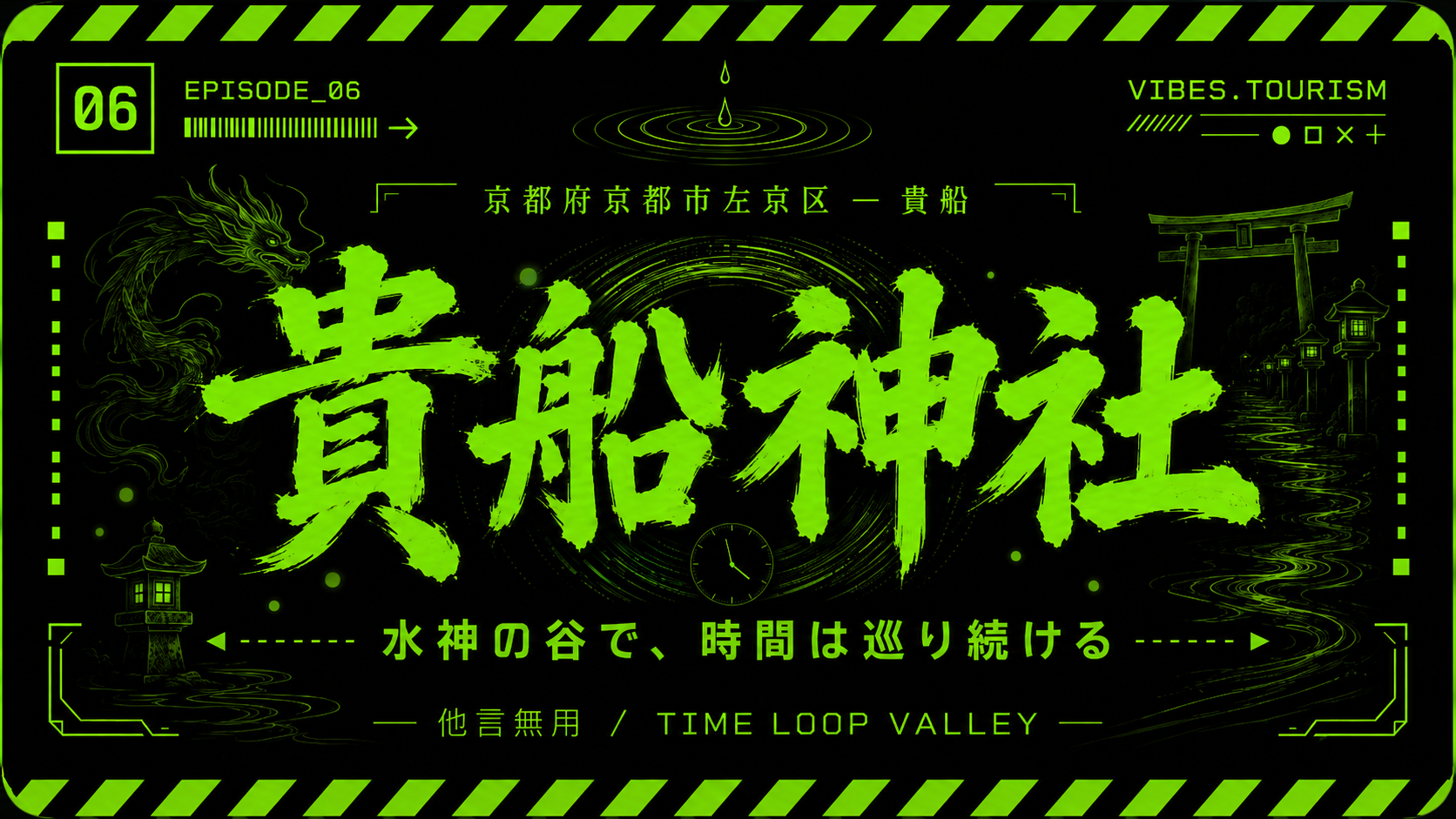

River, don’t flow away.
Kibune, the valley where time circles.
KIFUNE — NEON PILGRIMAGE
Why is a story of “wanting to stop time” born in the valley of the water god? The circling dragon born from fire, ritual purification, the hour of the Ox, fireflies and demons. To a valley where everything circles and returns.
SCROLL ▽
CONTENTS
- Listening Closely to the Sound of That Water
- The Circling Dragon Born from the Blood of a Severed Fire
- Water That Rewinds Time, the God Who Descends Again and Again
- Wishes That Circle and Amplify — The Firefly and the Demon
- The Hole You Must Not Look Into — The Center of the Circle
- Eating a Meal Over the Water — This One Moment, Now
Let me begin with a film. River, Don’t Flow Away (Rebooto, 2023). A time-loop movie set in Kibune, a valley north of Kyoto.
Winter, Kibune. Snow drifts over the Kibune River. A serving woman named Mikoto stands at the riverbank, is called back to work by the inn’s mistress—and two minutes later, finds herself at the same river again.
Not just Mikoto. The head clerk, the cook, the mistress, the guests. Everyone in the inn is pulled back to where they were, every two minutes. The hot sake never warms. The final rice porridge never runs out, no matter how much they eat. A half-written letter resets to blank paper after two minutes. No one can move past those two minutes. The same two minutes, again and again.
A strange film. And stranger still—why, of all places, was it shot in Kibune?
The screenwriter was Makoto Ueda of the Kyoto theatre troupe Europe Kikaku. He has said plainly how the film came to be. It was not that an interesting time-loop story came first, and Kibune was chosen to shoot it. The order was reversed. First came the wish to film Kibune. He stood in this land, scouted it, and asked: what story could begin here? And after much thought, he arrived at the rule of “two minutes that keep circling.”
The land came first. The story was decided afterward, by the land. Remember this. The valley of Kibune called the story forth.
And at the core of that story is this drama. Mikoto has someone she cares for. But that person is about to leave the small valley of Kibune, to go far away. Mikoto wants to stop it. Don’t go. Don’t leave me. Yet she cannot say it to his face. And that unspoken “don’t go,” swelling inside her chest, overlaps exactly with what happens: no one can leave Kibune anymore. The two-minute loop begins.
“Don’t go” becomes “Time, don’t flow away.” The title seems, at first, murmured to the Kibune River flowing past. But what is truly being told not to flow is not the river. It is time. Don’t let the moment of his departure ever arrive. So: time, don’t flow away.
Stop here a moment. “I want to stop the flow of time.” “I want to repeat the same time.” Such a wish, depicted of all places in the land of Kibune. Is this mere coincidence?
Kibune is a valley that enshrines the water god. A god who governs water, makes rivers flow, brings down rain. The god of flowing. At the foot of that “god of flow,” a film called “don’t flow away” was shot. No pairing could be more mismatched. And yet—when you watch it, the pairing fits, strangely well. Why?
Because Kibune is, from the start, a valley where time does not flow in a straight line. Water circulates. In ritual purification, time rewinds. The god descends again and again at the same hour. Not a line, but a circle. Round and round it goes, circling, returning, repeating. That sense has soaked into this valley for over a thousand years. Now—let us go listen to the sound of the water.
Chapter 1 — Listening Closely to the Sound of That Water

Let us actually go to Kibune. If you go, summer is best. Summer in central Kyoto is swelteringly hot. Heat pools at the bottom of the basin. On such days, you must not stay in the city. Flee north.
From Demachiyanagi Station, board a small two-car train of the Eizan Railway. Bound for Kurama. As the train runs north, the scenery outside the window changes. Houses thin out; green thickens. Past Ichihara, trees begin to cover both sides of the tracks. The stretch called the “Maple Tunnel.” In autumn it blazes red; in summer, it is a dazzling green of fresh maple. The window fills with flowing green.
And you get off at Kibuneguchi Station. The instant you step off the train, the air is different. The city’s clinging heat is gone. A breeze passes through. Mixed with cicada song, the sound of water comes from somewhere. From here, the valley begins.
Kibune. As a place name it is read “kibune,” voiced. But the shrine deep in the valley is read “kifune,” unvoiced. Because it enshrines the water god, the name alone is kept clear—so that the water may never grow cloudy. So it is said. Even in the reading of a single name, a prayer to water is held.
Walk up the valley. From Kibuneguchi Station to the shrine deep in the valley is about two kilometers. The road hugs the Kibune River, climbing gently. As you walk, the sound of the river follows from your left the whole way. Murmuring. Roaring. Trickling. The water’s sound changes by place. To the rhythm of your steps, the river keeps speaking to you.
Now and then you stop and peer into the river. The water is clear. Each stone on the bottom is plainly visible. The rocks are covered in deep green moss, wet with the river’s spray. Through the leaves, summer light falls dappled. Green, water, and light.
As you walk, you notice. The sweat that would not stop has, before you knew it, dried. The deeper into the valley you go, the more the temperature drops, little by little. The cold air the river carries, and the shade of the canopy overhead, make the whole valley like a natural refrigerator. You cannot believe it is the same Kyoto.
As you listen closely to that sound, a strange feeling comes. Where does this water come from? Trace the valley up and up, and at its end is a source. The place where that very first drop wells up. That is the deepest depth of this valley. The Okumiya, the inner shrine of Kifune.
And for over a thousand years, people have not thought of this water as mere water. They have thought of it as a dragon. Put your feet in it and it feels good. Drink it and it tastes good. But that is only one of the dragon’s faces. The same water, once it rages, breaks the banks, sweeps away villages, swallows people. In fact, Kibune’s shrine buildings, too, were once washed away by the river’s flooding. Gentle water and terrible water. Both are the same single dragon. The dragon’s name is Takaokami-no-kami. And this dragon is the very one who makes Kibune’s time a circle.
Chapter 2 — The Circling Dragon Born from the Blood of a Severed Fire
Takaokami-no-kami’s birth is nothing like the gentle image of water. It is, rather, bloody. Born from fire and death.
The tale goes back to the very beginning of Japanese myth. Izanagi and Izanami. Two deities birth the land, and birth the gods one after another. But—when they birthed Kagutsuchi, the fire god, the mother Izanami was burned by her child’s raging flames and lost her life. It was the moment death first came into the world.
His beloved wife, burned to death by the fire god they themselves had birthed. Izanagi loses himself in grief and rage. He draws his sword and severs the head of his newborn child—Kagutsuchi, the fire god. And from the gushing blood, from the severed body, new gods were born again.
In the Kojiki, the blood on the sword drips from between the fingers of Izanagi’s hand, and from it the water gods, beginning with Kuraokami, came to be. In one account of the Nihon Shoki, Kagutsuchi’s severed body splits into three, and from each come the god of thunder, the god of mountains, and the water god Takaokami. From the death of the slain fire god, the water god was born.
This god, from birth, bears opposites in a single body. Light and dark, life and death, fire and water—held all at once from the moment of birth. That is why, in this god’s valley, a tale of light that binds love and a tale of darkness that turns a person into a demon are both born in the same place.
And the name itself holds a secret. The character “龗.” At the very bottom is “dragon.” Above it, three “mouths” in a row. Above that, “rain” covers all. The three mouths in a row are said to represent vessels for offering prayer to the god. This single character depicts, whole, the scene of a rain-praying rite: beneath the rain, vessels lined up, the dragon beseeched for rain. The character itself is the prayer.
“龗” is an old word for dragon, meaning a serpent-bodied god who governs water. Even the Edo-period Confucian scholar Hayashi Razan recorded that Takaokami is of the dragon-god kind. The name itself, from the start, declares itself a dragon. “Taka” means a high mountain peak. The dragon of the high peak.
Here is the first key linking this valley to “time.” One shrine’s account states the god’s essence plainly: Takaokami-no-kami is the deification of nature’s water cycle itself.
The water cycle. Water evaporates from the sea and becomes cloud. Cloud is carried by wind and drops rain on the mountains. Rain soaks into the earth, becomes river, descends the valley, and at last returns to the sea. And from the sea, it evaporates again into cloud. There is no end. There is no beginning. Round and round, it circles forever. Takaokami-no-kami is the god of that very “thing that keeps circling.” Turning, returning, turning again. The deification of circulating water, of the circular motion itself.
And this god has a paired second dragon. Kuraokami-no-kami. Likewise born from the death of the fire god, a dragon of water. “Taka” points to the high peak; “kura” to the deep ravine. Rain falling on the high peaks, water flowing down the dark valley. Two phases of the same water. And crucially—these two are said to be both a pair and “the same god.” One dragon, with two faces: high (peak) and dark (valley). It rises to the peak, descends to the valley, rises again. The god of Kibune is, from the start, a circle.
By now, the outline of why that film’s prayer was born in this valley comes into view. “River, don’t flow away.” At the foot of the god who flows and circles, people wish to stop that flow. Yet the water that flowed circles back, and returns. And the time that flowed—in this valley, too, may circle and return. The god’s essence and the human wish face each other head-on, at the single point of “flow.” That is why the film fits.
Chapter 3 — Water That Rewinds Time, the God Who Descends Again and Again

What shows the circular nature of time is not a matter of myth alone. Walk this valley, and you can actually touch that “circle.” Misogi—ritual purification.
Near the entrance to the path leading to the Okumiya, a small stream called the Omoi River is crossed by a bridge. But this stream has another, older name: the Omonoimi River. Monoimi—to purify body and mind, avoid defilement, and prepare oneself before the god. Long ago, when Kibune’s main shrine still stood deep here, those who came to worship would always purify themselves in this stream. They washed away all the defilement carried from the secular world into this water. Only then were they permitted to step into the sacred precinct.
Consider carefully the meaning of this act of “purification.” Its origin lies in myth. Izanagi, who descended even to Yomi, the land of the dead, pursuing his wife Izanami. But terrified by her transformed figure, he fled barely back to the world above. And to cleanse the defilement of death he had taken on in the land of the dead, he entered the water at a river mouth and purified his whole body. That is said to be the origin of misogi. Return from the land of the dead, enter the water, return to one’s former pure self. This is nothing other than an act of rewinding time.
What is defilement? It is the grime that naturally accumulates in anyone simply by living. The more time passes, the more a person unknowingly takes on defilement. The passage of time is, in a sense, the process of defilement piling up. That accumulated defilement is, with water, washed away at once. Reset to zero. To the first, newborn, pure state.
That shrines hold the Great Purification (Ōharae) twice a year follows the same thought. On the last day of the sixth month and the last day of the twelfth. People transfer the defilement of that half-year onto paper effigies and purge it away. In a half-year cycle, people return, again and again, to “the beginning.” Time in Japanese belief is not something that only grows dirty in a straight line. Each time one enters the water, each time one purges, one returns to “the beginning.” Rewind and start over. Reset and begin again.
Recall the film once more. In River, Don’t Flow Away, the characters are pulled back to their “starting position” every two minutes. Again and again, returned to the beginning. This—and misogi—share the same structure. Loop, return to the original place, start over. That sense was not invented by SF cinema. In the form of misogi, water that rewinds time, it has flowed along Kibune’s approach for over a thousand years.
The third key showing the circular nature of time is carved into this valley’s very “hour.” Kibune has the legend of the Ushi-no-koku-mairi, the worship at the hour of the Ox. Many people associate the phrase with an eerie “curse.” But that is a great misunderstanding made in later ages; the original meaning is wholly different.
By the founding legend of Kifune Shrine, it goes thus. The great god of Kibune descended in ancient times, from the heavens to the Mirror Rock midway up Mount Kibune, in “the year of the Ox, the month of the Ox, the day of the Ox, the hour of the Ox.” All aligned with the Ox. The sacred hour when the god alighted upon the earth. For this reason, to pray at the hour of the Ox was held to carry a special miraculous power, as if attending the god’s descent. Originally, it was a sacred hour of prayer. The miraculous time when one could draw closest to the god.
Note here that the “hour” repeats. The god descended in a single, one-time event in ancient days. By a linear sense of time, it happened at one point in the distant past and should never return. Yet—the hour of the Ox comes around every night. The day of the Ox comes around every month. The year of the Ox comes around every twelve years. Each time that hour comes around, the ancient moment of descent is “re-enacted” once more. This is a sense that cannot hold without circular time.
Water circulates. In misogi, time rewinds. And at the hour of the Ox, the god descends again and again. Kibune’s time circles threefold. The natural circle of the water cycle. The human circle of misogi. The ritual circle of the hour of the Ox. Three circles overlap and keep turning in this valley. That River, Don’t Flow Away drew a two-minute circle in this valley was, therefore, inevitable. The land’s time decided the story’s form.
Chapter 4 — Wishes That Circle and Amplify — The Firefly and the Demon

In a valley where time circles, wishes too circle. A wish, once uttered, does not vanish on the spot. It keeps circling within circular time. As it circles, it resonates, echoes, amplifies. And once it crosses a threshold, the wish begins to take on the form of reality. Nothing shows this more clearly than the tale of two women handed down in this valley.
First, the side of light. In the Heian age, a woman climbed this valley. Izumi Shikibu. A leading court poet of the Heian period, who left many passionate love poems. But what she carried then was not the elation of new love. The change of heart of her husband, Fujiwara no Yasumasa. No longer loved, his heart drifting away. Carrying that flesh-cutting anguish, she came to worship at Kifune Shrine—to bind back, once more, her husband’s departing heart.
And by the Kibune River—she saw fireflies. It was a summer night. Over the river’s surface, countless fireflies danced. Fleeting, pale-blue light, blinking in the dark. Before that sight, she composed a single poem, gathered later in the Goshūi Wakashū, a poem far too famous. Roughly: lost deep in longing, even the fireflies of the marsh appear to me like my own soul, slipped from my body and wandered out.
Lost so deeply in love that her soul had slipped from her body. That firefly light drifting before her was not an insect flying outside—but her own soul, departed from her body, wandering. A harrowing love poem, like an out-of-body vision.
And Kibune answered this wish, it is told. The Kifune deity heard Izumi Shikibu’s prayer. Her husband’s heart returned, and the couple’s bond was restored to harmony. The deity itself, it is said, composed a poem in reply to her. A god answered a human love, with a poem.
Here, circular time shows its face again. The place where Izumi Shikibu saw her own soul came to be called “Firefly Rock.” And even now—every early summer, fireflies dance over the Kibune River. From late June through July. That pale-blue light Izumi Shikibu saw a thousand years ago comes around, every year, to the same place. Her wish did not vanish. It became fireflies, circling and returning to this valley every year. The wish circles. As light, it returns, again and again.
But—in this same valley, there was another woman, betrayed by her husband in the same way. That woman did not wish for reconciliation. She wished for a curse.
It was, it is told, the reign of Emperor Saga. There was a daughter of a court noble. There was a man she deeply loved. But the man’s heart moved to another woman. The daughter was abandoned. The same as Izumi Shikibu—the same betrayal, the same wound. But what welled up in the daughter’s heart was not grief. Jealousy. And—murderous intent. I want to kill that woman. Even if I must become a demon while still alive.
The daughter shut herself in Kifune Shrine. Seven days. And she prayed thus: I beseech you, deity of Kibune. Grant that I become a demon while still alive. I wish to kill the woman I so resent. An ordinary god would refuse. But—the Kibune deity did not refuse this prayer. It took pity. And it told her: truly, it is pitiful. If you truly wish to become a demon, change your form, go to the swift part of the Uji River, and steep yourself there for twenty-one days. Then you shall become a demon. A god taught the method of becoming a demon.
Here the essence of this valley’s dragon is laid bare. The circling dragon that holds light and dark together. To Izumi Shikibu’s wish of “come back” and to this daughter’s wish of “I want to kill,” it answers alike. It does not judge a wish good or evil. It answers only to the strength of the wish uttered.
The daughter returned joyfully to the capital and transformed herself. She parted her long hair into five and bound it into the shape of five horns. She painted her face with vermilion and dyed her body red with cinnabar. On her head she set an iron tripod ring—a kanawa—upside down, and burned torches on its three legs. She held another torch in her mouth and lit both its ends. Crowned with flame, fire in her mouth, her whole body burning red—the figure of a demon. And she steeped herself in the Uji River for twenty-one days. The daughter became, while still alive, a demon.
This is the “Hashihime of Uji.” The tale of a demon-woman handed down in the Tsurugi no Maki variant of the Tale of the Heike and in the Genpei Jōsuiki. Having become a demon, Hashihime first killed the woman she envied, then her kin, then the man, and at last killed people indiscriminately—high or low, man or woman, without distinction. A single jealousy swells into indiscriminate slaughter. This is the figure of a wish run wild within circular time. As Izumi Shikibu’s wish kept circling as beautiful light, Hashihime’s wish kept amplifying as an unstoppable calamity.
Physical proof remains, too. The “Kanawa-kake-ishi,” the stone said to be where Hashihime set down the iron ring she wore on her head, lies beside Kibuneguchi Station of the Eizan Railway. The very station where you got off the train. Right nearby. Hashihime, having become a demon, eventually returned to the capital, struck at Watanabe no Tsuna—one of Minamoto no Yorimitsu’s Four Heavenly Kings—at the Ichijō Modoribashi bridge, and had one arm severed. By one account, this demon is the same being as the later Ibaraki-dōji.
The woman of light and the woman of dark. Izumi Shikibu sent her soul into fireflies and won reconciliation. Hashihime changed into a demon and fell into slaughter. In the same valley, from the same betrayal. The strength of the wish was exactly the same. Only the direction was reversed. The valley of the circling dragon that holds light and dark together birthed both. And it keeps both circling even now.
Note that the image of “hour-of-the-Ox worship = curse” was formed by fusing this tale of Hashihime, the Noh play Kanawa that dramatized it, and the straw-doll-and-five-inch-nail sorcery added from the Edo period on. Neither the original Hashihime legend nor the Noh play contains the scene of nailing a straw doll. The original hour of the Ox was a sacred hour of granted wishes, of attending the god’s descent. A face of sacred hour and a face of curse—both are layered onto this hour over long time. It is no error, then, to actually visit Kibune and feel it is “if anything, refreshing.” But one thing must not be forgotten. This valley does not choose its prayers. What you wish for here is left entirely to you.
Chapter 5 — The Hole You Must Not Look Into — The Center of the Circle
Let us head for the center of the circle. To the single point where all water wells up, all time begins, all wishes gather. To the Okumiya.
From the main shrine, walk upstream along the river. People thin out. The trees deepen. The air grows colder, damper. Only the sound of the river grows louder. Cross the bridge of the Omoi River, and enter the sacred precinct in the spirit of purification. And you reach the Okumiya. This is the oldest place of Kifune Shrine. The land of its founding. Originally the shrine stood here. Later, in 1055, the buildings were washed away by the Kibune River’s flooding, and the main shrine was moved to its present site—but this Okumiya is the place where everything began.
The precinct is utterly still. The bright bustle of the main shrine seems a lie. Surrounded by trees, the air holds a density and stops. Cool—no, cold. Your spine straightens of itself. Here there is awe. And directly beneath the Okumiya’s main hall—there is a hole. The Dragon’s Hole (ryūketsu). A vast vertical shaft. The main hall is built to cover this hole. A sacred dragon hole, counted among the three great dragon holes of Japan. In feng shui, the exit where the earth’s energy gushes from the depths. The dragon’s dwelling.
And this hole has a firm law. You must not look into it. To see it directly with human eyes is forbidden. Even now. Sacred and inviolable. Sealed in darkness beneath the floor of the main hall. What happens if the law is broken? This legend remains. In the Bunkyū era—mid-nineteenth century. The main hall was under repair. A carpenter at work accidentally dropped the chisel in his hand into the hole. In that instant, the sky suddenly darkened. The clear sky was abruptly covered in black cloud, and a violent wind raged. And that wind, from the bottom of the hole, blew the fallen chisel up into the air. This tale remains even in the official records of the City of Kyoto, as a legend of this shrine.


Stand before the Okumiya’s main hall. Right beneath your feet, a deep vertical shaft you must not look into opens its mouth. And in its depths, the circling dragon born from fire breathes slowly. The sound of the river you heard while walking the valley. The firefly light Izumi Shikibu saw. The seven days Hashihime shut herself in. The source of all of it is here. The center of the circle, where water begins to circulate. The first point, where time wells up.
At the Okumiya, alongside Takaokami, Kuraokami too is enshrined, it is said. The dragon of the peak and the dragon of the valley. Light and dark, two-as-one, the circling dragon, enshrined over this one hole. And no one has ever seen that dragon. Because it must not be seen. Believed, feared, prayed to for a thousand years—unseen. Precisely because it cannot be verified, the circle keeps turning.
Beside the main hall is another trace of something that must not be seen. The Boat-Shaped Stone (Funagata-iwa). In the founding myth, Tamayori-hime came riding a yellow boat, ascending the rivers from Osaka Bay—the Yodo, the Kamo, the Kibune—reached this land, and enshrined the water god. That yellow boat was piled around and hidden with stones, away from human eyes. The Dragon’s Hole you must not look into. The hidden yellow boat. In this valley, the most important thing is always made unseen. What is unseen becomes the core of the circle.
Kibune was, in old times, also written “Kifune”—the root where energy is born. The root where the earth’s life-force, ki, rises like a dragon from the ground. The shrine’s history speaks of this place as one where “merely touching the god’s ki fills you with ki.” Set beside this another word: “ki-gare”—withered ki. The word for defilement, kegare, is said to derive from “ki-gare,” a state where ki has withered, where life-force has wilted and dried. That is defilement. By that view, Kibune is the very opposite place. Not the land of withered ki, but the root where ki is born. A valley that purges defilement = withered ki and restores ki to body and mind.
Recall misogi. In the Omoi River, people wash away the accumulated defilement = withered ki. They cast off withered ki. And in the land where ki is born, they fill with new ki. Wither, wash, fill again. Ki too circulates in this valley. Walk the valley and you will know. You enter the valley wilted by the city’s heat, in a state of withered ki. As you walk, cooled by the river’s chill, wrapped in the sound of water, drinking the sacred water, your body grows lighter and lighter. The withered ki fills. This is not a matter of believing in the spiritual or not. Walk this valley, and your body actually grows lighter. It is a real sensation that happens to anyone who walks it.
The ki you can taste in visible form is the sacred water of the main shrine. Before the main shrine, water wells up from gaps in the stone wall. It has never once run dry, it is said. Take a sip. Cold. Mellow, without a trace of harshness. Water that has passed through mountain limestone over long time. It feels like “living water.” With this sacred water, you can do the water fortune-slip. Float a blank slip on the sacred water and characters slowly rise up. And—when the paper dries, the characters vanish again. Good results and bad, when the water dries, the words vanish. Fate is not fixed. This too is the play of circling water.
In the main shrine precinct stands a sacred katsura tree, roughly four hundred years old, thirty meters tall. From the base several trunks divide, reaching for the sky, and high up they fan out in all directions. A single tree erupts from the earth and bursts open in the sky. Its figure is like a dragon. The shrine teaches: the way the katsura’s branches spread in all directions resembles the sacred ki rising like a dragon from the earth. That is why it is revered as a sacred tree. The tree itself is a dragon, the very eruption of ki.
And beside the Okumiya’s gate stands the “Renri-no-sugi”—the Joined Cedar. A cedar and a maple. Two trees of different species, grown side by side, their branches fused into one. An exceedingly rare tree. Two different things bound deeply, no longer to part. Yin and yang. High and dark. Fire and water. This valley has always made opposites into one. The Joined Cedar tells that thought with the tree itself.
Open a map. Just east of Kifune Shrine, across a single mountain, is Kurama-dera. The mountain where the young Minamoto no Yoshitsune—Ushiwakamaru—is said to have been taught swordsmanship and tactics by tengu. A holy ground of fire, known for the Kurama Fire Festival. The Nihon Kōki records that in 796, the god of Kifune Shrine appeared in the dream of Fujiwara no Isendo and gave the oracle: “Build Kurama-dera.” The shrine of shade birthed the temple of light. The water god summoned the temple of fire and arms. Kibune is water, valley, yin, passion. Kurama is fire and arms, mountaintop, yang, struggle. Water and fire, valley and peak, yin and yang. A perfect pairing. This is the structure of Takaokami (dragon of the peak) and Kuraokami (dragon of the valley)—the circling water god, one body of light and dark—transcribed directly onto the terrain.
At last, descend from the time of myth to the time of human history. Kifune Shrine has a face apart from its tales of miraculous power. The face of a shrine that, for centuries, had its freedom stripped away and yet kept fighting. Its opponent was Kamigamo Shrine. Once an independent, prestigious shrine, Kibune was, from the mid-to-late Heian period, absorbed as a subordinate shrine of Kamigamo, losing both its right of worship and its land. The feud between the two shrines eventually turned to violence, and the struggle carried over to the Edo period. Kibune brought suit to the shogunate seeking independence, but lost in every trial. The shrine official Zetsu Danjō, who led the negotiations as representative, is told to have gone mad at the defeat and, with two others, ended his life by seppuku. Behind the beautiful tale, flesh-and-blood people fought for centuries over the shrine’s pride.
And the long wish was at last granted. In 1871 (Meiji 4), Kifune Shrine achieved independence from Kamigamo Shrine. That same year it was designated a Kanpei-chūsha, and its name was formally changed to “Kifune.” Freedom, after centuries. Here too, circular time appears. However many times it was defeated, this shrine did not vanish. Like the sacred water that welled without ever drying, it rose again and again. Zetsu Danjō’s wish, across two or three hundred years, at last circled, returned, and was granted as the Meiji independence. The wish circles. However many centuries it takes, in this valley, a wish never abandoned someday draws a circle and returns.
Chapter 6 — Eating a Meal Over the Water — This One Moment, Now

So far we have spoken of the time of myth, of faith, of history—the long, circling time. But Kibune has a shorter joy too, the joy of present time. The kawadoko, the riverbed dining platform that appears in this valley only in summer.
A tatami platform juts out over the river. Central Kyoto’s Kamo River also sets out a “yuka,” but those are built at a height looking down on the river. Kibune’s is wholly different. Read “kawadoko,” it sits right above the river. Reach out your hand and you touch the flow. You can dip your bare feet gently into the water. You descend onto that platform. The instant you step onto the platform, a chill. The body that had grown hot from walking is wrapped, the moment you descend, in the river’s cold air. Not the mechanical cold of air conditioning. A more living, damp, soft cold. The temperature is nearly ten degrees lower than in the city. Midsummer, yet almost chilly.
Sit, and first put out your feet. From the edge of the platform, dip your bare feet into the river’s flow. Cold. Startlingly cold. Newborn water, just welled from the mountain. Your hot feet cool, slowly. This alone is worth the trip.
The dishes arrive. The star is river fish. Salt-grilled young sweetfish caught in the Kibune River. The skin crisply charred. You bite in from the head. Fragrant, a touch bitter. Soft to the bone. In summer, hamo (pike conger), the dish that represents Kyoto’s summer. Order the kaiseki course and over ten dishes come in order, from appetizer to sashimi, simmered dish, tempura, soup, rice, and dessert. But the true feast here is not the food itself. The very situation of eating over the water is the feast. The river flows ceaselessly beneath your feet. You move your chopsticks to its sound. A breeze crosses over the river and strokes the back of your neck. Cool. Cool, above all.
And at some establishments, nagashi-sōmen is the specialty. Hirobun, with its four-tiered riverbed at the highest reaches, is the only ryokan in Kibune where you can enjoy nagashi-sōmen. Cold water drawn from the mountain runs through a half-split bamboo flume, and sōmen is set into it. The white noodles ride the clear water and slide down the green bamboo. You catch them with chopsticks. Catch them and you eat them. Miss them—and they flow away. When red sōmen finally comes down the flume, it is the signal of the end.
Here is the smallest, most beloved teaching of the valley of circular time. What a person can do before flowing water is only to catch the one moment, the instant flowing past before your eyes. Time flows. It cannot be stopped. However much you wish “don’t flow away,” water flows on. Miss the sōmen and it flows away. That person departs. Summer ends. But—the water that flowed circles back, and returns. Next year, too, fireflies dance over the Kibune River. Next summer, too, the kawadoko is set out. Come here again, and again you can dip your feet into the cold flow. So, for now, simply catch this one moment. As you catch the sōmen before your eyes.
Mourning what flows away. Yet knowing it will circle and return. That is what it means, in this valley, to eat a meal over the water. The kawadoko runs from May to the end of September. If it rains, if the river swells, if a warning is issued, it is canceled. In the valley of the water god, in the end, it is at the mercy of the water’s mood. The blessing-water carries the feast; the raging-water takes it away. Gentle water and terrible water. Here too, the two-as-one dragon shows its face.
Descend the valley. Lighter in body than when you came. Even the slope you climbed in sweat is easy on the way down. The ki that was withered now fills the body. The river is beside you the whole way back. The same river as on the way up. But it no longer sounds like mere water.
This water is water that the dragon born of fire keeps circling. From sea to cloud, cloud to rain, rain to river, river to sea. Circling without end. The circling dragon with two faces, light and dark. Within that circle, people purify and rewind time; at the hour of the Ox, the god’s descent repeats; wishes echo again and again into story. Izumi Shikibu’s soul, into light that returns each year as fireflies. Hashihime’s jealousy, into a calamity told and retold as a demon. Zetsu Danjō’s wish, circling for centuries, into independence.
When you first came to this valley, that water was just pleasant, cold water. But now it is different. The same water—yet within it you see a thousand years of story. You see the circling dragon. You see light and dark. You see time that circles, returns, repeats. That River, Don’t Flow Away was shot in this valley was, therefore, inevitable. The wish to “stop time,” to “repeat the same time,” was a wish welling from the deepest place of the valley of the circling water god.
Water flows. It does not stop. However much you wish “don’t flow away,” time flows on. That person departs, summer ends, the fireflies fade. And yet—the time that flowed draws a circle and returns here again. Fireflies return every year. The hour of the Ox comes around every night. Purify, and a person can return to the beginning again. What ended begins again. Next summer, too, the kawadoko is set out, and again you can dip your feet into the cold flow.
Wish “don’t flow away,” and still time flows. Yet the time that flowed draws a circle and surely returns here. That is the valley called Kibune. A valley where time does not flow in a straight line. A valley where everything circles and returns. And perhaps—you will come again. When your ki withers. When you long to hear the sound of water. When you wish, once more, to confirm the meaning of that prayer: “don’t flow away.”
Kifune Navigator
Kibuneguchi Station
Nearest Eizan Railway station. Bus to “Kibune” then 5 min walk, or ~30 min on foot along the river past the kawadoko restaurants.
Honden (Main Hall)
Enshrines the water god Takaokami. The stone steps lined with vermilion lanterns are the iconic view. Mizu-omikuji: a fortune that appears when floated on water.
Okumiya (Rear Shrine)
The proper order is Main, then Rear, then Yui-no-Yashiro. Head upstream from the Main Hall. Known for granting all wishes; legend of the boat-shaped rock.
Yui-no-Yashiro (Middle)
Enshrines Iwanaga-hime, the shrine of matchmaking. It sits between the other two, so visit on the way back. Famous for the poet Izumi Shikibu.
Dine at a Kawadoko
May-Sep: dine on platforms over the river in the cool air. Autumn/winter: indoor river views. See the cards below for budgets. Most places need reservations.
Return
If tired, take the bus from Kibune stop back to Kibuneguchi Station. Some restaurants offer a shuttle (reservation required).
In the Valley of the Water God,
Dine Above the River.
Only those who are called may sit above the clear stream.
CHAPTER 01A Floor Built Over the Water God’s Valley

Even when the streets of Kyoto burn at forty degrees in midsummer, this valley alone stays cool. People say it feels ten degrees lower than the city center.
The Kibune River. The deepest source of the Kamogawa. Just above its clear current, planks are laid to build a sitting floor. This is the kawadoko. Reach out your hand, and your fingertips meet the water. The sound of the rapids rises from beneath your feet. A cold breeze carries the steam off your dishes.
Downstream, along the Kamogawa, the same characters are read “kawayuka.” But in Kibune, it is “kawadoko.” The reading differs. So does the position. On the Kamogawa you look down at the river from a high deck, but in Kibune you sit right at the water’s surface. It is closer to eating in the river.
The season runs, by custom, from the opening on May 1st until the end of September. Some restaurants stretch it to the end of October. High summer is a natural air conditioner; from September on the crowds thin, and you can savor it quietly. That is the hidden-gem season.
CHAPTER 02The Only Flowing Noodles in Kibune — Hirobun

Kawadoko cuisine is, frankly, not cheap. It is a world of ten to twenty thousand yen. But there is a way to sit on the kawadoko for two thousand.
Nagashi somen, flowing noodles. In Kibune, only one establishment serves it. The ryokan “Hirobun.” At the very top of the Kibune River, right beside the Yui-no-yashiro of Kibune Shrine, it holds a kawadoko renowned as the most dramatic in all of Kibune.
White noodles slide down a halved bamboo chute, riding the spring water. You catch them with your chopsticks. Miss them, and they will not come back. When a red (plum) noodle finally flows by, that is the signal that it is over.
You cannot reserve. On the day, you take a numbered ticket and wait your turn. The official line warns of a three-to-four-hour wait, but arrive before ten in the morning and you are often seated within an hour. There is no parking. In rain or high water it closes. Even so, it is worth the wait. This is the cheapest way to make your kawadoko debut.
 See Kibune Hirobun reservations & reviews on Tabelog
CHAPTER 03Sweetfish Swimming in a Bowl of Ice — Kibune’s Famous Houses
Even under the same word “kawadoko,” each house differs entirely in its signature dish and its price. Choose by your budget and your mood.
Kyo-Kibune Hiroya
Kaiseki 15,000–20,000 yen | The Height of LuxuryAn old house founded in 1932. Its signature is the sweetfish “stone-garden arrangement.” Pale, delicate wild ayu are plated exactly as they swim, composed like a dry landscape garden. So beautiful you hesitate to eat. A dish of hamo sashimi set in a hand-carved ice bowl is also celebrated, and the house carries the prestige of having once served as imperial game purveyor.
Kibune Ugenta
Lunch from 9,900 yen | Dinner 10,000sA ryokan opened by a family that long served as priestly stewards of Kibune Shrine. Live river-fish cuisine, plus an original craft beer. In autumn and winter the signature is the “Kifune-nabe,” wild boar meat sunk into a soft-shell turtle broth. There is a shuttle bus from Kibuneguchi Station.
Kibune Kiraku
Hamo-shabu Kaiseki | Close to the ShrineAn old house founded in 1924, beginning as a tochi-mochi rice-cake shop. Its standout is the “kawadoko hamo-shabu kaiseki,” pike conger swished in a broth of matsutake and hamo. For when you want a course a little different from the usual. Kibune Shrine is close by, so you can take both the kawadoko and a visit without much walking.
Kibune Nakayoshi
Most Affordable | Great for a First KawadokoThe most reasonable way onto the kawadoko among the houses here. Every seat lets you dip your feet in the river, and because the channel is narrow and the flow swift, a cool breeze cuts in straight from the front. The Kansai-style sukiyaki course is popular too. The perfect house for a kawadoko debut.
CHAPTER 04Don’t Just Eat and Leave — To the Water God’s Shrine

It would be a waste to eat and leave this valley.
Kibune Shrine. Enshrined here is the deity who governs water. So ancient its founding year is unknown, it is one of Kyoto’s foremost power spots. The stone stairway approach, lined with vermilion Kasuga lanterns, is the symbol of Kibune. With every step you climb, the air grows purer.
Worshipping at the main shrine is not the end. Walk a little deeper and you reach the “Yui-no-yashiro,” enshrining the deity of matchmaking; go further still and you find the “Okumiya,” the inner shrine where the energy of the earth gathers. Only by visiting all three, it is said, have you truly paid your respects to Kibune.
The local specialty is the water fortune-slip. Float a blank slip of paper on the sacred water, and characters quietly rise to the surface. A witty divination, fitting for a shrine of the water god. There is a riverside walking path too. Simply strolling to the sound of the rapids draws the heat out of your body.
CHAPTER 05Something Sweet, Above the River — Kawadoko Cafe

The full kaiseki feels a bit much. But you still want to taste the kawadoko air. For times like that, there is a cafe.
Walking about ten minutes from the main shrine toward the inner shrine, you come upon “Hyoe Cafe,” run by a long-established ryokan. A calm spot, with large windows framing the green of the Kibune River. You can take cafe items right on the kawadoko seating. Sake-lees monaka wafers, chilled matcha, Japanese sweets. About thirty minutes of cheap, luxurious cool.
Even without a meal reservation, here you can easily catch the kawadoko breeze. The perfect rest stop along your stroll.
CHAPTER 06The Valley Burns Red at Night — Autumn Illumination

If summer is Kibune’s main act, autumn is another.
The peak is, by custom, early November. In this season the “Kibune Momiji Toro” lanterns are lit. Along the main shrine, the Yui-no-yashiro, the Okumiya, and the road from Kibuneguchi all the way to the ryokan district, lanterns stand in long rows. The banks of the Kibune River are wrapped in soft light.
Visit by day to see the maples turning from green to red, stay until night for the illumination. You can taste both faces of Kibune, day and night, in a single day. At the shrine, the halls and the maples rise up dreamlike, and the red is mirrored on the water. The valley nights are cold. Don’t forget a warm layer.
CHAPTER 07How to Reach This Valley
You cannot reach Kibune directly from Kyoto Station. And that is good. Getting there is already part of the journey.
From JR Kyoto Station, take the JR Nara Line to Tofukuji. Change to the Keihan Main Line for Demachiyanagi. From there, transfer to the Eizan Railway and in about thirty minutes you arrive at “Kibuneguchi” Station. From the station to the heart of Kibune is about five minutes by Kyoto Bus. Many ryokan offer a free shuttle from Kibuneguchi Station (reservation required).
Along the way, don’t miss the Eizan Railway’s “Tunnel of Maples.” For about 250 meters between Ichihara and Ninose, the train slips through trees that arch over the tracks. Better still aboard the observation train “Kirara.”
CHAPTER 08Stay the Night, and Have the Valley to Yourself
A day trip more than satisfies. But stay the night, and the valley becomes entirely yours. Kibune after the day-trippers have gone. A stillness lit only by lanterns. The kawadoko in the morning, with no one there. To place yourself in that is the privilege of those who stay.
Many of Kibune’s ryokan let you stay with the kawadoko cuisine itself as your dinner. Choose from two banners, by your budget and your taste.
A ryokan of true standing, its rooms looking out over the Kibune River. For a once-in-a-lifetime anniversary, or the finest reward for yourself.
Compare availability and rates on standard plans. Plenty of inns to choose from to fit your dates.
Only those who are called will know its cool.

Kifune Shrine, Kyoto’s Hidden Valley —
underestimate it, and you might not make it home.
Everything here is a signpost, not a guarantee. Hours, fares and schedules change quietly with the seasons — always double-check the official sources before you set out.
PHASE 01The battle is won before you leave
How much cash do you need? — There’s no ATM and no convenience store in Kifune
The Kifune area has no convenience stores and no ATMs. Omikuji fortunes, amulets and offerings are cash, and the famous flowing somen noodles are cash-only too (more below). Travelers also report there’s nowhere to top up a transit IC card once you’re in the valley. Sort out your wallet in the city before you head into the mountains.
Kawadoko riverside dining gets cancelled — not just for rain, but for high water
The kawadoko platforms operate roughly May 1 to the end of September. Every restaurant cancels for rain, high water, or weather warnings, and some decide as late as 10 a.m. on the day. The blind spot: even on a sunny day, yesterday’s rain can swell the river and cancel your riverside seat. You’ll usually be offered an indoor table instead — but if your heart was set on dining above the water, be ready for a same-day change and check your restaurant’s cancellation policy.
Dress warmer than you think — it’s 5–10°C cooler than the city
Kifune is a natural summer retreat, said to feel 5–10 degrees cooler than central Kyoto. The flip side: evening kawadoko dinners and after-dark visits get chilly even in summer. Restaurants themselves advise bringing a layer for May, June and September nights.
Wheelchair access: officially not possible — plan carefully for three-generation trips
Kifune Shrine states officially that the shrine cannot be visited by wheelchair. The only route to the main sanctuary is the famous stone stairway — there is no ramp. If you’re traveling with elderly family or a wheelchair user, build a plan that doesn’t push anyone too hard. For those who can’t make the climb, the shrine accepts remote prayer requests by phone (shrine office: +81-75-741-2016).

PHASE 02Getting there is the real challenge
Only 25 parking spots in total — driving straight in is a trap
The shrine’s parking adds up to just 25 spaces — 10 at the main shrine, 15 at the Okumiya (¥500 per 2 hours; the fee may have changed, so check officially). The shrine itself officially warns that Kifune has almost no parking and strongly recommends public transport. Worse, the approach road is a narrow single lane where passing oncoming cars is a struggle. Find it full, and there’s nowhere to turn around — in peak season, stranded queues of cars are a sad local tradition.
Peak-season gridlock — the 2 km road has reportedly taken 70 minutes
The roughly 2 km road from Kifuneguchi Station to the shrine becomes a bottleneck in autumn and holiday seasons — there are reports of the normally 5-minute drive taking close to 70 minutes. The road is narrow, full of pedestrians, and once it jams there’s no escape route. The local bus runs on this same road, so in a traffic jam the bus is stuck too.
The 30-minute walk from Kifuneguchi is all uphill — your shoes decide everything
From Eizan Railway’s Kifuneguchi Station to the shrine is about 2 km — a 30-minute walk along the river, and a steady uphill climb the whole way. Heels and sandals claim victims here constantly. The bus (Kyoto Bus route 33, about a 4-minute ride) seems to run every 12–15 minutes during the day, but it’s a small vehicle and can fill up completely at busy times.

PHASE 03Don’t cry inside the shrine grounds
The amulet office runs 9:00–17:00 — no water fortunes at night
The main shrine gates are open long hours (6:00–20:00 from May through November; until 18:00 December through April), but the office for water fortunes (mizuura-mikuji), amulets and goshuin stamps runs 9:00–17:00. Come only for the early-morning quiet or the evening illuminations, and the famous water fortune will be closed. During illumination periods (the Tanabata display in early July–mid August, and the November maple lanterns) hours are extended — but dates and times change every year, so check officially.
Misjudging the time — the three shrines go Main → Okumiya → Yui-no-yashiro
Kifune Shrine is actually three shrines: the main shrine (Hongu), the middle Yui-no-yashiro (the matchmaking shrine), and the innermost Okumiya. The traditional order of worship is Hongu → Okumiya → Yui-no-yashiro. The Okumiya sits about 700 m — a 15-minute walk — beyond the main shrine, and you walk back too. “I’ll just see the main shrine” often ends with people accidentally skipping the matchmaking shrine entirely. To visit all three at a relaxed pace with photos, budget 90 minutes to 2 hours for the grounds alone.
The famous stairway photo is crowded all day — aim for before 8 a.m.
The stone stairway lined with vermilion lanterns is the social-media icon of Kifune — and the crowds never let up during the day. For an empty shot, go before 8 a.m. or near closing time at night. Overseas reviewers note that once the tour buses land around 8:30, the steps fill instantly.
English signage is sparse — make a translation app your ally
Signs and fortunes inside the grounds are mostly in Japanese. Bring a translation app with a camera function and you can enjoy your fortune down to the fine print. The bus is board-at-the-front and seems to accept IC cards and tap payments, but announcements and stop signage confuse some visitors. When in doubt, “Kifune Shrine?” plus pointing works perfectly.

PHASE 04The food traps
Flowing somen: no reservations — and 3–4 hour waits in peak season
Kifune’s summer icon, the flowing somen noodles at Hirobun, takes no reservations. The restaurant itself says peak-season waits average 3–4 hours, with no numbered-ticket system. Payment is cash only. Reception hours shift with the seasons, and in July and August they often stop accepting new guests by early afternoon.
The mid-afternoon closing gap — and zero convenience stores means snack refugees
Many Kifune restaurants close between lunch and dinner service. Wander out at 3 p.m. wanting “just a little something” and you may find nothing open — and there’s no convenience store to fall back on. Vending machines exist, but assume there’s essentially no way to buy food.

PHASE 05The way home is where trips collapse
The return bus fills up — screenshot the last departure time
The bus back from Kifune is a small vehicle. In the evening rush it can be too full to board, and departures thin out as night approaches. Miss it, and you’re walking the 2 km riverside road down in the dark. Streetlights are sparse — a lonely stretch, especially on your own.

■ Kifune packing & planning checklist
- □ Just under ¥10,000 in cash + coins (no ATMs, no IC top-up in the valley)
- □ Walkable shoes (2 km uphill from the station, stone steps inside)
- □ One light layer (5–10°C cooler than the city)
- □ One snack + one small trash bag (no convenience stores, no trash cans)
- □ Screenshot of the last bus departure
- □ Kawadoko day? Check yesterday’s rain, not just today’s forecast
- □ Fortunes & amulets between 9:00 and 17:00
- □ Driving? Before 9 a.m., or park & ride (25 spaces total)
※ About this article
All hours, fees, schedules and access details here were checked against official sources at the time of writing. But this kind of information changes quietly — construction, weather, festivals, seasons. Treat everything above as a signpost, not a promise. Before you set out, always verify the latest details yourself through official channels (websites or phone). My job is the groundwork; the final fact-check is yours.
[Sources] Kifune Shrine — head shrine of all Kifune shrines (official site / +81-75-741-2016), Kyoto Bus (route 33 timetable), Eizan Railway, and the official sites of each kawadoko restaurant (Hirobun, Kifune-so, and others)




Comments