
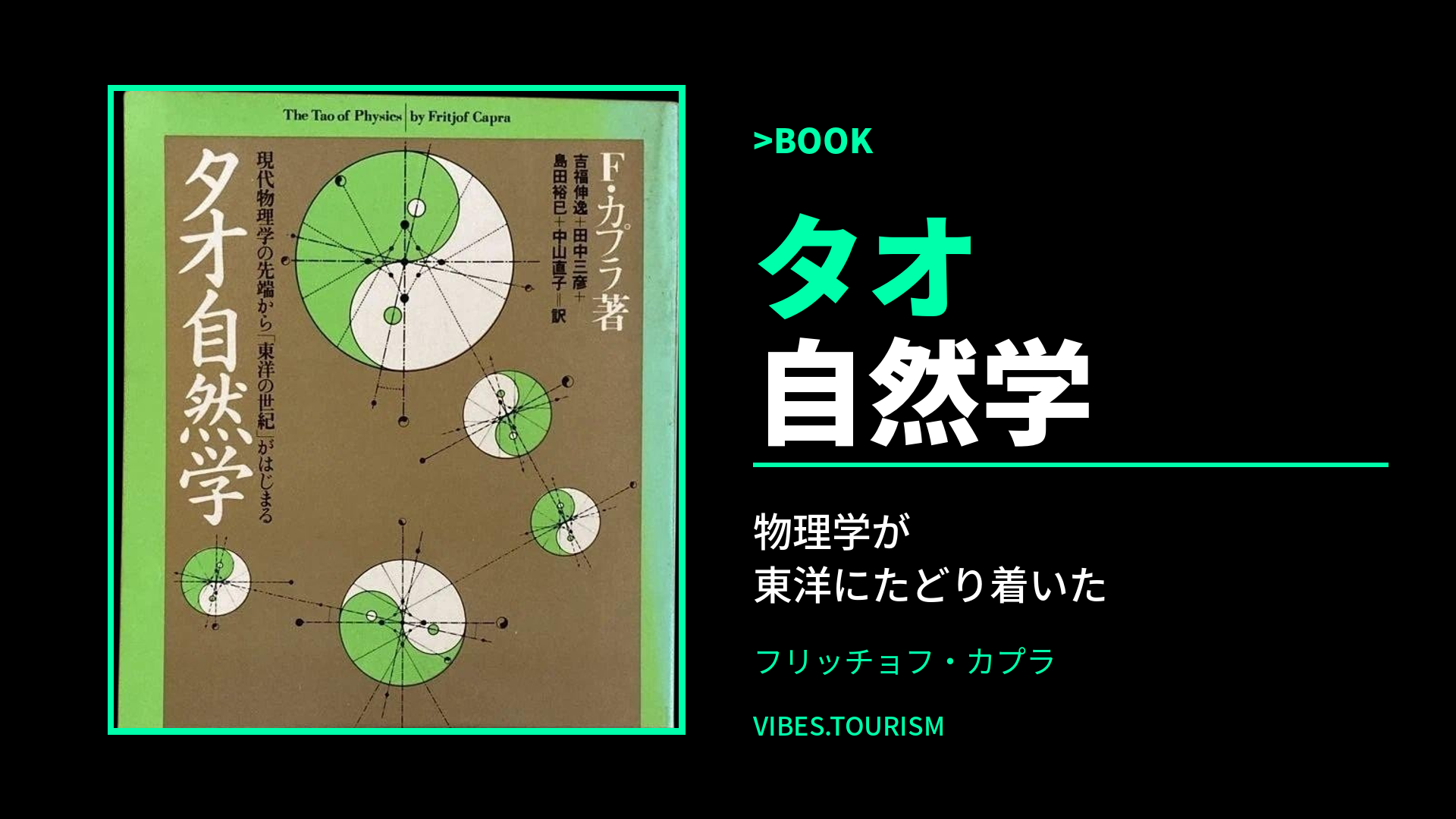

THE WORLD IS NOT
MADE OF THINGS.
It began on the afternoon a physicist wept on a beach, and it has been read for fifty years since. What this book sells is not physics knowledge. When you finish it, your own room no longer looks the same — it is an exchange of worldviews.

The book opens with a scene. One late-summer afternoon, a physicist was sitting by the ocean, watching the waves roll in, feeling the rhythm of his own breathing. And suddenly, he realized that everything around him was performing one gigantic dance. The sand, the rocks, the water, the air — all of it made of tiny particles, endlessly being born and vanishing. As a physicist, he knew all this, of course. But until that afternoon it had only ever been graphs and equations. Now it hit him as a living experience. He “saw” the cascades of energy pouring down from the sky, the countless particles and the atoms of his own body dancing one single dance. He “heard” its rhythm. And he “knew,” right there on the sand, that this was the dance of Shiva, the Hindu god of dancers — so he writes. A scientist who had lived by equations and analysis broke down crying on a beach.
The book he wrote to find out what those tears were is The Tao of Physics. What is the Tao? In ancient China, it was the word for the flow of nature, the law underlying all things — the very source of the universe. Think of how river water runs from high ground to low: that current no one can defy, scaled up to the whole world. So the title is a declaration: push physics far enough, and you arrive at that natural flow — the Tao. Published in 1975 by a small press with no advertising budget, the book spread by word of mouth alone and is still read in twenty-three languages. Over the next ten chapters, we will take out the core of what it says, as gently as we can.
For a physics book, the star of its first chapter is an odd one: the philosopher Descartes. “I think, therefore I am” — everyone has heard it at least once, and it sounds impressive. But according to this book, the misfortunes of the West begin with that single sentence.
How so? The moment you decide that “the thinking mind is the real me,” mind and body split into two different things. The self becomes a small somebody living inside the container of the body, and the world becomes whatever is outside it. The mind gets stuck with the job of managing the body, and will starts quarreling with instinct. And the same habit of splitting that we apply inside ourselves then turns outward: the world starts to look like a collection of disconnected parts, and society gets divided into nations, races, religions. Here the book makes its boldest move. The scramble for resources, the violence, the polluted environment, the troubles of mind and body — at the root, they all come from the same place: the view that “everything is separate.”
That is why the book’s first chapter is titled “Modern Physics — A Path with a Heart?” Will physics end up as a cold science of calculation? Or can it become a “path with a heart” — a Tao — that leads toward wisdom and a fuller way of being human? You can see how seriously the author means this on the dedication page. He dedicates the book to the people who helped him find his path, and on that list, Werner Heisenberg and John Coltrane sit side by side, along with Krishnamurti and Carlos Castaneda. This is a book written by a man who could place a Nobel-laureate physicist and a jazz giant on the same page of thanks — because in him, there never was a wall between physics, music, and the spirit.
This book’s enemy is not difficult equations. It is the belief that everything is separate.
So who first broke that “world of separate pieces”? Not philosophers, not priests — the physicists themselves. Knock on the desk in front of you. Hard, right? As thing-like as it gets. The old science thought the same way: the world is a heap of hard little grains, and if you keep splitting, you will eventually hit a “small, hard ball” you cannot split. The Greek word “atom” — the root of our word — literally means “that which cannot be cut.” The name itself is a fossil of that faith. In the twentieth century, humanity actually cut the uncuttable.
And the physicists who looked inside the atom never found the hard little ball. First, the atom turned out to be almost entirely empty. Blow a single atom up to the size of a baseball stadium, and the nucleus at the center is about the size of a marble; the rest is very nearly nothing. As for the electrons flying around it, they were not “grains sitting somewhere.” Try to pin down where one is, and it blurs; try to catch it, and it vanishes. What was there was not a hard pebble but flickering vibration — a “tendency to exist.”
…Which probably does not click yet, right? Think of an electric fan. When it spins, the blades look like a single solid disc. But really there are just a few blades, moving too fast for the eye to follow. Motion that is too fast looks, to human eyes, like one still thing — an experience everyone knows. The same is true of the desk. Inside it, atoms are trembling trillions of times per second, far too fast and far too small to see. That is why it looks like a still, solid object. The book has a section heading that says it in four words: “from things to events.”
Then what is that hardness you feel? When you rest your hand on the desk, the electrons in your hand and the electrons in the wood are repelling each other, pushing back and forth. It is the same mechanism as bringing two magnets together north-to-north: you feel the push without any contact. Your hand is not even touching the desk. The two of you are only pushing against each other.
The desk is not still. It only looks still.
Science, we were taught, means watching the world from outside and recording it as it is. The observer on one side, the observed on the other. If you only look, nothing changes. Obvious, right? But stop and ask: what is “looking,” actually? If you want to find a balloon in a pitch-dark room, you have to throw something and wait for it to bounce back. Ordinary seeing works the same way: we throw light at objects and catch what bounces into our eyes. Shine light on a desk and the desk does not care — which is why “looking changes nothing” holds in daily life.
But an electron is so small and so light that a single grain of light knocks it flying. The very act of finding out where it is changes what it does. Watching gently is impossible in principle. According to the book, in the atomic world the properties of a thing cannot even be defined on their own; they exist only in relation to the one observing. What we see is never nature’s bare face, but nature as it appears in the mirror of our way of questioning — Heisenberg left remarks to that effect. The book sums up the shift in one phrase: “from observer to participator.” The spectator was on the stage all along.
Now, try the book’s signature party trick yourself. Who said the following — a physicist, or a Buddhist monk? “Things do not exist on their own; they obtain their being and nature through their relations to other things.” …The answer: Nagarjuna, an Indian Buddhist monk from many centuries ago. One more: “An elementary particle is not an independent, unbreakable entity; in essence it is a set of relationships reaching outward to other things.” That one is the modern physicist H. Stapp. The book is full of these statements you cannot tell apart — and the very act of placing them side by side is its greatest set piece.
Seeing is not quietly watching. Seeing is participating.
Let us step away from physics for a moment. The middle of the book walks through Eastern thought one school at a time — Hinduism, Buddhism, Chinese thought, Taoism, Zen. If you do not know what the “Tao” in the title actually is, you can only read half of this book. We gave the thirty-second version in the introduction; here is the real thing.
The Tao is the invisible source said to exist from before the universe was born. But Lao Tzu drives in a warning nail first: the Tao that can be fully put into words is not the true Tao. The “limit of language” that the physicists hit in Chapter 3 — ancient China was already standing there, centuries before Christ. The thinkers who taught this were Lao Tzu and Chuang Tzu, the so-called Lao-Chuang school; and according to the book, the Tao is also the name for the cosmic process itself, in which all things change while staying connected. The world is not a finished product. It is a flow. And the flow has a cycle: it goes, and it returns. The moon waxes and wanes, the seasons turn, breath is drawn and released. What stretches to its limit begins to shrink; what reaches its extreme turns back. Lao Tzu said this turning-back is the very movement of the Tao. From it comes the famous advice: better too little than too much; better to leave undone than to overdo. The book rereads this old wisdom as a precise diagnosis of a modern society that raises its standard of living while lowering its quality of life.
At the heart of Taoism sits the phrase “wu-wei” — literally “non-doing.” But it does not mean doing nothing. In Chuang Tzu’s explanation, wu-wei means leaving things to their own nature and letting that nature be fulfilled. Nobody makes a plant grow by pulling on it. You arrange the water and the light, and you leave the rest to the plant — and the plant grows. When you drop the strain of fighting the current, things accomplish themselves. That is what Lao Tzu’s odd-sounding line “through non-doing, everything is done” actually means. In time, the Tao would also merge with folk religion — the pursuit of immortality, the training to become a sage-immortal — but what this book shines its light on is the philosophy at the source: Lao Tzu and Chuang Tzu.
One more thing. The Taoist sage does not try to perfect good and exterminate evil. Good and evil are the two poles of one circle; neither can exist without the other. What the sage aims for is not victory but balance. Hold on to that feeling — in the next chapter it connects head-on with physics.
Do not force the river — ride it. The Tao is not a technique. It is a way of seeing.
Is light a wave, or a particle? About a hundred years ago this question split physics in two. There were experiments that could only mean “wave,” and experiments that could only mean “particle” — both at once. Pick either answer alone and somewhere an experiment contradicts you. The answer, hard as it is to believe, was “both.” There is an old Indian parable about blind men touching an elephant. The one who touches a leg says “an elephant is a pillar”; the one who touches the trunk says “an elephant is a snake.” Neither is lying. It is just that an elephant is a creature no single word like “pillar” or “snake” can capture. Light is the same: “wave” and “particle” are conveniences of human language, and which face you see depends on which experiment you run — which part of the elephant you touch. The physicist Niels Bohr named this complementarity: two opposing pictures, neither of them false, that only together make the whole.
What the book points out is that this discovery already had a name, 2,500 years earlier: yin and yang. According to the book, opposition itself is a filing system inside the head; nature does not fit in the drawers. As Lao Tzu put it, the moment you declare beauty to be beauty, ugliness is born; declare good to be good, and evil is born. Good and evil, life and death — not absolutes in separate boxes, but the two poles of a single world. That is why, in the East, a person of virtue is not the one who stamps out evil but the one who can hold the two poles in balance.
The book carries this yin-yang all the way into the inside of a single human being. The “yang” mode of action, logic, competition; the “yin” mode of intuition, receptivity, spirit. Everyone has both — yet society has long favored only the yang and suppressed the yin. A book from 1975 had already written this much. The ideal it cites is Lao Tzu’s person who “knows the masculine, yet keeps to the feminine.” And Bohr himself, when he was honored in 1947 and had to design a coat of arms, placed at its center the taijitu — the yin-yang mark — with a Latin motto meaning “opposites are complementary.”
For minds trained to believe that being smart means settling things black or white, this sounds strange. Western logic stood for two thousand years on the foundation of “either A, or not-A.” Quantum mechanics put a crack in that foundation — and the East had been living on the far side of the crack all along. The deepest grammar of nature is not to erase contradiction, but to hold it and see the whole. It was the black-or-white question itself that was wrong.

Your “right now” and the “right now” of someone on the other side of the planet are the same now — surely. Clocks tick at the same speed everywhere in the universe, and “simultaneous” is simultaneous for everyone. Einstein’s relativity confiscated that shared clock. The clock of whatever moves fast runs slow. In the famous “twin paradox,” which the book also takes up, the brother who travels near light speed and comes home is younger than the twin who stayed on Earth. That really happens.
Hard to believe — but it is confirmed every day. When particles from space slam into the atmosphere, they create muons at an altitude of roughly fifteen kilometers. A muon’s lifetime is about 2.2 microseconds; even at the speed of light it should manage only about 660 meters, and almost none should ever reach the ground. Yet they are detected at the surface constantly — because the “clock” of a muon flying near light speed runs slower than ours, stretching its life. Closer to home: the map on your phone. The clocks on the satellites that compute your position drift out of step with clocks on the ground, and the system continuously corrects for that drift.
In 1908 the mathematician Minkowski declared in a lecture that, from then on, space by itself and time by itself were doomed to fade away, and only a union of the two would survive. “Spacetime” was born. And the book sets beside that declaration the words of D. T. Suzuki, the Buddhist scholar who carried Zen to the world: in the enlightened world of the Avatamsaka, there is no space without time and no time without space — the two interpenetrate. Here is where the book gets really interesting: it points out that both men insist these words came from experience. One experience was an experiment. The other was meditation. Different doorways — the same landscape on the other side.
Nowhere in the universe is there a “now” that everyone shares.
Picture “empty space” — the pitch-black vacuum between the stars. Nothing there. Zero. That is how the old science saw it too: space was a box for holding things, and vacuum meant the box was empty. Modern physics paints a completely different picture. Picture the sea instead — a perfectly calm surface with not a single wave. No waves does not mean no sea. What physics calls a “field” is like that sea, stretched through every corner of the universe. A particle is a wave standing on its surface. The wave can vanish; the sea remains. A vacuum is not “nothing” — it is the sea in its calm state.
And this is not armchair reasoning; it has been measured. In 1948 the physicist Hendrik Casimir made a prediction: bring two metal plates extremely close together in a vacuum, and the narrow gap between them can hold only certain kinds of ripples, while outside the plates every kind exists. The push from outside wins by a whisker — and the plates, pressed by supposedly empty vacuum, should drift together. The force is so faint that a clean measurement took half a century: in 1997 the physicist Steve Lamoreaux measured it, and the result matched the prediction to within a few percent. “Nothing” really moved visible metal plates.
Onto this, the book lays the Buddhist “sunyata” — emptiness — and the Tao’s “wu,” nothingness. These were never words for “blank” or “zero”; they name the womb from which everything arises and to which everything returns — the sea, not the absence of waves. And into this chapter on “generative emptiness” the book brings one Japanese figure: Hideki Yukawa. The force that binds particles inside the atomic nucleus does not reach across empty space; it is carried by an exchange of particles — mesons — born out of that very field. The book places this insight, which later won Japan its first Nobel Prize, as a living example of form arising out of emptiness. Yukawa, as his own essays famously tell, grew up steeped in the Chinese classics.
The vacuum is not “a place with nothing in it.” It is a sea where the waves have not yet risen.
E=mc². Most people know it as “the atomic-bomb equation.” The book reads it very differently. What the equation announces, in a single phrase, is that matter and energy are two appearances of the same thing. Think of water vapor and ice. Invisible vapor cools and hardens into visible grains of ice; the ice melts and evaporates and disappears again. In the same way, formless energy “condenses” into particles — matter — and particles dissolve back into energy.
And this condensing and dissolving is happening right now. Every time a high-speed particle from space strikes Earth’s atmosphere, new particles are born, change into other particles, and vanish — above your head, every second. In the “bubble chamber” photographs of particle detectors, their trails appear as countless glowing spirals: the tracks of particles that were born and died. The book goes one step further: an elementary particle is not something performing a dance. The particle is the dance.
The name the book gives this unending rhythm is the Dance of Shiva. The Hindu god Shiva dances inside a ring of flame, creating the universe, sustaining it, destroying it, creating it again — creation and destruction as a single gesture. The author saw that ancient Indian image in the particles of the bubble chamber. He even made a photomontage of his own, the dancing Shiva superimposed on particle tracks. When he showed it in his lab to an Indian colleague — a physicist who had deliberately distanced himself from his own tradition in order to study physics — the man wept in front of it. And in 2004, in the courtyard of CERN, the world’s largest particle-physics laboratory, a two-meter statue of Shiva was unveiled, with a plaque quoting this book. What the book saw had walked all the way to the headquarters of physics itself.
There is not a single piece of matter at rest in this universe.
Even after all this, do you not want to push back one more time? Fine, particles are motion, particles are waves — but at the very bottom there must be a final, unsplittable building block. The book faces this question head on. By then, a candidate for the smallest piece had already appeared: the “quark.” But quarks are strange. A quark can never be pulled out alone. However hard you smash particles apart, a single quark never rolls out onto the table. The book calls them phantom particles, and asks: is this a new koan?
On top of that, the book sets its climax: the bootstrap theory of the physicist Geoffrey Chew. In one sentence: there are no fundamental building blocks. Every particle’s properties are determined by its relationships with all the other particles, and the universe holds together for one reason only — that the whole is self-consistent. A picture helps here: a dictionary. Look up any word, and it is explained by other words. Look those up, and you get more words. You never reach a “first word that needs no explanation” — and yet the dictionary works, because all the words hold each other up. The bootstrap universe is that dictionary. It does not collapse despite having no foundation; because there is no foundation, everything is the foundation of everything else. The author placed the overlap between this “universe without a ground” and a Mahayana Buddhist image at the very peak of his book: “Indra’s Net” from the Avatamsaka Sutra. A vast net covers the palace of the god Indra; at every knot hangs a jewel; and every single jewel reflects all the others. The whole inside each one; each one inside the whole. The bootstrap theory was this net, written in mathematics.
One more thread: the book goes on to connect this idea — reading the world as a catalogue of changes rather than a catalogue of things — to the ancient Chinese I Ching, the Book of Changes, which reads the world through sixty-four patterns of transformation. The reaction patterns of elementary particles, set beside the book of change: it is this book’s boldest bridge, and also its thinnest.
Every part is made of all the other parts.
Now the book gathers all the parallel lines into a single picture. The mystic descends into the deep of the world from the inside, through consciousness, by meditation. The physicist descends into the deep of the world from the inside of matter, by instruments. The methods could not be more different — and yet the reports they bring back are the same: everything is connected; everything is in motion; the seer cannot be cut off from the seen. That is the whole book in one sentence.
Nor was this one author’s private fancy. Heisenberg visited the poet Tagore in India in 1929 and talked with him at length about science and Indian philosophy. And when the author showed Heisenberg the manuscript of this book, chapter by chapter, in Munich in 1972, Heisenberg is said to have told him at the end that he was, basically, in complete agreement. But let us clear up a misunderstanding here. This is not a “see, Eastern mysticism was right all along” book. Read it that way and you read it shallowly — and that reading has drawn real criticism: resemblance does not prove identity of truth. The book itself draws the line carefully. Science has not proven mysticism. Meditation is not an experiment; a koan is not an equation. They are two trailheads on the same mountain, and neither can substitute for the other.
Two trailheads. One mountain.And so we return to the question of Chapter 1. Is physics a path with a heart? If the world is a machine — a heap of separate parts — then nature is a warehouse of parts: removable, expendable. Other people are other machines, and you are one isolated component. The centuries in which we mined the earth bare, cut our ties to one another, and tried to repair mind and body in separate shops were a history traced exactly over that “machine picture.” If the world is a web, everything changes. Cut any thread, and the vibration comes back to you. Nature is not a warehouse; it is a fabric, and you are woven into it. What this book carried back from the deepest part of physics was, in the end, that one picture. In the author’s words: science does not need mysticism, and mysticism does not need science — but man needs both.
And this is no faraway story. Your body is made of atoms, and those atoms are being replaced all the time. Almost none of the particles that made you a few years ago remain — and yet you are still “you.” Which means you are not a solid thing. You are an ongoing process — one choreography in the dance of Shiva. When you finish reading, look around your room. Nothing in it is still. Everything you have been seeing as a “thing” is a spinning fan, a wave standing on a calm sea. And inside that dance, there are no audience seats.
You have been on the stage from the very beginning.One last question, then. If the world is not a collection of things but a single dance — with what eyes will you look, tomorrow, at the coffee cup in front of you, at the person beside you, at the palm of your own hand? The answer is written in no accelerator and in no scripture.
It is not decided until you look.
BOOK DATA
The Tao of Physics: An Exploration of the Parallels Between Modern Physics and Eastern Mysticism
Fritjof Capra — Shambhala Publications, 1975 (50th Anniversary Edition, 2025)
Japanese edition: “Tao Shizengaku,” translated by Shinichi Yoshifuku, Mitsuhiko Tanaka, Hiromi Shimada, and Naoko Nakayama — Kousakusha, first edition Nov. 15, 1979 (revised 1990), A5 format, 377 pages, ISBN 978-4-87502-108-7

Comments