
The Mountain That Hid Its Gate: Four Seals
Togakushi Shrine is no ordinary mountain shrine.
It stands at the foot of Mount Togakushi, a sacred peak in Nagano Prefecture, and comprises five shrines—Okusha, Chūsha, Hōkōsha, Kuzuryūsha, and Hinomikosha—with a history stretching back more than two thousand years. The deities enshrined here are deeply tied to the myth of the Opening of the Heavenly Rock Cave.
Yet the true nature of Togakushi lies beyond these titles.
There is myth here, and a dragon, and ascetics who secluded themselves in the mountains, and the sorcery of ninja passed down through generations. What would normally be told as separate stories, in separate places, are folded together here within a single mountain.
And the name itself is already a riddle.
Togakushi.
To hide the door. To conceal the gate.
What door is it? And why has it been hidden?
The Gate of Heaven Fell to Earth
The story begins with the most famous myth in all of Japan.
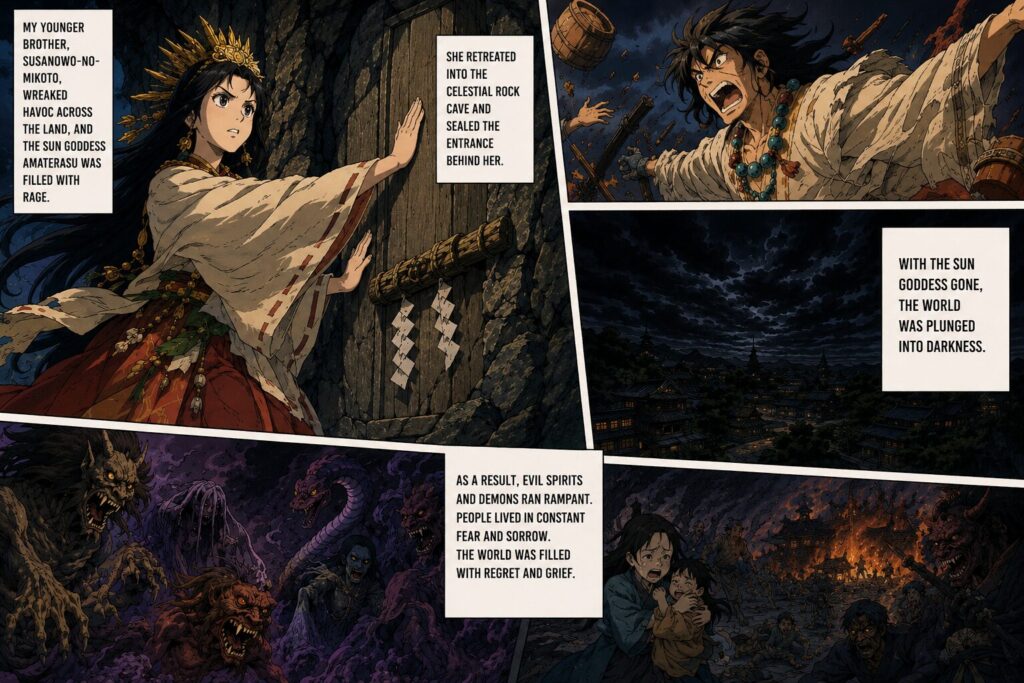
Enraged by the repeated violence of her younger brother Susanoo-no-Mikoto, Amaterasu-Ōmikami withdrew into the Heavenly Rock Cave, sealed the door behind her, and hid herself away. With the sun goddess gone from sight, the world plunged into total darkness. All manner of evil deities began to stir, and one terrible, sorrowful thing after another came to pass.
The eight million deities, at their wits’ end, gathered before the cave to confer. How could they coax the great goddess to come out once more?
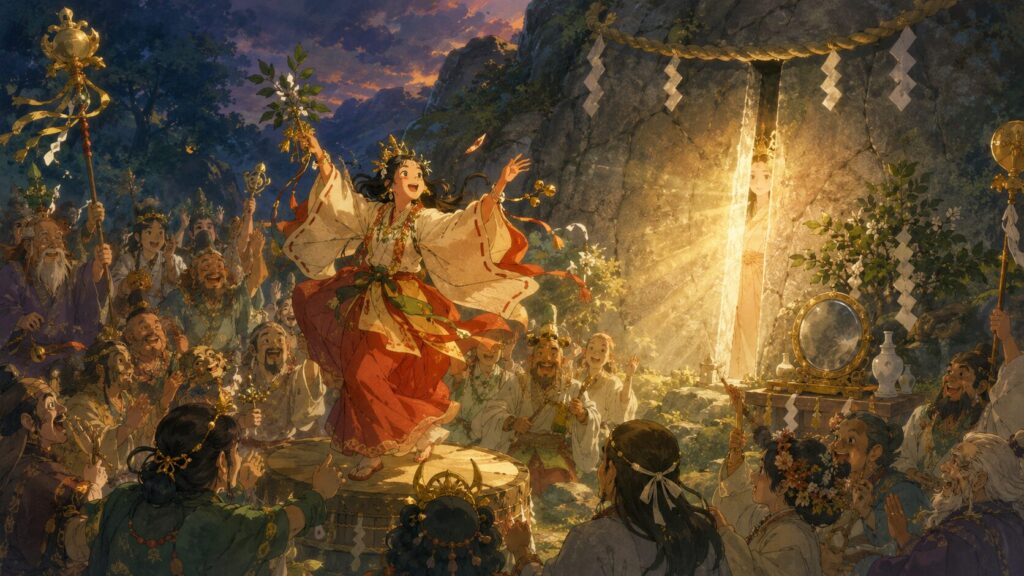
It was Ame-no-Yagokoro-Omoikane-no-Mikoto—the deity now enshrined at Chūsha—who devised the plan. Let us dance and revel merrily before the rock door. Surely the great goddess will wonder, “What are those ones doing?” and come out to peek.
The deities made their preparations. First, they gathered a great many roosters and made them crow. Then Ame-no-Uzume-no-Mikoto—the deity now enshrined at Hinomikosha—who was skilled in dance, mounted an overturned tub and danced with delightful stamping of her feet: ton-ton, to-to-ton. The assembled deities clapped along in time, cheering her on. When Omoikane-no-Mikoto mimicked the crow of a long-crowing cock—cock-a-doodle-doo—all the gathered roosters cried out at once. Uzume’s dance was so comical that the deities roared with laughter, holding their sides, and some were even moved to dance themselves.
Inside the cave, Amaterasu-Ōmikami could not help but wonder at the commotion outside. Curious as to what was happening, she quietly opened the rock door and peered out.
Waiting in the shadow of the door for that very instant was another deity: Ame-no-Tajikarao-no-Mikoto—the deity now enshrined at Okusha—the strongest of all in the High Plain of Heaven. Tajikarao-no-Mikoto seized the opened rock door and, with all his might, flung it wide in a single motion. Amaterasu-Ōmikami was drawn out, and light returned to the world once more.
It is from here that the story of Togakushi begins.
Tajikarao-no-Mikoto feared that the great goddess might withdraw into the cave once again. And so, with a mighty heave, he lifted that heavy rock door and hurled it far away, down into the mortal world below.
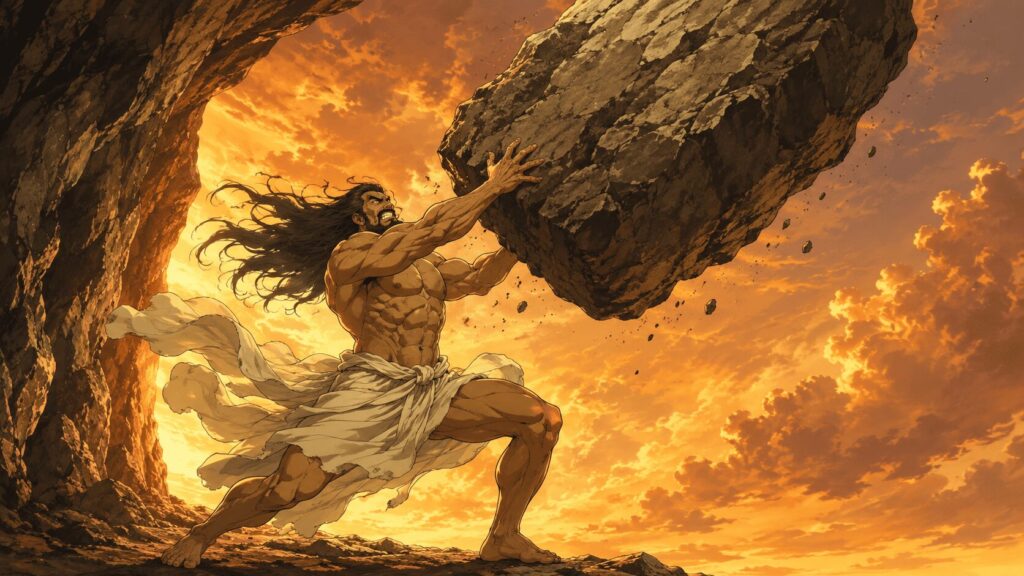
The rock door, soaring through the air, came to rest right around the very center of Japan.
That rock door became Mount Togakushi.
This is where the name Togakushi comes from. The Togakushisan Kenkōji Ruki, transcribed in 1458 during the Muromachi period, records that the place is called Togakushi because Ame-no-Tajikarao-no-Mikoto hid and set down the Heavenly Rock Cave door there.
In other words, Togakushi is the place where, in myth, the gate of heaven fell to earth.
When you actually behold Mount Togakushi, the weight of this legend is striking. The mountain has a distinctive form—thin and sheer, like a folding screen. Both sides plunge sharply into the valleys, and it looks as though an enormous slab of rock has been driven into the ground. Were you told that the rock door flew here and lodged itself in the earth, you could almost believe it.
Myths are often born to explain the landscape before our eyes. In the case of Togakushi, that landscape is simply too mythic for words.
Four Seals Within a Single Mountain
A mountain where the gate of heaven fell to earth. That is the face Togakushi shows the world.
But if the door had merely “fallen,” this would be no more than a stage for myth. What makes Togakushi truly eerie, and truly fascinating, is that this mountain is a place that has hidden and sealed things away.
By the power of a sutra, a dragon was sealed within the rock. By the sorcery of the Nine Syllables, an unseen enemy was sealed away. One who broke the law forbidding women was turned to stone and sealed. A child who ate the flesh of a mermaid was sealed into a body that would never age or die.
Togakushi is a mountain that has sought, through words and signs and laws, to subdue unseen forces and lock them away.
Now, one by one, we will open these four seals.
First, the tale of the dragon—who dwelt on this mountain even before the myth.
Why was there a dragon at Togakushi even before the deities of the Heavenly Rock Cave arrived? And by whom, and how, was that dragon sealed within the rock?
Chapter One — The Dragon Was Here Before the Myth
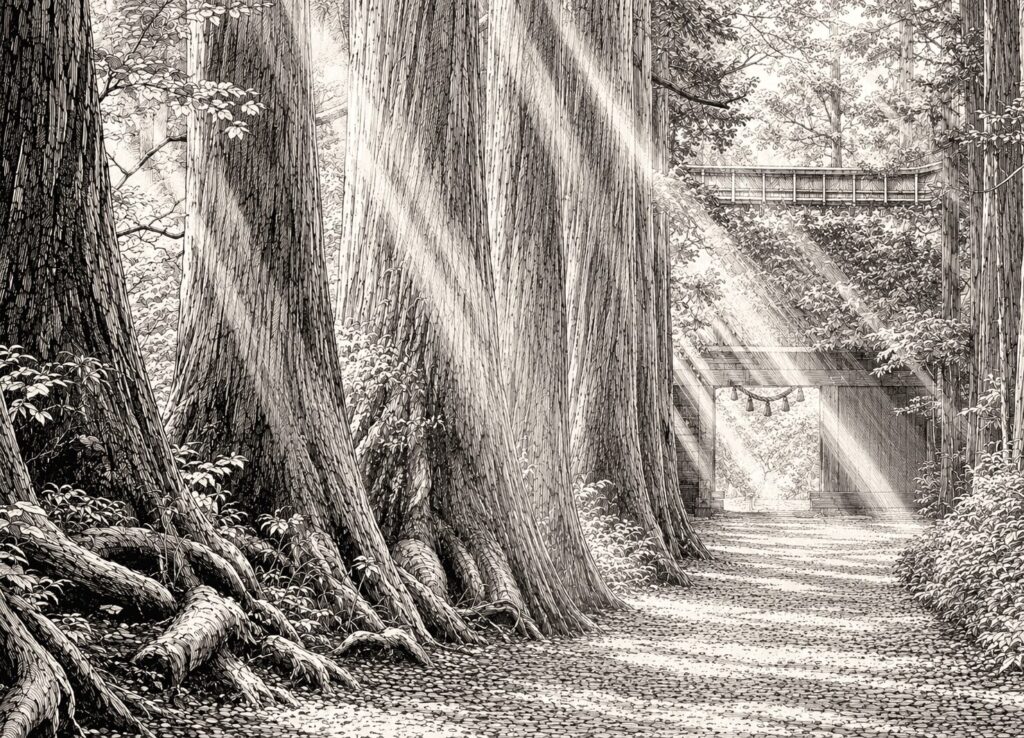
The path leading to Okusha is the place at Togakushi where the sense of otherworldliness is strongest.
From the entrance torii to the main shrine is about two kilometers one way. You proceed along a long avenue of cedars, pass through the thatched-roof Zuishinmon gate, and press on deeper still. At the end of that path stand Okusha and, just before it, Kuzuryūsha.
It is this Kuzuryūsha that deepens the mystery of Togakushi all the more.
The enshrined deity is Kuzuryū-Ōkami, the Great Nine-Headed Dragon Deity. He has been worshipped as a god of water, a god of rainmaking, a god of marriage bonds, and even a god of toothaches.
The official records of Togakushi Shrine state this plainly: that Kuzuryū-Ōkami was enshrined as the land-holding deity of this place even before Ame-no-Tajikarao-no-Mikoto came to be enshrined here.
This is the crucial point.
Kuzuryū is not a deity brought in later. He is a god who dwelt on this mountain before the deities of the Heavenly Rock Cave myth ever arrived.
Seen this way, Togakushi Shrine takes on a double structure.
Its outward face is the shrine of the Heavenly Rock Cave myth.
Its hidden face is a sacred site of far older mountain worship, guarded by Kuzuryū.
And here is the fascinating part: of the five shrines of Togakushi, only Kuzuryūsha embodies this structure. Ame-no-Tajikarao-no-Mikoto at Okusha, Ame-no-Yagokoro-Omoikane-no-Mikoto at Chūsha, Ame-no-Uwaharu-no-Mikoto at Hōkōsha, Ame-no-Uzume-no-Mikoto at Hinomikosha—these four shrines all enshrine figures from the Heavenly Rock Cave myth. The deity who opened the rock door, the deity who devised the plan to open it, his child, and the deity who danced before the door. To make the round of the five shrines is itself to walk the myth as geography.
Yet only the deity of Kuzuryūsha is not a figure from the myth. Of the five shrines, this one alone stands outside it—jutting up, solitary, from a stratum older than the myth itself.
So where, then, did this dragon come from? And how did it come to “settle” upon this mountain?
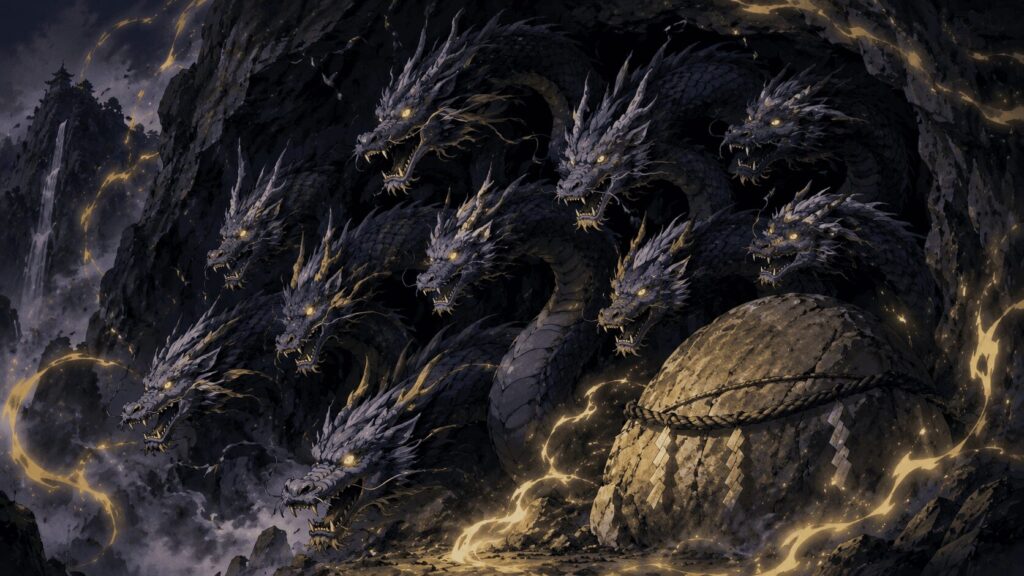
Sealing the Dragon with a Sutra
Togakushi holds another origin tale, entirely separate from the legend of the rock door. This one is far older, and far more eerie.
The story survives in the Asabashō Shoji Ryakki, a Buddhist text written in the Kamakura period.
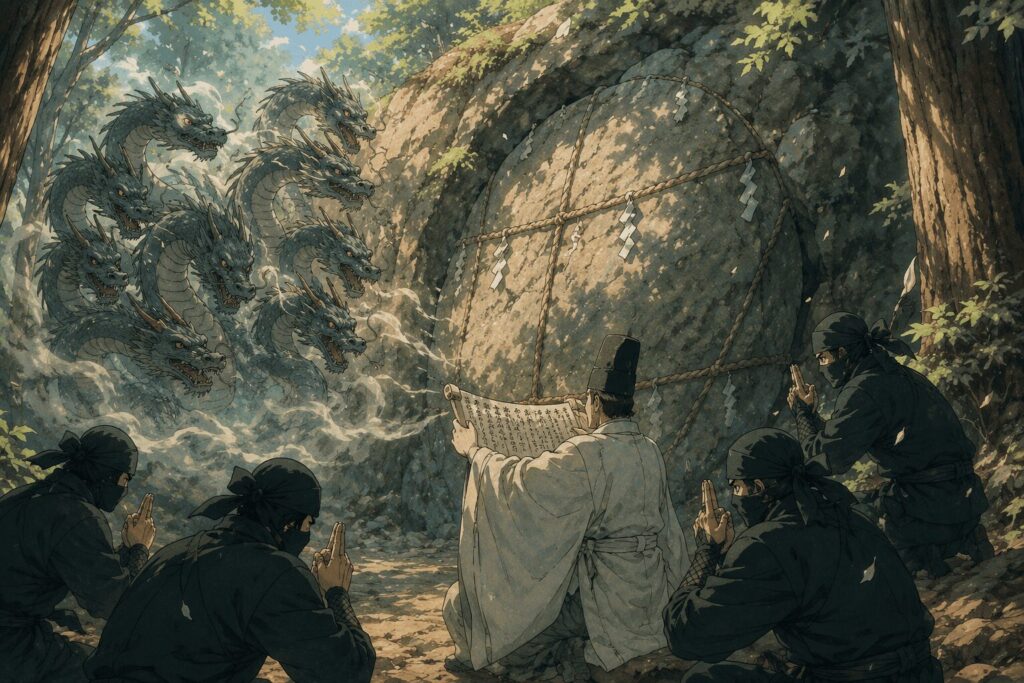
It happened around the second year of Kashō (849). An ascetic by the name of Gakumon was practicing his austerities on Mount Iizuna. Seeking a place where Buddhism might flourish, he hurled his tokko vajra to the west, and it fell into a rocky cavern on Mount Togakushi and gave off light. Following that light, Gakumon made his way into the mountain, reached the cavern, and was chanting the Lotus Sutra when—in the dead of night, from the south—a monstrous being appeared, bearing nine heads and the tail of a dragon.
In the more vivid version of the legend, this nine-headed dragon declares: I was once the bettō of this place—the administrator of its temple. For the crime of embezzling treasures offered to the Buddha, I was cast down into this dragon’s form.
And then, through the merit of the Lotus Sutra that had been chanted, the dragon attained Buddhahood and hid itself away within the cavern of its own accord. Gakumon sealed the entrance shut with a great boulder.
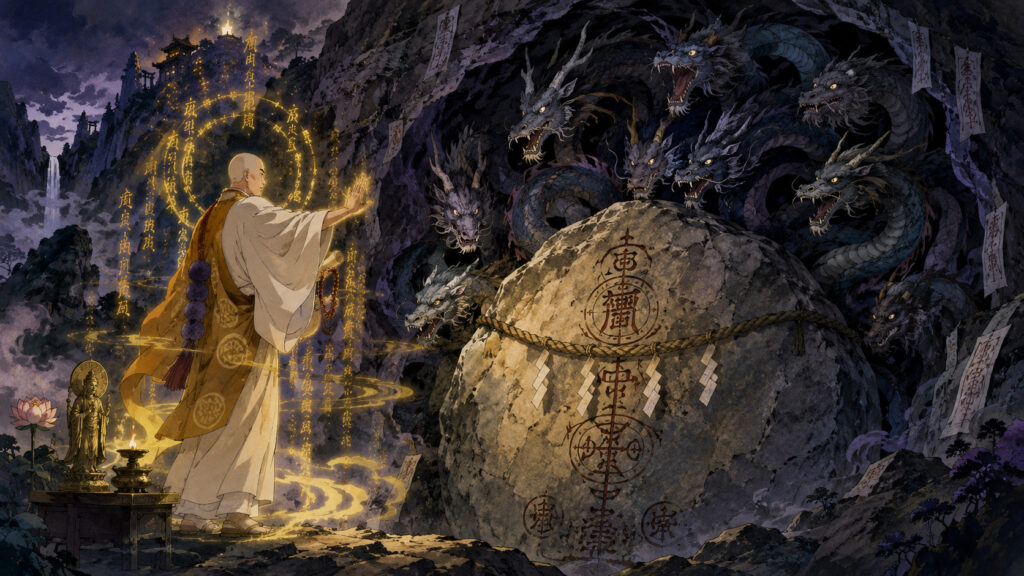
The dragon hid within a door of rock and was sealed inside.
And so this mountain came to be called Togakushi—the Hidden Door.
This is another origin of the name Togakushi.
Here, there is something we must not overlook.
The means by which Gakumon subdued the dragon was neither a sword nor brute strength. It was “words”—the Lotus Sutra. By the merit of the sutra he overpowered the monstrous being, brought the guilty dragon to Buddhahood, and sealed it within the rock.
This is sorcery in the truest sense: the art of subduing and sealing away an unseen being through the power of words.
The mountain called Togakushi was, from the very origin of its name, inseparably bound to sorcery.
A Guilt-Laden Dragon Becomes a God
This origin tale carries one more deep resonance.
The sealed dragon did not simply vanish. Its raging power subdued and its guilt purified, the dragon in time turned into a benevolent god—one that governs water, sends down rain, nourishes the rice fields, and aids the people.
That is Kuzuryū-Ōkami, the Great Nine-Headed Dragon Deity.
A guilt-laden monster, through being sealed away, is purified and becomes a god that gives people life. To seal is not merely to shut away, but also the work of “calming the raging thing and turning it into a useful power.” The dragon of Togakushi quietly tells us this.
The crest of Togakushi Shrine bears this out. The shrine’s emblem is called the kama-manji—four sickles arranged in the form of a manji (swastika).
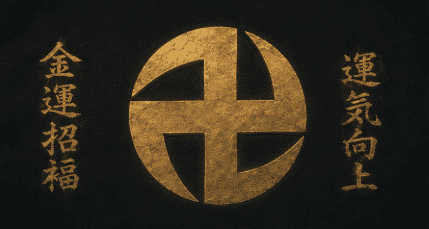
Togakushi’s deity has long been worshipped as a god of water and a god of bountiful harvest. The sickle—the farming tool that cuts away rank weeds and creates rich, fertile soil—was rendered as the symbol of the shrine’s blessings. A sealed dragon became a god of the water and abundance that gives people life, and the memory of this is etched even into the shrine’s crest.
To this day, the people of the Togakushi kō pilgrimage associations are said to always bring rice when they worship, offering it before the deity. Even now, twelve hundred years on, the dragon lives on as a god of water and abundance.
Forswearing Pears, Curing Toothaches
The dragon turned benevolent has one strange face.
For a god of water, it is somehow also a god of toothaches and tooth pain.
In the late Edo period, Jippensha Ikku wrote in his Togakushi Zenkōji Ōrai: Kuzuryū Gongen dwells within the cavern and receives pears as offerings. Those who suffer from toothaches, if they forswear pears and pray, will surely be cured.
The dragon favors pears. Offer it the pears it loves, and it will take away your tooth pain. The one making the vow, conversely, deliberately forswears the pears the dragon loves and prays.
By offering up the sacrifice of “abstaining,” one moves an unseen force. This, too, is a sorcerous practice—a bargain struck with the dragon.
Why pears, and why teeth? No clear reason has come down to us. And yet even now there are people at Togakushi who forswear pears and pray. That it has been passed down with the reason unknown is itself a testament to the antiquity of this faith.
The Art of Subduing Dragons, Scattered Across Japan
Incidentally, this pattern—an ascetic subduing a raging dragon by the power of the Dharma and turning it into a benevolent god—is not unique to Togakushi.
At Hakone Shrine in Kanagawa, it is told that Mangan Shōnin, who opened Hakone, subdued the nine-headed dragon of Lake Ashi and brought it into the faith. At Lake Ashi there had once been a custom of offering young maidens as sacrifices to the dragon. Mangan Shōnin, in the midst of his austerities, is said to have turned the dragon from its ways by the power of the Dharma.
Faith surrounding the nine-headed dragon is found across Japan—in Hakone, Nagano, Fukui, and elsewhere. And much of it is bound to “water.”
The dragon of Togakushi is no isolated curiosity. It is one knot in a sorcery, scattered across the whole country, of “subduing a raging water deity through words and the power of the Dharma.”
A dragon sealed by a sutra was the oldest master of this mountain.
Next, then, the tale of how that same technique—”overpowering a force through words and signs”—was handed down in an entirely different guise.
The sorcery of the ninja.
Chapter Two — The Sorcery of the Ninja Was Real
Togakushi has yet another famous face, distinct from the myth and from the dragon.
The ninja.
Togakushi is held to be the birthplace of “Togakure-ryū ninjutsu,” ranked alongside Iga and Kōga. The Ninpō Museum displays several hundred panels conveying ninja tools and techniques, and as a tourist destination, Togakushi is well known for this “village of the ninja” face.
But the truly fascinating part lies beyond that.
That Thing You Thought Was Just for the Manga
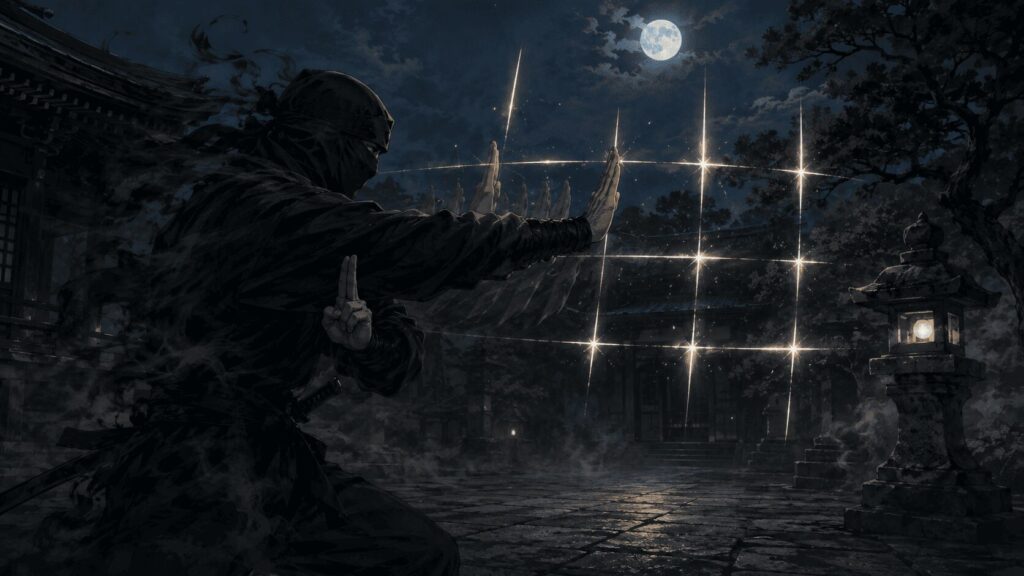
You have surely seen the scene, in period dramas and anime, where a ninja chants “Rin, Pyō, Tō, Sha, Kai, Jin, Retsu, Zai, Zen” while slicing the air crosswise and lengthwise with a knife-hand.
This is called “cutting the Nine Syllables.”
Did you think it was just a flourish invented for the manga? Throwing shuriken, you can tell, is a “technique.” But chanting a spell, forming signs, and vanishing—surely that is mere fantasy, something only in fiction?
It is not.
Those Nine Syllables are real. Fiction did not invent them out of nothing; manga and film merely borrowed a sorcery that had existed all along.
The Nine Syllables are a practice consisting of a spell made of nine characters—”Rin, Pyō, Tō, Sha, Kai, Jin, Retsu, Zai, Zen”—and a corresponding set of signs (ways of interlacing the hands), by which one prays to ward off calamity and prevail over an enemy.
In the simplified “Quick Nine Syllables Self-Protection Method,” it goes like this. Extend the index and middle fingers of the right hand, press the ring and little fingers down with the thumb, and form the shape of a blade with the hand (the tōin, or sword sign). Sheathe that knife-hand once in a “scabbard” formed by the left hand, and concentrate the mind. When ready, draw the knife-hand and, chanting “Rin, Pyō, Tō, Sha…” one character at a time, slice the air—five strokes horizontal, four strokes vertical, alternating. This is, for the most part, the gesture you see in the movies.
In the full practice, a separate sign is formed for each of the nine characters: the tokko-in, the daikongōrin-in, the gejishi-in, the naijishi-in, the gebaku-in, the naibaku-in, the chiken-in, the nichirin-in, and finally the hōbyō-in.
This last, the hōbyō-in, has another name.
The ongyō-in—the sign of hiding one’s form.
The manga depiction of a ninja vanishing was not pure nonsense after all. Within the practice of the Nine Syllables, there exists a sign named, quite literally, “hiding the form.”
The Source: A Charm for Those Who Enter the Mountains
So where did these Nine Syllables come from?
The Nine Syllables Self-Protection Method is often thought to be Buddhist or esoteric Buddhist, but its origin is not Buddhism. It is Daoism.
The oldest account of the Nine Syllables appears in the Baopuzi, a Daoist text written in the fourth century (the 300s CE) by the Chinese adept Ge Hong.
And the name of the chapter in which it appears is quite fitting.
Chapter Seventeen, the “Climbing and Wading” chapter—meaning, to climb mountains and ford rivers.
There, Ge Hong introduces the Nine Syllables as a spell to be used by those entering the mountains. One who enters the mountains would do well to know this secret incantation. If one always chants it in secret, there is no unavoidable calamity whatsoever.
In other words, the Nine Syllables were originally “a spell by which one who ventures into the mountains protects himself from the demons of the mountains.”
The mountains—an otherworld beyond human understanding. An art of self-protection for those who step into it.
This came to Japan and was handed down precisely to those who secluded themselves in the mountains to practice austerities.
The yamabushi of Shugendō.
The Nine Syllables Self-Protection Method is held to be a uniquely Japanese practice, formed when the Daoist “Secret Incantation of the Six Jia” flowed into Shugendō and mingled with esoteric Buddhism and various other elements. It is not a practice formally transmitted by Buddhism, but a sorcery that arose from the melting pot of the mountain religion.
Overpowering the Enemy with the Power of the Mountain
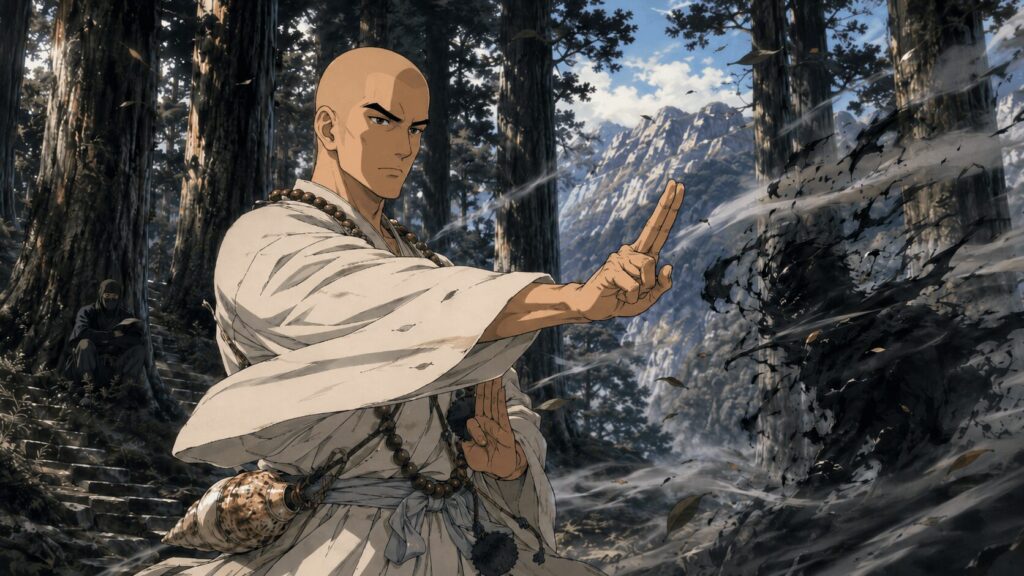
According to the religious scholar Miyake Hitoshi, to cut the Nine Syllables in Shugendō is no mere charm.
One chants the spell, forms the signs, visualizes the principal deity or buddha in the mind, and through that deity unites with the “spiritual power of the mountain.” Then, with that power of the mountain, one aims to subdue—to overpower—the enemy who would do one harm.
The Nine Syllables are not the resolve of one person alone. They are a technique for drawing in the power of that vast existence, the mountain, through the circuit of signs and spell, and hurling it at the enemy. That the yamabushi secluded themselves in the mountains to practice was, in part, to run this circuit of “uniting with the power of the mountain” through their own bodies.
Miyake also draws attention to the gesture of the Nine Syllables itself. In visible form, one moves the hands clearly and slices the air. In this concrete, forceful action, he says, there appears an active will to attack the enemy.
What Shugendō originally sought was the effect of subjugation—driving off unseen worldly passions and evil spirits. But in Japan, an effect of subjugating visible, real enemies as well came to be expected of it. And that, in the process by which the image of the “ninja” was constructed through military treatises, was taken up into ninjutsu as well.
Why Togakushi, of All Places?
Here, the story returns to Togakushi.
The historical founder of Togakure-ryū ninjutsu is held to be a figure from the late Heian period named Nishina Daisuke (also known as Togakushi Daisuke). Around 1181, this retainer of Kiso Yoshinaka is said to have acquired distinctive techniques while accumulating Shugendō training on Mount Togakushi and the neighboring Mount Iizuna. After Yoshinaka’s defeat in battle, Daisuke is said to have fled to Iga, where he incorporated Iga-ryū ninjutsu into the Shugendō techniques he had cultivated at Togakushi, perfecting the Togakure-ryū.
That said, we must set one thing down honestly. This lineage tracing back to Nishina Daisuke has no firm documentary support. There is even a theory that the legendary founder was a Chinese general who took exile in Japan. So “founded in 1181” is best received not as historical fact but as a story handed down as such.
Even so, there is one point that cannot be overlooked: that the roots of Togakure-ryū ninjutsu are held to lie in none other than Shugendō.
Here, everything connects.
That the ninja of Togakushi cut the Nine Syllables and formed signs was not because they possessed some special superhuman power. It was because their matrix was Shugendō, and they inherited, just as it was, the sorcery the yamabushi had used to draw out the power of the mountain.
A Daoist adept created the Nine Syllables as a charm against the mountain’s demons. That became the self-protection method of the Shugendō yamabushi. And from that Shugendō, Togakure-ryū ninjutsu was born.
That the ninja of Togakushi cut the Nine Syllables is nothing supernatural at all. Those who inherited the sorcery of the yamabushi were using that sorcery. That is all there is to it.
What we took to be “the ninja’s superpowers” turns inside out into “the inheritance of an orthodox practice of mountain worship.” In this moment, the sorcery of the ninja suddenly takes on a real texture. Not an illusion of vanishing in a puff of smoke, but a system of self-protective techniques handed down from the mountain over a thousand years. Precisely because Togakushi was a great sacred site of Shugendō, it was a natural consequence that “stealth practitioners who used sorcery” should have arisen from it.
Surviving, Rather Than Slaying
Togakure-ryū ninjutsu has one more fascinating trait.
Compared to other schools, it is said to have placed its weight not on slaying the enemy but on evading the enemy’s attacks and surviving—the arts of self-protection, concealment, and survival.
This, too, resonates with the origin of the Nine Syllables. Recall that the spell in the Baopuzi, from which the Nine Syllables derive, was a spell for one who enters the mountains to “hide himself and avoid danger.” Not a spell for attacking, but a spell for surviving.
That the Togakure-ryū took “surviving rather than slaying” as its principle makes perfect sense once you consider that its root lay in a sorcery for surviving in the mountains.
In the Ninjutsu Texts, “Sorcery” Is Written Down in Words
Decisive proof that the Nine Syllables are no abstraction has emerged in recent years.
In 2022, in Kōka City, Shiga Prefecture, an old document held to be the original source of a ninjutsu text was discovered. It is known that the Bansenshūkai (compiled in 1676), one of the three great ninjutsu transmissions, was based upon this document. It is a text that lies even further back at the very source of the ninja’s body of knowledge.
And what was written in it?
Alongside practical techniques of infiltration and espionage, “a sorcery for not being barked at by guard dogs” was recorded, firmly, as one of forty-eight articles.
This is telling. When we think of ninjutsu, we picture nimble body techniques, or knowledge of poison and gunpowder. But within the “secret transmissions” they actually left behind, sorcery stood, written down in words, with the same weight as technique.
For the stealth practitioner, sorcery was not a fanciful ornament but part of the practical knowledge for surviving. If a dog barked, the mission failed and life was lost. The sorcery to silence that dog was transmitted as earnestly as the way to throw a shuriken.
The sorcery of the ninja was real. The manga did not inflate it. The manga merely made something that existed a little flashier.
It should be added that Togakure-ryū ninjutsu is no relic of the past. It survives to this day as an extant school of ninjutsu, and Hatsumi Masaaki, regarded as its thirty-fourth grandmaster, is known as the man who served as ninjutsu adviser for the film You Only Live Twice. The techniques born (so it is said) on the mountain of Togakushi have crossed the seas, and now have more practitioners abroad than at home.
Sealing the dragon with a sutra, overpowering the enemy with the Nine Syllables.
Togakushi was a mountain that had subdued unseen forces through words and signs.
But what this mountain sealed away was not dragons and enemies alone.
Human beings, too, were sealed.
Chapter Three — The Woman Turned to Stone, the Vanished Princess
Togakushi preserves three unforgettable tales about human beings.
A woman turned to stone. A princess who departed. Children sealed into deathless, ageless life.
Each is one that Togakushi Shrine officially hands down as a “legend of Togakushi.” And each sends a chill down the spine.
Those Who Break the Law Forbidding Women Turn to Stone
Togakushi was once a place where women were forbidden.
Hard as it is to believe now, women were then considered impure, and it was earnestly believed that a woman’s entry would defile the sacred ground and provoke the wrath of the gods.
If you pass Chūsha coming from the direction of central Nagano and walk a while along the old Echigo road, you reach the place where a building called the Nyonindō—the Women’s Hall—once stood. Women coming from the Zenkōji direction were permitted no farther than here. They could only worship from afar at the Nyonindō, then turn back the way they came. On the road ascending from the Kashiwabara direction, too, stood a stone marking the women’s barrier. There, as well, women could go no farther.
It was a law harsher than we can now imagine.
And this tale has come down to us.
On a certain clear autumn day, a bikuni—a nun—came to Togakushi with an attendant. The two reached the Nyonindō, the limit beyond which women could not pass.
The attendant, and the nun herself, were of course well aware that beyond this point women were forbidden.
Yet the nun, as though the law were of no concern to her at all, set off briskly past the Nyonindō and deeper in.
The attendant hastily tried to stop her. Let us worship from here and descend the mountain quickly, she pleaded. But no matter how she implored, the nun would not heed her, and pressed on still deeper.
In the end, the attendant could not stop her mistress. Trembling at the dread of a broken law, unable to move forward or back, she could only pray with all her heart that the gods’ wrath would not fall upon her mistress.
And then—what should happen?
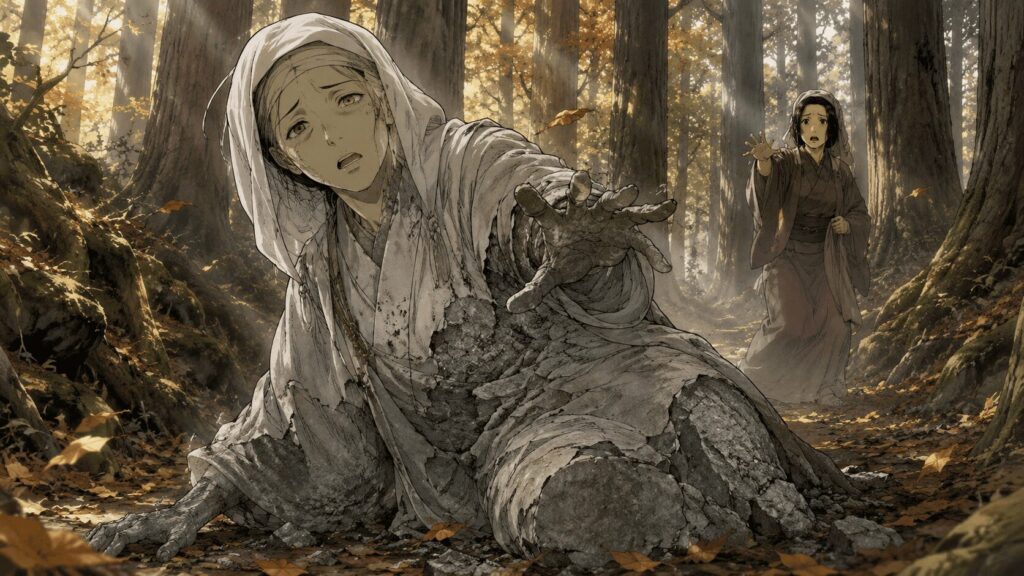
When the nun had advanced some way inward, her hale and hearty bearing changed utterly. She halted her steps, and then collapsed flat upon the spot.
And before one’s very eyes, her body began to stiffen.
Steadily, she was turning to stone.
The attendant, watching from behind, tried in her astonishment to rush to her, but remembering that women were forbidden beyond that point, she fled in a panic all the way back to the main temple.
Even today, a way along from the Nyonindō site toward Okusha, a great boulder called the “Bikuni Stone” lies on its side.
For a long time, it had become unclear which boulder was the Bikuni Stone. In recent years, the matter was settled when an elderly person living nearby was found to be always making offerings at one particular boulder—and that boulder, it turned out, was indeed the Bikuni Stone.
A woman who broke the law, turning to stone as she walked.
No tale tells so directly that Togakushi is a “mountain that seals things away.”
The Plate Was Broken, and the Princess Departed
The second is a gentler tale, yet quietly frightening all the same.
Long ago, when there were many lodging-temples at Togakushi, worshippers, having paid their respects to the Togakushi Gongen, would as a rule stay a night at a lodging-temple before heading home.
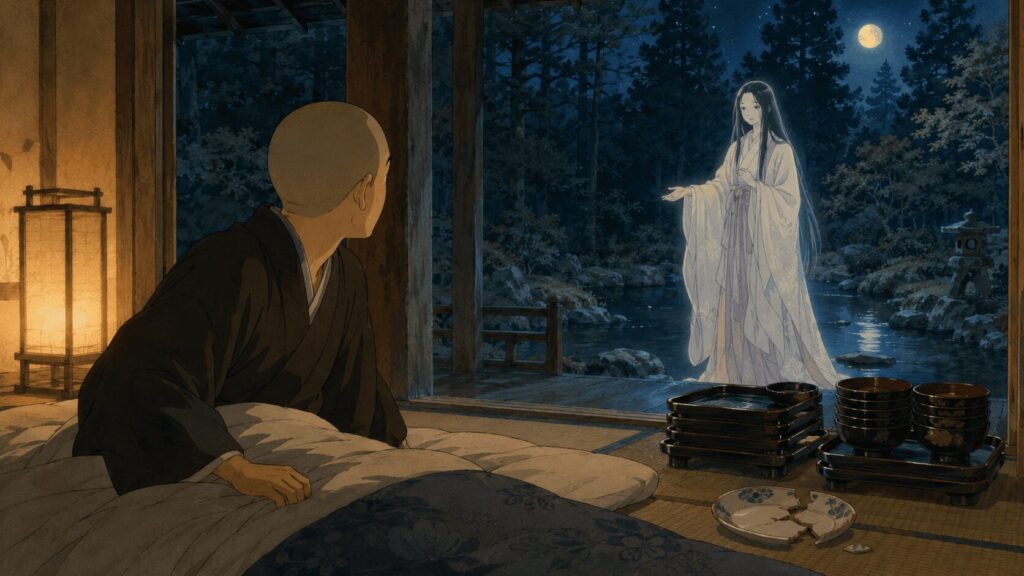
The head priest of Nōkaibō, a lodging in the Chūin district, carried one worry. When a great many worshippers came at once, the trays and bowls for entertaining them would run short.
One night, as the priest lay in bed, a faint woman’s voice came from his pillowside.
“Pray, Nōkaibō-dono…”
Presently a beautiful princess appeared from nowhere and announced: I am one called Princess Sarakashi, who dwells in the hearth pond behind your temple. Admiring how you labor day and night for the Togakushi Gongen, I shall furnish the wares you lack. Write down the items you are short of upon paper, and sink it in the pond.
Half in doubt, the priest the next morning wrote “twenty plates, ten trays” on paper, wrapped it around a pebble, and sank it in the pond unseen.
When he visited the pond a while later—what a marvel. The very wares he had written down, in all their beauty, lay heaped upon the pond’s edge.
From then on, whenever many worshippers came, he would borrow wares from the pond. The borrowed items, once washed clean and set at the pond’s edge, would vanish before anyone knew. The tale spread to the neighboring lodgings, and all of them came to borrow from the pond nearly every day.
But one day, it happened.
A nearby lodging, in the rush of its busyness, broke one of the borrowed plates. In a panic, its master set the broken plate at the pond’s edge and fled home as if running away.
After that, no matter how the head priest of Nōkaibō wrote the needed number on paper and sank it in the pond, nothing came forth anymore.
That night, Princess Sarakashi appeared once more at the priest’s pillowside.
And she announced: The other night, someone broke a plate. It was an accident, and no crime at all. Yet why did that person not own his fault and come, openly, to beg forgiveness? There is nothing so ugly as the figure of a person who hides his own fault and slinks away. I have no wish to lend my power to one who holds a lying, false heart.
With these parting words, the princess’s form vanished into the far reaches of the dark.
The hearth pond, they say, still holds its water behind the old Nōkaibō estate, unchanged from long ago.
It was not the broken plate itself, but the heart that hid it and fled. What drove the princess away was not the fault, but that one thing alone—the attempt to cover the fault over. The god of Togakushi loathes falsehood above all else.
Conclusion — Beyond the Door
Togakushi was a mountain that hid a door.
The gate of heaven flew here and fell. By the power of a sutra, a guilty dragon was sealed beyond a door of rock. By the sorcery of the Nine Syllables, an unseen enemy was overpowered. A woman who broke the law turned to stone, a princess who loathed falsehood vanished, and the reckoning for treating life lightly was held fast in the form of a deathless child.
Togakushi is a mountain that has sought, through words and signs and laws, to subdue unseen forces and lock them away.
To hide the door. To conceal the gate.
A door leading to the world of the gods is hidden somewhere upon this mountain. This is, of course, no confirmed fact—merely a reading born of the name and the legends. Yet to capture the air that the land of Togakushi holds, it strikes remarkably near the mark.
The true mystery of Togakushi Shrine is nothing so simple as ghosts or strange incidents.
Why did so many myths, faiths, and sorceries gather upon this single mountain? Why did this place become one that binds together all at once—the gate of the gods, the dragon deity, the ascetics, and the ninja?
The answer may still lie quietly hidden, deep within the avenue of cedars that leads toward Okusha.
How to Walk Beyond the Door
A practical word, at the last.
Beyond that door, you can only arrive on your own two feet. Togakushi is, above all, a place for walking.
To begin with, the five shrines are far apart. Okusha and Kuzuryūsha, Chūsha, Hōkōsha, and Hinomikosha are each scattered some kilometers apart. To make the full round, you will need a car or the regular bus to move between them.
And the main event, the Okusha approach, runs about two kilometers one way from the entrance torii to the main shrine—roughly four kilometers round trip. The first stretch, up to the cedar avenue, is flat, but past the Zuishinmon gate it turns to steep slopes and stone steps. The final flight of steps is quite steep, and will leave you breathless. In dress shoes or heels, you will surely regret it. So come in comfortable sneakers.
This is a highland at 1,200 meters’ elevation, so even in summer the mornings and evenings are cool and the weather changes easily. A layer you can throw on brings peace of mind. As for attire, the right call is to lean toward “light hiking” rather than “a shrine visit.”
Then, the season. The approach leading to Okusha and Kuzuryūsha is usually closed in winter, roughly from late November to early April, on account of the snow. Many of the nearby parking lots close as well. Togakushi in the snow is breathtakingly beautiful, but if you wish to worship all the way to Okusha, be sure to check the timing of your visit in advance.
Walk, on your own two feet, the very mountain where a dragon was sealed, where ninja cut the Nine Syllables, and where yamabushi united with the power of the mountain through their spells.
Recalling, as you go, that the spell from which the Nine Syllables derive was originally “a charm against the demons for those who enter the mountains.” Climb the approach of giant trees. Come back down, and slurp up soba, served in as many dishes as there are gods.
The sorcery-mountain called Togakushi is not a place you can grasp from a book. Only by walking, climbing, and eating does it finally enter your body.
So I will say it just once more.
Beyond the door—wear sneakers.

Feel Togakushi
A stone door, hurled open in myth, is said to have flown all the way here and become a mountain. Deep in a forest people have worshipped for over two thousand years, a dragon still sleeps. Welcome to Togakushi, at the far edge of Nagano.
The Hurled Stone That Became a Mountain
Togakushi is famous as one of Japan’s most powerful spiritual sites. Yet few know where its name comes from.
The story reaches back to Japan’s most famous myth. Amaterasu, the sun goddess, sickened by her brother’s violence, shut herself inside a cave, and the world fell into darkness. The troubled gods devised a plan, made a great commotion before the cave, and waited for the instant she peeked out. Then Ame-no-Tajikarao, the god of strength, wrenched open the massive stone door that sealed the cave and flung it away with all his might.
And that stone door flew.
It soared across the skies of distant Shinano and struck the earth, becoming a mountain—Mount Togakushi, so the legend goes. A “prop” flung away at the climax of the myth flew all the way here and became a sacred place: the landing point of the throw that saved the world. That, it is said, is how this place began.
Hence the name Togakushi—“the mountain that hid the stone door.” The final page of the gods’ story, the tale goes, remains here in the depths of Nagano as the very shape of the land.

Of course, this is the shrine’s own founding legend, not something proven by geology. Mount Togakushi is a genuine earthly mountain, formed by ancient volcanic activity and uplift. Its chain of sharp rocky peaks is known to climbers for a treacherous ridge called the “Ant’s Tower Crossing”—its steepness is utterly real.
But here is where it gets interesting. Count the gods enshrined on this mountain and you find the very cast of the cave-opening myth: Ame-no-Tajikarao who opened the door, Omoikane who devised the plan, and Ame-no-Uzume who danced before it. The characters of the myth, divided among five shrines, still dwell within the forest of Togakushi.
Togakushi Shrine, in other words, is like a vast stage that re-enacts a single myth across an entire mountain—a stage whose lead role is a hurled stone. For over two thousand years, people have kept worshipping it.
And deeper still, there is an older god—one who was here long before the stone door ever flew. From there, the story goes one layer deeper.
The Single Path Where a Dragon Waited Two Thousand Years
Togakushi Shrine is not a single shrine. Okusha, Kuzuryusha, Chusha, Hokosha, and Hinomikosha—five shrines scattered across the mountain are together called Togakushi Shrine. To visit them all takes more than half a day.
Climbing in order from the foot of the mountain, the first to greet you is Hokosha. Beyond 270 stone steps appears a hall adorned with magnificent carvings. Enshrining gods of learning, sewing, and safe childbirth, it has long been cherished as a guardian of women and children. Next comes Hinomikosha, a shrine of dance and fire prevention dedicated to Ame-no-Uzume, the goddess of performing arts who danced before the cave.
Further along stands Chusha, the liveliest shrine in Togakushi, enshrining Omoikane, the god of wisdom who devised the “strategy” for opening the cave. Beside its torii gate stand three cedars, said to be seven hundred years old, arranged in a perfect triangle. It is around Chusha, too, that the soba shops and pilgrim lodges line up.
And the main attraction lies deep within. Driving further into the mountains from Chusha, you reach the entrance to the approach of Okusha. From here on, no car can go. You must walk.
The approach runs about two kilometers. Partway along, you pass through the vermilion Zuishinmon Gate, and the scenery transforms. A cedar avenue over four hundred years old rises straight toward the sky on both sides of the path—every last tree a giant. You simply walk between them. This is the cedar tunnel that became famous overnight through a television commercial.


Beyond the avenue, after the final steep stone steps, two shrines appear side by side. On the right is Okusha, the main shrine of Togakushi, enshrining Ame-no-Tajikarao, the god of strength who opened the stone door. As a god of fortune, granted wishes, and victory in sport, he draws those who stake everything on a contest.
Beside it, quietly, stands Kuzuryusha. Enshrined here is Kuzuryu-no-Okami, the nine-headed dragon god—the land-holding deity of Togakushi.
Here you meet the mountain’s greatest paradox. Kuzuryusha was founded earlier than Okusha. In other words, the dragon was here before the “newcomer” god of strength who opened the door. By the shrine’s tradition, Kuzuryu-no-Okami, who had ruled this land from the beginning, welcomed the heaven-sent Ame-no-Tajikarao—a tale set long before the stone door ever flew.
Rain-making, toothaches, matchmaking. As a god of water and healing, Kuzuryu has been quietly worshipped for over a thousand years—an old dragon that has guarded the land itself, in the shadow of the dazzling stars of myth. What you finally meet after walking two kilometers to Okusha is both: the god of strength, and the dragon waiting behind him.
In the Heian era, Togakushi is said to have been a center of mountain asceticism ranked alongside Mount Hiei and Mount Koya. Known as the “Thirteen Valleys and Three Thousand Monks’ Quarters of Togakushi,” it was where mountain ascetics devoted themselves to training. That memory still lingers in the air of the approach. This path, which can only be entered on foot, is the true heart of Togakushi.
What You Must Slurp Before You Leave This Mountain
To come all the way to Togakushi and leave without eating soba is like coming to Mount Fuji and leaving without looking up. Togakushi soba is counted among the “Three Great Soba of Japan,” alongside Iwate’s wanko soba and Shimane’s izumo soba.
Its roots lie in the mountain of asceticism. In the Heian era, it is said, ascetics secluded in the mountains prized buckwheat flour as a portable food—and so it began. In time the art of soba-making spread to the temples and took root as the dish that welcomed pilgrims to Togakushi. Soba is so woven into daily life here that people say “every household has its own soba master.”
You know it at a glance. Bundled into small one-bite portions and arranged on a round bamboo tray—this is bocchi-mori. Five or six neat bundles sit on a tray woven from local bent bamboo. Grown in the morning mist of a plateau 1,200 meters high, “kirishita soba” carries a deep aroma. You lift the thin noodles, drawn tight in cold water, one bundle at a time.

Around Chusha alone there are nearly thirty soba shops. Wandering among them is the proper way to spend a day in Togakushi, but start with the famous names: Uzuraya, with its endless queue beside the Chusha torii; Yamaguchiya, devoted to milling its own flour; Sobanomi, near the entrance to the Okusha approach; and Tsuruya, in front of Hokosha. Each is an authentic shop working with native Togakushi buckwheat.
| Shop | Location | What to order | |
|---|---|---|---|
| UzurayaExpect a queue | By the Chusha torii | Zaru soba & sobagaki—sweetness and firm bite |  Tabelog ▶ Tabelog ▶ |
| Sobanomi | Near the Okusha approach entrance | Popular, easy to visit before or after worship | Tabelog ▶ |
| Togakushi Soba Yamaguchiya | About 200m from Chusha | House-milled, fresh-cut; also sells bamboo craft | Tabelog ▶ |
| Tsuruya | In front of Hokosha | Ten-zaru, with crisp tempura | Tabelog ▶ |
* Hours, closing days, prices, and sell-out times vary. Popular shops close once they sell out, so please check each shop’s official page or Tabelog before visiting.
It does not end with soba. Togakushi is also a village of bamboo craft. Artisans weave “bent bamboo”—its base curved from enduring the snow—one stalk at a time. That bocchi-mori tray, too, began as this craft. Workshops dot the area around Chusha, and trays and baskets make souvenirs you can carry home. For something sweet, try the humble soba manju or local Usui confectionery. Farm stands offer highland vegetables—mountain greens in spring, mushrooms in autumn.
Mirror Pond, and the Village of Ninja
You have toured the five shrines and eaten your soba. And still, there are places in Togakushi you ought to see.
One is Kagami-ike, the Mirror Pond. Holding its water on a plateau about 1,150 meters high, it is one of Togakushi’s finest views. True to its name, on a windless morning the jagged peaks of the Togakushi range are reflected whole upon its surface—two ranges, one above the other. Fresh green in early summer, blazing foliage in autumn, burning once more inside the mirror. It is the signature image of Togakushi, used even in the opening of a major TV drama. If you are after a striking photo, this is the place.

* On weekends and holidays during the foliage season, cars may be restricted from entering Kagami-ike. The access road is narrow and can become one-way. Please check the latest traffic restrictions in advance.
The other is ninja. Togakushi is regarded as the birthplace of Togakure-ryu ninjutsu, one of the “Three Great Ninjutsu of Japan” alongside Iga and Koga. Its steep mountains and ascetic culture, it is said, nurtured the arts of stealth.

You can touch that world at three museums: the Togakushi Folk Museum, the Togakure-ryu Ninpo Museum, and the Ninja Trick House. Five hundred real tools of stealth—shuriken, caltrops and more—and two hundred explanatory panels. The Trick House is hands-on: you search for the exit through hidden doors and tilted rooms, and even adults get thoroughly lost. There is also a dojo where you can throw shuriken. For families, the ninja-themed park Chibikko Ninja Village is close by. A sacred site of myth turns, in an instant, into a village of stealth. This range is the depth of Togakushi.
Book a Ninja Experience \u2014 Arrive Empty-Handed at the Village of Stealth
Securing admission tickets for Chibikko Ninja Village (the \u201cSarutobi pass\u201d) or experience tickets around the Togakushi and Nagano area online in advance makes the day go smoothly. Throw shuriken in ninja garb, run the athletic course, catch a ninja show. For families, you could build a whole day around this one spot and still not run out of things to do.
Find Togakushi experiences on Asoview
Wash Off the Sweat, and Stay in a Pilgrim Lodge
Walk the five shrines and the Okusha round trip alone is four kilometers. A pleasant tiredness settles into your legs and back. You will want to soak it away.
There is only one place in Togakushi for a day-trip bath: Togakushi Kamitsuge Onsen “Yuniikukan”. About 500 meters east of Chusha, at the foot of the ski slopes, it is the only day-use hot spring on the Togakushi plateau. There is no open-air bath—only an indoor one—but beyond its large glass windows spreads a grove of trees, and you can soak while watching wild birds. The water is a simple spring, gentle on neuralgia and aching muscles, just right after a mountain walk. At the adjoining eatery, once again, you can have Togakushi soba.

There is one more bath. On the way down from Togakushi toward central Nagano and the Nagano interchange lies Susobanakyo Natural Hot Spring “Uruoikan”. Filled with free-flowing, brownish cloudy water, it even has a large open-air bath overlooking the Susobana gorge. Freshen up in the mountain’s indoor bath, then soak deep in the gorge-side open air on the way home—a hot spring exactly opposite to Yuniikukan, and a fitting close to Togakushi.
| Facility | Address / Tel | Reception (guide) | Character of the bath |
|---|---|---|---|
| Togakushi Kamitsuge Onsen YuniikukanTogakushi | 3182 Togakushi, Nagano City 381-4101 Tel 026-254-1126 |
Bath: Weekdays & Sun 10:00–18:30 / Sat 10:00–19:00 Closed Thu · Adults ¥700 / children ¥350 * Confirm on official site |
Togakushi’s only day-use bath. Indoor only, simple spring. Eatery “Yasubei” on site |
| Susobanakyo Onsen UruoikanOn the way back | 98 Tsumashina, Nagano City 380-0872 Tel 026-237-4126 |
Day bath 10:00–23:00 / morning bath 6:00–9:00 * Check price & closures on official site |
Brownish cloudy water, free-flowing. Large open-air bath over the gorge; sauna & private baths too |
* Hours, closing days, and prices vary (some closures around the ski season). Always check the official site before visiting.
And for a night in Togakushi, an ordinary inn would be a waste. Here there are shukubo—pilgrim lodges, the shrine’s own lodgings that once housed worshippers and ascetics. Around Chusha and Hokosha, more than twenty are still in operation today.
Stay in a shukubo and you will often be served traditional Buddhist vegetarian cuisine, along with Togakushi soba and the bounty of Shinshu. In the morning you join the chohai dawn prayer, beginning the day with hands pressed together before the gods. Listening to the host recount the myths and history of Togakushi, you forget how late the night grows. More than a few lodges are themselves registered cultural properties. To stay on a mountain of myth, in a shrine’s own lodging—there is no finer way to savor Togakushi.
A Lodge Steeped in History — a Refined Night
Lodges that are registered cultural properties, and venerable inns whose masters serve as shrine elders. Serene Japanese gardens, native Togakushi soba, and seasonal kaiseki. A special night in Togakushi.
Find a Togakushi inn on Ikyu
Drop In for a Night, Try a Lodge
For a first shukubo, keep it easy. Pick a lodge around Chusha or Hokosha from the map, and taste dawn prayer, vegetarian cuisine, and Togakushi soba all at once.
Find a Togakushi inn on Jalan
Unsure How to Get There — Togakushi Is a Sanctuary You Enter on Foot
No railway runs near Togakushi Shrine. Public transport is limited to buses from Nagano Station, and they are infrequent. Okusha is a further two-kilometer walk each way from the approach entrance. Precisely because it is not an easy place to reach, a tour that arranges lodging, transport, and worship together—or a local rental car—proves its worth. If you are unsure, this is the quickest way to plan.
Arrange your Togakushi trip with JTB
Togakushi in Two Days, One Night
Togakushi is too good to rush through in a day. Walk the five shrines with care, and spend the night in a pilgrim lodge. Two days and one night is the most Togakushi-like way of all.
- 110:00 Nagano Station → TogakushiHead into the mountains by bus or rental car. As the altitude rises, the air changes. First visit Hokosha, Hinomikosha, and Chusha in order from the foot.
- 212:30 Togakushi soba at ChushaAt Uzuraya or Yamaguchiya, take bocchi-mori one bundle at a time. The rule is an early lunch, before they sell out.
- 314:00 Walk the Okusha approachPass through the Zuishinmon Gate into the cedar tunnel. Two kilometers on, you meet Okusha and Kuzuryusha—the heart of Togakushi.
- 416:30 A bath at YuniikukanSoak your walked-out legs in Togakushi’s only day-use bath. Reset in the indoor bath, watching the wild birds.
- 518:00 Check in at a pilgrim lodgeVegetarian cuisine and the bounty of Togakushi. The night deepens over the host’s tales of myth.
- 6Next morning: dawn prayer → Kagami-ikeBegin the day with hands joined before the gods, then chase the “reflection” of the Togakushi range on a windless morning at Kagami-ike. Close the afternoon in the village of ninja.
A hurled stone became a mountain, and a dragon guarded it for a thousand years. You walk two kilometers, on your own feet, through that story. The feel of the cedar avenue underfoot lingers far longer than any single striking photo.
Next, it is your turn to walk.
* Accounts such as “the hurled heavenly stone door became Mount Togakushi,” “Kuzuryu-no-Okami welcomed Ame-no-Tajikarao,” the “Thirteen Valleys and Three Thousand Monks’ Quarters,” and the “origin of Togakure-ryu ninjutsu” are based on the traditions of Togakushi Shrine and local lore, and are not academically established facts.

Underestimate Togakushi,
and you’re in for a mountain hike.
Come expecting a quick shrine visit, and a 2 km mountain walk — each way — is waiting for you.

Hi, I’m Viv, your guide.
For everyone heading to Togakushi Shrine,
I’ve gathered only the things people actually stumble on —
and how to get around them.
One thing before we start:
everything here is a signpost, not a guarantee.
Hours, fares, and bus schedules can change
with the seasons or construction,
so always check the official sources for the latest before you set out.
PHASE 01Chapter 1 — Before You Go, Know This Much.

①Okusha isn’t a “shrine visit” — it’s a hike. Budget your time first
This is the most common misunderstanding.
Okusha, the Upper Shrine, is a 2 km walk each way from the parking lot,
with a stone-step climb in the second half —
about 2 hours round trip.
If you expect to park right in front of the main hall,
you’ll run short on both time and energy.

②In winter (Jan 7 – late April), Okusha closes. Chusha becomes home base
In winter, Okusha and Kuzuryusha are closed,
and the trail beyond the cedar avenue is off-limits due to avalanche danger.
Every year, people hike the snowy path without knowing this,
only to turn back halfway.
Amulets, goshuin stamps, and prayer services
are all handled at Chusha, the Middle Shrine, during this period.
③Coming by bus? The timetable and the last bus are your lifeline
No train line runs near Togakushi —
public transport means the bus from Nagano Station.
And there are only a few buses a day;
miss the last one and you can’t get home.
There’s even a story of someone wolfing down soba 10 minutes before the final bus.
④Two bus traps: reservations required, and no Suica
The sightseeing express from Nagano Station is reservation-based
(assigned seats; pay by Visa contactless or at the counter),
while the local bus is cash only — no Suica or PASMO accepted.
Finding this out as you board is a scramble.
⑤In winter, buses don’t reach the Okusha entrance
Here’s the winter trap.
In the snow season, local buses stop short at the ski-area side,
and afternoon express buses terminate at Chusha.
If you don’t know this,
a surprise 2 km walk from Chusha to Okusha gets added to your day.
PHASE 02Chapter 2 — You’ve Arrived. Now the Car Trouble.

⑥Parking fills by 8 a.m. Assume it’s full on weekends and in foliage season
The Okusha lot holds about 100 cars,
but on weekends, holidays, and in autumn-foliage season it’s often full by around 8 a.m.
Arriving with kids to find it packed
means circling for a spot until everyone’s worn out.
⑦Kagami-ike Pond restricts cars in foliage season. Check the morning you go
From mid-October to early November, traffic restrictions apply around Kagami-ike.
Some years it’s one-way traffic; other years it’s no private cars plus a shuttle bus —
the rules change every year,
so relying on last year’s info can leave you stranded at the checkpoint.
PHASE 03Chapter 3 — Before the Climb: Body, Shoes, and a Pit Stop.

⑧The last restroom is just past Zuishinmon Gate. Go at the entrance
On the Okusha approach,
the restrooms are at the entrance,
and one midway point just past Zuishinmon Gate — and that’s the last one.
There is nothing beyond it.
Families with children and older visitors
sometimes end up searching in vain near Okusha.
⑨Sneakers or better. Heels and sandals end your day at the gate
The last 500 m is stone steps and rough, uneven climbing.
After rain, it gets seriously slippery.
Show up in casual heels or sandals,
and it’s simply too dangerous to climb.
⑩1,200 m elevation. Chilly evenings even in summer; full winter gear in autumn and winter
Togakushi sits at roughly 1,200 m above sea level.
Even when it’s hot down in town,
evenings up here turn cold fast.
Even in July,
it can feel chilly once 4 p.m. rolls around.
PHASE 04Chapter 4 — Trail Manners for a Sacred Mountain.

⑪This is bear country. Head down by 3 p.m., and make some noise
Togakushi is home to Asiatic black bears,
with sightings every year along the Okusha approach and around Kagami-ike (no injuries
or fatalities in recent years).
Early morning and dusk are when encounters happen most,
so avoid walking in alone when no one else is around.
⑫Soba lines can eat your whole afternoon. Play the order right
Togakushi is famous for soba,
but at peak season, lunch at the popular shops can mean waits of a few hours.
Some shops use a sign-in sheet,
and if you’re not careful, your entire afternoon plan evaporates.
⑬The Five Shrines tour is a half-day on its own. With grandparents, go by car
Walking all five shrines takes about 4 hours in total.
Hokosha has 270 stone steps,
and Hinomikosha’s lot fits only 3 cars.
Plan it too casually with three generations,
and the older folks will be struggling by the second half.
Packing & Prep Checklist
- □ Walkable shoes (sneakers or better — no heels or sandals)
- □ A screenshot of the last bus home
- □ Cash (amulets, goshuin, offerings — plus 1,000-yen bills and coins for the local bus)
- □ A layer / warm clothing (1,200 m elevation — chilly evenings even in summer)
- □ One trash bag (assume there are no trash cans)
- □ A bear bell or something that makes noise — and head down by 3 p.m.
- □ In winter (Jan 7 – late Apr), confirm Okusha is closed (pray at Chusha instead)
Hours, fares, bus schedules, and access rules listed here were checked against official sources at the time of writing. But this kind of information can change without notice due to weather, construction, festivals, or the seasons — so please treat everything here as a friendly signpost, not a guarantee. Before you actually set out, always confirm the latest details yourself with the official sources (websites or phone). My guide is your homework done in advance; the final check is in your hands.



Comments