
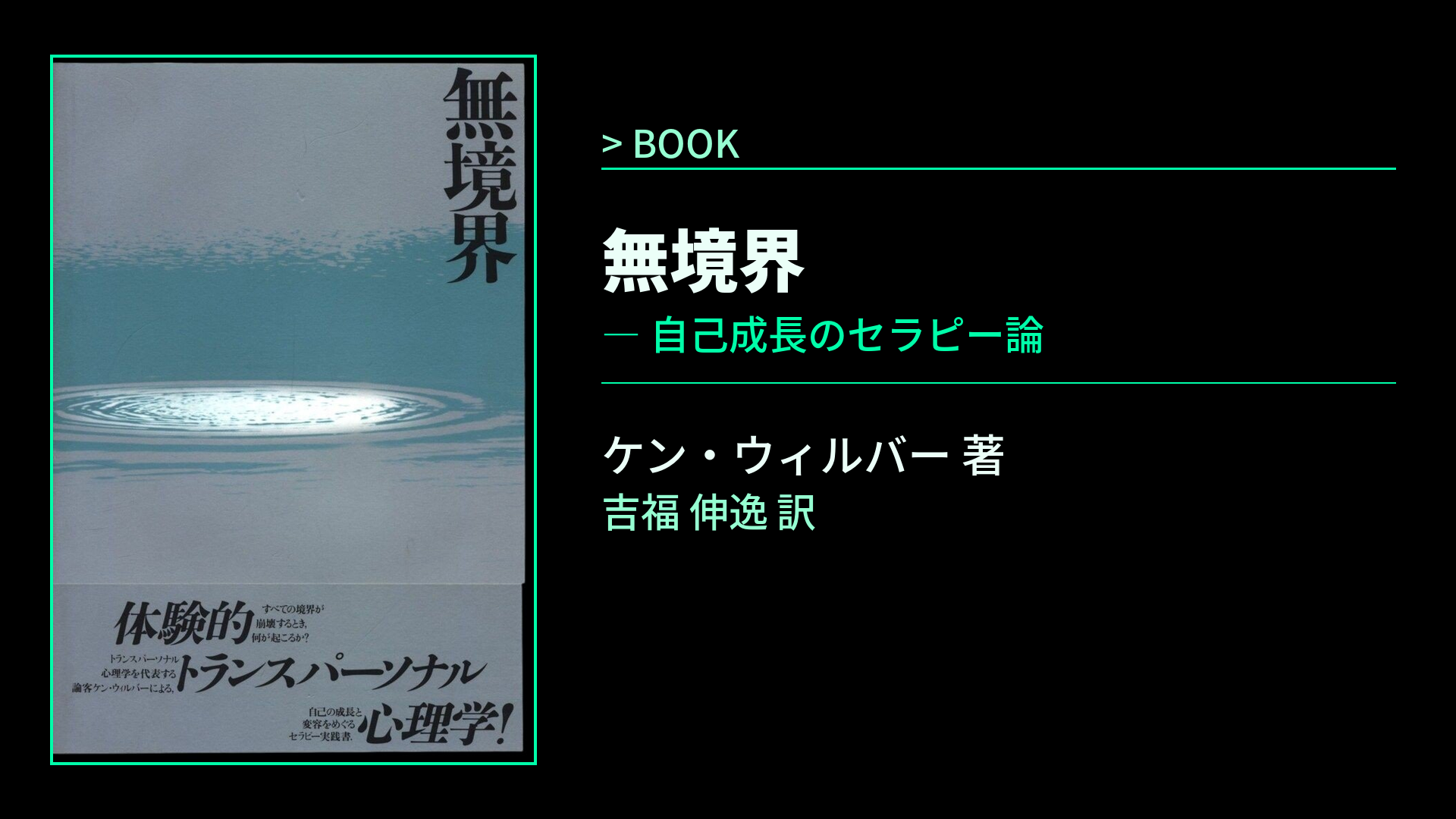

Your Suffering Is Made of
a Single Line
“Who am I?” turns out to mean “Where do I draw the line?” — a complete map of psychology and religion, drawn by a 23-year-old dishwasher.

One night, a man is suddenly wrapped in a flame-colored cloud. At first he thinks some great fire must be raging in the city. The next instant he understands: the fire is not out there. It is inside him. This book opens with that report, left to us by the 19th-century psychiatrist R. M. Bucke.
Let me give you the meaning of the title, No Boundary, in thirty seconds. The thing you call “me” is simply the inside of a line you have drawn between yourself and the world. And that line does not actually exist. What remains when the line disappears — that is what this book sets out to verify, using the tools of psychology and religion at the same time.
A map that fits the whole of psychology and religion onto a single sheet. Freud and Jung, Zen and yoga, all placed accurately on the same page — if you heard that someone had drawn such a thing, you would picture a white-haired professor, or a large research institute.
It was drawn by a 23-year-old graduate-school dropout.
Ken Wilber. Born in Oklahoma City in 1949. He entered Duke University in 1967 as a pre-med student, but quickly sensed that science alone could not answer the question “What is a human being?” and threw himself into Eastern thought. He went on to graduate school in biochemistry — the science that explains living bodies in the language of chemistry — at the University of Nebraska, then dropped out after a few years. He stepped off the rails of academia by his own choice.
Then, in the winter of his 23rd year, he completed an entire book inside his head. The following winter he spent three months writing it out in longhand. This was his debut, The Spectrum of Consciousness. A spectrum is the band of rainbow colors that appears when sunlight passes through a prism. Human consciousness, he argued, is like that rainbow: not one color but many layered bands — which is why, at each layer, a different psychology and a different religion turn out to be “right.” It was an audacious blueprint.
The manuscript was rejected by more than twenty publishers.
It finally appeared four years later, in 1977. In time the book came to be called a founding text of transpersonal psychology — trans meaning “beyond,” personal meaning “the individual”: a then-newborn school of psychology that takes seriously the kinds of consciousness that reach beyond the individual self.
Meanwhile, what was Wilber doing for a living all this time?
Washing dishes. At a restaurant in Lincoln, Nebraska, to pay his half of the rent. In his own words, that was the start of his “long career as a dishwasher,” a double life of writing and dishwashing. He never studied writing under anyone. He taught himself by copying out, by hand, on and on, the books of Alan Watts — the famous stylist who brought Zen to the English-speaking world.
This book, No Boundary, was written in exactly that dishwashing era. Published in 1979, it rewrote the thick, academic Spectrum in language anyone can read, and added a try-it-yourself exercise to each chapter — the definitive popular version. In his preface to the new edition some thirty years later, Wilber himself admits it is still one of the most popular of all his books. The Japanese edition appeared in 1986 from Hirakawa Shuppansha, translated by Shin’ichi Yoshifuku.
A man standing outside the institutions drew the map of the institutions. The man who wrote the book on boundaries was, first of all, a man standing outside the boundary lines of credentials and career.
So what was drawn on that map? The book opens with reports of a strange experience that saints and sages all over the world have left behind.

If someone asks, “Who are you?” — what do you answer? Your name, your job, your character, the things you love. We list all sorts of items. But according to this book, only one thing is actually happening in your head at that moment.
You are drawing a line.
You draw a single line across the whole field of your experience, call the inside “me” and the outside “not me.” The question “Who am I?” really means “Where do I draw the line?” — that is the book’s starting point.
And here is the interesting part: people draw the line in completely different places.
The most common line follows the skin. Inside the skin is “me,” outside is the world. But most people draw one more line, inside the body itself. Try asking yourself: do you feel that you have a body, or that you are a body? Most people answer “have.” Like a car or a house — a possession. Which means the body is already outside the line. Even St. Francis called his own body “poor brother ass.” We ride around on our bodies the way we would ride a donkey.
Lines get drawn inside the mind as well. Push the parts of yourself you would rather not see — anger, slyness, greed — outside the line with “this is not me,” and the narrow self-image that remains is called the persona (the mask), while the exiled parts become the shadow. The line can also widen outward, beyond the skin. And the state in which the line vanishes completely is the consciousness Bucke experienced at the start — “I am one with the universe” — what this book calls unity consciousness.
So consciousness comes in layers, depending on where the line is drawn. The mask layer, the ego layer, the layer where mind and body are one, the layer beyond the individual, and the layer of no boundary at all. This is Wilber’s “spectrum of consciousness.”
Out of this comes the single most practical discovery in the book. Zen says, “Let go of the ego.” Psychoanalysis says, “Strengthen the ego.” Exact opposites. Is one of them a fraud? No, the book says flatly. Both are right. They simply work at different depths. Psychoanalysis is the medicine that rejoins mask and shadow to build a healthy ego; Zen is the medicine that dissolves the boundary between that ego and the world. Different colors of the rainbow respond to different medicines.
Which layer is your suffering coming from right now? Know that, and you know which medicine to choose. The book is written as exactly that — a directory of addresses for your suffering.

It is strange, once you think about it: everything human beings value comes in pairs. Good and evil. Success and failure. Pleasure and pain. Life and death.
Yet nature contains none of these oppositions. There is no such thing as a “true frog” and a “false frog,” and there are no inferiority complexes among bears. An old cat does not panic before death; it quietly curls up under a tree. Only human beings write poems that rage against the dying of the light.
“Because nature is stupid,” you want to say — but the book places a delightful piece of testimony here. The Nobel Prize-winning biochemist Szent-Györgyi joined the Institute for Advanced Study at Princeton hoping for hints about the riddle of life. The moment he confessed that living systems contain more than two electrons, the great physicists stopped speaking to him. With all their computers, they could not predict what a third electron would do. The electron itself, meanwhile, knows exactly what to do. One electron knows something all the wise men of Princeton do not. Nature is not merely smarter than we think — nature is smarter than we can think.
Then why do humans alone live in a world of opposites?
The book’s answer is simple. Draw a circle on a piece of paper. In that instant, an “inside” and an “outside” are born together. Before the line, there was neither. In other words — it is the boundary line itself that manufactures opposites. To decide is to draw a line. To desire is to draw a line. Education, courts, wars: all line-drawing. Our lives are a line-drawing operation from morning to night.
And here the book sets down a terrifying sentence. Every boundary line is a battle line.
The firmer the line, the deeper the battle. The more you cling to pleasure, the more you fear pain. The harder you chase success, the more failure haunts you. The tighter you grip life, the more terrifying death becomes. The more you treasure anything, the larger grows the fear of losing it. Most of our problems are problems of lines, and of the opposites those lines create.
“Fine — then just erase the bad half,” humanity decided. Erase pain, erase sickness, push death away. We call this “progress.” But, the book counters: just as there is no seller without a buyer, neither pole of a pair can exist alone. Erase the night and the word “day” disappears with it. Draw a concave line on paper and the very same line has drawn a convex. A campaign to delete only the minuses cannot, in principle, be won. Progress is institutionalized frustration — one of the sharpest lines in the whole book.
So what do we do? The hint is in the line itself. Picture a shoreline. Is it a line that divides land from sea? Look again: it is the place where land and sea are touching. The lines of nature join exactly as much as they divide. Lines are fine. The war begins the instant we mistake a line for a wall — for a boundary whose only job is separation.
The book borrows the famous phrase of the language scholar Korzybski: the map is not the territory. The word “water” will not quench your thirst.

“Boundaries are an illusion” — say that out loud and it sounds like mystical poetry. But the witnesses this book calls to the stand here are not monks. They are physicists.
Human line-drawing, it turns out, came in three stages. Lines that classify things and give them names (Adam named the planets). Lines that count them (Pythagoras counted the planets). And lines that turn the relations between numbers into equations (Newton calculated how much the planets weighed). Name, count, legislate. With this three-layer stack of lines, classical physics explained the universe completely, as a collection of crisply bounded objects — or so it seemed.
From 1905 to 1925 — a mere twenty years — the whole building collapsed.
When scientists looked inside the atom, what they found were not tiny billiard balls. An electron cannot be located. It has no outline. It has no boundary. The book compares the shock to pulling off your glove and finding a lobster claw where your hand should be. And if there is no boundary, there is no measuring it; if there is no measuring it, no “law” governing a single electron can ever be written. The physicist Heisenberg called it “the dissolution of the rigid frame.” The smallest parts of matter turned out to be not independent grains but webs of relationship reaching out to everything else.
The astronomer Eddington left a perfect parable. Science found a strange footprint on the shores of the unknown, and devised theory after theory to account for its maker. At last it succeeded in reconstructing the creature — and the footprint was its own. The boundaries were never on the world’s side. They were on the side of those of us who map the world.
And here Wilber swings the wheel toward a Buddhism more than a thousand years old. The Huayan school of Buddhism teaches jiji muge — ji meaning “things and events,” muge meaning “no obstruction.” Between any thing and any event in the universe there is no boundary; everything mirrors and interpenetrates everything else — a vision of the cosmos as a vast net of jewels, each reflecting all. It chimes, almost eerily, with the modern physicist’s phrasing that each particle consists of all other particles.

Of all the lines human beings draw, one is drawn first and surrendered last: the line between “me” and “everything else.” The book calls it the primary boundary. Every other line is stacked on top of this one. It is the bottom block of an inverted pyramid. Pull it out, and the whole structure falls.
So let us destroy that line — except the book never says that. This is the strangest and most important move it makes. There is no need to destroy it, because the line does not exist. You cannot destroy an illusion. Flail your arms at a mirage and all you get is sweat. The only thing you can do with an illusion is see through it. So what the book recommends is not demolition but a search. Go and actually look for the “separate self.”
Let’s try it. Close your eyes and attend to the sounds around you. Traffic, someone’s voice, the hum of the air conditioner. All sorts of sounds. Now — among all those sounds, there is exactly one thing you will never hear.
The “hearer” of the sounds.
Strain your ears as long as you like; the “hearer” makes no sound. What you hear is always, only, sound. According to the book, that is because there is no hearer. The thing you were taught to call a “hearer” is nothing but the experience of hearing itself. One Zen master described the moment of his awakening this way: when the temple bell rang, there was no bell and no I — just the ringing.
Seeing works the same way. Search your visual field anywhere you like; the “seer” never appears in it. Thought, too. Look behind the thought “I am confused” for the thinker who is thinking it, and all you find is the next thought: “I am looking for the thinker.” In Alan Watts’s phrasing: there is simply experience — there is no someone experiencing the experience.
Buddhism has summarized this for more than two thousand years in almost the same words. There is suffering, but no one who suffers. There is the deed, but no doer. The poet Wei Wu Wei put it with a wink: you are unhappy because almost everything you think and do is for a self — and there isn’t one.
The moment you look for it, it is gone. And that very not-finding, the book says, is the doorway into unity consciousness. You went looking for the wall, and there was never a wall to begin with. Which would mean that at this very moment, you are already on the other side.

Hear the word “eternity” and you picture an enormously long time — a hundred million years times a hundred million, forever. According to this book, that is a misunderstanding. Eternity is not a long time. It is the absence of time.
That doesn’t land right away, does it? Let’s run an experiment. As before: close your eyes and listen. Every sound you hear is a present sound. You cannot hear a past sound. You cannot hear a future sound. The same goes for sight and taste. In your direct experience, the past and the future have never once appeared.
“But I know the past — I remember it,” you will object. Here is the book’s pressure point. When you recall a memory, you are not looking at the past. You are looking at a memory: an experience happening now. You cannot shake hands with the friend in your recollection, and he will not answer the question you forgot to ask. The play button can only ever be pressed now. Which means the past is a recording being played in the present. The future is the same: nothing but anticipations and expectations, which are present experiences. The medieval German mystic Meister Eckhart said it in one line — a day six thousand years ago is just as near to the present as yesterday. Because all of time is folded inside this moment. Or in Wittgenstein’s version: eternal life belongs to those who live in the present.
Now inspect your worries. Regret and guilt — all of it is about the past. Anxiety and dread — all of it is about the future. Inside the strict present, there is actually no place to put a problem. Medieval theologians had two names for this: the one-or-two-second present squeezed thin between past and future they called the nunc fluens, the passing present; the present that opens up when the squeezing vanishes they called the nunc stans, the standing present. Our present keeps restlessly “passing” because it is the filling of a sandwich, pressed between two slices of bread. And the filling has grown so thin that we are living on bread-ends.
The instant it sinks in that memory is not the past but a present experience, the slice of bread behind you vanishes. The instant you see that expectation is not the future but a present experience, the slice in front vanishes. What remains is an open-ended present with no findable beginning and no findable end. Emerson wrote: the roses under my window make no reference to former roses; they are perfect in every moment of their existence. Only human beings lament what has passed and stand on tiptoe to peer at what is coming.
Eternity is not a long time that starts after you die. It is another name for this moment.

Then why did we leave the world of no boundary and move into a world ruled by lines? Chapter six of the book is a genesis story: how the spectrum of consciousness came to be.
The first event is the primary boundary — the split between “the seer” and “the seen.” The moment it is drawn, I stop being one with the world and move in behind my skin. The world becomes “outside me,” enemy territory with the power to erase me. And at that moment, something entirely new appears in the universe.
The fear of death.
The chain reaction that follows is the book at its best. What is death? The condition of having no future. So to refuse death is the same as to demand a future. Give me a tomorrow, and then the tomorrow after that. And so, to flee death, human beings invented time. As we saw in the last chapter, time is an illusion — but then the death we are fleeing is an illusion too, so the books balance. Here the book drops in a little story. On a bus, an old man keeps feeding scraps into a paper bag. “What’s in the bag?” “A mongoose. I’m an alcoholic, see — when the shakes come, snakes appear. The mongoose scares them off.” “But those snakes are imaginary.” “Sure. So is the mongoose.” Time is the imaginary mongoose we keep to chase away an imaginary death.
The chain continues. Fleeing death, the next thing a human being cannot stand is his own body. The body rots. It sickens. It will certainly die. Anything that smells of death must go out of sight. “Ideas,” on the other hand, do not die. A real tree withers; the word “tree” does not. So we move out of the living body and into the deathless house of ideas — a mental picture of ourselves, a self-image. This is the birth of the ego. The being in whom mind and body were one (the centaur of the next chapter) splits, right here, into “the rider” and “the ridden donkey.”
The last line is finer still. Even inside the ego there are desires and angers we refuse to own. “I would never think such a thing.” So a mask — the persona — is assembled from the acceptable parts, and the exiled parts become the shadow.
From oneness with the universe, to the body. From the body, to an idea. From the idea, to a mask. With every line, “I” gets smaller and the enemies multiply. That is how the spectrum of consciousness is built. And the second half of the book plays this entire story in reverse.

From here on, the book becomes a therapy manual. The first patient is us, in our masks. The story begins with an utterly ordinary Saturday in the life of a man named Jack.
Jack has been meaning to clean his cluttered garage for a long time. Today’s the day, he decides, and heads out in his work clothes. But the sheer state of the place makes his enthusiasm wobble. He doesn’t leave, though. He flips through old magazines, plays with his old catcher’s mitt, putters and dawdles. The drive is still there — if it weren’t, he’d have gone back inside long ago — but he is starting to lose track of it. Since the drive hasn’t vanished, a single sensation remains in the back of his mind: somebody wants this garage cleaned. Who was it again? His irritation is peaking just as his wife pokes her head in and innocently asks, “Finished cleaning up?”
Jack explodes. “Get off my back!”
What just happened? According to the book, Jack projected his own drive. Push an impulse of yours outside the line with “this isn’t mine,” and the impulse doesn’t disappear — it comes back at you from outside. His own drive, returned to sender, arrived looking like pressure from his wife. A boomerang. So the book states it flatly: pressure is your own drive with the wrong address written on it. A person with genuinely no drive feels no pressure at all. He just says, “Not today,” and means it.
The book even supplies a dictionary for translating symptoms back into their original words. A few entries: pressure means “drive.” Anxiety means “excitement.” “Everybody is staring at me” means “I am far more interested in people than I knew.” “Nobody likes me” means “I am the one writing people off.” “You make me feel guilty” means “I resent your demands.” A symptom is not an enemy. It is a letter from yourself with the sender’s name rubbed out.
The ugliest form this mechanism takes is the witch hunt. The less someone can admit the small black heart inside them, the more fiercely they will find it in someone else and burn it there. The book is merciless: what we hate in others is what we secretly hate in ourselves — that, and only that. When someone cannot stop bad-mouthing a person, the gossip describes the speaker far better than the target.
The prescription is simple. Don’t fight the symptom. Translate it. The moment you reread “I feel pressured” as “I have more drive than I knew,” the mask and the shadow shake hands, and you get back an ego one size more honest. Persona + shadow = ego. That is the first step down the spectrum.

The next step down is the line drawn between mind and body. The state in which that line has dissolved, the book calls the centaur — the legendary creature, human above, horse below. The crucial point: a centaur is not a rider on a horse. Rider and horse are one from the start. Not a mind steering a body, but mind-and-body moving as a single animal.
Our everyday language, though, confesses the split honestly. We say “I move my arm,” but never “I beat my heart.” We say “I eat my dinner,” but never “I digest my dinner.” We call “me” only the parts the will can operate, and treat the vast machinery that runs by itself — heartbeat, digestion, growth — as “something that isn’t me.” We consider only half of ourselves to be ourselves.
And the price of pushing the body outside the line shows up, precisely, in the body. According to the book, the chronic knots all over us — shoulders, jaw, behind the eyes, the pit of the stomach — are a tug-of-war between muscles trying to let an emotion out and muscles straining to hold it in. The accelerator and the brake, floored at the same time. The only way to suppress the urge to scream is to lock the jaw, throat and shoulders. The only way to stop tears is to clamp the muscles around the eyes.
Then the book makes a chilling observation. Every one of those knots is made of voluntary muscle — muscle moved by your own will. Nobody is doing this to you. You are the one squeezing. You are pinching yourself, forgetting that you are pinching, and crying, “It hurts, it hurts.”
So the prescription runs against common sense. Don’t try to relax. Deliberately squeeze harder. The moment you reproduce the grip with your own hands, you remember — “I was the one doing this” — and the hand lets go on its own. No method is needed to stop pinching yourself. The book also includes a breathing exercise: inflate the belly like a balloon, draw vitality down to the spot below the navel — the hara, as the East calls it — then let the out-breath carry it to the fingertips, the toes, and out beyond the body. The places where the current jams: that is the map of your blocks.
Voluntary and involuntary — both are me. When that lands, a strange freedom arrives. Your will can handle two or three things at once. Meanwhile your body is performing literally countless jobs, from digestion to bloodflow, perfectly, without being asked. Letting go of control is not defeat. It is handing the work back to a self that is smarter than you.

From here the book descends to a depth ordinary psychology does not enter: the bands beyond the individual — the transpersonal bands.
The guide is Jung — Freud’s foremost student, who later broke with him. What astonished Jung was that the dreams of modern Europeans who had never studied ancient mythology contained, with precision, the same images found in myths the world over: the great serpent, the winged horse, the great mother. Material no one had acquired in their own lifetime kept welling up from the floor of everyone’s mind. Jung named this shared underground water table the collective unconscious, and called the primordial images sleeping in it archetypes. The deepest floor of the mind, it seems, is no longer your private room.
The book then introduces an astonishingly simple exercise for descending to that floor. Sit quietly and repeat inwardly:
I have a body, but I am not my body. The body may be tired or fresh, but that does not touch the inward I that watches it. I have desires, but I am not my desires. I have emotions, but I am not my emotions. Emotions pass through me. I have thoughts, but I am not my thoughts.
The logic is plain. What is seen is not the seer. If you can observe your own anxiety, you are not the anxiety itself. You are the side doing the observing. The eye can see red because the eye itself is not stained red. In the same way, what watches fear holds no fear; what watches tension is not tense. Patañjali, the ancient Indian who codified yoga, needed only one line to define ignorance: mistaking the seer for the instruments of seeing. You are not the telescope. You are the one looking through it.
The book calls this watching side the Witness. Even in a stormy sea, dive a few meters and the water is calm. Stop fighting the waves, sink to the bottom, lie back, and watch the raging surface far overhead — that is the Witness’s seat.
The heart of therapy at this level is, anticlimactically, to do nothing. Don’t solve the problem. When anxiety comes, watch it. When hatred of the anxiety comes, watch that. When you catch yourself straining to watch, watch that too. Every time you reach in to fix things, you reconfirm the premise that you and the anxiety stand at the same height.
But — the book drives in a nail — the Witness is not the goal. One last line remains: “the I that watches” versus “the world that is watched.” The place where that final line dissolves is the last chapter.

If you have read this far, you are surely thinking: “Fine — so how do I reach this unity consciousness?”
In its final chapter, the book snaps that question off at the root. You cannot reach it. The reason is almost cruel in its simplicity: you have never once left it. The consciousness reading this line right now — in which sounds are heard, letters are seen, thoughts arise — this ordinary consciousness already is it. Remember: the hearer could not be found. The past turned out to be a present memory. There never was a boundary. And you cannot travel to the “far side” of something that does not exist.
Here the supreme irony stands up. The act of “seeking enlightenment” repaints, with every step, the premise that you are not enlightened now. The harder you search, the farther you get — like a man hunting everywhere for the glasses he is wearing. The answer the book draws from the Zen teacher Shunryū Suzuki’s Zen Mind, Beginner’s Mind, among others, is this: practices like zazen and prayer are not machines that manufacture enlightenment. They are enlightenment — already present — taking on a visible form. Not a means, but an expression. Which is why Zen teachers in the Sōtō lineage of Dōgen do not say “we sit in order to awaken,” but “sitting itself is the expression of awakening.”
Finally, let us turn the blade this way. Having finished this article, you are probably preparing to “take something home.” To jot down the good lines and put them to use tomorrow. In that instant, another line gets drawn — between “the me who is not yet enough” and “the me who will someday be filled.” What the book points to, in the end, is not inside your notes. It is the brightness at your fingertips as you reach for the pen.
And there is one man we have not talked about yet: the man who carried this book into Japanese.
Shin’ichi Yoshifuku (1943–2013), the translator. In the mid-1960s he crossed to America as a jazz musician, and in the thick of the anti-Vietnam-War movement he met the rising tide of “consciousness transformation,” then returned home. Be Here Now, The Tao of Physics, Wilber’s debut The Spectrum of Consciousness, and this book — almost single-handedly, his translations carried into Japan the bookshelf that would later be called seishin sekai, “the spiritual world.” His name is still barely known to the general public. Yet to the seekers of the 1970s and 80s, he was a teacher, and a charismatic one. Then, in 1989, the man suddenly folded it all up. Destination: Hawai’i. His reasons were the weight of being depended upon, and a quiet verdict — that temporary, extraordinary experiences like workshops cannot heal a person’s wounds at the root. What he placed at the center of the life that followed: his family, and surfing. On that line where wave and sand touch.
The man who drew the map of boundaries kept washing dishes. The man who translated the book of boundaries went to ride the waves.
The world without boundaries is, most likely, found in places like that.

BOOK DATA
- Title
- No Boundary: Eastern and Western Approaches to Personal Growth (1979)
- Author
- Ken Wilber
- Japanese edition
- Mukyōkai: Jiko seichō no serapī ron, translated by Shin’ichi Yoshifuku, Hirakawa Shuppansha, June 1986, 302 pp.
- ISBN (JP)
- 4-89203-114-3


Comments