
Everything that should have been lost
somehow stayed on this hill
YOYOGI HACHIMANGU — NEON PILGRIMAGE
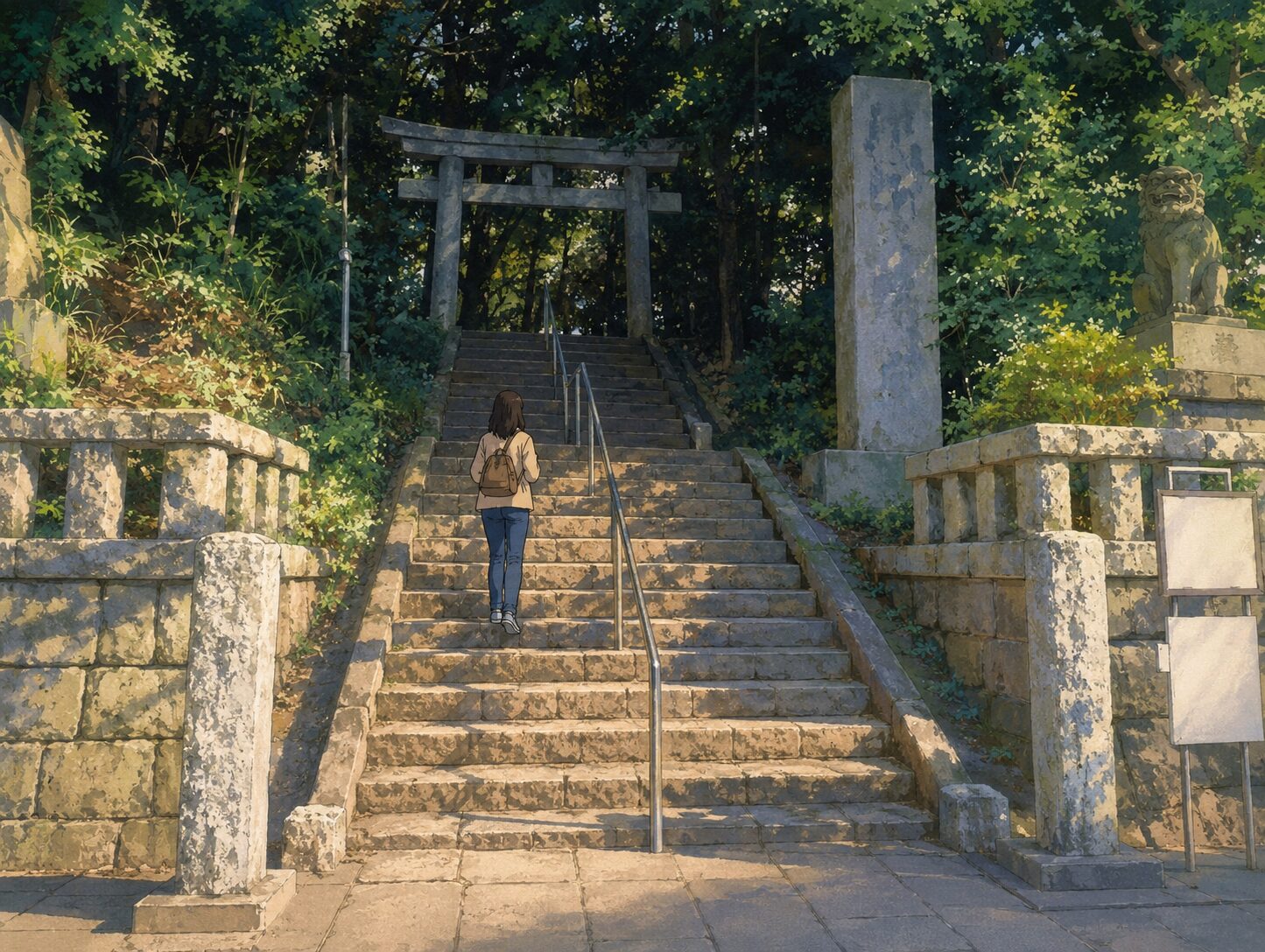
Shibuya. You turn your back on the traffic of Yamate-dori, climb a steep flight of stone steps, and the noise drops away. A green mound, thirty-two meters above sea level.
A portable shrine that slipped past two infernos. A four-thousand-five-hundred-year-old house that surfaced under a caretaker’s broom. A corner where burnt-out gods huddle together.
Nobody set out to save any of it. And yet nothing here gets lost.
The mikoshi they couldn’t wait for came home the day before the earthquake
Let me begin the story of this hill with a single portable shrine.
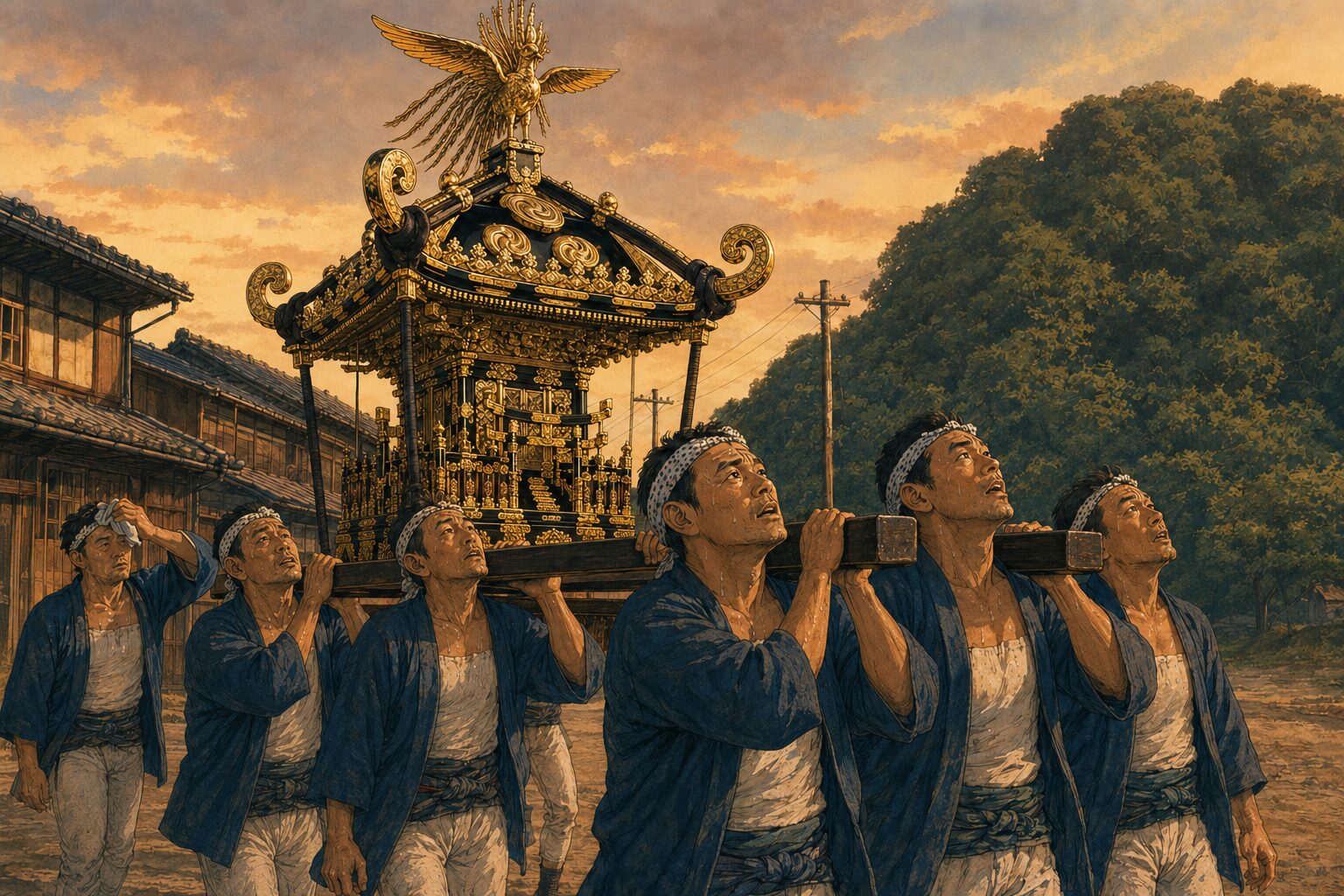
A mikoshi still sits in the storehouse in the precinct. It looks like any other — the kind shouldered through the streets at festival time. But this one has an almost unbelievable record of escape. Within a span of about twenty years, it slipped past two disasters that burned Tokyo to the ground. Both times.
The first was the Great Kanto Earthquake of the Taisho era. The second was the Tokyo air raids of the Showa era.
Either one would have left nothing but ash. And both times, this mikoshi dodged the fire by a hair, as though it had known in advance.
What makes it stranger is the reason. Both escapes were accidents. Nobody was trying to protect it. Small human conveniences, and one failure of patience, happened to move it out of the way of the flames.
Let me take it in order.
First, where the mikoshi came from.
It did not originally belong to Yoyogi Hachimangu. It belonged to a small neighborhood called Yoyogi Shinmachi, along the old Koshu Kaido highway — one of the parish districts of the shrine.
In 1923, Yoyogi Shinmachi decided to have a new mikoshi built. They placed the order in Gyotoku, in Chiba.
It is worth knowing something about Gyotoku. It was not just any workshop.
Since the days of Edo, Gyotoku was known as the town of mikoshi. To give a sense of the scale: of all the portable shrines carried across Edo from the Meiji through the Showa era — said to number around four thousand — nearly half are said to have been built there. Gyotoku held up the festivals of Edo from underneath. It had a run of skilled craftsmen, and for any neighborhood commissioning a new mikoshi, going to Gyotoku was simply the obvious thing to do.
So Yoyogi Shinmachi ordered its finest possession from Gyotoku. For a small neighborhood, this was the purchase of a lifetime.
Delivery was promised in time for the autumn festival that year — September 23rd. On the day, they would shoulder the brand-new mikoshi and parade it through the streets. The neighborhood spent the summer looking forward to it.
Then something happened.
At the end of August, word arrived from Gyotoku.
The mikoshi was finished.
That was far ahead of schedule. More than three weeks remained until the festival. The sensible thing would have been to leave it in the workshop until the appointed day and have it delivered then. That is what arrangements are for.
The people of Yoyogi Shinmachi could not wait.
Their brand-new mikoshi already existed. It was sitting alone in a workshop in Chiba. Once they knew that, they could not sit still.
Whatever good sense they had about waiting for the festival simply evaporated.
Grown men — the leading figures of the neighborhood — went all the way to Gyotoku, lifted the freshly finished mikoshi onto their shoulders on the spot, and carried it home to Yoyogi themselves.
A child who can’t wait until the promised day and goes to fetch the toy early. That is exactly what these grown men did, with a portable shrine.
Looking back, that failure of patience saved the neighborhood.
The mikoshi arrived safely at the hill in Yoyogi. And the following day —
September 1st.
A massive earthquake struck the entire Kanto region, its epicenter in Sagami Bay. The Great Kanto Earthquake. Tokyo turned into a sea of fire, and more than one hundred thousand people lost their lives. Neighborhood after neighborhood collapsed and burned.
And the mikoshi workshop in Gyotoku — the one that had built it — burned in that earthquake. The workshop was destroyed by fire.
If the people of Yoyogi Shinmachi had quietly waited for the September 23rd delivery as promised, the mikoshi would still have been in the Gyotoku workshop.
And it would have burned.
One day. Because they were impatient, by a margin of a single day, the brand-new mikoshi escaped the fire and stood on the hill in Yoyogi. Had they shown one more day of good sense, it would have been destroyed in the place where it was made.
The place where it was born and the place where it would have burned traded positions in the span of a single day. That is the mikoshi we are talking about.
But the escapes do not end there.
Twenty-two years later, in 1945.
This time it was war.
The Tokyo air raids. Incendiary bombs turned the low city and then the hill districts into fire, one after another. Yoyogi Shinmachi was no exception. The bustling streets along the Koshu Kaido became a burned plain in a single night.
The neighborhood burned.
The mikoshi, once again, was untouched.
It was not in Yoyogi Shinmachi at the time. It had been left in the precinct of Yoyogi Hachimangu, up on the hill, in a corner of the grounds surrounded by trees. So when the neighborhood burned in its entirety, the flames never reached it.
Twice.
The earthquake of the Taisho era and the air raids of the Showa era. Two disasters that burned Tokyo down, and this single mikoshi slipped past both.
The first time, because the neighborhood couldn’t wait.
The second time, because it happened to be stored at the shrine.
Neither was done with the intention of protecting it. Only impatience, and a convenient place to keep something. Both times, that moved the mikoshi to safety one step ahead of catastrophe.
To this day Yoyogi Hachimangu preserves it as the mikoshi of extraordinary fortune — the one that escaped two great disasters.
Here is a curious detail worth noting.
Gyotoku, the town that made the mikoshi, and Yoyogi, the hill that received it. On a modern map they sit far apart, on opposite sides of Tokyo Bay. One in Chiba, one in Shibuya. They look entirely unrelated.
Open an illustrated map from the Edo period, however, and the impression changes.
There is an old work called the Edo Meisho Zue, which introduced the famous places of Edo with illustrations. In its third volume, Yoyogi Hachimangu and the mikoshi town of Gyotoku appear side by side in the same book. In the minds of the people of Edo, these two places belonged to one continuous world that fit within a single illustrated map.
Which means that when Yoyogi Shinmachi ordered a mikoshi from Gyotoku across the water, it was not an eccentric choice at all. Within the one map that was Edo, you asked the mikoshi town for a mikoshi. It was the ordinary, reasonable thing to do.
Seen that way, the mikoshi was loosely connected to the hill in Yoyogi before it even existed. It came from a place that was continuous with this hill on an Edo map, following that continuity up to the top. And then it slipped past two fires.
So why did the mikoshi finally pass from the neighborhood to the shrine?
That reason, too, is a little sad.
The Tokyo Olympics of 1964.
Ahead of the games, roads were rebuilt across the city. The Koshu Kaido was widened, and construction of the metropolitan expressway came with it. Houses along the route were forced out, and the residents of Yoyogi Shinmachi left the neighborhood one by one.
Fewer people in a neighborhood means fewer people to carry a mikoshi.
Without a crowd of strong adults, a mikoshi cannot be shouldered at all. The neighborhood shrank, the bearers ran out, and this mikoshi lost the streets it had been carried through.
With nowhere left to go, it was placed in the shrine on the hill.
It escaped an earthquake. It escaped an air raid. And in the end, the very neighborhood that raised it disappeared beneath a road. The mikoshi alone remained.
Unburned by disaster, unerased by the times, still here on the hill.
You could dismiss all of this as good luck.
It happened to be finished early, they happened to be impatient, it happened to be stored at the shrine. Three coincidences stacked up, and that’s all.
But walk around Yoyogi Hachimangu and you notice that this coincidence is not a single event.
This hill holds a number of things that somehow refused to be lost. Things that should have burned and didn’t. Things that should have vanished and didn’t. Things that should have been forgotten and weren’t. The mikoshi is only the first of them.
Below the hill, something far older is sleeping. If the mikoshi story reaches back a mere hundred years, the next one goes far deeper — to something that survived four thousand five hundred years.
(End of Chapter 1)
A four-thousand-five-hundred-year-old house that came up under a broom
The last chapter told the story of a mikoshi that slipped past two fires. That was only a hundred years ago.
This chapter leaps back roughly thirty times further.
Beneath the ground of the hill at Yoyogi Hachimangu lies a house that is four thousand five hundred years old.
This is not a metaphor. The remains of a Jomon-period dwelling were literally found in the soil of this precinct. It is a historic site designated by Shibuya Ward, known as the Yoyogi Hachiman Site.
And the way that ancient house came to light echoes the mikoshi story almost exactly. Nobody was trying to dig it up. It simply came out to meet them.
First, the hill itself.
Step off at Yoyogi-Hachiman Station on the Odakyu Line, cross the flow of traffic on Yamate-dori, and a rounded green mound rises in front of you. About thirty-two meters above sea level — barely the height of a ten-story building downtown. Hardly a mountain.
Yet as you climb the stone steps, somewhere near the top, the traffic noise of Yamate-dori strangely recedes. A few dozen steps, and the world below quietly drops out.
And under the soles of your feet is a floor that somebody packed down four thousand five hundred years ago.
A survey in 1950 uncovered the remains of a pit dwelling on this hill — a Jomon house built by digging down into the earth. Traces of postholes were there as well. From the pottery found with it, of the Kasori E type that represents the middle Jomon period in the Kanto region, the dwelling is estimated to be about four thousand five hundred years old.
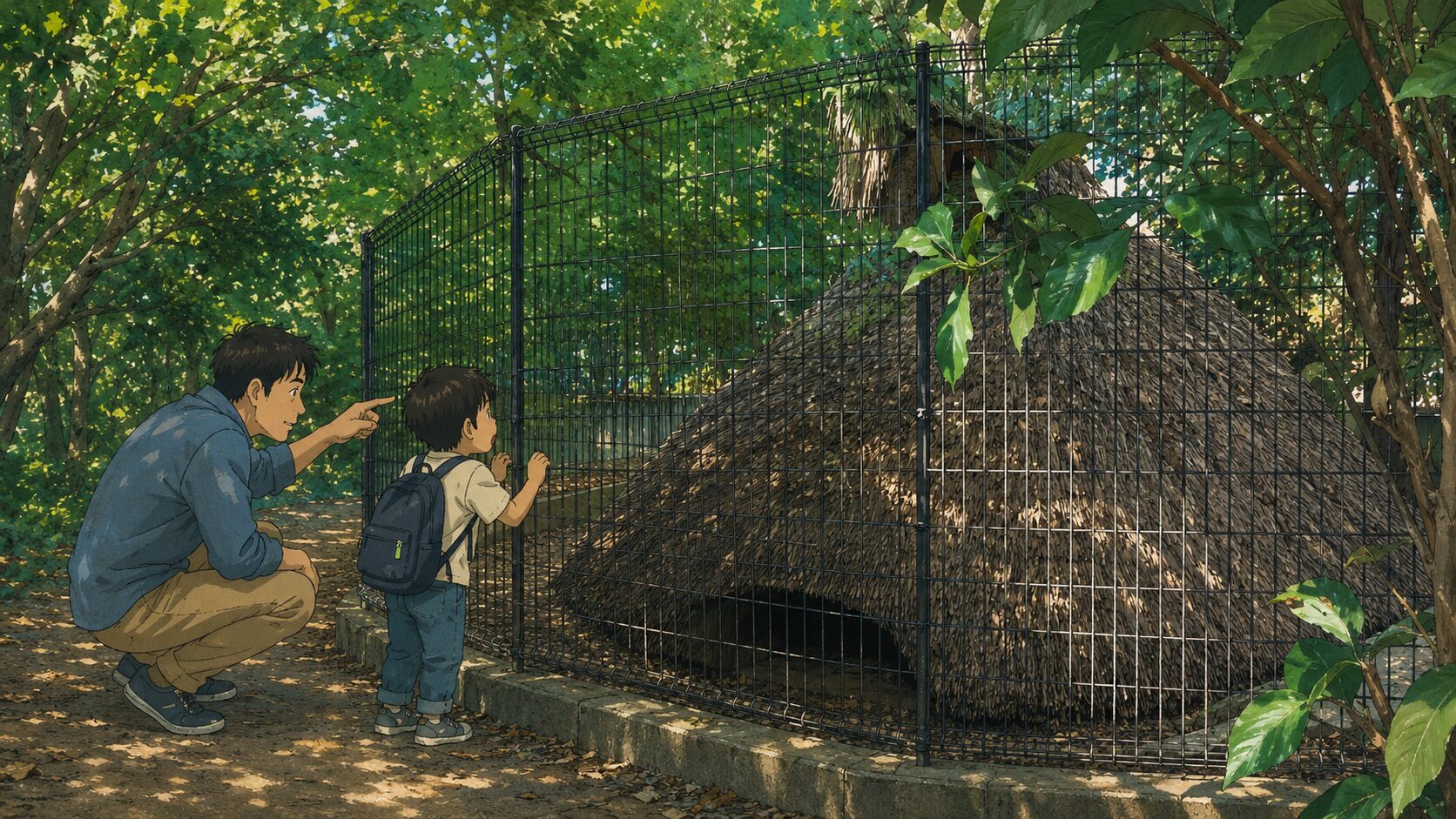
Today a reconstruction stands beside the approach path. Beyond a fence, a triangular roof of thatch. Four and a half millennia ago, somebody on this hill lit a fire inside it, cooked, and slept.
The shrine came much later. The first small sanctuary was built on this hill in the Kamakura period. That is already far older than the mikoshi’s hundred years. But from the vantage of four thousand five hundred years ago, even the Kamakura founding is recent. If you heard “an old shrine dating from the Kamakura period” and thought that sounded old enough, this hill is one whole order of magnitude beyond that.
Now, a figure published by Shibuya Ward. It is mildly astonishing.
More than thirty prehistoric sites have been identified within Shibuya Ward.
That may come as a surprise. Beneath the Shibuya of the famous scramble crossing, buried under buildings and asphalt, lay over thirty Jomon and Yayoi sites. Ancient people lived on the higher ground of a plateau carved out by rivers.
And yet.
Of those thirty-odd sites, only a handful still exist in visible form.
Most of them are gone. Erased from the surface without a trace.
So where did the vanished sites go? What happened to them?
The answer survives, plainly, in an unexpected place: the list of excavation reports published by the Shibuya Ward Library. Ebisu, Sendagaya, Hatsudai, Aoyama, Tomigaya — reports on sites dug across the ward, lined up in order.
The list includes a column for the publisher of each report. Read down that column and what happened beneath Shibuya becomes clear, one entry at a time.
The Sendagaya site. The report was issued by JR East.
The Hatsudai site. Excavated by the Japan Arts Council. What now stands on that ground is the New National Theatre.
The Hazawa shell mound. The publisher of the report is the Japanese Red Cross Medical Center.
The Ebisu site emerged from the grounds of a former Sapporo Breweries plant. What stands there today is Yebisu Garden Place.
Tokyu, Sumitomo, Tokyo Tatemono, NTT Urban Development — the names of the major companies that developed Shibuya’s prime land run down the list.
Which means this.
The Jomon sites of Shibuya were dug up by the companies that were about to build on top of them.
To be clear, this is neither illegal nor dishonest. It is a formal procedure under the Act on Protection of Cultural Properties, known as preservation by record. When development is known to destroy a site, the developer conducts an excavation before construction. They dig, measure, photograph, and compile a detailed report. Having preserved the site as a record, they build the offices, the rail line, the theater. This is development done properly, step by step.
But the motive for digging always came packaged with destruction.
The excavated record survives on paper. The ground itself, which had been there for four thousand five hundred years, never comes back. Preserved on paper, erased from the earth. That was the fate of nearly every site in Shibuya.
If you have read this far, you may already have noticed something.
Search that thick list of reports to the very end and there is exactly one site that never appears.
The Yoyogi Hachiman Site.
The best-known Jomon site in Shibuya, and its name is absent from the list of excavation reports filed by developers. No JR East. No New National Theatre. Not a single real estate company is attached to it.
Why?
The reason is almost anticlimactic. Because nobody ever tried to build anything on top of it.
Every other site followed the same pattern. The trigger for digging was development, and the digging was done by developers. The Yoyogi Hachiman Site alone was triggered by something entirely different.
Not development. Sweeping.
The story handed down at the shrine goes like this.
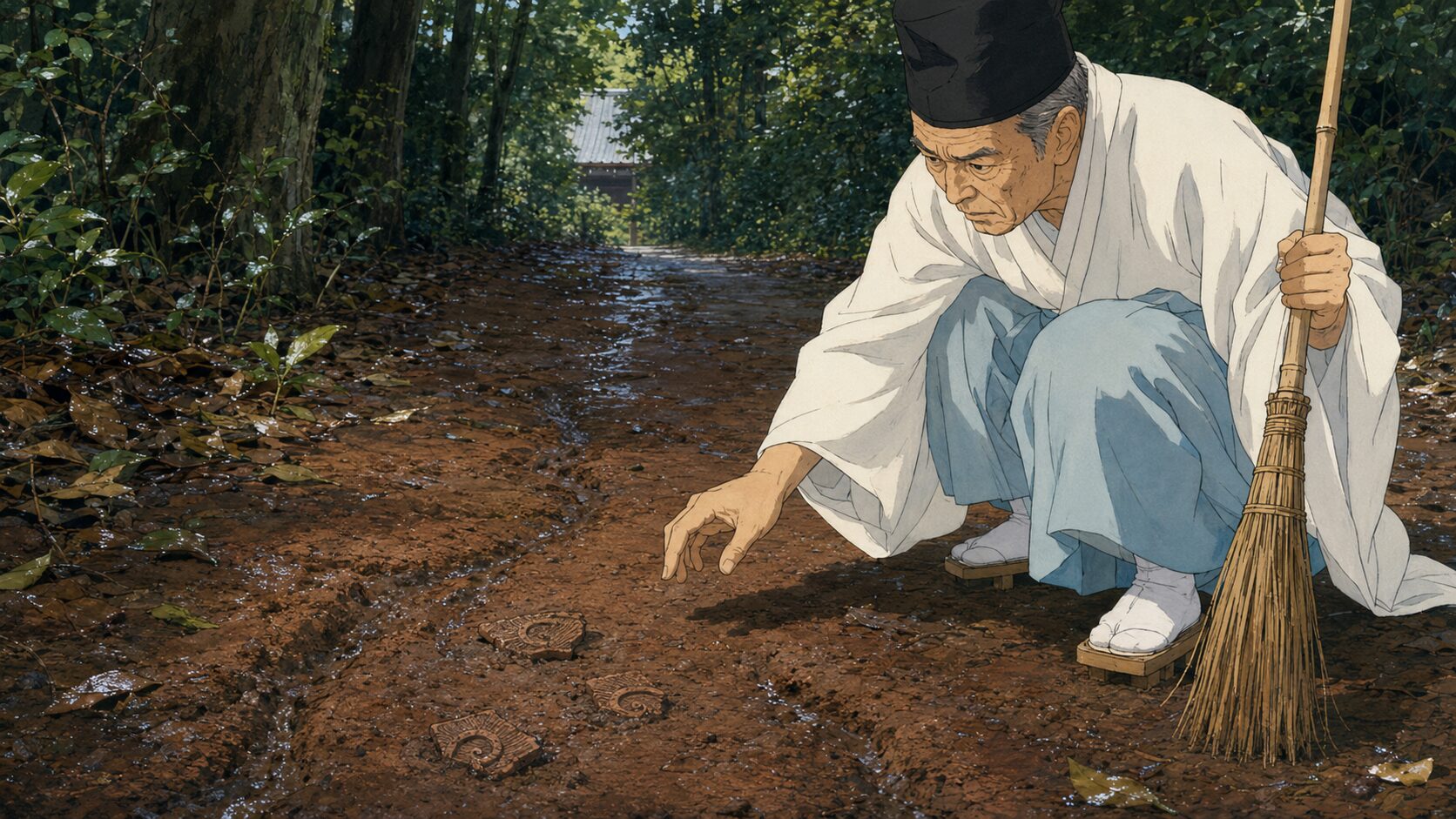
Long ago, the head priest of the time was tending the grounds. One morning after rain, he noticed something in the soil where the rain had washed the surface away — what looked like a fragment of a flowerpot. It happened more than once. Every time he swept, more of the same fragments turned up here and there.
Suspicious, the priest consulted a social studies teacher at the nearby Uehara Junior High School.
The teacher looked at them and said: isn’t this Jomon pottery?
Things moved from there. The teacher brought his own students, and they put shovels into the soil of the precinct. Out it came. Pottery, then stone tools, one after another. Eventually it grew into a full survey, and the remains of a four-thousand-five-hundred-year-old dwelling emerged from the top of the hill.
Not to build offices. Not to lay track. A priest was sweeping, and the ground offered it up.
Think back to the mikoshi in the last chapter. The neighborhood did not protect it by trying to protect it. They simply moved because they were impatient, and as a result they avoided disaster.
The pottery is the same. Nobody was trying to unearth a house from four and a half thousand years ago. Somebody was sweeping the precinct, and it came out to meet them.
And here is where this site differs decisively from every other one: even after it was excavated, nothing has been built on top of it. No office block, no rail line, no theater. The remains of that ancient house sit where they were uncovered, quietly, on the hill.
Why did nothing get built only here?
The answer stands squarely on the hill. The shrine.
On top of a four-thousand-five-hundred-year-old house, a sanctuary has been sitting for eight hundred years. Because the sanctuary sat there, nobody could level the hill. Because nobody could level it, the house directly beneath survived.
Across every hill in Shibuya, traces of the Jomon were swept away by waves of development. Throughout all of it, the Jomon layer of this one hill was protected under the weight of a shrine.
And that shrine had no idea what it was protecting — for seven hundred years. From the building of the first sanctuary in the Kamakura period until a caretaker’s broom brushed against pottery in 1950. For more than seven centuries, the shrine had no knowledge whatsoever that a four-thousand-five-hundred-year-old house lay sleeping at its feet. Simply by continuing to exist, it kept the treasure below intact. Without even knowing it was doing so.
This hill was protecting something it had no intention of protecting.
Exactly the same shape as the mikoshi. Whatever comes to this hill somehow does not get lost. It stays, even when nobody tries to keep it.
And that strangeness continues. In the next chapter, the people who were drawn back to the hill.
(End of Chapter 2)
A self-declared skeptic got goosebumps at the same torii, three times
The last chapter told the story of a four-thousand-five-hundred-year-old house that came up under a broom. Even without anyone trying, things on this hill remain.
So far, these have been the stories the shrine itself hands down. Testimony from the priesthood, records from Shibuya Ward, old illustrated maps. The official record, so to speak.
This chapter changes register.
What did ordinary visitors to this hill feel, and see? Let us follow the records they left in their own words.
Let me say up front: nothing in what follows is frightening. Nothing malevolent, nothing like a curse. These are simply the accounts that, once read, make you want to go and stand on that hill.
Start with one visitor’s record.
In January 2020, a post appeared on a site where people share their shrine visits. The author describes themselves this way:
Someone who prides themselves on having zero psychic sensitivity.
In other words, a self-declaration: I don’t feel things. A practical person, with no connection to the occult. And the reason they went to Yoyogi Hachimangu is itself interesting.
An acquaintance had told them: apparently, if you’re sensitive, that shrine can make you physically unwell.
I have zero sensitivity, so none of that applies to me. If anything, let me go and check. Perhaps that was the mood. Still not fully recovered from a cold, they took the first train of the morning and climbed the hill at seven a.m.
After paying respects, they headed for a corner deep in the grounds known as Shusse Inari. Several torii gates stand in a row along the path leading to it. And just as they were about to pass under the last one —
Goosebumps surged across their entire body.
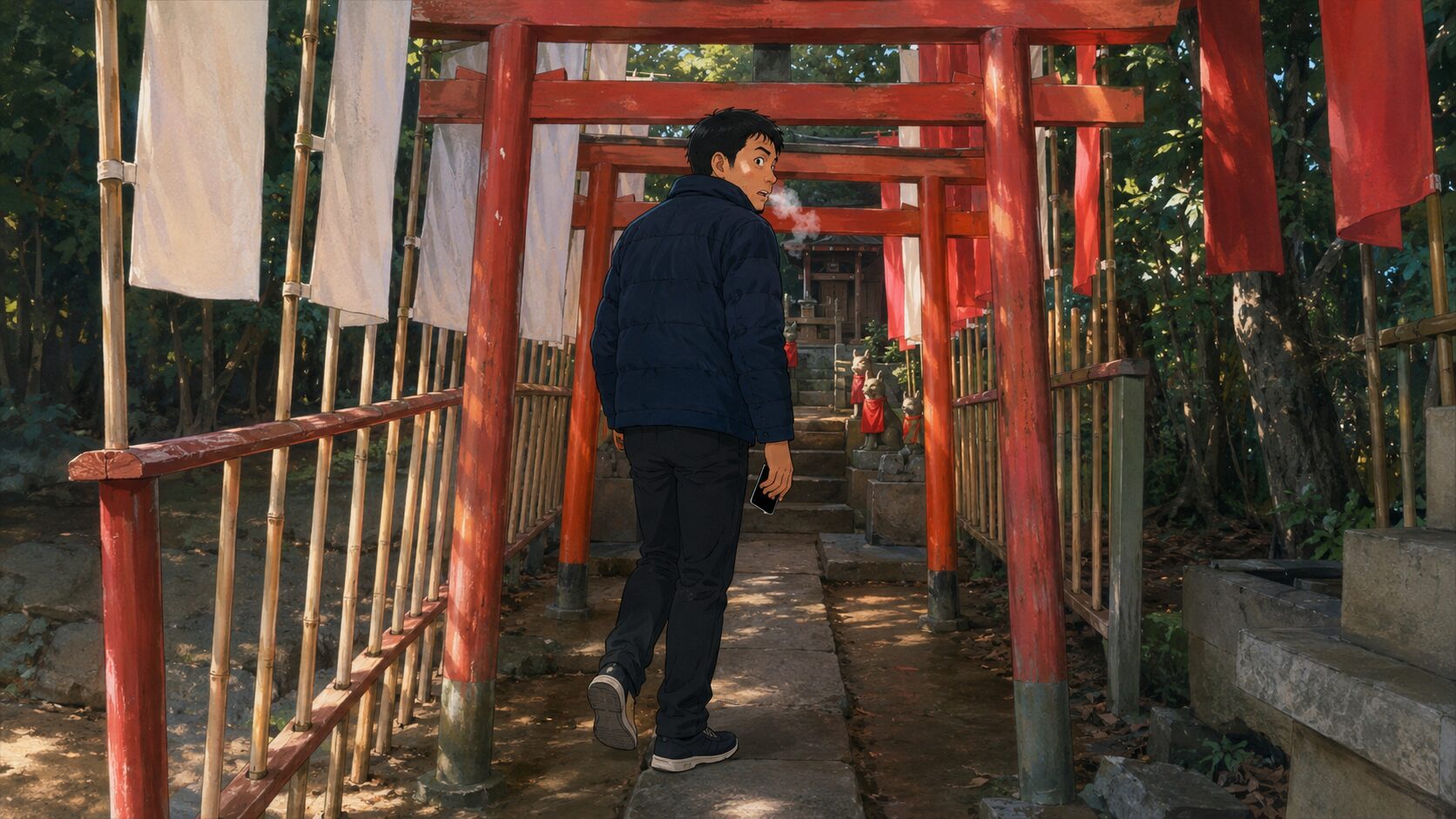
They tried to write it off as imagination.
After all, they had a cold. It was seven in the morning and chilly. It was probably just the cold air. So they stepped back from the torii and passed under the same one again.
Goosebumps again. In the same spot.
Still unconvinced, they tried a third time.
The third time was identical. The same torii, the same position, the same full-body reaction. Three attempts, three results.
If it were the cold, location would not matter. Yet the phenomenon occurred nowhere else in the precinct — only at that final torii.
This self-declared skeptic has apparently visited a good many shrines. And on that basis, they wrote that this place was stronger than the famous dragon shrine at Enoshima, a site with a considerable reputation.
The story does not end with goosebumps.
Two of the photographs they took in the precinct failed. One at the first torii, one when photographing the main hall. Both came out flooded with green, the subject invisible.
And the smartphone in their hand switched itself into airplane mode, untouched.
A practical skeptic, riding the first train while ill, walked away from that hill with three sets of goosebumps, two green photographs and a phone that changed its own settings.
The comment section under that post is the interesting part.
A complete stranger wrote that yes, the Shusse Inari corner does feel distinctly different. It was not one person’s imagination. Others had felt the same texture in that specific corner.
And this place, Shusse Inari. If you have read the previous chapters, you may already have a hunch. It is the corner where this hill’s tendency to keep things is most concentrated — but that story belongs to the next chapter.
Another record from a visitor.
There is a regular who carefully documents the goshuin seal of Shusse Inari. Slipped casually into their otherwise matter-of-fact record is a single line.
Went to Shusse Inari as usual, and overhead, the crows — on some days too dangerous to approach the shrine at all.
Note the phrase: as usual. This is not the tale of a one-off encounter with a startling bird. For this person, crows flocking above that particular corner is an ordinary sight, hardly worth remarking on. The flatness of the writing is exactly what conveys how routine it is.
Above that one corner of the hill, there are crows. Nobody knows why.
One last account, from a well-known figure.
The comedian Chihara Junior described an experience on a television program, in an episode broadcast in the spring of 2024.
He used to live near Yoyogi-Hachiman. One day he had been drinking in Yoyogi-Uehara until four in the morning, and on his way home he stopped by Yoyogi Hachimangu and paid his respects. That same evening, he had a taping for a program known for its spiritual content — the one featuring Miwa Akihiro.
During the recording, Miwa turned to him and said this.
I can see it. There are these steps, and a forest, and a sanctuary. What is this? And a large road, too. What is that?
Chihara caught his breath. He answered: I went to pray at Yoyogi Hachiman this morning.
To which Miwa replied: ah, that explains it.
Savor what happened there. Miwa did not name Yoyogi Hachimangu. He described stone steps, a forest, a sanctuary tucked behind it — and a large road running alongside. The shape of the hill itself.
Anyone who knows Yoyogi Hachimangu recognizes it instantly. The steep stone steps. The forest closing overhead. The quiet sanctuary at the back. And Yamate-dori running along the foot of the hill. The layout of that hill, rendered directly into words.
Miwa had not seen the place. Working only from the trace of someone having gone there that morning, he traced the topography of the hill.
A skeptic got goosebumps at the same torii three times. Photographs came out green and a phone switched itself over. Crows are always overhead. And someone who had never been there described the shape of the hill.
None of it is frightening. No curses, no vengeful spirits. Simply this: for those who feel such things, this hill appears to hold a genuine density of something. That is all.
And the place where that density is thickest is the corner whose name keeps coming up — the one where burnt fox statues gathered on their own, at nobody’s instruction.
The next chapter is about Shusse Inari.
(End of Chapter 3)
A corner where burnt-out gods huddle together somehow advances careers
The long journey ends with this chapter.
Across the three preceding chapters we have seen this hill refuse to lose things. A mikoshi that slipped past two fires. A four-thousand-five-hundred-year-old house that came up under a broom. And a density that certain people can feel.
Now to the corner where that density is thickest — the place whose name I have been withholding.
Shusse Inari.
Today this corner is known as one of Tokyo’s foremost power spots. It has been featured on television repeatedly, and well-known figures are said to visit discreetly to pray. Advancement at work, more jobs coming in — that reputation has been passed along for a long time.
But knowing the history underneath that reputation changes how it feels to stand there and press your palms together.
This is a place where gods that were burnt out of their homes huddle together.
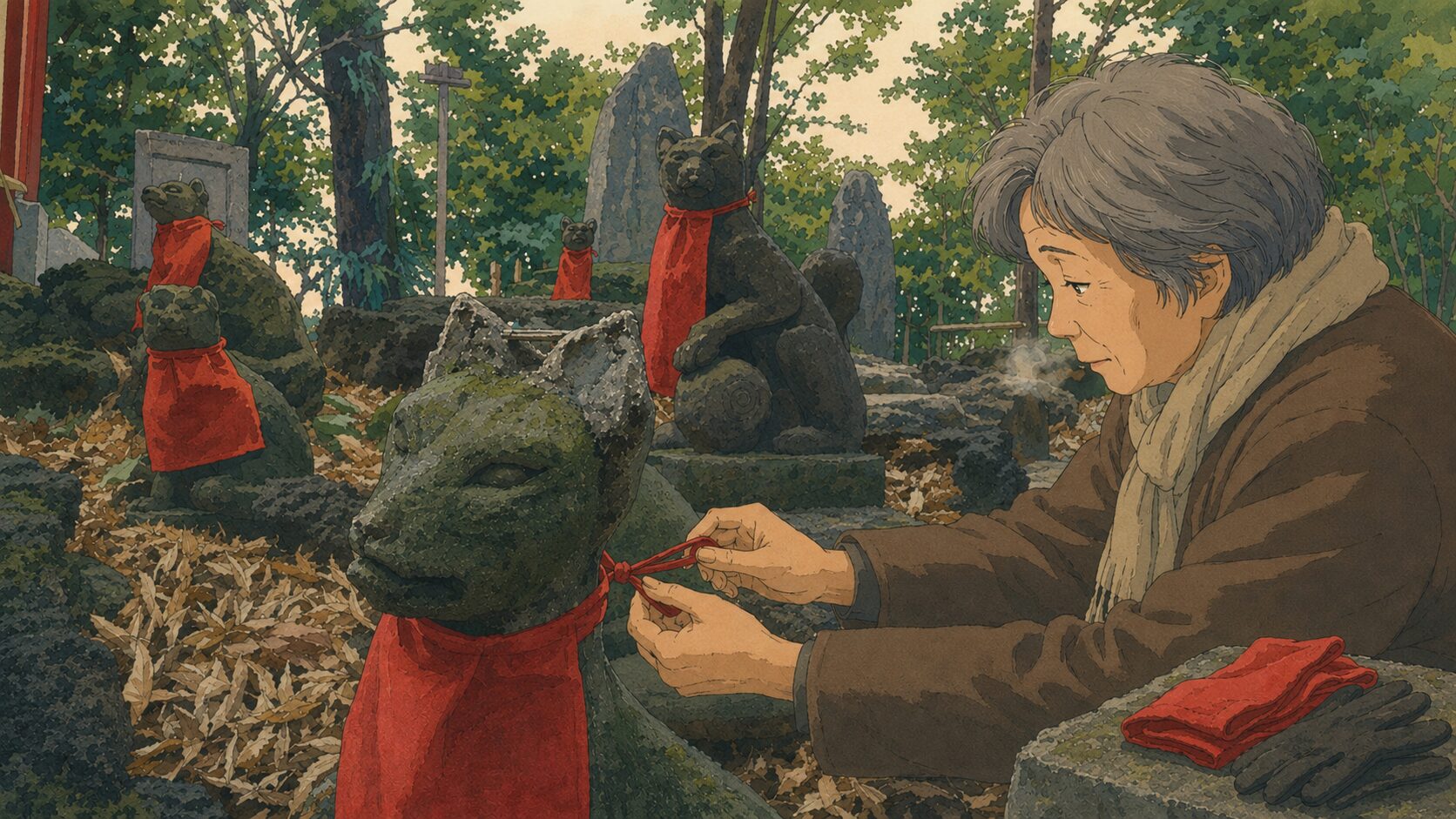
The story goes back, again, to the Tokyo air raids.
In Chapter 1, those raids burned Yoyogi Shinmachi while the mikoshi survived because it had been left at the shrine. On that same night, in the neighborhoods at the foot of the hill, it was not only houses that burned. The small Inari shrines enshrined here and there throughout the district were swallowed by fire as well.
Japanese neighborhoods have always held countless small Inari shrines. In the back garden of a merchant house, at the corner of an alley, in one corner of an estate. Household gods, kept by each family and each shop in the course of daily life.
The air raids burned all of them at once.
A house burns. A shop burns. The small Inari enshrined there burns down along with its miniature sanctuary. And if the people who kept it died, or left the neighborhood, the surviving fox statue had nowhere to go. Scorched stone foxes with nobody left to care for them were stranded across the burned ground.
That is when the parishioners of Yoyogi Hachimangu acted.
Unable to leave the abandoned Inari statues in the ruins, people carried them up to the shrine on the hill, one at a time.
Our Inari burned. Could the shrine at least take it in?
Statues brought together this way, from all over, gradually accumulated in one corner of the hill. That, the shrine says, is the origin of Shusse Inari.
There is evidence of how they gathered.
Look closely at the foxes of Shusse Inari.
Every single one has a different face.
Normally, when a shrine outfits its own Inari, it commissions a matched set from a single craftsman in a single design. The faces match. The sizes match. That is what you expect.
The foxes of Shusse Inari do not match. Some have sharp eyes, others are round. Some are narrow-faced, others broad. Some are old, some are new. Different craftsmen, different eras, different neighborhoods of origin — so every face is its own.
This is the unmistakable proof of an assemblage. Surviving foxes were carried in from various neighborhoods, each keeping its own face, and set down shoulder to shoulder. Different faces mean each one had a home, a street, and an owner of its own.
A refuge for burnt-out gods. That is what this corner invites you to call it.
And there is a stranger custom here.
The foxes wear red bibs. Draping red cloth on Inari foxes is a common sight. But about these particular bibs, the shrine says something quite plainly.
The shrine did not put those bibs there.
Then who did?
Nobody knows.
The shrine did not tie them on. And yet the foxes always have red bibs. And when a bib grows old and dirty, at some point it has been replaced with a new one. Somebody is quietly changing them.
The shrine does not know who that somebody is.
When they come, who they are, how they untie the soiled cloth and knot a fresh one — nobody has ever come forward. The bibs simply get dirty and then become new again. It has gone on for a long time. In winter, some foxes are found wearing not only bibs but small knitted scarves.
They must be cold, someone thinks. And so someone wraps a scarf around a burnt-out god, and leaves without giving a name.
A priest interviewed about the shrine described it this way: nobody started it, and through the hands of considerate people, they were gathered here quite naturally.
Nobody started it. Quite naturally.
That is the phrase that captures everything happening on this hill. There is no one giving orders. There is no one who began it. And still, whatever is about to be lost, whatever has nowhere left to go, is guided by anonymous hands to gather here — and then it stays.
Now, back to that reputation.
This corner where burnt-out gods huddle together has, for whatever reason, made its name as a place that advances your career.
The spark is generally credited to Shimada Shuhei, known for palm reading. He has introduced this corner repeatedly in his books on power spots and on television. In 2013 it was featured on a morning program’s tour of the strongest power spots. Shimada is said to have described this Inari as the place that lifts your professional fortunes sharply.
The singer Wada Akiko is reported to have visited and remarked that the air here is filled with the best energy. The comedian Chihara Junior, too, has spoken about living on this hill and visiting quietly — the same person from the Miwa Akihiro episode in Chapter 3.
And in the entertainment industry, a rumor circulates in earnest.
Move near Yoyogi Hachimangu and your career takes off.
It is, of course, a rumor. Nothing about it can be proven. Did people succeed because they moved nearby, or did people about to succeed happen to move there? There is no way to check. This article makes no claim that it is fact.
And yet — having followed the story of this hill this far, it becomes hard to read the rumor as pure coincidence.
Consider it. This corner is where things with nowhere to go are guided by anonymous hands to gather, and then remain. That was true of the mikoshi. It was true of the pottery. Names carved into stone that should have disappeared did not, and called descendants back a century later.
Things that should vanish, remaining. Things with nowhere to go, drawn in and held.
If that is the power of this hill, then people who have not yet made their name, people about to bloom, being drawn to the foot of it and then remaining rather than vanishing, may be another face of the very same phenomenon.
The hill draws in whatever is about to be lost, and holds it. Scorched foxes. The name of a neighborhood that disappeared. And the fortunes of those about to make their way into the world.
The story of this hill, which began with a mikoshi, ends here.
A mikoshi that slipped past the flames. A Jomon house that came up from a sweeping. Stone that called descendants back. A density that stops sensitive people in their tracks. And this corner, where burnt-out gods huddle together and somehow advance careers.
None of it was protected by anyone trying to protect it. Nobody ordered it, nobody started it, and still, the things of this hill remained and gathered. The way anonymous hands tie a bib onto a scorched fox.
If you ever climb the stone steps of Yoyogi Hachimangu —
when you reach the top and feel the traffic noise of Yamate-dori fall quietly away, pay your respects at the main hall, then turn toward the red torii beside it and walk in.
Foxes with mismatched faces are sitting shoulder to shoulder, wearing bibs tied by nameless hands. Small gods that were burned out, left with nowhere to go, gathered onto this hill, and not lost.
When you press your palms together in front of them, you may be one more thing this hill has drawn in and kept.
Everything that should have been lost is still here.
That is the place you are standing in.
(End of Chapter 4 / End of the series)
※ The mikoshi said to have escaped two disasters, the origin of Shusse Inari (statues burned out of their homes and gathered by parishioners), and the red bibs replaced by an unknown hand are based on traditions and records handed down at the shrine, and are not academically established facts. Visitor accounts are personal impressions and do not guarantee any effect or phenomenon.
SECTION 01The basics before you go
| Address | 5-1-1 Yoyogi, Shibuya-ku, Tokyo |
|---|---|
| Visiting hours | No closing gate; the precinct is accessible at any hour |
| Shrine office | 9:00–17:00 (goshuin seals, amulets, ofuda) |
| Prayer rituals | 9:00–16:30, by prior reservation. On the 23rd of each month, no reception between 13:30 and 15:00 due to rites |
| Admission | Free |
| Time needed | 30 minutes to 1 hour, including Shusse Inari and the pit dwelling |
| Highlights | Main hall / Shusse Inari / reconstructed Jomon pit dwelling (viewed from outside the fence) / small exhibition of excavated items |
| Main festivals | Grand Festival, September 22–23 (100+ stalls, mikoshi processions) / Goldfish Festival, 4th Sunday of May |
SECTION 02Access, and the route without stairs
| By train | About 5 minutes on foot from Yoyogi-Hachiman Station (Odakyu Line), or from Yoyogi-Koen Station (Tokyo Metro Chiyoda Line) |
|---|---|
| Main approach | Along Yamate-dori. A steep flight of stone steps, followed by a further gentle climb. Difficult with heels, suitcases or a stroller |
| Step-free route | On the Hatsudai side there is a vehicle access road with no steps. Recommended for strollers, wheelchairs and anyone unsteady on their feet |
| Parking | About 10 spaces for worshippers. The entrance is hard to find (from the Yamate-dori side, take the narrow diagonal lane just before the Yoyogi-Hachiman-mae signal, then the first right). Assume it is full on weekends, New Year and festival days |
| Nearby parking | Coin parking lots are scattered in the area |
Taking the long way round beats turning back at a step. With small children or older relatives, head for the Hatsudai side from the start.
SECTION 03Where to eat, before or after
Yoyogi-Hachiman, Tomigaya and Yoyogi-Uehara form one of the most competitive dining areas in Tokyo. Assume you will queue at the popular places, shift your timing, or take food away and escape to Yoyogi Park.
| Name | Notes | Hours | Payment | |
|---|---|---|---|---|
| PATH (bistro / cafe) |
A Tomigaya landmark, open from early morning; the Dutch pancake is the signature dish. Numbered tickets when busy. No parking | 8:00–15:00 Closed Mon & Tue |
Cards OK Transit IC OK No QR pay |
 Tabelog ▶ Tabelog ▶ |
| Levain Tomigaya (bakery) |
Founded in 1982, a pioneer of naturally leavened bread in Japan and a Tabelog Bread Top 100 selection. Sold by weight, which makes it ideal for takeaway | 9:00–19:00 Sun & holidays until 18:00 Closed Mon (Tue irregular) |
Cash only No cards or e-money |
Tabelog ▶ |
SECTION 04Nearby stops that fill half a day
| Yoyogi Park | Within walking distance. Wide lawns, ideal for spreading out takeaway food and an excellent escape valve with children |
|---|---|
| Meiji Jingu | Walkable through Yoyogi Park. You can also reverse the order: visit crowded Meiji Jingu first, then come to the quiet of Yoyogi Hachimangu |
| Tokyo Camii | One of Japan’s largest mosques, near Yoyogi-Uehara Station. Open to visitors (check hours and etiquette on the official site) |
| Oku-Shibuya (Tomigaya–Kamiyamacho) | A strip of independent shops, cafes and bookstores. Good for a wander after your visit |
The precinct itself takes under an hour, so if you have half a day, plan to combine it with the surrounding area.
SECTION 05Stay the night, arrive at first light
If you are aiming for the Grand Festival or New Year, staying nearby pays off. From directly opposite Yoyogi Park through to Shibuya and Shinjuku, the choice is wide.
Take it slowly, in comfort
Choose from design hotels facing Yoyogi Park and refined properties around Shibuya and Harajuku. Close enough to walk straight to the shrine at opening light.
Find a hotel on Ikyu.com
Affordable, just one night
Stretch to Shibuya or Shinjuku and the price range widens considerably. Ideal for staying only on festival night and walking a quiet precinct the next morning.
Find a hotel on Jalan
※ Hours, prices, opening days and access details are current as of writing and subject to change. Please confirm on each official site before visiting.
※ Bicycle and scooter parking availability is unconfirmed. Please contact the shrine directly.
Things you notice too late:
those stone steps, and
the 5 p.m. wall.
Dead centre of the city. Five minutes from the station. And yet there are a handful of things that will quietly wear you down if you show up unprepared.
The steps. The car park. The hour it all closes. Know them first and you can dodge every one.
I do the guiding around here at VIBES TOURISM.
Today I’ll walk you through Yoyogi Hachimangu before you go, so nothing catches you out.
Everything here is a signpost. Always double-check the official source before you set off.
PHASE 01Decide these before you leave
You can pray around the clock. But the counter shuts at five
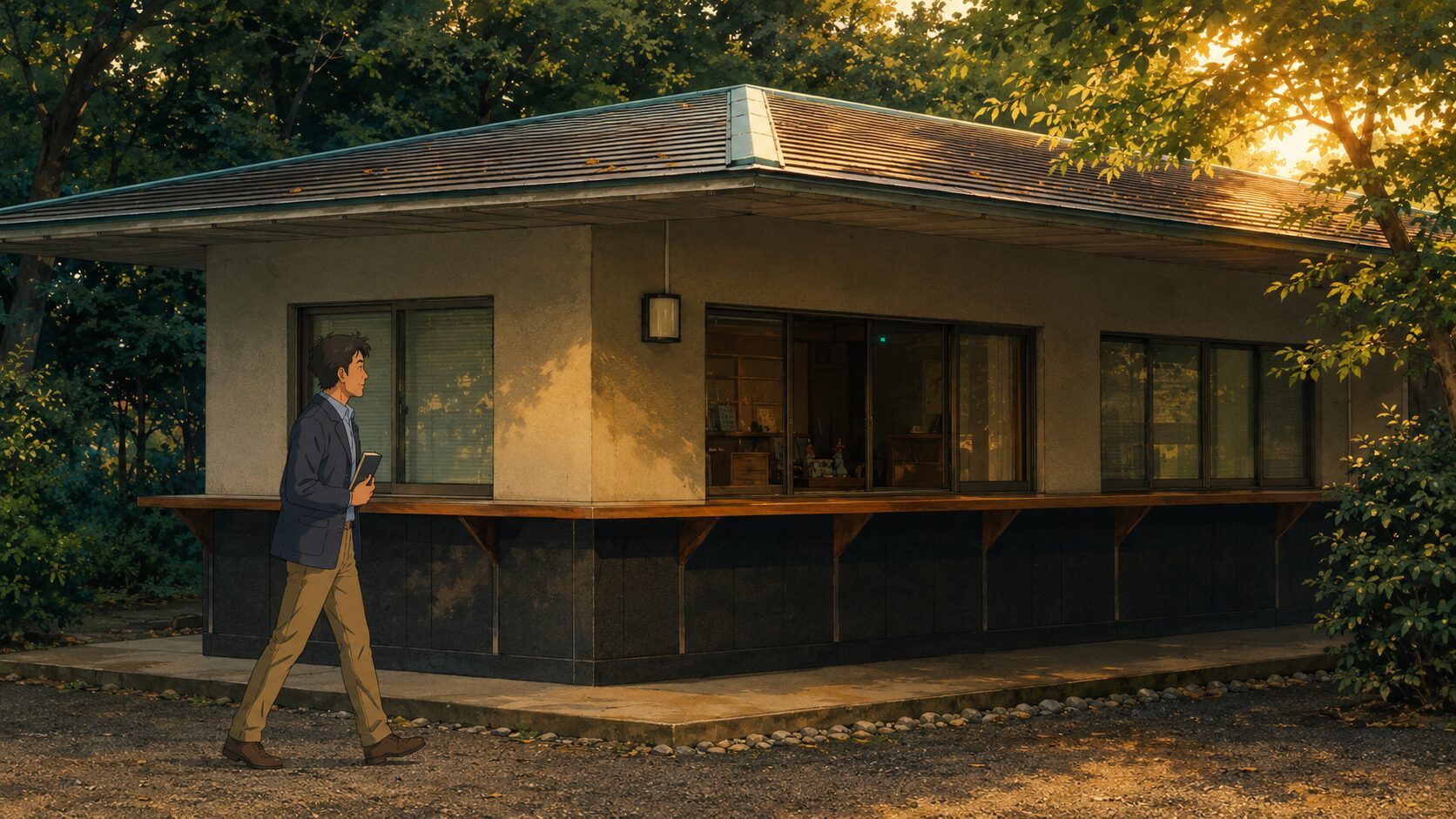
Yoyogi Hachimangu has no closing gate, so you can visit at dawn or late at night. The shrine office, however, is open from 9:00 to 17:00. Goshuin seals, amulets and ofuda are only available within those hours.
“Open all hours” and “everything available all day” are two different things. If the seal is your goal, plan to arrive well before evening.
But if you’re bringing a goshuin book,
get there by four-something.
Prayers are by reservation, and the 23rd has a gap
Prayer rituals are received from 9:00 to 16:30, by prior reservation. On top of that, on the 23rd of each month, rites are held and no reception is possible between 13:30 and 15:00. If you have pencilled in a safe-birth or first-visit ritual on the 23rd, that is where your day gets squeezed.
book a morning slot to be safe.
Calling ahead and fixing the time is the fastest route.
Couples hoping for a photo shoot will be turned away
The shrine states clearly that using the precinct purely for photography, without a prayer ritual — for shichi-go-san, coming-of-age or wedding shoots — is not permitted. If you are going mainly to take pre-wedding photos in a beautiful setting, you will not be able to do what you planned.
and booking the grounds as a location,
are two different things.
Couples trip on this one the most.
PHASE 02Getting there is the hard part
Steep steps first, then more uphill
Walk along Yamate-dori from Yoyogi-Hachiman Station and the entrance to the approach appears on the street. That is where it begins: a steep flight of stone steps, and after you reach the top, the path keeps climbing gently. Heels, suitcases and strollers all come to a halt right here.
There is a route with no steps at all
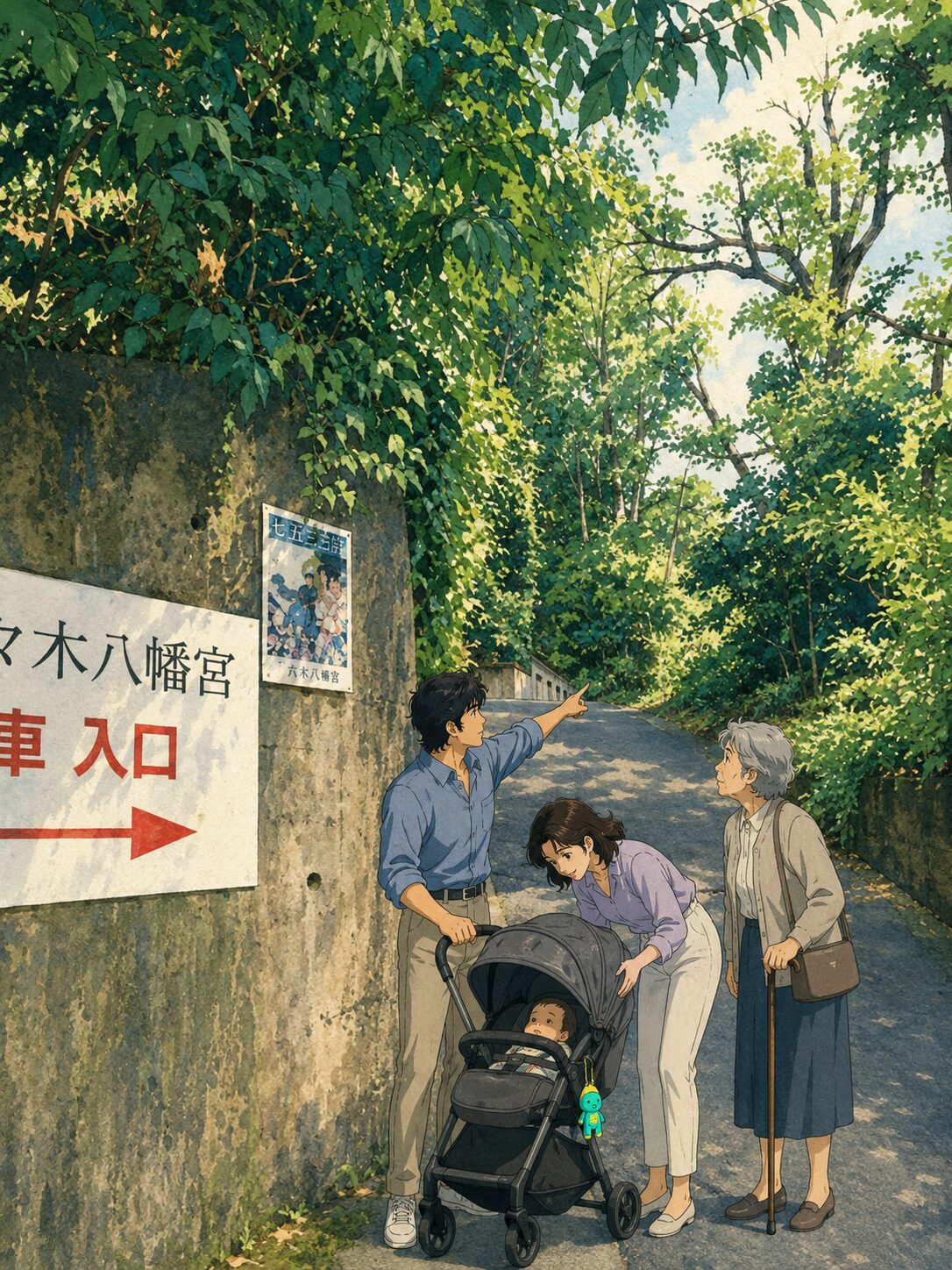
On the Hatsudai side there is a vehicle access road with no steps. With a stroller, a wheelchair, or family members unsteady on their feet, take that way round instead of the main approach.
Taking the long way beats turning back at a step.
head for the Hatsudai side from the start.
You can admire the steps from the top on your way out.
About ten parking spaces, and the entrance hides
There is parking for worshippers, but only around ten spaces — and the entrance is genuinely hard to spot. Walking the pavement along Yamate-dori past the torii, you reach the Yoyogi-Hachiman-mae signal; just before it, a narrow lane runs off at an angle. Follow it, take the first right, and the parking signs appear.
On weekends, at New Year and during the Grand Festival, assume it is full. Coin parking lots are scattered nearby.
It’s five minutes on foot
from either Yoyogi-Hachiman or Yoyogi-Koen.
PHASE 03How to spend your time inside
The precinct is small. Thirty minutes to an hour
The path from the torii to the main hall is paved with stone. Walking the whole precinct takes under an hour. If you have set aside half a day, the shrine alone will leave you with time on your hands, so plan around that.
Note that paths away from the main approach are not all paved, and they get muddy and slippery in the rain.
The Jomon pit dwelling is viewed from outside the fence
The precinct holds a reconstruction of a dwelling roughly 4,500 years old. It is enclosed by a fence, and you cannot go inside. Children who arrive expecting to enter are in for a letdown. Simply saying “we’re going to look at it from outside” beforehand changes the whole impression.
Excavated pottery and stone tools can be seen in a small exhibition space beside the kagura hall.
“We’re going to see a house from 4,500 years ago, from the outside.”
Say it like that and watch their eyes change.
Shusse Inari is to the right of the main hall, then further back
The famous Shusse Inari is not in front of the main hall. Pass through the torii on the right-hand side of the sanctuary, go by the combined shrine of Inari, Tenjin and Haruna, and climb the steps at the back. Rows of white and red banners mark the spot. Pray at the main hall and leave, and you will miss it entirely.
After sunset, it is dark
The precinct is enclosed by trees, so outside festival illumination periods it is hard to see your footing after dark. Plan to finish your visit before evening.
PHASE 04Filling the time either side
In this neighbourhood, expect to queue
Yoyogi-Hachiman, Tomigaya and Yoyogi-Uehara make up one of Tokyo’s toughest dining districts. Queues from early morning are not unusual. Line up before opening, take a numbered ticket, or shift your timing. Build one of those into the plan and the day holds together.
Small independent shops are the norm here, and some are cash only. A little cash in your pocket goes a long way.
Shifting your meal by an hour
can make the wait disappear entirely.
With kids, retreat to Yoyogi Park
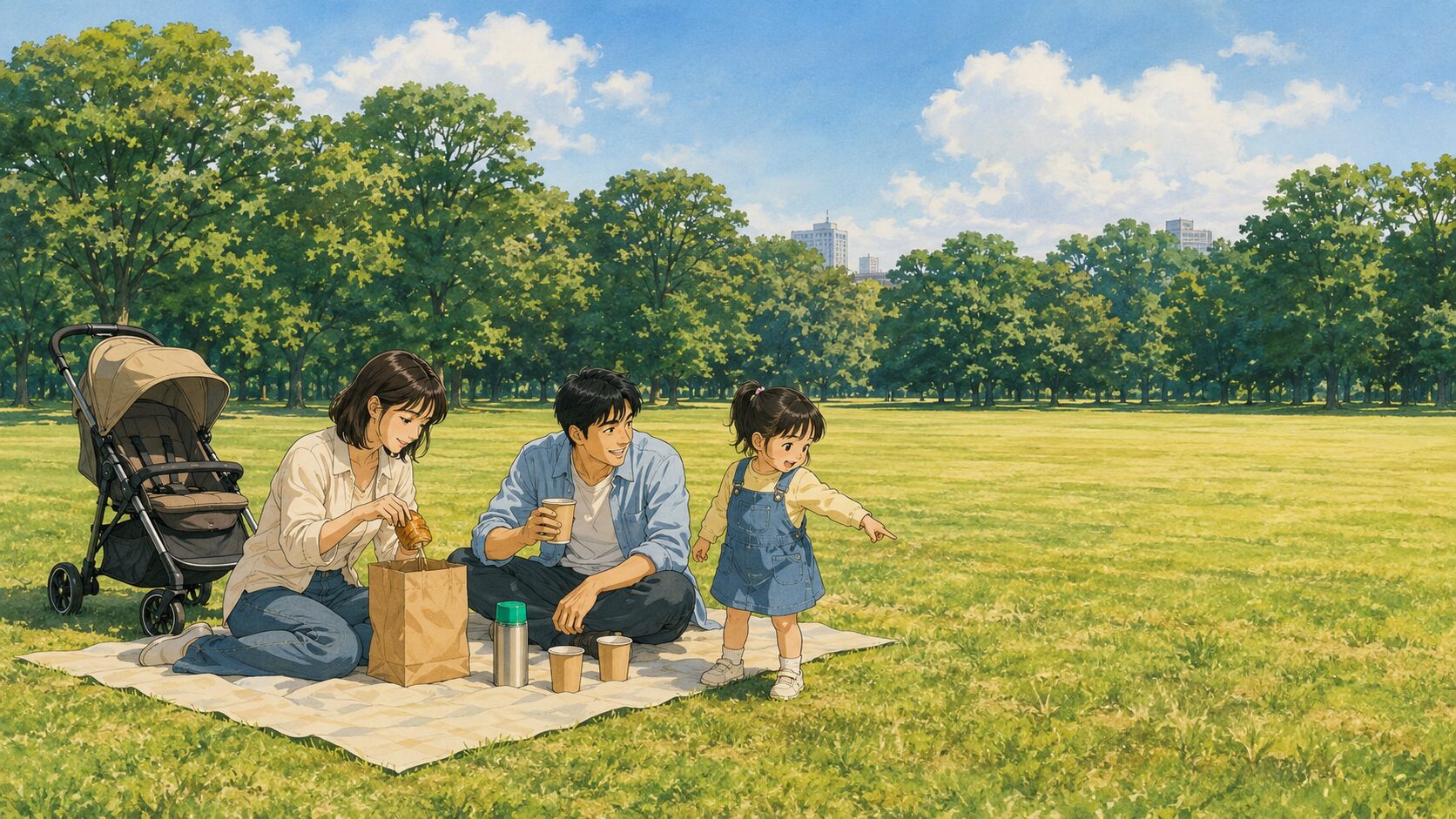
The shops here are small, and few can take a stroller inside. When that happens, get your food to go and head for Yoyogi Park. Having wide lawns a short walk away is the great advantage of this location.
With children, that’s the most peaceful plan there is.
They get to run, and you get to sit down.
Meiji Jingu and Yoyogi Park connect into half a day
Both Yoyogi Park and Meiji Jingu are within walking distance. Put Yoyogi Hachimangu in the morning, cut through the park, and continue to Meiji Jingu. Or reverse it: after the crowds of Meiji Jingu, drop into the quiet of Yoyogi Hachimangu. That works just as well.
PHASE 05The crowded days, and the good ones
The Grand Festival is September 22–23, fixed regardless of weekday
On both days more than a hundred stalls fill the precinct, and on the 23rd the mikoshi of the parish neighbourhoods arrive one after another. It is the best possible day to see a festival, and the worst possible day for a quiet visit. The same date is a hit or a miss depending entirely on what you came for.
Want to see the festival? Those two days are the only ones.
The Goldfish Festival, 4th Sunday of May, is the family jackpot
Goldfish scooping and ring toss stalls fill the grounds with children. Limited goshuin and amulets shaped like goldfish appear around this time as well. With small children, it is worth aiming for.
For New Year, shift your hours
Expect queues over the New Year period. If you must go within the first three days, push to early morning or after dark. If you can wait until the 4th or later, the visit is far calmer.
The steps, five o’clock, and two days in September.
Keep those three in mind and Yoyogi Hachimangu gets a great deal easier to walk.
Take care, and enjoy the trip.
※ About this article
The hours, prices and reception details here were checked against official sources at the time of writing. But this kind of information quietly changes with construction, weather, events and seasons, so please read everything here as a signpost rather than a guarantee. Before you actually set off, confirm the latest details yourself with the official source — the website or a phone call. My job is the groundwork; the final check is yours.
[Where to check]
- Yoyogi Hachimangu official site (reception hours, prayer rituals, annual events, precinct map)
- Shibuya Ward cultural properties page (Yoyogi Hachiman Site)
※ Bicycle and scooter parking availability is unconfirmed. Please contact the shrine directly.




Comments